
CRISPR‑Cas9 System for of Type 1 Diabetes Treatment
Ziqing Yang
Guangdong Country Garden School, Foshan City, Guangdong Province, China
Keywords: CRISPR‑Cas9, Type 1 Diabetes, Gene Therapy.
Abstract: Type 1 diabetes (T1D) is one of serious chronic metabolic illnesses, the reason behind is the hyposecretion of
pancreatic β cells because of the autoimmune system, and traditional therapy mainly focuses on insulin
replacement, which can not reverse the disease process. In recent years, the discovery and rapid development
of gene editing technology like the CRISPR/Cas9 system has provided a new idea for the radical treatment of
T1D. In this paper, the use of CRISPR/Cas9 technology for T1D treatment is systematically reviewed. First,
based on the pathogenesis of T1D, the core links of immune disorder and β cell function loss are described.
Secondly, we reviewed the development of CRISPR/Cas9 from a bacterial adaptive immune system to an
efficient gene editing tool, and analyzed its targeted DNA cutting and repair mechanism guided by sgRNA.
Further, two main application directions of the technique in T1D were discussed: editing immune cells to
inhibit autoimmune attack, and inducing stem cells to differentiate into functional β cells or enhancing
endogenous β cell regeneration. Current challenges, including off-target effects, low delivery efficiency, and
immunogenicity, are analyzed, and some optimization strategies. Finally, we look forward to the future
research direction, emphasizing the importance of interdisciplinary research in promoting clinical
transformation and providing ideas for future research.
1 INTRODUCTION
Diabetes mellitus is one of serious metabolic
illnesses, whose pathogenesis is the lack of insulin
and hyperglycemia as an external manifestation. The
diabetes mellitus is mainly divided into 2 types---type
1 diabetes and type 2 diabetes. Among them, the
treatment of type 1 diabetes is the most difficult. T1D
is an autoimmune disease caused by some relative
susceptibility genes leading to the error recognition of
T cells, they attack and damage the islet β cells then
contribute to the abnormal secretion of insulin. Of all
the diabetes patients around the world, T1D patients
account for about 5%~10% and increase at the speed
of 2%~3%. In the whole T1D patients, the major
group is children, the T1D patients under 20 years old
take up a percentage greater than 85% (Liang & Hu.,
2013). They all require lifelong medication therapy.
We have some current developments on treating
T1D. For example, insulin injection, which is the
most common therapy method, but it requires long-
term injection and there may be complications.
Patients can also take medicine, and they need to take
lifelong intake for treatment. The other methods are
immunotherapy and pancreatic islet transplantation.
However, immunotherapy has different effects on
different patients with complications, and it always
has a high price; pancreatic islet transplantation needs
high cost as well, and the donor sources are limited.
There are still no any complete cures at present.
Nevertheless, gene therapy as an emerging
treatment in recent years has the hope to completely
cure T1D. Gene editing technology can pinpoint a
specific spot in the genome and use specific nucleases
to achieve high profiling of the human genome’s
precise modification. CRISPR/Cas9 system has the
most potential among all kinds of gene editing
technology. Compared to most other gene editing
technologies, the CRISPR/Cas9 system only needs to
design 1 sgRNA to edit related genes, which has a
simpler operation, lower cost and higher efficiency.
CRISPR/Cas9 system can precisely modify stem cells
to achieve treatment for T1D. This article will
research the development of the CRISPR/Cas9
system in the treatment of type 1 diabetes.
218
Yang, Z.
CRISPR-Cas9 System for of Type 1 Diabetes Treatment.
DOI: 10.5220/0014464900004933
Paper published under CC license (CC BY-NC-ND 4.0)
In Proceedings of the 1st International Conference on Biomedical Engineering and Food Science (BEFS 2025), pages 218-222
ISBN: 978-989-758-789-4
Proceedings Copyright © 2026 by SCITEPRESS – Science and Technology Publications, Lda.

2 TYPE 1 DIABETES
2.1 Factors Cause Type 1 Diabetes
Type 1 diabetes is one type of diabetes mellitus and
belongs to the autoimmune disease. The core
mechanism is the attack of T cells (T lymphocytes) to
pancreatic β cells. There are a few factors that lead to
this mechanism: The first one is the hereditary factor,
some susceptibility genes related to T1D may
generate to the next generation, which is the
necessary basis for T1D. It affects immune
recognition, making an abnormal tendency of the
recognized function of the immune system and cells,
it may lead to the core mechanism above and increase
the risk of T1D. The second factor is the
environmental factor. Some environmental factors
like virus infection and chemical substances may also
increase the possibility of pancreatic β cells’
dysfunction by mistakenly attacking T cells, finally
raising the risk of T1D. The third factor is abnormal
autoimmunity regulation. It is the immediate cause of
T1D due to the interaction of hereditary genetic
factors and environmental factors, which directly
leads to T cells’ attack on pancreatic β cells.
2.2 The Detailed Mechanism behind
Under the influence of the above factors, T cells
attack β cells mainly through 2 ways respectively.
The first and also the core pathway is the direct killing
by the CD8⁺T cells which is one type of T
lymphocytes. CD8⁺T cells recognize an antigen on
the surface of pancreatic β cells, release perforin and
granzymes to form membrane pores and let the
granzymes enter the cell, activate the caspase
cascade, and induce β cell apoptosis (Atkinson et
al.,2011). The second pathway is the indirect killing
by the CD4⁺T cells. On one hand, CD4⁺T cells secret
chemical substances like IFN-γand TNF-α to activate
macrophage and aggravate the damage to pancreatic
β cells. On the other hand, CD4⁺T cells can also assist
B cells to produce the specific antibodies to damage
pancreatic β cells again (Chow et al., 2014). These
abnormal responses of T cells are the result of
abnormal gene expression.
2.3 The Difficulties of Treating T1D
According to the nosogenesis of T1D, the difficulty
of the treatment of T1D is that the constant attack of
the immune system is difficult to suppress
completely. There are a number of T cells’ attack
pathways working together to cause the damage of
pancreatic β cells. A single-target intervention may
not be able to stop the attack altogether. Also the
Existing therapies are easily destroyed by the
inflammatory microenvironment in the body and are
difficult to maintain long-term tolerance.
Additionally, Long-term immunosuppression carries
a risk of side effects, it can increase the risk of
infection, and tumor, and needs long-term
medication. However, using gene editing technology
like CRISPR/Cas9 system, can make a personalized
plan for each patient and achieve precision targeted
therapy. Furthermore, it can also promote β cell
regeneration and protection, and achieve the effect of
long-term treatment.
3 CRISPR/CAS9 SYSTEM
COMPOSITION AND
WORKING MECHANISM
CRISPR/Cas9 system is a simple and useful tool that
efficiently modifies endogenous genes in various
species and cell types (Hryhorowicz et al., 2017). It
enables targeted gene knockouts, base editing,
epigenetic modulation, and therapeutic applications
across eukaryotes. In 1987, Japanese scientist
Yoshizumi Ishino's team has for the first time
identified clusters of regularly spaced short
palindromic repeats (CRISPR) in the E. coli genome,
but the function is unknown (Ishino et al., 1987).
Until 2012, Jennifer Doudna, in collaboration with
Emmanuelle Charpentier, demonstrated that Cas9 can
cut specific DNA under sgRNA (single-guide RNA)
guidance, enabling CRISPR programmability for the
first time (Martin et al., 2012), and won the Nobel
Prize in Chemistry in 2020. At present, CRISPR/Cas9
technology was applied in multiple fields, including
but not limited to the treatment of diseases such as
cancer, agriculture and ecological applications.
3.1 Composition of the CRISPR/Cas9
CRISPR/Cas9 system is derived from an adaptive
immune mechanism to resist the invasion of foreign
genetic materials like bacteriophages. It consists of
Cas9 nuclease and single guide RNA (sgRNA). Cas9
nuclease comes from bacteria and archaea, it plays a
key role in recognizing and cutting both strains of
foreign DNA. sgRNA is an artificially engineered
RNA sequence from crRNA (CRISPR RNA) with
specific targeting at the 3 'end and tracrRNA (tans-
CRISPR-Cas9 System for of Type 1 Diabetes Treatment
219
acting CRISPR RNA) produced by trans-activated
ribonucleic acid gene expression at the 5' end.
As for the design and synthesis of sgRNA. To
design the sgRNA, first, Identify the target gene locus
you want to edit according to the protospacer adjacent
motif (PAM) sequence. Secondly, select an
appropriate length and scaffold sequence for a
specific secondary structure to make sure it can
accurately match with the target DNA sequence. Next
comes to the synthesis of sgRNA, there are 2 different
approaches. One is chemical synthesis: by chemical
synthesis technology, accurately controls the
sequence and modification of nucleotides, to produce
sgRNA, but it is difficult and low-yield (Hoy et al.,
2022). Another one is In vitro transcription synthesis:
the DNA template encoding sgRNA is synthesized
and then transcribed in vitro by RNA polymerase to
produce sgRNA. The design and synthesis of sgRNA
make sure the sgRNA will only bind to the target
sequence but not other regions of the genome.
3.2 Working Mechanism of the
CRISPR/Cas9 System
After having a specific sequence of sgRNA which is
complementary to the target mutant gene sequence
affecting pancreatic β cell in the genome, we extract
the multipotential stem cells from a patient and
introduce the CRISPR-Cas9 system into the extracted
stem cells (through carrier). The sgRNA binds to the
specific part of DNA, followed by Cas9 nuclease. The
Cas9 binds to the sgRNA and corresponding DNA,
and makes a cut across both strands of the DNA. The
cell recognizes that the DNA is damaged and tries to
repair it. It activates its own DNA repair mechanisms,
then we start to intervene.
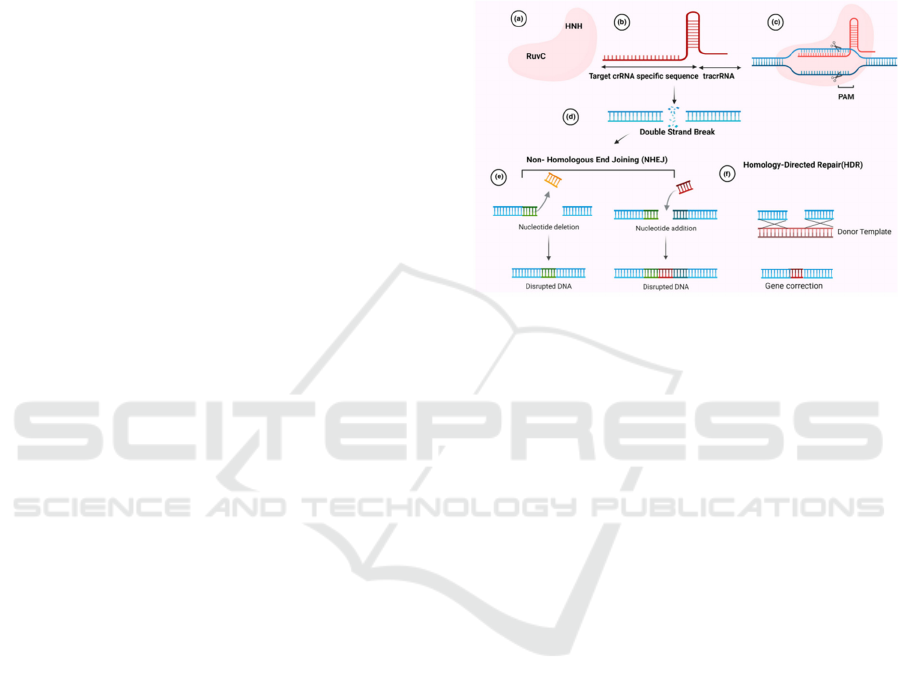
As the figure 1 shown, the process to repair the
severed DNA also have 2 different methods. The first
one is non-homologous end joining (NHEJ), it means
when the double strains break, it quickly joins the two
ends of the broken DNA together, and in this process,
there is always some insertion or deletion of genes at
the junction part. Thus genes that enhance the
function of islet beta cells can be introduced in and
abnormal genes that impair the function of pancreatic
β cells can be knocked out. The second method is
homologous directed repair (HDR), it needs to offer
a foreign DNA template homologous to the sequence
at both ends of the broken DNA. When the cell starts
to repair, it will accurately integrate the genetic
information on the template into the break site to
achieve accurate gene editing-like replacement. It
repairs the mutated gene sequence to a normal one,
returning the pancreatic β cells’ function to normal.
After that, the edited stem cells are induced to
differentiate into pancreatic β cells and transplanted
back into the patient's body to return to the normal
function of the genes, thus promoting the normal
work of pancreatic β cells and synthesis of insulin.
(Lotfi et al., 2023)
Figure 1: Two Process of the CRISPR/Cas9 System’s
Mechanism (Lotfi et al., 2023).
4 CURRENTLY USED IN THE
TREATMENT OF T1D
The application of the CRISPR/Cas9 system in the
treatment of T1D is currently in the early stage of
research, focusing on gene-edited immune cells, islet
cell regeneration, and immune tolerance induction.
4.1 Suppress Autoimmune Responses
Luo’s team used the CRISPR/Cas9 system to knock
down the expression of co-stimulatory molecules on
the DCs surface. Cationic lipid-assisted PEG-b-
PLGA nanoparticles (CLAN) were used as the
delivery system and vector, then injected into the type
1 diabetes model mice, finally found that blood sugar
levels were significantly reduced in the treatment
group and damage to islet beta cells was reduced by
50 percent. It inhibits the ability to activate effector T
cells and suppress the autoimmune responses (Luo et
al., 2020). More innovatively, Martina S Hunt’s team
used CRISPR/Cas9 system through dual-locus, dual-
HDR editing to achieve double HDR synergism,
using the RNP complex formed by purified Cas9
protein and sgRNA. It enables Treg to obtain antigen-
specific recognition ability while enhancing the
expression stability of FOXP3, which prevents Treg
BEFS 2025 - International Conference on Biomedical Engineering and Food Science
220

from transforming into effector T cells in an
inflammatory environment. This directly inhibits the
activation of autoreactive T cells, thereby restoring
the immune system's tolerance to autoantigens. (Hunt
et al., 2023)
4.2 Regeneration of Pancreatic β Cells
In 2006, for the first time, Samson S L and Chan L’s
team systematically demonstrated the feasibility of
gene therapy PDX-1, NeuroD/BETA2 and
Neurogenin 3 to promote the regeneration and
functional reconstruction of β cells by
transdifferentiation of non-endocrine cells. (Samson
S. L. & Chan L. 2006). Although limited by the
technology of the time, it laid the theoretical
foundation for the breakthrough technology of
CRISPR/Cas9. After that, Saleh’s team reviews the
potential of pancreatic α cell to β cell
transdifferentiation in the treatment of diabetes
mellitus, focusing on the mechanism of
reprogramming α cells into insulin-secreting cells
induced by gene editing (such as overexpression of
PDX-1) or small molecule compounds. The effect of
improving blood glucose homeostasis in animal
models was verified. (Saleh et al., 2021)
5 CHALLENGS AND
PROSPECTS
5.1 Limitation of CRISPR/Cas9 System
The first limitation is the delivery challenge. Until
now, there are many ways to introduce the
CRISPR/Cas9 system into the cells. For example,
viral vectors like lentivirus and non-viral vectors like
plasmid vectors. However, all of them have their own
positive and negative aspect. We still need to find a
safer and more efficient method to deliver the
CRISPR/Cas9 system. Next the immunoreaction
challenge is also important. The injection of Cas9
nuclease as a foreign substance, it will activate the
immune reaction inside the human body, attacking
and destroying the Cas9 enzyme, also prevents the
gene editing and affects CRISPR/Cas9 system
effectiveness. The third one is an off-targeting
challenge. CRISPR/Cas9 has a high rate of off-
targeting. The sgRNA may bind with incorrect DNA
sequence and lead to gene editing errors with a high
rate of gene mutation. The fourth restriction is an
ethical challenge. There are still many ethical and
social concerns about using CRISPR/Cas9
technology to change the gene sequences in embryo
cells. The final one is a technical challenge. The
technology and machinery need to be very advanced.
In addition, facing different patients, we need to
consider changing situations and produce different
gRNA, which will contribute to a high cost of time
and money. We still need to find a cheap and more
accurate way to use the CRISPR/Cas9 system and
make sure everyone’s type 1 diabetes can be treated.
(Cheng et al., 2023)
5.2 Improvement
To deal with these limitations, we can search for new
delivery carriers to optimize the delivery system, or
attempt to deliver Cas9 mRNA instead of protein,
reducing immunogenicity and improving expression
efficiency and delivery efficiency. Try a double
sgRNA design. using two sgRNA to simultaneously
target both ends of the target region may improve
specificity. Try to scale and automate production, and
simplify the production process, reduce the
production cost. Let everyone afford this treatment.
6 CONCLUSION
To sum up, CRISPR/Cas9 technology for Type 1
Diabetes (T1D) treatment represents a
groundbreaking frontier in both gene editing and
diabetes research. This review has systematically
explored the pathogenesis of T1D, the historical
development and mechanistic principles of
CRISPR/Cas9, and its transformative potential in
addressing the challenges of T1D. Key findings
highlight the versatility of CRISPR/Cas9 in targeting
immune dysregulation, promoting β-cell
regeneration, and inducing immune tolerance,
offering hope for a curative approach to this chronic
autoimmune disease. Apart from its promise,
CRISPR/Cas9 still faces challenges such as off-target
effects, immunogenicity, and delivery efficiency. The
design of high-fidelity Cas9 variants, new delivery
systems, and immune escape strategies is gradually
addressing these issues. The research on the
CRISPR/Cas9 system for treating type 1 diabetes
treatment can show the potential of this technology in
treating type 1 diabetes and promoting the clinical
transformation. While significant progress has been
made, we still need to explore the way to improve
specificity and safety, optimize delivery strategy, and
more multi-disciplinary collaboration to try to reduce
CRISPR-Cas9 System for of Type 1 Diabetes Treatment
221

the cost of treatment, so that everyone can achieve the
treatment of disease.
REFERENCES
Atkinson, M. A. 2011. How does type 1 diabetes develop?:
the notion of homicide or β-cell suicide revisited.
Diabetes 60(5):1370-9.
Cheng, Y. 2023. The promise of CRISPR/Cas9 technology
in diabetes mellitus therapy: How gene editing is
revolutionizing diabetes research and treatment. J
Diabetes Complications 37(8):108524.
Chow, I. T. 2014. Assessment of CD4+ T cell responses to
glutamic acid decarboxylase 65 using DQ8 tetramers
reveals a pathogenic role of GAD65 121-140 and
GAD65 250-266 in T1D development. PLoS One
9(11):e112882.
Hoy, A. 2022. Bio-Orthogonal Chemistry Conjugation
Strategy Facilitates Investigation of N-
methyladenosine and Thiouridine Guide RNA
Modifications on CRISPR Activity. CRISPR J
5(6):787-798.
Hryhorowicz, M. 2017. CRISPR/Cas9 Immune System as
a Tool for Genome Engineering. Arch Immunol Ther
Exp (Warsz) 65(3):233-240.
Hunt, M. S. 2023. Dual-locus, dual-HDR editing permits
efficient generation of antigen-specific regulatory T
cells with robust suppressive activity. Mol Ther.
31(10):2872-2886.
Ishino, Y. 1987. Nucleotide sequence of the iap gene,
responsible for alkaline phosphatase isozyme
conversion in Escherichia coli, and identification of the
gene product. J Bacteriol169 5429-5433.1987
Liang, M. L. & Hu, Y. H. 2013.The progress of the
epidemiology of type 1 mellitus. Chinese journal of
disease control & prevention 17(04):349-353.
Lotfi, M. 2023. Application of CRISPR-Cas9 technology in
diabetes research. Diabet Med. 41(1):e15240.
Luo, Y. L. 2020. An All-in-One Nanomedicine Consisting
of CRISPR-Cas9 and an Autoantigen Peptide for
Restoring Specific Immune Tolerance. ACS Appl
Mater Interfaces 12(43):48259-48271
Martin, J. 2012. A Programmable Dual-RNA–Guided
DNA Endonuclease in Adaptive Bacterial Immunity.
Science 337, 816-821
Saleh, M. 2021 . Alpha-to-beta cell trans-differentiation for
treatment of diabetes. Biochem Soc Trans. 49(6):2539-
2548.
Samson, S. L. & Chan, L. 2006. Gene therapy for diabetes:
reinventing the islet. Trends Endocrinol Metab.
17(3):92-100.
BEFS 2025 - International Conference on Biomedical Engineering and Food Science
222
