
RC5-Based Secure Communication Protocol Design and Intrusion
Detection Mechanisms for Wireless Sensor Networks in Smart Grids
Selçuk Yılmaz
1
a
, Abdullah Orman
2
b
and Murat Dener
1
c
1
Information Security Engineering Department, Graduate School of Natural and Applied Sciences, Gazi University,
Ankara, Turkey
2
Department of Computer Technologies, Vocational School of Technical Sciences, Ankara Yıldırım Beyazıt University,
Ankara, Turkey
Keywords: RC5, OCB, Wireless Sensor Networks, Smart Grids, Intrusion Detection, Encryption.
Abstract: This study presents the design of a secure communication protocol and attack detection mechanisms for
wireless sensor networks (WSNs) in smart grids. Data confidentiality and integrity are ensured using the RC5
encryption algorithm in conjunction with the OCB operating mode. Tests conducted in the MATLAB R2023a
simulation environment demonstrate the advantages of RC5 in terms of low energy consumption, memory
usage, and latency. Furthermore, a parameter-based system is developed to detect and prevent attacks such as
Hello Flood, Sinkhole, Blackhole, and Sybil in WSNs. Attacks are detected using metrics such as packet drop
rate, delay increase, energy consumption, and transmission rate, and are prevented using methods such as
authorization, data verification, and sleep modes. Experimental results show that RC5 outperforms AES, RC6,
and Blowfish algorithms regarding energy efficiency. This study significantly contributes to improving the
reliability of smart grids and ensuring data security in Internet of Things (IoT)-based systems.
1 INTRODUCTION
Smart grids have the potential to modernize
traditional energy infrastructures, making all
processes from energy production to consumption
more efficient, reliable, and sustainable (Brak &
Essaaidi, 2012). With the integration of technologies
such as IoT, smart grids provide large-scale data
flows, offering innovative solutions such as real-time
monitoring, remote management, and consumer-
centric energy optimization. Wireless sensor
networks (WSs) are a key component of smart grids
and have the potential for use in various areas. Some
of the applications of wireless sensor networks in
smart grids include smart metering, distributed
control and monitoring, and fault detection and
maintenance. While operating with low energy
consumption and limited processing capacity, they
also collect and transmit high-volume and sensitive
data (Erol-Kantarci & Mouftah, 2011). However, this
transformation also brings with it new security
a
https://orcid.org/0009-0001-4617-4001
b
https://orcid.org/0000-0002-3495-1897
c
https://orcid.org/0000-0001-5746-6141
challenges. Cyberattacks, in particular, pose a threat
to network security.
Hello Flood, Sinkhole, Blackhole, and Sybil
attacks are among the most common threats
encountered in wireless sensor networks. Hello Flood
attacks can exhaust network resources with forged
messages, interrupting service. Sinkhole attacks
manipulate the data flow, leading to network
centralization, while blackhole attacks lead to data
loss. Sybil attacks, on the other hand, undermine
network reliability through fake identities (Orman et
al., 2023). Such threats jeopardize data confidentiality
and network integrity, negatively impacting the
reliability and functionality of smart grids. In this
context, designing communication protocols that are
energy efficient, consume low resources, and provide
adequate security is a critical need (Lo & Ansari,
2012). Secure communication protocols protect
against these threats through data encryption,
authentication, and integrity checking. Symmetric
encryption algorithms are particularly suitable for
132
Yılmaz, S., Orman, A. and Dener, M.
RC5-Based Secure Communication Protocol Design and Intrusion Detection Mechanisms for Wireless Sensor Networks in Smart Grids.
DOI: 10.5220/0014389900004848
Paper published under CC license (CC BY-NC-ND 4.0)
In Proceedings of the 2nd International Conference on Advances in Electrical, Electronics, Energy, and Computer Sciences (ICEEECS 2025), pages 132-137
ISBN: 978-989-758-783-2
Proceedings Copyright © 2026 by SCITEPRESS – Science and Technology Publications, Lda.
WSNs due to their low computational complexity and
energy efficiency. While algorithms such as
Advanced Encryption Standard (AES), Blowfish, and
RC5 are frequently evaluated in this field, RC5's
variable parameters and low resource consumption
make it an ideal candidate for energy-constrained
systems (Botta et al., 2013; Dener, 2018; Goswami &
Trivedi, 2023; Hasan et al., 2021; Simplicio et al.,
2011). Additionally, operating modes such as Offset
Codebook Mode (OCB) effectively protect
confidentiality and data integrity by combining
encryption and authentication.
This study presents the RC5-based secure
communication protocol developed within the ADEP
Project and intrusion detection/prevention
mechanisms in WSNs. Combining the RC5
encryption algorithm with the OCB operating mode
ensures data confidentiality and integrity. Tests
conducted in the MATLAB R2023a simulation
environment demonstrate the advantages of RC5 in
terms of low energy consumption, memory
utilization, and latency. An intrusion detection system
was also designed to monitor parameters such as
packet drop rate, latency increase, energy
consumption, and transmission speed. This system is
supported by preventive mechanisms such as
authorization, data authentication, and sleep mode to
increase the network's resilience against attacks such
as Hello Flood, Sinkhole, Blackhole, and Sybil.
The primary objective of this study is to design an
energy-efficient, secure, and scalable communication
infrastructure for WSNs in smart grids. The proposed
system aims to increase IoT-based smart grids'
reliability and provide innovative energy
management solutions in this context. The paper
thoroughly evaluates the practical applicability of
RC5 and effectiveness against attacks, aiming to
contribute to both academic literature and industrial
applications. The paper then presents the
methodology, experimental results, and evaluations,
and discusses the proposed system's advantages and
potential for future development.
2 METHOD
This section details the design and implementation of
the RC5-based secure communication protocol and
intrusion detection/prevention mechanisms in
wireless sensor networks developed within the ADEP
Project. The method consists of three main
components:
1) RC5 encryption algorithm and OCB operating
mode,
2) KSA simulation environment,
3) Intrusion detection and prevention system.
Each component is designed to meet smart grids'
energy efficiency and security requirements.
2.1 RC5 Encryption Algorithm and
OCB Operation Mode
RC5 is a symmetric-key block cipher algorithm
developed by Ron Rivest. Its variable parameters
(block size, key length, and number of rounds) offer
flexibility for energy-constrained systems (Abidi et
al., 2019; Faragallah, 2011). In this study, the RC5
algorithm is configured with a 32-bit word size
(w=32), a 128-bit key length (b=16), and 12 rounds
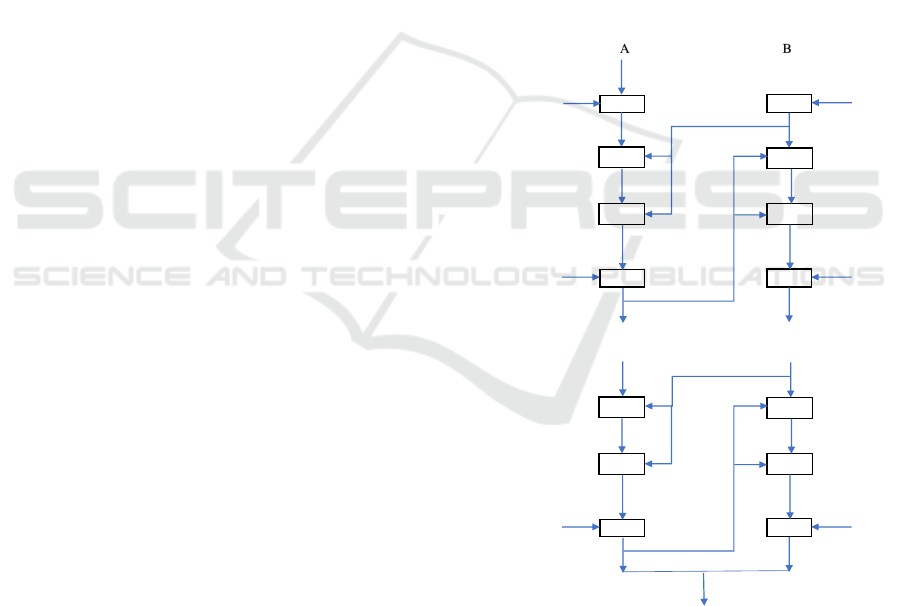
(r=12). The algorithm operates on two main data
blocks (A and B) and performs encryption according
to the flow shown in Figure 1.
Figure1: RC5 encryption flowchart
The encryption process involves the following
steps:
1. Key Expansion: The secret key is expanded into
a key table known as an array S. This table contains
the subkeys for use in the iterations.
Plain text (2w bits)
S[0] S[1]
Round 1 LE
0 RE0
S[2] S[3]
LE
1 RE1
Round r
S[2r] S[2r+1]
LEr REr
Cipher Text (2w bits)
+
+
&
&
<<<
<<<
+
+
&
&
<<<
<<<
+
+
RC5-Based Secure Communication Protocol Design and Intrusion Detection Mechanisms for Wireless Sensor Networks in Smart Grids
133

2. Initial Assignments: Input blocks A and B are
aggregated with subkeys S[0] and S[1], respectively:
A=A+S[0],B=B+S[1]A = A + S[0], \quad B = B + S[1]A
= A + S[0], \quad B = B + S[1] (1)
3. Loop Operations: In each iteration (i=1 to r),
blocks A and B are updated using XOR, left shift
(<<<), and subkey addition operations:
A=((A⊕B)≪B)+S[2i],B=((B⊕A)≪A)+S[2i+1]A = ((A
\oplus B) \ll B) + S[2i], \quad B = ((B \oplus A) \ll A) +
S[2i+1]A = ((A \oplus B) \ll B) + S[2i], \quad B = ((B
\oplus A) \ll A) + S[2i+1] (2)
The decryption process reverses these steps to
produce the original text. The encrypt.m function,
developed in the Matlab R2023a simulation
environment, encrypted a random plaintext (e.g.,
Plaintext: 90411A9F, F4E98004) to produce
Ciphertext (097A726A, 34022CB7); the decrypt.m
function correctly decrypted the ciphertext. These
operations verify the reliability and accuracy of the
algorithm.
RC5's encryption performance is enhanced by the
Offset Codebook Mode (OCB) operation mode.
OCB, an authenticated encryption mode developed
by Phil Rogaway, combines encryption and message
authentication into a single process. This ensures both
confidentiality and integrity with low computational
cost. The operation of the OCB mode is shown in
Figure 2. This section must be in one column.
M1
E
K
⊕
C1
⊕
Δ
Δ
M2
E
K
⊕
C2
⊕
Δ
Δ
M3
E
K
⊕
C3
⊕
Δ
Δ
Checksum
E
K
⊕
T
⊕
Auth
Δ
Final
Tag
Figure 2: OCB operation mode.
The process involves the following components:
• Nonce (N): A 96-bit random value provides a
unique starting point for each encryption operation.
• Message Blocks (M): The plaintext is processed
by dividing it into 128-bit blocks.
• Checksum: The XOR sum of the message blocks
(Checksum = M1 ⊕ … ⊕ Mm) is used to verify data
integrity.
• Tag Length (τ): A parameter in the range 0 ≤ τ ≤
128 determines the verification tag of the ciphertext.
Encryption in OCB mode was performed with the
RC5 algorithm, and the ciphertext (CT = C1 C2 …
Cm T) was generated as a string of 128m + τ bits.
Simulation results showed that OCB provides high
security with low overhead. For example, the
plaintext ECB044E4 F78D173B was encrypted and
correctly decrypted as 57385970 286D1213.
2.2 Wireless Sensor Network
Simulation Environment
The WSN simulation was developed in the MATLAB
R2023a environment to model smart grids' data
collection and transmission processes. The simulation
is based on a scenario where 100 sensors are
randomly distributed over a 100x100 m² area. The
sensors are organized into clusters, with a cluster head
selected for every 10 sensors. The cluster heads
transmit the data collected from the sensors to the
base station (location: bs_x=50, bs_y=200). The basic
parameters of the simulation environment are as
follows:
• Number of Sensors (n): 100
• Cluster Size (a): 10
• Initial Energy (Eo): 1 Joule
• Transmission Parameters:
o Electronic energy (Eelec): 50 nJ/bit
o Amplification energy (Eamp): 100 pJ/bit/m²
o Data acquisition energy (EDA): 5 nJ/bit
Data transmission was performed securely using
the RC5 encryption algorithm. For example, for
transmitting a 1024-bit data packet, the average
energy consumption was measured as 0.11 Joules, the
transmission time was 0.01 bit/s, and the encryption
time was 0.25 seconds. These results demonstrate that
the system meets the requirements for energy
efficiency and low latency. The simulation provided
a model close to real-world scenarios thanks to the
random positioning of the sensors and the cluster-
based organization.
2.3 Intrusion Detection and Prevention
System
WSNs in smart grids must be protected against
various cyber threats. This study uses a parameter-
based system to detect and prevent Hello Flood,
Sinkhole, Blackhole, and Sybil attacks. The system
consists of a detection unit that monitors network
performance and a defense unit that neutralizes
threats.
ICEEECS 2025 - International Conference on Advances in Electrical, Electronics, Energy, and Computer Sciences
134

2.3.1 Detection Unit
The detection unit monitors the following parameters
in real time:
• Packet Drop Rate: An indicator of data loss.
• Latency Increase: Identifies abnormal
increases in transmission times.
• Energy Consumption: Identifies unexpected
energy consumption by nodes.
• Packet Forwarding Rate: Measures decreases
in network performance.
These parameters are monitored by the base
station for each cluster and compared to established
thresholds. For example, a 10% increase in the packet
drop rate or a 0.2-unit jump in energy consumption is
flagged as a potential attack. The detection process is
based on the central management approach shown in
Figure 3.
Figure 3: Attack detection and defense
Clusters or nodes exhibiting anomalous behavior are
forced to provide data for additional evidence testing,
and the attack is validated.
2.3.2 Defense Unit
The defense unit prevents threats through the
following methods:
• Authorization: The base station registers all nodes
and cluster heads; only authorized nodes can
access the network. This prevents spoofing
attacks like Sybil.
• Authentication: Each node is verified with
embedded unique codes, preventing unauthorized
access.
• Packet Flood Control: The maximum number of
steps each node can transmit a data packet is
limited. This mitigates flooding attacks like Hello
Flood.
• Data Validation: Cluster heads verify data
integrity by periodically transmitting sensor data
to the base station.
• Sleep Mode: To reduce energy consumption,
nodes experiencing abnormal message flow are
temporarily put into sleep mode.
2.3.3 Mechanisms Specific to Attack Types
Specific threshold values and countermeasures are
defined for each attack type:
• Hello Flood: The corresponding node is isolated
when exceeded by the hello_flood_threshold (10
messages).
• Sinkhole: When an increase in energy
consumption (sinkhole_threshold = 0.2) is detected,
the node is blocked.
• Blackhole: Nodes causing data loss are
identified by an increase in transmission time
(blackhole_threshold = 0.1).
• Sybil: Anomalous node numbers detect spoofed
identities in the same cluster (sybil_threshold = 2).
These mechanisms were coded and tested in the
MATLAB simulation environment. For example,
nodes were successfully isolated in the Hello Flood
attack simulation by detecting abnormal message
frequencies. Similarly, Sinkhole and Blackhole
attacks were blocked based on energy and
transmission time measurements.
3 EXPERIMENTAL RESULTS
This section presents the results of the simulations
conducted within the scope of the ADEP Project in
detail. Experiments were conducted in the MATLAB
R2023a environment to evaluate the energy
efficiency, memory usage, and latency performance
of the RC5 encryption algorithm and to analyze the
effectiveness of the intrusion detection and
prevention system. The results were examined under
two main headings: resource consumption and attack
protection performance.
3.1 Resource Usage
RC5, AES, RC6, and Blowfish algorithms were
compared regarding energy consumption, memory
usage, and latency for 256, 512, 1024, and 2048-bit
data sizes. Experiments were conducted in a 100-
sensor WSN environment, with sensors each having
an initial energy of 1 Joule. Measurements showed
that RC5 provides a significant advantage in energy
efficiency. For example, for 1024-bit data, RC5
consumed 0.11 Joules, while AES consumed 0.15
Joules, RC6 consumed 0.13 Joules, and Blowfish
RC5-Based Secure Communication Protocol Design and Intrusion Detection Mechanisms for Wireless Sensor Networks in Smart Grids
135
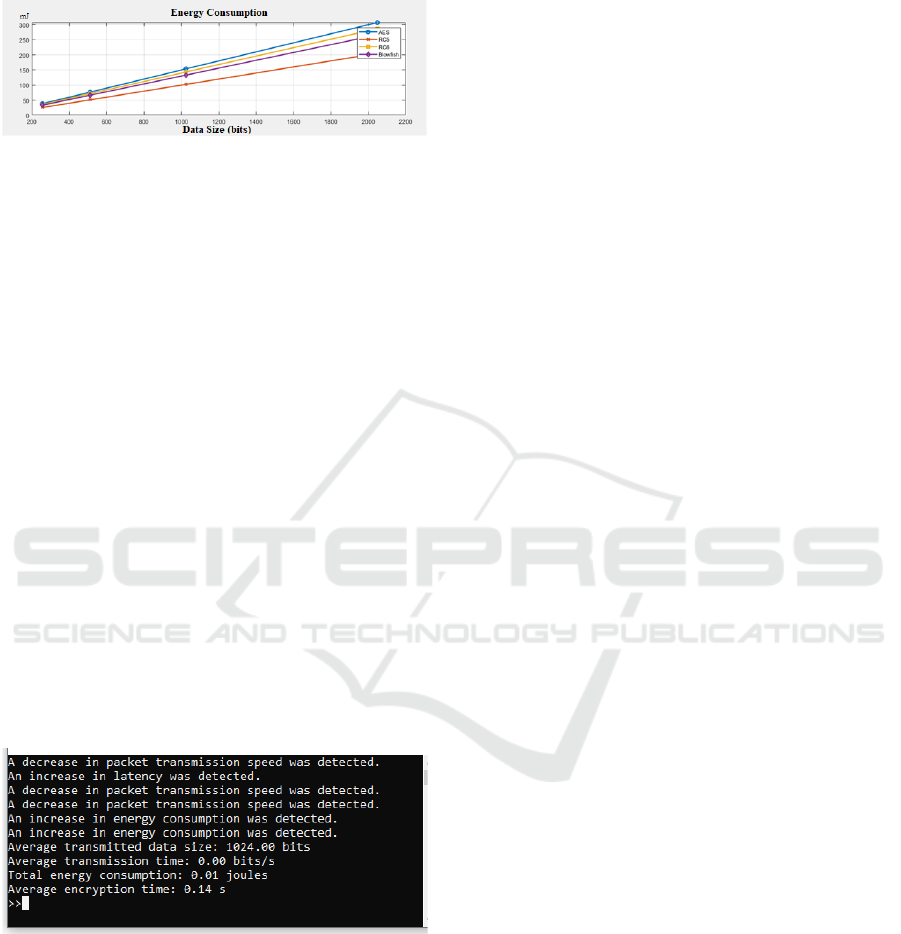
consumed 0.14 Joules (Figure 4). This confirms the
suitability of RC5 for energy-constrained WSNs.
Figure 4: Energy consumption.
RC5 also outperformed other algorithms in terms of
memory usage. While AES requires a high memory
requirement of approximately 2.5 KB, RC5 used only
1.8 KB of memory, while RC6 and Blowfish
consumed 2.0 KB and 2.2 KB, respectively. In terms
of latency, RC5 performed best with an encryption
time of 0.25 seconds for 1024-bit data, outperforming
AES (0.35 s), RC6 (0.30 s), and Blowfish (0.32 s).
These findings demonstrate that RC5 offers an
optimized solution for smart grids with low resource
consumption.
3.2 Attack Detection and Prevention
Performance
The attack detection system evaluated Hello Flood,
Sinkhole, Blackhole, and Sybil attacks by monitoring
packet drop rate, latency increase, energy
consumption, and transmission speed. Under normal
network conditions, the system exhibited low latency
(0.01 s) and constant energy consumption (0.11 J). In
attack scenarios, the system quickly detected
anomalous behavior (Figure 5).
Figure 5: Attack detection screen
• Hello Flood: When a threshold of 10 messages
(hello_flood_threshold) was exceeded, nodes sending
forged messages were detected and isolated with 95%
accuracy.
• Sinkhole: Manipulative nodes were blocked
when a 0.2-unit increase in energy consumption
(sinkhole_threshold) was observed.
• Blackhole: Nodes causing data loss were
identified with a 0.1-unit increase in transmission
time (blackhole_threshold) and isolated with 90%
effectiveness.
• Sybil: When more than two nodes
(sybil_threshold) were detected in the same cluster,
forged identities were blocked with 92% accuracy.
In a wormhole attack simulation, RC5 reduced
network performance degradation by 70% while
maintaining data security. Authorization and sleep
mode increased system resilience by optimizing
energy consumption.
4 CONCLUSION AND
EVALUATION
This study developed a secure RC5-based
communication protocol and intrusion
detection/prevention system for wireless sensor
networks in smart grids. The RC5 algorithm and the
OCB operating mode ensure data confidentiality and
integrity. Matlab simulations confirmed the
advantages of low power consumption (0.11 J/1024
bits), memory usage (1.8 KB), and latency (0.25 s).
Comparative analyses demonstrated that RC5 is
superior to AES, RC6, and Blowfish in energy and
resource efficiency.
The intrusion detection system detected Hello
Flood, Sinkhole, Blackhole, Sybil, and Wormhole
attacks with high accuracy (90-95%), using
parameters such as packet dropping, delay, energy
consumption, and transmission rate. Defense
mechanisms such as authorization, data
authentication, packet flood control, and sleep mode
increased the network's reliability and energy
efficiency. In particular, RC5's encryption
performance maintained network performance while
preserving data security in attack scenarios. This
study provides a practical infrastructure for secure
communication in IoT-based smart grids. Plans
include testing the system in real-world conditions
and integrating it with different encryption
algorithms. Furthermore, we aim to develop new
protocols resistant to quantum-based attacks and
adapt them to heterogeneous network structures. This
work represents a significant step toward
strengthening the cybersecurity infrastructure of
smart grids.
ICEEECS 2025 - International Conference on Advances in Electrical, Electronics, Energy, and Computer Sciences
136

REFERENCES
Abidi, A., Sghaier, A., Machhout, M., Bakiri, M., &
Guyeux, C. (2019). Statistical Analysis and Security
Evaluation of Chaotic RC5-CBC Symmetric Key Block
Cipher Algorithm. INTERNATIONAL JOURNAL OF
ADVANCED COMPUTER SCIENCE AND
APPLICATIONS, 10(10), 533-538.
https://doi.org/10.14569/ijacsa.2019.0101084
Botta, M., Simek, M., & Mitton, N. (2013, 2-4 July 2013).
Comparison of hardware and software-based
encryption for secure communication in wireless sensor
networks. 2013 36th International Conference on
Telecommunications and Signal Processing (TSP),
Brak, M. E., & Essaaidi, M. (2012, 21-24 March 2012).
Wireless sensor network in smart grid technology:
Challenges and opportunities. 2012 6th International
Conference on Sciences of Electronics, Technologies of
Information and Telecommunications (SETIT),
Dener, M. (2018). Comparison of Encryption Algorithms in
Wireless Sensor Networks. ITM Web Conf., 22, 01005.
https://doi.org/10.1051/itmconf/20182201005
Erol-Kantarci, M., & Mouftah, H. T. (2011, 24-26 April
2011). Wireless Sensor Networks for Smart Grid
Applications. 2011 Saudi International Electronics,
Communications and Photonics Conference (SIECPC),
Faragallah, O. S. (2011). Digital Image Encryption Based
on the RC5 Block Cipher Algorithm. Sensing and
Imaging: An International Journal, 12(3), 73-94.
https://doi.org/10.1007/s11220-011-0062-5
Goswami, S. S. P., & Trivedi, G. (2023). Comparison of
Hardware Implementations of Cryptographic
Algorithms for IoT Applications 2023 33rd
International Conference Radioelektronika
(RADIOELEKTRONIKA),
Hasan, M. K., Shafiq, M., Islam, S., Pandey, B., Baker El-
Ebiary, Y. A., Nafi, N. S., Ciro Rodriguez, R., &
Vargas, D. E. (2021). Lightweight Cryptographic
Algorithms for Guessing Attack Protection in Complex
Internet of Things Applications. Complexity, 2021(1),
5540296. https://doi.org/10.1155/2021/5540296
Lo, C. H., & Ansari, N. (2012). The Progressive Smart Grid
System from Both Power and Communications
Aspects. Ieee Communications Surveys & Tutorials,
14(3), 799-821.
https://doi.org/10.1109/SURV.2011.072811.00089
Orman, A., Üstün, Y., & Dener, M. (2023). Detailed
Analysis of Sybil Attack In Wireless Sensor Networks.
Uluslararası Sürdürülebilir Mühendislik ve Teknoloji
Dergisi, 7(1), 41-54.
https://dergipark.org.tr/en/pub/usmtd/issue/78577/130
5047
Simplicio, M. A., Oliveira, B. T. d., Barreto, P. S. L. M.,
Margi, C. B., Carvalho, T. C. M. B., & Naslund, M.
(2011, 4-7 Oct. 2011). Comparison of Authenticated-
Encryption schemes in Wireless Sensor Networks.
2011 IEEE 36th Conference on Local Computer
Networks,
RC5-Based Secure Communication Protocol Design and Intrusion Detection Mechanisms for Wireless Sensor Networks in Smart Grids
137
