
Research on the Compliance of Green Subsidy Policy in International
Trade-Based on WTO Rules
Yuru Lai
Business School, International Economics and Trade, Beijing Language and Culture University, Beijing, China
Keywords: Green Subsidy Policy, WTO Reform, Compliance Challenge, International Trade.
Abstract: The green subsidies have become important policy tools for economic green transition in the context of the
severity of global climate governance and the increasing trade protectionism. This article analyses the
compliance challenges of the green subsidy policy. After a comparison between different nations through case
analysis and literary review of the WTO jurisprudence, the research discovers that differentiated strategies of
various countries are easier to cause trade distortions because of the uncertainty in the rules of WTO judicial
interpretation and scope of application. Considering the results, this article presents three paths. compliance
strategies should be made at the enterprise level. The state-level should design policies rationally. As for the
international part, it’s necessary to promote WTO mechanism reform. The research provides theoretical
support and practical reference in optimization of green subsidy policy, attaching great importance to
balancing the environmental objectives and trade rules under the multilateral trading system.
1 INTRODUCTION
With the increasing awareness of environmental
protection and sustainable development in the world,
more and more countries are altering their goals to
develop new energy industries, curb climate change
and promote sustainable production and
consumption. Take China as an example, its
competitiveness in the global market has realized
remarkable change recently by granting large
amounts of subsidies for new energy vehicles (NEVs)
industry in the links among upstream, midstream and
downstream, which is beneficial to low-carbon
energy transformation (LCE) (Fang, & Zhou, 2022).
The United States provides $400 billion within a
decade through Inflation Reduction Act of 2022
(IRA) in order to fuel the development of clean
energy and green technology (Buccella et al., 2024).
The European Union released the Foreign Subsidies
Regulation (FSR) to make sure that fair competition
and energy transformation go smoothly (Gam &
Papaefthymiou, 2023).
Green subsidy policy refers to the economic
incentives measures provided by the government or
public institutions for enterprises, industry and
customers, whose objective is to protect the
environment, reduce pollution, support the
application of low-carbon technologies and advocate
sustainable development with financial instruments.
While its core aim lies in the initiative of correcting
the market failure in environmental governance and
guiding the flow of resources to the low-carbon field
(Eurostat, 2023). With the trend of green
transformation and globalization, Governments have
adopted green subsidy policies one after another to
accelerate the development of clean energy,
renewable energy and environmental-friendly
industries (Charnovitz, 2014). However, these
policies may lead to international trade disputes.
GATT was formally incorporated into the WTO
system in 1995. In 1994, SCM was concluded in
Uruguay Round Negotiations to provide a mechanism
to settle down subsidy disputes without distorting
international trade (Cim & Esty, 2024). WTO has
been performing constraints on the subsidy policies
all the time from GATT to SCM, but there are still
certain limitations in terms of green subsidies.
Moreover, it is easy to generate compatibility
problems in practical terms.
Nowadays, research on green subsidy policy is
ubiquitous. Academic circles commonly believe that
from the perspective of economic advisability, green
subsidies can foster public interest, produce positive
externality (Charnovitz, 2014) and to a certain extent
help to increase social benefits (Nagy et al., 2021). As
488
Lai, Y.
Research on the Compliance of Green Subsidy Policy in International Trade-Based on WTO Rules.
DOI: 10.5220/0014385100004859
Paper published under CC license (CC BY-NC-ND 4.0)
In Proceedings of the 1st International Conference on Politics, Law, and Social Science (ICPLSS 2025), pages 488-493
ISBN: 978-989-758-785-6
Proceedings Copyright © 2026 by SCITEPRESS – Science and Technology Publications, Lda.

for the topic of what effects green subsidies have on
international trade, one research points out that the
lack of clarity in green subsidies usually triggers
irrational subsidy competition, then results in trade
disputes (Sun & Peng, 2023). However, the
systematic analysis and comparison of subsidy
policies or concrete cases are still lacking.
This research aims to fill the above-mentioned
blanks by applying such methods as literature review,
case analysis, comparative analysis and so on.
Through systematic analysis of specific cases of
major economies, this article better understands the
similarities and differences of green subsidy policies
in different countries. Then it investigates potential
issues and how these policies influence international
trade under the WTO rules. Finally, the article figures
out the contribution that different districts account for
the international trade, as well as how these policies
interact, and provides a reference for the
improvement of WTO subsidy rules.
2 LITERATURE REVIEW
Centering around the economic advisability of green
subsidy policy, one of the researchers proposes that
not only can it reduce the costs of clean energy
technology, gaining a strong competitiveness in
market, but it allows social resources to follow the
direction of high-efficiency industry so that the global
energy structure successfully transforms (Charnovitz,
2014). Such interpretation provides an important
reference to further understanding green subsidy
policy and a different angle for subsequent research.
Some researchers analyzed how carbon emission
reduction policies can become a potential strategic
trade policy tool by constructing a model that
includes two exporting countries adopting
environmental policies such as taxes and subsidies in
third-country markets, discovering that reducing
pollution through subsidies benefits all the
stakeholders under certain conditions (Buccella et al.,
2024). Moreover, other scholars have noted that in
most cases, the market fails to reflect the true value of
the environmental resources because of existing
public attributes, but the green subsidies guide
enterprises and individuals to make proper use of
environmental resources through economic
incentives (Nagy et al., 2021).
Regarding the effects derived from international
trade, one research has mentioned that WTO rules
lack clarity in some clean energy subsidies. Hence,
the government would unconsciously break the rules
as they cannot access the compliance of those
policies, resulting in unfair competition (Charnovitz,
2014). Some scholars have claimed that under WTO
rules, countries had better weigh the relationship
between compliance and economic objectives when
implementing green subsidy policies to ensure that
policies are consistent with international trade rules
and green development (Fang & Zhou, 2022).
Additionally, some scholars suggested international
communication and cooperation are important to
promote the transparency, fairness and sustainability
of green subsidy policy making and implementation,
thereby reducing trade friction and promoting the
healthy development of global trade.
3 COMPLIANCE ANALYSIS OF
GREEN SUBSIDY POLICY
UNDER WTO FRAMEWORK
3.1 Definition of Green Subsidy Policy
Under the GATT, there are definitions of
transparency requirements and additional
requirements for the export and periodic check of
primary products in Article 16. It emphasizes that fair
competition requires the government to disclose the
subsidy policies and countries should negotiate
whether to limit them when there is a conflict with the
interests of the contracting states. Meanwhile, the
general exception part of Article 20 makes strict
provisions on special areas such as environmental
protection and public health, resource preservation,
and non-discrimination principles. According to the
SCM, the types and implementation conditions of
subsidies include prohibited subsidies directly linked
to export performance or import substitution, and
actionable subsidies that have specificity and would
cause damage to the interests of other countries.
According to the domestic and foreign literatures,
this article summarizes that green subsidy policy is a
key mechanism to coordinately promote
environmental goals and economic development in
order to balance environmental legitimacy and trade
fairness, which financial intervention is carried out in
many fields such as renewable hydrogen energy, new
energy vehicles, and lithium battery with the aim of
correcting the excessive waste of resources in
traditional markets, promoting green technology
research within enterprises, and alleviating the lower
effect of low-carbon transformation on vulnerable
industries or groups.
Green subsidy policies such as research and
development (R&D) support, production-side
Research on the Compliance of Green Subsidy Policy in International Trade-Based on WTO Rules
489

stimulation, consumption incentives, and
environmental protection goals are widely used all
around the world. For example, in Shanghai Lingang
New Area, China, the government provides R & D
support at a ratio of 10% ~ 30% of investment to
encourage some breakthroughs in new energy storage
technology projects. The Chinese government has
introduced a policy called “Two New” to promote the
penetration rate of new energy vehicles to exceed
50% (Zhu, 2024). The Inflation Reduction Act (IRA)
and the Chip and Science Act of the United States
plan to subsidize the green energy and semiconductor
industry by $700 billion within ten years, mentioning
that 40% of the key minerals in electric vehicle
batteries should come from North America, and the
local manufacturing can enjoy tax credit once they
reach the standard. The EU provides full funding of
7.81 million euros for all-solid-state lithium battery R
& D projects through the 'Horizon Europe' fund. In
2022, photovoltaic subsidies will reach 25 billion
euros, supporting the research and development of
ultra-thin film technology and perovskite facilities.
Through the 'Recovery and Resilience Fund' (RRF),
it provides up to 87.9 billion euro for industrial chains
such as electric vehicle R & D, manufacturing, and
charging facilities. The EU Carbon Border
Adjustment Mechanism (CBAM) imposes carbon
tariffs on imported high-carbon products such as steel
and cement. France provides an 'ecological subsidy'
of 27% for the purchase price of electric vehicles.
(WTO Law Research Society of China Law Society
Center for WTO Legal Studies,2024) Spain 's
'MOVES III' plan allocates 150 million euros to
support the installation of charging facilities. Brazil
implements the Low Carbon Agriculture Program
plus (ABC+), which provides low-interest loans to
farms that adopt no-till farming and agroforestry
systems (United States Development of Agriculture,
2024).
The implementation of these subsidies has played
an active role in green technology development,
industrial upgrades and market demand stimulation.
However, some policies may lead to problems like
technology monopoly, overcapacity, price
competition and trade disputes, which need to be
balanced and coordinated in the process of policy
formulation and implementation.
3.2 Case Analysis of Subsidy Policy
Practice Among Countries
In the Sino-US Wind Energy Subsidy case (Canada-
Renewable Energy/Canada-FIT, 2023), the
compliance debate focused on import substitution
subsidies and the applicability of Article 20 of GATT
1994. Based on WTO rules, the United States accus
that China 's subsidies, funding or incentives to
enterprises with domestic products violate the
provisions under the SCM agreement, while China
tries to invoke Article 20 of GATT 1994 to defend
itself, arguing that it’s in line with the exceptions to
environmental protection in this article because its
subsidy measures are aimed at protecting the
environment. The case not only affects the trade
pattern between China and the United States but also
impact the trade order of the global renewable energy
industry and hinder the efforts of international
cooperation to cope with climate change and energy
crisis.
In the EU 's Anti-Subsidy Investigation of Electric
Vehicles against China (European Comittion, 2023)
the compliance disputes mainly focus on whether the
local component requirements constitute import
substitution subsidies. The European Commission
believes that China 's subsidies to BYD and Weilai at
the production end and export section seriously
distort the market competition and cause 'serious
damage' to the EU industry, which violates the
'specificity' in Article 2 of SCM and the provisions of
Article 5. China advocates that the subsidy is in line
with the public goal of 'carbon neutrality', and the EU
cannot clearly prove that the subsidy causes industrial
damage. On the one hand, China has higher cost when
entering the European market, while on the other
hand, the EU also faces China 's anti-dumping
investigation response.
In addition, it’s obvious that there is a particularity
among the cases. For example, China 's new energy
products are blamed for domestic overcapacity with
the reason that the 'New Three' exports are using 'low-
price dumping' to transfer excess capacity. The EU
level is superimposed on the subsidies of member
states, but due to coordination problems, it is easy to
generate double subsidy mechanism risks and green
barrier adversity. The localization requirements of the
US green subsidy policy are greatly affected by the
political cycle, and fluctuate with the change of
government, resulting in long-term investment
uncertainty of enterprises.
3.3 Analysis on the Compliance and
Limitations of Green Subsidy
Policy
Based on the above research and analysis of green
subsidy policies, it is obvious that there are certain
uncertainties in the interpretation and application of
WTO rules. Firstly, the WTO rules have an
ICPLSS 2025 - International Conference on Politics, Law, and Social Science
490

ambiguous definition of subsidies, and both the
implementation mechanism and judicial
interpretation are often uncertain. The decisions of
the dispute settlement body (DSB) are often
subjective, which makes it difficult for member states
to determine whether they are in compliance with the
rules when implementing policies. Moreover, the
appellate body is prone to suspension, but the interim
appeal arbitration (MPIA) lacks coercive force,
fragmentating the adjudication standards. Secondly,
there is a conflict between the specificity
identification standard and the green subsidy target in
the structure of WTO rules. According to the SCM
agreement, subsidies need to meet the 'specificity'
standard before they can be sued. However, green
subsidies often cover multiple industries with
environmental protection goals while their actual
beneficiaries may be concentrated in specific areas,
resulting in being identified as 'factual specificity'.
Third, the current SCM agreement does not make a
distinction between environmental protection
subsidies and traditional industrial subsidies,
resulting in green policies often classified as
"actionable subsidies" and corresponding green
subsidies "exception clauses". The application
threshold of environmental protection exceptions in
Article 20 of the GATT is at a high level. It is
necessary to pass the "necessity test" and prove that
the measures are non-discriminatory, but green
subsidies are often questioned and discriminated
against for the choice of policy tools.
Green subsidy policy will certainly reshape the
global trade pattern. In terms of market access, some
countries increase green trade barriers by setting strict
environmental protection standards and certification
procedures, limiting the entry of products from other
countries, which may lead to higher market access
costs. In terms of trade, countries reduce the cost of
their products through subsidies to make them more
price competitive in the international market, thus
putting pressure on similar products in other
countries, but this pressure will be passed on to
consumers and increase their burden. In terms of
international investment, some countries attract
investment in green industries by providing subsidies
to promote the development of their own green
industries, but this may also lead to the outflow of
investment from other countries and aggravate the
tendency of capital hedging.
4 THE OPTIMIZATION PATH OF
GREEN SUBSIDY POLICY
COMPLIANCE
4.1 Compliance Coping Strategies at
the Enterprise Level
As the direct beneficiaries of green subsidy policies,
enterprises need to actively participate in the
formulation of international standards and
compliance review mechanisms to anticipate policy
risks and ensure their competitiveness in international
trade. For example, enterprises can influence the
formulation of international standards through
industry associations or direct participation under the
WTO frame framework. When faced with unfair
trade barriers or subsidy disputes, Amicus Curiae
Briefs are suggested because that makes full use of
the WTO dispute settlement mechanism to safeguard
their own interests (McDaniel & Matthews, 2024).
4.2 Policy Design and Risk Aversion at
the National Level
Governments should give priority to supporting basic
R & D and non-specific subsidies when designing
green subsidy policies. For example, policies such as
carbon tax returns can encourage technological
innovation, avoid excessive support for specific
enterprises, and reduce the risk of trade disputes
(McDaniel & Matthews, 2024). In addition, the green
subsidy policy is designed to avoid the terms directly
linked to exports as much as possible, while
strengthening the quantitative assessment of the
environmental benefits of subsidies to ensure that the
subsidy policy can not only promote green
development but also conform to WTO rules and
reduce trade risks. In the process of policy
implementation, the state needs to strengthen the
quantitative assessment of environmental benefits to
ensure that subsidy policies can truly bring about
environmental improvement and can prove their
compliance through scientific data support.
4.3 Promote WTO Rules Reform at the
International Level
According to World Trade Organization data, as of
December 31, 2024, a total of 631 consultation
requests had been circulated to WTO members, of
which 141 disputes were related to subsidy claims
under WTO agreements. The data in Figure 1 shows
that, in general, the application of various agreements
Research on the Compliance of Green Subsidy Policy in International Trade-Based on WTO Rules
491
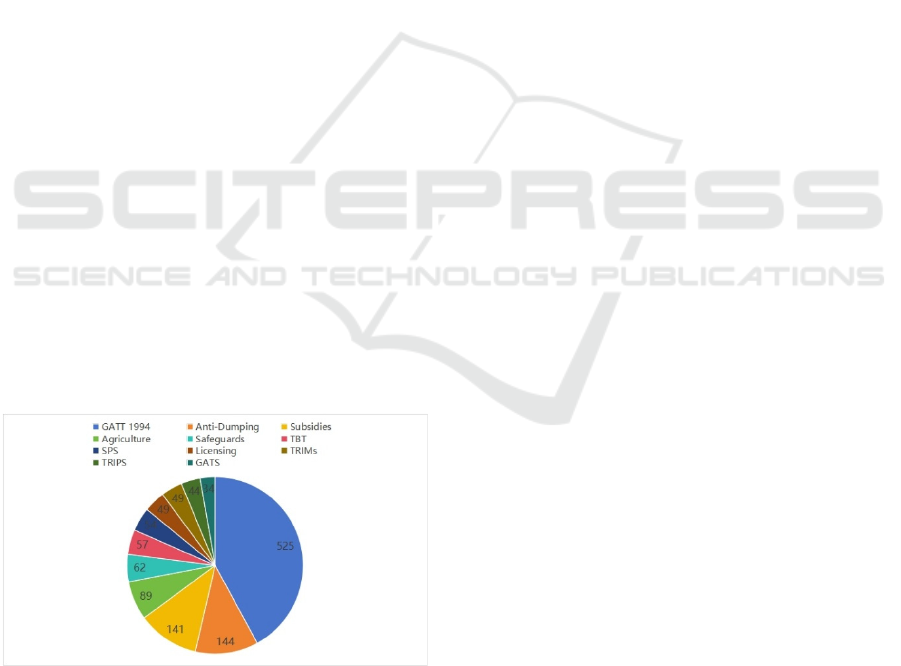
under the WTO dispute settlement platform reflects
the hot and difficult issues in different fields of
international trade. GATT 1994 accounts for the
largest number of related disputes, reaching 525 due
to its involvement in basic trade rules and industrial
policies. Agreements such as Agriculture and
Safeguards have also caused more disputes due to the
sensitivity and complexity of specific areas. It can be
seen that promoting the reform of WTO rules is the
key to ensuring the compliance of green subsidy
policies.
In view of the limitations of WTO rules, first of all,
revise the SCM agreement and add the green subsidy
exception clause to provide a clear legal basis for
green subsidies to reduce disputes caused by vague
rules. Secondly, seeking cooperation with
international institutions such as OECD, IMF and the
World Bank to promote transparency and information
sharing of subsidy issues, establish a multilateral
environmental subsidy transparency mechanism,
promote communication and coordination among
countries on subsidy policies, and reduce trade
frictions caused by information asymmetry
(Organization for Economic Co-operation and
Development, 2023). Finally, establishing a complete
framework or agreement to deal with climate change
as soon as possible and incorporating green subsidies
into the framework of global climate governance can
provide broader support and recognition for green
subsidy policies. The Annex 2 of the Agreement on
Agriculture policy serves as a reference which allows
green subsidy exemption litigation that meets the
conditions of carbon emission reduction intensity as
the benchmark, covering the whole industry, and
regularly accepting third-party environmental benefit
audits (Wang et al., 2021)
Data source: WTO
Alt Text for the figure: The figure reflects the number of cases
of various disputes under the WTO.
Figure 1. Agreements raised in WTO disputes (1995-2024).
5 CONCLUSION
Through analyzing the practical situations of green
subsidy policy in international trade and combining
with the interpretations under the WTO rules, this
article on the one hand finds that the policies which
have both similarities and differences are widespread
used. However, the existing rules still have
limitations and ambiguities and pose challenges to
determine the compliance of green subsidy policy. On
the other hand, by comparing the related cases
happened in China, the United States and the
European Union, it is concluded that green subsidy
policy generally face compliance risks and is prone to
trade disputes. The optimization path for the
compliance of green subsidy policies requires the
joint efforts of enterprises, countries, and the
international community. Enterprises need to actively
participate in making international standards and
making use of the dispute settlement mechanism.
Countries need to design reasonable subsidy policies
to avoid triggering trade disputes. The international
community should promote the reform of WTO rules,
providing legal foundation and transparency
mechanisms for green subsidies.
REFERENCES
Buccella, D., Fanti, L., & Gori, L. 2024. Green subsidies as
strategic trade policy tools. Environmental Economics
and Policy Studies 26: 741–757.
Carbon Border Adjustment Mechanism. [n.d.]. Taxation
and Customs Union. https://taxation-
customs.ec.europa.eu/carbon-border-adjustment-
mechanism_en.
Charnovitz, S. 2014. Green subsidies and the WTO. World
Bank Policy Research Working Paper No. 7060.
doi:10.1596/1813-9450-7060.
Cima, E. & Esty, D.C. 2024. Making international trade
work for sustainable development: Toward a new WTO
framework for subsidies. Journal of International
Economic Law 27(1): 1–17.
Eurostat. 2023. Environmental statistics and accounts in
Europe. Eurostat Statistics Explained. Available:
Environmental subsidies and similar transfers statistics
| System of Environmental Economic Accounting.
Fang, M.M. & Zhou, W. 2022. Greening the road: China’s
low-carbon energy transition and international trade
regulation. Leiden Journal of International Law 35(2):
357–378.
Gam, L. & Papaefthymiou, A. 2023. The EU foreign
subsidies regulation: Green subsidies treading the line
between the FSR, state aid, and WTO law. Competition
Policy International. Available:
https://www.competitionpolicyinternational.com/wp-
ICPLSS 2025 - International Conference on Politics, Law, and Social Science
492

content/uploads/2023/05/5-THE-EU-FOREIGN-
SUBSIDIES-REGULATION-GREEN-SUBSIDIES-
TREADING-THE-LINE-BETWEEN-THE-FSR-
STATE-AID-AND-WTO-LAW-Liliane-Gam-
Argyrios-Papaefthymiou.pdf.
Nagy, R.L. et al. 2021. Green capacity investment under
subsidy withdrawal risk. Energy Economics 98:
105259.
Natural Resources Conservation Service. 2025.
Environmental Quality Incentives Program.
Shi, X. et al. 2024. The EU's industrial subsidy policy for
lithium batteries, photovoltaic products, and electric
vehicles in the name of green transition. WTO Legal
Studies Blue Book.
Sun, A. & Peng, D. 2023. Revisiting WTO subsidy rules in
a changing global landscape: Problems and prospects.
Journal of WTO and China 13(3): 23–44.
United States Department of Agriculture. 2021. ABC Plus:
Brazil's new climate change adaptation and low carbon
emission in agriculture plan.
Zhu, Y. [n.d.]. The "two new" support policies are fully
launched: Policy Interpretation. China Government
Network.
https://www.gov.cn/zhengce/202409/content_6976037
.htm.
Research on the Compliance of Green Subsidy Policy in International Trade-Based on WTO Rules
493
