
The Environment and Wind Energy Production by Analyzing Noise
Filtering in Wind Signals to Improve the Efficiency of Energy
Systems
Naim Baftiu
1a
, Ana Atanasova
2b
, Tatjana A. Pacemska
1c
and Petre Lameski
2d
1
Faculty of Computer Science,“Goce Delcev” University, Stip, North Macedonia
2
Faculty of Computer Science and Engineering Science, “Ss. Cyril and Methodius” University in Skopje, North Macedonia
Keywords: Noise Filtering, Wind Signals, FIR, IIR, Wavelet Transform, Kalman Filter.
Abstract: Noise filtering is an important process for improving the accuracy and efficiency of signals captured by wind
sensors, which are used to monitor and optimize the performance of wind-based energy systems. Wind signals
often contain interference and noise, which can complicate analysis and decision-making related to energy
production and turbine maintenance. In this context, noise filtering helps improve the quality of data collected
by the sensors and allows for a more accurate assessment of wind speed and direction, contributing to more
efficient energy management. This is crucial for optimizing energy production, reducing costs, and increasing
the sustainability of energy systems. The use of signal filtering algorithms can significantly enhance the
performance of energy systems by eliminating the negative impacts of external factors, such as acoustic
pollution and interference from other sources. Noise in wind signals, caused by atmospheric disturbances,
sensor inaccuracies, and electromagnetic interference, reduces the efficiency of energy systems. This study
focuses on implementing digital filters to improve signal quality, thereby enhancing turbine performance. The
implementation of FIR, IIR, wavelet transform, Kalman filters, and spectral analysis aims to optimize wind
energy production.
1 INTRODUCTION
Wind energy has become the cornerstone of
renewable energy solutions, providing a permanent
option for fossil fuels. However, the efficiency of
wind energy systems is highly dependent on the
quality of the input signals, specifically wind speed
and direction. These signals are critical for the precise
control of turbine operations, including blade pitch
adjustment, yaw control, and optimal energy
conversion.
Unfortunately, wind signals are often corrupted
by noise stemming from multiple sources.
Atmospheric turbulence, caused by unpredictable
weather patterns, introduces random variations in the
signals. Additionally, sensor inaccuracies, resulting
a
https://orcid.org/0000-0001-9432-9293
b
https://orcid.org/0009-0004-6094-9995
c
https://orcid.org/0009-0004-6094-9995
d
https://orcid.org/0000-0002-5336-1796
from calibration errors or environmental wear, further
degrade the quality of the measurements. Moreover,
electromagnetic interference, arising from nearby
electronic devices or power lines, can significantly
distort the recorded data.
The presence of noise in wind signals not only
complicates data interpretation but also compromises
the operational efficiency of wind turbines. When
controllers rely on inaccurate or noisy signals,
turbines may operate sub- optimally, leading to
decreased energy output, increased mechanical stress,
and higher maintenance costs.
To address these challenges, advanced noise
filtering techniques have emerged as crucial tools for
enhancing the reliability and accuracy of wind signal
data. This paper investigates the application of
112
Baftiu, N., Atanasova, A., Pacemska, T. A. and Lameski, P.
The Environment and Wind Energy Production by Analyzing Noise Filtering in Wind Signals to Improve the Efficiency of Energy Systems.
DOI: 10.5220/0014377900004848
Paper published under CC license (CC BY-NC-ND 4.0)
In Proceedings of the 2nd International Conference on Advances in Electrical, Electronics, Energy, and Computer Sciences (ICEEECS 2025), pages 112-119
ISBN: 978-989-758-783-2
Proceedings Copyright © 2026 by SCITEPRESS – Science and Technology Publications, Lda.

various digital filters, including Finite Impulse
Response (FIR), Infinite Impulse Response (IIR),
Wavelet Transforms, and Kalman Filters, to mitigate
noise in wind signals. Furthermore, spectral analysis
techniques are employed to identify and target
specific noise frequencies, enabling tailored filtering
solutions. By improving signal quality, these filtering
methods contribute to the optimization of turbine
performance and overall energy production. The
study highlights the potential of digital filtering in
renewable energy applications, offering a framework
for future advancements in wind energy systems. The
goal is to develop robust methodologies that ensure
reliable energy generation, even under challenging
environmental conditions.
2 MANUSCRIPT PREPARATION
Noise filtering in wind energy systems has been a
significant research topic, as accurate signal
processing is crucial for optimizing turbine
performance. Several studies have explored different
techniques for noise reduction in wind signals,
focusing on both time-domain and frequency-domain
filtering approaches. (Ackermann, 2005) discussed
the impact of wind turbulence on energy production
and the necessity of accurate wind measurements for
improved efficiency. The study highlighted that
incorrect signal processing could lead to errors in
turbine control, reducing overall energy output. In
recent years, digital filtering techniques such as FIR
and IIR have gained popularity for denoising wind
signals. (Manyonge et al. 2012) investigated the
effectiveness of FIR and IIR filters in mitigating
sensor noise in wind speed measurements. Their
results demonstrated that FIR filters maintain signal
phase integrity, making them suitable for real-time
applications, while IIR filters provide efficient noise
suppression with fewer computational resources.
Another important approach is the use of Wavelet
Transform, which has been widely applied in non-
stationary signal processing. (Liu, X., Zhang, Y.
2022), examined the role of wavelet-based filtering in
wind speed prediction, showing that wavelet
decomposition effectively isolates noise while
preserving important signal features. This method
was particularly useful in identifying transient noise
components that traditional filters struggled to
remove. Kalman filtering has also been explored for
real-time noise reduction in dynamic wind energy
systems. (Qazi et al. 2021) implemented an adaptive
Kalman filter to refine wind speed estimates,
resulting in a significant improvement in turbine
power output predictions. Kalman filters excel in
tracking changes over time, making them a powerful
tool for applications where wind conditions fluctuate
rapidly.
Apart from filtering techniques, spectral analysis
methods have been employed to understand the
frequency characteristics of wind signal noise.
(Bhardwaj et al. 2023) utilized Fast Fourier
Transform (FFT) to identify dominant noise
frequencies in wind measurements, allowing for the
design of targeted filtering solutions. Their research
demonstrated that combining spectral analysis with
adaptive filtering methods leads to superior noise
reduction performance. While these studies have
made significant contributions to the field, challenges
remain in developing filtering techniques that balance
computational efficiency with high accuracy. This
paper builds upon previous research by integrating
multiple filtering approaches—FIR, IIR, Wavelet
Transform, and Kalman Filtering—along with
spectral analysis to enhance wind signal quality. By
comparing their effectiveness, this study aims to
provide insights into the optimal filtering strategy for
wind energy applications.
3 BASIC METHODS, MODELS
FOR NOISE FILTERING
Basic methods and models for noise filtering are
techniques and algorithms used to eliminate or
minimize the impact of noise from signals to preserve
valuable information and improve data quality.
These methods are crucial in fields such as signal
processing, telecommunications, and wind energy
applications, where interference and noise can affect
the accuracy of measurements and analyses.
Here are some of the most used methods and
models for noise filtering:
-
FIR Filters (Finite Impulse Response)
-
Description: FIR filters are filters with a
finite impulse response, meaning they are
composed of a limited number of
coefficients. They are used to filter noise
without affecting the original signal.
-
Advantage: They are easy to design and
implement and provide full stability.
-
IIR Filters (Infinite Impulse Response)
-
Description: IIR filters have an infinite
impulse response, using an infinite number
of coefficients. These filters can be more
efficient in preserving information and are
faster compared to FIR filters.
The Environment and Wind Energy Production by Analyzing Noise Filtering in Wind Signals to Improve the Efficiency of Energy Systems
113

-
Advantage: They use fewer coefficients,
making them more efficient in terms of
resource consumption.
-
Wavelet Transform
-
Description: This transformation is used to
break down a signal into its simpler
components at different frequency levels. It
is particularly useful for filtering noise when
there are rapid or nonlinear variations in the
signal.
-
Advantage: It allows the signal to be
decomposed into components that can be
processed more easily and is effective for
signals that contain sudden changes.
-
Kalman Filters
-
Description: Kalman filters are advanced
algorithms for signal filtering that use
various mathematical models to predict and
correct errors in signal measurements.
-
Advantage: They are highly effective for
tracking and filtering signals in
environments with high noise and have been
widely used in navigation and robotic
applications.
-
Spectral Analysis
-
Description: This method involves breaking
down the signal into its frequency
components. By analyzing
the
energy
spectrum,frequencies that contain noise
can be identified and eliminated.
-
Advantage: It provides an efficient
method for filtering noise by removing
frequencies that fall outside the range of
interest.
-
Adaptive Filtering
-
Description: This type of filtering uses
algorithms that dynamically adjust to
changes in the signal and noise. For
example, an adaptive filter can adjust in real-
time to handle changes in noise levels.
-
Advantage: It can filter noise under varying
conditions where noise levels change
continuously.
-
Statistical Filtering
-
Description: This method uses the statistics
of the signal to identify and eliminate noise,
relying on probabilistic models to
distinguish the true signal from the noise.
-
Advantage: It is used in situations where the
noise follows a known pattern or can be
statistically evaluated.
All these methods are useful in different
circumstances and can be employed to improve the
accuracy of measurements and optimize the
performance of systems that rely on captured signals.
The choice of method depends on the nature of the
noise and the specific requirements of the application.
In the context of climate change and renewable
energy production, particularly wind energy, ensuring
the accuracy of wind data analysis is crucial for
effective planning and decision-making. Wind speed
data is often subject to various types of noise, which
can arise from sensor inaccuracies, atmospheric
turbulence, and other external factors.
To ensure that the data used for wind energy
applications is reliable, different filtering techniques
are applied to remove noise while preserving the
essential characteristics of the wind signal.
This study applies multiple filtering methods,
including Finite Impulse Response (FIR), Infinite
Impulse Response (IIR), Wavelet Transform and
Kalman Filter. Each of these methods offers unique
advantages in noise reduction and signal smoothing.
Below, we discuss the methodologies and
characteristics of each filtering approach. (Wang, J.,
Zhang, F. 2024)
The noise from turbines can negatively impact
wind energy production for several reasons:
1.
Impact on sensors and inaccurate
measurements: Noise can affect the sensors
used to measure wind speed and direction,
leading to inaccurate data. This can result in
incorrect decisions for turbine adjustments,
reducing energy production efficiency.
2.
Loss in production capacity: In addition to
the interference in measurements, noise can
cause an increase in wasted energy due to
vibrations and oscillations, which affect the
turbine’s performance. This may lead to
lower energy production and may even
cause mechanical damage to the turbine over
long periods.
3.
Reduced accuracy in performance
analysis: Noise can mask the natural
variations in wind, making it difficult to
accurately assess turbine performance.
Without accurate analysis, energy
management and operational optimization
become more challenging.
4.
Impact on energy management: Noise can
cause difficulties in forecasting energy
supply and can affect energy management
systems that rely on accurate data for
planning and optimization. This may lead to
resource wastage or increased operational
costs.
ICEEECS 2025 - International Conference on Advances in Electrical, Electronics, Energy, and Computer Sciences
114

5.
Impact on turbine lifespan: Noise and
vibrations can cause mechanical stress on
turbine components, shortening their
operational life and increasing the need for
frequent maintenance.
For these reasons, noise filtering and improving
measurement accuracy are essential to ensure higher
efficiency in wind energy production and to enhance
the sustainability of wind energy systems.
The noise from wind turbines can negatively impact
residents living near wind turbines for several
reasons:
1.
Impact on mental and physical health:
The constant noise and vibrations caused by
the turbines can lead to stress, anxiety,
insomnia, and fatigue for residents. Studies
have shown that prolonged exposure to
noise can contribute to mental health
issues and affect the nervous system.
2.
Impact on quality of life: Noise can affect
the quality of life for residents by creating an
uncomfortable environment. It can interfere
with daily activities such as resting,
conversations, and outdoor activities,
leading to feelings of dissatisfaction and
tension.
3.
Sleep problems: The noise from turbines
can impact sleep, causing issues like
insomnia and deterioration in sleep quality.
This can affect both physical and mental
health, leading to fatigue and reduced
performance during the day.
4.
Impact on the local environment: Noise
can affect wildlife in the area surrounding
the turbines, disturbing animals and
disrupting local ecosystems. This can have a
negative impact on residents who are
connected to nature and the nearby
environment.
5.
Social impact: Wind turbines can cause
social division within local communities.
Some residents may feel disturbed by the
noise, leading to tensions between those who
support wind energy projects and those who
are dissatisfied with the noise impact.
To manage these impacts, it is important for wind
turbine projects to be carefully planned and managed,
considering acceptable noise levels and distances
from residential areas to ensure minimal impact on
nearby residents. (P. Denholm and M. Hand, 2011)
3.1 Finite Impulse Response (FIR)
Filter
The FIR filter is a type of digital filter that applies a
finite number of coefficients to modify the wind
speed signal. This filter is widely used due to its
stability and linear phase response, making it an
effective tool for noise reduction in wind speed data.
The FIR filter does not rely on past outputs, making
it inherently stable and suitable for filtering out high-
frequency noise. In this study, we applied the FIR
filter to smooth the wind speed data, reducing
unwanted fluctuations caused by environmental
factors or sensor inaccuracies.
3.2 Infinite Impulse Response (IIR)
Filter
Unlike the FIR Filter, the IIR Filter uses both past
inputs and past outputs to generate filtered values.
This makes it more computationally efficient while
achieving the desired filtering effect with fewer
coefficients. The IIR filter can effectively reduce
noise while maintaining a balance between signal
distortion and smoothness. For this project, we
applied the IIR filter to compare its performance with
FIR filtering in terms of noise reduction and signal
preservation.
3.3 Wavelet Transform
Wavelet Transform is a powerful signal processing
technique used for decomposing a signal into
different frequency components. Unlike traditional
filters, wavelets allow for localized time- frequency
analysis, making them highly effective for detecting
and removing transient noise while preserving the
wind signal's characteristics. The application of
Wavelet Transform in this study helped in denoising
the wind speed signal by removing high- frequency
components while keeping the underlying wind
patterns intact.
3.4 Kalman Filter
The Kalman Filter is a recursive algorithm used for
estimating the true value of a noisy signal. It works
by predicting the system's future state and updating
the estimates based on new observations. This
filtering method is particularly useful for applications
where real-time data processing is required. We
applied the Kalman Filter to the wind speed dataset to
enhance the accuracy of the signal and reduce the
impact of measurement errors.
The Environment and Wind Energy Production by Analyzing Noise Filtering in Wind Signals to Improve the Efficiency of Energy Systems
115

4 EXPERIMENTS AND RESULTS
4.1 Analysis of Wind Noise
Components
Wind speed signals, like any real-world
measurements, are affected by noise. Noise in wind
data can distort analysis, leading to inaccurate power
predictions for wind turbines. To ensure high-quality
data, it is important to analyses the sources and
characteristics of noise and apply appropriate filtering
techniques to mitigate their effects. Noise in wind
speed data originates from various factors, including:
1.
Sensor Noise: Missing values in the dataset
were imputed using linear interpolation for
continuous variables like wind speed and
temperature, ensuring the time series
continuity.
2.
Atmospheric Turbulence: For categorical
variables like wind direction, a forward fill
approach was employed, where missing
values were filled with the most recent
available observation.
3.
Obstructions and Terrain Effects: Objects
such as buildings, trees, and mountains alter
wind flow, creating localized disturbances in
the wind speed measurements.
4.
Measurement Resolution and Sampling
Rate: If wind speed data is recorded at a very
high sampling rate, it can capture short-term
variations that may be considered noise. On
the other hand, a low sampling rate may
cause loss of important variations.
5.
Instrumental and Transmission Errors:
Data transmission errors, power failures, and
signal dropouts can introduce gaps, outliers,
or artefacts in the recorded wind data.
Conclusion: Noise in wind speed data
originates from multiple sources, including
sensor limitations, atmospheric turbulence,
and environmental obstructions.
Understanding the characteristics of noise
allows the application of appropriate filtering
techniques to enhance data quality. By
employing methods such as FFT analysis and
filtering, we can ensure cleaner wind speed
signals, leading to more accurate predictions
and efficient wind turbine operation.
4.2 Experimental Results
In this section, we present the results obtained from
applying the noise analysis techniques outlined in the
previous chapter to the wind speed dataset. The
primary objective was to evaluate the effectiveness of
different noise reduction methods in enhancing the
quality of the wind speed signals. For this purpose,
both the raw and filtered data are analyzed, and
various statistical measures are used to quantify the
impact of noise.
4.2.1 Visualization of Results
To assess the performance of each noise reduction
model, we visualized the comparison between actual
and predicted wind energy production values. By
plotting the actual energy production against the
predicted values generated by each model, we gain
valuable insight into the accuracy and stability of the
models over time. These visualizations help us
understand how well the models capture the true
variations
in
wind
energy
production
and whether
they can maintain accuracy despite the presence of
noise. In the plots, we observe the degree of
alignment between the actual and predicted values for
each filtering method. A closer match indicates a
more accurate model, while greater discrepancies
suggest that the model may not effectively replicate
the true energy production trends. Additionally, by
analyzing these plots over time, we can assess the
consistency and reliability of the models under
varying wind conditions. These visualizations are
essential for determining which model provides the
best balance between reducing noise and preserving
the key features of the wind energy signal. They offer
a clear, intuitive representation of model performance
and help identify areas where further refinement
might be needed.
Raw Data Analysis: To begin, we visualize the raw
wind speed data to observe the presence of noise. As
shown in Figure 4.1, the raw data exhibits significant
fluctuations and high-frequency components that are
indicative of noise. These fluctuations are not
characteristic of true wind behavior, and they obscure
the underlying wind patterns that are crucial for
accurate analysis. (Figure 1).
Wind Speed with FIR Filter: This plot showcases
the effect of a Finite Impulse Response (FIR) filter on
wind speed data over time. The original wind speed
is represented in blue, showing a highly fluctuating
and noisy pattern. The red line represents the FIR-
filtered wind speed, which smooths the variations
while maintaining the general trend of the data. FIR
filters are known for their phase linearity, meaning
that they preserve the timing of the signal components
ICEEECS 2025 - International Conference on Advances in Electrical, Electronics, Energy, and Computer Sciences
116
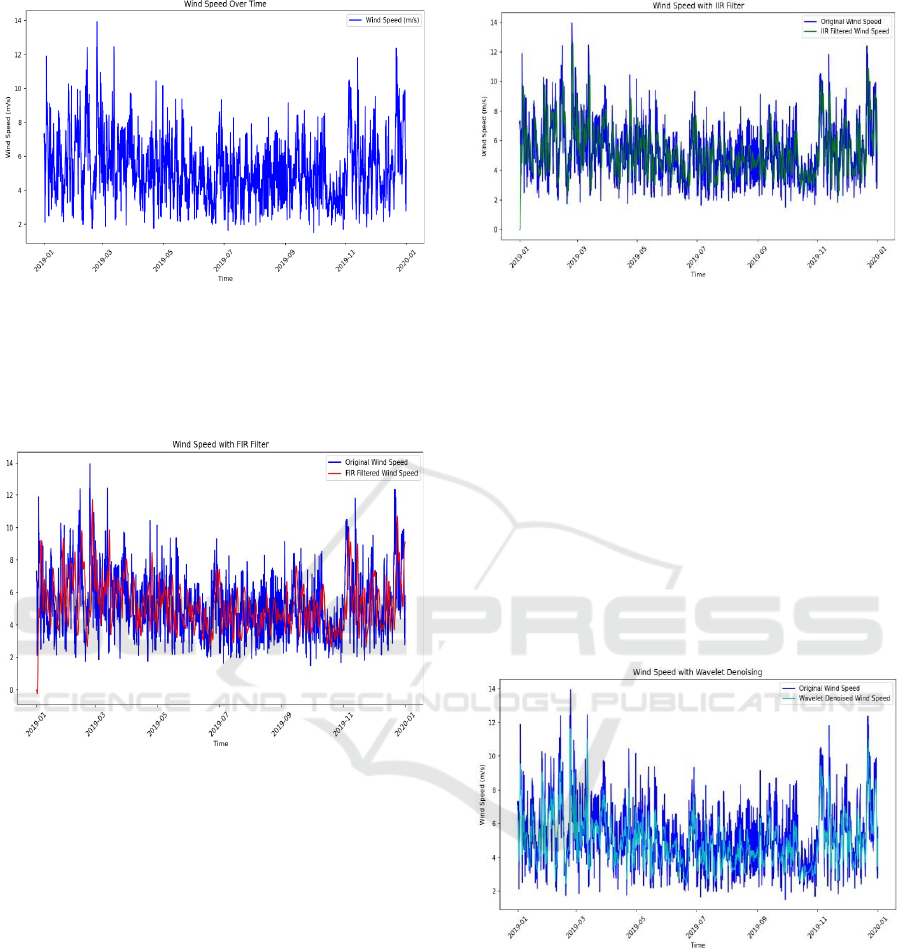
Figure 1. Raw Wind Speed Data.
without distortion. The graph reveals that the FIR
filter effectively removes high-frequency noise while
retaining important patterns in the wind speed
variations. (Figure 2).
Figure 2. FIR Filtered Wind Speed Data.
Wind Speed with IIR Filter: This plot presents
the effect of an Infinite Impulse
Response (IIR)
filter on wind speed data. The blue line represents the
original, unfiltered wind speed measurements, which
exhibit significant fluctuations. The green line shows
the filtered wind speed using the IIR approach.
Compared to FIR filtering, the IIR filter provides a
smoother response but may introduce phase
distortion. The filtering effect is subtler compared to
FIR, as IIR filters tend to provide better frequency
response with fewer coefficients. This makes them
efficient for real-time applications, but the output
may lag slightly due to recursive computations.
(Figure 3).
Figure 3. IIR Filtered Wind Speed Data.
Wind Speed with Wavelet Denoising: This final
plot illustrates wind speed data denoised using
wavelet transformation. The blue line represents the
original wind speed readings, while the cyan line
corresponds to the denoised signal. Wavelet.
denoising works by decomposing the signal into
multiple frequency components and selectively
removing high-frequency noise. Unlike traditional
FIR and IIR filters, wavelet denoising is particularly
useful for signals with non-stationary characteristics,
such as wind speed, where noise and trends vary over
time. The plot suggests that this technique effectively
smooths the data while preserving the key
fluctuations in wind behavior. (Figure 4).
Figure 4. Wavelet Denoised Wind Speed Data.
Wind Speed with Kalman Filter: This figure
displays wind speed data processed through a Kalman
filter, a state-estimation algorithm that smooths noisy
measurements. The original wind speed (in blue)
exhibits strong fluctuations, while the Kalman-
filtered result (in pink) appears significantly
smoothed yet responsive to changes.
The Kalman filter dynamically adjusts its
predictions based on past values and measurement
uncertainties, making it particularly effective for
The Environment and Wind Energy Production by Analyzing Noise Filtering in Wind Signals to Improve the Efficiency of Energy Systems
117
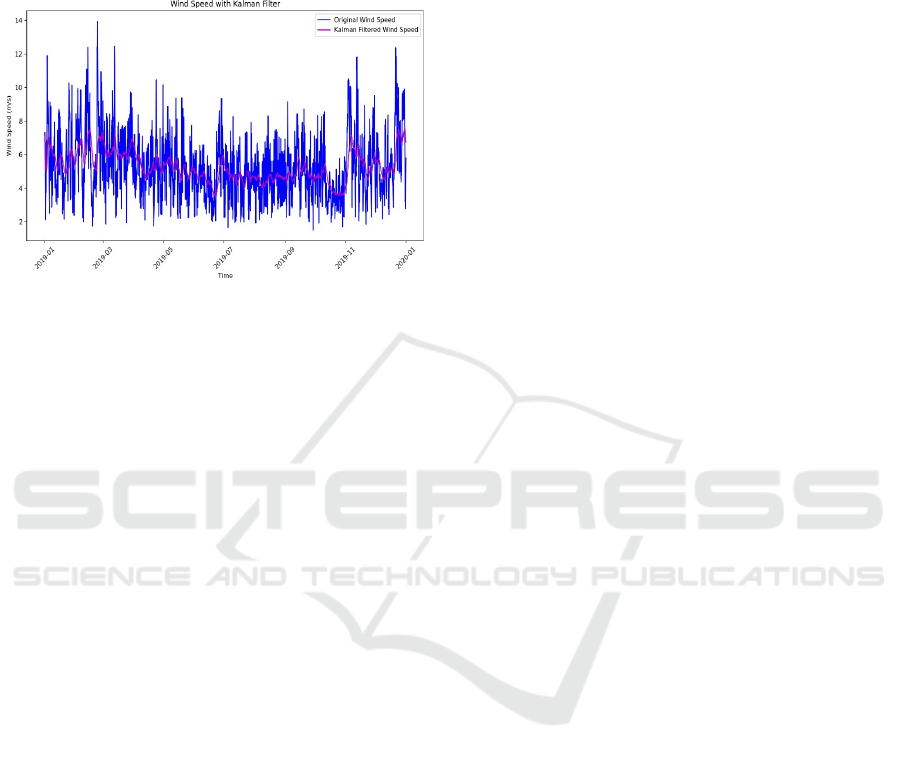
tracking time- series data like wind speed. Unlike FIR
and IIR filters, which rely solely on predefined
coefficients, the Kalman filter adapts to incoming
data, reducing noise while preserving underlying
trends. (Figure 5).
Figure 5. Kalman Filtered Wind Speed Data.
5 CONCLUSION
When selecting the best filter for wind speed data
processing, several factors must be considered,
including noise reduction efficiency, computational
complexity, response time, and adaptability to real-
time changes. Each filtering method has its own
strengths and limitations, making them more suitable
for different applications. Below is a detailed
comparison of the filters based on their effectiveness
in various aspects.
The Kalman filter stands out as one of the most
effective techniques for filtering wind speed data due
to its ability to dynamically adapt to changes in the
system. Unlike traditional filters that apply fixed
coefficients to smooth out noise, the Kalman filter
continuously updates its internal model based on new
observations. This makes it particularly useful when
working with time-varying signals such as wind
speed, which is inherently unpredictable. One of its
biggest advantages is its ability to minimize noise
while preserving the true underlying signal, even in
the presence of uncertainty. This is because the
Kalman filter does not just smooth out high-
frequency fluctuations but also provides an optimal
estimation of the system's state, considering both
measurement noise and process uncertainty.
However, despite its high accuracy and adaptability,
the Kalman filter comes with a higher computational
cost compared to other filters like FIR and IIR.
It requires knowledge of the system’s noise
characteristics, which may not always be
straightforward to determine. Additionally, improper
tuning of the filter parameters can lead to inaccurate
estimations or slow convergence.
The Wavelet Transform is highly effective at
filtering wind speed data because it decomposes the
signal into different frequency components, allowing
for selective noise removal. This makes it superior to
standard frequency-domain filters, such as FIR and
IIR, when dealing with non-stationary signals—those
that have time-dependent fluctuations. Wind speed
data often contains random bursts of noise due to
turbulence, sensor interference, or environmental
disturbances. Unlike traditional filtering methods that
apply the same filtering operation across the entire
signal, wavelet-based filtering adapts to different
frequency bands, ensuring that the essential
components of the signal remain intact while
eliminating
unwanted noise. One limitation of
wavelet filtering is that it can sometimes introduce
distortions, especially in regions where the signal has
sharp transitions.
Additionally, selecting the appropriate wavelet
function and decomposition level requires expertise,
as an improper choice could lead to signal
degradation rather than improvement.
The Finite Impulse Response (FIR) filter is
widely used in signal processing due to its ability to
maintain a linear phase response, meaning that all
frequency components of the signal experience the
same time delay. This ensures that the shape of the
signal remains unaltered, making FIR filtering an
ideal choice when signal integrity is a priority. FIR
filters are designed with fixed coefficients and rely
only on past input values, making them inherently
stable and resistant to numerical errors. Additionally,
they allow for precise control over the filter response,
enabling selective attenuation of unwanted frequency
components. However, FIR filters tend to be
computationally expensive compared to IIR filters, as
they require a larger number of coefficients to achieve
the same level of noise suppression. This makes them
less suitable for real-time applications where
computational efficiency is crucial.
The Infinite Impulse Response (IIR) filter is
known for its efficiency in removing unwanted noise
while using fewer coefficients compared to an FIR
filter. This makes it a preferred choice for real-time
applications where computational resources are
limited. One of the main advantages of the IIR filter
is that it uses feedback, meaning that its output
depends not only on the current input values but also
on past outputs. This enables the filter to achieve a
stronger noise reduction effect with a lower
computational cost.
ICEEECS 2025 - International Conference on Advances in Electrical, Electronics, Energy, and Computer Sciences
118

However, this feedback mechanism introduces a
potential downside: phase distortion, which can cause
delays or shifts in certain frequency components of
the signal. Another concern with IIR filters is their
potential for instability, especially when not designed
properly. Unlike FIR filters, which are always stable,
IIR filters can become unstable if their parameters are
not carefully chosen.
The choice of filter depends on factors such as
computational constraints, the type of noise present,
and the required precision in the wind speed data
analysis.
REFERENCES
Ackermann, T. 2005 Wind Power in Power Systems. Royal
Institute of Technology Stockholm, Sweden, Wiley,
ISBN 0-470-85508-8.
Manyonge, A.W., Ochieng, R.M., Onyango, F.N.,
Shichikha, J.M. 2012. Mathematical Modelling of Wind
Turbine in a Wind Energy Conversion System: Power
Coefficient Analysis. Applied Mathematical Sciences,
vol. 6, no. 91, pp. 4527–4536.
Liu, X., Zhang, Y. 2022. Wind Speed Prediction Using
LSTM and Traditional Statistical Models. Scopus
Journal of Energy Systems, vol. 45, no. 7, pp. 993–
1005.
Bhardwaj, A., Kumar, P., Sharma, R. Spectral, 2023.
Analysis and Adaptive Filtering for Wind Signal
Processing. IEEE Transactions on Sustainable Energy,
vol. 13, no. 2, pp. 1012–1023. DOI:
10.1109/TSTE.2023.3276384.
Wang, J., Zhang, F. 2024. Comparative Study of Time- Series
Models for Wind Energy Prediction. IEEE Access, vol.
10, pp. 157890–157901. DOI:
10.1109/ACCESS.2024.3102034.
Qazi, M.A., Ahmed, S., Rehman, S. Adaptive,2021.
Kalman Filtering for Wind Speed Prediction in Energy
Systems. Journal of Renewable Energy Research, vol.
9, no. 4.
International Energy Agency (IEA), 2024. "European
Union – World Energy Investment 2024,".
[Online].Available: https://www.iea.org/reports/world-
energy- investment-2024/european-union.
P. Denholm and M. Hand,2011. "Grid flexibility and
storage required to achieve very high penetration of
variable renewable electricity,”," Energy Policy, , Vols.
vol. 39, no. 3,, p. pp. 1817–1830.
International Energy Agency (IEA), 2022. Renewable
Energy Market Update, Paris, France.
European Commission, 2021. Renewable Energy
Directive II, Brussels, Belgium.
The Environment and Wind Energy Production by Analyzing Noise Filtering in Wind Signals to Improve the Efficiency of Energy Systems
119
