
A Review of Research on Delayed Retirement Policies and the
Protection of Elderly Rights and Interests
Haoyang Liu
School of Public Management, South China Agricultural University, Guangzhou, Guangdong, 510642, China
Keywords: Delayed Retirement Policy, Population Aging, Pension Sustainability, Gradual Reform.
Abstract: China's rapidly aging population and growing pension sustainability pressures have necessitated the
implementation of a delayed retirement policy. This study systematically reviews existing research on the
policy's design, societal impacts, and international benchmarks, focusing on its implications for elderly rights
and labor market dynamics. Key findings reveal that a gradual, flexible approach to retirement age reform—
emphasizing phased adjustments, differentiated implementation, and public consensus-building—effectively
mitigates resistance while enhancing policy coherence. International comparisons highlight the importance of
tailored policy bundles, such as pension-employment linkage mechanisms, though challenges persist in
balancing intergenerational equity and regional disparities. Domestically, studies underscore the need for
synergistic optimization of pension and labor systems, alongside robust monitoring of public sentiment. The
research concludes that while delayed retirement can alleviate fiscal pressures and optimize workforce
allocation, its success hinges on context-specific adaptations, equitable design, and complementary social
policies to address heterogeneous im-pacts across demographics.
1 INTRODUCTION
China's decision to implement a delayed retirement
policy is an inevitable choice in response to the
accelerated aging of the population, pressure on the
sustainability of pensions, and the transformation of
the labor force structure. The issue of an aging
population in China is becoming increasingly serious.
As Figure 1 shows, for all previous national
population censuses, national 1% population
sampling surveys and population age structure in
recent years (Zhang, Zhang, 2025). As China’s
population aged 60 and above surpasses 21% and
average life expectancy climbs to 78.6 years, the
current retirement age has become increasingly
incompatible with the extended lifespan of the
population (National Health Commission of the
People’s Republic of China, 2023). This
misalignment has intensified fiscal pressures on the
pension insurance system, causing a persistent
imbalance between its revenue and expenditures. In
2023, China’s basic pension insurance system
covered 106.643 million participants, with the fund
recording an annual income of 7,669.1 billion yuan
against expenditures of 6,836.9 billion yuan. The
burden of pension is relatively heavy (Ministry of
Human Resources and Social Security of the People’s
Republic of China, 2024). At the same time, there are
734.39 million employed people nationwide, and the
proportion of the young labor force shows a trend of
first increasing and then decreasing. Policy
adjustments have become a key measure to alleviate
employment pressure and optimize the allocation of
labor resources National Bureau (Statistics, 2024; Xu,
Lv, 2021; Development Research Center of the State
Council, 2022).
China has been deeply studying the specific reform
plan for postponing the statutory retirement age. The
11th Meeting of the Standing Committee of the 14th
National People's Congress officially approved a
resolution to gradually implement the postponement
of the statutory retirement age. The delayed
retirement policy will be implemented through a
flexible, step-by-step approach. Starting from
January 1, 2025, the retirement age will be gradually
extended. The proposed plan aims to gradually raise
the retirement age to 63 for men and 55-58 for women
over a 15-year implementation period, while
introducing flexible retirement arrangements through
employer-employee negotiations. Supporting
measures include extending the minimum payment
period
for social security to 20 years, strengthening
Liu, H.
A Review of Research on Delayed Retirement Policies and the Protection of Elderly Rights and Interests.
DOI: 10.5220/0014372900004859
Paper published under CC license (CC BY-NC-ND 4.0)
In Proceedings of the 1st International Conference on Politics, Law, and Social Science (ICPLSS 2025), pages 257-262
ISBN: 978-989-758-785-6
Proceedings Copyright © 2026 by SCITEPRESS – Science and Technology Publications, Lda.
257
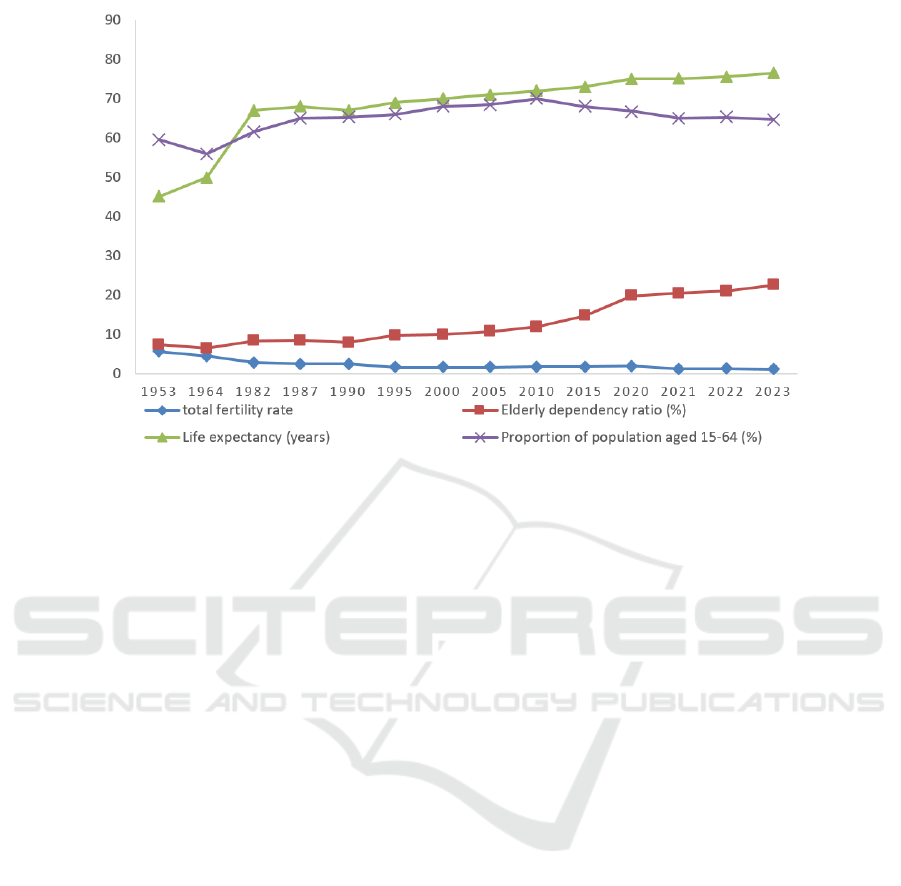
Figure 1: Previous national censuses, national 1% population sampling survey and population age structure in recent years
(Zhang, Zhang, 2025)
the incentive mechanism of "more payment, more
reward", and synchronously promoting the
development of supplementary pension insurance
such as enterprise annuity and occupational annuity
(Chinese government website, 2024). However,
policies also face issues such as the risks to workers'
psychosocial and physiological well-being, the
crowding out effect of youth employment, and other
supporting measures such as vocational training and
employment security to balance the interests of
different groups and ensure the smooth
implementation of reforms (Fan, Feng, 2015).
The significance of studying the delayed
retirement policy is that, with the aggravation of
China's aging population and the change of labor
force structure, the traditional retirement system has
been unable to meet the needs of social and economic
development. This article aims to conduct a
comprehensive analysis of the background,
implementation path, and potential social impacts of
the delayed retirement policy. This study will
systematically review and analyze existing literature,
fill in the existing research gaps, provide direction for
subsequent research, and provide scientific basis for
policy formulation and implementation.
2 RESEARCH METHODS AND
PROCESSES
In the CNKI database, a total of 1476 relevant
literature were retrieved using the keyword "delayed
retirement policy". The scope was limited to
academic journals, reducing the number of
documents to 935. Subsequently, the retrieved
literature was excluded, and non-core literature with
low research value was screened out. On this basis,
by further searching for literature on keywords such
as "research on delayed retirement policies",
"Safeguarding elderly rights and welfare ", and
"aging", eleven academically valuable articles were
finally selected. Literature searches were conducted
on the Wiley Online Library and Web of Science
platforms, focusing on core articles related to
keywords such as "delayed retirement policy" and
"aging." After reviewing and summarizing the
relevant literature, the author ultimately selected three
articles as references.
3 RESULT
3.1 Domestic Research
3.1.1 Progressive Governance and Analysis
of Public Attitudes
Researchers represented by Liu Cong and Sun
Yongjian believe that the progressive governance
concept plays an important role in the reform of
delaying retirement age (Liu, 2025; Sun, 2025). Liu
Cong's research focuses on the theory of progressive
ICPLSS 2025 - International Conference on Politics, Law, and Social Science
258

governance and delves into the policy mechanism of
delaying retirement age reform. This study constructs
a policy analysis framework that includes key
dimensions such as small-step adjustment, flexible
implementation, classified promotion, and overall
consideration, reflecting the important role of the
progressive governance concept in reform. Liu Cong
believes that this concept is helpful in steadily
advancing reforms in complex interest patterns,
resolving obstacles, building consensus, and
improving the pertinence, coordination, and
sustainability of reforms. Sun Yongjian's research
starts from the perspective of online public opinion,
using Python data mining and NLP sentiment analysis
tools. This paper analyzes the public's attitude and
opinions on the delayed retirement policy on Weibo
and TikTok platforms. The study found that the
public's evaluation of the delayed retirement policy is
generally positive and neutral, indicating that the
progressive governance concept has gained a certain
degree of recognition among the public.
The progressive governance concept has
demonstrated significant advantages in the delayed
retirement reform, but also faces many practical
challenges. This governance model, through a phased
and step-by-step implementation approach, can
effectively resolve resistance to reform. It can also
consolidate social consensus through negotiation and
dialogue, thereby enhancing the pertinence,
coordination, and sustainability of policy measures,
while providing flexibility for policy implementation
and promoting public participation. However, the
implementation process needs to address multiple
challenges, especially how to establish a mechanism
for balancing interests among multiple stakeholders
such as government, enterprises, and workers, ensure
the fairness and reasonableness of policy adjustments,
and establish a dynamic monitoring mechanism to
timely respond to changes in public attitudes. These
challenges highlight the need to establish a scientific
evaluation and dynamic optimization mechanism
while adhering to a gradual reform path, in order to
ensure the smooth progress and expected results of
the reform.
3.1.2 International Comparison and Policy
Reference
Researchers represented by Zhang Su, Zhang Hui,
Man Xiaoou, and Zhang Yijia believe that
international comparison and policy reference are of
great significance for the formulation of China's
delayed retirement policy (Zhang, Zhang, 2025; Man,
Zhang, 2023). Zhang Su and Zhang Hui's research
analyzed the experience and lessons of developed
countries in delaying retirement policies from an
international comparative perspective. Research
suggests that developed countries have certain
reference significance in exploring the optimal
retirement age, studying the factors affecting the
willingness to delay retirement, implementing
supporting measures in the labor market, and
coordinating reforms in the pension system. The
study also identified challenges faced by China in
implementing delayed retirement policies, such as
employment issues for young workers, increasing
income inequality, and deteriorating health
conditions for elderly workers. The research of Zhang
Su and Zhang Hui provides an international
experience reference for China's delayed retirement
policy. Man Xiaoou and Zhang Yijia employed the
fuzzy-set qualitative comparative analysis (fsQCA)
in their research to analyze the age effect of delayed
retirement policy combinations in Organization for
Economic Co-operation and Development (OECD)
countries. Research has found that high age
constraints-low pension contributions, low pension
contributions - high employment security, low age
constraints-high employment security, and low age
constraints - low pension contributions are four
effective paths. This study suggests that China should
pay attention to the combination of policies when
formulating delayed retirement policies, and form a
gradual and flexible delayed retirement policy
system.
3.1.3 Collaborative Optimization of Pension
System and Labor Employment
System
Researchers represented by Lin Xi, Jin Gang, Song
Jingxiang, and Zhang Jiwen believe that the
coordinated optimization of the pension system and
labor employment system is the core goal of the
delayed retirement policy (Lin, 2024; Jin, Song,
Zhang, 2023). Lin Xi's research, from the
perspectives of pension system and labor
employment system, argues that the fundamental
objective of delayed retirement policies is to facilitate
the reconfiguration of workers' life courses. Lin Xi
believes that the traditional policy of delaying
retirement is no longer suitable for China's actual
situation, and should break out of the existing policy
thinking pattern and seek new policy design
breakthroughs. This study proposes to replace
delayed pension collection with a fair and clear
pension system design, and to replace the
solidification and continuation of professional careers
A Review of Research on Delayed Retirement Policies and the Protection of Elderly Rights and Interests
259

with diversified employment for the elderly,
promoting the coordinated optimization of the
pension system and labor employment system. Jin
Gang, Song Jingxiang, and Zhang Jiwen's research
analyzed the differences between China's statutory
retirement age regulations and OECD countries from
an international perspective. Their study proposes
that delayed retirement policies could strategically
maintain a moderate gender gap in retirement ages as
a key reform lever. They recommend implementing
flexible retirement mechanisms—including early,
delayed, and category-based retirement options—
while underscoring that supporting policy designs
must safeguard workers' rights, reduce effective
working hours, and mitigate occupational burdens.
3.1.4 Policy Economic Effects and Social
Impact
Researchers represented by Tian Song, Zhang
Liqiong, Yang Liangchu, Li Guiping, and Lu Nana
believe that the economic and social effects of
delayed retirement policies need to be
comprehensively evaluated (Tian, Zhang, 2022;
Yang, Li, 2021). Tian Song and Zhang Liqiong's re-
search explored the economic effects of the policy of
delaying retirement age, mainly from four aspects:
pension revenue and expenditure effects,
employment effects, income redistribution effects,
and economic growth effects. Research has shown
that the pension income and expenditure effects of
delayed retirement policies are effective, but there
may be crowding-out effects on employment,
worsening income redistribution effects, and positive
economic growth effects. Yang Liangchu, Li
Guiping, and Lu Nana's study systematically
examined the societal implications of delayed
retirement policies through a social policy lens. Their
findings indicate that effective implementation
necessitates reinforced policy guidance, an optimized
social environment, and improved coordination of
interests among stakeholders, including government
entities, enterprises, and employees. Importantly, the
research highlights that the legal codification of such
policies demands a delicate equilibrium between
evidence-based rationale and humanistic
considerations to foster broader consensus and ensure
policy efficacy.
3.2 Research on Delayed Retirement
Policies in Foreign Literature
The research conducted by researchers such as
Michael Baker, Zhang Linlin, Wu Y, Rafael Lalive
on delayed retirement policies focuses on policy
incentive effects, determination of optimal retirement
age, and the impact of social security reform on
retirement behavior. This provides the important
theoretical basis and practical reference for policy-
making (Baker, Gruber, Miligan, 2024; Zhang, Gu,
An, 2023; Wu, Xu, Yi, 2022). The study by Michael
Baker and other researchers is about the impact of
Canada's income security plan on retirement
incentives. They found that these plans incentivize
some workers to retire early by providing economic
support, and pointed out that incentive structures in
policy design can affect labor market participation
rates. Zhang et al. focused on the optimal delayed
retirement age in the context of China's aging
population, and determined the optimal range of
delayed retirement age through model analysis. They
emphasized that policy implementation needs to
consider the health status and employment ability of
elderly workers. Researchers such as Wu explored the
optimal choice of China's delayed retirement policy
through economic models and pointed out that a
moderate delayed retirement policy can alleviate
pension pressure. It is suggested that policy
formulation should be gradually promoted and
accompanied by social security measures Rafael
Lalive and other researchers studied the impact of
social security reform on retirement and pension
application behavior, and found that reform measures
significantly affect individual retirement decisions.
They emphasized that policy design needs to consider
the differences among different groups.
4 DISCUSSION
The implementation of delayed retirement schemes
has gained significant traction among re-searchers
and policymakers as a crucial response to
demographic aging trends. Existing re-search has
made significant progress in progressive governance
and public attitude analysis, international comparison
and policy reference, synergistic optimization of
pension system and labor employment system, policy
economic effects and social impact, as well as
relevant studies in foreign literature. Researchers
represented by Liu Cong, Sun Yongjian, Zhang Su,
Zhang Hui, Lin Xi, Tian Song, etc. have provided rich
theoretical and practical references for The
formulation and implementation of delayed
retirement policies require a dual focus on domestic
policy mechanism development and international
best practice reference, institutional synergy
optimization, and economic and social effects. The
ICPLSS 2025 - International Conference on Politics, Law, and Social Science
260

concept of progressive governance has provided
important support for the steady advancement of
policies, and international comparative research has
provided valuable experience for China's policy
design.
However, there are still some shortcomings in
existing research. Firstly, some studies overly focus
on the construction of theoretical frameworks, while
lacking in-depth empirical analysis and evaluation of
the actual effects of policy implementation. Secondly,
existing international comparative studies often fail to
fully consider the differences between China's
national conditions and those of other countries,
resulting in significant adaptability and feasibility
challenges for the policy measures borrowed when
implemented in China. Again, current studies lack
detailed roadmaps and complementary policies for
aligning pension reforms with employment system
adjustments. Finally, research on the economic and
social effects of policies lacks in-depth exploration of
individual-level impacts. Future research should
further strengthen empirical analysis of policy
implementation effects, especially the differentiated
impacts in different regions and groups. At the same
time, combined with China's specific national
conditions, more targeted policy designs should be
explored to ensure the fairness and sustainability of
the delayed retirement policy. Research should also
pay attention to the balance of interests between
elderly and young workers, and avoid
intergenerational conflicts that may arise during
policy implementation.
5 CONCLUSION
The delayed retirement policy, as a strategic
intervention to mitigate demographic aging pressures,
alleviate pension payment pressure, and optimize
labor resource allocation, has sparked widespread
discussion in recent years. Through a systematic
review of existing literature, this study summarizes
the research status and main achievements of the
delayed retirement policy from five aspects:
progressive governance and public attitude analysis,
international comparison and policy reference,
coordinated optimization of pension system and labor
employment system, policy economic effects and
social impact, and relevant research in foreign
literature. These studies provide rich theoretical basis
and practical references for policy formulation and
implementation.
Firstly, the proposal of the progressive governance
concept provides important support for the steady
implementation of the delayed retirement policy.
Progressive governance not only helps to resolve
resistance to reform, but also enhances policy
flexibility and public participation. Secondly, cross-
national policy comparisons offer critical insights for
shaping China's delayed retirement framework.
Drawing on the policy practices of other countries,
policy recommendations that are more suitable for
China's national conditions can be proposed, such as
the design of policy matching combinations and
flexible retirement mechanisms. In addition, the
collaborative optimization research of pension
system and labor employment system pro-vides new
ideas for setting the goals of delayed retirement
policy. The research highlights the dual imperatives
of equitable pension provisions and adaptable
employment frameworks, providing a theoretical
basis for policy design. Finally, the study of policy
economic effects and social impacts provides a
multidimensional analytical framework for the
comprehensive evaluation of delayed retirement
policies. The study starts from both economic and
social effects, revealing the potential impact of
policies and providing reference for policy
optimization.
REFERENCES
Baker, M., Gruber, J., & Milligan, K. (2003). The
Retirement Incentive Effects of Canada’s Income
Security Programs. The Canadian Journal of
Economics / Revue Canadienne d’ Economique, 36(2),
261–290.
Chinese government website. 2024. Decision of the
Standing Committee of the National People's Congress
Regarding Gradually Raising the Statutory Retirement
Age.
Development Research Center of the State Council. 2022.
Understand the Basic Laws of Population Evolution
and Promote the Long-term Balanced Development of
China's Population. Journal of Management World
38(01):1-19+34+20.
Fan, Q., Feng, J. 2015. The Research of Crowding Out
Effect of Delay Retirement on Youth Employment.
Shanghai Journal of Economics (08):11-19.
Jin, G., Song, J., Zhang, J. 2023. International Practice of
Delayed Retirement Policy and China's Choice.
Journal of Beijing University of Aeronautics and
Astronautics (Social Sciences Edition) 36(02):78-89.
Lin, X. 2024. Functional Substitutes, Systematic
Expansion, and Institutional Coordination of Delayed
Retirement Policies. Journal of Xiamen University
(Arts & Social Sciences) 74(03):21-30.
Liu, C. 2025. Progressive Governance: Policy Mechanism
Analysis of Delayed Retirement Reform.
Contemporary Economic Management 1-12.
A Review of Research on Delayed Retirement Policies and the Protection of Elderly Rights and Interests
261

Man, X., Zhang, Y. 2023. Research on the Age Effect of
Delayed Retirement Policy Mix: An fsQCA Study
Based on OECD Countries: How to Effectively
Postpone Retirement. Comparative Economic & Social
Systems (04):90-100.
Ministry of Human Resources and Social Security of the
People's Republic of China. 2024. Main Statistical
Express Data of Human Resources and Social Security
from January to December 2023. mohrss.gov.cn, last
accessed 2025.3.12.
National Bureau of Statistics. 2025. Statistical Bulletin on
National Economic and Social Development of the
People's Republic of China in 2024. stats.gov.cn, last
accessed 2025.3.11.
National Health Commission of the People's Republic of
China. 2025. 2023 China Health Statistics Yearbook.
nhc.gov.cn, last accessed 2025.3.11.
Sun, Y. 2025. The Evolution Pattern, Mechanism and
Governance Strategy of Online Public Opinion on the
Delayed Retirement Policy—Based on NLP Analysis
of Online Big Data. Journal of Hohai University
(Philosophy and Social Sciences) 27(01):77-89.
Tian, S., Zhang, L. 2022. The Economic Effects of
Delaying Retirement Age Policy: A Literature Review.
Contemporary Economy 39(01):98-104.
Wu, Y., Xu, C., Yi, M. 2022. The Optimal Choice of
Delayed Retirement Policy in China. Sustainability
4(19):12841.
Xu, Z., Lv, C. 2021. Research on the Legal Protection Path
of Reemployment Rights of the Elderly under the
Background of Active Aging. Journal of Henan
University of Economics and Law 36(02):63-72.
Yang, L., Li, G., Lu, N. 2021. Delayed Retirement Policy:
International Experience and Chinese Path. Local
Finance Research (10):72-79.
Zhang, L., Gu, J., An, Y. 2023. The Optimal Delayed
Retirement Age in Aging China: Determination and
Impact Analysis. China Economic Review 79:101972.
Zhang, S., Zhang, H. 2025. The Realistic Challenges,
International Experience, and Practical Path of Delayed
Retirement Policy. Journal of Finance and Economics
Theory 1-17.
ICPLSS 2025 - International Conference on Politics, Law, and Social Science
262
