
Enhancing Network Security with RNA-Based Intrusion Detection
and Cuckoo Search Algorithm
Omar Fitian Rashid
1a
, Hind Moutaz Al-Dabbas
2b
and Humam Al-Shahwani
3c
1
Department of Geology, College of Science, University of Baghdad, Baghdad, Iraq
2
Department of Computer Science, College of Education for Pure Science/Ibn Al-Haitham, University of Baghdad,
Baghdad, Iraq
3
Department of Computer Science, College of Science, University of Baghdad, Baghdad, Iraq
Keywords: Intrusion Detection System, RNA Encoding, Cuckoo Search Algorithm, Pattern Matching, CICIDS2017
Dataset, Network Security, Anomaly Detection.
Abstract: Intrusion detection systems are an important component of defensive measures protecting computer systems
and networks from abuse. The CICIDS2017 dataset is a rich dataset that contains the recent attack patterns
on the network, therefore it suitable for IDS models. This paper focuses on the development of a new anomaly-
based IDS utilizing RNA encoding coupled with the Cuckoo Search Algorithm for pattern-matching
optimization on the CICIDS2017 network traffic dataset. The proposed method involves four steps: picking
up the records from the dataset at random, encoding the 83 attributes into RNA sequences, identifying the
keys for optimal behaviour through the Cuckoo Search Algorithm, and employing a matching model to
categorize records as benign or malicious. The integration of the Cuckoo Search Algorithm helps in adjusting
the behaviour key selection process using global exploration (Levy flights) and local optimization that
enhances accuracy and the detection rate. Performance analysis of the proposed method was done based on
detection rate (DR) for each thread, DR for all threads, false alarm rate (FAR), accuracy, RNA encoding time,
and keys matching time. This novel approach has the potential to improve the response to real-time network
security threats and the ability to counter new forms of cyber threats.
1 INTRODUCTION
Cyberattacks represent an ever-growing threat that
has become a real priority for most organizations.
Where attackers used various scenarios to trick
defence systems into entering the system and private
information or causing harm. Detecting attacks has
become necessary to save information privacy within
computer systems. Where intrusion can have severe
consequences, such as financial losses, theft of
sensitive data, or even critical infrastructure
disruptions (Bilot et al., 2023). An Intrusion
Detection System (IDS) is an effective method to
secure systems from cyber-attacks (Singh et al.,
2022). Emerging technologies such as Big Data,
Internet of Things, Cloud Computing, Wireless
Sensor Networks, etc. (Pirozmand et al., 2020;
a
https://orcid.org/0000-0002-8186-0795
b
https://orcid.org/0000-0002-3912-2051
c
https://orcid.org/0000-0003-1248-1991
Shivhare et al. 2020). Where IDS can be placed
between the network switch and firewall, employing
port mirroring technology to monitor incoming and
outgoing network traffic enables the detection of
intrusions. Figure 1 shows a running of IDS
connectivity (Azam et al., 2023).
Figure 1: Implementation of IDS.
106
Rashid, O. F., Moutaz Al-Dabbas, H. and Al-Shahwani, H.
Enhancing Network Security with RNA-Based Intrusion Detection and Cuckoo Search Algorithm.
DOI: 10.5220/0014372600004848
Paper published under CC license (CC BY-NC-ND 4.0)
In Proceedings of the 2nd International Conference on Advances in Electrical, Electronics, Energy, and Computer Sciences (ICEEECS 2025), pages 106-111
ISBN: 978-989-758-783-2
Proceedings Copyright © 2026 by SCITEPRESS – Science and Technology Publications, Lda.

To improve the effectiveness of the IDS and
increase the speed of pattern matching, the RNA
encoding with Cuckoo Search Algorithm (CSA)
based IDS approach is presented in this paper. RNA
encoding is applied to the network traffic data to map
it into a biological format in order to effectively
process the 83 attributes of the dataset. The method
of finding out the most typical patterns in this
encoded data is done by CSA, an optimization
algorithm which mimics the actions of parasitic
cuckoo birds. CSA effectively searches for the
behaviour keys within the search space and uses Levy
flights for the global search. In contrast, random
walks are used for local optimization, guaranteeing
that only the best patterns are used for classification.
The inclusion of CSA into the IDS framework brings
in the following benefits. First, CSA performs
dynamic pattern matching by going through a
population of behaviour keys and thus can respond to
changes in the dataset and the threat landscape. This
leads to increased DR and decreased FAR as
compared to the matching algorithms used in the past.
Second, CSA has a faster computational time than
encoding and key matching to make the system
suitable for real-time intrusion detection in large-
scale networks (Yang and Deb, 2010). The following
are the advantages that can be obtained from the use
of CSA in the IDS (Gupta and Kalra, 2020; Li et al.,
2024):
• Avoiding Local Minima: The other benefit of
CSA over the other conventional matching
algorithms is that the CSA is not easily stuck in
the local optimum. Levy flights are used to ensure
that the algorithm can search throughout the
whole search space, hence increasing the
probability of identifying the best patterns for
intrusion detection all over the world. This move
also helps in minimizing false positive results and
negative results.
• Better Classification: CSA can potentially
improve the performance of discriminating
malicious traffic from benign traffic by
identifying better pattern-matching patterns. This
leads to a higher DR and lower FAR due to the
fact that the optimization step is in a position to
fine tune the matching keys for data.
• Flexibility: CSA, on the other hand, is capable of
real-time matching, unlike other methods that are
fixed in as much as the traffic flow is concerned.
This means that it can be used to always update
the behaviour keys that are used in your IDS as
new types of attacks surface hence making the
IDS more robust.
• Reduced Computation Time: CSA has been
established to be efficient in the time complexity
and hence can be used in real time intrusion
detection. CSA is advantageous because unlike
the situation where one has to think of all the
patterns and, after that, eliminate the unsuitable
ones, CSA is able to identify the suitable patterns
right from the onset.
This paper is structured as follows: Section 2
presents the literature review of anomaly-based
intrusion detection and optimization algorithms. In
section 3, the authors provide the proposed method
with a focus on RNA encoding as well as the CSA for
extracting key behaviours. In section 4, the
experimental setup and the performance evaluation of
the proposed system are illustrated using the
CICIDS2017 dataset. Finally, Section 5 provides the
conclusion of the paper and points to further research.
2 LITERATURE REVIEW
Several new works deal with IDS based on different
techniques. A new IDS is implemented by
(Jayalatchumy et al. 2024) to enrich the intrusion
detection performance, where the proposed method
starts by reducing data methodologies, then applies
the Crow search method to select the most significant
features, and finally, the ensemble classifier method
to classify the standard and invader labels. Multiple
feature selection methods are applied for anomaly
IDS (Eljialy et al., 2024) based on a software-defined
networking dataset, where the proposed method uses
different feature extraction methods to select the
high-scoring features. A novel feature selection
method is suggested (Tripathi et al., 2024) based on
machine learning algorithms to detect intrusion
threats more accurately, and this system is done with
target features with a big effect on the target variable,
where the achieved results showed an almost 51%
reduction in irrelevant features. A genetic algorithm
with a clustering method is applied for IDS (Fouad
and Hameed, 2022) where the proposed method is
used to recognize the incoming network traffic and
classify it as either normal or attack. This system has
two genetic algorithm models; the first one is used to
handle digital features, and the second handles all
features. Abdulboriy and Sun Shin, (2024) proposed
an improvement method for IDS based on
incremental majority voting, and this enhancement is
done based on leveraging the collective decision-
making power of multiple machine learning models
such as the KNN classifier, SoftMax Regressor and
Adaptive Random Forest classifier. An anomaly
Enhancing Network Security with RNA-Based Intrusion Detection and Cuckoo Search Algorithm
107
detection method is suggested (Li et al., 2022); this
method is different from the existing and traditional
generative adversarial networks method, where the
proposed method includes a generator and a
discriminator and is used to map the different traffic
feature data from separate datasets. Nallakaruppan et
al., 2024 executed a comparative test for different
classification techniques for IDS based on machine
learning. Then, they proposed a new security
framework to overcome the intrusions on the host
side. A new feature selection system is built for IDS
(Rashid et al., 2029) by using DNA encoding and
Short Tandem Repeats (STR) positions, where the
performance of this method shows that the proposed
method classification results are faster than the
previous IDS methods.
A new network IDS is proposed (Saikam and Ch,
2024) based on the combination of deep networks and
hybrid sampling, where this system starts by reducing
the noise samples and then uses Deep Convolutional
Generative Adversarial Networks to increase sample
size; also, a deep network model is established based
on DenseNet169. A novel IDS using an artificial
neural network and genetic algorithm is suggested by
(Cengiz et al., 2024), where the optimal weights are
generated by applying a genetic algorithm and then
used for the artificial neural network. A new IDS is
built based on a few-shot class-incremental learning
technique, and this system can learn new attacks by
using a few samples; also, the proposed method
contains a feature extraction model and classifier
learning (Du et al., 2024). A new IDS idea is proposed
by (Subhi et al., 2024) based on Deoxyribonucleic
Acid (DNA) sequences and Shortest Tandem Repeat
(STR), where DNA encoding is suggested to encode
network traffic into DNA sequences, then used
Teiresias algorithm to extract the STR values, and
finally applied Horspool algorithm to classify testing
dataset based on keys and their positions. Han et al.
(2023) suggested a novel IDS by using binary particle
swarm-wrapped feature selection, where the
proposed method can enhance achieved accuracy
results by increasing the relationship between training
and feature selection method. A hierarchical IDS
model is proposed by (Xu et al., 2023) based on
applying many deep learning methods with attention
mechanism, and this led to achieving different
advantages such as reducing the noise based on the
Stacked Convolutional Denoising Autoencoders
model, extracting spatial features by using the CNN
method, and the classification results are achieved by
applying SoftMax classifier. Osa et al. (2024)
designed the IDS method based on a Deep Neural
Network, where data imbalance is managed by using
SMOTE and Random Sampling, and the evaluation is
done by using a single Jupyter notebook in the Google
Collaboratory environment.
3 MATERIALS AND METHODS
This paper proposes a new anomaly IDS model using
RNA encoding with CSA in order to enhance the
pattern matching of the new proposed model based on
the CICIDS2017 dataset; the reason for choosing this
dataset over other datasets, this set includes the latest
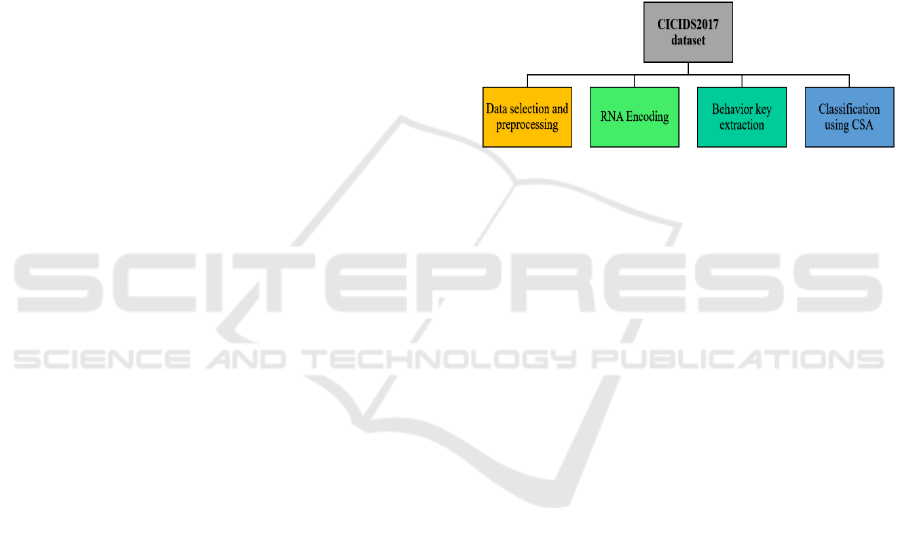
network attacks. The proposed system consists of
four steps, which are listed in Figure 2.
Figure 2: The proposed anomaly intrusion detection method
steps
The first step of the proposed method is data
selection and pre-processing, where a random sample
of the CICIDS2017 dataset is chosen to include all
labels that represent different types of network traffic,
which provides for normal, Benign, Bot, DDoS, DoS
GoldenEye, DoS Hulk, DoS Slowhttptest, DoS
slowloris, FTP-Patator, Heartbleed, Infiltration,
PortScan, SSH-Patator, Web Attack (Brute Force),
Web Attack (SQL Injection), and Web Attack (XSS).
The selected data is then divided into the data used in
training the model and the data used for testing.
The second step of the proposed method is RNA
encoding, where all record attribute values convert
into RNA characters; this is done by understanding
the dataset features and the possible values for each
attribute. Where this data set has 83 features and all
possible attribute values are numerical values, which
means the possible values range from 0 to 9 and
floating points. In order to apply RNA encoding, each
value is converted to two RNA characters, where
these two characters can handle all possible values.
An example of encoding 0 can be converted to “CT”
and so on for other possible values.
The third step of the suggested method is
behaviour key extraction. This is done by using the
Cuckoo Search Algorithm (CSA) to automatically
extract the behaviour keys. This step involves finding
the best patterns in the RNA sequences that would
assist in distinguishing the traffic that is normal from
ICEEECS 2025 - International Conference on Advances in Electrical, Electronics, Energy, and Computer Sciences
108

that which is an attack. CSA is iteratively applied to
the current procedure to improve the selection of the
patterns for classification and to maintain only the
best ones.
The final step is classification using CSA. The
Cuckoo Search Algorithm is used subsequently for
the behaviour keys extraction in order to perform
pattern matching. CSA generates several patterns that
are employed in the identification of whether or not
the testing records constitute a threat. This means that
if any of the extracted keys are present in the RNA
sequence of a record, it is considered a benign record.
If it does not, then it is categorised as a threat. CSA is
adapted to our IDS framework to enhance the process
of pattern matching. CSA is a nature-inspired
optimization algorithm which is based on the brood
parasitism of some species of cuckoos. In this
behaviour, cuckoos lay their eggs in the nests of other
birds of different species with the aim of replacing the
genuine eggs of the host birds. Any strange egg
present in the nest is removed, or the host bird stops
attending the nest. This process is similar to how CSA
investigates and optimizes potential solutions, which
are improved until the optimal solution is discovered.
Cuckoo Search Algorithm used for pattern matching
based on the following stages:
• Initializing P|otential Patterns: each pattern is a
potential RNA sequence or behaviour key that
may be used for the differentiation of benign and
malicious traffic. The algorithm starts with a
population of candidate solutions, or ‘patterns,’
of which each is a key extracted from the RNA-
encoded data set. These initial patterns are
generated randomly and are spread over a very
large area of possibility of the RNA sequences.
• Fitness Evaluation and Optimization: the
following step is to measure the fitness of each
pattern that has been developed. In our IDS, the
fitness of a pattern is defined by the ability of a
pattern to classify traffic into either benign traffic
or malicious traffic categories. The fitness
function includes the detection rate (DR), false
alarm rate (FAR), and the total accuracy of
classification. The patterns that exhibit higher
accuracy and DR are preferred, while the patterns
that lead to higher FAR are penalized.
• Levy Flights and Exploration: CSA has the
capability of performing Levy flights, and this
has been considered one of the strengths of this
algorithm as it helps to perform the global search.
Levy flights consist of making a random walk or
large jumps across the solution space and thus
avoid being trapped in local optima. They are
crucial in this global exploration to help identify
such patterns that are otherwise not easily
discernible in the regular search algorithms.
• Replacement and Elitism: in each iteration, the
current patterns which are not very effective are
substituted by new patterns that are based on the
Levy flight process. It uses both random search
and elitism in order to enable the algorithm to
search for the solutions while at the same time
exploiting the promising solutions. This aids in
ensuring that only the best of patterns (nests) are
retained and improved on all the time. During the
training of the gradient boosting, the algorithm
finds the best set of patterns which yields the best
performance.
Finally, when the set of behaviour keys is
optimized for the final time using the Cuckoo Search
Algorithm, the keys are used to classify the network
traffic. These optimized patterns are employed to
search the RNA sequences available in the testing
dataset. If any of the extracted and optimized keys is
present in a record, then such a record is considered
to be benign. If there is no match with the key, then
the record is labelled as a threat. This process is
highly efficient especially due to CSA’s effectiveness
in the matching process.
4 RESULTS AND DISCUSSIONS
As criteria used for assessing the performance of the
proposed RNA encoding approach integrated with the
Cuckoo Search Algorithm, the following parameters
were used: the detection rate (DR) for each attack
separately, the DR for the total attack records, the
false alarm rate (FAR), the accuracy of the proposed
method, the time required to encode the records into
RNA characters, and the needed time to classify the
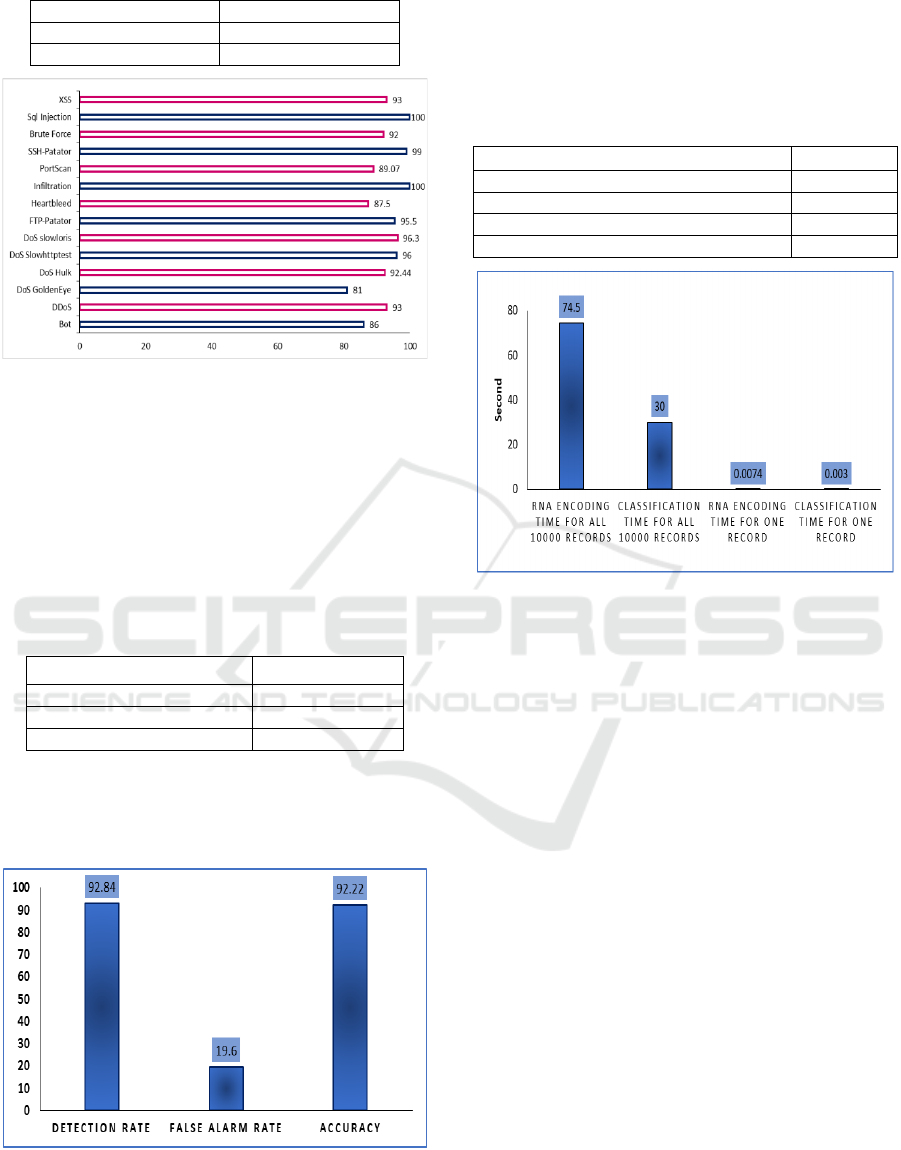
records either to benign or threat. The obtained DR
results for each attack separately are shown in Table
1 and Figure 3.
Table 1: The detection rate results for each attack type.
Attack name Detection Rate
Bot 86%
DDoS 93%
DoS GoldenE
y
e 81%
DoS Hul
k
92.44%
DoS Slowhttptest 96%
DoS slowloris 96.3%
FTP-Patato
r
95.5%
Heartblee
d
87.5%
Infiltration 100%
PortScan 89.07%
SSH-Patato
r
99%
Enhancing Network Security with RNA-Based Intrusion Detection and Cuckoo Search Algorithm
109
Brute Force 92%
Sql Injection 100%
XSS 93%
Figure 3: The detection rate results for each attack type.
As shown in Table 1 and Figure 3, the achieved
detection rate for all attacks separately is good. Where
the highest DR result is achieved for SQL injection
attack and is equal to 100%, and the lowest DR results
are equal to 81% for DoS GoldenEye attack.
The obtained DR, FAR, and accuracy for the
suggested anomaly IDS method are listed in Table 2
and Figure 4.
Table 2: Obtained DR, FAR, and accuracy results.
Results
Detection Rate 92.84%
False alarm rate 19.6%
Accurac
y
92.22%
As mentioned in Table 2 and Figure 4, the
obtained DR, FAR, and accuracy by applying the
proposed method are equal to 92.84%, 19.6%, and
92.22%, respectively.
Figure 4: The detection rate results for each attack type.
Finally, the performance of the proposed method
is calculated based on the time needed for RNA
encoding and classification in terms of seconds for all
random testing records and for one record only, and
these times are listed in Table 3 and Figure 5.
Table 3: The required times for both RNA encoding and
classification
Results
RNA encoding time for all 10000 records 74.5 sec
Classification time for all 10000 records 30 sec
RNA encodin
g
time for one recor
d
0.00745 sec
Classification time for one recor
d
0.003 sec
Figure 5: The detection rate results for each attack type.
Table 3 and Figure 5 show the time needed to
encode one record and all testing records (10000
records) to RNA characters are equal to 0.0074 and
74.5 seconds, respectively, while the time required
for applying the CSA algorithm for classification
based on extracted keys for one record and all testing
records are equal to 0.003 and 30 seconds
respectively.
5 CONCLUSIONS
In this paper, an IDS that employs RNA encoding and
CSA for pattern-matching optimization was
demonstrated as an anomaly-based IDS. Through the
incorporation of CSA into the pattern-matching
phase, the detection rate was boosted, the false alarms
were minimized and the classification ability of the
system was also enhanced. CSA enabled the
flexibility in the ‘‘behavior keys’’ that only the
optimal patterns would be used in classification. The
results clearly show that the proposed method
achieves high accuracy and real-time detection rate
for intrusion detection. Future work could be
performed by integrating CSA with other
optimization algorithms or by trying different
ICEEECS 2025 - International Conference on Advances in Electrical, Electronics, Energy, and Computer Sciences
110

encoding schemes. Moreover, the system could be
expanded to cover more intricate network topology
which will enhance the overall security of the system
in cyber security.
ACKNOWLEDGEMENTS
If any, should be placed before the references section
without numbering.
REFERENCES
Abdulboriy, A. J., Shin, S. (2024). An Incremental Majority
Voting Approach for Intrusion Detection System Based
on Machine Learning. in IEEE Access, vol. 12, pp.
18972-18986.
Azam, Z., Islam, M. M., Huda, M. N. (2023). Comparative
Analysis of Intrusion Detection Systems and Machine
Learning-Based Model Analysis Through Decision
Tree. in IEEE Access, vol. 11, pp. 80348-80391.
Bilot, T., Madhoun, N. E., Agha, K. A., Zouaoui, A. (2023).
Graph Neural Networks for Intrusion Detection: A
Survey. in IEEE Access, vol. 11, pp. 49114-49139.
Cengiz, K., Lipsa, S., Dash, R. K., Ivković, N., Konecki, M.
(2024). A Novel Intrusion Detection System Based on
Artificial Neural Network and Genetic Algorithm With
a New Dimensionality Reduction Technique for UAV
Communication. in IEEE Access, vol. 12, pp. 4925-
4937.
Du, L., Gu, Z., Wang, Y., Wang, L., Jia, Y. (2024). A Few-
Shot Class-Incremental Learning Method for Network
Intrusion Detection. in IEEE Transactions on Network
and Service Management, vol. 21, no. 2, pp. 2389-2401.
Eljialy, A. E. M., Uddin, M. Y., Ahmad, S. (2024). Novel
Framework for an Intrusion Detection System Using
Multiple Feature Selection Methods Based on Deep
Learning. Tsinghua Science and Technology, Vol. 29
Issue. 4. Page: 948 - 958.
Fouad, N., Hameed, S. M. (2022). Genetic Algorithm based
Clustering for Intrusion Detection Iraqi. Journal of
Science, 58(2B): 929-938.
Gupta, A., Kalra, M. (2020). Intrusion Detection and
Prevention system using Cuckoo search algorithm with
ANN in Cloud Computing. 2020 Sixth International
Conference on Parallel, Distributed and Grid
Computing (PDGC), Waknaghat, India, pp. 66-72.
Han, Y., Wang, Y., Cao, Y., Geng, Z., Zhu, Q. (2023). A
Novel Wrapped Feature Selection Framework for
Developing Power System Intrusion Detection Based on
Machine Learning Methods. in IEEE Transactions on
Systems, Man, and Cybernetics: Systems, vol. 53, no. 11,
pp. 7066-7076.
Jayalatchumy, D., Ramalingam, R., Balakrishnan, A.,
Safran, M., Alfarhood, S. (2024). Improved Crow
Search-Based Feature Selection and Ensemble Learning
for IoT Intrusion Detection. in IEEE Access, vol. 12, pp.
33218-33235.
Li, S., Cao, Y., Hadi, H. J., Hao, F., Hussain, F. B., Chen, L.
(2024). ECF-IDS: An Enhanced Cuckoo Filter-Based
Intrusion Detection System for In-Vehicle Network. in
IEEE Transactions on Network and Service
Management, vol. 21, no. 4, pp. 3846-3860.
Li, Z., Wang, P., Wang, Z. (2024). FlowGANAnomaly:
Flow-Based Anomaly Network Intrusion Detection with
Adversarial Learning. in Chinese. Journal of
Electronics, vol. 33, no. 1, pp. 58-71.
Nallakaruppan, M. K., Somayaji, S. R. K., Fuladi, S.,
Benedetto, F., Ulaganathan, S. K., Yenduri, G. (2024).
Enhancing Security of Host-Based Intrusion Detection
Systems for the Internet of Things. in IEEE Access, vol.
12, pp. 31788-31797.
Osa, E., Orukpe, P. E., Iruansi, U. (2024). Design and
implementation of a deep neural network approach for
intrusion detection systems. e-Prime Advances in
Electrical Engineering, Electronics and Energy,
Volume 7.
Pirozmand, P., Ghafary, M. A., Siadat, S., Ren, J. (2020).
Intrusion detection into cloud-fog-based iot networks
using game theory. Wireless Communications and
Mobile Computing, 1-9.
Rashid, O. F., Othman, Z. A., Zainudin, S. (2019). Features
Selection for Intrusion Detection System Based on DNA
Encoding. In: Piuri V., Balas V., Borah S., Syed Ahmad
S. (eds) Intelligent and Interactive Computing. Lecture
Notes in Networks and Systems, vol 67. Springer,
Singapore.
Saikam, J., Ch, K. (2024). EESNN: Hybrid Deep Learning
Empowered Spatial–Temporal Features for Network
Intrusion Detection System. in IEEE Access, vol. 12, pp.
15930-15945.
Shivhare, A., Singh, V. K., Kumar, M. (2020).
Anticomplementary triangles for efficient coverage in
sensor network-based IoT. IEEE Systems Journal,
14(4), 4854-4863.
Singh, V. K., Singh, C., Raza, H. (2022). Event
classification and intensity discrimination for forest fire
inference with IoT. IEEE Sensors Journal, 22(9), 8869-
8880.
Subhi, M. A., Rashid, O. F., Abdulsahib, S. A., Hussein, M.
K., Mohammed, S. M. (2024). Anomaly Intrusion
Detection Method based on RNA Encoding and
ResNet50 Model. Mesopotamian Journal of
CyberSecurity, 4 (2), pp. 120 - 128.
Tripathi, G., Singh, V. K., Sharma, V., Vinodbhai, M. V.
(2024). Weighted Feature Selection for Machine
Learning Based Accurate Intrusion Detection in
Communication Networks. in IEEE Access, vol. 12, pp.
20973-20982.
Xu, H., Sun, L., Fan, G., Li, W., Kuang, G. (023). A
Hierarchical Intrusion Detection Model Combining
Multiple Deep Learning Models With Attention
Mechanism. in IEEE Access, vol. 11, pp. 66212-66226.
Yang, X., Deb, S. (2010). Engineering Optimisation by
Cuckoo Search. International Journal of Mathematical
Modelling and Numerical Optimisation, vol. 1, no. 4.
Enhancing Network Security with RNA-Based Intrusion Detection and Cuckoo Search Algorithm
111
