
Research on the Impact of Real Estate on China's Economy
Zheng Tan
QianWeiChang College, Shanghai University, Shanghai, 200444, China
Keywords: Real Estate, Economy, Economic Structure, Policy.
Abstract: During the past 3 decades of rapid economic progress in China, the real estate industry has played an important
role in advancing the Chinese economy. Real estate plays different roles in the economy at different times
and circumstances. This paper aims to explore the relationship between real estate and China's economy, and
what progress and risks real estate has brought to the economy over the decades of development. Through
data collection and analysis, this paper makes a detailed analysis and enumeration of the role of real estate in
promoting China's economy, such as the support of local finance, employment promotion, etc. At the same
time, it also notes a series of financial risks and foam caused by the excessive development of real estate, as
well as the living pressure of ordinary residents caused by excessive housing prices.This paper also calls on
residents and consumers to view real estate rationally and not to adopt irrational purchase behavior. So as not
to add too much life pressure and loan repayment risk to yourself.
1 INTRODUCTION
Reviewing the history of China’s real estate
development, it can generally be categorized into four
distinct phases. From 1949-1978, China's housing
system was still in the state allocated stage. From
1978-1998, the State Council promulgated many
reform policies on land use and housing system,
marking the beginning and establishment of the real
estate industry. From 1998 to 2008, surge in housing
demand and the deepening reform of the housing
system promoted the rapid development and real
estate’s marketization. Since 2019, due to the bubble
and risk of real estate, the real estate industry has
entered a stage of regulation and financialization.
Throughout the development of the real estate
industry, the relationship between real estate and
China's economy is very close. However, the question
that what advantages and related risks and problems
real estate industry brought to China’s economy and
what role it plays in is worth discussing and
researching.
2 THE POSITIVE IMPACT OF
REAL ESTATE
2.1 The Significance of Real Estate
Development Investment to Social
Fixed
Real estate development investment refers to the
investment of funds by enterprises or individuals in
real estate development for obtaining investment
benefits. The development process involves various
aspects and processes, such as land acquisition, house
design and planning, house facility construction,
construction and other links. Therefore, real estate
development requires a large amount of capital and
money to invest (Zhu, 2024). Social fixed asset
investment refers to the total amount of funds
invested in fixed asset construction in a country or
region in the form of currency over a certain period
of time. It covers multiple fields such as infrastructure
construction (transportation, energy,
communications, etc.), real estate development,
manufacturing, agriculture, etc. Social fixed asset
investment is also an important indicator for
measuring the economic growth of a country or
region.
Although investment in real estate development is
a
part of social fixed asset investment, it has an
606
Tan, Z.
Research on the Impact of Real Estate on China’s Economy.
DOI: 10.5220/0014369900004718
Paper published under CC license (CC BY-NC-ND 4.0)
In Proceedings of the 2nd International Conference on Engineering Management, Information Technology and Intelligence (EMITI 2025), pages 606-612
ISBN: 978-989-758-792-4
Proceedings Copyright © 2025 by SCITEPRESS – Science and Technology Publications, Lda.
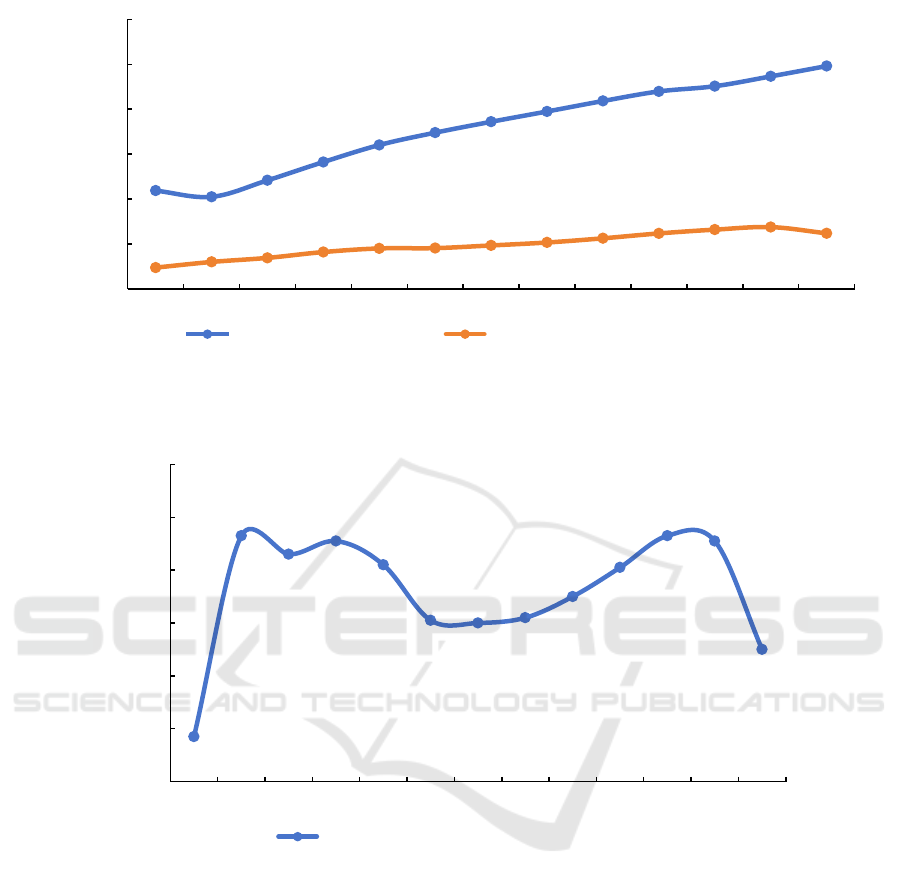
Data source: National Bureau of Statistics
Figure 1: Annual amount of social fixed assets and real estate development investment.
Data source: National Bureau of Statistics
Figure 2: Proportion of real estate development investment.
important impact and role on social fixed asset
investment. According to the related data from 2010
to 2022, the amount of real estate development
investment has steadily increased every year from
475.62 billion yuan in 2010. By 2022, the amount of
real estate development investment reached 1238.47
billion yuan, nearly three times. Correspondingly, the
amount of social fixed asset investment also increased
from 2188.33 billion yuan to 5209.16 billion yuan
(Figure 1). According to data calculations, the share
of real estate development investment within total
social fixed asset investment has largely maintained a
level above 25% between 2010 and 2022 and even
reached nearly 30% in some years (Figure 2). This
reflects that real estate development investment takes
a considerable proportion of social fixed asset
investment, and it plays a vital role in the entire social
fixed asset investment.
China has also issued many related favorable
policies like the "Continue to promote and expand
private enterprise bond financing support tools to
support private enterprise financing, including real
estate companies" issued in 2022. The increase in
financing tools for real estate companies allows them
to raise more funds for real estate development, and
indirectly promotes the growth of social asset
0
100000
200000
300000
400000
500000
600000
2010 2011 2012 2013 2014 2015 2016 2017 2018 2019 2020 2021 2022
100 million yuan
Social fixed asset investment real estate development investment
21,7
29,3
28,6
29,1
28,2
26,1
26,0
26,2
27,0
28,1
29,3
29,1
25,0
20
22
24
26
28
30
32
2010 2011 2012 2013 2014 2015 2016 2017 2018 2019 2020 2021 2022
percentage %
Proportion of real estate development investment
Research on the Impact of Real Estate on China’s Economy
607

investment. The series of policies on lower loan
interest rates, tax incentives, and lower down
payment ratios issued in the policy year of 2024 also
stimulated people's enthusiasm for buying houses.
The expanded real estate demand has also increased
investment in real estate development, further
promoting consumption and the economic
environment at the time.
2.2 The Important Role of Real Estate
in Land Finance
Public ownership of land has always been one of the
basic principles of the Communist Party of China.
China's Constitution specifies that land in urban areas
is owned by the state, while land in rural regions is
collectively owned.. The development of the real
estate and land markets is actually closely related to
the handling of land use rights (Hu, 2012). The
development of land finance in China can be traced
back to the late 1980s. With the rapid development of
China's economy and the acceleration of
industrialization, local governments raised funds by
selling or leasing land use rights. In the tax-sharing
reform in 1994, the proportion of local and central
taxes was redistributed, and local government tax
revenue was reduced. However, the smaller land
revenue at that time was allocated to local
governments, which laid the foundation for land
finance. As an important part of China's current
economic system, land finance is only tied to real
estate, and the relationship between the two can be
said to be very close. Local governments obtain
income by selling the use rights of state-owned land
through auctions, bidding, etc., which is an important
part of land finance.
In the golden period of rapid real estate
development before, the booming real estate market
has promoted the increase in housing demand, which
in turn has strengthened the demand for land, and in
turn has caused the price of land transfer to rise,
which has directly increased local fiscal revenue. In
1999, the income from land transfer fees accounted
for only 9.3% of the total budget revenue of local
governments. But by 2011, this proportion had
increased to an astonishing 60.7%. Even in some
years when the real estate industry was booming, the
land transfer income of some regions such as Tianjin
and Hangzhou has exceeded the local total budget
revenue (Wang & Ye, 2016). These data and cases are
enough to show that the development of real estate
has driven the growth of income in various parts of
China and provided a good guarantee for the
urbanization and industrialization of various regions.
In addition, the land whose value has increased due to
real estate development can also be used as high-
quality collateral to borrow from banks and other
financial institutions or issue bonds. The funds raised
can help some local governments alleviate the
shortage of funds in the short term, or be used for
investment in public infrastructure construction and
other public service projects, which also indirectly
confirms that land finance has been positively
affected by real estate.
2.3 The Promotion on Employment
The real estate industry has a significant impact on
employment. It not only directly creates a large
number of jobs, but also indirectly creates and
promotes many employment opportunities in its
upstream and downstream industrial chains. In terms
of direct employment: In the early stage of real estate
development, from project planning, design
drawings, on-site construction, house sales and other
processes and links, human resources are required.
The positions involved include engineers, designers,
construction workers, house salesmen... Take the
construction industry, which is most strongly
associated with the real estate industry as an example:
the number of relevant workers required for every
10,000 square meters of house construction area is
about 170 (Chen, 2014). The growing prosperity of
the real estate industry represents an increase in the
number of house purchases, and the increase in
housing demand means an increase in the
construction area of houses, so the number of workers
required will also increase rapidly (Chen, 2014). The
increase in residential houses and houses also means
an increase in the demand for property management
personnel. At the same time, the intermediary
consultation in the house transaction process also
requires a large number of corresponding
professionals. In terms of indirect employment: the
increase in housing demand has caused an increase in
the demand for raw materials required for upstream
houses, such as steel, cement, glass, wood, etc., which
has increased the demand for personnel in these
corresponding industries. When the house purchase is
completed, the house decoration, home appliances
and furniture purchase and other links involved
require the employment of labor. Mortgage loan
services provided by banks and other financial
institutions also benefit from the active housing
market, increasing demand for employment related to
credit business.
EMITI 2025 - International Conference on Engineering Management, Information Technology and Intelligence
608
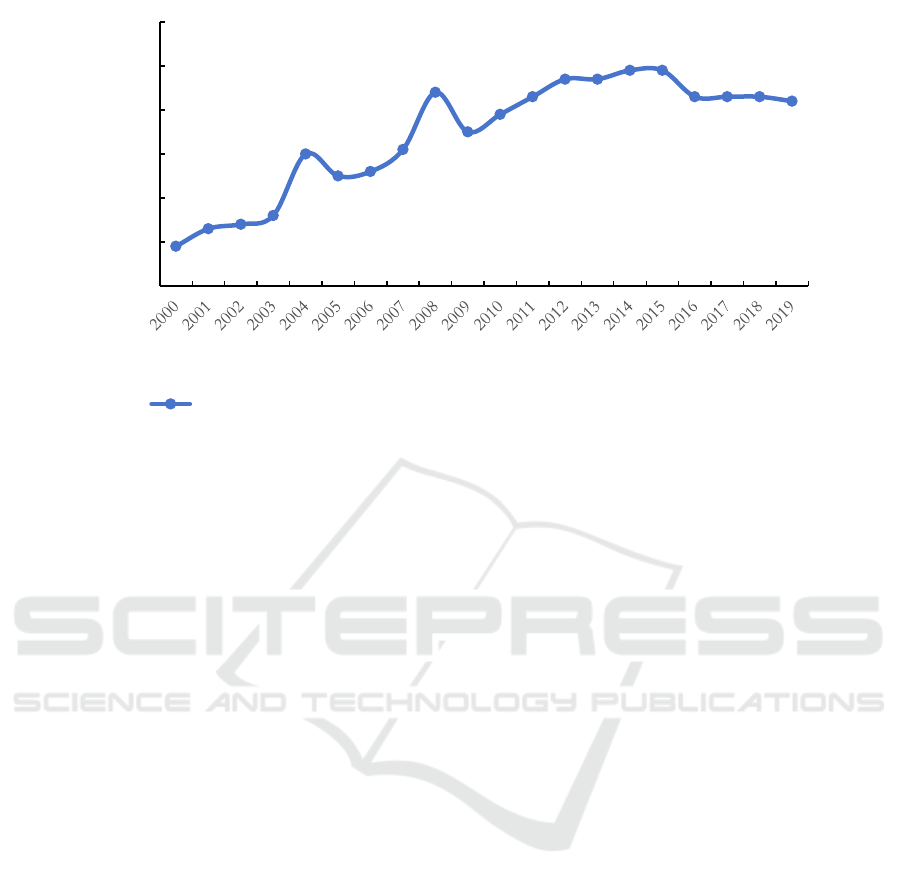
Data source: National Bureau of Statistics
Figure 3: The proportion of direct real estate employment to tertiary industry employment.
According to the relevant data in Figure 3, the
number of direct employment in the reality industry
was only about 930,000 in 2000, accounting for about
0.49% of the total employment in the tertiary service
industry. However, with the rapid development of the
reality industry, the number of direct employment
provided by the real estate industry is also rising
rapidly. By 2018, the number of direct employment
in real estate reached a peak of 2.94 million, nearly
three times the number in 2000. From these data, it
can also be seen that the real estate industry has
created many jobs and employment opportunities in
the process of development. At the same time, it can
be found that the proportion of direct employment in
real estate to employment in the service industry has
shown an overall upward trend. Although the
proportion is not large, less than one percent, the
proportion has also increased significantly. By 2014,
it has reached about 0.89%, an increase of about 82%
compared to 2000. And this is only the direct
employment created by the real estate industry, and
does not include the increase in employment in
upstream and downstream raw material supply,
construction industry, etc. due to the influence of the
real estate industry. Therefore, real estate
undoubtedly has a boosting effect on China's
employment situation.
3 NEGATIVE IMPACT OF REAL
ESTATE
3.1 The Debt Crisis
Over the last two decades, the fast-paced economic
growth of China ,steady GDP growth and stable
employment market are inseparable from the
promotion and help of the real estate industry.
However, even though the real estate industry has
brought many positive effects to China's economy,
there are also many problems and huge risks behind
it. The real estate industry is a capital-intensive
industry. The land purchase cost, construction cost,
design planning and other links in real estate
development require a large amount of capital
investment. A real estate development project is
usually accompanied by high investment and long
cycle characteristics, so real estate companies have a
high demand and dependence on capital. The high
dependence on funds means that real estate
companies need to raise a lot of funds to make the
project go smoothly, and companies usually adopt
high-leverage debt financing methods. Although the
high-leverage financing strategy will enable the
company's business and scale to expand rapidly, it
will also cause the company to bear huge financial
risks and debt pressure (Bai & Zhou, 2025). Because
most of the assets of real estate companies are fixed
assets such as land and houses, the ability to convert
0,4
0,5
0,6
0,7
0,8
0,9
1
percentage %
year
The proportion of direct real estate employment to tertiary industry employment
Research on the Impact of Real Estate on China’s Economy
609

them into cash flow is poor. In addition, the long cycle
of real estate development, these factors further test
the capital operation and management capabilities of
real estate companies that adopt high-leverage
financing. The real estate industry is also extremely
susceptible to the influence and regulation of national
policies. The real estate market’s direction is heavily
impacted by each specific policy enacted by the
authorities. The constant changes also make real
estate companies vulnerable to fluctuations but
difficult to adjust and respond in time (Liu, 2018).
The above internal and external factors show that the
risk and possibility of debt crisis in real estate
companies are much higher than other industries.
In recent years, there have been many cases of real
estate companies going bankrupt due to debt defaults,
among which the famous companies are: Country
Garden, Evergrande Group, etc. The bankruptcy of
these real estate giants has brought a series of
financial problems, causing very bad impacts and
losses to the society. Take the bankruptcy of
Evergrande Group as an example: Evergrande Group
entered a state of crazy expansion between 2016 and
2020, and the company's asset scale also reached a
historical high of 2.3 trillion yuan in 2020.
Correspondingly, such a radical expansion is
inevitably accompanied by high financing loans. In
2020, Evergrande Group's liabilities reached 1.95
trillion yuan, and its asset-liability ratio was as high
as 84.8%. Such an astonishing debt ratio has shown
that Evergrande's financial risks are in an extremely
dangerous situation, and the high debt has put great
pressure on its cash flow. What is more fatal is that
the country began to implement stricter controls on
the real estate sector in 2020, promulgated the "three
red lines" policy, and imposed relevant restrictions
and supervision on the high-leverage financing
behavior of real estate companies. This series of
measures made it even more difficult for Evergrande,
which was already in a debt crisis, to maintain normal
operations through refinancing. Coupled with
Evergrande's failed investments in other fields such
as medicine, new energy, and health, it eventually led
to the bankruptcy of Evergrande, a former leading
real estate company. Evergrande's bankruptcy caused
huge losses to upstream raw material merchants,
depreciation of the wealth of Evergrande bond
holders, and the loss of money for Evergrande's pre-
sale buyers, among other social harms and losses.
This case also fully reflects that real estate not only
represents high returns, but also contains crises and
risks.
3.2 Increased Living Pressure on
Residents
The fast-paced expansion of estate sector and the
rapid rise in property values have brought
considerable income and wealth to those who invest
in this industry. However, the high property prices
have brought considerable living pressure to many
people who want to buy properties. The property
value is usually affected by the development costs,
expected income and housing supply and demand of
real estate developers. The price of real estate should
fully reflect the value of real estate. However, in
property market in China, the price of property
deviates from its corresponding value. This
phenomenon also exposes the bubbles and risks
contained in real estate prices (Li, Li & Nuttapong,
2022). According to relevant data from National
Bureau of Statistics: in 2005, the price of commercial
residential housing was about 2,937 yuan per square
meter. In the following 20 years, due to the rapid
advancement within the property industry and social
economy, the price of property has been rising
accordingly every year. By 2023, the value of
commercial residential homes per square meter has
risen to 10,864 yuan, nearly 3.7 times that of 2005.
The sharp increase in housing prices also shows that
the financial pressure faced by ordinary residents
when they want to buy houses will also increase
accordingly. The ratio of housing prices to household
income is an important indicator for measuring the
housing prices in a region and the purchasing power
of residents. It has a good reference value. The World
Bank indicates that in developed countries, a standard
housing price-to-income ratio usually lies within the
range of 1.8 to 5.5, whereas in developing countries,
the acceptable level ranges from 3 to 6.However, in
2016, the housing price-to-income ratio in first-tier
cities such as Beijing and Shanghai reached an
astonishing 25 times (Glaeser, Huang & Shleifer,
2017). In 2010, the housing price-to-income ratio in
Shenzhen reached about 22 times. Although it briefly
dropped to about 17 times in 2015, it reached a peak
of about 40 times in 2020 after another round of
housing price increases. The extremely high housing
price-to-income ratio in the above-mentioned first-
tier cities in China has far exceeded the reasonable
housing price-to-income ratio range proposed by the
World Bank. When a family in a first-tier city needs
to spend more than 25 years of annual income without
food or drink to buy a house to live in, it is foreseeable
that most families may be under a series of pressures
and influences such as high housing prices and
mortgage repayments for a long time. According to
EMITI 2025 - International Conference on Engineering Management, Information Technology and Intelligence
610

CHFS data in 2017, the total asset change index of
urban households without housing was 96.3,
indicating that wealth is shrinking. The index of
households with houses is 110.3, indicating that their
wealth continues to grow. This shows that due to the
rise in housing prices, wealth has begun to transfer
from households without houses to households with
houses. The faster the housing prices rise, the greater
the gap between the rich and the poor between the
people with houses and the people without houses.
This phenomenon also stimulates the public to choose
to work hard to buy houses in order to avoid losing
wealth, which in turn stimulates the housing prices to
continue to rise due to the increase in demand,
forming a vicious circle.
3.3 Challenges of Economic
Restructuring
China's long-term rapid economic advancement has
relied on the real estate industry as the engine of
economic growth. The over-reliance on the real estate
industry has led to obstacles and challenges in China's
economic structural transformation. In the previous
article, the relationship between land finance and the
real estate industry was analyzed in detail. Although
real estate has brought a lot of benefits to the finances
of various regions, the corresponding data show that
the land transfer income related to real estate has
occupied too large a proportion of the local
government's budget revenue. Local government debt
funds have poured into real estate-related industries.
The over-reliance on real estate has caused the funds
that should have been invested in other fixed assets to
flow into real estate, thereby limiting the
government's ability to invest in other areas and
distorting the ability to adjust fund allocation
accordingly (Yang, n.d.). According to data surveys,
since 2018, the land transfer income of real estate
companies has begun to decline continuously, from
120.7 billion yuan in 2018 to 67.4 billion yuan in
2023. The continuous decline in land transfer income
shows the unsustainability of land finance. Today, the
Chinese government has promulgated a series of
relevant laws to suppress and regulate real estate, and
gradually transfer the long-term, high-investment,
and high-leverage characteristics of real estate to the
real economy model (Chen, 2025). Therefore, local
governments cannot continue to develop the real
estate industry as the mainstay of local finances. The
adjustment and transformation of the industrial
structure is a big challenge for them. It is difficult to
transform from the land finance model to other
models quickly.
4 CONCLUSION
This paper takes the real estate’s influence on China's
economy as the survey background, and discusses in
detail the positive and negative impacts of the
property industry on China's economic growth
through data analysis and case analysis. It is found
that real estate sector has significantly contributed to
the swift growth of local financial systems in China ,
employment, and economic level, but the
phenomenon of China's economy over-relying on
property also contains corresponding financial risks
and social harm. The analysis of real estate, a key
driving force in China’s economic structure , has very
important social significance. A deeper
understanding of the two sides of the real estate
industry will help people have a more rational view
and understanding of it. For the current problems of
high house prices and financial bubbles, the
government should strengthen the monitoring of the
corresponding real estate loan situation. Increase the
supply of land to build more public rental housing and
affordable rental housing, in order to cope with the
current phenomenon that house prices are generally
too high and low - and middle-income people can not
afford house prices. At the same time, government
should continue to emphasize the residential
attributes of the house and limit its financial attributes
to avoid another irrational rise in house prices.
Although this article provides a specific analysis
of the dual nature of real estate, most of it focuses on
existing data analysis and does not involve relevant
data calculations or predict and analyze future
development trends in the real estate industry. This is
one of the shortcomings of this article. After that, this
paper can focus on predicting and exploring the
adjustment and future prospects of the real estate
industry based on the relevant policies issued by
China.
REFERENCES
Zhu, Y. (2024). Analysis of the Contribution and Impact of
Real Estate Investment on Urban Economic Growth.
Shang Xun(14),1-4.
Hu, R. (2012). Understanding Chinese real estate: The
property boom in perspective. In Law and Policy for
China's Market Socialism. Routledge, 87-100.
Wang, W. & Ye, F. (2016). The political economy of land
finance in China. Public Budgeting & Finance, 36(2),
91-110.
Chen, B, D. (2014) Quantitative Research on Real Estate
Industry Development Driven Social Employment.
Wuhan University of Science and Technology, 2-12.
Research on the Impact of Real Estate on China’s Economy
611

Bai, Y, Zhou, L, J.(2025). The Impact of Real Estate
Industry Characteristics on Financial Management: A
Case Study of Evergrande Group . Science Technology
and Industry, 237-242.
Liu, C., & Xiong, W. (2018). China's real estate market.
Li, N., Li, R. Y. M., & Nuttapong, J. (2022). Factors affect
the housing prices in China: a systematic review of
papers indexed in Chinese Science Citation Database.
Property Management, 40(5), 780-796.
Glaeser, E., Huang, W., Ma, Y., & Shleifer, A. (2017). A
real estate boom with Chinese characteristics. Journal
of Economic Perspectives, 31(1), 93-116.
Yang, F, D. Real Estate Investment, Local Government
Debt, and Credit Risk in the Commercial Banking
System. Inner Mongolia University of Finance and
Economics, 1-3
Chen, Y, J. (2025) Research on the Impact of Real Estate
Downgrading on Economic Development and Urban
Renewal Strategy.Market Outlook, 7-9.
EMITI 2025 - International Conference on Engineering Management, Information Technology and Intelligence
612
