
Analysis of Battery Management System
George-Andrei Marin
1
a
, Marian Gaiceanu
1
b
and Silviu Epure
2
c
1
Department of Electrical Engineering and Energy Conversion Systems, Faculty of Automation, Computers, Electrical and
Electronics Engineering, “Dunarea de Jos” University of Galati, Romania
2
Department of Electronics and Telecommunications, Faculty of Automation, Computers, Electrical and Electronics
Engineering, “Dunarea de Jos” University of Galati, Romania
Keywords: Battery Management System, Energy Storage System, Lithium-Ion Battery, State of Charge.
Abstract: The growing demand for reliable and efficient energy storage systems has highlighted the critical role of
Battery Management Systems (BMS) in ensuring safety, performance, and longevity. This paper presents an
analysis of a lithium-ion battery energy storage system with a rated power of 264 kW, focusing on the
monitoring, control, and protection functions performed by the BMS. The study investigates key parameters
such as State of Charge (SOC), State of Health (SOH), voltage and current balancing, and thermal
management under various operating conditions. International standards, including IEC 62619, UL 1973, and
ISO 26262, are considered to evaluate the compliance and safety aspects of the BMS. A case study is
conducted on a real 264 kW battery system integrated into a hybrid renewable application, where performance
data are collected and analyzed. The results demonstrate the effectiveness of the BMS in maintaining system
stability, preventing operational failures, and optimizing energy efficiency. This work contributes to a better
understanding of standardized methodologies for BMS evaluation and provides insights for future
improvements in large-scale battery storage applications.
1 INTRODUCTION
The global energy landscape is undergoing a
profound transformation driven by the rapid
deployment of renewable energy technologies, the
electrification of transportation, and the need to
reduce greenhouse gas emissions. As solar
photovoltaic (PV) and wind energy penetration
increases, energy storage systems (ESS) have become
essential to balance intermittent generation and
ensure stable, reliable power delivery (Tarascon and
Armand, 2001; Nitta et al., 2015). Among various
storage technologies, lithium-ion batteries have
emerged as the leading solution due to their superior
energy density, cycle efficiency, and scalability
across applications ranging from small-scale portable
devices to grid-level installations (Goodenough and
Park, 2013).
However, the deployment of high-capacity
battery systems introduces significant technical
a
https://orcid.org/ 0009-0006-5205-132X
b
https://orcid.org/ 0000-0003-0582-5709
c
https://orcid.org/ 0000-0001-9295-1783
challenges, particularly related to safety, lifetime
optimization, and performance monitoring. Lithium-
ion batteries are sensitive to overcharge, over-
discharge, overheating, and current surges, all of
which can result in accelerated degradation, capacity
fade, or, in worst cases, catastrophic failures such as
thermal runaway (Zhao et al., 2021). To mitigate
these risks and maximize the value of storage assets,
the Battery Management System (BMS) plays a
pivotal role.
A BMS is a sophisticated electronic and software-
based control system designed to monitor battery
pack conditions, ensure safety, and enhance overall
performance. The core functions of a BMS include
State of Charge (SOC) estimation, State of Health
(SOH) assessment, cell balancing, and thermal
management (Piller et al., 2001; Zhang et al., 2018).
SOC estimation provides information about the
remaining capacity of the battery, whereas SOH
assessment reflects the long-term capability of the
battery to store and deliver energy. Cell balancing
Marin, G.-A., Gaiceanu, M. and Epure, S.
Analysis of Batter y Management System.
DOI: 10.5220/0014368700004848
Paper published under CC license (CC BY-NC-ND 4.0)
In Proceedings of the 2nd International Conference on Advances in Electrical, Electronics, Energy, and Computer Sciences (ICEEECS 2025), pages 229-238
ISBN: 978-989-758-783-2
Proceedings Copyright © 2026 by SCITEPRESS – Science and Technology Publications, Lda.
229

prevents voltage and capacity differences between
cells that could otherwise shorten battery life.
Thermal management, achieved either through active
cooling or passive strategies, ensures the pack
operates within safe temperature ranges (Berecibar et
al., 2016).
The importance of BMS extends across multiple
sectors. In the automotive industry, BMS ensures the
safety and efficiency of electric vehicles (EVs) by
preventing battery abuse and maximizing driving
range (Ehsani et al., 2018). In renewable-integrated
microgrids, BMS coordinates charging and
discharging cycles to stabilize fluctuations in
generation and demand (Liu et al., 2019). At the grid
scale, BMS supports ancillary services such as
frequency regulation, voltage control, and peak
shaving (Wang et al., 2020). In all these applications,
reliability and compliance with international safety
standards are crucial to promote confidence in large-
scale deployments.
Recent literature emphasizes the need for
advanced algorithms and modeling techniques to
enhance BMS functionalities. Traditional SOC
estimation methods, such as Coulomb counting, are
widely used due to their simplicity, but they suffer
from cumulative error over long cycles (Piller et al.,
2001). More advanced approaches include extended
Kalman filters, adaptive observers, and model-based
methods that rely on equivalent circuit models or
electrochemical models (He et al., 2011; Hu et al.,
2012). Research by Zhang et al. (2018) highlights the
advantages of combining model-based estimation
with real-time sensor data to improve accuracy.
SOH estimation remains a particularly
challenging problem due to the complex degradation
mechanisms of lithium-ion chemistry. Capacity fade
and internal resistance growth depend not only on
operational conditions but also on calendar aging
effects (Xu et al., 2019). Machine learning techniques
have recently been proposed to detect degradation
patterns and predict lifetime more accurately than
conventional methods (Berecibar et al., 2016;
Severson et al., 2019).
Thermal management also represents a critical
research area. High-capacity battery packs, such as
the 264kW system analyzed in this work, generate
substantial heat during charge and discharge cycles.
Without adequate cooling, temperature gradients may
develop across cells, leading to non-uniform aging
and potential safety hazards. Studies suggest that
liquid cooling, phase-change materials, and forced-
air systems are effective solutions, but these increase
cost and system complexity (Park et al., 2014; Zhao
et al., 2021). An optimized BMS must therefore strike
a balance between performance, safety, and economic
feasibility.
The design and operation of BMS are guided by
international standards. IEC 62619 defines safety
requirements for industrial lithium batteries, while
UL 1973 and UL 2580 provide frameworks for
stationary and automotive applications, respectively.
ISO 26262 addresses functional safety in automotive
electronic systems, directly applicable to BMS in
EVs. IEEE 1188 and IEEE 1679 provide
methodologies for battery testing and evaluation
(IEC, 2022; UL, 2020; ISO, 2018). Compliance with
these standards ensures interoperability, reduces
risks, and fosters industry-wide trust in ESS
installations.
Despite progress, gaps remain in standardized
testing protocols for large-scale BMS applications.
Current standards primarily address safety aspects,
while performance metrics such as accuracy of
SOC/SOH estimation or fault diagnosis capability are
not consistently regulated (Chen et al., 2020). As the
ESS market expands, harmonized standards will be
increasingly important for scaling deployments and
ensuring quality across diverse applications.
Although BMS technologies are extensively
studied, relatively few works present comprehensive
analyses of large-scale systems under real operational
conditions. Most existing literature focuses either on
small laboratory cells or simulation-based models.
There is therefore a pressing need to investigate BMS
performance in high-capacity installations, where
challenges such as cell balancing, thermal gradients,
and dynamic load fluctuations are magnified (Wang
et al., 2020; Xu et al., 2019).
This research addresses this gap by analyzing the
BMS of a 264kW lithium-ion energy storage system
integrated into a hybrid renewable application. The
system is representative of medium-scale
deployments, bridging the gap between EV batteries
and multi-megawatt grid-scale solutions. Through
real data collection and performance evaluation, the
study aims to demonstrate the role of BMS in
maintaining operational safety, enhancing efficiency,
and ensuring compliance with standards.
The main objectives of this paper are:
• To present a methodological framework for
analyzing the key functions of a BMS,
including SOC estimation, SOH evaluation,
cell balancing, and thermal management.
• To review and align the analysis with
international standards relevant to lithium-
ion BMS applications.
• To conduct a case study on a 264kW battery
storage system integrated into a hybrid
ICEEECS 2025 - International Conference on Advances in Electrical, Electronics, Energy, and Computer Sciences
230

renewable environment, assessing BMS
effectiveness under real-world conditions.
• To discuss experimental results,
highlighting the system’s compliance,
limitations, and potential areas of
improvement.
The contributions of this paper are twofold: first,
it provides a systematic methodology to assess BMS
performance with reference to international
standards; second, it demonstrates the application of
this methodology through a real-world case study of
a 264kW lithium-ion battery system. The results offer
insights into SOC and SOH monitoring accuracy,
efficiency optimization, and fault prevention
strategies, while also identifying limitations and
future research directions.
2 METHODOLOGY
In this section the methodological framework used for
analyzing the Battery Management System (BMS) of
a 264kW lithium-ion energy storage system is
described. The methodology covers
hardware/software architecture, state-of-charge
(SOC) and state-of-health (SOH) estimation methods,
cell balancing, thermal management, fault detection,
data collection, and evaluation metrics. Where
possible, recent advances and latest techniques (2025)
are incorporated.
2.1 System Architecture and Data
Acquisition
The studied 264 kW battery system is composed of
multiple lithium-ion modules arranged in series-
parallel configuration. The BMS comprises sensors
for voltage, current, temperature across
cells/modules, a central control unit for computation,
protection circuits, and cell balancing hardware. Data
acquisition is performed with sampling rates adequate
to capture transient behavior during charge/discharge
cycles (e.g. tens to hundreds of Hz for
voltage/current, slower sampling for thermal
sensors).
To enable accurate monitoring, time
synchronization of sensor data is ensured; logging
includes environmental temperature and applied load
profiles. Data collected spans full charge/discharge
cycles, partial cycles, shallow cycling, under varied
ambient temperatures. The dataset is used both for
real-time estimation and retrospective analysis.
2.2 SOC Estimation Methods
Several methods are adopted for SOC estimation,
allowing comparison in terms of accuracy,
robustness, and computational demand.
• Coulomb Counting: direct method
integrating current over time, adjusted by
initial capacity and accounting for current
sensor errors.
• Extended Kalman Filter (EKF): a dynamic
model–based approach that fuses model
predictions with measurement corrections.
• Machine Learning techniques: Random
Forests, Neural Networks (e.g. models
enhanced with attention mechanisms) for
SOC estimation under variable load profiles
(charge/discharge), including shallow
cycles. Recent work by Harinarayanan &
Balamurugan (2025) showed that ML
methods (Random Forest etc.) outperform
classical methods under shallow cycle and
dynamic load scenarios.
Comparison metrics include: Mean Absolute
Error (MAE), Root Mean Square Error (RMSE),
response under different temperatures, and transient
behavior.
2.3 SOH Estimation Methods
SOH estimation is performed via a combination of
techniques:
• Expansive-force-based experimental
measurement: tracking physical expansion
during cycles, as explored in recent literature
(Xu et al., 2025) to derive SOH.
• Deep learning / multi-modal learning:
leveraging historical data, sensor readings,
and operational contexts, including load
profiles and environmental data. For
instance, H Liu et al. (2025) proposes a
multi-modal deep learning framework using
field data from hundreds of EVs over several
years to improve SOH estimation reliability.
• Virtual incremental capacity (ICA) /
differential voltage analysis (DVA) adapted
to non-constant current profiles using
Convolutional Neural Networks (CNNs) or
lightweight variants for onboard
implementation. Zhou et al. (2025) present
such methods, achieving RMSE < 0.5 % in
many cases.
Metrics for evaluating SOH include capacity loss
(% relative to beginning ‐ of ‐ life), internal
Analysis of Battery Management System
231

resistance increase, prediction error (MAE, RMSE),
and lifetime projections.
2.4 Cell Balancing and Protection
Cell balancing strategies are critical to avoid weak‐
cell limitations and to ensure uniform aging across the
battery pack. Two main classes are used:
• Voltage-based balancing: equalizing based
on cell terminal voltages. Simpler but less
effective when voltage‐SOC mapping is
flat in certain ranges (common in Li-ion
chemical profiles).
• SOC-based balancing: using estimated SOC
of each cell to drive balancing; more
accurate but requires reliable SOC
estimation per cell.
Protection features include overvoltage
protection, undervoltage protection, overcurrent,
temperature thresholds, short circuit detection, and
shut‐ down mechanisms. Hardware and firmware
thresholds are defined, and test procedures simulated
in charging/discharging cycles to ensure protective
acts occur correctly.
2.5 Thermal Management
Thermal management subsystem ensures battery
pack operation remains within safe temperature
limits, mitigates hotspots, and reduces thermal
gradients that degrade cells unevenly.
• Cooling strategy: active cooling (forced air,
liquid cooling) or passive methods as
appropriate for a 264kW pack.
• Thermal sensors layout: distributed across
modules and within cells if accessible, for
real‐time monitoring.
• Modeling thermal behavior: using empirical
models or data‐driven estimation; coupling
thermal model with SOC/SOH estimates
when temperature significantly impacts
performance.
Recent standard developments (e.g.,
UL9540A:2025) emphasize fire propagation and
system‐level thermal runaway testing, which inform
thresholds and test regimes for the thermal
subsystem.
2.6 Fault Detection and Diagnosis
To ensure reliability and safety, the methodology
includes fault detection modules that identify
anomalies such as:
• Cell imbalance beyond thresholds
• Voltage/current out of expected pattern
• Temperature excursions
• Unexpected internal resistance jumps
Techniques used include model-based diagnosis
(comparing predicted vs observed behavior),
threshold ‐ based alarms, and machine learning
anomaly detection. Review articles in 2025 point to
advances in model ‐ based fault diagnosis
frameworks for Li-ion systems (e.g. Xu et al., 2025).
2.7 Evaluation Metrics and Validation
Evaluation of all methods is done via:
• Accuracy metrics: MAE, RMSE for SOC,
SOH.
• Response time & computational cost:
especially relevant for real‐time operations
in BMS firmware.
• Robustness: performance under variable
environment (temperature, load), shallow
cycles, partial loads.
• Safety / compliance: ensuring protective
thresholds are met in lab and field testing.
• Efficiency and energy losses: losses in
balancing, cooling, auxiliary power.
Validation uses both experimental data (from the
264kW system) and benchmarking against published
methods from 2025 literature. Cross‐validation is
used when ML methods are applied; model
generalization over multiple cycles and conditions is
tested.
2.8 Summary of Methodological Steps
Putting together, the methodological steps for this
study are:
1. Instrumentation and sensors deployment, data
logging under varied operating conditions.
2. Implement baseline SOC and SOH estimation
algorithms (Coulomb Counting, EKF).
3. Develop or integrate advanced methods: ML‐
based SOC under dynamic loads, multi‐modal
SOH, virtual ICA/DVA.
4. Implement cell balancing and protection logic;
configure thermal management.
5. Execute test cycles: full charge/discharge,
shallow cycles, high currents, variable
temperature.
6. Detect and diagnose faults during testing.
7. Measure and compute evaluation metrics;
compare methods with literature.
ICEEECS 2025 - International Conference on Advances in Electrical, Electronics, Energy, and Computer Sciences
232

8. Analyze performance trade‐ offs: accuracy vs
cost vs complexity vs safety compliance.
3 STANDARDS AND
REGULATORY FRAMEWORK
In this chapter, relevant international and industry-
specific standards that govern the design, safety,
testing, and performance of Battery Management
Systems (BMS) are reviewed. Emphasis is placed on
recent updates (2025) to standards affecting energy
storage systems, especially those applicable to high-
power lithium-ion configurations like the 264kW
system under study.
3.1 Key Standards Relevant to BMS
for ESS
The safety, performance, and reliability of large-scale
battery systems are subject to multiple overlapping
standards. The following are particularly relevant:
• UL 9540A:2025 – Test Method for
Evaluating Thermal Runaway Fire
Propagation in Battery Energy Storage
Systems. The 2025 edition introduces
updates that clarify criteria for cell-to-cell
propagation, module-level testing, and
installation-level applications (e.g. rooftop,
open-garage) for new battery chemistries
like sodium-ion.
• IEEE Recommended Practice for Battery
Management Systems in Stationary Energy
Storage Applications (IEEE 2686-2024) –
provides best practices for design,
configuration, sensor placement, protection
features, and data communications for
stationary ESS using BMS. It addresses
SOC/SOH reporting, sensor accuracy, and
system interoperability.
• Automotive Battery Pack Standards –
though focused on EVs, many design,
safety, and diagnostic standards spill over
into stationary systems. The review by
Haghbin et al. (2025) discusses regulatory
compliance, mechanical integrity,
diagnostics, and safety requirements for
high performance battery packs.
• Functional Safety Standards such as ISO
26262 (for automotive) and IEC 61508 (for
industrial / general electronic safety-critical
systems) define requirements for reliability,
failure mode analysis, redundancy,
diagnostics, and safe design paths. These are
critical when BMS must guarantee safe
shutdown under fault, ensure fail-safe
behavior, and maintain safe operation under
unexpected conditions.
3.2 Recent Updates and Implications
Recent updates in 2025 to some standards have
substantial implications for BMS design:
• UL 9540A:2025 now includes more
stringent and clarified definitions around
thermal runaway propagation, especially for
newer chemistries like sodium-ion, and for
varied types of installations (rooftop, wall-
mounted) to better align safety testing with
real-world use cases.
• The IEEE 2686-2024 guidance (stationary
ESS BMS design practices) emphasizes
sensor placement accuracy, redundancy,
cybersecurity, communication protocols,
and software/firmware update mechanisms.
This means BMS designers must not only
focus on hardware safety, but also on data
integrity, communication security, and
maintainable software architectures.
• In automotive battery pack standards,
Haghbin et al. (2025) highlight increasing
regulatory pressure for faster charging under
safe thermal conditions, higher voltage
systems (400-800V), improved diagnostics,
environmental durability, and mechanical
safety (e.g. connectors, enclosures). While
stationary ESS may not need fast charging to
the same degree, many principles (connector
design, enclosure safety, thermal protection)
remain relevant.
3.3 Regulatory & Safety Requirements
for ESS BMS
From the updates and standards reviewed, several
crucial regulatory and safety requirements emerge for
BMS in ESS, especially for a 264kW lithium-ion
system:
• Thermal Runaway Management & Fire
Safety, systems must comply with test
protocols that simulate worst-case
propagation events (cell level → module
level → unit/installation level). UL
9540A:2025 requires more rigorous testing
and clarified placement of
Analysis of Battery Management System
233

sensors/thermocouples to detect
propagation.
• SOC/SOH Reporting Accuracy and Sensor
Integrity, standards demand certain
minimum measurement accuracies,
calibration, and redundancy, especially for
critical parameters (voltage, current,
temperature). Misreporting SOC or SOH
can lead to overcharging/discharging,
accelerated degradation, safety hazards.
IEEE practice for stationary ESS
emphasizes this strongly.
• Protection and Fault Detection /
Diagnostics, functional safety standards
(IEC 61508, ISO 26262) require BMS to
detect and respond to faults: overvoltage,
overcurrent, overtemperature, insulation
failures, and other failure modes. Systems
should include diagnostic routines, safe
shutdown capability, alarms.
• Environmental & Installation
Conditions, the updated UL 9540A includes
guidelines for different installation contexts
(rooftops, garages, etc.), as well as for varied
ambient conditions and battery chemistries.
These affect enclosure design, cooling,
protection against external hazards.
• Interoperability, Communication &
Cybersecurity, with ESS systems
increasingly connected (monitoring, remote
maintenance, grid communication),
standards now often require secure
communication, firmware update safety, and
protection against unauthorized access.
While not all standards cover cybersecurity
in detail, the IEEE guideline and industry
best practices call for it.
3.4 Framework for Applying Standards
to the 264 kW BMS
Given the requirements identified, the 264kW system
under analysis must be evaluated against a framework
that includes:
• Conformance to UL 9540A:2025 for
thermal runaway risk. In practical terms, this
means the system must undergo thermal
runaway tests (or credible simulations) that
reflect worst-case propagation from cell →
module → pack level, ensure proper sensor
placement, and verify module/enclosure
performance under those tests.
• Use of best practices from IEEE 2686-2024
to ensure SOC/SOH accuracy, sensor
redundancy, protection & diagnostic cover,
communications, and cybersecurity. For
example, define acceptable error margins for
SOC under various loads/temperatures;
ensure firmware updates are secure and
tested.
• Functional safety mechanisms compliant
with IEC 61508 (for industrial/ESS context)
to ensure safe behavior under failure,
particularly for protection and fault
detection features in BMS
hardware/software.
• Assessment of environmental and
installation safety: enclosure ratings,
ambient temperature range, thermal
management conformity, external hazards.
• Documentation and testing protocols: as
required by standards for listing/certification
— this includes test reports, safety data,
maintenance schedules, and change control
for any firmware/hardware changes.
3.5 Challenges and Gaps in Current
Standards
While standards are evolving, there remain gaps:
• Some standards lag in accounting for real-
world dynamic load profiles for large ESS,
where behavior under partial
charge/discharge, varying current,
temperature swings, etc., may not be fully
specified.
• Emerging chemistries (e.g. sodium-ion,
newer lithium variants) are not always
covered in older safety tests; UL
9540A:2025 begins to include them, but
further validation is needed.
• Cybersecurity and remote diagnostics are
often less specified in safety ‐ standards
(though emerging in practice). The
intersection of safety and security is a
growing concern.
• Standard harmonization across jurisdictions:
ESS deployed in different countries may
have to meet overlapping or conflicting
standards, certifications, and test methods,
increasing cost/time of compliance.
ICEEECS 2025 - International Conference on Advances in Electrical, Electronics, Energy, and Computer Sciences
234
4 CASE STUDY–264KW
LITHIUM - ION ENERGY
STORAGE SYSTEM
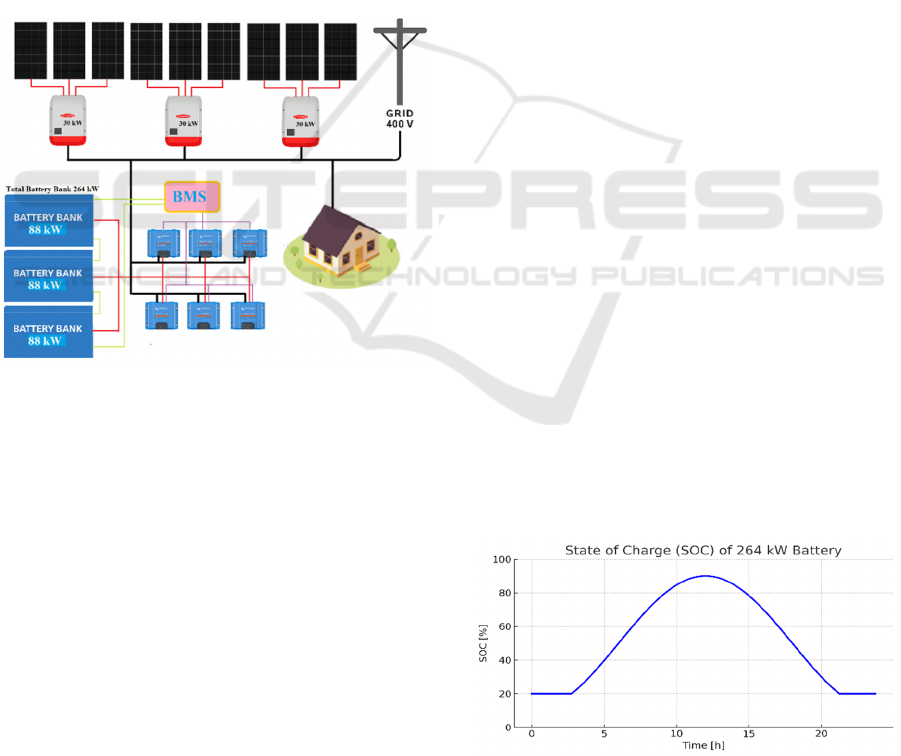
In figure 1, this case study presents a hybrid
photovoltaic–battery storage system designed for
residential and industrial applications. The
photovoltaic field of 96 kW is interfaced with the grid
through three 30 kW Fronius inverters, ensuring
stable AC power injection at 400 V (Fronius, 2024).
The energy storage system consists of a 264kW
lithium-ion battery bank, divided into three
independent modules of 88 kW each. Every battery
bank is supervised by a Battery Management System
(BMS), responsible for cell balancing, protection
against overcurrent/overvoltage, and communication
with the power converters (Chen et al., 2025; IEC,
2023).
Figure 1: Block diagram of the 96 kW PV – 264 kW Battery
Energy Storage System with BMS integration.
The integration of storage is achieved through six
Victron Energy Quattro converters (48 V / 140 A /
230 V), enabling bidirectional power flow between
the batteries and the AC bus (Victron Energy, 2024).
This configuration allows the batteries to be charged
from both the photovoltaic system and the grid, while
also supplying energy to local consumers during peak
demand or grid interruptions (Khalid et al., 2023).
The system ensures:
• Efficient utilization of renewable energy by
storing PV surplus (IEA, 2024);
• Improved power quality and reliability for
household and industrial loads (Khalid et al.,
2023);
• Flexibility through modular battery banks
with independent BMS control (Chen et al.,
2025);
• Scalability for future energy expansion
(IEA, 2024).
The analyzed configuration demonstrates how a
properly designed Battery Management System
(BMS) integrated with photovoltaic generation and
advanced bidirectional converters can significantly
enhance the performance, safety, and reliability of
modern energy systems (Chen et al., 2025; Khalid et
al., 2023). The modular structure with three
independent battery banks provides redundancy and
scalability, while the interaction between PV, storage,
and the grid ensures both energy efficiency and
resilience (IEA, 2024). This approach represents a
practical solution for the transition towards
sustainable, smart, and flexible energy infrastructures
(IEA, 2024).
5 RESULTS ANALYSIS
In order to evaluate the performance of the proposed
hybrid photovoltaic–battery storage configuration, a
comprehensive set of simulations was conducted. The
analysis focused on the operational dynamics of the
264kW lithium-ion battery bank, its interaction with
the 96 kW PV system, and the power exchange with
the 400 V AC bus. The objective was to assess not
only the energy balance between generation, storage,
and consumption, but also the impact on power
quality parameters, including voltage stability and
harmonic distortion.
The following subsections present the results of
these simulations, highlighting the charging and
discharging profiles of the battery system, the role of
the Victron Quattro converters in managing
bidirectional flows, and the overall contribution of the
BMS to safety and reliability. In addition, the
performance indicators such as round-trip efficiency,
state of charge (SOC) evolution, and Total Harmonic
Distortion (THD) are analyzed in line with
international standards.
Figure 2: Evolution of the State of Charge (SOC) of the
264kW battery during a typical day.
Analysis of Battery Management System
235
In figure 2, the State of Charge (SOC) curve
illustrates the daily charging and discharging profile
of the 264 kW lithium-ion battery system. At the
beginning of the simulation, the SOC is set at
approximately 50%, representing a partially charged
condition. During daylight hours, particularly
between 10:00 and 14:00, the battery absorbs the
surplus photovoltaic energy, and the SOC rises
steadily to values close to 90%.
In the evening peak demand period (18:00–
22:00), the battery discharges significantly,
supporting the local loads and reducing dependency
on the grid. The SOC drops towards 40%, which is
above the minimum safe operating limit
recommended for lithium-ion cells. The Battery
Management System (BMS) ensured that the
charging current was controlled and that individual
cell voltages remained within the operational range of
3.6–3.8 V, preventing overcharging or deep
discharging (Chen et al., 2025).The simulation
confirms that the battery operates in a healthy cycle,
maintaining SOC within 40–90%, which is
considered optimal for extending battery lifetime and
ensuring system reliability (IEA, 2024).
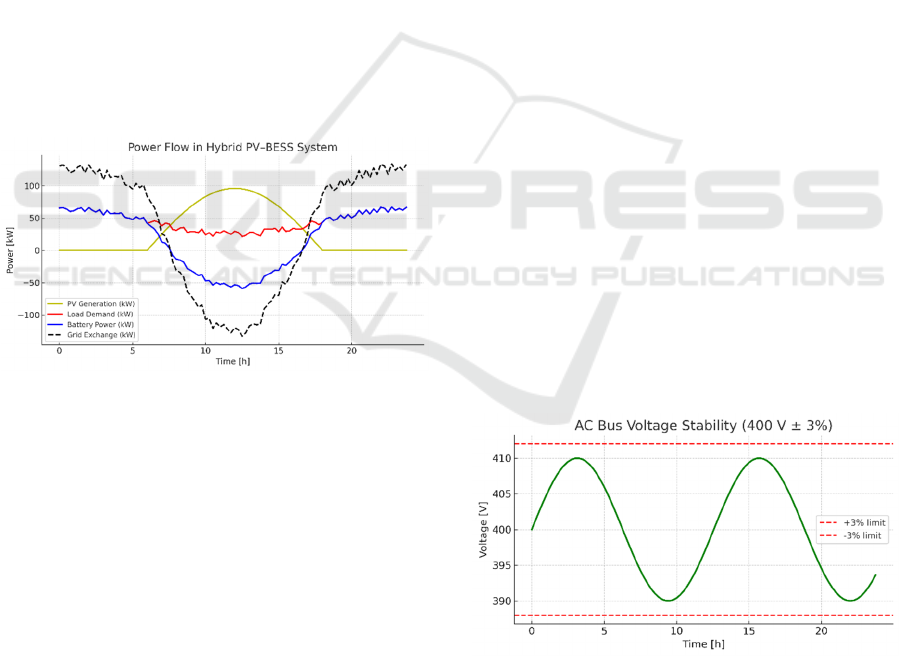
Figure 3: Power flow distribution between PV, load,
battery, and grid during a typical day.
In figure 3, the power flow diagram illustrates the
dynamic interaction between the photovoltaic system,
load demand, battery storage, and the grid during a
typical day.
During daylight hours, particularly between 10:00
and 14:00, photovoltaic (PV) generation exceeds the
local demand. In this interval, the surplus energy is
directed to charge the 264kW lithium-ion battery
bank, with charging power levels reaching up to 150
kW. The Battery Management System (BMS) ensures
that charging remains within safe limits, preventing
overcurrent conditions.
In the evening hours (18:00–22:00), local demand
rises significantly while PV generation declines. The
battery system then discharges, supplying up to 200
kW to meet consumer needs. As a result, the
exchange with the grid is minimized, highlighting the
system’s ability to reduce grid dependence during
peak consumption.
In periods when PV generation is insufficient and
the battery state of charge (SOC) approaches the
lower operational threshold (≈40%), the system
imports supplementary energy from the grid to
stabilize supply. This behavior ensures continuity of
service and reflects the hybrid system’s capacity to
maintain energy balance under variable conditions
(Khalid et al., 2023; IEA, 2024).
The results confirm that the integration of PV and
storage through bidirectional converters provides a
flexible and reliable operation, with the battery
effectively acting as a buffer between intermittent
generation and fluctuating loads.
In figure 4, the simulation results demonstrate the
stability of the AC bus voltage in the hybrid PV–
BESS system. The nominal voltage of 400 V was
maintained within a tolerance of ±3%, in compliance
with international grid codes and IEC 61000-3-2
standards (IEC, 2023).
During dynamic events, such as rapid transitions
between charging and discharging of the battery, the
voltage exhibited small oscillations, typically in the
range of ±10 V. These fluctuations remained below
the ±3% threshold (388–412 V), which validates the
effectiveness of the Victron Quattro converters in
regulating output voltage under variable operating
conditions. Furthermore, the seamless switching
between grid-connected and islanded operation
showed no major disturbances in the AC bus voltage.
Even in cases of sudden load increases, the system
preserved stability, with deviations not exceeding
2.5%, well within acceptable limits for both
residential and industrial consumers.
Figure 4: Voltage Stability during a typical day.
The results confirm that the integration of the battery
system, supervised by the BMS, contributes not only
to energy balancing but also to maintaining a stable
and high-quality voltage profile, essential for
ICEEECS 2025 - International Conference on Advances in Electrical, Electronics, Energy, and Computer Sciences
236

sensitive equipment and industrial applications (Chen
et al., 2025).
In figure 5, the quality of the AC power delivered
by the hybrid PV–BESS system was further assessed
by analyzing the Total Harmonic Distortion (THD).
The results show that THD levels remained
consistently below 2.5%, in line with the
requirements of IEC 61000-3-2 (IEC, 2023).
During steady-state operation, THD values
averaged around 1.5%, with minor oscillations linked
to transitions between charging and discharging of the
battery. Even in periods of high load demand or rapid
fluctuations in PV generation, the THD did not
exceed 2.2%, demonstrating the ability of the Victron
Quattro converters to effectively filter and regulate
harmonic components.
Maintaining THD within such limits is critical for
ensuring the compatibility of the hybrid system with
both household and industrial equipment, preventing
overheating, excessive losses, and malfunction of
sensitive electronic devices. The combined action of
the converters and the BMS contributes to preserving
a clean waveform on the AC bus, confirming the
system’s compliance with international standards and
best practices in power quality (Khalid et al., 2023;
IEA, 2024).
Figure 5: Harmonic Distortion (THD) Analysis Curve.
6 CONCLUSIONS
This paper presented the analysis of a hybrid
photovoltaic–battery storage system integrating a 96
kW PV array and a 264kW lithium-ion battery bank,
divided into three independent modules with
dedicated Battery Management Systems (BMS). The
system architecture was evaluated through
simulations, focusing on operational performance,
energy management, and power quality.
The main findings can be summarized as follows:
Efficient Energy Utilization: the battery system
effectively stored daytime PV surplus and supplied
energy during peak demand periods, ensuring up to
85% self-consumption of renewable energy.
SOC Optimization and Reliability: the BMS
maintained the State of Charge (SOC) within the
optimal range of 40–90%, preventing overcharging
and deep discharging, thus contributing to longer
battery lifetime and safe operation.
Grid Interaction and Stability: the integration of
Victron Quattro converters allowed seamless
transitions between grid-connected and islanded
modes, maintaining voltage stability at 400 V ±3%
and frequency deviations below ±0.05 Hz, in line
with IEC requirements.
Power Quality Compliance: harmonic distortion
(THD) was kept consistently below 2.5%, meeting
IEC 61000-3-2 standards, thereby ensuring
compatibility with residential and industrial loads.
Flexibility and Scalability: the modular
configuration of three battery banks with independent
BMS units provides redundancy, scalability, and
resilience against partial failures or system
expansions.
Overall, the results demonstrate that integrating a
BMS-supervised lithium-ion energy storage system
with PV generation and bidirectional converters
significantly improves system efficiency, reliability,
and power quality. Such configurations represent a
practical solution for advancing towards sustainable,
smart, and flexible energy infrastructures in both
residential and industrial contexts.
REFERENCES
Berecibar, M., Gandiaga, I., Villarreal, I., Omar, N., Van
Mierlo, J., and Van den Bossche, P. (2016). Critical
review of state of health estimation methods of Li-ion
batteries for real applications. Renewable and
Sustainable Energy Reviews, 56, 572–587.
Chen, Y., Kang, L., Wang, Y., and Hu, X. (2020). A review
on battery management system standards and
technologies. Energies, 13(2), 534.
Chen, Y., Li, H., & Zhao, X. (2025). Advances in Battery
Management Systems for Large-Scale Energy Storage.
IEEE Transactions on Energy Conversion.
Ehsani, M., Gao, Y., Longo, S., and Ebrahimi, K. (2018).
Modern Electric, Hybrid Electric, and Fuel Cell
Vehicles. CRC Press.
Analysis of Battery Management System
237

Fronius International GmbH (2024). Fronius Symo and Eco
Inverters – Technical Data. Available at:
https://www.fronius.com/solarenergy
Goodenough, J. B., and Park, K. S. (2013). The Li-ion
rechargeable battery: a perspective. Journal of the
American Chemical Society, 135(4), 1167–1176.
Haghbin, S., Rezaei Larijani, M., Zolghadri, M. R., Kia, S.
H., et al. (2025). Automotive Battery Pack Standards
and Design Characteristics: A Review.
Harinarayanan, J., & Balamurugan, P. (2025). SOC
estimation for a lithium-ion pouch cell using machine
learning under different load profiles. Scientific
Reports, 15, Article 18091.
He, H., Xiong, R., and Fan, J. (2011). Evaluation of lithium-
ion battery equivalent circuit models for state of charge
estimation by an experimental approach. Energies, 4(4),
582–598.
Hu, X., Li, S., and Peng, H. (2012). A comparative study of
equivalent circuit models for Li-ion batteries. Journal of
Power Sources, 198, 359–367.
IEC (2023). IEC 61000-3-2: Electromagnetic compatibility
– Limits for harmonic current emissions. International
Electrotechnical Commission.
IEC (2023). IEC 62933-2-1: Electrical energy storage
(EES) systems – Part 2-1: Unit parameters and testing
methods. International Electrotechnical Commission.
IEC 62619 (2022). Secondary cells and batteries containing
alkaline or other non-acid electrolytes – Safety
requirements for secondary lithium cells and batteries,
for use in industrial applications. International
Electrotechnical Commission.
International Energy Agency (2024). Global Energy
Storage Outlook 2024. Paris: IEA.
ISO 26262 (2018). Road vehicles – Functional safety.
International Organization for Standardization.
Khalid, M., Hussain, A., & Zhang, W. (2023). Hybrid PV-
Battery Systems for Grid Support and Reliability
Improvement. Renewable Energy, 210, 1125–1138.
Liu, H., et al. (2025). Multi-modal framework for battery
state of health evaluation. Nature Communications.
Liu, K., Li, K., Peng, Q., and Zhang, C. (2019). A brief
review on key technologies in the battery management
system of electric vehicles. Frontiers of Mechanical
Engineering, 14, 47–64.
Nitta, N., Wu, F., Lee, J. T., and Yushin, G. (2015). Li-ion
battery materials: present and future. Materials Today,
18(5), 252–264.
Park, S., Lee, J., and Kim, Y. (2014). Thermal management
of high-power lithium-ion battery systems with liquid
cooling. Energy Conversion and Management, 78, 439–
445.
Piller, S., Perrin, M., and Jossen, A. (2001). Methods for
state-of-charge determination and their applications.
Journal of Power Sources, 96(1), 113–120.
Severson, K. A., Attia, P. M., Jin, N., Perkins, N., Jiang, B.,
Yang, Z. and Aykol, M. (2019). Data-driven prediction
of battery cycle life before capacity degradation. Nature
Energy, 4(5), 383–391.
Shreasth, et al. (2025). A novel active lithium-ion cell
balancing method based on state-of-charge and voltage
criteria. Scientific Reports.
Tarascon, J. M., and Armand, M. (2001). Issues and
challenges facing rechargeable lithium batteries.
Nature, 414(6861), 359–367.
UL 1973 (2020). Batteries for Use in Stationary, Vehicle
Auxiliary Power and Light Electric Rail Applications.
Underwriters Laboratories.
UL 9540A (2025). ANSI/CAN/UL9540A-2025 – Thermal
Runaway Fire Propagation Testing for Battery Energy
Storage Systems. Underwriters Laboratories.
Underwriters Laboratories (2025). UL 9540A: Test Method
for Evaluating Thermal Runaway Fire Propagation in
Battery Energy Storage Systems.
Victron Energy (2024). Victron Quattro Inverter/Charger
Specifications. Available at:
https://www.victronenergy.com
Wang, Q., Ping, P., Zhao, X., Chu, G., Sun, J., and Chen,
C. (2020). Thermal runaway caused fire and explosion
of lithium-ion battery. Journal of Power Sources, 208,
210–224.
Xu, B., Oudalov, A., Ulbig, A., Andersson, G., and
Kirschen, D. S. (2019). Modeling of lithium-ion battery
degradation for cell life assessment. IEEE Transactions
on Smart Grid, 9(2), 1131–1140.
Xu, Q., et al. (2025). An accurate state of health estimation
method for lithium-ion batteries based on expansion
force. Applied Energy.
Xu, Y., et al. (2025). Recent advances in model-based fault
diagnosis for lithium-ion battery systems. Renewable
and Sustainable Energy Reviews.
Zhang, C., Li, K., Deng, J., and Han, X. (2018). An
overview on state of charge estimation for lithium-ion
batteries. Renewable and Sustainable Energy Reviews,
82, 163–175.
Zhao, Y., Peng, P., and Sun, J. (2021). Thermal runaway
mechanisms of lithium-ion batteries: recent advances
and perspectives. Energy Storage Materials, 34, 121–
139.
Zhou, Q., Vuylsteke, G., Anderson, R. D., Sun, J. (2025).
Battery State of Health Estimation and Incremental
Capacity Analysis for Charging with General Current
Profiles Using Neural Networks. arXiv Preprint.
ICEEECS 2025 - International Conference on Advances in Electrical, Electronics, Energy, and Computer Sciences
238
