
Energy Selective Surface Superstrate on Antenna both Gain
Enhancement and HPM Protection
Adem Kocyigit
1,2 a
, Burak Çelik
3b
, Mahmut Burak Karadeniz
3c
, Onur Arsalı
3d
,
Ebru Efeoğlu
4e
and Bahattin Turetken
3f
1
Institute of Science, Electronics and Telecommunication Engineering, Kocaeli University, Umuttepe, Kocaeli, Turkey
2
Department of Electronics and Automation, Bilecik Seyh Edebali University, Gulumbe, Bilecik, Turkey
3
Department of Electronics and Telecommunication Engineering, Kocaeli University, Umuttepe, Kocaeli, Turkey
4
Department of Software Engineering, Kütahya Dumlupınar University, Kütahya, Turkey
Keywords: Energy Selective Surfaces, ESS, Superstrate, HPM Protection.
Abstract: Energy selective surfaces (ESS) have gained great interest for one decade to protect vulnerable electronic
devices due to their adaptive surfaces against the power of electromagnetic waves. In this study, we designed
a double layer ESS structure both to enhance gain of an antenna in the case of low power electromagnetic
waves and to protect it against high-power microwave (HPM) or electromagnetic pulse (EMP). The antenna
was designed by using Rogers RT5880 substrate as rectangular patch with a line feed for the 2.45 ISM
(Industrial, Scientific, and Medical) band. The ESS layers as arrays were placed on the antenna as superstrate
by a distance. The design results revealed that ESS superstrate layers can increase gain of antenna in the
transmission band and protect antenna in the case of HPM. The ESS layers can be act as both superstrate and
protection layers at the same time.
1 INTRODUCTION
Antennas need to be protected against HPM and EMP
because they are the opening door to the outside of
the electronic parts of vehicles such as aircraft and
unmanned aerial vehicles (Huang et al., 2022). These
are realized with materials such as active absorber
metasurfaces (Luo et al., 2023), frequency selective
surfaces (FSS) (Chatterjee et al., 2024), plasma
confinements (L. Wang et al., 2022), ceramic-based
film materials (Zurauskiene et al., 2013) and large
magnetoresistive materials (Pannetier-Lecoeur et al.,
2007). The ESS is a field-induced surface sensitive to
the field intensity of the incident wave, is first
proposed by Liu et al. in a patent in 2009, and it has
been published as a paper in 2013 (Yang et al., 2013).
ESS structures which are typically designed as a two-
dimensional array, are integrated into the front end of
a
https://orcid.org/0000-0002-8502-2860
b
https://orcid.org/0000-0002-3204-5444
c
https://orcid.org/0000-0002-6645-2734
d
https://orcid.org/0009-0005-0170-3968
e
https://orcid.org/0000-0001-5444-6647
f
https://orcid.org/0000-0001-5451-7089
a radar system or as a protective layer on an antenna,
operating as a power-dependent switch in free space
(Qin & Zhang, 2019). These structures have been
quite popular since 2017 and have attracted the
attention of many scientists (Gong & Zhang, 2021;
Hu et al., 2024; Zhang et al., 2019).
Metamaterials (MTM), FSS or partially selective
surface (PRS) periodic structures are used as antenna
superstrate layers to enhance the performance of
planar antennas (K & Pradeep, 2022; Kangeyan &
Karthikeyan, 2024). The efficiency, bandwidth, and
gain of planar patch antennas can be successfully
increased with antenna superstrates, and that these
antennas can be easily used in a wide variety of
applications, such as health monitoring and
communications (K.Sumathi et al., 2021; Melouki et
al., 2022). Sumathi et al. (2021) showed that the
operating frequency of the antenna can be configured
by using MTM multilayered superstrates and adding
176
Kocyigit, A., Çelik, B., Karadeniz, M. B., Arsalı, O., Efeo
ˇ
glu, E. and Turetken, B.
Energy Selective Surface Superstrate on Antenna both Gain Enhancement and HPM Protection.
DOI: 10.5220/0014364000004848
Paper published under CC license (CC BY-NC-ND 4.0)
In Proceedings of the 2nd International Conference on Advances in Electrical, Electronics, Energy, and Computer Sciences (ICEEECS 2025), pages 176-181
ISBN: 978-989-758-783-2
Proceedings Copyright © 2026 by SCITEPRESS – Science and Technology Publications, Lda.
diodes to them, and the gain can be increased from
3.66 dB to 7.36 dB by configuring the diodes
(K.Sumathi et al., 2021). In a study carried out by Dey
and Dey (2023), a broad-band miniaturized Fabry-
Perot cavity resonator antenna fabricated of a new
electromagnetic band gap (EBG) superstrate as a
rectangular patch antenna supported by PRS and
reactive impedance surface (RIS) was used, with a
bandwidth between 9.91 and 12.71 GHz (24.8) and a
gain increase of 6.59 dB compared to the reference
antenna was achieved (Dey & Dey, 2023). Abdelaziz
et al. (2023) designed a multiple-input multiple-
output (MIMO) circular spiral patch antenna using a
bifacial logarithmic spiral metamaterial superstrate
which acts as new planar concave-concave lens for
circularly polarized (CP) antenna system which are
used in 5G applications and the proposed top layer
increased the isolation, gain and bandwidth of the
antenna by about 32 dB, 3.47 dB and 900 MHz
respectively (Abdelaziz et al., 2023). Nguyen and Seo
(2023) demonstrated 33% bandwidth, -14.3 dBi
maximum peak gain, and a low specific absorption
ratio (SAR) by integrating a drilled ground plane
(DGS) and a holed dielectric superstrate layer
operating at a center frequency of 2.4 GHz to achieve
CP characteristics of an ultraminiature antenna and
gain enhancement (Nguyen & Seo, 2023).
According to our best knowledge, there are no
studies in the literature that use ESS structure as the
antenna top layer which both to protect the antenna
from high power electromagnetic waves and to
improve its performance. This study aims to improve
antenna performance while protecting antenna from
HPM or EMP by using ESS surfaces as the
superstrate. In this study, we have designed a patch
antenna for 2.45 GHz ISM band and superstrate ESS
layer to improve antenna properties at transmission
band and to protect antenna from HPM when the
diodes are in the ON state.
2 DESIGN OF ANTENNA AND
ESS STRUCTURES
In the modelling of ESS structures, a standard FSS or
metamaterial structure is constructed, and the patch
elements of these structures are connected to each
other by lumped diode elements exhibiting nonlinear
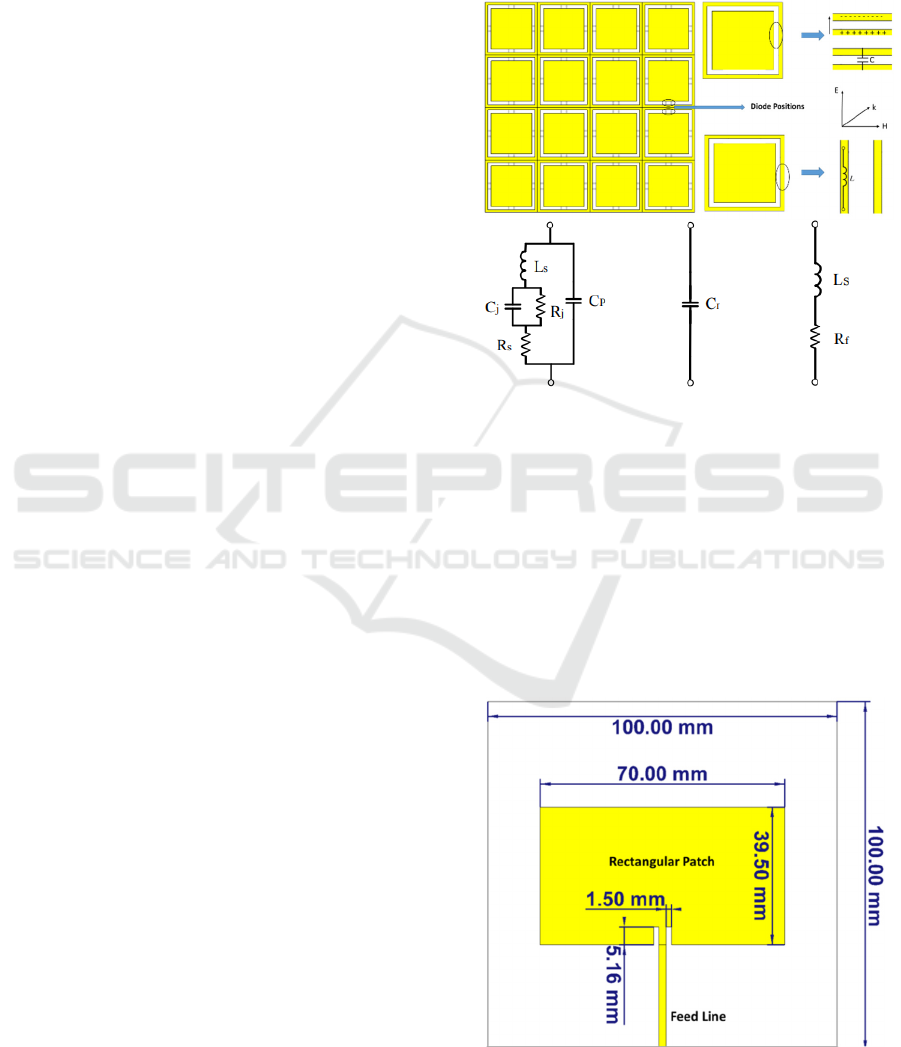
properties. Figure 1A shows the equivalent
capacitance and inductance model of a structure
designed as an ESS in an electromagnetic wave
environment. As can be seen here, the gaps between
the metal conductors exhibit capacitance properties,
while the metal conductors exhibit inductance
properties. Figure 1B shows the equivalent circuit
model of the PIN diodes used in ESS structures and
simplified representations of them in the OFF and ON
states. Here, the diodes are represented by a
capacitance when OFF state, and when the diodes are
triggered or ON state by the HPM, they are
represented by an inductance and a low resistance
connected in series (K. Wang et al., 2017).
Figure 1: A) Representation of the structures of the ESS
surface in the electromagnetic wave environment with
equivalent capacitance and inductance. B) Equivalent
circuit model of a PIN diode, simplified circuit
representation in the OFF and ON states, from left to right,
respectively (K. Wang et al., 2017).
The model of antenna and ESS were designed by
using CST Microwave Studio. Antenna was designed
on the Rogers RT5880 with the thickness of 1.52 mm.
Top view of antenna and other related design
specifications are displayed in Figure 2.
Figure 2: Top view of the antenna and its dimensions.
PIN
OFF
ON
(A)
(B)
Energy Selective Surface Superstrate on Antenna both Gain Enhancement and HPM Protection
177
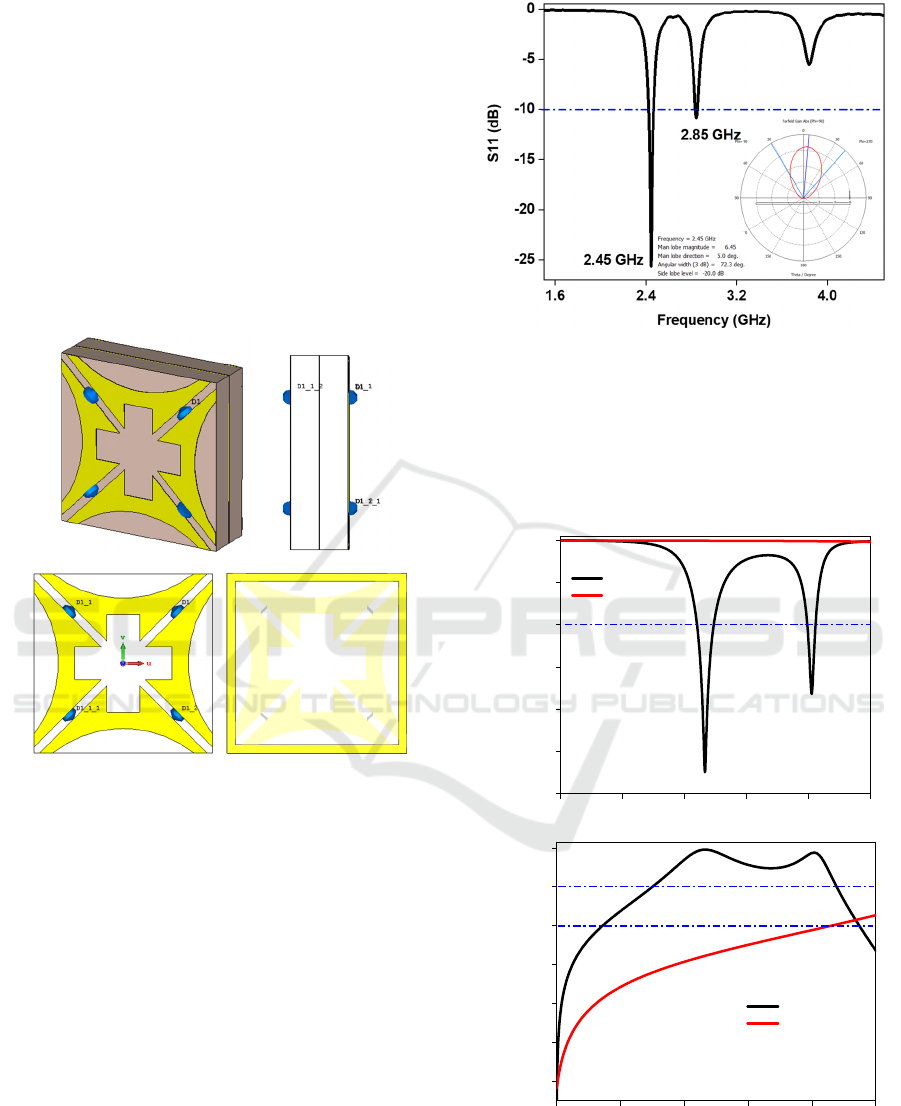
The ESS structure has been designed on the FR-4
substrates with 1.6 mm thicknesses as double layers.
While Figure 3A display ESS unit cell for 3D and side
views, Figure 3B indicates front-back and middle
layers. The dimension of the substrate was
determined as 12 mm. The cross length and width on
the front surface were 6.5 mm and 3.5 mm. The radius
of side circles was 6.5 mm. The distance between the
layers, which are diode placed, is 0.8 mm. The square
ring width in middle is determined 0.5 mm after
optimization of all parameters. The unit cell was used
to obtain superstrate array with 12 × 12 on the antenna
to test antenna performance in the case of
transmission and reflection.
Figure 3: A) 3D (left) and side (right) view and B) front-
back and middle layers of the designed ESS unit cell
3 RESULTS AND DISCUSSION
The return loss (S
11
) graph of antenna has been
illustrated in Figure 4. The inset of Fig. 4 exhibits
polar radiation pattern of antenna for 2.45 GHz centre
frequency. The main lobe magnitude for linear
scaling is 6.45 with 5 degrees direction. Side lobe
level of the antenna is -20 dB. The efficiency of the
antenna was determined to be 88.25%.
The transmission characteristics of ESS unit cell
is shown in Figure 5 with return loss and transmission
coefficient (S
21
) in the case of when the diodes are in
the OFF and ON states. The equivalent capacitance
(C) is determined as 0.2 pF and 0, respectively, in
these states. The ESS has two transmission bands in
the centre frequency of 2.40 GHz and 4.05 GHz.
When the diodes are in the ON state, the ESS provides
Figure 4: S
11
graph of the antenna. The inset shows the polar
radiation pattern at 2.45 GHz
shielding efficiency less than -25 dB at approximately
2.40 GHz and less than -20 dB for a wide band of 0-
4 GHz. The insertion loss for transmission is obtained
to be -0.39 dB. The obtained results are good
agreement with literature (Zhou et al., 2021).
Figure 5: A) S
11
and B) S
21
graphs of ESS unit cell for
ON/OFF diode states.
012345
-30
-25
-20
-15
-10
-5
0
4.05 GHz
S11 (dB)
Frequency (GHz)
C=0.2 pF
C=0
2.40 GHz
012345
-60
-50
-40
-30
-20
-10
0
S21 (dB)
Fre
q
uenc
y
(
GHz
)
C=0.2 pF
C=0
(A)
(B)
(A)
(B)
ICEEECS 2025 - International Conference on Advances in Electrical, Electronics, Energy, and Computer Sciences
178
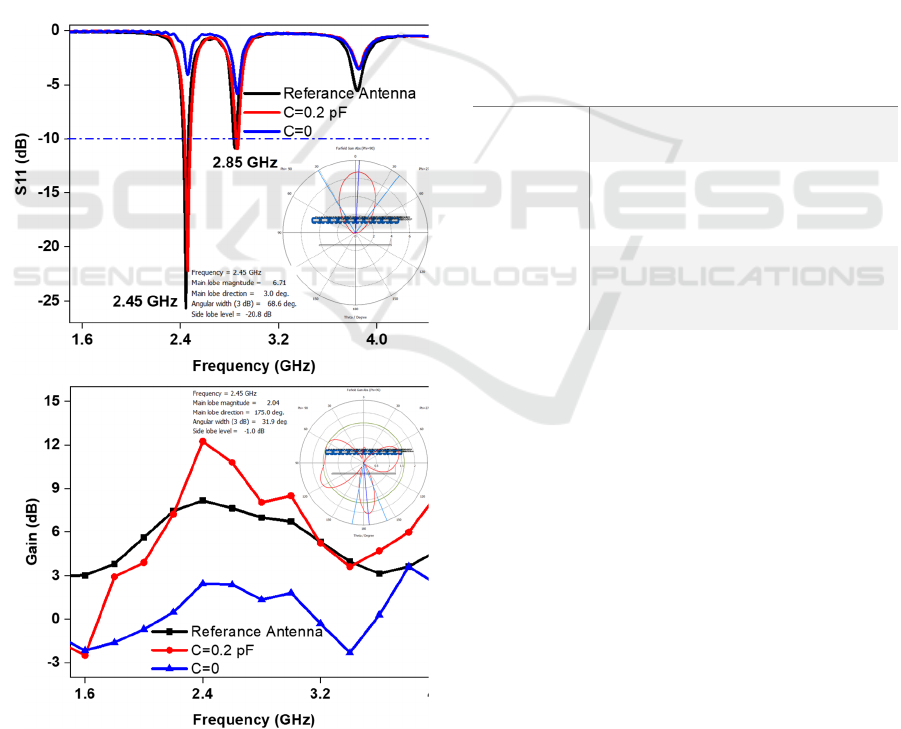
The ESS unit cells were transformed the array and
used as superstrate layer on the antenna by a distance
of 32 mm. Figure 6A shows S
11
graphs of the
reference antenna and antenna-superstrate system.
When the diodes are in the OFF state (C=0.2 pF), the
S
11
profile almost was not affected from the
superstrate layer and the radiation pattern almost did
not change much. Main lobe is increased from 6.45 to
6.71. In the case of triggering or in the ON state of the
diodes, the transmission is declined. Figure 6B shows
peak gain graphs of the reference antenna and
antenna-superstrate system. Whereas the gain of
reference antenna is obtained as 8.09 dBi, the peak
gain increased to 12.24 dBi with ESS superstrate for
diodes were in the OFF state. When the diodes are in
the ON state in the ESS superstrate, the protection
mode has been activated and gain decrease to 2.45
dBi as shown in the broadband gain graphs at 2.45
GHz frequency.
Figure 6: A) S
11
graphs of antenna with ESS superstrate. B)
Broadband gain graphs of reference antenna and antenna-
superstrate system for the case of diodes are in the ON and
OFF states.
Table 1 indicates performance of the reference
antenna and antenna-superstrate systems for diodes
are in the ON state. These values were obtained from
3D Farfield plots of antennas. While the resonance
frequency did not change with antenna types, the S
11
parameters and efficiency of antenna slightly changed
for superstrate layer with diodes were in the OFF
state. However, the S
11
parameter increased -4.13 dB
and gain decreased to 2.04 dBi with 175 degrees after
diodes were in the ON state (Inset of Figure 6B).
Furthermore, the bandwidth of the antenna increased
from 44.00 MHz to 48.40 MHz by ESS as superstrate
layer. These results confirm enhancement of the
antenna performance in the transmission states and
protection of antenna in case of HPM.
Table 1: Performances of the antennas with and without
superstrate for the diodes are in the ON or OFF states
Antenna
S
11
(dB)
Freq.
(GHz)
Efficiency
(%)
Gain
(dBi)
BW
(MHz)
Reference
Antenna
-25.61 2.44 88.25 8.09 44.00
A
ntenna
with
Superstrate
(OFF State)
-22.28 2.46 79.23 8.26 48.40
Antenna
with
Superstrate
(ON State)
-4.13 2.46 30.84 2.04 -
4 CONCLUSIONS
We designed double-layer ESS structures was
motivated by two primary goals: enhancing the
antenna's gain in the presence of low-power
electromagnetic waves and ensuring its protection
against HPM or EMP attacks. The design of antenna
incorporates a rectangular patch with a line feed using
a Rogers RT5880 substrate for the 2.45 ISM band.
We placed the ESS layers with arrays above the
antenna as a superstrate layer. The results show that
ESS superstrate layers (diodes are in the OFF states)
can boost antenna gain up to 12.24 dBi in the
transmission band without change other antenna
parameters and shield antenna against HPM when the
diodes are in the ON state. Thus, the proposed ESS
structure serves as both a performance-enhancing
superstrate and a protective layer against high-power
electromagnetic threats.
(A)
(B)
Energy Selective Surface Superstrate on Antenna both Gain Enhancement and HPM Protection
179

ACKNOWLEDGEMENTS
Authors would like to thanks Kocaeli University BAP
Coordination Unit, project number FDK-2024-3576.
REFERENCES
Abdelaziz, A., Mohamed, H. A., & Hamad, E. K. I. (2023).
Performance analysis of double-face logarithmic spiral
metamaterial superstrate for full enhancement of
circularly polarized 5G spiral patch antenna
investigated using characteristic mode analysis.
International Journal of Microwave and Wireless
Technologies, 15(1), 129–142.
https://doi.org/10.1017/S1759078722000113
Chatterjee, A., Dey, P., Roy, K., & Parui, S. K. (2024). A
Monolayer Frequency‐Selective Surface for Wideband
Shielding Application with Adequate Out‐of‐Band
Separation and Angular Stability. International Journal
of Antennas and Propagation, 2024(1).
https://doi.org/10.1155/2024/6692659
Dey, S., & Dey, S. (2023). Broadband high gain cavity
resonator antenna using planar electromagnetic
bandgap (EBG) superstrate. International Journal of
Microwave and Wireless Technologies, 15(1), 90–101.
https://doi.org/10.1017/S1759078721001768
Gong, W., & Zhang, W. (2021). Design of Energy Selective
Surface with Ultra-wide Protection Band. Proceedings
of the 2021 Cross Strait Radio Science and Wireless
Technology Conference, CSRSWTC 2021, 106–108.
https://doi.org/10.1109/CSRSWTC52801.2021.96316
08
Hu, N., Zhu, X., Wang, H., Yin, H., & Xu, Y. (2024).
Design and analysis of response threshold of energy
selective surface based on serial LC circuits.
International Journal of Microwave and Wireless
Technologies, 16(7), 1181–1186.
https://doi.org/10.1017/S1759078724000771
Huang, R., Liu, J., & Liu, C. (2022). A Design of Pluggable
High Power Microwave Protection Device in
Waveguide. 2022 IEEE 9th International Symposium
on Microwave, Antenna, Propagation and EMC
Technologies for Wireless Communications (MAPE),
292–295.
https://doi.org/10.1109/MAPE53743.2022.9935211
K.Sumathi, Lavadiya, S., Yin, P. Z., Parmar, J., & Patel, S.
K. (2021). High gain multiband and frequency
reconfigurable metamaterial superstrate microstrip
patch antenna for C/X/Ku-band wireless network
applications. Wireless Networks, 27(3), 2131–2146.
https://doi.org/10.1007/s11276-021-02567-5
K, A. S. B., & Pradeep, A. (2022). Complementary
Metamaterial Superstrate for Wide Band High Gain
Antenna. 2022 IEEE Wireless Antenna and Microwave
Symposium (WAMS), 1–5.
https://doi.org/10.1109/WAMS54719.2022.9847735
Kangeyan, R., & Karthikeyan, M. (2024). Circularly
polarized implantable MIMO antenna for skin, brain
and heart implantation with wide axial ratio bandwidth.
International Journal of Communication Systems,
37(10). https://doi.org/10.1002/dac.5778
Luo, Z., Shan, X., Ren, X., Wu, K., Chen, Y., Hong, L., Ma,
H. F., Cheng, Q., & Cui, T. J. (2023). Active
Metasurface Absorber for Intensity- Dependent
Surface-Wave Shielding. IEEE Transactions on
Antennas and Propagation, 71(7), 5795–5804.
https://doi.org/10.1109/TAP.2023.3269160
Melouki, N., Hocini, A., Fegriche, F. Z., PourMohammadi,
P., Naseri, H., Iqbal, A., & Denidni, T. A. (2022). High-
Gain Wideband Circularly Polarised Fabry–Perot
Resonator Array Antenna Using a Single-Layered
Pixelated PRS for Millimetre-Wave Applications.
Micromachines 2022, Vol. 13, Page 1658, 13(10),
1658. https://doi.org/10.3390/MI13101658
Nguyen, D., & Seo, C. (2023). An Ultra-Miniaturized
Circular Polarized Implantable Antenna With Gain
Enhancement by Using DGS and Holey Superstrate for
Biomedical Applications. IEEE Access, 11, 16466–
16473.
https://doi.org/10.1109/ACCESS.2022.3174078
Pannetier-Lecoeur, M., Fermon, C., Biziere, N., Scola, J.,
& Walliang, A. L. (2007). RF Response of
Superconducting-GMR Mixed Sensors, Application to
NQR. IEEE Transactions on Applied
Superconductivity, 17(2), 598–601.
https://doi.org/10.1109/TASC.2007.898056
Qin, D., & Zhang, W. (2019). Design of Energy Selective
Surfaces with Wide Reflection Band. 2019 Computing,
Communications and IoT Applications (ComComAp),
425–427.
https://doi.org/10.1109/ComComAp46287.2019.9018
811
Wang, K., Liu, P., Liu, H., & Meng, J. (2017). A
miniaturized, self-actuated, energy selective spatial
filter. 2017 IEEE 17th International Conference on
Communication Technology (ICCT), 1689–1692.
https://doi.org/10.1109/ICCT.2017.8359918
Wang, L., Tang, Z., Bao, H., & Ding, D. (2022). An
Electromagnetic-Plasma Fluid Model Simulation of
Waveguide Plasma Limiter Filled With Different
Easily Ionized Inert Gas. IEEE Transactions on Plasma
Science, 50(10), 3839–3847.
https://doi.org/10.1109/TPS.2022.3205968
Yang, C., Liu, P. G., & Huang, X. J. (2013). A novel
method of energy selective surface for adaptive
HPM/EMP protection. IEEE Antennas and Wireless
Propagation Letters, 12, 112–115.
https://doi.org/10.1109/LAWP.2013.2243105
Zhang, J., Lin, M., Wu, Z., Ding, L., Bian, L., & Liu, P.
(2019). Energy Selective Surface with Power-
Dependent Transmission Coefficient for High-Power
Microwave Protection in Waveguide. IEEE
Transactions on Antennas and Propagation, 67(4),
2494–2502.
https://doi.org/10.1109/TAP.2019.2894274
Zhou, L., Liu, L., & Shen, Z. (2021). High-Performance
Energy Selective Surface Based on the Double-
Resonance Concept. IEEE Transactions on Antennas
ICEEECS 2025 - International Conference on Advances in Electrical, Electronics, Energy, and Computer Sciences
180

and Propagation, 69(11), 7658–7666.
https://doi.org/10.1109/TAP.2021.3075548
Zurauskiene, N., Balevicius, S., Zurauskaite, L., Kersulis,
S., Stankevic, V., & Tolvaisiene, S. (2013).
Nanostructured Manganite Films as Protectors Against
Fast Electromagnetic Pulses. IEEE Transactions on
Plasma Science, 41(10), 2890–2895.
https://doi.org/10.1109/TPS.2013.2269480
Energy Selective Surface Superstrate on Antenna both Gain Enhancement and HPM Protection
181
