
Implementation of Serious Games as an Interactive Media to Improve
Fullball Recognition
Nicholas Martin, Raffel Nathanael, Thomas Aquinas Rai Tambas and Galih Dea Pratama
Game Application & Technology Program, Computer Science Department, School of Computer Science,
Bina Nusantara University, Jakarta, Indonesia
Keywords: Fullball, Serious Game, Sport Awareness, Interactive Media, Game Development Life Cycle.
Abstract: Fullball is a new sport from Indonesia combining elements of basketball and football, and it is currently facing
a problem where it remains largely unknown to the public throughout the world, even in Indonesia where the
sport is created, though there are communities dedicated to this sport in several cities in Indonesia. Serious
game is a game that educate and train people for the sake of fixing real-world problems. This study proposes
a serious game as an interactive medium to introduce Fullball and improve public understanding of its rules
and benefits. Developed using the Game Development Life Cycle (GDLC) method with Unity and Blender,
the game’s effectiveness is evaluated through a Game Experience Questionnaire (GEQ). The results are
expected to prove the effectiveness of serious game as a media to promote and spread word about Fullball to
the public. The pre-test and post-test questionnaire showed a significant improvement of the respondents
understanding of Fullball’s rules after playing Fullball Madness, with the pre-test questionnaire having a mean
of 42.90% correct answer regarding Fullball’s knowledge questions which increases to 87.41% from post-test
questionnaire data after playing Fullball Madness, this is the first sign that shows that the Fullball serious
game is effective.
1 INTRODUCTION
Sports play a vital role in human life, offering both
entertainment and physical benefits (Abdullah,
2023). Among the many types of sports worldwide,
Fullball is a newly developed sport from Indonesia
that combines elements of basketball and football.
Players can score by either kicking the ball into a goal
or throwing it onto a small board above the goal (the
"target"). Each team consists of five players, assigned
specific roles: hustler, midlaner, sideliner, and
frontliner (IDN Times & Alatas, 2024).
Despite its unique concept, Fullball remains
largely unknown—even within Indonesia, its country
of origin. While small communities exist in cities like
Jakarta and Bandung, broader public awareness is
still minimal. Most people have never heard of
Fullball, and those who have often lack interest or
understanding due to limited access to clear rules and
information (IDN Times & Alatas, 2024).
With the advancement of digital technology,
serious games offer a promising solution to increase
awareness. A serious game is a digital application
designed for educational purposes while maintaining
entertaining gameplay (Kane, 2021). Several studies
have proven the effectiveness of serious games in
education and physical training. Examples include:
games used to teach physics (Richter & Kickmeier-
Rust, 2025), promote wellness through exergaming
(Sinnemäki et al., 2025), enhance surgical training
(Topalli et al., 2025), and improve physical education
using gamified methods (El-Tanahi et al., 2023)
(Sotos-Martínez et al., 2023). These examples show
how gamification can support learning and
engagement in various fields.
This study aims to apply that concept to Fullball
by developing a serious game called Fullball
Madness to introduce and explain the sport to the
public (Ferriz-Valero et al., 2020), (Camacho-
Sánchez et al., 2023). The research evaluates the
game's effectiveness in raising awareness and
explores its potential to increase public interest
(Richter & Kickmeier-Rust, 2025), (Feng et al.,
2023). The expected outcomes include both
theoretical contributions to sports promotion through
digital media (Abdullah, 2023) and practical
recommendations for developers and sports
Martin, N., Nathanael, R., Rai Tambas, T. A. and Pratama, G. D.
Implementation of Serious Games as an Interactive Media to Improve Fullball Recognition.
DOI: 10.5220/0014363900004928
Paper published under CC license (CC BY-NC-ND 4.0)
In Proceedings of the 1st International Conference on Research and Innovations in Information and Engineering Technology (RITECH 2025), pages 175-183
ISBN: 978-989-758-784-9
Proceedings Copyright © 2025 by SCITEPRESS – Science and Technology Publications, Lda.
175
communities in using games as promotional tools
(Kane, 2021), (Richter & Kickmeier-Rust, 2025).
2 METHODOLOGY
This section will explain the methods used for the
research on this paper. There are two methods, the
development method, which will explore the multiple
stages of creating a serious game; And the next one is
evaluation method which will evaluate through
multiple questionnaires.
2.1 Development Method
The development of the Fullball serious game
follows the Game Development Life Cycle (GDLC),
a structured framework that ensures a systematic and
organized development process. GDLC consists of
several stages: Concept, Pre-production, Production,
Testing, Release, and Post-release (Luay, Asriyanik,
& Apriandari, 2024), (Ariyana et al., 2022). This
research focuses on the stages up to the Testing phase,
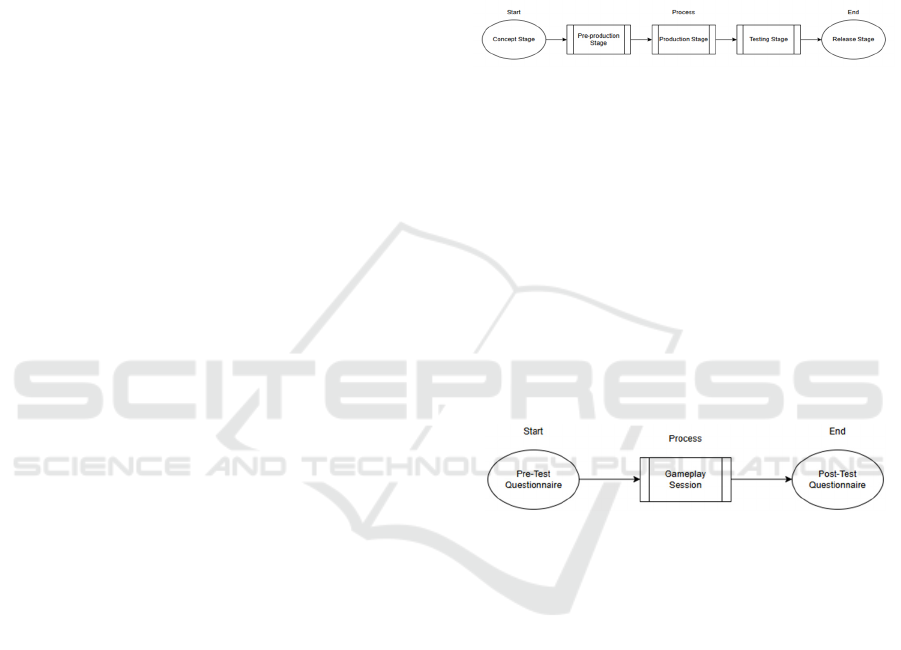
as the game has not yet been publicly released. Figure
1 illustrates the adapted GDLC workflow used in this
study.
1. Concept Stage: In this phase, the core
vision of Fullball was established: to
introduce and promote the sport of Fullball
to local communities, with teenagers as the
primary target audience. The game was
designed for the PC platform to maximize
accessibility and ease of testing.
2. Pre-production Stage: The team created a
Game Design Document (GDD) outlining
gameplay mechanics, level structure, and
visual design concepts. The MDA
framework was adopted to align game
mechanics, player dynamics, and aesthetic
goals. Key technologies and tools—Unity
for game development and Blender for 3D
modeling—were selected during this stage.
3. Production Stage: The game was
developed using Unity, while Blender was
used to create and refine 3D assets. Core
features such as scoring system, character
movement, multiplayer mode were
implemented in this phase.
4. Testing Stage: Testing was conducted
iteratively. The development team initially
tested the game internally, followed by
informal external testing involving peers.
Feedback from testers was used to identify
bugs, refine mechanics, and adjust visual
elements, and the process was repeated until
the game reached a satisfactory level of
quality.
5. Release and Post-release: As this project
remains in the testing stage, the game has not
yet been publicly released. Post-release
updates and player-driven iterations will be
considered in future development.
Figure 1: Game Development Method Flowchart.
The project started with defining objectives and
core mechanics. In pre-production, gameplay and
visuals were designed. Unity was used to develop the
game, while Blender handled 3D modeling and
animation (Luay, Asriyanik, & Apriandari, 2024).
2.2 Evaluation Method
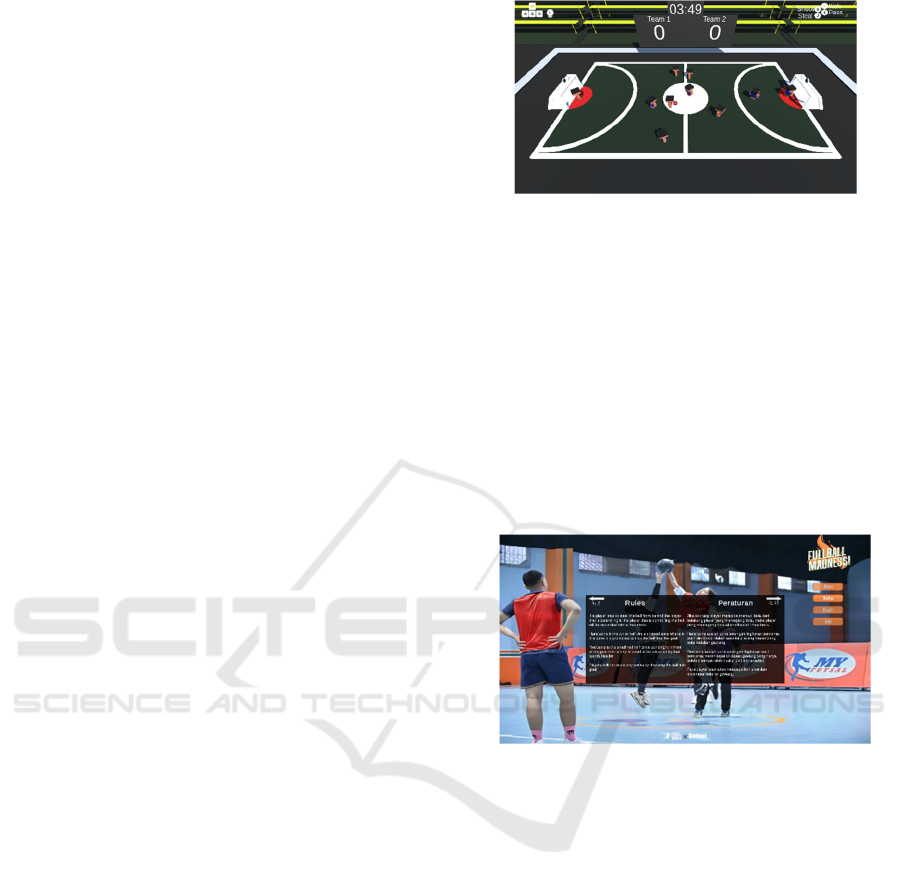
A multi-group GEQ evaluation with pre- and post-
tests is used to assess the game’s effectiveness in
increasing Fullball’s recognition (Figure 2).
Respondents are aged 18–35, and the evaluation
occurs in three phases.
Figure 2: Evaluation Method Flowchart.
1. Pre-test: Respondents will be asked to complete
a questionnaire regarding their knowledge of
Fullball before playing the game.
2. Gameplay Session: Respondents will play the
serious game that has been developed to
introduce Fullball to them.
3. Post-test: After playing, respondents will again
be asked to fill out a questionnaire to measure
changes in their understanding of Fullball and
provide feedback on their gameplay experience
(Law, Brühlmann, & Mekler, 2018).
This study also uses the Game Experience
Questionnaire (GEQ) to evaluate key gameplay
aspects: Immersion, Flow, Competence, Challenge,
Negative Affect, and Positive Affect (Law,
Brühlmann, & Mekler, 2018). These metrics help
assess player experience and support Fullball
Madness’s role as an engaging medium to introduce
Fullball to a broader audience.
RITECH 2025 - The International Conference on Research and Innovations in Information and Engineering Technology
176
3 RESULT AND DISCUSSION
In this section, the Fullball serious game made in
Unity will be shown and have its features explained.
The results of the evaluation done through multiple
questionnaires will also be analyzed to determine
whether the Fullball serious game successfully
increases the recognition of Fullball sport or not.
3.1 Development Result
The development of Fullball Madness followed the
Game Development Life Cycle (GDLC), progressing
through the Concept, Pre-production, Production, and
Testing stages. This section describes the results of
each stage.
1. Concept Stage: The primary objective of
Fullball Madness is to introduce and promote
the sport of Fullball to a wider audience,
particularly teenagers. This demographic was
chosen because teenagers possess the
physical capacity to engage in a sport like
Fullball and the technological literacy to
share the game with peers. The PC platform
was selected for its larger display, which
supports local multiplayer gameplay, and its
portability compared to mobile devices.
2. Pre-production Stage: The game design was
based on the official Fullball sport, using real
court layouts as references. A low-poly art
style was adopted due to time and skill
constraints, while still ensuring visual clarity
and engagement. Preliminary sketches and a
basic game design document (GDD) were
developed to plan gameplay flow, controls,
and arena designs. Unity was chosen as the
primary game engine, and Blender was used
to create custom 3D assets.
3. Production Stage: In the production phase,
core gameplay mechanics were implemented,
including local multiplayer functionality for
two players. Player One uses a keyboard
(WASD for movement, UIJK for actions),
and Player Two uses a gamepad (left joystick
for movement, right-side buttons for actions).
The game includes Fullball’s core
mechanics—such as scoring systems, penalty
rules (Free Throw, Throw-In, Corner Throw,
Penalty Kick), and arena restrictions—
faithfully adapted from the real sport. While
pivoting is not explicitly coded, players can
simulate it through movement mechanic.
Figure 3: Fullball Madness Gameplay.
4.
Knowledge Embedded in the Game:
Fullball Madness primarily serves as an
educational medium to familiarize players
with the rules and flow of Fullball. The
knowledge is presented through a bilingual
rules page, tutorial elements, and gameplay
that encourages players to apply learned
mechanics in real time. Although some
strategic elements are included, the game’s
main focus is introducing the fundamentals
of the sport rather than advanced tactics.
Figure 4: Fullball Madness Rules.
5. Testing Stage: The game underwent
multiple rounds of iterative testing with 6–7
testers. Initial tests were conducted internally
by the development team, followed by peer
testing. Feedback focused on gameplay feel
and accessibility, such as adjusting floor
friction for smoother player movement and
enlarging interface elements like tutorial text
and buttons. These refinements improved
playability and ensured a smoother user
experience.
As of this study, Fullball Madness remains in the
testing stage and has not yet been released to the
public. Post-release development and wider user
evaluation are planned for future iterations.
Implementation of Serious Games as an Interactive Media to Improve Fullball Recognition
177

3.2 Evaluation Result
Pre-test results from 31 respondents show that most
were unaware of Fullball and lacked knowledge
about its rules, indicating low initial recognition.
Table 1: Questions regarding prior experience.
QUESTION
ID
QUESTION
1
Have you ever heard of a sport called
Fullball?
2
If you have, where or who did you
hear it (Fullball) from?
3
Do you understand the rules of
Fullball?
4 Have you ever played Fullball?
Table 1 above presents respondents' initial
awareness of Fullball. For question 2, 45.20% of the
31 respondents had heard of Fullball through sources
like friends, family, and social media, as shown in
Table 2 and Figure 5.
Table 2: Answers regarding prior experience. questions.
Figure 5: Answers regarding prior experience questions.
After Fullball Madness gameplay session, the
respondents are expected to understand more about
Fullball, and it is proven by the post-test
questionnaire because it indicates improvement upon
the respondents understanding of Fullball’s
knowledge and rules.
In Table 3 below are much more in-depths
questions regarding the rules and mechanics of
Fullball that we asked the respondents twice, before
and after playing the Fullball Madness serious game.
With this we can assess how much did the
respondents are able to learn via the Fullball Madness
serious game.
Table 3: Questions regarding Fullball Knowledge.
I HAVE NOT / I
DO NOT
1 35.50% 64.50%
2 45.20% 54.80%
3 6.50% 93.50%
4 6.50% 93.50%
MIN 6.50% 54.80%
MAX 45.20% 93.50%
MEAN 23.43% 76.58%
QUESTION
ID
QUESTION
1
Fullball is a sport that combines the
element of two different sports, which
are?
2
In the beginning of the game both
teams stand on their own area, then the
referee throw the ball from the middle
of the field and the frontliner from each
team must try to take the ball. Is the
definition of?
3
This role's job is to guard the goal and
target, can move freely anywhere, and
the only role that is allowed to be in the
redzone, the name of this role is?
4
In Fullball, a team must consist of how
many players?
5
In a Fullball field there is an area
where the players are only allowed to
score by throwing the ball to the target,
this area is called?
6
How many points do you get from
throwing the ball to the opponents
tar
g
et from outside the hand zone?
7
If the ball goes out from the right or
left side of the field, it can be played
again by throwing it back into the field.
Is the definition of?
8
What is it called when a player scored
by kicking the ball to the opponents
tar
g
et from outside the hand zone?
9
Free throw is a reward for a foul that
happened in the field outside the hand
zone. Free throw itself is done where?
10
What is the term for the rule where,
after a team concedes a point, the
match resumes only after a signal from
the referee? This rule allows time for
celebration and lets the scoring team
return to their own area before play
continues.
0.00%
50.00%
100.00%
1234
PRIOR EXPERIENCE
I HAVE / I DO I HAVE NOT / I DO NOT
RITECH 2025 - The International Conference on Research and Innovations in Information and Engineering Technology
178

Table 4: Answers regarding Fullball knowledge questions.
Figure 6: Answers regarding Fullball knowledge
questions.
Figure 7: Normal distributions of correct answers from pre-
test and post-test questions.
From the normal distribution shown in Figure 7,
T-test is run on the pre-test data against a hypothetical
mean of 50 with t-statistic of -2.25 and p-value of
0.051, which suggests that the pre-test mean is not
significantly different from 50. Another test using
Mann-Whitney U test is run between pre-test and
post-test data shown in Table 4 with a result of U-
statistic of 0.0 and p-value of 0.00016, indicating that
the difference between pre-test and post-test scores
are indeed significant (Nachar, 2008).
There are also in-game experience related
questions that show positive feedback for the Fullball
Madness serious game (Table 5). The questions were
directly taken from The Game Experience journal
from Eindhoven University of Technology
(IJsselsteijn, de Kort, & Poels, 2013).
Table 5: Scoring guidelines GEQ In-Game version.
COMPONENTS
SCORE
0 1 2 3 4
COMPETENCE 0% 6.50% 22.60% 38.70% 32.30%
IMMERSION 16.50% 4.85% 12.95% 38.70% 27.40%
FLOW 14.50% 11.30% 24.20% 29.05% 21%
TENSION 33.85% 40.30% 6.50% 9.70% 9.70%
CHALLENGE 4.85% 14.55% 21% 27.45% 32.30%
NEGATIVE
AFFECT
35.50% 32.25% 14.50% 9.65% 8.10%
POSITIVE
AFFECT
0% 3.20% 16.10% 41.95% 38.70%
In Figure 8, the results suggest that most
respondents felt quite competent while playing
Fullball Madness with score 3 being most picked
(39%) showing that the serious game can help
respondents understand Fullball better and also
ensure that they feel the gameplay experience to be
enjoyable.
Figure 8: Competence scoring guidelines GEQ In-Game
version.
The results below (in Figure 9) suggest that most
respondents felt quite immersed while playing
Fullball Madness with score 3 being most picked
(38.7%) showing that the serious game can make
respondents immerse themselves in the gameplay,
showing that the gameplay experience is quite
enjoyable. However, there are few that do not feel
immersed at all, this is solid sign that Fullball
Madness is still lacking in some aspects that should
be able to invite the player to be immersed in the
gameplay and should be improved.
0.00%
50.00%
100.00%
12345678910
FULLBALL KNOWLEDGE
PRE-TEST CORRECT % POST-TEST CORRECT %
0%
20%
40%
60%
01234
SCORE
COMPETENCE
QUESTION
ID
PRE-TEST POST-TEST
CORRECT % CORRECT %
1 38.70% 87.10%
2 45.20% 83.90%
3 41.90% 93.50%
4 41.90% 93.50%
5 51.60% 93.50%
6 45.20% 87.10%
7 51.60% 87.10%
8 25.80% 87.10%
9 29% 74.20%
10 58.10% 87.10%
MIN 25.80% 74.20%
MAX 58.10% 93.50%
MEAN 42.90% 87.41%
Implementation of Serious Games as an Interactive Media to Improve Fullball Recognition
179

Figure 9: Immersion scoring guidelines GEQ In-Game
version.
The results (Figure 10) suggest that most
respondents felt the flow of the gameplay quite
smooth while playing Fullball Madness with score 3
being most picked (29.05%) showing that the
gameplay experience is smooth enough to help
players understand the core mechanics and flow of
the real game of Fullball. Unfortunately, some
players still feel that the flow of the game is not
smooth enough to represent the real Fullball sport
experience. Another sign that Fullball Madness needs
improvement to help players picture the real
experience of playing Fullball as if playing it in real
life.
Figure 10: Flow scoring guidelines GEQ In-Game version.
In Figure 11, the results suggest that most
respondents felt little to no tension while playing
Fullball Madness with score 1 being most picked
(40.3%) showing that the gameplay experience is not
stressful and puts tension on the players. By not
feeling tense, the players can focus better on
understanding the core mechanic and rules of
Fullball.
Figure 11: Tension scoring guidelines GEQ In-Game
version.
Based on Figure 12, The results show that most
respondents felt the gameplay to be challenging while
playing Fullball Madness with score 4 being most
picked (32.3%) showing that the gameplay
experience provides mechanic that can help players
felt challenged as if they are playing a real game of
Fullball.
Figure 12: Challenge scoring guidelines GEQ In-Game
version.
The illustration results from Figure 13 suggest
that most respondents felt little to no negative effect
while playing Fullball Madness with score 1 being
most picked (35.5%) showing that the gameplay
experience provides content that does not bring any
negative influence or offend any party. Ensuring that
the players can enjoy the game without needing to
worry about dangerous content within the serious
game, because the original purpose of a serious game
is to bring a positive result such as being able to teach
the players valuable learning materials.
Figure 13: Negative affect scoring guidelines GEQ In-
Game version.
0.00%
20.00%
40.00%
60.00%
01234
SCORE
IMMERSION
0.00%
10.00%
20.00%
30.00%
40.00%
01234
SCORE
FLOW
0.00%
20.00%
40.00%
60.00%
01234
SCORE
TENSION
0.00%
10.00%
20.00%
30.00%
40.00%
01234
SCORE
CHALLENGE
0.00%
20.00%
40.00%
01234
SCORE
NEGATIVE AFFECT
RITECH 2025 - The International Conference on Research and Innovations in Information and Engineering Technology
180

In Figure 14, the results illustrate that most
respondents felt the gameplay had a significant
positive effect while playing Fullball Madness with
score 3 being most picked (42%) showing that the
gameplay experience can help players understand
Fullball core mechanics, rules, real gameplay
experience.
Figure 14: Positive affect scoring guidelines GEQ In-Game
version.
Overall, the respondents show good feedback
regarding the GEQ In-game experience meaning that
the game successfully brought satisfaction and taught
the respondents something new, and that is the
Fullball sport itself. As a promotion media and an
interactive learning media, serious games are proven
to be effective.
3.3 Discussion
While Fullball Madness has a few limitations, such
as limited visual assets and the need for future updates
in line with Fullball’s evolving rules, it has proven
effective as an educational tool. Since Fullball is still
a relatively new sport, especially outside Indonesia,
the game’s continued development will be important
to maintain its relevance.
Despite these challenges, evaluation results
indicate that players gained a stronger understanding
of the sport. After gameplay, 9 out of 10 participants
correctly answered the questionnaire, showing
improved comprehension of Fullball’s rules and
mechanics. These improvements were supported by
statistical analysis, including T-test and Mann-
Whitney U test, confirming the significance of the
knowledge gain (Nachar, 2008), (Wouters et al.,
2013).
This strong correlation between the game's design
and learning outcomes is further supported by GEQ
feedback, which highlighted high levels of
immersion, enjoyment, and flow. The focus on
intuitive controls and accurate rule implementation
contributed to the game's success. Overall, Fullball
Madness has achieved its primary objective: raising
awareness and promoting understanding of Fullball
through an engaging serious game (Connolly et al.,
2012).
4 CONCLUSION
This study aimed to improve public recognition of
Fullball, a new Indonesian sport that combines
elements of basketball and football. Due to limited
exposure and promotion, Fullball has struggled to
gain popularity both locally and internationally. As a
solution, a serious game titled Fullball Madness was
developed using Unity and Blender, following the
GDLC method. Designed as an engaging and
interactive medium, the game helps players
understand the sport’s rules and mechanics through
gameplay (Laamarti, Eid, & El Saddik, 2014).
The game's effectiveness was evaluated through a
combination of pre-test and post-test questionnaires,
as well as the Game Experience Questionnaire
(GEQ), involving 31 respondents aged 18–35. Most
participants were unfamiliar with Fullball prior to the
study, yet showed a significant improvement in their
understanding after gameplay. GEQ results also
indicated positive feedback in terms of enjoyment,
engagement, and low levels of negative emotions
such as frustration (Carlier, De Backere, & De Turck,
2024) (Elvsaas et al., 2023). Statistical tests,
including a T-test and Mann-Whitney U test,
confirmed that the increase in knowledge was
significant. Overall, Fullball Madness successfully
fulfilled its goal as a serious game to introduce and
promote Fullball to a broader audience.
Despite the positive outcomes, this study had
several limitations (Gómez García et al., 2025). It did
not account for respondent demographics—such as
gender, education, or gaming background—which
could have influenced their gameplay experience.
Furthermore, the reliance on self-reported data for
both knowledge and experience introduces potential
biases, such as recall or social desirability bias.
For future research, a larger-scale study with a
more diverse sample and detailed demographic data
is recommended to enable more comprehensive
analysis (Chen, 2025). Future improvements may
also include deeper gameplay features, additional
levels or storylines, and improved evaluation tools to
further enhance user engagement and better assess
learning outcomes (Gurbuz & Celik, 2022).
0%
20%
40%
60%
01234
SCORE
POSITIVE AFFECT
Implementation of Serious Games as an Interactive Media to Improve Fullball Recognition
181

ACKNOWLEDGMENT
This article presents only the qualitative analysis of
the game; additional data is available here:
https://drive.google.com/drive/folders/19U9WDavU
RrIYGZ1CFRDM89cSVBDTHNP_?usp=sharing
Author contributions are as follows: Raffel Nathanael
led the research, data collection, and writing;
Nicholas Martin handled game programming and
design; Thomas Aquinas Rai Tambas supervised the
research and proofread the article.
REFERENCES
Abdullah, M. R. (2023). The importance of sports for public
health. International Journal of Health, 1(4), 25–28.
Alatas, A. N., & IDN Times. (2024). Mengenal Fullball,
olahraga baru revolusioner dari Indonesia. IDN Times.
https://sumut.idntimes.com/sport/arena/ari-nofal-
alatas/mengenal-fullball-olahraga-baru-yang-
revolusioner-dari-indonesia
Ariyana, R. Y., Susanti, E., Ath-Thaariq, M. R., & Apriadi,
R. (2022). Penerapan metode Game Development Life
Cycle (GDLC) pada pengembangan game motif batik
khas Yogyakarta. INSOLOGI: Jurnal Sains dan
Teknologi, 1(6), 796–807.
https://doi.org/10.55123/insologi.v1i6.1129
Camacho-Sánchez, R., Manzano-León, A., Rodríguez-
Ferrer, J. M., Serna, J., & Lavega-Burgués, P. (2023).
Game-based learning and gamification in physical
education: A systematic review. Education Sciences,
13(2). https://doi.org/10.3390/educsci13020183
Carlier, S., De Backere, F., & De Turck, F. (2024).
Personalised serious games and gamification in
healthcare: Survey and future research directions.
Frontiers in Digital Health.
Chen, C. W. (2025). Low-tech serious games in higher
education: Bridging the digital divide and enhancing
student thinking and performance. Humanities and
Social Sciences Communications, 12(1).
https://doi.org/10.1057/s41599-024-04341-2
Connolly, T. M., Boyle, E. A., MacArthur, E., Hainey, T.,
& Boyle, J. M. (2012). A systematic literature review
of empirical evidence on computer games and serious
games. Computers & Education, 59(2), 661–686.
https://doi.org/10.1016/j.compedu.2012.03.004
El-Tanahi, N., El-Adl, A., El-Kassas, H., Al-Dahshan, M.,
& Mahmoud, A. (2023). The effectiveness of
gamification in physical education: A systematic
review. International Journal of Education in
Mathematics, Science and Technology, 12(2), 406–417.
https://doi.org/10.46328/ijemst.4005
Elvsaas, I. K. O., Garnweidner-Holme, L., Habib, L., &
Molin, M. (2023). Development and evaluation of a
serious game application to engage university students
in critical thinking about health claims: Mixed methods
study. JMIR Formative Research, 7, e44831.
https://doi.org/10.2196/44831
Feng, Z., Li, J., Zhang, Y., Chen, Q., Wang, L., & Liu, H.
(2023). Behavioural design of gamification elements
and exploration of player types in youth basketball
training. Smart Learning Environments, 10(1).
https://doi.org/10.1186/s40561-023-00278-2
Ferriz-Valero, A., Østerlie, O., Martínez, S. G., & García-
Jaén, M. (2020). Gamification in physical education:
Evaluation of impact on motivation and academic
performance within higher education. International
Journal of Environmental Research and Public Health,
17(12), 1–16. https://doi.org/10.3390/ijerph17124465
Gómez García, L. D., María, G., Aranda, Z., Jesus, E., &
Concha, T. (2025). A design science approach to
mixed-methods evaluation in serious game research.
MethodsX, 14, 103299.
https://doi.org/10.5281/zenodo.15103804
Gurbuz, S. C., & Celik, M. (2022). Serious games in future
skills development: A systematic review of the design
approaches. Computer Applications in Engineering
Education, 30(5), 1591–1612.
https://doi.org/10.1002/cae.22557
IJsselsteijn, W. A., de Kort, Y. A. W., & Poels, K. (2013).
The Game Experience Questionnaire (GEQ):
Development of a self-report measure to assess the
psychological impact of digital games. Eindhoven:
Technische Universiteit Eindhoven, Department of
Industrial Engineering and Innovation Sciences.
Kane, D. (2021). An investigation to determine if sport
video games helps community college students become
interested in real-life sports. The Sport Journal.
https://thesportjournal.org/article/an-investigation-to-
determine-if-sport-video-games-helps-community-
college-students-become-interested-in-real-life-sports
Laamarti, F., Eid, M., & El Saddik, A. (2014). An overview
of serious games. International Journal of Computer
Games Technology, 2014, Article 358152.
https://doi.org/10.1155/2014/358152
Law, E. L. C., Brühlmann, F., & Mekler, E. D. (2018).
Systematic review and validation of the Game
Experience Questionnaire (GEQ): Implications for
citation and reporting practice. In CHI PLAY 2018:
Proceedings of the 2018 Annual Symposium on
Computer-Human Interaction in Play (pp. 271–283).
Association for Computing Machinery.
https://doi.org/10.1145/3242671.3242683
Luay, D. M., Asriyanik, & Apriandari, W. (2024).
Penggunaan metode GDLC (Game Development Life
Cycle) untuk mengenal bendera dunia. INFOTECH
Journal, 10(1), 40–48.
https://doi.org/10.31949/infotech.v10i1.8374
Nachar, N. (2008). The Mann–Whitney U: A test for
assessing whether two independent samples come from
the same distribution. Tutorials in Quantitative
Methods for Psychology, 4(1), 13–20.
https://doi.org/10.20982/tqmp.04.1.p013
Richter, K., & Kickmeier-Rust, M. (2025). Gamification in
physics education: Play your way to better learning.
RITECH 2025 - The International Conference on Research and Innovations in Information and Engineering Technology
182

International Journal of Serious Games, 12(1), 59–81.
https://doi.org/10.17083/ijsg.v12i1.858
Sinnemäki, J., Abrori, F. M., Prodromou, T., Lavicza, Z.,
Fenyvesi, K., & Jarvis, D. H. (2025). Exploring
educational exergames in well-being education: A
study in a Finnish primary school. International
Journal of Serious Games, 12(1), 103–120.
https://doi.org/10.17083/ijsg.v12i1.869
Sotos-Martínez, V. J., Tortosa-Martínez, J., Baena-
Morales, S., & Ferriz-Valero, A. (2023). Boosting
student motivation through gamification in physical
education. Behavioral Sciences, 13(2).
https://doi.org/10.3390/bs13020165
Topalli, D., Tokdemir, G., & Cagiltay, N. E. (2025).
Influence of gamification on skill-based training of
surgical residents. International Journal of Serious
Games, 12(1), 25–36.
https://doi.org/10.17083/ijsg.v12i1.833
Wouters, P., van Nimwegen, C., van Oostendorp, H., & van
der Spek, E. D. (2013). A meta-analysis of the cognitive
and motivational effects of serious games. Journal of
Educational Psychology, 105(2), 249–265.
https://doi.org/10.1037/a0031311
Implementation of Serious Games as an Interactive Media to Improve Fullball Recognition
183
