
Predicting Second-Hand Housing Prices in Beijing: A Comparative
Study of Machine Learning and Ensemble Models
Jia He
a
School of Information Engineering, China University of Geosciences (Beijing), Beijing, 100083, China
Keywords: Housing Price Prediction, Machine Learning, Ensemble Model, Web Crawler.
Abstract: In recent decades, the real estate market has always been an imperative force boosting China’s economic
development. Accurate housing price prediction plays a key role in policymaking and investment decisions.
Nonetheless, the traditional models often fall short when dealing with complex and nonlinear relationships.
This study focuses on predicting second-hand housing prices in Beijing using machine learning techniques.
The web crawler is used to obtain historical transaction data, then yield a dataset that includes 56,793 records
with 23 features after pre-processing in Beijing. Three models-Random Forest, XGBoost, and LightGBM-
were trained using grid-search and five-fold cross-validation. A combined ensemble model was also built to
improve the overall robustness. Evaluation and visualizations were used to compare performance. The
ensemble model outperformed the single model, followed by XGBoost, Random Forest, and LighGBM. This
paper aims to provide a new idea for house price prediction research through machine learning methods,
hoping to bring some inspiration to theoretical research and practical applications in related fields.
1 INTRODUCTION
In recent decades, the real estate industry has been a
vital engine driving economic growth in China
(Huang et al., 2021; Tang et al., 2016). Houses are not
only important fixed assets for people for either
residing or investing, but also the trading of houses
motivates plenty of related industries. Therefore,
accurate house price prediction plays a crucial role in
policy making, investment strategies, and urban
planning (Liu & Xiong, 2018). Nonetheless, due to
the multiple and non-linear factors influencing the
price--such as location, transportation convenience,
and interior decoration, the traditional linear
regression model cannot capture these features well
and give people a meaningful reference. At the same
time, with the rapid development and high reliability
of computational power (Thompson et al., 2020), this
study decides to utilize machine learning technology
to tackle these issues.
This study focuses on predicting second-hand
house prices in Beijing, the most energetic and
variable real estate market in China. To achieve this,
this study will construct advanced machine learning
models and optimize them for predictive work,
a
https://orcid.org/0009-0007-9926-2690
including Random Forest, XGBoost, and LightGBM.
Furthermore, considering each model cannot cover all
situations when prediction and there must be flaws in
some special facets, the paper will adopt an ensemble
strategy, weighted-averaging, to enhance the overall
behavior as a combined model. Eventually, the
combined model will offer significant insight into the
real estate market for homebuyers, real estate
investors, and government agencies for future plans.
The paper proceeds with the following
organization: Chapter 2 is Dataset obtained and pre-
processed, explaining how to obtain data via web
crawler, and data cleaning, feature generating, data
encoding, and normalization. Chapter 3 is Method,
presenting three models with their theories, including
Random Forest, XGBoost, LightGBM, and the
ensemble techniques. Chapter 4 is Experiment &
Analysis, elaborating details about the experimental
setup, and hyperparameter tuning by Grid Search
optimization. Chapter 5 is Results, displaying the
output of prediction. Chapter 6 is the Conclusion,
summarizing the whole study.
574
He, J.
Predicting Second-Hand Housing Prices in Beijing: A Comparative Study of Machine Learning and Ensemble Models.
DOI: 10.5220/0014363000004718
Paper published under CC license (CC BY-NC-ND 4.0)
In Proceedings of the 2nd International Conference on Engineering Management, Information Technology and Intelligence (EMITI 2025), pages 574-582
ISBN: 978-989-758-792-4
Proceedings Copyright © 2025 by SCITEPRESS – Science and Technology Publications, Lda.

2 DATASET OBTAINED AND
PREPROCESSED
2.1 Dataset Obtained
In order to obtain reliable data, this paper chooses the
Lianjia website to access historical records. Lianjia is
one of the most influential real estate transaction
companies in China, and its website includes
tremendous data on houses.
Web crawler is a technique that can automatically
traverse web pages and extract target information. Its
basic process includes web requests, getting
responses, analysing content, extracting data, and
storage. In this study, the dataset comes from a web
crawler program in Python.
Here is the explanation of the web crawler’s
working:
Step 1, setting the target website’s URL list,
making the program request them in turn. Step 2,
sending a request to the website server with headers
that include details of the terminal that sends requests,
to decline the possibility of being recognized as a
crawler. Step 3, sometimes the website requires
passing a Captcha. By finishing it manually, the
program can work continuously. However, Captcha
will only show up several times at the beginning, and
will not interrupt the program later. Step 4, receiving
web source code. Decoding source code into HTML
using the function of the Beautiful Soup package in
Python. Step 5, Search and extract the needed
information from HTML. Step 6, storing information
in Excel. Step 7, getting the next URL in the list and
enter the next circulation. The following Figure 1
shows it directly:
Figure 1: Flowchart of Crawler Program Operation (Picture
credit: Original)
2.2 Data Basic Information
After crawling, the dataset has 73,952 data. There are
20 features in total displayed in Table 1:
Table 1: Features in Dataset
Feature Ex
p
lanation Exam
p
le
Region Administrative district Haidian
Business district Surrounding commercial area Jingsong
Communit
y
S
p
ecific residential communit
y
Jin
g
ke
y
uan
Area Overall residential floor area
(
m²
)
132.0
Longitude Geographic coordinate measuring east-west position of a
communit
y
116.475053
Latitude Geographic coordinate measuring the north-south position
of a communit
y
39.885225
Layout Housing arrangement 4 bedrooms, 2 living room, 1 kitchen and 2
b
athrooms
Floor Number of floor levels
and label of it
High-floor (28 floor)
Orientation The main light-receiving surface of the housing North
Buildin
g
t
yp
e T
yp
e of construction Towe
r
Structure t
yp
e Structural material Steel-concrete
Yea
r
The time when the building was finishe
d
2008
Decoration status Interior finishing condition of housing Hardcove
r
Heating method How the housing is
heated in winte
r
Centralized heating
Predicting Second-Hand Housing Prices in Beijing: A Comparative Study of Machine Learning and Ensemble Models
575

Feature Ex
p
lanation Exam
p
le
Elevato
r
Whether or not the building has at least one elevato
r
Yes or No
Transaction
ownershi
p
Legal form of housing transaction Commercial housing
Usage Designated function of housing Villas
Years of holding How long the current owne
r
has held the property More than 5 years
Ownership Nature of housing ownership rights Non-share
d
Price Total price of housing
(×10,000 RMB)
328.0
2.3 Data Cleaning
The obtained data needs to be cleaned. By filling in
the data features, discarding partial incomplete
records, and extracting the feature keywords,
enhancing dataset quality for later data pre-processed
and modelling.
The first step is filling in the data features.
Especially, there are keywords No data shown in two
columns-Year and Heating method. Considering that
in one community, the time when the building was
constructed and the Heating method are almost the
same. For these data, searching for other data whose
Community is the same. Then, firstly take the average
number of their Year column, then replace No data
with the number in the Year column. Secondly, taking
the majority type in the Heating method column, then
replacing No data with the type in the Heating method
column.
The second step is deleting features. Given that
Community has 5809 categories and each category
has approximately 5 data only after pre-processing,
this paper decides to delete this feature because
Community will hardly offer a contribution to price
prediction. Moreover, it is not meaning to analyse
Latitude and Longitude in numerical form, so this
study deletes these two features as well.
The third step is discarding data with missing
values. The proportion of data with missing values is
relatively low like 1.03% and 0.23% in the specific
columns, so this study decides to discard these data.
Eventually, the remaining dataset has 56793
pieces of data, which is enough for training and
testing models.
2.4 Generating Features
To improve models’ behaviors significantly, this
study generated 2 key features by utilizing the
features Longitude and Latitude.
City ring zone: Refers to the housing location
based on Beijing’s ring road(e.g., 2nd Ring, 3rd
Ring). By setting points and connecting them to
outline each area on Google map, this study obtains
each point’s latitude and longitude precisely.
Therefore, we can judge each housing with their
locations belonging to which city ring zone. The
closer to the city center (inner rings), the more central
and expensive the area tends to be.
Subway: How far is the housing from the nearest
subway station. The closer to the subway station, the
more expensive the housing is relative. To obtain
each station’s location, this study wrote Overpass
Query Language and ran it on the Overpass Turbo
website, searching for all subway stations in the area
of Beijing and their latitude and longitude
coordinates, and exporting and processing them as
csv files.
Each housing’s location is compared to a dataset
including all subway stations over the coordinate of
latitude and longitude, this study uses the Geodesic
distance algorithm to transform longitude and latitude
between two points into straight-line
distance(meters), which is based on the WGS-84
ellipsoid.
For the column Layout, there are actually 4
features and this study decides to split them into 4
new features bedroom_Layout, living_room_Layout,
kitchen_Layout, bathroom_Layout. For example, 4
bedrooms, 2 living rooms, 1 kitchen and 2 bathrooms
will be separated into 4 columns, reducing the
dimensions of the dataset and increasing the
interpretability of the models.
2.5 Encoding
Map coding is a popular way to transform text into a
number, facilitating building models later. This study
adopts this way to encode every column, whose
values are text.
Business district, Construction type, and
Decoration status are encoded using the sequential
encoding method(Zaraket et al., 2006). The
remaining features are encoded by manual mapping.
There are 16 features required to be encoded.
After encoding, all the values have been numbered
now.
EMITI 2025 - International Conference on Engineering Management, Information Technology and Intelligence
576
2.6 Normalization
In this study, Z-score normalization was employed to
standardize feature values across various scales. The
normalization formula is:
𝑧=
𝑥−μ
σ
1
Where 𝑥 indicates the raw data point, μ
corresponds to the mean of the dataset, and σ refers
to the standard deviation. Eventually, the data of each
feature will be normalized to zero mean and unit
variance.
This method eliminates the negative effect of the
scale differences among variables, ensuring
comparability among variables.
3 METHOD
3.1 Random Forest
Random Forest serves as a powerful ensemble
method, which was originally introduced by Breiman
(Breiman, 2001). The reason this study chose
Random Forest is that, unlike parametric models,
Random Forest is particularly effective in handling
noisy data in high dimensions(Liaw & Wiener, 2002),
keeping flexibility and reducing variance when
predicting.
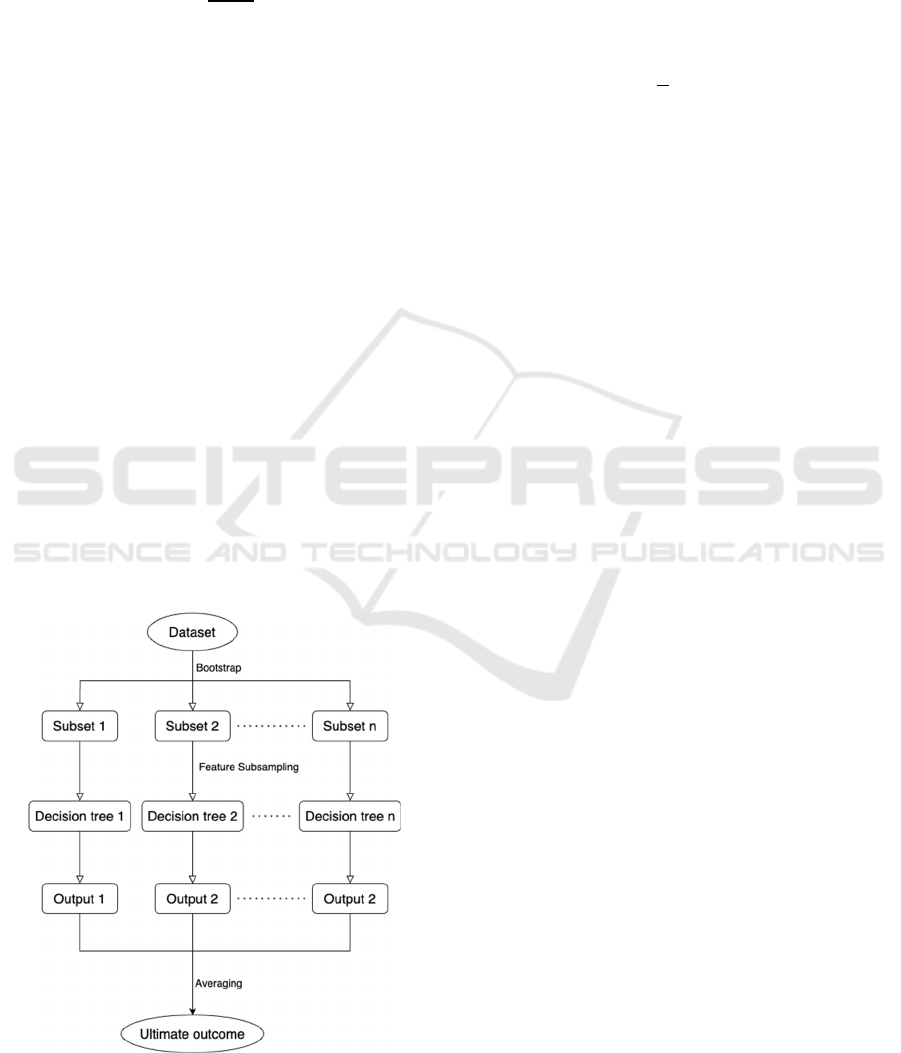
Figure 2 displays a basic schematic of how the
Random Forest works:
Figure 2: Flowchart of Random Forest (Picture credit:
Original)
Each regression decision tree is trained using a
bootstrap sample of the original data, and at each
node, a random subset of features is selected to
determine the best split, which decorates the trees and
enhances generalization performance(Biau, 2012).
Random Forest derives continuous output through
the aggregation of predictions by an array of decision
trees:
𝑦=
1
𝑇
ℎ
𝑥
2
Where T is the total tree count, with ℎ
𝑥
being
the prediction result from the t-th tree.
3.2 XGBoost
Extreme Gradient Boosting (XGBoost) is a type of
learning algorithm, recognized for its speed,
accuracy, and avoidance of overfitting over
regression tasks. Additionally, it is widely recognized
for handling structured data(Chen & Guestrin, 2016),
which is appropriate for the dataset in this study.
Unlike the method of building a decision tree in
Random Forest, XGBoost adopts a sequential
approach. The purpose of every subsequent tree is to
capture the residuals left by the prior prediction
round, which is the part that cannot be explained
former. As the number of trees, XGBoost will
gradually remedy the residuals, making the result
more precise.
The model output 𝑦
is the sum of K regression
trees applied to input 𝑥
:
𝑦
=𝑓
𝑥
,𝑓
∈ℱ
3
Each tree 𝑓
comes from a function space of
decision trees ℱ. Moreover, XGBoost minimizes the
objective function containing the loss term and the
regularization term to prevent model overfitting:
ℒ=l
y
,y
Ω
f
4
Where ℒ is the overall objective function,
𝑙
𝑦
,𝑦
is the loss between the true value 𝑦
and
predicted value 𝑦
, and Ω
𝑓
is the regularization
term that penalizes the complexity of tree 𝑓
.
3.3 LightGBM
A Light Gradient Boosting Machine (LightGBM) is a
kind of high-efficiency framework based on decision
Predicting Second-Hand Housing Prices in Beijing: A Comparative Study of Machine Learning and Ensemble Models
577
trees. LightGBM utilizes histogram-based split
finding, specializing in large-scale and high-
dimensional data(Ke et al., 2017). It is widely applied
in financial modeling and environmental forecasting
for regression problems(Wasserbacher & Spindler,
2022).
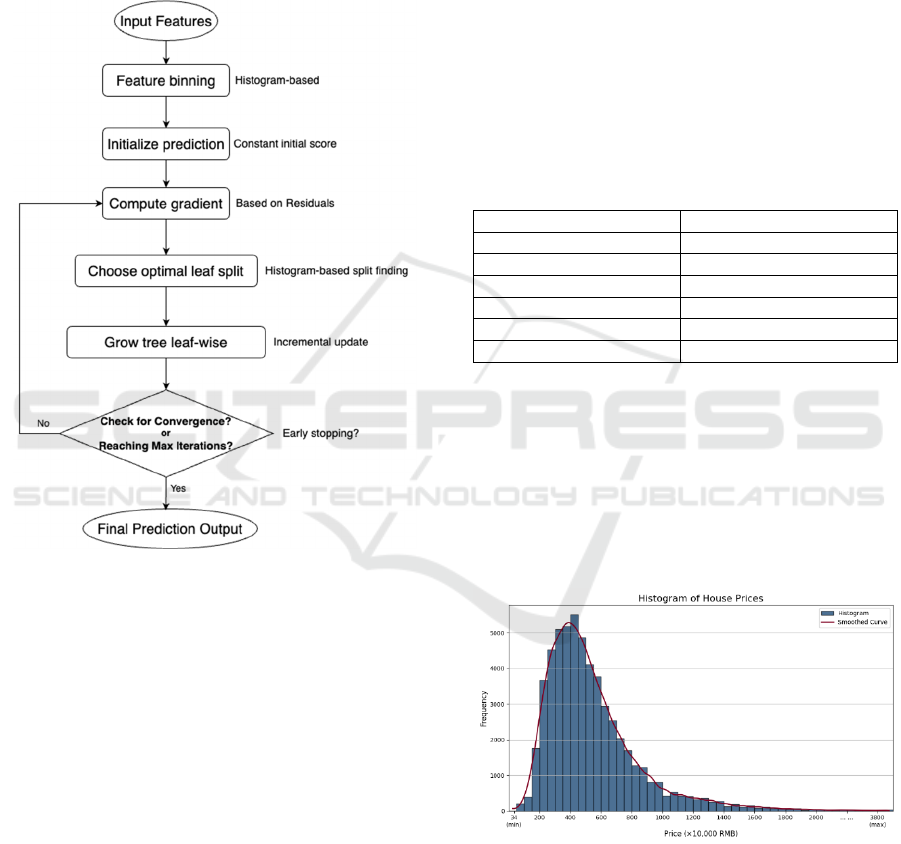
Following is a simple flowchart of the LightGBM,
shown in Figure 3:
Figure 3: Flowchart of LightGBM (Picture credit:
Original).
As the flowchart illustrates, LightGBM begins
with feature binning and initial prediction, followed
by computing gradients and selecting optimal splits.
It grows the leaf with the highest loss, allowing the
model to build deeper trees that reduce errors.
Furthermore, the model checks whether convergence
has been achieved. If not, it loops back to recompute
gradients for the next round of training.
3.4 Ensemble Method
This study uses weighted-average method to
ensemble three models.
This method in ensemble learning combines
multiple outputs by assigning each a weight based on
its performance. In this way, the final output can
generate or retain the best result from various angles
of analysis, and decrease the impact of weaker
models.
Using a numerical strategy, this study minimized
RMSE on the validation set to automatically adjust
the weight.
4 EXPERIMENT & ANALYSIS
4.1 Experimental Environment
The environment of this study includes a dataset, a
laptop. All experiments were implemented using
Pycharm and executed locally. Here is the
information in Table 2 of the laptop:
Table 2
Experiment Environment.
Item Details
Com
p
ute
r
MacBook Ai
r
Chi
p
A
pp
le M2
Memory 8GB
Storage 512GB
Operating System Sonoma 14.4
IDE P
y
Charm 2024.1.6
4.2 Data Exploration
This study depicts the Histogram of House Prices,
House Price Distribution by Region, and Feature
Correlation Heatmap for a better understanding of the
dataset
4.2.1 Histogram of House Prices
Figure 4: Histogram of House Prices (Picture credit:
Original).
Figure 4 presents the house price distribution,
measured in units of ten thousand RMB. The majority
of houses are located between 200 and 800, with a
prominent peak at around 400, showing a clear right-
EMITI 2025 - International Conference on Engineering Management, Information Technology and Intelligence
578
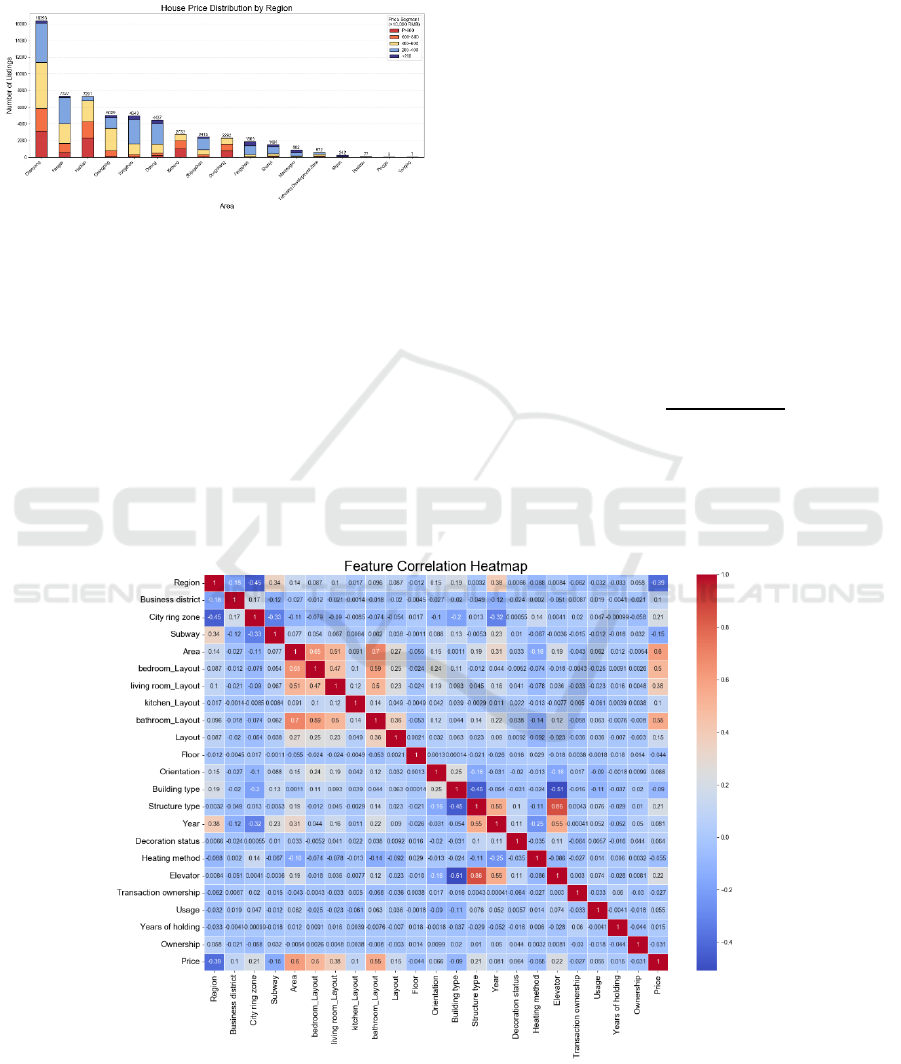
skewed pattern. A fitted smoothed line emphasizes
the decline in frequency as prices increase.
4.2.2 House Price Distribution by Region
Figure 5 House Price Distribution Chart (Picture credit:
Original).
Figure 5, a stacked histogram, vividly illustrates
the distribution of houses across five price ranges
within each region, with regions ranked from highest
to lowest in total transactions.
Chaoyang records the highest number of
transactions, with a relatively even distribution across
all price ranges except the lowest. Moreover, in
Haidian, Dongcheng, and Xicheng regions, high-
priced houses dominate, reflecting their central
location and well-developed infrastructure.
4.2.3 Feature Correlation Heatmap
Though Figure 6, is a correlation heatmap, it is clear
to see the correlation coefficient between any two
features. The price has a relatively high coefficient
with Area, Layout, and Region, indicating these
features influence price most.
5 EXPERIMENT & ANALYSIS
5.1 Experimental Environment
In order to compare each model’s performance, this
study adopts uniformly three indicators, 𝑅
, MAPE
and RMSE, to evaluate.
Coefficient of determination (𝑅
) assesses the
degree to which the variation in the target is explained
by the model. A value closer to 1 indicates better
predictive performance. Formula:
𝑅
=1−
∑
𝑦
−𝑦
∑
𝑦
−𝑦
5
where 𝑦
is the predicted value, 𝑦
is the mean of
actual values, and 𝑛 is the number of samples. All of
them represent the same meaning in the formula
down below.
Figure 6: Feature Correlation Heatmap (Picture credit: Original).
Predicting Second-Hand Housing Prices in Beijing: A Comparative Study of Machine Learning and Ensemble Models
579

Mean Absolute Percentage Error(MAPE)
reflects the mean proportionate difference between
forecasts and true values. It indicates how accurate
predictions are in relative terms—a lower MAPE
means higher accuracy. Formula:
𝑀𝐴𝑃𝐸=
1
𝑛
𝑦
−𝑦
𝑦
×100%
6
Root Mean Squared Error(RMSE), as a
standard metric in regression analysis, evaluates
model accuracy by measuring the square root of the
mean squared discrepancy between predicted and
actual values. RMSE reflects the extent of the error
between the true value and the predicted value in
numerical form. Formula:
𝑅𝑀𝑆𝐸=
1
𝑛
𝑦
−𝑦
7
5.2 Histogram of House Prices
For each model, this study uses the Grid Search
optimized algorithm to find the best combination of
parameters (Claesen & De Moor, 2015). Later,
utilizing 5-Fold Cross Validation to evaluate fairly
the hyperparameter combinations to identify the
model that generalized best to unseen data (Soper,
2021). Table 3, Table 4, Table 5 are the
hyperparameters of three models.
Table 3: Hyperparameters of Random Forest.
Hyperparameter Value Explanation
n_estimators 200 Numbe
r
of decision trees
max
_
de
p
th 10 Maximum de
p
th of each tree
min
_
sam
p
les
_
s
p
lit 2 Minimum sam
p
les to s
p
lit node
min
_
sam
p
les
_
leaf 1 Minimum sam
p
les in leaf node
Table 4: Hyperparameters of XGBoost.
Hyperparameter Value Explanation
n_estimators 400
N
umber of boosting rounds
max
_
de
p
th 9 Maximum tree de
p
th
learnin
g_
rate 0.2 Ste
p
size shrinka
g
e
subsam
p
le 0.9 Row sam
p
lin
g
ratio
colsample_bytree 1 Column sampling per tree
Table 5: Hyperparameters of LightGBM.
Hyperparameter Value Explanation
n_estimators 150 Number of trees
max_depth -1 No tree depth limit
learnin
g_
rate 0.1 Trainin
g
ste
p
size
num
_
leaves 70 Max leaves
p
er tree
Shown as three tables above, the key
hyperparameters and values of Random Forest,
XGBoost and LightGBM are different respectively.
6 RESULTS
6.1 Evaluating by Indicators
Table 6: Evaluation Results by Indicators.
Model
𝑹
𝟐
MAPERMSE Execution Time(s)
Random Forest 0.9205 8.62% 95.92 175.18
XGBoost 0.9254 7.66% 92.90 850.21
Li
g
htGBM 0.9211 9.74% 95.58 42.46
Ensemble model0.9317 7.54% 88.88 1072.24
The evaluation is shown in Table 6. In single
model performance:
The 𝑅
of XGBoost is the minimum, suggesting
it has the best interpretation for the trend of housing
price fluctuations
The MAPE and RMSE of XGBoost are the
smallest in the single model’s performance,
suggesting it gives the best prediction of housing
price.
The execution time of LightGBM is the least
when losing little performance, suggesting it is the
most appropriate for the quick prediction of numerous
cases.
As expected, the ensemble model performs best in
all cases. Notably, 𝑅
and RMSE improves a lot,
though the execution time is the longest.
6.2 Evaluating by Visualizing
Since there are over 10 thousand data points in the
testing set, plotting all of them would make the charts
too dazzling to see clearly. Therefore, this study
divides these data into 100 groups and takes their
average price to compare to the predicted price:
EMITI 2025 - International Conference on Engineering Management, Information Technology and Intelligence
580
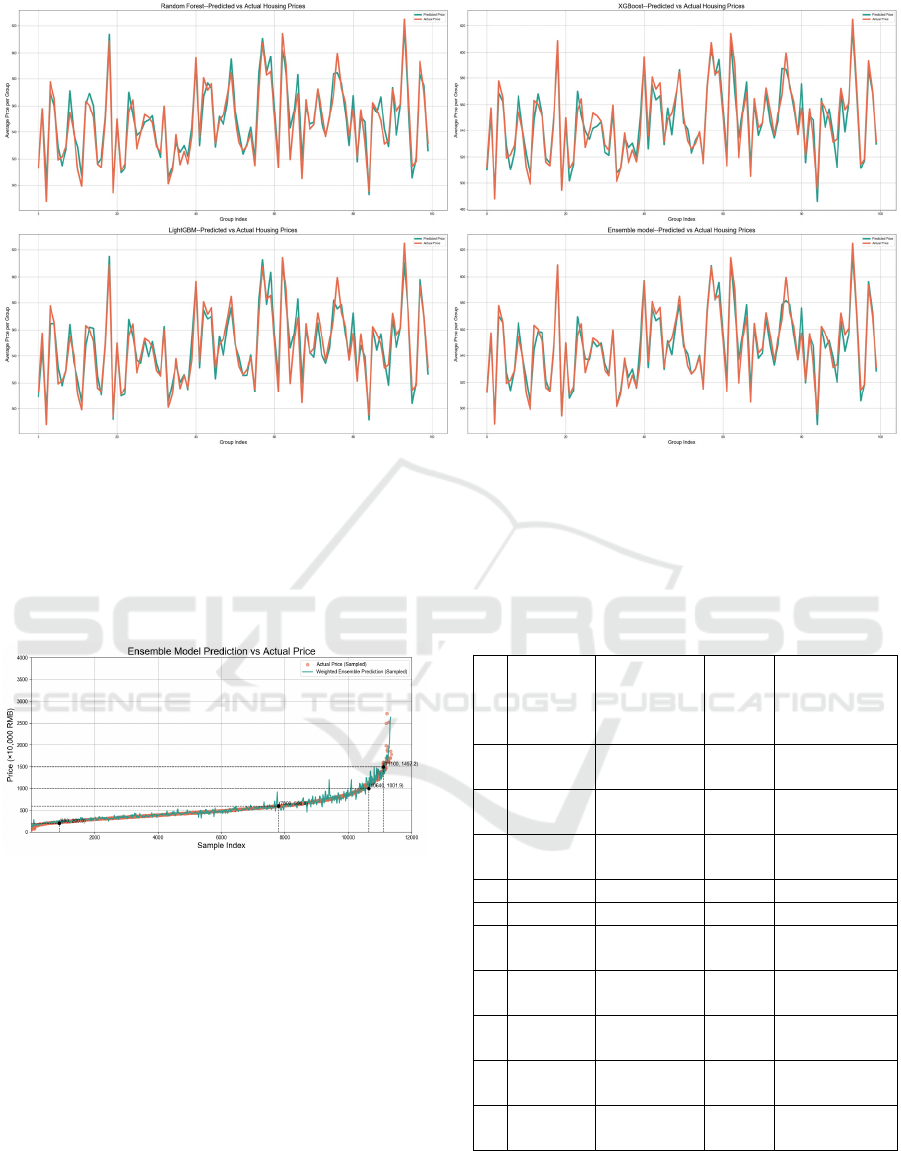
Figure 7: Evaluation Results by Visualizing (Picture credit: Original)
Figure 7 is a line chart between actual and
predicted housing prices showing the performance of
three models and the ensemble model directly. As the
charts illustrate, the effects, from best to worst, are:
Ensemble model, XGBoost, Random Forest and
LightGBM.
Figure 8 Ensemble Model Prediction (Picture credit:
Original)
Here is the final result, Figure 8, with all samples
in the testing set measured in units of ten thousand
RMB. This chart shows that in the price range
between 200 and 600, the prediction is fairly accurate.
In the range of 600-1500, the prediction presents little
fluctuations. And under 200 and beyond 1500, the
prediction can only catch the basic trend due to fewer
samples in this range.
The deviation of RMSE is mainly caused by high-
priced housing with prices above 600.
6.3 Examples
The following Table 7 shows details about
predictions on the testing set:
Table 7.
Id
Actual
Price
(×10,000
RMB)
Predicted
Price
(×10,000 RMB)
Absolute
Error
Percentage
Error
352
1
280.0 281.968126 1.968126 0.70%
784
3
580.0 514.600970
65.39903
0
11.27%
997
9
335.0 330.706546 4.293454 1.28%
4 218.0 224.593320 6.593320 3.02%
…… … … …
589
3
1080.0 1032.699834
47.30016
6
4.37%
214
0
163.5 203.736533
40.23653
3
24.60%
115
6
1700.0 1538.769007
161.2309
9
9.48%
893
4
800.0 822.051541
22.05154
1
2.756443%
381
2
485.0 482.632405 2.367595 0.48%
Table 7 above shows there are discrepancies
between actual and predicted prices, with varying
error rates.
Predicting Second-Hand Housing Prices in Beijing: A Comparative Study of Machine Learning and Ensemble Models
581

7 CONCLUSION
This study utilizes web crawler technology to obtain
a dataset for historical transactions in Beijing. After
the data is pre-processed, there are 56793 pieces of
data with 23 features. With grid-search and 5-Fold
Cross Validation, training Random Forest, XGBoost,
LightGBM and the ensemble model to offer
predictions for housing price. Afterward, this study
evaluates each model by indicators and visualization.
The effects, from best to worst, are: Ensemble
model, XGBoost, Random Forest and LightGBM. As
the research results show, the ensemble method can
outperform a single model in complex real estate
prediction tasks. This study offers a comparison of
various models and emphasizes the strengths of
ensemble approaches.
This study offers a practical machine learning
method for real estate market prediction. It offers
meaningful insight for real estate analysts and
policymakers. Moreover, it contributes to the
growing body of research applying ensemble
methods to China’s housing prices.
Though the results are great, this study has the
limitation that the omission of inflation effects in the
time span of the dataset may constrain the model’s
interpretation to capture real-estate market trends
years later. Future studies can explore deeper time-
series models like ARIMA and introduce them into
an ensemble model, promoting long-term stability in
model outcomes.
REFERENCES
Biau, G. 2012. Analysis of a random forests model. Journal
of Machine Learning Research, 13, 1063–1095.
Breiman, L. 2001. Random forests. Machine Learning,
45(1), 5–32.
Chen, T., & Guestrin, C. 2016. XGBoost: A scalable tree
boosting system. In Proceedings of the 22nd ACM
SIGKDD International Conference on Knowledge
Discovery and Data Mining (pp. 785–794).
Claesen, M., & De Moor, B. 2015. Hyperparameter search
in machine learning. arXiv.
Huang, Y., Khan, J., Girardin, E., & Shad, U. 2021. The
role of the real estate sector in the structural dynamics
of the Chinese economy: An input–output analysis.
China & World Economy, 29(1), 61–86.
Ke, G., Meng, Q., Finley, T., Wang, T., Chen, W., Ma, W.,
... & Liu, T.-Y. 2017. LightGBM: A highly efficient
gradient boosting decision tree. In Advances in Neural
Information Processing Systems, 30 (pp. 3146–3154).
Liaw, A., & Wiener, M. 2002. Classification and regression
by randomForest. R News, 2(3), 18–22.
Liu, C., & Xiong, W. 2018. China’s real estate market
(NBER Working Paper No. 25297). National Bureau of
Economic Research.
Soper, D. S. 2021. Greed is good: Rapid hyperparameter
optimization and model selection using greedy k-fold
cross validation. Electronics, 10(16), 1973.
Tang, B., Liu, C., & Li, J. 2016. An investigation into real
estate investment and economic growth in China: A
dynamic panel data approach. Sustainability, 8(1), 66.
Thompson, N. C., Greenewald, K., Lee, K., & Manso, G. F.
2020. The computational limits of deep learning. arXiv.
Wasserbacher, H., & Spindler, M. 2022. Machine learning
for financial forecasting, planning and analysis: Recent
developments and pitfalls. Digital Finance, 4, 63–88.
Zaraket, F., Aziz, A., & Khurshid, S. 2006. Sequential
encoding for relational analysis. In Proceedings of the
18th International Conference on Computer Aided
Verification (CAV) (pp. 164–178). Springer.
EMITI 2025 - International Conference on Engineering Management, Information Technology and Intelligence
582
