
The AI Generation Revolution in Open-World Games and Its
Technological Constraints
Zhiyuan He
Perkiomen School, Pennsylvania, U.S.A.
Keywords: Generative AI, Open-World Game Design, Human-Machine Collaboration.
Abstract: As open-world games evolve toward greater scale and complexity, traditional AI tools struggle to meet the
demands of dynamic environments and player-driven interactions. This has spurred growing interest in
generative AI as a means to enhance creativity, scalability, and responsiveness in game design. This article
analyzes the decision redundancy, state collapse, and labor cost dilemma faced by traditional technologies
such as behavior trees and finite state machines in a dynamic open world, revealing the fundamental
contradictions they cause, which forces developers to abandon creative solutions to maintain feasibility; Post
argument generative artificial intelligence has achieved breakthrough improvements in development
efficiency through neural symbolic architectures such as WHAM models, director actor collaboration, and
reconstruction of art production chains. This article also points out a series of technological bottlenecks that
artificial intelligence needs to face, such as the collapse of continuity narrative, the misalignment of physical
logic, and the distortion of cultural transfer, which exposes the enormous challenges that AI faces in the fields
of logical consistency, physical rules, and culture.
1 INTRODUCTION
The gaming industry is undergoing a shift from being
driven by mechanical rules to intelligent collaborative
symbiosis. Traditional development heavily relies on
logical frameworks such as behavior trees and finite
state machines. Although these techniques are classic
in closed systems, they cannot meet the dynamic
needs of modern open worlds. The fundamental
reason is that the static decision architecture cannot
respond to real-time changes in players' strategies,
which can lead to redundant decision paths in
complex scenes, and the combination of discrete
states can cause design space collapse with the
increase of interaction dimensions. This will force
creators and developers to abandon some of their
creativity, and labor costs have also become a huge
problem. The rise of artificial intelligence is
restructuring the creative paradigm, and the neural
symbol fusion architecture achieves personalized
generation of game space topology through the
dynamic coupling of the rule constraint layer and
behavior analysis layer, greatly shortening the
development cycle. The human-machine
collaborative narrative model also demonstrates great
potential for co-creation. With the help of AI, the
efficiency of the art production chain has increased by
nearly 80%. These technological breakthroughs
confirm the enormous potential of artificial
intelligence in the gaming industry.
However, there are still many problems with
current technology, such as the frame by frame
generation mechanism of diffusion models inducing
continuous narrative collapse, and the appearance of
characters undergoing illogical changes under
semantic fine-tuning; The Newtonian paradigm of
physics engines makes supernatural actions and
phenomena impossible, leading to homogenization of
combat styles and ultimately causing AI generated
images and models to deviate from popular
aesthetics. So the future of game development is
neither a retro manual paradigm nor a complete AI
takeover, but rather the establishment of a symbiotic
system between human creative thinking and
machine execution networks.
He, Z.
The AI Generation Revolution in Open-World Games and Its Technological Constraints.
DOI: 10.5220/0014362400004718
Paper published under CC license (CC BY-NC-ND 4.0)
In Proceedings of the 2nd International Conference on Engineering Management, Information Technology and Intelligence (EMITI 2025), pages 535-539
ISBN: 978-989-758-792-4
Proceedings Copyright © 2026 by SCITEPRESS – Science and Technology Publications, Lda.
535
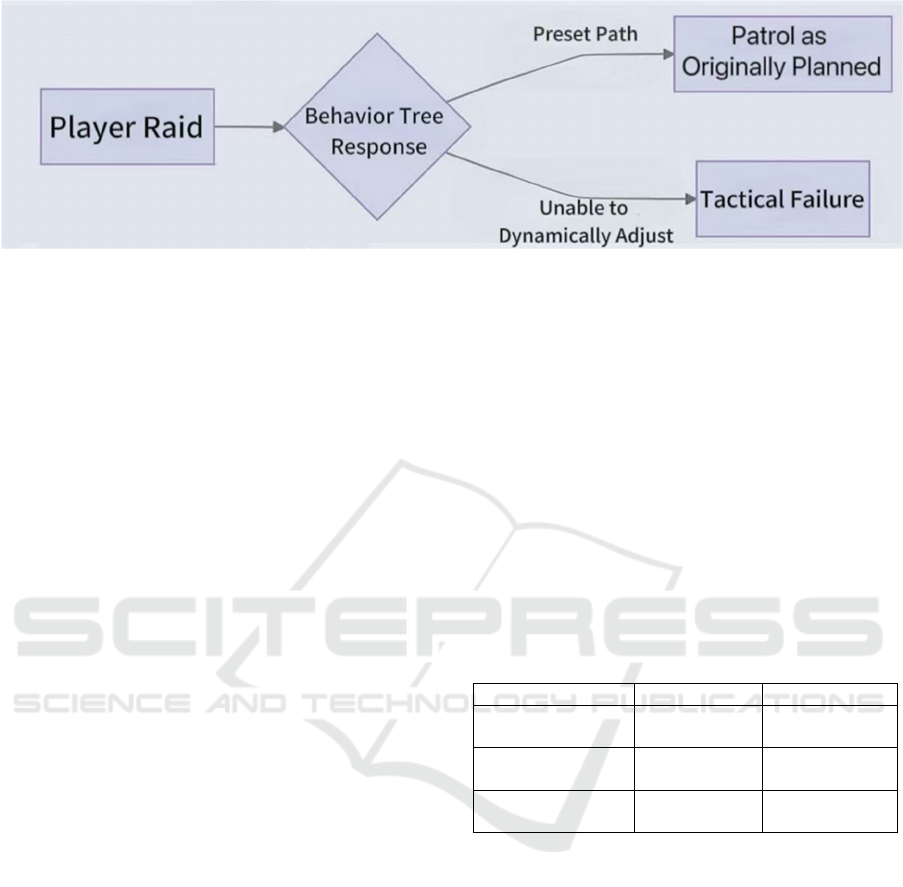
Figure 1: Behavior Tree (Picture credit: Original).
2 TRADITIONAL GAME DESIGN
2.1 Behavior Tree: Paradox of
Structured Decision Making
The behavior tree constructs a logical hierarchy
through modular nodes (Selector/Condition/Action).
For example, in StarCraft II, which people are
familiar with, it follows the decision chain of
"discovering enemies → selecting weapons →
attacking". Although this "LEGO style" architecture
enhances code reusability, it falls into a static trap as
shown in Figure 1.
Deng Yongjian’s empirical study revealed that
traditional behavior trees lead to NPC behavior
rigidity in dynamic environments due to the expansion
of conditional branches (Deng, 2014). When Elden
Ring required NPCs to adjust tactics in real-time based
on player equipment, developers were forced to write
hundreds of conditional branches - a microcosm of
how behavior trees struggle to support the complexity
of modern games(Cai, 2017; Deng, 2014)
2.2 Finite State Machine: Visualization
of Dimensional Disaster
FSM abstracts game entities into discrete states (such
as Mario's run/jump/injury) and triggers state
transitions through events. Its intuitiveness was
significant in early RPGs, but it hit a ceiling due to
exploding state combinations, particularly in fighting
games:
For example, the character "Instant Shadow" in
SNK's "King of Fighters 15" has 8 basic states, 6
superpower forms, and 4 environmental interaction
modes. The theoretical number of states is 192, which
triggers "State Collapse" during actual debugging.
Development Director Yasuyuki Oda candidly stated,
"We ultimately reduced 37% of the design proposal,
which was not a creative compromise, but a
technological massacre by FSM.". It is not difficult to
see from this that the problem faced by FSM in state
combination is catastrophic(Dong et al., 2019).
2.3 The Huge Cost of Labor
According to incomplete statistics, Rockstar Games
paid a staggering price in the development of the
remastered version of GTA5. Table 1 shows the
representative manual workloads and low reusability
in traditional game development.
Table 1: Representative Manual Workloads and Low
Reusability in Traditional Game Development.
Content t
yp
e human in
p
ut Reusabilit
y
rate
Vehicle Physical
System
≈ 3000
working hours
10-15%
Pedestrian
b
ehavior database
≈ 4500
workin
g
hours
8-12%
Random event
scri
p
t
≈ 6000
workin
g
hours
≤5%
This phenomenon highlights the shortcomings of
traditional development in terms of manpower(Fang
et al., 2017), but it also forces the industry to seek new
paradigms.
3 AI ENHANCED DESIGN:
CREATIVE LIBERATION OF
HUMAN-MACHINE
SYMBIOSIS
3.1 Technological Breakthroughs in
Generative Architecture
The WHAM model achieves topology generation
through neural symbol fusion.
EMITI 2025 - International Conference on Engineering Management, Information Technology and Intelligence
536
The WHAM model adopts a three-layer
collaborative architecture to achieve intelligent
content generation. The symbol rule layer system
ensures that the level design meets the technical
specification of a safe path length not less than 70%
of the straight-line distance through geometric
constraints. The neural understanding layer uses
behavior pattern analysis methods to accurately
identify the behavioral characteristics of players in
different strategies, such as stealth, strong attack, and
exploration. Based on the above analysis, the process
generation layer can dynamically construct a highly
personalized level topology structure.
The WHAM model can greatly improve
development efficiency and save time and costs. This
model significantly compresses the level generation
cycle, while also enriching the content(Hao, 2018)
3.2 Collaborative Creation between
Humans and AI
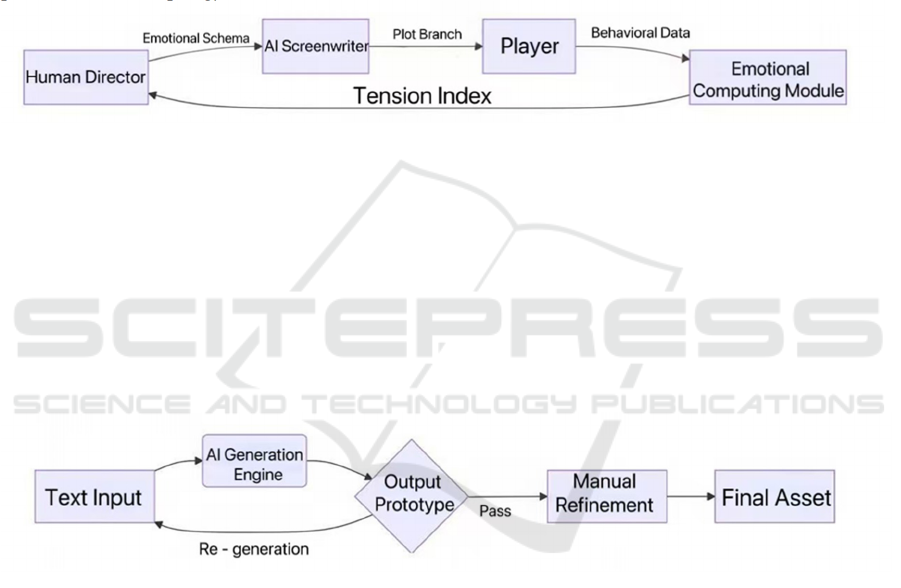
The director actor model of Microsoft GamePlot
roughly realizes the creative collaboration between
humans and AI(Dong et al., 2019). Figure 2 shows the
collaborative creation between humans and AI.
Figure 2: Collaborative Creation between Humans and AI (Picture credit: Original).
This can greatly reduce the cost of labor, but the
obvious disadvantage is that AI models lack the
ability to express emotions, which makes the dialogue
formed by AI lack dramatic tension, resulting in a
lack of emotional expression and cultural
adaptability(He, 2018)
3.3 Application of AI in the Art
Production Chain
As is well known, the traditional process involves
conceptual design, 3D modeling, and finally texture
mapping, which requires a significant amount of time
and labor costs. But if AI is applied to the art
production chain, this process becomes text
description to prototype, generation to manual
refinement, which can reduce labor costs and improve
efficiency. Figure 3 shows the AI in the art production
chain.
Figure 3: AI in the Art Production Chain (Picture credit: Original).
In the development of "Collapse: Star Dome
Railway", miHoYo reconstructed the art production
process through its self-developed AI toolchain (such
as "Star Dome Workshop"): the designer first inputs
a text description, and then the AI engine
automatically generates three versions of the basic
model, PBR material mapping, and skeleton binding
within 2 hours, compressing 98% of the basic work
hours from concept design to 3D modeling to texture
mapping in the traditional process. Finally, the artist
performs debugging and optimization. The
application of AI has compressed the total
development cycle of a single role (Qiu, 2017).
4 TECHNOLOGICAL
BOTTLENECKS AND FUTURE
PROSPECTS OF AI
4.1 Collapse of Continuous Narrative:
Breakage of Logical Chain:
The mechanism of frame by frame generation in
diffusion models lacks cross frame memory
capability (Tu & Liu, 2017). When the input prompt
word undergoes semantic fine-tuning (such as "Red
Cloak Boy" changing to "Red Clothed Boy"), the
The AI Generation Revolution in Open-World Games and Its Technological Constraints
537

model cannot recognize it as the same object,
resulting in illogical changes in the character's
appearance.
The technology blind spot AI strictly follows the
Newtonian mechanics model, while anime action
design needs to break through the laws of real physics
(such as hovering rolling, sword air shock waves, and
supernatural phenomena). This conflict leads to the
AI designed soaring motion becoming stiff and
falling due to excessive gravity simulation.
The weapon trajectory has been corrected to a
parabolic trajectory (Xu et al., 2018), losing the
unique "sharpness" of anime.
These situations have stifled creativity and
imagination in the gaming and anime fields, leading
many Japanese animators to protest that the
homogenization of character combat styles is
inevitable when AI automatically corrects "anti-joint
backflips" to regular jumps that conform to
biomechanics.
4.2 Limitations of AI Modeling
Creativity and artistry: Game modeling is not just a
technical task, it also involves a high degree of
creativity and artistry. Modelers need to transform
ideas and concepts into unique 3D models, which
requires rich imagination and aesthetic ability.
However, currently, AI still has significant
limitations in terms of creativity and artistry, and the
generated images and figures deviate from public
aesthetics(Xiao, 2020). It cannot completely replace
human creativity and aesthetics.
Flexibility and adaptability: Game modelers need
to make flexible adjustments and adaptations
according to project requirements. They not only
need to understand the needs of customers or teams,
but also transform them into models that meet the
requirements. This flexibility and adaptability are
manifestations of human intelligence and experience,
and AI is difficult to fully simulate in this regard.
Problem solving ability: During the modeling
process, various complex problems and challenges
may be encountered. A modeler needs to have
problem-solving skills and judgment, and be able to
analyze and solve technical problems in the model.
Although AI can provide assistance in certain aspects,
human judgment and decision-making abilities are
still indispensable when facing complex problems.
5 CONCLUSIONS
This article reveals the triple dilemma that traditional
rule systems face under the demands of an open
world, namely decision path redundancy, state space
collapse, and labor costs. Generative AI has been
proven to greatly improve efficiency and enrich game
content through neural symbolic architectures such as
WHAM models, director actor narrative
collaboration, and art production chain
reconstruction.
However, currently the technology still faces
significant problems such as the collapse of
continuous narrative, physical logic disorder, and the
deviation of generated images and models from
popular aesthetics. These challenges also fully
demonstrate the huge gap between algorithms and
creativity.
As mentioned in the introduction, the future of
game development is neither a retro manual paradigm
nor a complete AI takeover, but rather the
establishment of a symbiotic system between human
creative thinking and machine execution networks:
designers should act as gatekeepers of rules, defining
and planning content and ethical boundaries; AI
improves efficiency and helps designers unleash their
creativity. This human-machine symbiotic paradigm
will drive the development of games, making them an
artistic medium and reshaping the future of
interactive storytelling.
REFERENCES
Cai, L. Q. (2017). Game AI modeling and application based
on fuzzy logic inference behavior tree (Master’s thesis).
South China University of Technology.
Deng, Y. J. (2014). Design and implementation of AI
behavior tree in mobile online games (Master’s thesis).
Sun Yat-sen University.
Dong, Q., Ji, M. Q., Zhu, Y. F., & others. (2019). Air
combat decision behavior tree modeling and simulation.
Command Control & Simulation, 41(1), 12–19.
Fang, J., Yan, W. J., Deng, X. Y., & others. (2017). CGF
air combat behavior decision based on Q-learning and
behavior tree. Computer and Modernization, (5), 37–
39+44.
Hao, Y. (2018). Design and implementation of AI decision
model driven by behavior tree (Master’s thesis).
University of Chinese Academy of Sciences (Shenyang
Institute of Computing Technology, CAS).
He, W. J. (2018). Design and implementation of game AI
based on behavior tree (Master’s thesis). Chengdu
University of Technology.
EMITI 2025 - International Conference on Engineering Management, Information Technology and Intelligence
538

Qiu, X. (2017). Implementation methods of non-player
character AI in role-playing games (Master’s thesis).
South China University of Technology.
Tu, H., & Liu, H. X. (2017). An improved Q-learning
algorithm and its application in behavior tree.
Computer Applications and Software, 34(12), 235–239.
Xu, W. S., Wu, B., & Jiang, J. H. (2018). Design and
implementation of behavior tree in virtual maintenance
training system for weapon equipment. Journal of
System Simulation, 30(7), 2722–2728.
https://doi.org/10.16182/j.issn1004731x.joss.2018070
36
Xiao, Z. C. (2020). Application research of behavior tree in
autonomous driving behavior planning strategy
(Master’s thesis). Lanzhou University.
https://doi.org/10.27204/d.cnki.glzhu.2020.000663
The AI Generation Revolution in Open-World Games and Its Technological Constraints
539
