
A Study in Emotion-Aware Adaptive Interaction in Intelligent
Vehicle Cockpits
Sihui He
1,*
, Hexuan Ying
2
and Hao Zhong
3
1
School of Design, Royal College of Art, London, U.K.
2
High School Affiliated To Shanghai Jiao Tong University IB Center, Shanghai, China
3
School of Artificial Intelligence, Zhujiang College, South China Agricultural University, Guangzhou, Guangdong, China
*
Keywords: Multimodal Emotion Recognition, Intelligent Oockpit, Road Rage, Emotional Regulation.
Abstract: With the rapid development of intelligent cockpit technology in today's era, the emotional state of drivers has
become a significant factor influencing driving safety. Among these, negative emotional behaviors such as
‘road rage’ pose a significant threat to traffic safety. This study focuses on analysing the integrated application
of multi-modal emotion recognition and intelligent interaction. It first explores the causes of negative
emotions during driving and then examines the technical pathways for emotion recognition from both single-
modal and multi-modal perspectives, emphasising the advantages of multi-sensory collaboration in enhancing
recognition accuracy and response sensitivity. The study explores an emotion monitoring system based on
multi-modal perception and analyses adaptable human-machine interaction mechanisms. The aim is to
mitigate driver emotional fluctuations through proactive intervention strategies, thereby enhancing driving
safety and cabin experience. Additionally, this study identified current challenges in emotion recognition
accuracy, emotion classification dimensions. Based on this, it proposed future development directions,
including leveraging deep learning to enhance individual emotional personalisation and optimising the
collaborative mechanisms between multi-modal sensors and driving behavior big data. This study provides a
theoretical foundation and practical pathways for achieving more emotionally intelligent interaction systems,
driving the evolution of intelligent cockpits toward more humanised and emotional directions.
1 INTRODUCTION
In recent years, intelligent cockpits have gradually
become a hot topic of research in the automotive
industry and human-machine interaction field,
attracting widespread attention from all sectors of
society. With the continuous development of cutting-
edge technologies such as artificial intelligence, the
Internet of Things, and big data analysis, a series of
intelligent interaction functions such as intelligent
driving, automatic parking, and voice control have
emerged and are gradually being applied to mass-
produced models. These features not only effectively
reduce the operational burden on drivers during
driving but also significantly enhance the
convenience and safety of travel, driving the
transformation of automobiles from traditional
transportation tools to intelligent mobile terminals.
Currently, an increasing number of automakers and
technology companies are investing substantial
resources and R&D efforts into in-depth research on
intelligent driving assistance systems, striving to
integrate automation technology with human-centric
design to achieve a qualitative leap in driving
experience (Xu & Lu, 2024).
Against this backdrop, the driver's emotional
state, as a critical factor influencing driving behaviour
and road safety, has garnered significant attention
from researchers and the industry. In recent years,
emotion recognition and intervention functions have
gradually been integrated into the core design of in-
vehicle systems. Research indicates that emotion
recognition technology incorporating multimodal
data (such as facial expressions, voice tone, and
physiological signals) can significantly improve
recognition accuracy, particularly in complex and
dynamic driving scenarios, demonstrating strong
application potential. Additionally, adaptive
adjustment strategies based on real-time emotion
monitoring have been proven to effectively alleviate
negative emotions such as tension and anxiety in
drivers, reduce their cognitive load, and thereby
He, S., Ying, H. and Zhong, H.
A Study in Emotion-Aware Adaptive Interaction in Intelligent Vehicle Cockpits.
DOI: 10.5220/0014359000004718
Paper published under CC license (CC BY-NC-ND 4.0)
In Proceedings of the 2nd International Conference on Engineering Management, Information Technology and Intelligence (EMITI 2025), pages 387-393
ISBN: 978-989-758-792-4
Proceedings Copyright © 2025 by SCITEPRESS – Science and Technology Publications, Lda.
387
improve driving performance and road safety (Li,
2021).
Therefore, this paper will explore the application
value of emotion perception in intelligent cockpits,
focusing on how to achieve precise monitoring and
intelligent adjustment mechanisms for driver
emotional states. By analysing existing driver-centric
adaptive interaction system research and exploring
the complete perception-recognition-intervention
process mechanism, this study will thoroughly
analyse the feasibility and challenges of multimodal
fusion in real-world scenarios. Additionally, by
addressing the challenges faced in existing research,
this study will conduct a systematic evaluation of the
system's user acceptance, functional performance,
and human factors adaptability, thereby providing a
theoretical foundation and future outlook for more
humanised and emotionally intelligent intelligent
cockpit design.
2 ANALYSIS OF THE CAUSES OF
ROAD RAGE
Road rage refers to angry or aggressive behaviour
exhibited by drivers while driving. The causes of road
rage can generally be categorised into: age, driving
experience, driving frequency, road conditions, and
personal circumstances (Ren et al., 2021; Fan, 2024).
A study (Fan, 2024) using a binary logistic regression
model found that age and driving experience have an
inverse relationship with road rage. Among those
aged 36–48, the proportion of road rage incidents
caused by cutting in line was 55.1% of that among
those aged 18–24. while among driving frequency,
the proportion of road rage among infrequent drivers
was 66.4% of that among frequent drivers (Fan,
2024). Road conditions include traffic obstacles such
as congestion, rude behaviour such as cutting in line,
uncivil language, sudden appearances of pedestrians
or non-motorised vehicles, and dangerous behaviour.
Among these, rude behaviour is more likely to trigger
road rage than the other two. Personal circumstances
include gender, personality, family situation, and
education level. Male drivers are more prone to road
rage than female drivers; among family
circumstances, married but childless and married with
children have lower road rage probabilities than
unmarried individuals, and married with children
have lower probabilities than married but childless
individuals; among educational backgrounds,
postgraduate and undergraduate degrees are more
likely to trigger road rage (Ren et al., 2021; Fan,
2024). When driving an SUV, road rage caused by
frequent lane changes and U-turns is 56.6% higher
than in sedans, indicating that open spaces help
alleviate road rage (Fan, 2024).
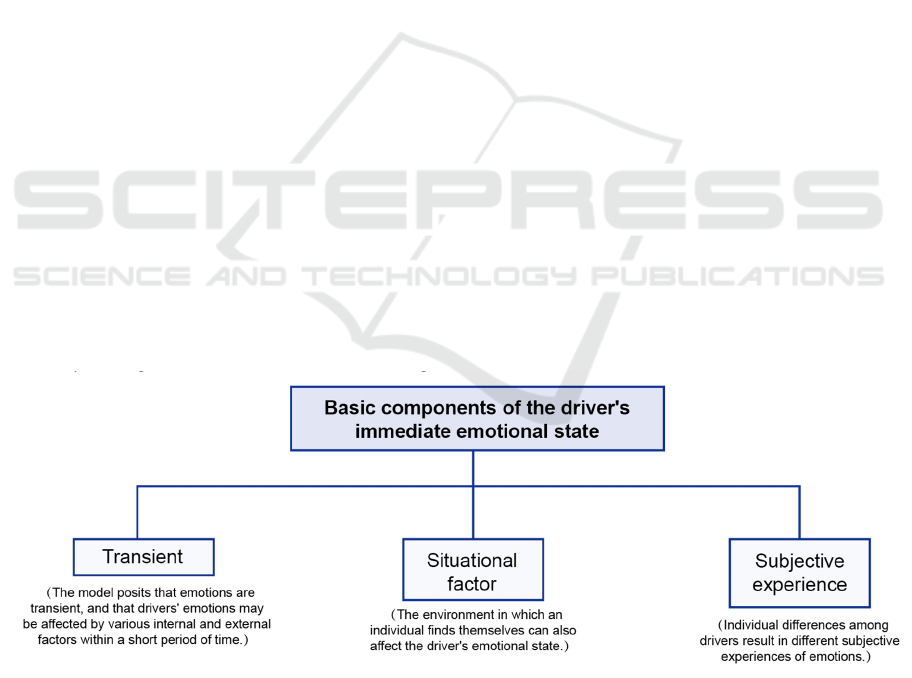
Based on the theoretical framework of the
Momentary Experience Model (as shown in Figure
1), it can be concluded that a driver's momentary
emotional state is composed of transient factors
(Cannon, 1927; Ningjian, 2024), situational factors
(Behnke & Beatty, 1981), and subjective experiences.
Therefore, by regulating a driver's momentary
emotional state, their emotional responses can be
intervened, thereby effectively alleviating the
potential risks associated with negative emotions and
enhancing overall driving safety and user experience.
Figure 1: Basic components of the driver's immediate emotional state. (Picture credit: Original)
Additionally, research has utilised the Kubler-
Ross Change Curve model (Kübler-Ross, 1973) to
simulate the detailed emotional changes associated
with road rage in traffic congestion scenarios (as
shown in Figure 2). By identifying the psychological
state at each stage, it is possible to analyse potential
behavioural characteristics, further inferring the risk
behaviours that may be triggered, thereby identifying
EMITI 2025 - International Conference on Engineering Management, Information Technology and Intelligence
388

the highest-risk emotional stages and providing a
foundation for subsequent measures to mitigate these
risks. This also helps us clearly identify at which stage
most need to intervene in the driver's emotions,
providing theoretical support for subsequent
experimental testing.
Figure 2: Kuber-Ross change curve. (Picture credit: Original).
3 ROAD RAGE EMOTION
MONITORING METHOD
A driver's emotional state directly affects their
attention, judgment, and reaction speed while driving,
making it an important factor in traffic safety.
Emotion detection technology analyses data such as
facial expressions, physiological signals, and voice
characteristics to detect changes in a driver's
emotions in real time, providing a basis for risk
warning and emotional intervention. Applying
emotion detection to driving scenarios helps prevent
dangerous behaviour caused by negative emotions,
improving the overall driving experience and road
safety.
3.1 Emotion Detection based on Single
Modality
The in-vehicle system is based on the Android
operating system and includes features such as
communication, apps, and podcasts. The voice
recognition module currently has errors in identifying
dialects and Mandarin, requiring improved accuracy.
The dynamic visual monitoring system uses real-time
monitoring of the eyes to assess focus on the road
surface and confirm whether the interaction module
may have a negative impact on the user. The eye-
tracking system Super Cruise enters autonomous
driving mode after the user fails to respond to
warnings, reducing the risk of fatigued driving
(Operator, 2016). The in-vehicle system can monitor
vehicle status in real time when connected to the
internet. Gesture interaction has been proven through
experiments to be more efficient than touch
interaction (Wu, 2016). Currently, emotional
detection in automotive applications lacks data on
multi-sensory interaction, particularly olfactory
interaction. Eye-tracking is relatively more mature
compared to other modules, with abundant
experimental data available. The voice module has
diversified voice tones, but there are still issues with
dialect recognition. Currently, monitoring and
prevention of road rage are based on Spatial-
Temporal Attention Neural Networks (STANN),
which combine electroencephalography (EEG)
signals and eye movement signals, and are validated
using the public dataset SEED IV to ensure accuracy.
Additionally, by improving techniques such as
CenterFace, StarGAN, and KMU-FED, it is possible
to capture more facial information from drivers and
more accurately detect expressions of anger (Li,
2024).
A Study in Emotion-Aware Adaptive Interaction in Intelligent Vehicle Cockpits
389

3.2 Emotion Detection Based on
Multimodal Data
In the study of road rage detection mechanisms, the
method of integrating facial expressions with driving
behavior has demonstrated significant advantages.
This method uses in-vehicle devices to capture the
driver's facial expressions in real time, combining
them with driving behavior data such as steering
wheel angle change rate, acceleration, and braking
pedal operation to construct a Fisher linear
discriminant model for comprehensive judgment
(Huang et al., 2022). Experiments have shown that
compared to using facial expressions or driving
behavior features alone, the fusion method
significantly improves recognition accuracy,
providing an effective means for online monitoring of
road rage. Key technological research on intelligent
vehicle occupant monitoring systems (OMS) has also
provided new insights into road rage detection. The
passenger-side child monitoring and warning scheme
achieved through technologies such as OpenPose
demonstrates the potential of multimodal information
fusion in enhancing vehicle safety monitoring (Fu,
2022).
Emotion perception technology plays a critical
role in driving safety within intelligent cockpits,
especially in high-risk emotional scenarios such as
road rage. A driver monitoring system (DMS) based
on a 940 nm wavelength infrared light source
combined with facial micro-expression analysis can
real-time capture physiological features of anger in
drivers (such as tense brow muscles and drooping
corners of the mouth) (Shaobi, 2021). When road rage
symptoms are detected, the system can collaborate
with the cockpit environment control module for
proactive intervention: for example, dynamically
adjusting the lighting to a cooler tone via
environmental light sensors to reduce visual
stimulation; simultaneously activating the fragrance
system to release calming scents to alleviate
emotional escalation (Shaobi, 2021). This real-time
response mechanism effectively suppresses
aggressive driving behavior and reduces the risk of
traffic accidents caused by emotional outbursts.
However, precise perception of road rage still faces
significant challenges. While existing algorithms
perform well in laboratory settings, they are easily
influenced by individual differences in real-world
driving scenarios (e.g., variations in facial
expressions due to cultural backgrounds or dialectal
intonation changes) (Guo et al., 2023). Additionally,
intervention strategies for road rage are currently
limited to environmental regulation functions and
have not yet achieved deep synergy with vehicle
control layers (e.g., adjusting adaptive cruise control
following distance or steering sensitivity). Future
research should establish a dedicated road rage
dataset covering multiple driving scenarios and
design a layered response logic: primary
interventions use environmental adjustments to
alleviate emotions, and if emotions continue to
deteriorate, the level of autonomous driving
intervention is automatically increased, with
cognitive guidance provided by a voice assistant
when necessary (Guo et al., 2023). This tiered
response system can achieve a closed-loop safety
protection mechanism from emotion recognition to
behavior correction.
Existing multimodal emotion recognition systems
have achieved a certain level of accuracy, collecting
data from multiple sensors to identify and analyses
the driver's state and provide emotion regulation
measures (Zhang & Chang, 2025). Building on this,
the relationship between emotional changes and
driving state is a critical step that requires
experimental validation. Monitoring driving
behaviour styles under different emotional states,
testing and analysing factual data, and constructing a
reasonable logical structure will lay the foundation
for subsequent integrated mechanisms.
Research indicates that a driver's emotional state
(primarily negative emotions) can spontaneously
influence driving behaviour without cognitive control
(Eherenfreund Hager et al., 2017). Additionally,
drivers cannot clearly articulate the specific triggers
for these emotions (Hu et al., 2013). Based on this,
previous studies have shown that experimental tests
using driving simulators with emotionally charged
vocabulary can induce emotional responses in drivers
(Steinhauser et al., 2018). Some tests have used video
presentations to induce fluctuations in drivers'
emotions (Gu, 2021), while others have employed
emotionally charged music and evocative
recollections to induce emotional responses (Kwallek
et al., 1988).
In summary, it can be seen that drivers' emotions
can be influenced by external factors, and different
methods can cause varying degrees of emotional
changes. Therefore, based on the identified emotional
states, we need to design an integrated mechanism for
the overall cabin environment to achieve positive
intervention and interaction with drivers, thereby
regulating users' psychological states, enhancing
driving safety and experience, and achieving
EMITI 2025 - International Conference on Engineering Management, Information Technology and Intelligence
390

personalised interaction optimisation—this is the
core challenge of our research.
3.3 Analysis of the Advantages of
Multi-Sensory Coordination and
Regulation
A multi-sensory coordination strategy integrates
multiple stimuli from hearing, touch, smell, and even
sight to provide a new solution for alleviating road
rage. Research shows that this strategy can effectively
improve drivers' reaction speed and warning
effectiveness when fatigued (Li et al., 2014). At the
same time, it can change drivers' perception of speed
through multi-sensory stimulation, thereby adjusting
driving behaviour and reducing the risk of traffic
accidents (Liu et al., 2013). In terms of emotional
regulation, multi-sensory coordination can
comprehensively intervene in drivers' emotions. For
example, using stimuli such as soft music, warm
lighting, and mild vibrations, creates a soothing
driving atmosphere, helping drivers detach from tense
or angry emotions and regain composure. This
strategy not only demonstrates the universality of
multi-sensory stimulation principles but also offers a
new perspective on addressing driving-related mental
health issues.
Multisensory coordination demonstrates multiple
advantages in road rage intervention. From a
physiological perspective, multisensory stimulation
can more quickly capture the driver's attention and
interrupt negative emotional cycles. From a
psychological perspective, multisensory coordination
may trigger positive emotional responses in drivers,
alleviating tension. From a behavioural perspective,
multisensory coordination can also indirectly reduce
road rage triggers by regulating driving behaviour.
With the widespread adoption of autonomous
driving technology and the continuous development
of intelligent cockpits, multi-sensory coordination
strategies are poised to become a new paradigm in
emotional management, enhancing road safety and
comfort more comprehensively by integrating
different sensory stimuli.
4 CURRENT LIMITATIONS AND
FUTURE PROSPECTS
4.1 Current Limitations
To reduce the safety risks posed by road rage drivers
and help them calm down more quickly, an
interactive system design has been adopted that
adjusts angry emotions through multi-channel
sensory stimulation. When the emotion sensing
system detects that the driver is in an angry state, the
adaptive system will address the issue based on the
following detailed principles. First, visual sensory
adjustment: the interior lights are switched to a cool
colour tone to help the driver transition to a calm
state, reducing stress and relaxing the mind, creating
a cool-toned environment throughout the vehicle.
Second is auditory sensory adjustment, where the in-
vehicle system automatically plays soothing music to
promote the relaxation of tense emotions, enhances
voice support, and provides positive feedback to the
driver to help restore their state. Third is olfactory
sensory adjustment, where the air conditioning
system releases mint-scented or plant-based essential
oils to alleviate physical fatigue, awaken the brain's
senses, and soothe the driver's anxious emotions.
Although this system has established a foundation
and feasible strategies for positive emotional
regulation, it still has certain limitations. First, the
accuracy and timeliness of emotional recognition are
easily affected. Multi-modal emotional recognition
algorithms are still susceptible to interference from
factors such as lighting, obstructions, and driving
behavior in real driving environments, leading to
reduced recognition accuracy. Especially when
dealing with drivers whose emotional expressions
vary greatly, errors in judgment and inappropriate
adjustments are more likely to occur. Secondly, the
multi-sensory intervention mechanism lacks
personalisation. Different drivers have individual
differences in their acceptance of colours, smells, and
sounds, and the current system has not implemented
personalised adaptive intervention schemes, which
may cause some users to feel uneasy or affect their
driving experience.
Therefore, future technical improvements and
personalised multi-modal sensory mechanisms are
also key areas that require attention. However,
existing research still faces numerous limitations. On
one hand, the algorithm complexity is high, and the
process of integrating multiple information streams
may affect real-time performance, making it difficult
to meet the rapid response requirements of complex
traffic scenarios. On the other hand, environmental
adaptability needs to be enhanced, as factors such as
varying lighting conditions and changes in driver
posture may affect detection accuracy. Additionally,
current research primarily focuses on group
characteristics and lacks in-depth consideration of
individual driver differences.
A Study in Emotion-Aware Adaptive Interaction in Intelligent Vehicle Cockpits
391

4.2 Future Prospects
Looking ahead, research into road rage detection and
intervention systems can be explored from multiple
dimensions, with the ultimate goal of developing an
intelligent emotional driving cockpit system. First,
explore the deep integration of multimodal data,
combining physiological signals such as heart rate
variability and skin conductance response, as well as
behavioral data such as voice features and gesture
recognition, to build more refined emotion detection
models, enhancing the comprehensiveness and
accuracy of identification. This will facilitate the
incorporation of deep learning and personalized big
data, further optimising the multimodal driver
emotion recognition system to improve identification
accuracy and generalisation capabilities. Second,
optimise algorithm structures by adopting lightweight
neural networks or improved algorithm workflows to
reduce computational complexity, ensuring the
system's real-time response capability in complex
traffic scenarios. Additionally, integrate machine
learning and AIGC technology to provide
personalised intervention strategies based on drivers'
historical behaviour and emotional responses,
achieving strategy optimisation. Additionally,
environmental adaptability testing should be
strengthened to ensure algorithm stability under
various lighting conditions and road conditions in
real-world driving scenarios. During system design,
human factors engineering and driving safety
assessments should be integrated to prevent sensory
interventions from causing new attention burdens.
Through continuous simulation and testing,
intervention intensity and frequency should be
optimised. Finally, personalised recognition research
is conducted, fully considering factors such as the
driver's age, gender, and driving habits to enhance the
targeting of recognition and the effectiveness of
interventions. This enables the system to accurately
identify emotions while adapting to individual
differences, providing drivers with customised
emotional management solutions. Through these
improvements, it is anticipated that more reliable and
efficient road rage detection and intervention
solutions will be provided for intelligent vehicle
safety driving, further reducing driving risks and
enhancing road safety standards.
5 CONCLUSIONS
This paper focuses on the identification of driver
emotional states and adaptive interaction mechanisms
in intelligent cockpits. It proposes an emotion
monitoring system that integrates multi-modal
sensory information from vision, hearing, and smell,
and designs a coordinated adjustment strategy based
on emotion recognition results. When the system
detects negative emotions such as ‘road rage’ in the
driver, it can employ proactive intervention measures
(such as in-cabin atmosphere adjustment, soothing
voice prompts, and aromatic scent release) to create a
calm cabin environment, thereby effectively
alleviating emotional fluctuations and enhancing
driving safety and user experience. This study
highlights the advantages of multi-modal
collaboration in improving emotion recognition
accuracy and human-machine interaction sensitivity,
and preliminarily validates its feasibility and practical
value in real-world application scenarios. Future
research, will further explore more refined emotional
modelling algorithms to enhance the system's
personalised response capabilities. Simultaneously,
by optimising edge computing performance and
sensor collaboration mechanisms, aim to drive the
transformation of intelligent cockpits from traditional
‘feature aggregation’ to ‘emotion-driven’ deep-level
human-machine collaboration, ultimately achieving a
more human-centric intelligent interaction system
and providing theoretical support for human-centred
intelligent cockpit design.
AUTHORS CONTRIBUTION
All the authors contributed equally and their names
were listed in alphabetical order.
REFERENCES
Behnke, R. R., & Beatty, M. J. (1981). A cognitive‐
physiological model of speech anxiety.
Communications Monographs, 48(2), 158–163.
Cannon, W. B. (1927). The James-Lange theory of
emotions: A critical examination and an alternative
theory. The American Journal of Psychology, 39(1/4),
106–124.
Eherenfreund Hager, A., Taubman Ben Ari, O., Toledo, T.,
et al. (2017). The effect of positive and negative
emotions on young drivers: A simulator study.
Transportation Research Part F: Traffic Psychology and
Behaviour, 49, 236–243.
Fan, Q. (2024). Multimodal road rage emotion recognition
based on deep transfer learning. Engineering
Technology II Information Technology.
Fu, S. (2022). Research and implementation of key
technologies for intelligent vehicle occupant
EMITI 2025 - International Conference on Engineering Management, Information Technology and Intelligence
392

monitoring system (OMS) (Master’s thesis, Yangzhou
University).
Gu, W. J. (2021). Research on the influencing factors of
road rage: The mechanism of external causes and
subject traits.
Guo, Y., et al. (2023). Review on emotion recognition in
intelligent cockpit scenarios. Journal of Beijing Union
University.
Hu, T. Y., Xie, X., & Li, J. (2013). Negative or positive?
The effect of emotion and mood on risky driving.
Transportation Research Part F: Traffic Psychology and
Behaviour, 16(1), 29–40.
Huang, H., Lai, J., Liang, L., et al. (2022). Research on road
rage recognition method by fusing facial expressions
and driving behavior. Equipment Manufacturing
Technology, 3, 26–32.
Kübler-Ross, E. (1973). On death and dying. Routledge.
Kwallek, N., Lewis, C. M., & Robbins, A. S. (1988).
Effects of office interior color on workers’ mood and
productivity. International Journal of Biosocial
Research, 3(1), 10–38.
Li, Cunbo. (2024). Research on individual emotional state
recognition based on EEG (PhD dissertation,
University of Electronic Science and Technology of
China).
Li, R., Mo, Q., & Zhang, K. (2014). Research on fatigue
driving warning scheme based on multi‑sensory
coordination. Modern Electronics Technique, 37(5),
117–120.
Li, W. B. (2021). Research on the influence, recognition
and regulation methods of driver's emotional behavior
for automotive intelligent cockpit (Doctoral dissertation,
Chongqing University).
Liu, W., Ouyang, L., Guo, J., et al. (2013). Study on spacing
of deceleration vibrating marking groups based on
multi‑sensory stimulation to drivers. China Safety
Science Journal, 23(3), 86–90.
Ningjian, L. (2024). Cannon-Bard Theory of Emotion. In
The ECPH Encyclopedia of Psychology (pp. 178–179).
Springer, Singapore.
Operator (Auto Business Review). (2016). Eye tracking
improves fatigue driving. Operator (Auto Business
Review).
Ren, Q. W., Lu, X. W., Zhao, Y., Tang, Z. F., & Wu, H. Z.
(2021). Research on the endogenous and exogenous
logic and influencing factors of road rage. China Safety
Science Journal, 17(7).
Shaobi, T. (2021). The “sensing principle” in intelligent
vehicle cabins. Electronic Engineering Product World.
Steinhauser, K., Leist, F., Maier, K., et al. (2018). Effects
of emotions on driving behavior. Transportation
Research Part F: Traffic Psychology and Behaviour, 59,
150–163.
Wu, Gang. (2016). Using the “five senses” interaction
concept to explore the three-dimensional experience in
product design (Master’s thesis, East China University
of Science and Technology).
Xu, N., & Lu, J. Y. (2024). A review of multimodal
interaction design research for automotive advanced
driving assistance systems based on safety and
emotionalization. Chinese Journal of Automotive
Engineering, 14(3), 336–353.
Zhang, X. Y., & Chang, R. S. (2025). The impact of traffic
negative emotions on drivers’ driving decisions.
Chinese Journal of Ergonomics, 31(1), 13–17, 23.
A Study in Emotion-Aware Adaptive Interaction in Intelligent Vehicle Cockpits
393
