
Speech Emotion Recognition Technology in Human-Computer
Interaction
Jingming Wang
a
Stony Brook Institute at Anhui University, Anhui University, Hefei, China
Keywords: Speech Emotion Recognition, Development History, Speech Feature Extraction.
Abstract: Speech Emotion Recognition (SER), as an important research direction in the field of human-computer
interaction, enables computers to perceive and understand the user's emotional state, thereby improving the
naturalness and intelligence of the interaction. This paper systematically reviews the development context and
key technologies of speech emotion recognition. First, the development history of this field is reviewed and
the main stages of its algorithm evolution are sorted out. Then, based on the overall process of speech emotion
recognition, this paper focuses on the core link, the feature extraction stage, and deeply explores its key role
in recognition performance, and systematically compares the differences between traditional methods and
machine learning methods. In addition, this paper also deeply analyzes the core challenges faced by current
research from the perspectives of features and models. Through a comprehensive review of existing research
results, this paper aims to provide theoretical references and technical support for building a more efficient
and robust speech emotion recognition system.
1 INTRODUCTION
With the rapid development of artificial intelligence
technologies, human-computer interaction has
gradually permeated various aspects of daily life.
Voice interaction, in particular, has been widely
applied in fields such as Siri, Xiao Ai, and smart home
systems. By introducing speech emotion recognition
technology into human-computer interaction
systems, the focus of these systems can extend
beyond merely understanding semantic information
to also analyzing voiceprint signals and perceiving
users' emotions. This makes interactions more
humanized while improving both system intelligence
and user experience.
Speech emotion recognition technology has a
wide range of applications. In the field of intelligent
customer service, it can replace manual quality
inspection methods, providing a more efficient and
cost-effective way to detect customer service staff’s
emotions and reduce conflicts with users (Zhang,
2023). In the power grid industry, SER can
effectively monitor the emotional states of
dispatchers, thereby significantly reducing human
errors and preventing safety incidents (Luo, 2023).
a
https://orcid.org/0009-0004-0654-2078
However, in real life, speech emotions are
characterized by diversity, hybridity, and uncertainty
(Luo, Ran, Yang, & Dou, 2022), making emotion
recognition quite challenging. Fortunately, with the
continuous development of machine learning, its
powerful data processing and feature learning
capabilities have brought new opportunities for
advancing speech emotion recognition (Lieskovská,
Jakubec, Jarina, & Chmulík, 2021).
This paper first reviews and summarizes the
development history of SER, outlining the main
stages of algorithm evolution. It then explains the
workflow of emotion recognition, evaluates
traditional methods and machine learning approaches
from a feature perspective, and identifies the core
challenges of each. Finally, feasible directions for
future research are proposed.
354
Wang, J.
Speech Emotion Recognition Technology in Human-Computer Interaction.
DOI: 10.5220/0014355300004718
Paper published under CC license (CC BY-NC-ND 4.0)
In Proceedings of the 2nd International Conference on Engineering Management, Information Technology and Intelligence (EMITI 2025), pages 354-358
ISBN: 978-989-758-792-4
Proceedings Copyright © 2025 by SCITEPRESS – Science and Technology Publications, Lda.
2 THE OVERALL
DEVELOPMENT OF SPEECH
EMOTION RECOGNITION
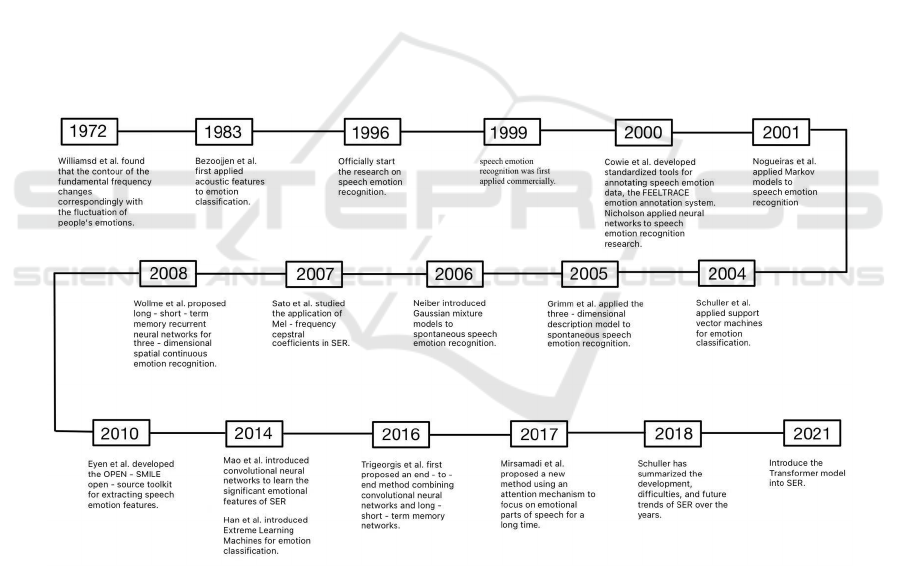
Speech emotion recognition technology has
developed rapidly over the past 40 years. Figure 1
illustrates the research progress in this field. In 1996,
Daellert et al. conducted pioneering research in SER
(Schuller, 2018). Early studies mainly relied on
handcrafted features and traditional classification
models. It was not until 2000, when Nicholson
applied neural networks to this field, that machine
learning models began to enter speech recognition
research (Milton & Tamil Selvi, 2014). In 2005,
Grimm et al. introduced a three-dimensional emotion
description model to spontaneous SER (Elbarougy &
Akagi, 2012). In 2006, Neiberg et al. applied
Gaussian Mixture Models (GMM) to spontaneous
SER (Neiberg, Elenius, & Laskowski, 2006).
In 2010, Eyben et al. developed OPEN-SMILE, a
toolkit for extracting speech emotion features (Eyben,
Wöllmer, & Schuller, 2010). By 2014, Mao et al.
introduced Convolutional Neural Networks (CNNs)
to learn emotionally salient features for SER, marking
the adoption of deep learning models in this field
(Mao, Dong, Huang, & Zhan, 2014). Subsequently,
deep learning models have continued to evolve. In
2016, Trigeorgis et al. proposed an end-to-end
approach that combined CNNs with Long Short-
Term Memory (LSTM) networks (Trigeorgis et al.,
2016). In 2018, Schuller summarized the
development, challenges, and future trends of CNNs
and LSTMs in SER (Schuller, 2018).
Since 2021, an increasing number of studies have
focused on incorporating Transformer models (Chen,
Xing, Xu, Pang, & Du, 2023). In recent years, SER
has been transitioning from traditional handcrafted
features and machine learning classifiers toward deep
learning and multimodal fusion approaches (Zhu,
Sun, Wei, & Zhao, 2023). This includes integrating
linguistic information with text, facial expressions,
body movements, and other modalities, thereby
making emotion recognition more accurate and
efficient.
Figure 1: Schematic diagram of speech emotion recognition research development (Picture credit: Original).
3 EMOTION RECOGNITION
METHODS
3.1 Overall Workflow
Speech Emotion Recognition (SER) technology
involves using computers to analyze various
emotional information in preprocessed speech
signals, extracting features that describe emotions,
associating these features with specific emotional
categories, and ultimately classifying the emotional
states (Luo, Ran, Yang, & Dou, 2022). In the
preprocessing stage, incomplete and unnecessary
noise signals are removed. Subsequently, feature
extraction is performed, typically extracting
Speech Emotion Recognition Technology in Human-Computer Interaction
355

traditional features such as prosodic features, wavelet
features, spectral features, and cepstral features from
the edges, segments, and utterances of speech signals,
alongside automatically extracted features by deep
learning models (Lieskovská, Jakubec, Jarina, &
Chmulík, 2021; Ramyasree & Kumar, 2023). Several
classic tools such as PRAAT, APARAT,
OpenSMILE, and OpenEAR can be used for mining
features from speech signals (Shukla & Jain, 2022).
Finally, a classifier is employed to categorize the
emotional features and build the SER model. Among
these stages, feature extraction is a critical process
that has a decisive impact on recognition
performance.
3.2 Feature Extraction
3.2.1 Traditional Feature Extraction
Traditional handcrafted features include prosodic
features, wavelet features, spectral features, and
cepstral features. Prosodic features mainly cover
aspects such as stress, pauses, and intonation,
reflecting the rhythm and pitch variations in speech.
Wavelet features are derived using wavelet transform
techniques, which can effectively capture the local
transformation characteristics of speech signals and
offer certain advantages in analyzing non-stationary
signals. Spectral features are obtained by
transforming time-domain signals into the frequency
domain through methods such as Fourier Transform,
providing insights into the energy distribution of
speech signals across different frequency bands.
Cepstral features are further processed parameters
based on spectral features, with the most
representative being Mel-Frequency Cepstral
Coefficients (MFCCs) and Perceptual Linear
Prediction (PLP) coefficients. These features can
reflect subtle adjustments in the spectrum during
emotional changes and exhibit a degree of similarity
to how humans perceive emotions.
3.2.2 Machine Learning-Based Feature
Extraction
The automatic learning capability of machine
learning enables it to autonomously extract emotional
features from speech signals, with different deep
learning models capturing distinct types of features.
Features extracted using Convolutional Neural
Networks (CNNs) primarily include local spectral
features and hierarchical features. Compared with
traditional spectral features, the spectral features
extracted by CNN are higher in dimensionality, more
abstract, and harder to interpret. However, this
extraction approach avoids the subjectivity of manual
feature engineering, saves time, and offers strong
adaptability to different types of speech data.
Furthermore, it can comprehensively and
meticulously describe variations in the spectrum. The
hierarchical features extracted by CNN are
progressively abstracted and summarized as the depth
of the network layers increases. Each subsequent
layer further processes the features from the previous
layer, resulting in a more comprehensive and accurate
representation of the intrinsic structure of speech
information, thereby improving the recognition
accuracy of the model.
Features extracted using Recurrent Neural
Networks (RNNs) and their variants possess temporal
dynamics and contextual dependency. Temporal
dynamic features are extracted by combining the
current feature with information from previous
moments through the recurrent structure of RNNs,
capturing the rising, falling, or steady trends of these
features. This also allows the model to detect
periodicity in speech signals and, through learning
from previous cycles, extract related features more
accurately. Context-dependent features are derived
from speech information such as contextual pauses
and speech rate, rather than isolated features at a
single time point. RNNs and their variants can
leverage these features to account for the coherence
of speech, leading to a more accurate understanding
of overall emotional states.
3.2.3 Advantages of Machine Learning in
SER
With the advancement of deep learning, end-to-end
deep SER has gained increasing attention, capable of
directly using raw emotional speech signals or
handcrafted features as input for deep learning
models (Luo, Ran, Yang, & Dou, 2022). The
integration of machine learning technology with SER
brings numerous advantages. Firstly, the powerful
self-learning ability of machine learning allows it to
automatically extract features from large amounts of
speech data, offering stronger adaptability and more
representative features compared to traditional
speech recognition methods (Lieskovská, Jakubec,
Jarina, & Chmulík, 2021). Secondly, when dealing
with imbalanced datasets, machine learning
algorithms — such as convolutional recurrent neural
networks (CRNNs) with variable-length inputs and
focal loss — can adjust the contribution of different
samples to the total loss, enabling the model to
perform well even on minority samples (Liang, Li, &
EMITI 2025 - International Conference on Engineering Management, Information Technology and Intelligence
356

Song, 2020). Additionally, the incorporation of
attention mechanisms allows models like CNNs to
compute attention weights, determining the
importance of different parts of the speech, thus
making emotion recognition more accurate (Zhu,
Sun, Wei, & Zhao, 2023).
4 KEY CHALLENGES
4.1 Features
Compared with the automatically extracted features
from deep learning methods, traditional features
possess stronger interpretability and lower
computational complexity. Most traditional features
have explicit physical meanings, making them easily
recognizable within speech signals. These intuitive
features facilitate researchers' understanding and
analysis. In contrast, features extracted through deep
learning are more complex and represent deeper
emotional characteristics. These features are typically
difficult to detect using conventional approaches, but
they exhibit stronger discriminative power and
adaptability. When dealing with more complex
speech information, deep learning-based features
demonstrate superior expressive capabilities and are
better suited for accommodating emotional
expression differences across various regions and
cultures.
Traditional feature extraction algorithms are
relatively simple and computationally efficient.
Under limited hardware resources, these algorithms
can quickly extract features, making them suitable for
scenarios where high precision in emotion
recognition is not required. Conversely, features
extracted by deep learning models require no manual
design, and offer greater discriminative power and
adaptability. Through automatic learning from large
amounts of speech data, deep learning models can
autonomously extract complex and deep emotional
features, significantly enhancing recognition
performance in challenging conditions.
4.2 Models
There are notable differences between traditional
models and deep learning models in the field of SER.
Traditional models, such as Hidden Markov Models
(HMM) and Support Vector Machines (SVM), are
relatively simple. These approaches typically offer
stronger interpretability, demand less hardware, and
are efficient when handling small-scale data training
and recognition tasks. However, due to their simple
structure, the recognition accuracy of these models
tends to degrade when dealing with complex speech
signals.
Deep learning models effectively address this
issue. With their powerful feature learning and fitting
capabilities, machine learning and deep learning
models achieve higher accuracy and better robustness
in SER tasks. Nevertheless, deep learning models also
have certain drawbacks, such as higher hardware
requirements and a greater dependence on large-scale
training datasets.
5 CONCLUSIONS
This paper focused on SER technology, first
providing a comprehensive review of the 40-year
development history of SER. Subsequently, the
workflow of SER technology was explained,
including preprocessing, feature extraction, feature-
to-emotion mapping, and emotion classification.
From a feature extraction perspective, this study
extensively discussed the principles, advantages, and
limitations of both traditional methods and machine
learning approaches.
For traditional methods, due to their reliance on
handcrafted features, these models offer higher
interpretability and simpler structures, making them
advantageous in scenarios with limited hardware
resources and modest recognition accuracy
requirements. In contrast, machine learning methods
possess automatic feature extraction capabilities,
enabling them to mine complex and deep emotional
features from large volumes of speech data. These
features exhibit greater adaptability and
discriminative power, achieving better performance
in complex speech environments and across diverse
cultural contexts.
Future research can further explore fusion
strategies for different deep learning models,
combining the strengths of CNNs and RNNs to
construct more powerful hybrid models. Such
approaches can achieve collaborative optimization of
local feature capture and long-term dependency
processing, thereby enhancing model performance in
complex SER tasks. Additionally, integrating
multimodal information—such as text, facial
expressions, and body movements—can facilitate the
construction of multimodal fusion SER models,
enabling a more comprehensive understanding of
emotional expression and improving both recognition
accuracy and system robustness.
Speech Emotion Recognition Technology in Human-Computer Interaction
357

REFERENCES
Chen, W., Xing, X., Xu, X., Pang, J., & Du, L. (2023).
SpeechFormer++: A hierarchical efficient framework
for paralinguistic speech processing. IEEE/ACM
Transactions on Audio, Speech, and Language
Processing, 31, 775–788.
Elbarougy, R., & Akagi, M. (2012). Speech emotion
recognition system based on a dimensional approach
using a three-layered model. In Proceedings of the 2012
Asia Pacific Signal and Information Processing
Association Annual Summit and Conference (pp. 1–9).
IEEE.
Eyben, F., Wöllmer, M., & Schuller, B. (2010).
openSMILE: The Munich versatile and fast open-
source audio feature extractor. ACM.
Liang, Z., Li, X., & Song, W. (2020). Research on speech
emotion recognition algorithm for unbalanced data set.
Journal of Intelligent & Fuzzy Systems, 39(3), 2791–
2796.
Lieskovská, E., Jakubec, M., Jarina, R., & Chmulík, M.
(2021). A review on speech emotion recognition using
deep learning and attention mechanism. Electronics,
10(10), 1163.
Luo, D. (2023). Research on power grid dispatching
operation safety early warning model based on speech
emotion recognition (Master’s thesis, Shaanxi
University of Technology). CNKI.
Luo, D., Ran, Q., Yang, C., & Dou, W. (2022). A review of
speech emotion recognition. Computer Engineering
and Applications, 58(21), 40–52.
Mao, Q., Dong, M., Huang, Z., & Zhan, Y. (2014).
Learning salient features for speech emotion
recognition using convolutional neural networks. IEEE
Transactions on Multimedia, 16(8), 2203–2213.
Milton, A., & Tamil Selvi, S. (2014). Class-specific
multiple classifiers scheme to recognize emotions from
speech signals. Computer Speech & Language, 28(3),
727–742.
Neiberg, D., Elenius, K., & Laskowski, K. (2006). Emotion
recognition in spontaneous speech using GMMs.
Interspeech 2006.
Ramyasree, K., & Kumar, C. S. (2023). Multi-attribute
feature extraction and selection for emotion recognition
from speech through machine learning. Traitement du
Signal, 40(1), 265–275.
Schuller, B. (2018). Speech emotion recognition: Two
decades in a nutshell, benchmarks, and ongoing trends.
Communications of the ACM, 61(5), 90–99.
Shukla, S., & Jain, M. (2022). Deep GANITRUS algorithm
for speech emotion recognition. Journal of Intelligent &
Fuzzy Systems, 43(5), 5353–5368.
Trigeorgis, G., Ringeval, F., Brueckner, R., Marchi, E.,
Nicolaou, M. A., Schuller, B., & Zafeiriou, S. (2016).
Adieu features? End-to-end speech emotion recognition
using a deep convolutional recurrent network. In
Proceedings of IEEE International Conference on
Acoustics, Speech and Signal Processing (ICASSP).
Zhang, M. (2023). Design and implementation of a
customer service emotion monitoring system based on
speech emotion recognition (Master’s thesis, Southeast
University). CNKI.
Zhu, R., Sun, C., Wei, X., & Zhao, L. (2023). Speech
emotion recognition using channel attention
mechanism. In 2023 4th International Conference on
Computer Engineering and Application (ICCEA) (pp.
680–684). IEEE.
EMITI 2025 - International Conference on Engineering Management, Information Technology and Intelligence
358
