
NLP-Based Query Interface for InfluxDB: Designing a Hybrid
Architecture with SpaCy and Large Language Model
Fatih Kaya
a
and Pinar Kirci
b
Department of Computer Engineering, Bursa Uludağ University, Bursa, Turkey
Keywords: Time-Series Database, InfluxDB, LLM, Natural Language Interface to Database (NLIDB).
Abstract: Digital transformation has unleashed a tidal wave of data that is big data, as we like to call it, and working
with that mountain brings real hurdles. Chief among them is the need for specialists who can speak in arcane
query languages, which keeps everyday users at arm’s length. To break down that barrier, we introduce a
natural-language interface (NLI) that lets users chat with a time-series database, such as InfluxDB, instead of
writing SQL-style commands. The design follows a hybrid playbook, splitting the work into two clear tracks.
Whenever absolute precision is essential, such that the system must craft an exact database query, it leans on
a rules-based engine that behaves predictably every time, sidestepping the hallucinations sometimes seen in
large language models. Once the data lands and the job shifts to drawing meaning from the numbers, the baton
passes to Llama 3.1, whose generative skills excel at turning rows of metrics into clear insight. A working
prototype already shows the approach can bridge everyday language and InfluxDB without missing a beat.
1 INTRODUCTION
The twenty-first century marks an era in which digital
technologies have fundamentally transformed social
and economic structures. This process of digital
change is commonly referred to as digital
transformation. Digital transformation is a process
that aims to improve an organization or system by
triggering significant changes in its characteristics
through the convergence of information, computing,
communication, and connectivity technologies (Vial,
2019). This transformation involves not only the
adoption of new technologies, but also a radical
rethinking of business models, operational processes,
and methods of value creation.
As a result of digital transformation, organizations
and individuals are faced with an unprecedented
volume of data to support strategic and operational
decision-making. Although this phenomenon, known
as Big Data, appears to derive its name solely from
the quantity of data it contains, it also encompasses a
wide range of data diversity, speed, and complexity
(McAfee et al., 2012). While this wealth of data
provides a significant competitive advantage when
analyzed correctly, unlocking this potential stored in
a
https://orcid.org/0009-0000-0457-0834
b
https://orcid.org/0000-0002-0442-0235
databases often requires advanced technical
expertise. This lack of proficiency in accessing data
creates a fundamental challenge that limits the
dissemination and accessibility of information within
organizations and makes the need for more intuitive
interfaces that simplify human-computer interaction
critical.
In response to this need, Natural Language
Interfaces (NLIs) have been developed which allow
users to interact with databases through natural
language rather than structured query languages. This
idea has a deep-rooted history dating back to early
computer science research, such as systems like
LUNAR (Woods et al., 1972). Traditionally,
accessing data required proficiency in formal
languages like SQL or SPARQL, which may present
a significant barrier for domain experts without a
technical background. Indeed, although SQL was
initially designed for business professionals, it is a
fact that even technically skilled users often struggle
to assemble the right queries (Affolter et al., 2019).
NLIs aim to shift this translation burden from the user
to the system by translating a user question like
“Show me the most popular movies of the last five
years" into a complex SQL query in the background.
Kaya, F. and Kirci, P.
NLP-Based Query Interface for InfluxDB: Designing a Hybrid Architecture with SpaCy and Large Language Model.
DOI: 10.5220/0014353200004848
Paper published under CC license (CC BY-NC-ND 4.0)
In Proceedings of the 2nd International Conference on Advances in Electrical, Electronics, Energy, and Computer Sciences (ICEEECS 2025), pages 271-277
ISBN: 978-989-758-783-2
Proceedings Copyright © 2026 by SCITEPRESS – Science and Technology Publications, Lda.
271

Nevertheless, the inherent complexities of human
language mean that this NLI promise is difficult to
achieve consistently. A key challenge is the
ambiguity surrounding the concept. This issue may be
seen in both lexical and structural contexts, resulting
in an expression that has multiple potential
interpretations (Jurafsky & Martin, 2008). Moreover,
the necessity of correctly interpreting user inputs,
which frequently contain orthographic errors,
colloquialisms, or requests for complex database
operations such as subqueries, joins, and aggregations
and subsequently converting these inputs into valid
structured queries, poses a substantial engineering
challenge for NLI systems.
In addressing these limitations, NLI technology
has experienced a significant trajectory of
development over several decades. Initial iterations
utilized methodologies predicated on keyword
matching, centering upon the correlation of user input
terminology with the extant database schema. With
technological progression, a subsequent evolution
occurred towards pattern-based systems, which
endeavored to interpret more complex queries via
designated trigger words and grammatical constructs,
parsing-based systems, which generated queries of
greater accuracy and complexity through the analysis
of syntactic sentence structure, and grammar-based
systems, which depend upon inflexible rule-sets to
constrain user interaction. Every architectural
paradigm presents a distinct equilibrium among
expressiveness, flexibility, and domain-specific
adaptability (Affolter et al., 2019).
In recent years, the advent of machine learning
and deep learning techniques, exemplified by Long
Short-Term Memory (LSTM) models, has
precipitated a paradigm shift within the NLI domain
(Sutskever et al., 2014). This transformation
subsequently accelerated considerably, particularly
following the advent of Large Language Models
(LLMs). These models have been trained on vast
textual corpora and utilise billions of parameters, thus
presenting unprecedented capabilities for interpreting
linguistic variability and discerning complex
semantic relationships. It is hypothesised that they
may offer more flexible and powerful resolutions for
numerous challenges inherent in traditional NLI
systems (Chang et al., 2024).
The integration of LLMs expands the capabilities
of NLIs not only for traditional relational databases
but also for a wider variety of data models. Current
researches have introduced innovative approaches
such as improving semantic interpretation accuracy
by integrating SQL grammar into neural networks
(Cai et al., 2017), developing multilingual
frameworks that support multiple database engines by
generating synthetic data (Bazaga et al., 2021), and
chatbots that translate natural language queries for
graph databases into specialized languages such as
Cypher (Hornsteiner et al., 2024). Similarly, LLMs
are also used in specialized domains such as time-
series databases to simplify data querying and
complex analyses (Jiang et al., 2024). While these
rapid advances offer great potential, they have also
introduced new and important research challenges,
such as model hallucinations which is generating
false information, output interpretability, and privacy
concerns arising from the processing of sensitive
data.
To provide an alternative solution to this problem,
this study proposes a system architecture that acts as
an abstraction layer between users and time series
databases, enabling interaction with natural language.
The system's primary goal is to understand analytical
requests expressed by end users in colloquial
language without knowledge of a technical query
language, translate them into valid and optimized
Flux queries for the target database which is
InfluxDB (InfluxData, n.d.), and present the resulting
numerical results in a user-friendly, interpreted
natural language format.
The fundamentals of the system developed in this
study consist of a hybrid approach that combines two
distinct AI paradigms within a single architecture. In
the Query Generation phase, this hybrid architecture
utilizes rule-based and grammar-driven Natural
Language Processing (NLP) techniques using SpaCy
(Honnibal & Montani, 2017) to produce
deterministic, reliable, and manageable results. In the
Result Interpretation phase, it leverages the reasoning
and text generation capabilities of LLMs to extract
deep insights from raw data and produce human-like
explanations.
2 METHODOLOGY
When designing the system architecture, a hybrid
architectural approach was adopted that has the
capacity to separate two different cognitive tasks,
such as query understanding and result interpretation,
and selecting the most suitable technology for each
task. This approach aims to optimize the overall
performance and reliability of the system as follows.
Deterministic Inference for Query Generation:
The task of generating database queries from
natural language input requires high accuracy
and repeatability. The same input should
always produce the same query output. This
ICEEECS 2025 - International Conference on Advances in Electrical, Electronics, Energy, and Computer Sciences
272

requirement makes LLMs, which carry the risk
of hallucination due to their probabilistic
nature, risky for that kind of task. Therefore, in
this study, the matcher component of the
SpaCy library as a rule-based and predictable
method for parsing the semantic and syntactic
structure of text, was used.
Generative Synthesis for Response
Interpretation: The task of generating human-
understandable insights from structured
numerical data returned from the database
requires contextual reasoning and semantic
richness. This is a task which cannot be
effectively solved with deterministic rules.
Therefore, known and open-source LLM
Llama 3.1 (Dubey et al., 2024) that is capable
of ingesting data summaries and transforming
them into a coherent narrative was used in this
phase.
This hybrid methodology encourages the use of the
most appropriate cognitive tool for each sub-problem,
making the system both reliable and intelligent. When
examined in terms of its cycle, this system can be
divided into three parts:
Proof of Concept: In this first cycle, the
system's core data flow pipeline, which turns
API requests into InfluxDB response, was
tested with a static query. The primary goal was
to verify the interoperability of the
infrastructure components which are Docker,
InfluxDB, FastAPI and the data serialization
processes from CSV to a DataFrame.
Deterministic Translation Capability: In the
second iteration, the NLP layer SpaCy was
integrated, providing entity recognition
capabilities based on predefined rules. At the
end of this phase, the system was able to
dynamically generate Flux queries from simple
natural language input.
Generative Interpretation Capability: In the
final iteration, the native LLM service Ollama
(Ollama, n.d.) which enables the use of Llama
was integrated. The process of statistically
summarizing the DataFrame returned from the
database and sending this summary to LLM via
a command line to obtain a qualitative
interpretation is completed in this manner.
At the end of each iteration, the developed
prototype was evaluated using specific test scenarios
such as cURL requests, and its functionality was
verified before proceeding to the next step. The
detailed layered architecture of the system, that is
designed according to this methodology and
principles, is presented in the System Architecture
section.
3 SYSTEM ARCHITECTURE
The system developed in this study is based on a
design model similar to the Layered Pipeline
Architecture. This architecture comprises
autonomous components, each with a particular and
delineated responsibility, where data is processed
sequentially and unidirectionally to accomplish a
task. The architecture of the system has been designed
in such a way as to ensure the security of data by
having all components run on the local host machine.
3.1 Architectural Overview
Figure 1: Architectural Overview.
The system takes natural language input from the
user and follows a data flow through four main
components until it produces natural language output.
Each component passes a standard data structure to
the next. Figure 1 visualizes the conceptual
architecture of the proposed system and the end-to-
end data flow of a user request within the system. This
architecture follows a sequential pipeline structure
that takes natural language input, processes it through
a series of transformations, and produces natural
language output.
The process begins with the end user by providing
text-based input. This unstructured, free-form text is
fed to the Natural Language Parser, as the first core
component of the system. The component performs
linguistic analysis on the text as extracting the user's
intent and critical entities for the query, such as
measurement, area, time period, etc. The output of the
analysis is a JSON object, which converted into a
machine-readable, structured format. This resulting
semantic representation is provided as input to the
next stage, which is the Flux Query Generation
NLP-Based Query Interface for InfluxDB: Designing a Hybrid Architecture with SpaCy and Large Language Model
273

component. This component synthesizes the abstract
semantic contract created in the previous stage into a
concrete and syntactically valid Flux Query that the
target database, InfluxDB understands.
In the second half of the data processing pipeline,
first the query is executed on InfluxDB, then the
result is returned as raw data. In Figure 1, this raw
data is represented as a CSV file. In practical
application, this stage involves taking the CSV data
and converting it into a structured Pandas DataFrame
for analysis and statistical calculations.
As the final stage, this structured data is provided
as input to Llama 3.1 LLM, that is the system's
interpretation and synthesis engine. The LLM
analyzes this quantitative data within the context of
the user's original query and produces the final
Natural Language Response to be presented to the
user. With this step, the cycle that began with natural
language is completed with understandable and
interpreted natural language output.
3.2 Components of the Architecture
3.2.1 Natural Language Parser
The Natural Language Parser is responsible for
transforming the raw text input into a syntactically
and semantically structured representation. It
analyzes the input text string using the SpaCy
library's rule-based Matcher mechanism. This
deterministic approach recognizes terms defined in
the system's metadata, such as measurement, field,
and label names, with high accuracy. The output of
this process is a structured JSON object containing
the user's intent and query entities, which serves as a
"semantic contract" for subsequent layers. The
fundamental design philosophy of this layer is to
provide absolute reliability and repeatability in a
delicate task like database queries, rather than the
uncertainty that probabilistic models can introduce.
3.2.2 Flux Query Generator
The Flux Query Generator functions as a translation
engine, translating the semantic representation from
the NLP Parser into a technical command that the
target database can execute. It processes the input
JSON object using parametric templating. Predefined
keywords that exist in the database act as Flux query
skeletons for each query intent are securely populated
only with entities validated in the NLP layer. This
methodology provides a natural layer of protection
against potential security vulnerabilities like Flux
Injection by preventing user input from altering the
structural integrity of the query. The final output of
this layer is a syntactically valid Flux query in text
format for transmission to the next layer.
3.2.3 Data Access and Preprocessing
This component handles the actual communication
between the application logic and the database. Its
role is to take the Flux query text generated in the
previous layer and execute it on the InfluxDB API.
The raw CSV data returned from the database as a
result of an authenticated HTTP POST request is
processed in this layer. In this process, incoming text-
based data is converted into a DataFrame that is
essential to provide a consistent, structured, and
analysis-ready data table for the subsequent
interpretation layer to work with.
3.2.4 Response Interpreter
The final component of the pipeline, which is the
bridge of system to the user, is responsible for
synthesizing numerical data into qualitative insights
and a human-readable narrative. It takes as input the
DataFrame from the previous layer and the user's
original query text to provide context. This layer uses
a hybrid methodology combining statistical analysis
and generative AI. First, descriptive statistics like
mean and maximum are calculated from the
DataFrame using Pandas. This numerical summary is
then structured into a prompt and transmitted via an
API call to the locally running Ollama/Llama 3.1
LLM service. The LLM's task is to interpret these
statistics within the given context and produce
coherent text. The final output of the system is the
natural language response generated by this LLM and
presented to the user.
4 SYSTEM OPERATIONAL
FLOW AND DATA
PROCESSING
The present section elucidates the operational
principles of the architecture by delineating the
lifecycle of a user request as it traverses the system.
The process can be conceptualised as a data
processing pipeline, where each system component
sequentially activates the next by transforming data
from one representation to another. The baseline
scenario for this analysis involves the processing of a
natural language query that requests the average value
for a designated metric and field.
ICEEECS 2025 - International Conference on Advances in Electrical, Electronics, Energy, and Computer Sciences
274

4.1 Receiving and Verifying the
Request
The system's operational flow begins with an external
client sending an HTTP POST request to the system's
query API endpoint. This request carries a JSON
payload, identified by the Content-Type:
application/json header, containing the user's raw
query text. The FastAPI web framework (Ramírez,
2018) serves as the system's gateway to this request.
During this phase, automatic type checking and data
validation are performed on the incoming payload.
This validation step ensures that the system only
accepts input in the expected format and with a valid
data type, creating the first layer of security and
robustness. After successful validation, the raw query
text is passed to the next processing component.
4.2 Semantic Parsing and Structural
Representation
Natural language input is directed to the NLP
component, the principal objective of which is the
conversion of unstructured text into a computationally
tractable intermediate representation (IR) employing
deterministic rules. This transformation leverages the
rule-based Matcher mechanism provided by the
SpaCy library. The mechanism in question performs
an inference operation through the application of
predefined lexical patterns against the input text. The
resultant artefact of this operation is a JSON object
encapsulating the core semantic constituents of the
intended Flux query (e.g. {"measurement": "...",
"field": "..."}). Subsequently, the object functions as a
standardized input contract for downstream
components.
4.3 Deterministic Query Synthesis
The semantic representation formulated during the
preceding stage serves as input for the Flux Query
Generator component. The function of this
component is to translate the abstract semantic
representation into a concrete syntactic structure that
is compatible with the execution engine of InfluxDB.
The translation process is facilitated by the utilisation
of parametric templating. This approach maintains
the query's immutable structural framework,
permitting only those entities validated by the NLP
layer to be assigned to variables therein.
Consequently, this design methodology ensures
system reliability and predictability, upholding
structural integrity while simultaneously mitigating
vulnerabilities such as flux injection.
4.4 Database Execution and Data
Transformation
The synthesised Flux query is then passed to the Data
Access and Preprocessing component. This
component initiates an authenticated HTTP POST
request to the InfluxDB API via the InfluxDB service
address, utilising the Docker internal network and
DNS resolution mechanism. The query result, when
executed by the database engine, is returned in a
serialised text format as CSV. As this raw data is not
suitable for subsequent qualitative analysis steps, it
undergoes a critical transformation at this layer. The
pivot function within the query facilitates the
conversion of the incoming data into a wide-format
structure, which is then represented in memory as a
DataFrame object, a standard data analysis structure
within the Python ecosystem.
In the final stage of the data processing pipeline,
the structured DataFrame is routed to the Response
Interpreter component, whose purpose is to
synthesize a qualitative narrative from the
quantitative data. To this end, descriptive statistics are
first calculated. Then, this statistical summary is
combined with the original user query to preserve
context, creating a contextual prompt for the native
LLM. This prompt is sent via an API request to the
Ollama service, also via the Docker network. Using
this structured data and context, the LLM synthesizes
text that summarizes and interprets the results.
Finally, the main application combines the
intermediate outputs from each stage of the pipeline,
that are the recognized entities, the generated query,
the raw data table, and the LLM-interpreted response
into a single JSON composition. This completes a
query's lifecycle within the system.
4.5 Experimental Setup
To develop and test the prototype presented in this
study, a container-based development environment
was established that ensures the isolated, portable,
and repeatable operation of all components. The
installation process involves systematically
configuring the infrastructure services and the
application environment.
Environment containerization with Docker is
used to prevent configuration differences and
conflicts that could arise from directly
installing the InfluxDB database and Ollama
LLM service on the local machine.
Runtime and dependencies are isolated within
the application's Python library by creating a
NLP-Based Query Interface for InfluxDB: Designing a Hybrid Architecture with SpaCy and Large Language Model
275
virtual environment, to ensure packages are
seperated from system wide installation.
5 CASE STUDY
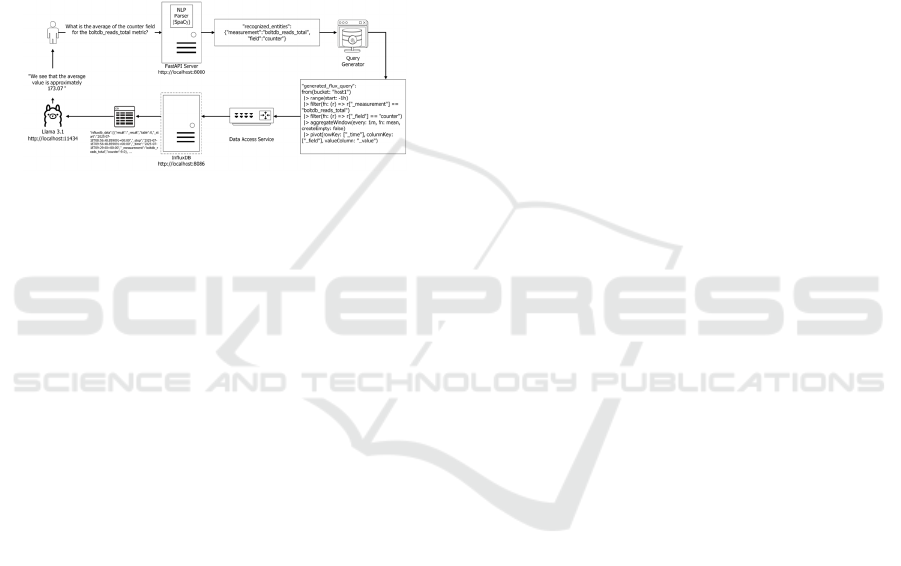
The pipeline structure of the architecture shows how
the user's natural language input goes through a series
of transformation and enrichment stages to reach the
final interpreted response. The operational flow of the
proposed system and the interactions between
components are visualized in detail in Figure 2 using
a reference query.
Figure 2: Operational Flow of the System.
The process begins with the end user expressing
an analytical request in natural language, for instance
with a question like "What is the average of the
counter field for the boltdb_reads_total metric?" This
textual input is transmitted via an HTTP request to the
FastAPI Server, which operates at localhost, acting as
the system's main gateway. The first processing unit
hosted within the server is the NLP Parser SpaCy.
This component performs deterministic linguistic
parsing of incoming unstructured text. SpaCy's rule-
based Matcher mechanism recognizes predefined
entities like boltdb_reads_total and counter within the
text with high accuracy. The output of this process is
a structured JSON object, denoted as {
"recognized_entities": {...} }, that contains the
semantic essence of the query.
This resulting semantic representation is fed into
the Query Generator, the next logical unit of the
system. This component synthesizes the received
structured JSON object into a valid Flux Query that
conforms to the syntax of the target database. This is
a critical translation step, where an abstract user intent
is translated into a concrete command that can be
executed by the machine.
The generated Flux query is transmitted to the
InfluxDB server running also on localhost via the
Data Access Service, which is responsible for the
system's communication with the database. InfluxDB
executes the query on its own time series data and
returns the results in raw data format that is
represented as a CSV file in the diagram.
In the final phase of the data processing pipeline,
this structured data table is provided as input to the
Llama 3.1 model, the system's interpretation engine.
While the diagram conceptually depicts a
straightforward flow, in practice, the application layer
extracts a statistical summary from this data and
passes it to Llama 3.1 along with a contextual prompt
that includes the user's original question. By
analyzing this quantitative data and context, LLM
produces a user-understandable, qualitative NLP,
such as "We see that the average value is
approximately 173.07." This response is returned to
the end user via the FastAPI server, completing the
query lifecycle.
6 RESULTS
With the intention of comprehensively define the
functionality of the prototype, the system's
performance was evaluated under successful
operational scenarios, while also assessing capability
thresholds that could cause failures. This analysis
underlines the distinct advantages and inherent
limitations associated with the current rule-based
NLP methodology.
Since the system's NLP uses the SpaCy library's
Matcher component, it operates according to
predefined lexical (word-based) rules, such as
measurement pattern and field pattern. Thus, the
design has two important outcomes.
The first is semantic flexibility in successful
cases. The system successfully processes queries that
contain entities found within the vocabulary but
which have not previously been encountered in terms
of grammar or sentence structure. For instance,
requests with different expressions such as the
following were all correctly converted by the NLP
layer to the same semantic representation:
Query A:"Tell me the last value of
boltdb_reads_total"
Query B:"Is there a value field for the
boltdb_reads_total metrics?"
Query C:"Bring data for go_info metrics
about gauge”
This demonstrates that, rather than performing a
simple text match, the matcher mechanism breaks the
text down into its linguistic components (tokens) and
recognises defined keywords regardless of their
position in the sentence.
The second is the lexical limitation which ends up
with a Failure Case. When a query containing an
ICEEECS 2025 - International Conference on Advances in Electrical, Electronics, Energy, and Computer Sciences
276

entity not in the system's lexicon was encountered, the
system failed as expected. As an illustration, the
following query containing the word "temperature",
which is not defined in the parser file, was tested:
Query D: "Show temperature sensor data for
the last 15 minutes”
In this case, the parser function returned an empty
dictionary, because it found no matches to the
Matcher rules. The control mechanism identified this
empty result, and the system responded to the user
with an HTTP 400 Bad Request error: “Could not
extract both the measure and field names from your
query”.
7 CONCLUSION
The evaluation of the prototype's rule-based NLP
methodology reveals both distinct advantages and
inherent limitations. This analysis reveals a
fundamental trade-off between semantic flexibility
and a strictly constrained vocabulary. This result is a
natural consequence of the system's current rule-
based and closed-vocabulary design. While the
system is robust to grammatical variations in the
terms it is taught, it lacks the ability to understand or
predict concepts outside its knowledge base. This is a
price to pay for reliability and predictability. The
system clearly prefers to fail rather than hallucinate
an unfamiliar topic and generate an incorrect query.
This behavior is particularly desirable for critical
monitoring systems.
Future work will target enhanced semantic
understanding and analytical depth. The extant rule-
based Matcher is planned for augmentation with
enhancing flexibility for synonyms and extra-
vocabulary expressions. Concurrently, the Query
Builder layer will be developed to support advanced
Flux functions, such as aggregation, to enable cross-
source correlation analyses. A dialogue management
module is envisioned to preserve context across
sequential requests, extending interaction beyond
discrete queries.
REFERENCES
Vial, G. (2019). Understanding digital transformation: A
review and a research agenda. The Journal of Strategic
Information Systems, 28(2), 118–144.
https://doi.org/10.1016/j.jsis.2019.01.003
McAfee, A., Brynjolfsson, E., Davenport, T., Patil, D. J., &
Barton, D. (2012). Big data: The management
revolution. Harvard Business Review, 90(10), 61–67.
Woods, W., Kaplan, R., & Webber, B. (1972). The Lunar
Sciences Natural Language Information System.
Affolter, K., Stockinger, K., & Bernstein, A. (2019). A
comparative survey of recent natural language
interfaces for databases. The VLDB Journal, 28, 793–
819. https://doi.org/10.1007/s00778-019-00567-8
Jurafsky, D., & Martin, J. (2008). Speech and language
processing: An introduction to natural language
processing, computational linguistics, and speech
recognition (2nd ed.). Prentice Hall.
Sutskever, I., Vinyals, O., & Le, Q. V. (2014). Sequence to
sequence learning with neural networks. In
Proceedings of the 27th International Conference on
Neural Information Processing Systems (NIPS’14) (pp.
3104–3112).
Chang, Y., Wang, X., Wang, J., et al. (2024). A survey on
evaluation of large language models. ACM
Transactions on Intelligent Systems and Technology,
15(3), Article 39. https://doi.org/10.1145/3641289
Cai, R., Xu, B., Yang, X., Zhang, Z., & Li, Z. (2017). An
encoder-decoder framework translating natural
language to database queries. arXiv Preprint
arXiv:1711.06061.
https://doi.org/10.48550/arXiv.1711.06061
Bazaga, A., Gunwant, N., & Micklem, G. (2021).
Translating synthetic natural language to database
queries with a polyglot deep learning framework.
Scientific Reports, 11, 18462.
https://doi.org/10.1038/s41598-021-98019-3
Hornsteiner, M., Kreussel, M., Steindl, C., Ebner, F., Empl,
P., & Schönig, S. (2024). Real-time text-to-Cypher
query generation with large language models for graph
databases. Future Internet, 16(12), 438.
https://doi.org/10.3390/fi16120438
Jiang, Y., Pan, Z., Zhang, X., et al. (2024). Empowering
time series analysis with large language models: A
survey. In Proceedings of the International Joint
Conference on Artificial Intelligence (IJCAI’24) (pp.
8095–8103). https://doi.org/10.24963/ijcai.2024/895
InfluxData. (n.d.). InfluxDB time series data platform.
https://www.influxdata.com/
Honnibal, M., & Montani, I. (2017). spaCy 2: Natural
language understanding with Bloom embeddings,
convolutional neural networks and incremental
parsing. https://spacy.io/
Dubey, A., et al. (2024). The Llama 3 herd of models. arXiv
Preprint arXiv:2407.21783.
https://doi.org/10.48550/arXiv.2407.21783
Ollama. (n.d.). Ollama. https://ollama.com/
Ramírez, S. (2018). FastAPI [Computer software].
https://github.com/fastapi/fastapi
APPENDIX
The source code can be downloaded at
https://github.com/kayalaboratory/NLQ-Flux
NLP-Based Query Interface for InfluxDB: Designing a Hybrid Architecture with SpaCy and Large Language Model
277
