
Optimizing Export Strategy of Photovoltaic Modules Under Trade
Policy Constraints: A Linear Programming Approach
Zhaoqi Jin
a
School of Intelligent Finance and Business, Xi’an Jiaotong-Liverpool University, Suzhou, 215000, China
Keywords: Photovoltaic Exports, Linear Programming, Trade Policy, Carbon Adjustment, Tariffs.
Abstract: The This paper develops a linear programming (LP) model to optimize the export strategy of Chinese
photovoltaic (PV) manufacturers under dynamic international trade conditions. Given increasing policy
complexities-such as tariffs, transportation costs, and carbon adjustment mechanisms-the study simulates
cross-border cost structures and identifies optimal production allocation to global markets. The model
incorporates key cost factors including unit production cost, destination-specific transportation fees, country-
level tariff rates, and carbon border adjustment charges. Using a self-constructed virtual dataset, the model
evaluates export allocation to four major markets: the United States, Germany, Japan, and Brazil. Cost
structure analysis shows that tariff-related costs are the most influential factor affecting export decisions,
followed by carbon adjustment charges. Sensitivity analysis reveals that a reduction in U.S. tariff rates
significantly alters the optimal allocation, making the U.S. a viable export destination. Results highlight the
importance of flexible planning tools in navigating policy uncertainty. The study provides a decision-support
framework for Chinese PV exporters to optimize cross-border logistics and minimize total export costs in a
policy-sensitive global environment. This model can be extended to other industries facing similar challenges
in global trade optimization.
1 INTRODUCTION
Building on this foundation, the present study
develops a linear programming (LP) model aimed at
minimizing total export costs for PV modules by
jointly optimizing production allocation and cross-
border distribution. The model integrates critical cost
elements such as manufacturing expenses,
transportation fees, tariffs, and carbon adjustment
levies. This research not only extends the application
of LP techniques to policy-sensitive, multi-node
global supply chains but also offers Chinese PV
exporters a data-driven tool to improve cost
efficiency and strategic adaptability in an
increasingly uncertain trade environment. In a similar
effort to integrate carbon policy into operational
models, a carbon-adjusted tariff evaluation
framework was developed, highlighting the role of
environmental regulations in export decision-making
(Zhu et al., 2021).
The global photovoltaic (PV) industry has
experienced substantial growth in recent years, driven
a
https://orcid.org/0009-0005-3670-192X
by the rising demand for sustainable and clean energy
solutions. According to the International Energy
Agency (IEA), the global installed capacity of solar
PV reached 1,047 Gigawatt by the end of 2022 and is
projected to exceed 2,400 GW by 2030. As the
world’s leading producer and exporter of PV
modules, China occupies a dominant position in the
global solar market. However, this upward trajectory
is increasingly threatened by a shifting international
trade landscape, characterized by escalating tariffs
and tightening regulatory measures.
The global trade environment has grown
increasingly volatile. The World Trade Organization
(WTO) has reported a surge in protectionist measures
and geopolitical tensions, particularly in key sectors
such as energy and electronics. Since 2018, the
United States has enacted multiple rounds of tariffs
on solar imports under trade remedy frameworks such
as Section 201 and anti-dumping policies. In
response, numerous Chinese manufacturers have
relocated production to Southeast Asia in an effort to
circumvent these restrictions. Concurrently, the
Jin, Z.
Optimizing Export Strategy of Photovoltaic Modules Under Trade Policy Constraints: A Linear Programming Approach.
DOI: 10.5220/0014324300004718
Paper published under CC license (CC BY-NC-ND 4.0)
In Proceedings of the 2nd International Conference on Engineering Management, Information Technology and Intelligence (EMITI 2025), pages 169-174
ISBN: 978-989-758-792-4
Proceedings Copyright © 2025 by SCITEPRESS – Science and Technology Publications, Lda.
169

European Union (EU) has implemented the Carbon
Border Adjustment Mechanism (CBAM) to mitigate
“carbon leakage,” which may significantly increase
the cost of PV exports from high-emission regions.
These developments present new operational
constraints for Chinese PV firms, necessitating
strategic reconfiguration of production and export
plans to maintain global competitiveness under
dynamic policy conditions. In response to these
challenges, a growing body of research has proposed
various modeling approaches to optimize global PV
supply chains. A mixed-integer programming model
was developed to coordinate production and
distribution under tariff-induced cost volatility
(Zhang et al., 2020). A dynamic production allocation
model was introduced to demonstrate how flexible
resource deployment can mitigate the risks associated
with tariff uncertainty (Liu and Wang, 2021). The
role of regional trade agreements was emphasized in
enabling strategic capacity realignment across
markets, highlighting the importance of geographic
diversification (Gong et al., 2023). It was further
argued that operational models should be coupled
with policy forecasting mechanisms to support real-
time decision-making amid regulatory shocks (Chen
and Xu, 2022).
In the context of supply chain resilience, recent
studies have investigated structural responses to
trade-related disruptions. A resilience-based
framework for PV supply chain design was proposed,
advocating for multi-country sourcing and distributed
manufacturing to mitigate political and policy risks
(Sun and Chen, 2022). This framework was expanded
by integrating transportation risk and infrastructure
capacity into optimization models, showing that
alternative routing can substantially reduce
vulnerability to bottlenecks (Huang et al., 2023).
Empirical evidence was provided that firms
optimizing both production and export routing under
an integrated cost-minimization framework achieved
greater profitability in policy-constrained
environments (Wang and Zhao, 2023).
Building on this foundation, the present study
develops a linear programming (LP) model aimed at
minimizing total export costs for PV modules by
jointly optimizing production allocation and cross-
border distribution. The model integrates critical cost
elements such as manufacturing expenses,
transportation fees, tariffs, and carbon adjustment
levies. This research not only extends the application
of LP techniques to policy-sensitive, multi-node
global supply chains but also offers Chinese PV
exporters a data-driven tool to improve cost
efficiency and strategic adaptability in an
increasingly uncertain trade environment.
2 METHODOLOGY
In this part, the data resources used in this study,
variables involved and specific methods will be
introduced.
2.1 Data Source and Description
LP is chosen for its ability to efficiently handle
continuous decision variables and cost minimization
under multiple restrictions. The objective is to
minimize the combined costs of production,
transportation, tariff, and carbon-related fees. The
decision variables represent the number of modules
exported to each destination. Constraints include total
production capacity and the demand of each country.
Due to the sensitivity and limited availability of
detailed cost data from real-world enterprises, this
study constructs a virtual dataset to simulate
representative international export scenarios in the
photovoltaic (PV) sector. The simulation reflects
typical contemporary policy settings and models the
production and policy-induced export costs faced by
Chinese PV manufacturers under realistic global
trade conditions.
The dataset covers five representative countries:
China (serving as the production base), and four
major export destinations — Germany, the United
States, Japan, and Brazil. These countries were
selected based on their strategic relevance, diversity
of trade regulations, geographic distribution, and
significance in the global PV market. This sample
captures typical configurations encountered by
export-oriented manufacturers across multiple policy
environments.
Cost-related parameters-including production
cost, transportation fee, tariff rate, and carbon
adjustment charges-are assigned using aggregated
estimates from recent industry reports, WTO tariff
schedules, and relevant academic literature. Demand
quantities in each destination are also preset to reflect
market scale. To ensure comparability, all cost
elements are standardized on a per-unit basis. The
dataset maintains internal consistency while
representing plausible trade constraints that affect
global solar supply chains.
EMITI 2025 - International Conference on Engineering Management, Information Technology and Intelligence
170

2.2 Indicator Selection and
Explanation
To capture the major cost drivers in cross-border PV
export, four key indicators are selected in this model:
unit production cost, transportation cost, tariff rate,
and carbon adjustment charge. These parameters
quantify the primary components of total export cost
under current trade and environmental policy
regimes.
Production cost reflects the baseline manufacturing
expense per unit in China and remains constant across
destinations.
Transportation cost varies by destination country
and reflects route-specific logistics expenses.
Tariff rate represents destination-imposed import
duties, applied as a percentage of product value.
Carbon adjustment charge accounts for
environmental policy costs such as the EU CBAM
and is estimated based on emission intensity and
country-specific rules.
These indicators are treated as fixed inputs in the
linear programming model and serve as cost
coefficients in the objective function. This
configuration helps simulate realistic variations in
policy and logistics conditions across export
destinations. The parameter values used in the
simulation are summarized in Table 1.
Table 1: Cost Parameters for PV Export Simulation.
Countr
y
Productio
n Cost
(USD/un
it)
Transpo
rtation
Cost
(USD/u
nit
)
Tariff
Rate
(%)
Carbon
Adjustme
nt
(USD/unit
)
China 100 - - -
Germa
n
y
- 25 10% 12
United
States
- 30 25% 10
Japan - 20 5% 15
Brazil - 35 20% 8
2.3 Model and Solution Approach
This study uses a linear programming (LP) model to
minimize the total cost of exporting photovoltaic
modules from China to multiple countries, subject to
trade-related constraints. LP is chosen for its ability
to efficiently handle continuous decision variables
and cost minimization under multiple restrictions.
The objective is to minimize the combined costs
of production, transportation, tariff, and carbon-
related fees. The decision variables represent the
number of modules exported to each destination.
Constraints include total production capacity and the
demand of each country.
The model is formulated as follows:
𝑓
(
𝑥
)
=𝑚𝑖𝑛
∑
(𝐶
+𝑇
+𝐷
+𝐸
)×𝑋
(1)
Subject to:
∑
𝑋
≤ 𝑇𝑜𝑡𝑎𝑙 𝑃𝑟𝑜𝑑𝑢𝑐𝑡𝑖𝑜𝑛 𝐶𝑎𝑝𝑎𝑐𝑖𝑡𝑦 (2)
𝑋
≤ 𝐷𝑒𝑚𝑎𝑛𝑑 𝑖𝑛 𝑐𝑜𝑢𝑛𝑡𝑟𝑦 (3)
Where 𝑋
represents the quantity of modules
exported to country 𝑖 . 𝐶
represents the unit
production cost in China. 𝑇
represents the
transportation cost to country 𝑖 . 𝐷
represents the
tariff per unit imposed by country 𝑖. 𝐸
represents
the carbon adjustment cost per unit in country 𝑖.
3 RESULTS AND DISCUSSION
3.1 Model Output and Export
Allocation
The linear programming model was successfully
solved based on the defined parameters and
constraints. The optimal export allocation fully
utilizes the total production capacity of 2,500 units,
distributing them across three of the four target
markets. Specifically, 1000 units are allocated to
Germany, 900 units to Japan, and 600 units to Brazil.
The United States, despite its high demand of 800
units, receives no allocation. This allocation result is
summarized in Table 2.
This outcome reflects the influence of policy-
driven costs and demonstrates how the model
prioritizes destinations offering the most cost-
effective trade conditions. Export allocation,
therefore, is shaped not merely by market size but
also by trade and environmental policy burdens.
This outcome highlights that the model allocates
resources strictly based on cost efficiency, not on
perceived market importance. The fact that the United
States, a major PV importer, is excluded demonstrates
how even large markets can be deprioritized when
policy barriers distort cost structures. As shown in
Table 2, this reinforces the critical role of modeling
tools in revealing non-obvious but rational allocation
Optimizing Export Strategy of Photovoltaic Modules Under Trade Policy Constraints: A Linear Programming Approach
171
strategies under complex policy environments. Such
prioritization illustrates that trade policy variables can
override traditional market metrics, highlighting the
need for exporters to monitor geopolitical
developments in real-time.
Table 2: Optimal Export Allocation Summary.
Country Export
Quantity
(Units)
Demand
(Units)
Allocation
Ratio
German
y
1000 1000 100%
Ja
p
an 900 900 100%
Brazil 600 700 85.7%
USA 0 800 0%
3.2 Cost Structure and Sensitivity
Analysis
A detailed examination of the cost structure reveals
that tariff-related expenses are the most influential
factor affecting export decisions. While all countries
incur basic production and transportation costs,
variation in policy-induced components-particularly
tariffs and carbon adjustment charges-significantly
alters each destination’s effective unit export cost.
Logistics disruptions caused by trade barriers
significantly distort the overall cost-effectiveness of
cross-border PV delivery routes (Zhao and Zhang,
2023).
Their study emphasizes that route-specific risks
and regulatory bottlenecks can undermine cost
advantages even in low-tariff environments.
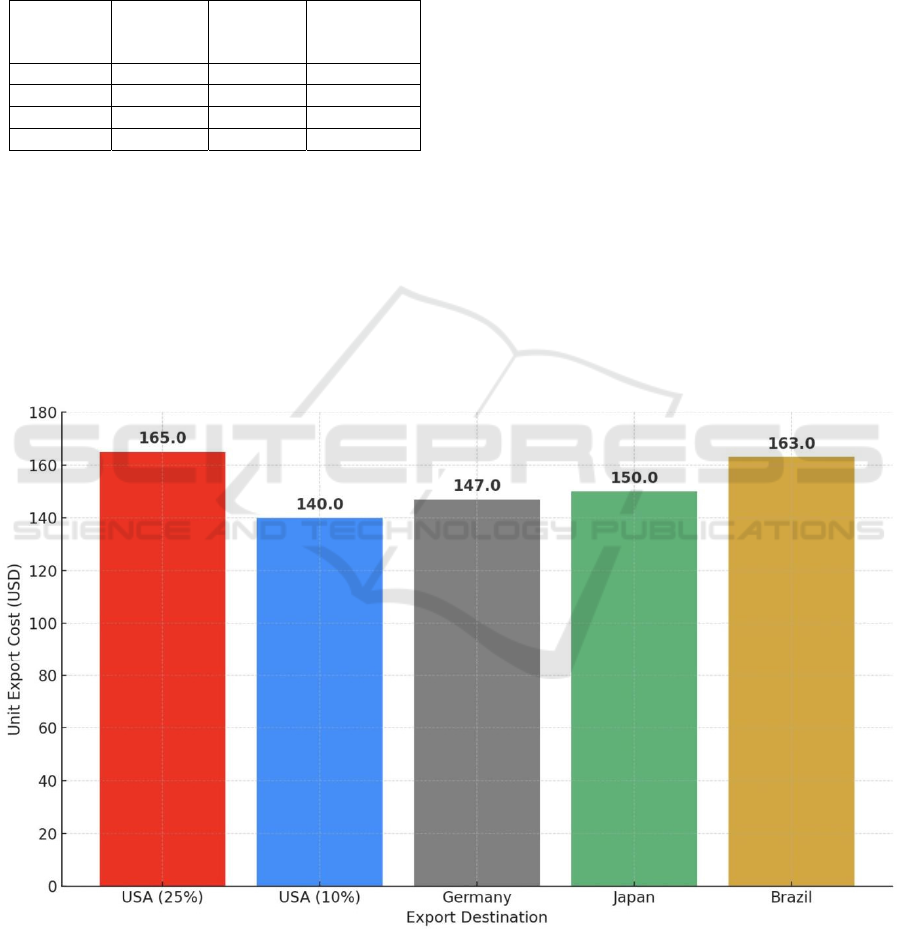
For instance, the effective unit export cost to the
United States is approximately USD 165, calculated
as:
𝐶𝑜𝑠𝑡_𝑈𝑆 = 100(𝑃𝑟𝑜𝑑𝑢𝑐𝑡𝑖𝑜𝑛) + 30(𝑇𝑟𝑎𝑛𝑠𝑝𝑜𝑟𝑡) +
25(𝑇𝑎𝑟𝑖𝑓𝑓) + 10(𝐶𝑎𝑟𝑏𝑜𝑛) (4)
This cost structure comparison is illustrated in Figure
1. In comparison, Germany’s total cost is around
USD 147, and Japan’s is approximately USD 150.
Although Japan faces a relatively high carbon
adjustment cost (USD 15), its low tariff (5%) offsets
the impact. Brazil, despite a high transportation cost
(USD 35), remains cost-effective due to moderate
tariffs (20%) and the lowest carbon adjustment (USD
8).
Figure 1: Comparison of Unit Export Costs Across Destinations (Picture credit: Original).
This chart compares the unit export costs to different
destinations under baseline and adjusted tariff
conditions. The United States becomes cost-
competitive only after tariff reduction. To further
examine the influence of trade policy, a sensitivity
analysis was conducted by lowering the U.S. tariff
EMITI 2025 - International Conference on Engineering Management, Information Technology and Intelligence
172
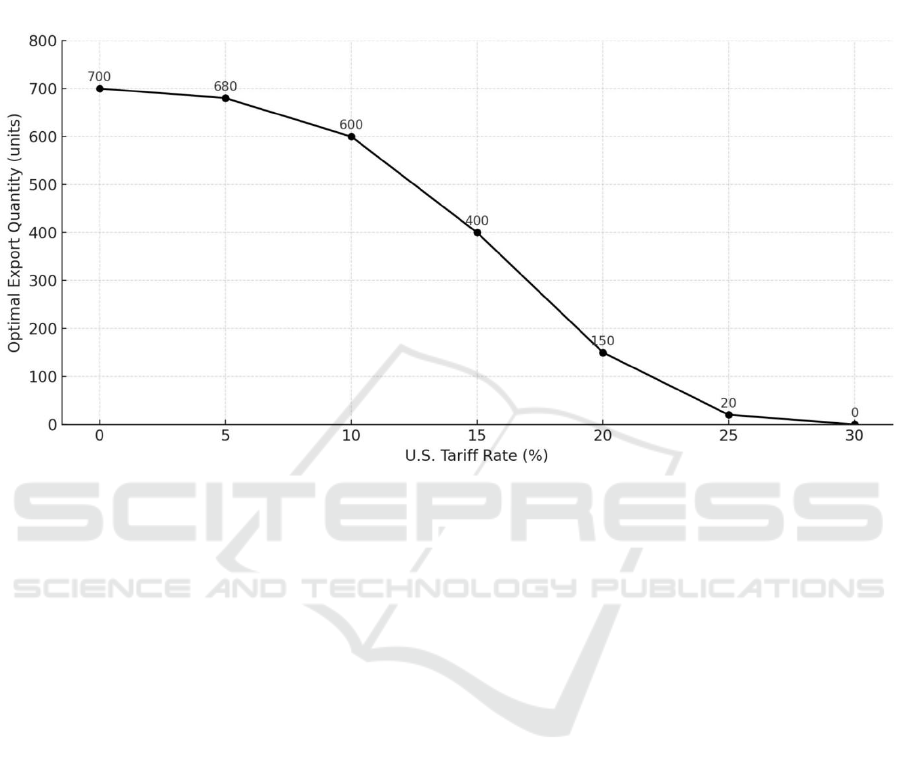
from 25% to 10%. This adjustment reduces the U.S.
unit cost to roughly USD 140, making it more
competitive than Brazil. In this scenario, the optimal
export allocation shifts: the United States would
receive up to 700 units, displacing Brazil. Figure 2
illustrates this shift in export allocation in response to
changes in the U.S. tariff rate.
Figure 2: Sensitivity of U.S. Export Allocation to Tariff Rate (Picture credit: Original).
This line graph illustrates how export allocation to the
U.S. fluctuates as the tariff rate increases (Figure 2).
When tariffs exceed 20%, the U.S. is excluded from
the optimal allocation. This finding highlights that
even minor tariff changes can lead to significant shifts
in export strategy. Sensitivity analysis is therefore
crucial for helping firms plan under policy
uncertainty and prepare for contingency scenarios.
3.3 Strategic Implications and Model
Limitations
From a managerial perspective, the model highlights
the critical importance of incorporating trade policy
environments-not merely demand levels-into global
supply chain planning. Germany and Japan emerge as
cost-efficient and policy-stable markets, suggesting
that exporters should prioritize long-term
infrastructure investment and strategic partnerships in
these regions.
Moreover, the model functions as a flexible
decision-support tool. It allows firms to simulate
“what-if” scenarios by adjusting key policy
parameters, thereby enabling them to anticipate and
adapt to evolving trade conditions. This predictive
capability is particularly valuable amid the rapidly
shifting regulatory landscape of the renewable energy
industry.
Despite offering actionable insights, the current
model has certain limitations. First, it assumes fixed
unit costs and excludes real-world uncertainties such
as currency exchange fluctuations, variable
transportation rates, and supply chain disruptions. In
addition, it does not account for demand elasticity-
namely, how market demand responds to price
changes-which can significantly influence actual
sales volumes.
Another simplification lies in the assumption of
perfect information and static policy environments. In
practice, tariffs and carbon regulations may change
rapidly, and firms often lack full visibility of future
policy shifts. Incorporating stochastic elements or
scenario-based modeling could enhance the model’s
realism and robustness.
Furthermore, the model focuses solely on cost
minimization, overlooking potential trade-offs
between cost, revenue, and profit. This narrow focus
may limit its applicability for firms pursuing market
share expansion or long-term brand positioning.
Future models may benefit from integrating multiple
objectives that more accurately reflect business
priorities.
Optimizing Export Strategy of Photovoltaic Modules Under Trade Policy Constraints: A Linear Programming Approach
173

Future research could expand this model by
incorporating multi-period decision frameworks or
carbon credit trading mechanisms. Additionally,
calibrating the model with empirical trade data would
enhance its external validity. Combining qualitative
scenario planning with quantitative optimization
techniques could further strengthen strategic export
planning for firms operating in volatile geopolitical
environments. This view aligns with previous
research emphasizing the necessity of infrastructure
resilience when planning export strategies in
politically unstable regions (Zhou and Huang, 2022).
These findings collectively underscore that cost-
effective export decisions in the PV industry require
data-driven models, sensitivity to policy dynamics,
and a long-term strategic outlook on market
prioritization.
4 CONCLUSION
This research presents a linear programming
framework tailored to optimize the global export
strategies of Chinese photovoltaic (PV)
manufacturers operating under increasingly complex
trade environments. By systematically incorporating
major cost components — namely production costs,
transportation fees, import tariffs, and carbon
adjustment levies — the model replicates realistic
cross-border decision-making scenarios across
multiple destinations.
The analysis demonstrates that tariff policies exert
the most profound influence on export
competitiveness, followed by carbon-related
regulatory costs. Sensitivity testing reveals that even
marginal changes in tariff rates can induce substantial
shifts in optimal export allocation, highlighting the
critical need for adaptive strategy planning under
policy uncertainty.
The proposed model offers a scalable and
transferable decision-support framework that enables
PV exporters to minimize total export costs while
maintaining strategic agility. Beyond the solar
industry, the methodology holds potential for broader
application in sectors navigating policy-sensitive
international logistics.
Future enhancements could include the
integration of stochastic parameters, dynamic market
demand profiles, or multi-objective optimization
layers, allowing firms to concurrently balance cost-
efficiency, risk exposure, and environmental
sustainability.
REFERENCES
Chen, K., Xu, L., (2022). Modeling real-time supply chain
adaptation under regulatory shock. Operations
Research Letters, 50 (2), 111-120.
Gong, S., Tan, Y., Liu, C., (2023). Trade agreements and
global manufacturing strategies in the PV sector.
Journal of International Business Studies, 54(1), 88-
102.
Huang, Y., Tang, F., Zhou, W., (2023). Multi-route
optimization under policy and infrastructure risk.
Transportation Research, 174, 103032.
Liu, H., Wang, M., (2021). Dynamic allocation strategies
for export-oriented manufacturers under tariff
uncertainty. Journal of Supply Chain Management,
57(3), 45-62.
Sun, Q., Chen, L., (2022). Resilient supply chain design in
the PV industry. Renewable Energy, 187, 847-859.
Wang, J., Zhao, Y., (2023). Joint optimization of export
cost and routing under trade disruptions. Computers &
Industrial Engineering, 179, 108106.
Zhang, Y., Zhao, X., Li, J., (2020). Optimal production and
distribution planning for solar panels under trade tariffs.
International Journal of Production Economics, 229,
107758.
Zhao, Y., Zhang, Y., (2023). Impact of trade barriers on
photovoltaic logistics. Renewable and Sustainable
Energy Reviews, 176, 112345.
Zhou, W., Huang, Y., (2022). Infrastructure disruption and
export resilience in Asia-Pacific. Journal of Operations
Management, 68, 23-39.
Zhu, L., Chen, L., Wang, M., (2021). Carbon-adjusted tariff
evaluation model for renewable exports. Energy Policy,
156, 113728.
EMITI 2025 - International Conference on Engineering Management, Information Technology and Intelligence
174
