
Comparison of Linear Regression, MLP, 1D CNN, and Graph Neural
Networks for Financial Asset Forecasting
Xiaoting Yang
a
Computer Science, University of Wisconsin-Eau Claire, Eau Claire, Wisconsin, U.S.A.
Keywords: Financial Time Series, Stock Price Forecasting, Deep Learning Models, Graph Neural Networks, SHAP
Interpretability.
Abstract: Recent advances in deep learning have led to powerful new tools for modeling complex, nonlinear patterns
in financial markets. This study conducts a head-to-head comparison of four distinct forecasting approaches—
linear regression, multilayer perceptron (MLP), one-dimensional convolutional neural network (1D CNN),
and graph neural network (GNN)—to predict next-day adjusted closing prices for two equities (Amazon and
Netflix), one consumer-goods stock (Domino’s Pizza), and one cryptocurrency (Bitcoin). The results
demonstrate that while all four methods achieve similarly high accuracy on the more stable equity series (R²
≈ 0.96–0.97), the nonlinear neural models—particularly the MLP and 1D CNN—offer clear advantages for
the highly volatile Bitcoin series (R² ≈ 0.92–0.93 compared to ≈ 0.86–0.88 for the linear and graph-based
models). To shed light on each model’s decision process, this paper employ SHapley Additive exPlanations
(SHAP) and find that the most recent price lag (the prior day’s close) consistently carries the greatest
predictive weight across all methods. These findings highlight both the strengths and limitations of deep
learning approaches in one-step financial forecasting and underscore the value of interpretability techniques
for understanding model behavior.
1 INTRODUCTION
Financial time series forecasting, including stock and
cryptocurrency price prediction, is a crucial but
challenging field. Accurate forecasts can inform
investment decisions, but market dynamics are non-
stationary and often volatile. Traditional statistical
methods have been used but struggle with nonlinear
patterns and abrupt shifts. Recent surveys note that
deep learning has emerged as a “new frontier” in stock
market forecasting, and that data-driven neural
networks have become mainstream in financial
prediction. Deep learning has recently seen extensive
application in stock market prediction, with
significant advancements being continually achieved
in terms of forecast accuracy and robustness (Jiang,
2021; Bao et al., 2025)
Among machine learning models, feedforward
networks like MLP serve as flexible nonlinear
regressors, while specialized architectures capture
temporal structure. CNN applies convolutional filters
along the time axis to extract local features from price
a
https://orcid.org/0009-0008-9189-7277
sequences. For example, Zeng emphasize that CNNs
effectively capture short-term dependencies in
financial series. Recurrent models (e.g., LSTM, GRU)
capture longer-term sequential dependencies, though
they may still miss complex multi-asset interactions
(Zeng et al., 2023). Zhang review notes that deep
learning models are increasingly favored over
traditional ones for price forecasting. These
approaches can model nonlinear relationships that
simple models cannot (Zhang et al., 2023).
Graph Neural Networks (GNNs) have emerged
prominently in recent years, widely applied to node
classification, link prediction, and graph classification
tasks, demonstrating strong modeling capabilities
across various domains (Zhou et al., 2021; Wu et al.,
2020). GNNs explicitly leverage graph structure. In a
GNN, each data point is a node, and edges encode
relationships, enabling information to propagate
across the graph. In finance, one can represent each
time step as a node or each asset as a node. Surveys by
Jin note that GNNs can model inter-temporal and
inter-variable relationships that standard methods
struggle to capture (Jin et al., 2024). For instance, Ran
84
Yang, X.
Comparison of Linear Regression, MLP, 1D CNN, and Graph Neural Networks for Financial Asset Forecasting.
DOI: 10.5220/0014321000004718
Paper published under CC license (CC BY-NC-ND 4.0)
In Proceedings of the 2nd International Conference on Engineering Management, Information Technology and Intelligence (EMITI 2025), pages 84-91
ISBN: 978-989-758-792-4
Proceedings Copyright © 2025 by SCITEPRESS – Science and Technology Publications, Lda.

applied graph convolution on a stock-correlation
graph and reported improved trend predictions (Ran et
al., 2024). These studies suggest that GNNs leverage
structural information beyond what feedforward or
convolutional networks capture.
Interpretability is also essential. Complex models
can be opaque, so explainable AI tools highlight the
importance of features. SHAP assigns each input
feature an importance value for a prediction. Dost et
al. applied SHAP to a stock trend model and identified
the features driving its predictions (Muhammad et al.,
2024). SHAP is widely adopted as a model
interpretability technique due to its clear and intuitive
feature importance explanations and has become a
standard tool in explainable machine learning
(Lundberg & Lee, 2017). My study uses SHAP to
interpret how each model weighs input price features.
This study systematically compares Linear
Regression, MLP, 1D CNN, and GNN on identical
datasets for four assets (Amazon, Domino’s Pizza,
Bitcoin, and Netflix). Each model is trained on
historical adjusted closing prices (May 2013–May
2019) and evaluated on held-out test data. Forecast
accuracy is measured by the coefficient of
determination (R²), and the research visualize
predicted vs. actual price trajectories. The research
also computes SHAP values to analyze the importance
of each model's feature. The goal is to understand the
strengths and limitations of each model class in
financial time series forecasting.
2 DATASET AND
METHODOLOGY
2.1 Dataset
Historical daily price data for AMZN, DPZ, BTC, and
NFLX were obtained from Kaggle. The period covers
May 2013 through May 2019, yielding roughly 1500
trading days per asset. The dataset includes columns
Open, High, Low, Close, Adjusted Close, and
Volume. This research focuses on the Adjusted Close
price as the primary series for forecasting. The data
were split chronologically: the first 70% of records
are used for training and the last 30% for testing. All
price features were normalized to the range [0,1] to
aid model training.
2.2 Methods
As shown in Figure 1, Linear Regression is an
ordinary least squares model that predicts the next-
day price as a linear combination of input features.
The research uses a fixed number of past days as input
features. Linear regression provides a simple,
interpretable baseline that captures linear trends in the
data.
Figure 1: Linear Regression (Picture credit: Original).
As shown in Figure 2, MLP: A fully connected
feedforward neural network. The MLP takes a fixed
window of past prices as input, processes them
through one or more hidden layers with ReLU
activation, and outputs the predicted next price. The
research trains the network via backpropagation using
mean squared error loss. The MLP can learn complex
nonlinear mappings from the input history to future
prices.
As shown in Figure 3, 1D CNN: A convolutional
network that applies one-dimensional convolution
filters along the time axis of the input window. The
CNN extracts local temporal features via successive
convolutional layers before a final fully connected
output. 1D CNNs effectively capture local trends and
patterns in time series. CNN architecture uses several
convolutional layers to process the input window and
then regresses to the next-day price.
Figure 2: MLP (Picture credit: Original).
Figure 3: 1D CNN (Picture credit: Original).
Comparison of Linear Regression, MLP, 1D CNN, and Graph Neural Networks for Financial Asset Forecasting
85
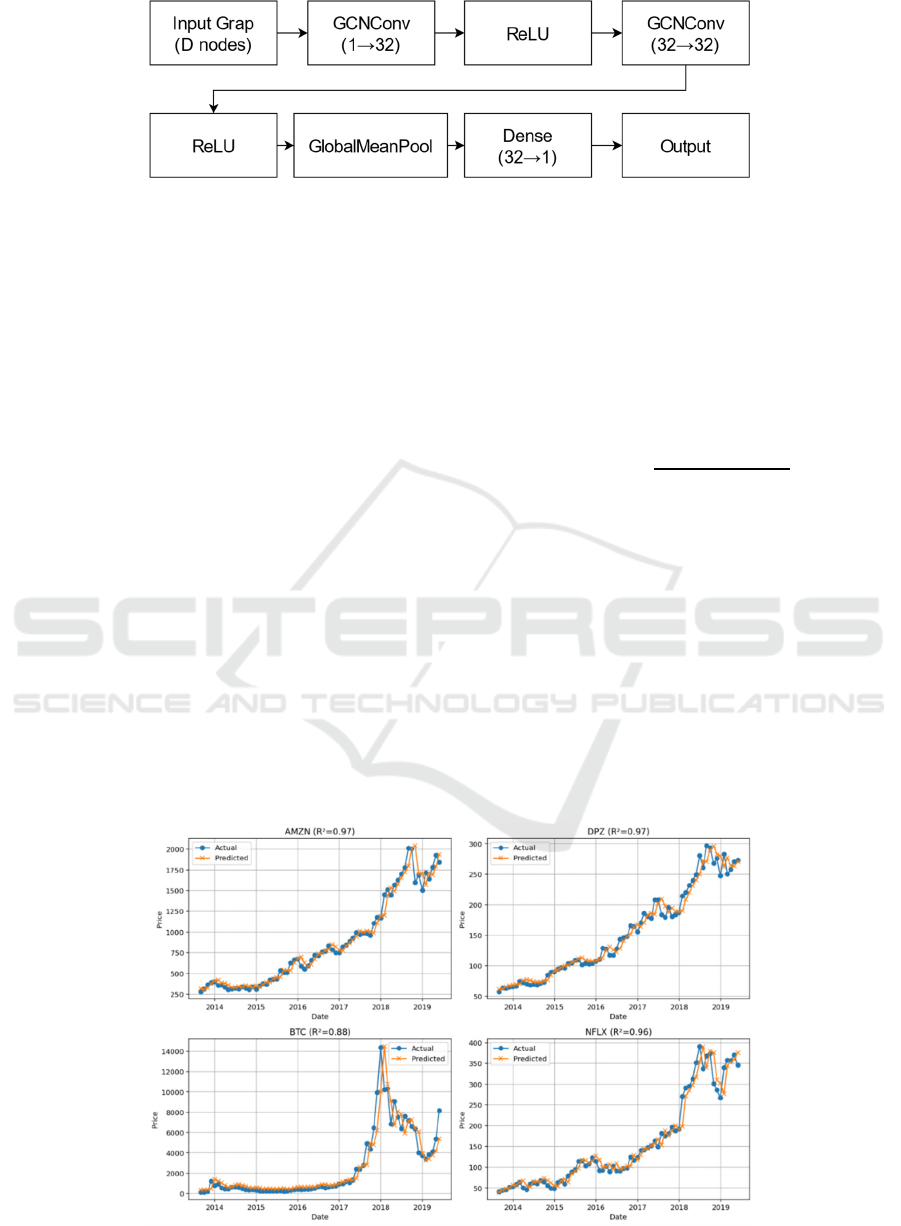
Figure 3: GNN (Picture credit: Original).
As shown in Figure 4, GNN have emerged
prominently in recent years, widely applied to node
classification, link prediction, and graph
classification tasks, demonstrating strong modeling
capabilities across various domains (Zhou et al.,
2021; Wu et al., 2020). The research constructs a
graph for each time series where each node represents
a day’s data. Edges connect consecutive days,
forming a chain graph. The GNN applies graph
convolution or message-passing layers: each node
updates its embedding by aggregating information
from its neighbors. After graph convolution, the
research uses a readout layer to predict the next-day
price from the final node features. This architecture
allows the model to learn patterns across adjacent
time points.The objective for all models is to predict
the next day Adjusted Close price. The research trains
each model on the training set and evaluate
performance on the test set. After training, the
research applied SHAP to each model to measure the
importance of each feature. SHAP computes a
contribution value for each input feature in each
prediction, which helps interpret how each past price
contributes to the forecast.
3 EXPERIMENTS
3.1 Evaluation Metric
The research evaluates forecasting accuracy using the
coefficient of determination, R². The R² score is
defined as:
𝑅
1
∑
,
,
∑
,
(1)
where y_(true,i) are the actual prices, y_(pred,i) are
the predicted prices, and y ̅ is the mean of the actual
prices in the test set. An R² of 1.0 indicates perfect
prediction, while 0 indicates the model explains none
of the variance. The research report R² on the test set
for each model and asset.
3.2 Results
As shown in Figure 5, the linear regression model
forecasts (orange) versus actual prices (blue) for
AMZN, DPZ, BTC, and NFLX are shown above.
Linear
regression achieved R²≈0.97 for AMZN
Figure 4: Linear Regression Results (Picture credit: Original).
EMITI 2025 - International Conference on Engineering Management, Information Technology and Intelligence
86
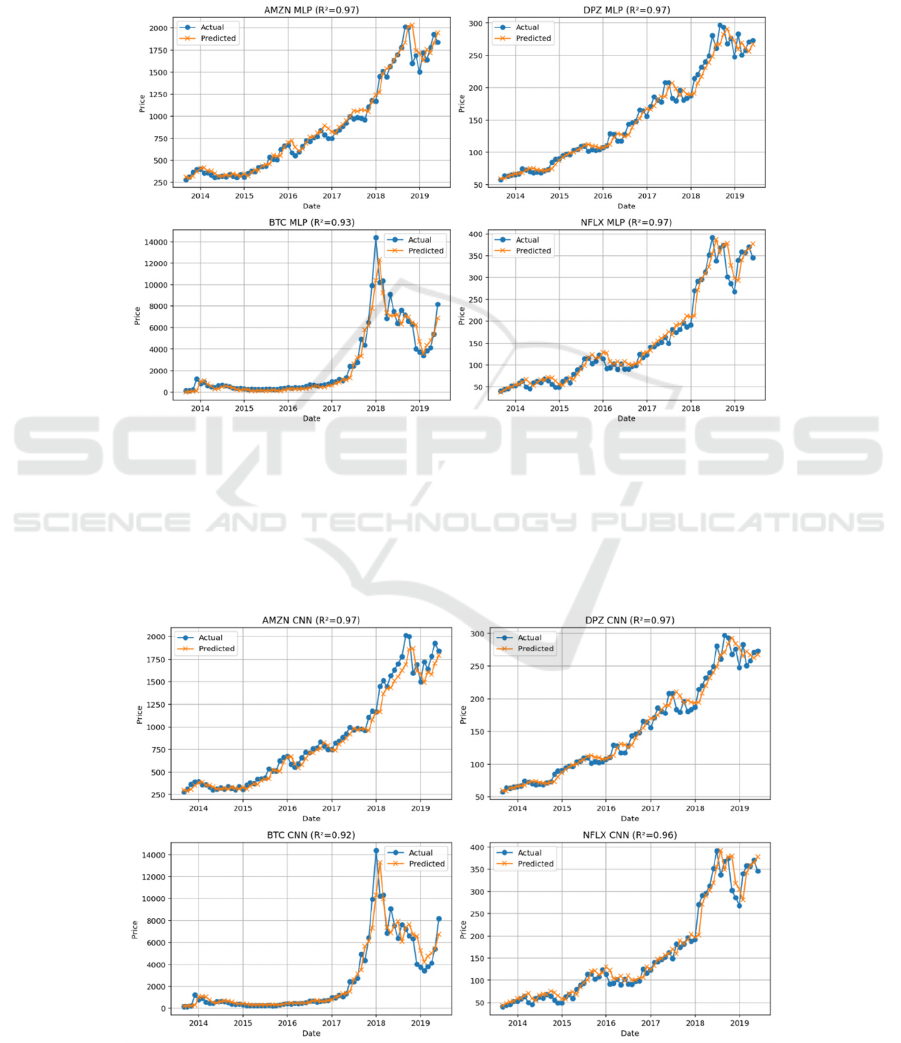
and DPZ, and R²≈0.96 for NFLX, indicating accurate
fits on these stocks. Bitcoin’s forecast is less precise
with R²≈0.88. The plot shows that the linear model
tracks the long-term trends in the stock prices well,
but it underestimates the rapid spikes in Bitcoin.
The Figure 6 above displays the MLP results. The
MLP attains R²≈0.97 for AMZN, DPZ, and NFLX.
For BTC, the MLP achieves a higher R²≈ 0.93,
outperforming the linear model. The predictions
(orange) closely follow most of each series' actual
(blue). In particular, the MLP’s nonlinear learning
allows it to capture Bitcoin’s volatility more
effectively, as seen by the tighter fit to the large BTC
price swings.
Figure 5: MLP Results (Picture credit: Original).
As shown in Figure 7, the CNN also achieves R²≈
0.97 for AMZN and DPZ, and R²≈0.96 for NFLX,
like the other models. For BTC, the CNN’s R²≈0.92,
slightly lower than the MLP but higher than linear
regression. The CNN predictions (orange) capture
many of the local fluctuations in each series. The
CNN’s performance is comparable to the MLP,
successfully learning short-term patterns in the time
series.
Figure 6: 1D CNN Results (Picture credit: Original).
Comparison of Linear Regression, MLP, 1D CNN, and Graph Neural Networks for Financial Asset Forecasting
87
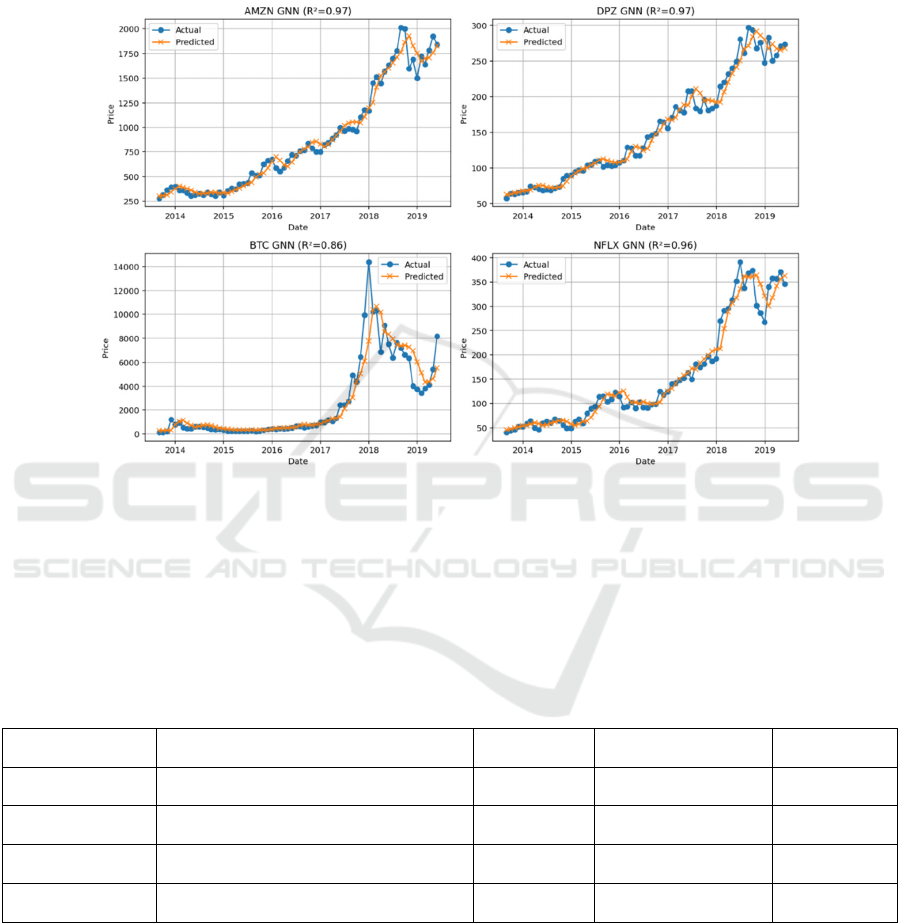
As shown in Figure 8, the GNN achieves R²≈0.97
for AMZN and DPZ, and R²≈0.96 for NFLX, again
on par with the other stock models. However, for
BTC, the GNN’s R²≈0.86 is the lowest. The predicted
Bitcoin prices (orange) show larger deviations from
actual (blue) at peak points. This suggests that the
simple graph construction did not improve Bitcoin
forecasting. The GNN performed similarly to linear
regression on BTC but did not capture its extreme
moves.
Figure 7: GNN Results (Picture credit: Original).
As shown in Table 1, all models fit the stock price
data well (R² ≈ 0.96–0.97). The main performance
differences occur on Bitcoin: the MLP and CNN
achieved higher R² ( ≈ 0.92–0.93) than Linear
Regression (0.88) or the GNN (0.86). This indicates
that the neural networks’ nonlinear modeling helped
capture Bitcoin’s volatility. Nevertheless, even the
lowest R² (0.86) still represents a reasonable fit.
Visually, the predicted and actual prices mostly align
across all assets. Thus, the deeper models provided
marginal gains on stocks but offered noticeable
improvement for the highly volatile cryptocurrency.
Table 1: Comparison of Forecasting Performance (R² values) Across Models and Assets.
Asset Linear Regression MLP 1D CNN GNN
AMZN 0.97 0.97 0.97 0.97
DPZ 0.97 0.97 0.97 0.97
NFLX 0.96 0.97 0.96 0.96
BTC 0.88 0.93 0.92 0.86
3.3 Feature Important Analysis
As shown in Figure 9, it relies most on the previous
day's closing price (Price_t-1), followed by the price
of the last 5 days (Price_t-5). This shows that the
short-term (one day) and slightly longer lagged (five
days) prices of AMZN have the most influence on the
prediction, while the importance of the middle days is
relatively low.
EMITI 2025 - International Conference on Engineering Management, Information Technology and Intelligence
88
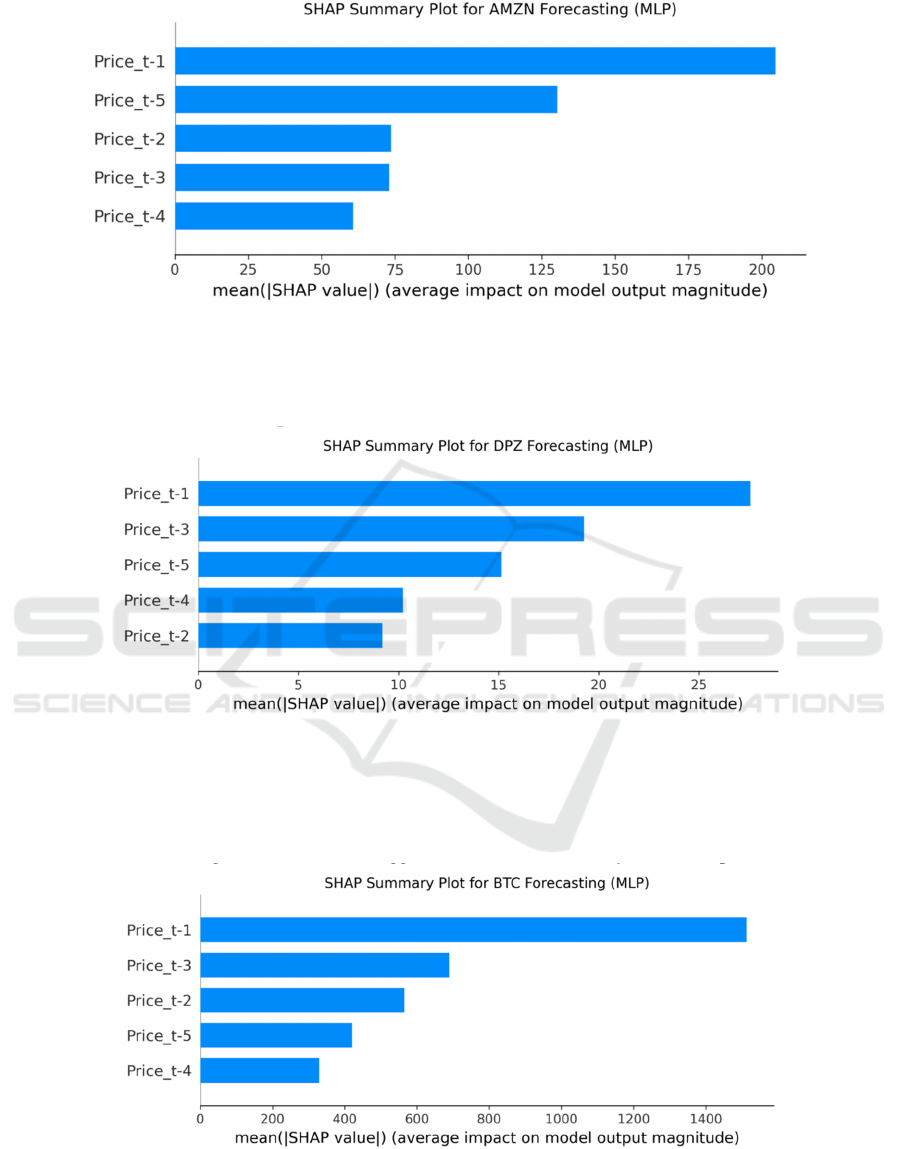
Figure 9: AMZN prediction (Picture credit: Original).
As shown in Figure 10, like AMZN, Price_t-1 still
has the highest importance, followed by Price_t-3 and
Price_t-5. This indicates that the prediction of DPZ
price is significantly affected by recent (1 day ago)
and slightly distant (3 days and 5 days ago) price
information.
Figure 10: DPZ prediction (Picture credit: Original).
As shown in Figure 11, BTC's price fluctuates
violently. SHAP analysis shows that the closing price
of the previous day (Price_t-1) has a very high impact
on BTC prediction, far greater than other lagged
features. The importance of other features (Price_t-3,
Price_t-2, Price_t-5, Price_t-4) decreases in turn,
indicating that the model's prediction of BTC mainly
relies on extremely short-term price information.
Figure 11: BTC prediction (Picture credit: Original).
Comparison of Linear Regression, MLP, 1D CNN, and Graph Neural Networks for Financial Asset Forecasting
89
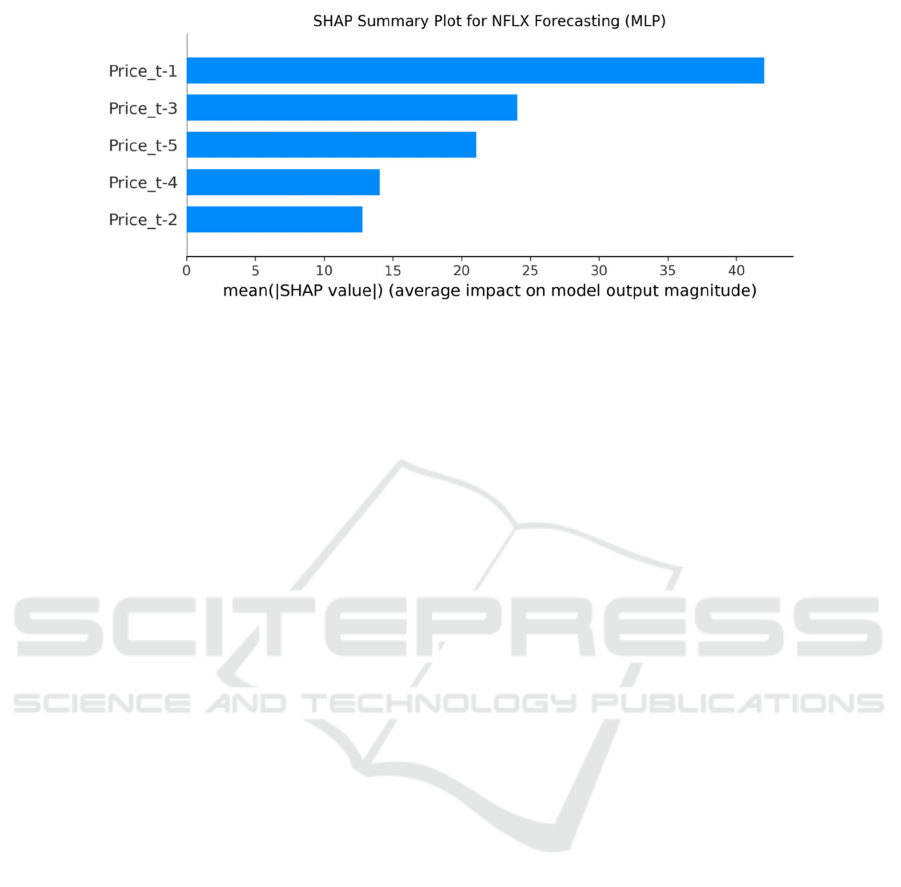
Figure 12: NFLX prediction (Picture credit: Original).
As shown in Figure 12, the SHAP analysis results
of NFLX also show that the price of the previous day
(Price_t-1) is the most important, followed by the last
3 days (Price_t-3) and the previous 5 days (Price_t-
5). This is like the situation of DPZ, indicating that
NFLX predictions strongly rely on historical price
information from recent and past days.
In summary, the feature importance analysis of
the four assets shows that the MLP model generally
relies heavily on the most recent one-day price
information (Price_t-1) when predicting future prices
and then selectively refers to other lagged days of
prices based on the characteristics of different assets.
This reflects that the model can capture the price
volatility characteristics of different assets.
4 CONCLUSIONS
In the experiments, all models achieved high
accuracy on the stock assets (AMZN, DPZ, NFLX),
with R² values around 0.96–0.97. The simpler Linear
Regression baseline performed nearly as well as the
neural models on these well-behaved series.
However, the neural models outperformed for the
volatile cryptocurrency: the MLP and CNN achieved
the highest R² (≈0.92–0.93) while Linear Regression
and the GNN were lower (≈0.86–0.88). This indicates
that the nonlinear learning capacity of the MLP and
CNN helps capture Bitcoin’s erratic behavior better
than the linear model or the GNN.
SHAP analysis revealed that, for each model, the
most recent price lags were the dominant features
influencing predictions. This confirms that all models
rely primarily on immediate price history in one-step
forecasting. Overall, deeper models provided only
marginal gains on stable stock forecasts but delivered
more benefit on the highly volatile asset.
This study has limitations. We used only historical
adjusted closing prices as inputs to predict next day
closing prices, without incorporating additional
potentially influential variables such as
macroeconomic factors, or market sentiment data.
Including these additional features could enhance
predictive performance. Furthermore, the graph
construction for the GNN was relatively
straightforward, utilizing only temporal relationships
within individual assets; constructing more complex,
multi-asset interaction graphs might further improve
forecasting accuracy. Additionally, this research
focused exclusively on one-step-ahead predictions
evaluated via the R² metric; future studies could
extend analyses to multi-day forecasts, employ
alternative evaluation metrics, and explore more
sophisticated neural network architectures. Despite
these limitations, the study provides a comprehensive
comparison among predictive models and highlights
the importance of interpretability in financial time
series forecasting.
REFERENCES
Bao, W., Cao, Y., Yang, Y., Che, H., Huang, J., Wen, S.,
… Zhang, C. (2025). Data-driven stock forecasting
models based on neural networks: A review.
Information Fusion, 113, 102616.
Graph neural networks: A review of methods and
applications. AI Open, 1, 57–81.
Jiang, W. (2021). Applications of deep learning in stock
market prediction: Recent progress. Expert Systems
with Applications, 184, 115537.
Jin, M., Koh, H. Y., Wen, Q., Zambon, D., Alippi, C.,
Webb, G. I., & Pan, S. (2024). A survey on graph neural
EMITI 2025 - International Conference on Engineering Management, Information Technology and Intelligence
90

networks for time series: Forecasting, classification,
imputation, and anomaly detection. arXiv preprint
arXiv:2307.03759.
Lundberg, S. M., & Lee, S.-I. (2017). A unified approach
to interpreting model predictions. In Advances in
Neural Information Processing Systems, 30.
Muhammad, D., Ahmed, I., Naveed, K., Bendechache, M.,
& Yaseen, U. (2024). An explainable deep learning
approach for stock market trend prediction. Heliyon,
10(21), e40095.
Ran, Y., Fan, Y., Wang, Y., Yu, Z., & Han, J. (2024). A
model based on LSTM and graph convolutional
network for stock trend prediction. PeerJ Computer
Science, 10, e518.
Wu, Z., Pan, S., Chen, F., Long, G., Zhang, C., & Yu, P. S.
(2020). A comprehensive survey on graph neural
networks. IEEE Transactions on Neural Networks and
Learning Systems, 32(1), 4–24.
Zeng, Z., Kaur, R., Siddagangappa, S., Rahimi, S., Balch,
T., & Veloso, M. (2023). Financial time series
forecasting using CNN and Transformer. arXiv preprint
arXiv:2304.04912.
Zhang, C., Sjarif, N. N. A., & Ibrahim, R. (2023). Deep
learning models for price forecasting of financial time
series: A review of recent advancements (2020–2022).
arXiv preprint arXiv:2305.04811.
Zhou, J., Cui, G., Hu, S., Zhang, Z., Yang, C., Liu, Z.,
Wang, L., & Sun, M. (2021).
Comparison of Linear Regression, MLP, 1D CNN, and Graph Neural Networks for Financial Asset Forecasting
91
