
Research on Traditional Chinese Medicine Intelligent Diagnosis
Based on Arterial Blood Detection and Pulse Diagnosis
Jianjin Tang
Mechanical Engineering and Automation, Northeastern University, Shenyang, Liaoning, China
Keywords: Artificial, Intelligence, Intelligent Diagnosis, Traditional Chinese Medicine.
Abstract: Traditional Chinese Medicine (TCM) pulse diagnosis has always been regarded as an important means to
reflect the operation of qi and blood in the body and the functions of the zang-fu organs. However, the
traditional method has long relied on the subjective experience of doctors and lacks objective and quantitative
standards, which limits its scientific promotion. This paper reviews the current research progress and technical
approaches related to the combination of arterial blood detection technology and TCM pulse diagnosis. This
article explores the use of modern instruments and equipment such as ultrasonic flowmeters and optical
sensors to obtain key physiological indicators, including hemodynamics, pulse waveforms, vascular elasticity,
and heart rate variability, and to establish a quantitative model of TCM pulse conditions. At the same time,
multi-modal data fusion and machine learning methods are introduced to conduct feature extraction,
classification, and intelligent diagnosis of pulse diagnosis signals. Moreover, a human-machine interaction
system is integrated to optimize the display and practicality of the diagnostic results. The research shows that
this technical solution is expected to significantly improve the accuracy and repeatability of TCM diagnosis,
providing new ideas for the coordinated development of TCM and Western medicine.
1 INTRODUCTION
Over thousands of years, the diagnosis and treatment
system of Traditional Chinese Medicine (TCM) has
developed unique theories and practices. Among
them, the four diagnostic methods of "inspection,
auscultation and olfaction, interrogation, and pulse
taking and palpation", especially the part of pulse
diagnosis, embodies TCM's unique insights into life
and diseases. Although traditional pulse diagnosis has
its unique charm, it often relies on the personal
experience of doctors, and it is difficult to establish a
quantitative evaluation standard. This has imposed
certain limitations on its application within the
modern medical system. In recent years, how to
transform the "empirical judgment" in TCM pulse
diagnosis into data-driven indicators and achieve
objective diagnosis through modern technologies has
gradually become an important issue that urgently
needs to be addressed in the field of integrating
traditional Chinese and Western medicine.
As the core of TCM pulse diagnosis, the pulse
condition not only reflects the physical movement of
the blood but also reveals the overall information
about the qi and blood of the body as well as the
functions of the zang-fu organs. With the rapid
development of artificial intelligence, signal
processing, and biosensing technologies, an
increasing number of scholars are attempting to
transform traditional pulse diagnosis into quantifiable
data. For example, some studies have utilized multi-
point sensors to achieve the synchronous collection of
pulse signals from the three locations of "cun",
"guan", and "chi". This breaks through the limitations
of single-point collection in the past and provides data
support for the pattern recognition of pulse conditions.
However, most of the current pulse diagnosis
instruments are based on methods such as pressure
sensors, and there is a significant difference between
the pulse diagnosis results obtained by these
instruments and those of clinical physicians (Hsieh et
al., 2021). Many scholars have also attempted to
introduce more meticulous physiological
measurement methods. For instance, they use
Doppler ultrasound technology to explain the
characteristics of traditional pulse conditions,
providing a basis of physical quantities for
descriptions like "stringy", "slippery", and "thin" in
pulse diagnosis. The research on pulse diagnosis is
currently in a rapid development stage where tradition
66
Tang, J.
Research on Traditional Chinese Medicine Intelligent Diagnosis Based on Arterial Blood Detection and Pulse Diagnosis.
DOI: 10.5220/0014320400004718
Paper published under CC license (CC BY-NC-ND 4.0)
In Proceedings of the 2nd International Conference on Engineering Management, Information Technology and Intelligence (EMITI 2025), pages 66-70
ISBN: 978-989-758-792-4
Proceedings Copyright © 2025 by SCITEPRESS – Science and Technology Publications, Lda.

and modernity converge, and technology and
medicine integrate. The CiteSpace software can be
used to understand the research status quo and
development trends in this field by measuring the
literature in the relevant domain (Hou & Hu, 2013,
Chen et al., 2015). This paper combs through the
research status quo and hotspots of TCM pulse
diagnosis, and points out that future research will
focus more on intelligent diagnosis, integration of
multimodal information, and quantitative extraction
of pulse characteristics.
At present, most of the research is still limited to
signal collection and the extraction of single
characteristics, and the correlation between the pulse
condition and the overall physiological and
pathological state of the human body has not been
fully explored. Combining modern precision
detection technologies such as arterial blood testing
with pulse diagnosis can not only fill the information
gap of traditional pulse diagnosis but also provide a
basis for biological verification of TCM diagnosis. As
an important flowing tissue in the body, arterial blood
has rich indicators and mature collection techniques,
and it has become an important data source for
modern medical testing.
This study aims to construct an intelligent
diagnosis model that integrates modern detection
techniques and TCM theories. By means of high-
precision pulse condition collection and standardized
arterial blood testing, a multimodal health data
system will be established. Moreover, machine
learning and data mining techniques will be applied
to extract representative features, so as to achieve
accurate classification of disease states and the
construction of a TCM syndrome differentiation
model. It is hoped that this will build a bridge between
pulse condition data and biochemical indicators,
enhancing the persuasiveness of TCM in the context
of modern medicine.
2 INTELLIGENT DIAGNOSIS
SCHEME AND DISEASE
CONDITION PREDICTION:
SENSORS AND DATA
ANALYSIS
2.1 Design and Implementation of the
Sensor System
The scheme envisioned in this paper adopts a brand-
new design of the sensor module, striving to
organically integrate arterial blood testing with the
collection of pulse diagnosis signals. With high-
precision pressure sensors and photoelectric sensors
as the core, this module combines microfluidic
technology and wireless data transmission to achieve
real-time monitoring of the pulse waveform and
blood biochemical indicators. For the arterial blood
testing part, a color Doppler ultrasound diagnostic
instrument is used to collect the blood flow
spectrograms of normal pulse, superficial pulse, deep
pulse, stringy pulse, slippery pulse, weak pulse and
unsmooth pulse (Gao et al., 2024). At the same time,
for the pulse diagnosis signal collection part, a high-
resolution pressure sensor array is employed to
accurately record the subtle changes in the pulse
waveform, and with the help of a high-speed data bus,
real-time data transmission with the host computer is
achieved. The entire module adopts a modular and
standardized design, thus ensuring the synchronism
and consistency of signal collection in each part,
laying a solid foundation for subsequent data
processing (Tian et al., 2025).
2.2 Methods of Data Collection and
Preprocessing
During the data collection process, this scheme
adopts a dual-channel synchronous collection
strategy: on the one hand, it conducts quantitative
determination of the biomarkers in the blood, and on
the other hand, it performs continuous and dynamic
collection of the pulse signals. A high-precision timer
is used to ensure the precise synchronization of the
sampling time. After the collected raw data are
processed by hardware signal amplification and
filtering, they are further subjected to combined low-
pass and high-pass filtering according to the
measurement principles of traditional pulse graph
parameters (such as h1, t1) (Zhang et al., 2025). A
band-pass filter is used to eliminate noise and
baseline drift in the pulse signals. For the positioning
and extraction of the pulse waves, the Shannon
energy envelope line and Hilbert transform methods
are adopted (Cui et al., 2018) to filter out external
noise and interference. Subsequently, at the software
level, through real-time normalization and smoothing
algorithms, short-term mean value correction is
applied to the continuous curve, and time-frequency
joint analysis methods such as wavelet transform are
used to extract key features, providing high-quality
input for multimodal data fusion and ensuring that the
results of intelligent diagnosis are objective and
clinically practical.
Note:Observation Indicators of the Pressure-based
Pulse Diagnosis Instrument and Their Interpretations
Research on Traditional Chinese Medicine Intelligent Diagnosis Based on Arterial Blood Detection and Pulse Diagnosis
67
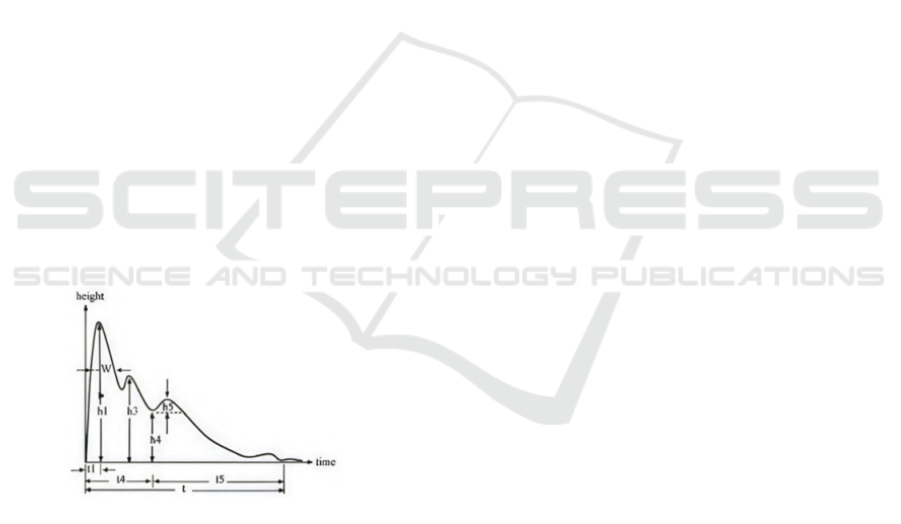
Modern Pulse Diagnosis of TCM has provided
detailed definitions of the pulse graph parameters
(Figure 1), which mainly include the following
contents: h1: The height of the main wave; h3: The
height of the pre-dicrotic wave; h4: The height of the
mid-diastolic notch; h5: The height of the dicrotic
wave; t1: The time value from the starting point of the
pulse graph to the peak point of the main wave; t3:
The time value from the starting point of the pulse
graph to the pre-dicrotic wave; t4: The time value
from the starting point of the pulse graph to the mid-
diastolic notch; t5: The time value from the mid-
diastolic notch to the ending point of the pulse graph;
t: The pulsation cycle, that is, the time value from the
starting point to the ending point of the pulse graph
(the heart rate can be indirectly calculated); w1: The
height at 1/3 of the main wave; w2: The height at 2/3
of the main wave; w: The time duration during which
the pressure in the left ventricle and the large arteries
remains at a high level; w1/t and w2/t: The elasticity
at the fixed position on the amplitude of the main
wave and the magnitude of the peripheral resistance;
t1/t and t1/t4: Cardiac ejection; h4/h1 and h5/h1: The
peripheral resistance of the blood vessels; h3/h1: The
elasticity of the arterial vessels and the peripheral
resistance; U angle: The viscosity of the blood and the
elasticity of the blood vessels; s1: The slope of the
ascending branch; s2: The slope of the rapid
descending segment; s3: The slope of the slow
descending segment (Fei, 2003).
Figure 1: Main measurement parameters of the pulse graph
(Fei, 2003).
2.3 Data Fusion and Intelligent
Analysis Algorithms
In the data fusion stage, the scheme adopts the
popular multimodal data fusion technology in the
current objective research of TCM pulse diagnosis to
achieve precise docking between the arterial blood
test data and the pulse diagnosis signals. Firstly, a
time alignment algorithm is used to ensure the
consistency of the two types of data at the collection
moment. Secondly, a multi-layer feature extraction
framework is constructed by using a Convolutional
Neural Network (CNN) and a Support Vector
Machine (SVM). Then, time-domain, frequency-
domain, and time-frequency joint analysis is carried
out on the preprocessed data to extract key parameters
that can quantitatively describe the characteristics of
pulse diagnosis (Yi et al., 2024). The constructed
feature vectors are then used as inputs and fed into the
intelligent diagnosis model that has been repeatedly
trained and optimized with large-scale data samples.
Supported by historical data, this model can achieve
accurate identification of TCM syndromes and
diseases (Yi et al., 2024). At the same time, the
ensemble learning model of the TCM-assisted
diagnosis system based on artificial intelligence
(iterative algorithms (Luo et al., 2022), Gradient
Boosting Decision Tree can be applied to avoid their
respective weaknesses (Yan et al., 2022)), and
conduct disease condition analysis to ensure the
accuracy of the diagnosis. The ensemble learning
model used for syndrome prediction can utilize four
existing prediction methods (Backpropagation,
Random Forest, Extreme Gradient Boosting, and
Support Vector Classifier) to achieve consistently
high prediction accuracy (Zhang et al., 2020). The
overall data processing flow not only takes fully into
account the nonlinear characteristics of the sensor
data, but also incorporates the quantitative indicators
from the TCM diagnostic methods of "inspection,
auscultation and olfaction, inquiry, and pulse-taking"
into the model, thus achieving a deep integration of
traditional experience and modern intelligent
technology (Chen et al., 2025).
2.4 Result Feedback and System
Optimization
After completing the data fusion and feature
extraction, the intelligent diagnosis system will
provide feedback on the diagnostic results to the
physicians in the form of intuitive charts and detailed
reports. It not only displays the changing trends of
key pulse condition parameters but also presents an
analysis of the preliminary pathological state. The
system also has a built-in feedback mechanism. By
comparing the real-time data with the historical
standard database, it will regularly retrain the model
and calibrate the parameters, so as to ensure the
accuracy and stability of the detection indicators. In
clinical trials, the system compares and validates its
results with those of traditional pulse diagnosis
through multiple evaluation indicators such as
EMITI 2025 - International Conference on Engineering Management, Information Technology and Intelligence
68

accuracy rate, recall rate, and F1 value, demonstrating
its high clinical reference value. In addition, the
device supports remote data storage and multi-center
sharing, enabling multi-dimensional data integration
and big data analysis. This provides technical support
for the continuous optimization of the objectivity and
intelligence of TCM pulse diagnosis, and also lays a
scientific and standardized foundation for future
clinical decision-making assistance.
3 APPLICATION PROSPECTS
AND CHALLENGES
3.1 Application Prospects
The intelligent diagnostic technology that combines
arterial blood testing with pulse diagnosis has broad
development potential in the field of TCM. With the
progress of sensor, artificial intelligence, and big data
technologies, the intelligent diagnosis system of TCM
will be improved in many aspects. Firstly, the
integration of multimodal physiological data has
become a trend. By using high-precision sensors to
collect various types of information such as pulse
waveforms, hemodynamic parameters, and blood
biochemical indicators, and combining them with the
syndrome differentiation elements such as the
patients' symptoms and the information obtained
from inquiry, comprehensive objective data can be
provided for diagnosis. Signal processing and pattern
recognition algorithms can explore the correlations
between pulse conditions and disease states from a
large number of clinical samples.
Secondly, the development of remote monitoring
and wearable devices will drive the intelligent
diagnosis of TCM out of the consulting room and
expand it into community and home scenarios.
Patients can collect health data at any time through
wearable pulse sensors and portable detectors,
providing data support for the monitoring of chronic
diseases and health management. In communities or
remote areas with limited medical resources, such
technologies can improve the accessibility of
diagnosis and treatment.
Thirdly, the in-depth application of artificial
intelligence technology empowers the intelligent
diagnosis of TCM. Researchers can utilize deep
learning models to train diagnostic models and
continuously optimize the algorithms. Technologies
such as knowledge graphs combine TCM theories
with data-driven methods, improving the
interpretability of the system's conclusions regarding
pulse diagnosis. This integration helps to reduce the
dependence on empirical judgment.
In addition, the development of intelligent
diagnosis in TCM is closely related to the digital
transformation of the medical system. In the context
of electronic health records and intelligent medical
environments, TCM pulse data can be integrated with
Western medicine indicators, providing multi-
dimensional references for clinical decision-making.
In the future, the intelligent TCM diagnosis system is
expected to play a role in fields such as collaborative
diagnosis and treatment between TCM and Western
medicine, as well as personalized health
management. The data-driven auxiliary diagnosis
system can provide reference opinions for doctors,
promoting the standardization of the diagnosis and
treatment process; at the same time, it helps with the
inheritance of experience and improves the quality of
medical care.
3.2 Challenges
Despite its broad application prospects, the actual
implementation of intelligent diagnosis in TCM still
faces multiple challenges, which require
comprehensive responses from aspects such as
technology, ethics, policies, and user behavior.
From the technical aspect: The pulse diagnosis
signals in TCM are dynamically complex, and there
are significant differences in pulse conditions among
different individuals, making it difficult to establish a
unified standard. Current sensing devices are limited
by precision and environmental factors, which affect
the stability of the data. The fusion and modeling of
multi-source heterogeneous data remain a difficult
problem, and the insufficient compatibility of data
from different devices also restricts the utilization of
large-scale data. Training diagnostic models requires
a large amount of annotated data. However, the lack
of a unified annotation and sharing mechanism TCM
diagnostic data restricts the generalization ability of
the algorithms. Finally, the polysemy of TCM
theories poses a challenge to the interpretability of the
models. It is necessary to combine expert knowledge
with data analysis to improve the traceability of
diagnostic decisions.
From the ethical aspect: The intelligent diagnosis
system involves patients' sensitive health data. How
to protect privacy, prevent leakage and abuse, and
ensure informed consent are issues that must be
resolved. Algorithmic decision-making may affect
the trust between doctors and patients. If
misdiagnosis or bias occurs, it will have a negative
impact on this trust. Therefore, a transparent
Research on Traditional Chinese Medicine Intelligent Diagnosis Based on Arterial Blood Detection and Pulse Diagnosis
69

evaluation and feedback mechanism should be
established to continuously monitor and correct the
diagnostic results, and the auxiliary position of
artificial intelligence in clinical practice should be
clearly defined to prevent excessive dependence.
From the policy aspect: Currently, there is a lack
of unified supervision standards for the technologies
and devices related to intelligent diagnosis in TCM.
For the promotion and application, it is necessary to
improve the policies and regulations regarding
software certification, data security, and the
qualifications of medical devices. It is also essential
to coordinate the differences between TCM and
Western medicine in terms of diagnosis and treatment
records as well as the indicator systems, so as to
achieve data intercommunication and collaborative
diagnosis and treatment. In addition, research,
development, and application require policy and
financial support. The lack of supportive policies and
talent cultivation plans will also affect the
development of this field.
From the user behavior aspect: New technologies
need to gain the trust of both doctors and patients.
Some TCM practitioners may have reservations about
intelligent diagnostic tools, believing that machines
are difficult to replace experience. The trust level of
patients towards machine-assisted diagnosis also
needs to be improved. Therefore, it is necessary to
provide training to enhance the understanding and
acceptance of the technology by both doctors and
patients, and optimize the system design to meet the
needs of different users. Only by taking into account
both technical and humanistic needs can intelligent
diagnosis in TCM truly be integrated into clinical
practice and contribute to social health services.
4 CONCLUSION
The development of the intelligent diagnosis system
of TCM provides a new way for the modern
transformation of TCM. By integrating artificial
intelligence, sensing technology, and the concept of
the integration of TCM and Western medicine, it can
not only improve the diagnostic accuracy but also
help TCM go global. With the continuous
advancement of technology, intelligent diagnosis in
TCM is expected to play an increasingly important
role in the global medical system and make greater
contributions to the public health cause.
REFERENCES
Chen, Y., Chen C. M., Li, Z. Y., et al.: 'The Methodological
Functions of the Knowledge Map of CiteSpace',
Scientia Sinica (Studia Naturalia), 2015 (2): 242-253
Chen, Z., Zhang, D., Nie, P. F.: ‘Developing the Artificial
Intelligence Method and System for "Multiple Diseases
Holistic Differentiation" in Traditional Chinese
Medicine and Its Interpretability to Clinical Decision.’
EVIDENCE-BASED MEDICINE, 18(2), 2025
Cui, J., Tu, L. P., Zhang, J. F., et al.: 'Analysis of pulse
signals based on array pules volume', Chin J Integr Med
,2018, 25(2): 103-107
Fei, Z. F.: 'Modern Pulse Diagnosis in Traditional Chinese
Medicine', Beijing: People's Medical Publishing House,
2003: 5-30
Gao, L. S., Li, Y., Yu, X. F., et al.: 'Screening of
Identification Indicators of Traditional Chinese
Medicine Pulse Patterns Based on Doppler Ultrasound
Technology', Journal of Binzhou Medical University,
2024, 47(05): 385-388
Hou, J. H., Hu, Z. G.: 'Review and Prospect of the Research
on the Application of CiteSpace Software', Modern
Information, 2013(4): 99-103
Hsieh, T. C., Wu, C. M., Tsai, C. C., et al.: 'Portable
Interactive Pulse Tactile Recorder and Player System',
Sensors (Basel), 2021, 21: 4349
Luo, Z. Y., Cui, J., Hu, X. J., et al.: 'A study of machine-
learning classifiers for hypertension based on radial
pulse wave', Biomes Signal Proc Control, 2022
Tian, H. Y., Huang L. Q., Xian, N, X., et al.: 'Automatic
Pulse Signal Acquisition System Based on a Six-Array
Sensor', Transducer and Microsystem Technologies,
2025, 44(01): 83-87
Yan, J. J., Cai, X. L., Zhu, G. Y., et al.: 'A non-invasive
blood pressure prediction method based on pulse wave
feature fusion', Biomed Signal Proc
Control,2022,74;103523
Yi, K., Zhang, M. D., Guo, S., et al.: 'Review of the
Research on Data Annotation of Intelligent Equipment
for Pulse Diagnosis in Traditional Chinese Medicine',
Shanghai Journal of Traditional Chinese Medicine,
2024, 58(10): 5-10
Zhang, H., Ni, W. D., Li, J., Zhang, J. J.: ‘Artificial
Intelligence–Based Traditional Chinese Medicine
Assistive Diagnostic System: Validation Study’, JMIR
Medical Informatics, 8(6), 2020
Zhang, J., Liu M. H., Song, X. H., et al.: 'Clinical Research
and Analysis of Pulse Diagnosis Instruments and Their
Detection Indicators', Chinese Journal of Basic
Medicine in Traditional Chinese Medicine, 2025,
31(03): 425-430
EMITI 2025 - International Conference on Engineering Management, Information Technology and Intelligence
70
