
Data Complexity-Oriented Classification of Multispectral Remote
Sensing Imagery via Machine and Deep Learning Approaches
Berrin Islek
1
a
and Hamza Erol
2
b
1
Department of Computer Engineering, Sivas Science and Technology University, Sivas, Turkey
2
Department of Computer Engineering, Mersin University, Mersin, Turkey
Keywords: Deep Neural Network, Data Complexity, Computational Complexity, Information Complexity, Support
Vector Machines, Random Forest.
Abstract: In this study, the land cover of an agricultural region was classified at a field level using multispectral satellite
imagery. The primary objective of the study was to evaluate different classification methods in terms of data
complexity, computational complexity, and information complexity. The data labelling process was
performed using hierarchical clustering, making the groups in the data more meaningful. A separate clustering
tree structure was created for each feature, and data complexity was analysed using parameters such as level,
number of families, and number of children. Object-oriented approaches were adopted in the classification
phase, employing Deep Neural Networks, Random Forest, and Support Vector Machines. The performance
of these methods was examined not only in terms of accuracy but also in terms of evaluation metrics such as
F1-score, recall, and precision. The results demonstrate the classification capabilities of the methods in a
comprehensive manner and provide important clues about which approach is more suitable in different
scenarios. Furthermore, the methods were compared in terms of computational costs and processing times,
and a comprehensive evaluation was conducted regarding the classification of agricultural regions using
remotely sensed data.
1 INTRODUCTION
Multispectral remote sensing images are widely used
to classify vegetation types and estimate crop yields
in agricultural regions (Thyagharajan and Vignesh,
2019; Modica et al., 2021). This approach has
emerged as a key resource in contemporary precision
agriculture, allowing extensive assessment of crop
conditions, vegetation patterns, and soil
characteristics (Sishodia et al., 2020; Guanter et al.,
2013). These images capture data across multiple
spectral bands, providing information that is not
visible to the human eye, which is crucial for accurate
assessment of crop status and yield prediction
(Thenkabail, Lyon, & Huete, 2016).
Over the years, various approaches have been
proposed to improve classification accuracy using
multispectral images. For example, Erol and Akdeniz
employed mixture distribution models for land cover
classification, achieving an accuracy of 94% (Erol &
a
https://orcid.org/ 0000-0003-1984-357X
b
https://orcid.org/0000-0001-8983-4797
Akdeniz, 2005). Sehgal applied preprocessing
techniques and different classification algorithms to
multispectral satellite images, reaching a maximum
accuracy of 87% using a Backpropagation Neural
Network (BPNN) (Sehgal, 2012). Similarly, Çalış
and Erol (2012) applied mixture discriminant
analysis, while Crnojević et al. (2014) integrated
Landsat-8 and RapidEye images for pixel-based
classification in northern Serbia. Gogebakan and Erol
(2018) developed a semi-supervised approach for
classifying multispectral data, which utilizes
clustering based on mixture models. Sicre et al.
(2020) analyzed the contribution of microwave and
optical data for land type classification in
southwestern France, achieving up to 85% accuracy
using Support Vector Machines and Random Forests.
Selecting an appropriate classification method for
multispectral satellite imagery of agricultural regions
containing diverse crop types remains a critical task.
To address this challenge, numerous machine
Islek, B. and Erol, H.
Data Complexity-Oriented Classification of Multispectral Remote Sensing Imagery via Machine and Deep Learning Approaches.
DOI: 10.5220/0014313500004848
Paper published under CC license (CC BY-NC-ND 4.0)
In Proceedings of the 2nd International Conference on Advances in Electrical, Electronics, Energy, and Computer Sciences (ICEEECS 2025), pages 257-265
ISBN: 978-989-758-783-2
Proceedings Copyright © 2026 by SCITEPRESS – Science and Technology Publications, Lda.
257
learning and deep learning algorithms have been
developed to improve land use and vegetation
classification accuracy. In Dash et al. (2023) study,
LandSat image data was used to increase the accuracy
of land use and vegetation classification in
agricultural regions. In this study, Support Vector
Machines (SVM) (Kadavi & Lee, 2018; Singh,
Gayathri, & Chaudhuri, 2022), Random Forest
Classifier (RFC) (Pal, 2005; Zhang et al., 2017), and
Deep Neural Networks (DNN) (Singh et al., 2025)
were used. The objectives of this study are as follows:
First, the complexity of remotely sensed multi-
spectral satellite imagery will be calculated and data
labeling will be performed. Then, we will classify
remotely sensed multi-spectral satellite imagery of
agricultural regions using object-based SVM, RFC,
and DNN classification methods and compare the
classification performance of these three methods.
Finally, the obtained results will be evaluated and
discussed.
2 MATERIALS AND METHOD
In this section, we provide a comprehensive
description of the study workflow. Specifically, we
discuss (i) the remotely sensed multispectral images
of the agricultural region under study, (ii) the
complexity of these data, (iii) the data labelling
process, (iv) the classification methods applied to
these datasets, and (v) the performance evaluation
metrics used to assess the models.
2.1 Remotely Sensed Multispectral
Image of Agricultural Region
The multispectral imagery employed in this research
was obtained using the Landsat Thematic Mapper and
depicts an agricultural region situated in the Seyhan
Plain (approximately 37° N, 36° E) in Adana, Turkey.
The image spans an area of 198 × 200 pixels, resulting
in a total of 39,600 pixels, and was acquired on 27
March 1992 (Path 175–Row 34). For analysis, bands
3, 4, and 5 were selected, as they are effective in
differentiating healthy vegetation, open water, and
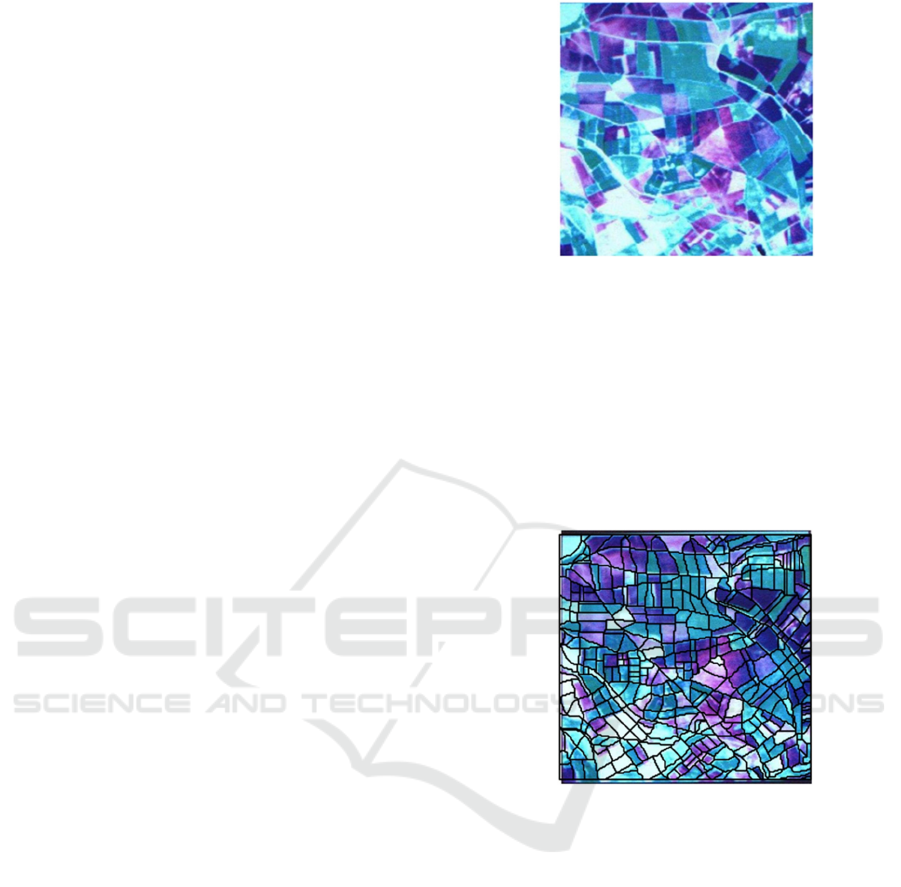
soil surfaces, respectively. Figure 1 presents the
Landsat Thematic Mapper image of the study area
without incorporating prior field information.
Figure 1: Landsat Thematic Mapper image, without a prior
information, of the agricultural region studied.
The study area consists of 269 individual fields,
labeled with codes from F001 to F269 on the
parcelization map prepared by the Government
Irrigation Department (DSI). Five major land cover
classes—wheat, potato, vegetable garden, citrus, and
bare soil—are present in the region, with a total of 24
subcategories. Based on this classification, 24 control
fields have been defined within the area.
Figure 2: Landsat Thematic Mapper image of the study
area, incorporating the previously collected parcel
information.
Based on a land cover survey, the control plots
were designated with identifiers CF001 to CF024 on
the parcel map provided by the Government Irrigation
Department. The remaining 245 plots, serving as test
sites, were labeled TF001 through TF245 on the same
map. Figure 2 shows a Landsat Thematic Mapper
image of the study area, incorporating the previously
collected parcel information.
2.2 Data Complexity Analysis of
Multispectral Remote Sensing
Image in Agricultural Regions
The multispectral image data analysed in this study
were acquired using the Landsat Thematic Mapper
sensor. Let’s bands 3, 4 and 5 values denoted by
ICEEECS 2025 - International Conference on Advances in Electrical, Electronics, Energy, and Computer Sciences
258
variables X
1
, X
2
and X
3
respectively. There are 39600
instances (observations) surrounding 198x200 data
matrix for each variable (feature).
The method for determining the degree of data
complexity is based on hierarchical structure of all
groups and all clusters in data (Erol & Erol, 2018).
The assessment of data complexity is conducted by
utilizing the hierarchical tree structure of groups and
clusters based on the features of the data. The tree
structures are obtained by finding all groups for each
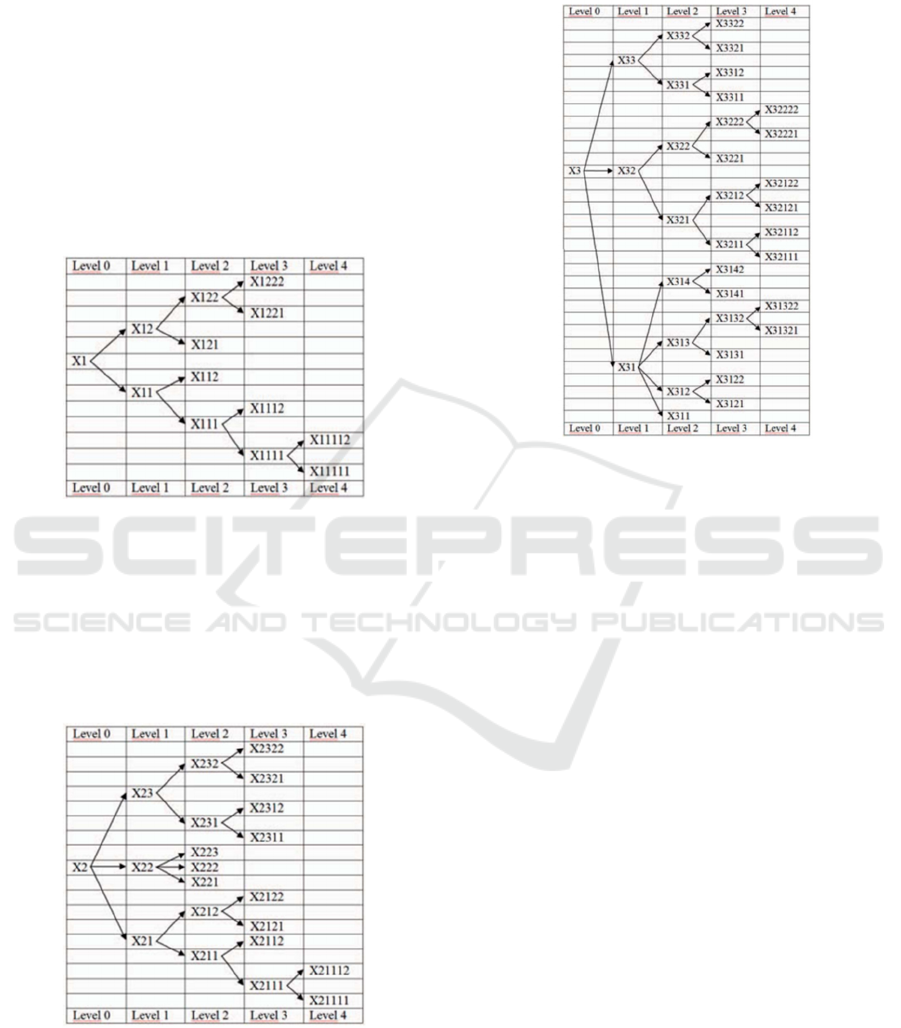
feature in data. The hierarchical tree structures of all
groups in each feature for obtaining remotely sensed
multispectral image data complexity were shown in
Fig. 3 – Fig. 5 respectively.
Figure 3: The hierarchical tree structures of all groups in the
first feature X
1
for remotely sensed multispectral image
data complexity.
The number of levels is 4, the number of parent
nodes (npn
1
) is 5 and the number of child nodes (ncn
1
)
is 7 in hierarchical tree structures of all groups in
feature X
1
for remotely sensed multispectral image
data as shown in Fig 3 (Erol & Erol, 2018).
Figure 4: The hierarchical tree structures of all groups in the
second feature X
2
for remotely sensed multispectral image
data complexity.
The number of levels is 4, the number of parent
nodes (npn
2
) is 8 and the number of child nodes (ncn
2
)
is 12 in hierarchical tree structures of all groups in
feature X
2
for remotely sensed multispectral image
data as shown in Fig 4 (Erol & Erol, 2018).
Figure 5: The hierarchical tree structures of all groups in the
third feature X
3
for remotely sensed multispectral image
data complexity.
The number of levels is 4, the number of parent
nodes (npn
3
) is 14 and the number of child nodes
(ncn
3
) is 19 in hierarchical tree structures of all groups
in feature X
3
for remotely sensed multispectral image
data as shown in Fig 5 [18].
Let ncn
i
and npn
i
denote the number of child
nodes and parent nodes for feature X
i
respectively.
Let DCX
i
denote data complexity for feature X
i
. Then
the data complexity for each feature X
i
is defined as
DCX
i
= ncn
i
- npn
i
for i=1,2,3 (1
)
So DCX
1
= 2, DCX
2
= 4 and DCX
3
= 5 for i=1,2,3
respectively. Let DC denote the data complexity for
entire data. Thus for all features. Then DC is defined
as:
DC =
∏
DCX
i
(2
)
DCX
1
= 2, DCX
2
= 4 and DCX
3
= 5 for feature
X
1
, X
2
and X
3
are 2, 4 and 5 respectively. Then the
data complexity for entire data DC = DCX
1
* DCX
2
* DCX
3
= 2 * 4 * 5 = 40. In the rest of this study, with
this DC = 40 for entire data which classification
method among three methods give the best
classification performance will be determined. Thus,
which method? Machine learning methods versus
deep learning method.
Data Complexity-Oriented Classification of Multispectral Remote Sensing Imagery via Machine and Deep Learning Approaches
259

2.3 Data Labelling of Remotely
Acquired Images for Agricultural
Lands
Two types of data are considered in this study:
incomplete data, which lack class labels, and
complete data, which include class labels. Class
labels (or class codes) are essential for the
classification of vector data. For the remotely sensed
multispectral image data of the agricultural area, data
labelling was performed based on the field (parcel)
structure within the region. A total of 245 test fields
and 24 control fields were identified in the
multispectral imagery using an edge detection
algorithm in conjunction with the parcelization map
of the agricultural area. The field types and
corresponding class codes are listed in Table 1.
Table 1: Control field codes and data labels (class codes).
Field Types Data Labels
Wheat1 1
Wheat2 2
Wheat3 3
Wheat4 4
Wheat5 5
Wheat6 6
Potato1 7
Potato2 8
Potato3 9
Potato4 10
Vegetable garden1 11
Vegetable garden2 12
Vegetable garden3 13
Vegetable garden4 14
Vegetable garden5 15
Vegetable garden6 16
Citrus1 17
Citrus2 18
Citrus3 19
Citrus4 20
Bare soil1 21
Bare soil2 22
Bare soil3 23
Bare soil4 24
Bare soil5 25
Data labelling is made for totally 39600 instances
(observations) in the 245 test fields and 24 control
fields of remotely sensed multispectral image data in
the agricultural area. Complete data is obtained as
comma separated values data file.
2.4 Classification Methods
The Support Vector Machine (SVM) is a supervised
learning algorithm grounded in Vapnik’s statistical
learning theory (Vapnik, 2013). Its main objective is
to identify the optimal separation boundaries between
classes. By using a kernel function, SVM can project
training examples into a higher-dimensional space,
allowing it to distinguish classes that are not linearly
separable in the original feature space. The selection
of the kernel function is a key design choice. Typical
kernels include linear, polynomial, radial basis
function (RBF), and sigmoid. In this study, the RBF
kernel is chosen because of its effectiveness in
managing non-linear separation tasks (Kadavi & Lee,
2018).
The Random Forest Classifier (RFC) is an
ensemble learning technique that generates a
collection of decision trees, each trained on randomly
selected subsets of data and features. At every split
within a tree, only a randomly chosen portion of the
available attributes is considered for determining the
division (Breiman, 1999). Each tree produces its own
prediction for a given input, and the final
classification outcome is obtained through majority
voting across the ensemble. This approach improves
model stability and helps mitigate overfitting. For the
induction of individual decision trees, a feature
selection criterion and a pruning strategy must be
specified. Among the available criteria, the Gini
index is widely used to select the most informative
feature at each split. The aggregation of predictions
from the N randomly constructed trees forms the
foundation of the Random Forest algorithm.
Subsequently, the trained forest is used to predict the
labels of samples in the test dataset, and the class with
the most votes across the trees is assigned as the final
prediction (Pal, 2005).
A Deep Neural Network (DNN) is an advanced
type of artificial neural network designed to capture
complex relationships in data through multiple layers
of interconnected neurons. Inspired by the
information processing mechanisms of the human
brain, DNNs consist of several hidden layers, where
each layer transforms the output of the previous layer
into increasingly abstract representations. Training
typically involves the backpropagation algorithm,
which adjusts network weights by propagating
prediction errors backward, allowing the network to
improve its performance iteratively. The
effectiveness of a DNN depends on several factors,
including structural choices such as the number of
layers and neurons per layer, learning parameters
such as activation functions, learning rate, number of
ICEEECS 2025 - International Conference on Advances in Electrical, Electronics, Energy, and Computer Sciences
260

epochs, batch size, and the use of regularization
methods. These factors collectively influence how
well the network learns patterns, generalizes unseen
data, and avoids overfitting. DNNs are particularly
suitable for handling large-scale and high-
dimensional datasets due to their capacity for
hierarchical feature extraction (Schmidhuber, 2014).
2.5 Performance Measures
Evaluating classification models requires not only the
correct implementation of algorithms but also the
selection of appropriate performance metrics. These
metrics quantify how well a model predicts class
labels and help identify which aspects of performance
are most relevant for a given application. For
balanced datasets, accuracy may provide a sufficient
measure, whereas for imbalanced datasets, precision,
recall, and F1-score offer more informative
assessments. Therefore, multiple metrics are typically
reported rather than relying on a single measure.
In classification tasks, the performance of a model
is commonly evaluated by comparing its predicted
labels with the actual labels. These results can be
summarized in a confusion matrix, which presents the
counts of correctly and incorrectly classified samples.
Instances that are correctly predicted as positive are
referred to as True Positives (TP), whereas correctly
predicted negative instances are True Negatives (TN).
False Positives (FP) indicate negative cases that were
mistakenly classified as positive, and False Negatives
(FN) represent positive cases incorrectly identified as
negative. These counts serve as the basis for
computing various performance metrics.
Accuracy, for example, quantifies the ratio of
correctly classified samples to the total number of
observations. (see Eq. 3)
𝐴
𝑐𝑐𝑢𝑟𝑎𝑐𝑦 =
(3)
Precision indicates the fraction of predicted
positive instances that are actually positive, reflecting
the model’s reliability in its positive predictions. (see
Eq. 4)
𝑃𝑟𝑒𝑐𝑖𝑠𝑖𝑜𝑛 =
TP
TP + FP
(4)
Recall, also referred to as sensitivity, measures the
fraction of actual positive instances that the model
successfully identifies, capturing its ability to detect
positive cases. (see Eq. 5)
𝑅𝑒𝑐𝑎𝑙𝑙 =
TP
TP
+
FN
(5)
The F1-score provides a balanced assessment by
combining precision and recall through their
harmonic mean, offering a single measure that
considers both false positives and false negatives.
(see Eq. 6) (Dalianis, 2018)
𝐹1 𝑠𝑐𝑜𝑟𝑒 = 2 ∗
∗
(6
)
These metrics together offer a comprehensive
evaluation of classification performance and were
used to assess the predictive models in this study.
3 RESULTS
In this section, all classification experiments were
conducted using Python and executed on the high-
performance computing environment provided by
Google Colab (Google Research, 2025). For each
model, classification reports were generated to
evaluate class-wise performance metrics such as
accuracy, precision, recall, and F1-score. In addition,
confusion matrices were analyzed to better
understand misclassification patterns between
different classes. The following subsections present
the results obtained for each classification method
applied to the multispectral remote sensing dataset.
3.1 SVM-Based Classification
Outcomes of Remotely Sensed
Multispectral Data
The first classification experiment was conducted
using the Support Vector Machine (SVM) algorithm.
The multispectral remote sensing dataset was divided
into training (80%) and testing (20%) subsets. Class-
based evaluation metrics such as precision, recall, and
F1-score are presented in Table 2, while the
corresponding confusion matrix is illustrated in Fig 6.
These results provide insights into the SVM model’s
ability to accurately distinguish between the different
land cover classes.
The SVM model achieved an overall accuracy of
95%, with weighted average precision, recall, and F1-
score also around 95%, indicating a generally
balanced performance across the dataset. While the
model performed well for most classes, some
underrepresented classes showed lower recall values,
reflecting occasional misclassifications. Very small
classes exhibited extreme metric values, with some
appearing perfect due to overfitting rather than
genuine predictive capability. The confusion matrix
(Fig.6) highlights the distribution of misclassifications
Data Complexity-Oriented Classification of Multispectral Remote Sensing Imagery via Machine and Deep Learning Approaches
261
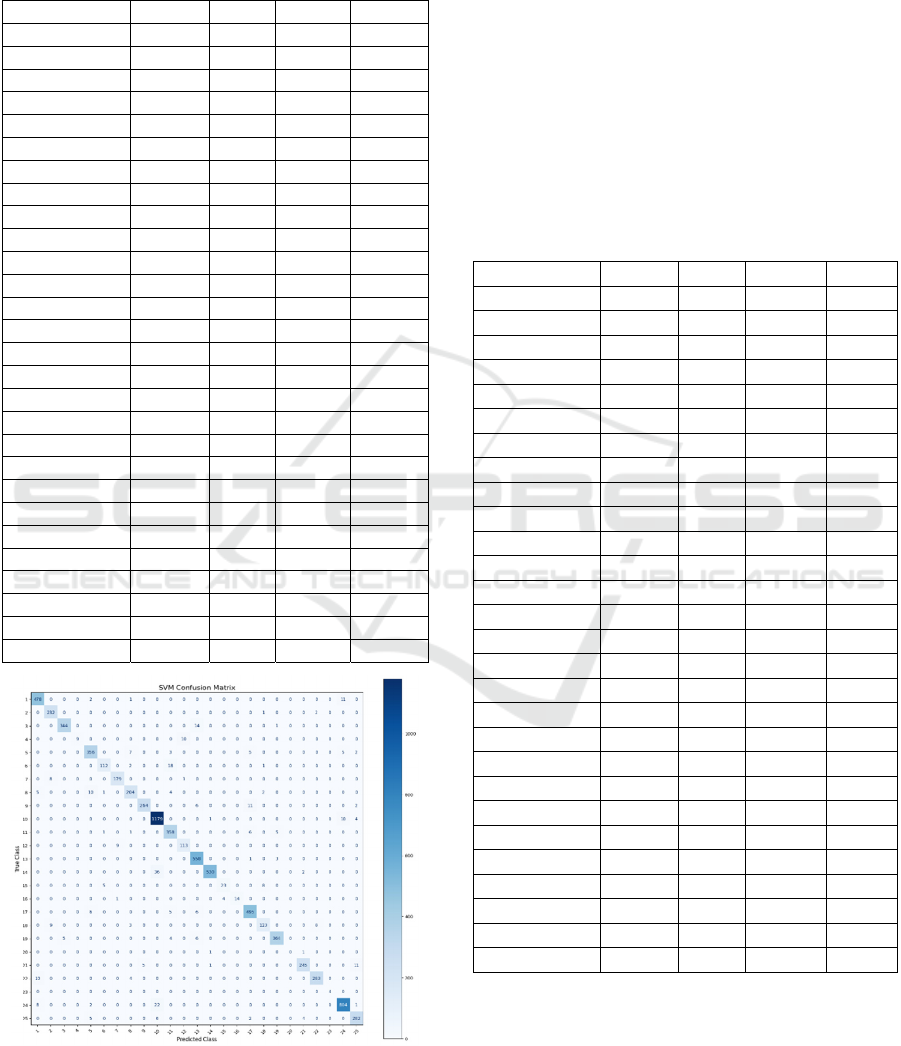
and provides insight into the model’s strengths and
weaknesses.
Table 2: Classification report for the SVM model applied to
the image data used in the study.
Class Precision Recall F1-score Su
pp
ort
1 0.95 0.97 0.96 492
2 0.93 0.99 0.96 235
3 0.99 0.96 0.97 359
4 1.00 0.47 0.64 19
5 0.93 0.94 0.94 378
6 0.94 0.84 0.89 133
7 0.95 0.95 0.95 188
8 0.92 0.90 0.91 226
9 0.98 0.93 0.96 283
10 0.95 0.99 0.97 1194
11 0.91 0.96 0.94 371
12 0.91 0.93 0.92 122
13 0.95 0.99 0.97 562
14 0.99 0.93 0.96 568
15 0.85 0.64 0.73 36
16 1.00 0.74 0.85 19
17 0.95 0.97 0.96 512
18 0.91 0.86 0.88 143
19 0.98 0.96 0.97 379
20 0.00 0.00 0.00 2
21 0.97 0.94 0.95 262
22 0.97 0.95 0.96 297
23 1.00 1.00 1.00 4
24 0.97 0.96 0.96 837
25 0.93 0.94 0.94 299
Accurac
y
0.95 7920
Macro Avg 0.91 0.87 0.89 7920
Weighted Avg 0.95 0.95 0.95 7920
Figure 6: Confusion matrix of the image data used in the
study using SVM.
3.2 RFC-Based Classification
Outcomes of Remotely Sensed
Multispectral Data
In Next, the Random Forest (RF) method was
applied to the dataset to evaluate its classification
performance. The multispectral remote sensing
dataset was divided into training (80%) and testing
(20%) subsets. Class-wise metrics are summarized in
Table 3, and the corresponding confusion matrix is
shown in Figure 7. The results illustrate the RF
algorithm’s handling of class separability and
highlight its comparative strengths and limitations.
Table 3: Classification report for the RFC model applied to
the image data used in the study.
Class Precision Recall F1-score Su
pp
ort
1 0.99 1.00 0.99 492
2 0.95 0.97 0.96 235
3 1.00 0.99 0.99 359
4 1.00 0.84 0.91 19
5 0.94 0.95 0.94 378
6 0.94 0.98 0.96 133
7 0.97 0.96 0.97 188
8 0.93 0.93 0.93 226
9 0.99 0.98 0.98 283
10 0.99 1.00 0.99 1194
11 0.96 0.97 0.97 371
12 0.98 0.98 0.98 122
13 0.99 1.00 0.99 562
14 0.99 1.00 0.99 568
15 0.91 0.86 0.89 36
16 1.00 0.79 0.88 19
17 0.96 0.96 0.96 512
18 0.92 0.92 0.92 143
19 0.98 0.98 0.98 379
20 0.00 0.00 0.00 2
21 1.00 0.99 0.99 262
22 0.97 0.96 0.97 297
23 1.00 1.00 1.00 4
24 1.00 0.99 0.99 837
25 0.96 0.97 0.97 299
Accurac
y
0.98 7920
Macro Av
g
0.93 0.92 0.92 7920
Wei
g
hted Av
g
0.98 0.98 0.98 7920
The Random Forest model achieved an overall
accuracy of 98%, with weighted average precision,
recall, and F1-score also at 98%, demonstrating
strong and consistent performance across the dataset.
Although the model performed exceptionally well
overall, lower recall values were observed for some
ICEEECS 2025 - International Conference on Advances in Electrical, Electronics, Energy, and Computer Sciences
262
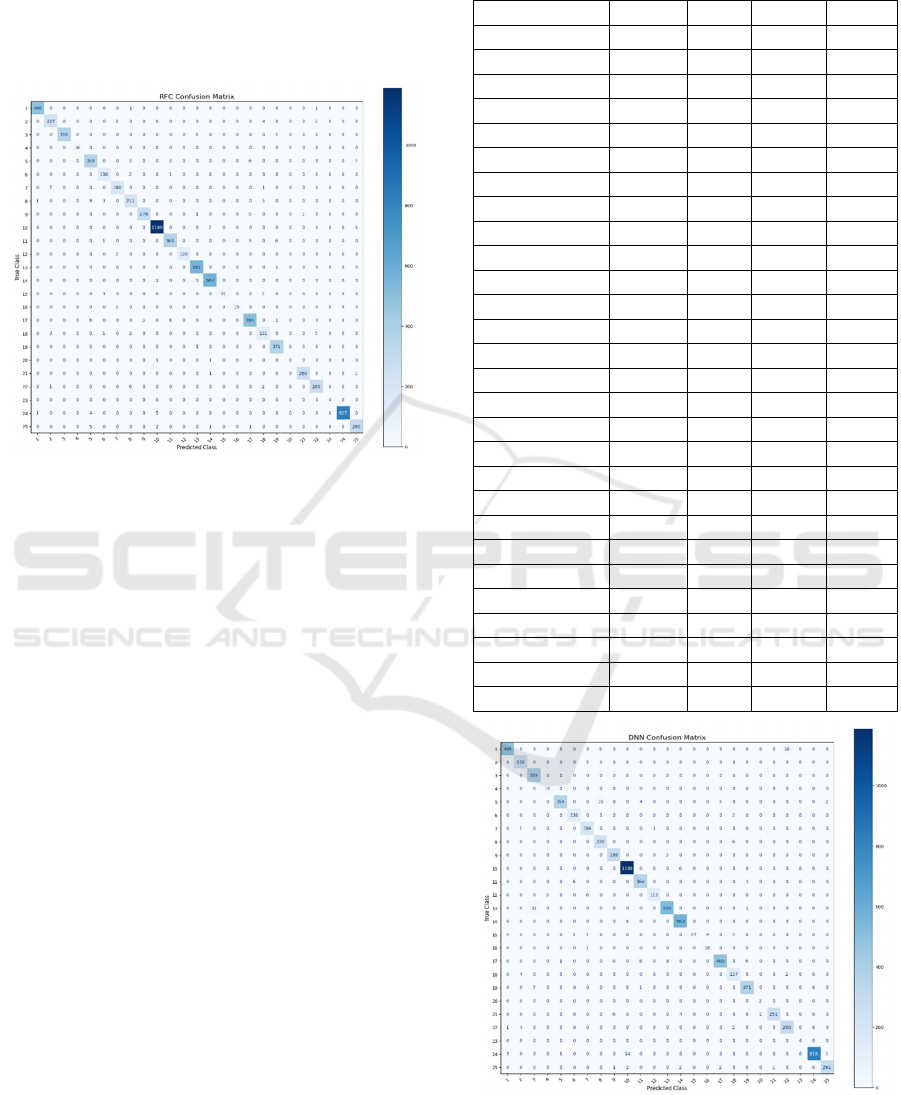
underrepresented classes, indicating occasional
misclassifications. Very small classes again showed
extreme metric values, which may be indicative of
overfitting. The confusion matrix (Fig.7) illustrates
the patterns of misclassification and highlights the
model’s general strengths and limitations.
Figure 7: Confusion matrix of the image data used in the
study using RFC.
3.3 DNN-Based Classification
Outcomes of Remotely Sensed
Multispectral Data
Finally, a Deep Neural Network (DNN) model was
trained and tested to assess the effectiveness of a deep
learning-based approach. The multispectral remote
sensing dataset was divided into training (80%) and
testing (20%) subsets. Evaluation metrics for each
class are presented in Table 4, while the confusion
matrix is provided in Figure 8. These results
demonstrate the DNN model’s capability to capture
complex patterns in the multispectral data and serve
as a benchmark for comparing machine learning and
deep learning approaches.
The DNN model achieved an overall accuracy of
97%, with weighted average precision, recall, and F1-
score also at 97%, indicating a strong and balanced
performance across the dataset. While the model
performed well for most classes, some
underrepresented classes exhibited lower recall
values, reflecting occasional misclassifications. Very
small classes showed extreme metric values in some
cases, which may indicate overfitting rather than
genuine predictive performance. The confusion
matrix (Figure 8) illustrates the distribution of
misclassifications and highlights the general
strengths and limitations of the model.
Table 4: Classification report for the DNN model applied to
the image data used in the study.
Class Precision Recall F1-score Support
1 0.99 0.95 0.97 492
2 0.96 0.99 0.97 235
3 0.90 1.00 0.95 359
4 0.86 1.00 0.93 19
5 0.99 0.94 0.96 378
6 0.95 0.98 0.96 133
7 0.94 0.99 0.97 188
8 0.91 0.97 0.94 226
9 0.95 0.99 0.97 283
10 0.98 0.99 0.99 1194
11 0.97 0.98 0.97 371
12 0.99 0.93 0.93 122
13 0.98 0.94 0.96 562
14 0.98 0.99 0.99 568
15 1.00 0.75 0.86 36
16 0.82 0.95 0.88 19
17 0.99 0.94 0.96 512
18 0.91 0.96 0.94 143
19 0.98 0.98 0.86 379
20 0.67 1.00 0.98 2
21 1.00 0.96 0.98 262
22 0.94 0.98 0.96 297
23 1.00 1.00 1.00 4
24 1.00 0.98 0.99 837
25 0.99 0.97 0.98 299
Accurac
y
0.97 7920
Macro Av
g
0.95 0.96 0.95 7920
Wei
g
hted Av
g
0.97 0.97 0.97 7920
Figure 8: Confusion matrix of the image data used in the
study using DNN.
Data Complexity-Oriented Classification of Multispectral Remote Sensing Imagery via Machine and Deep Learning Approaches
263

4 DISCUSSION AND
CONCLUSION
Classification reports are presented in Tables 2, 3, and
4, respectively, and confusion matrices are presented
in Figs. 6, 7, and 8, respectively, obtained from the
three classification methods: SVM, RFC, and DNN.
Accuracy, precision, recall, and f1 score are
calculated from the confusion matrix results.
The overall accuracies of the SVM, RFC, and
DNN are 0.96, 0.99, and 0.95 in Table 2, Table 3, and
Table 4, respectively. As explained in Section 2, the
best classification accuracy result calculated from the
DNNs is 0.95 due to data complexity. Based on the
results in the precision and/or recall columns, the f1-
score columns of SVM and RFC cannot distinguish
or classify some classes, as can be seen in Tables 2
and 3. However, based on the results in the precision
and recall columns, the f1-score column of DNN can
distinguish or classify all classes, as can be seen in
Table 4. Due to the greater number of processing
layer steps, the processing time is the longest for
DNN.
The findings of this study indicate that when the
data complexity is low, classification can be
effectively performed using machine learning
techniques, whereas high data complexity may
require the utilization of deep learning approaches.
REFERENCES
Thyagharajan, K. K., & Vignesh, T. (2019). Soft computing
techniques for land use and land cover monitoring with
multispectral remote sensing images: A
review. Archives of Computational Methods in
Engineering, 26(2), 275-301.
Modica, G., De Luca, G., Messina, G., & Praticò, S. (2021).
Comparison and assessment of different object-based
classifications using machine learning algorithms and
UAVs multispectral imagery: A case study in a citrus
orchard and an onion crop. European Journal of
Remote Sensing, 54(1), 431-460.
Sishodia, R. P., Ray, R. L., & Singh, S. K. (2020).
Applications of remote sensing in precision agriculture:
A review. Remote sensing, 12(19), 3136.
Guanter, L., Rossini, M., Colombo, R., Meroni, M.,
Frankenberg, C., Lee, J. E., & Joiner, J. (2013). Using
field spectroscopy to assess the potential of statistical
approaches for the retrieval of sun-induced chlorophyll
fluorescence from ground and space. Remote Sensing of
Environment, 133, 52-61.
Thenkabail, P. S., Lyon, J. G., & Huete, A. (2016).
Hyperspectral remote sensing of agriculture and
vegetation. Remote Sensing of Environment, 185, 1–17.
https://doi.org/10.1016/j.rse.2016.01.005
Erol, H., & Akdeniz, F. (2005). A per-field classification
method based on mixture distribution models and an
application to Landsat Thematic Mapper data.
International Journal of Remote Sensing, 26(6), 1229–
1244. https://doi.org/10.1080/01431160512331326800
Sehgal, S. (2012). Remotely sensed LANDSAT image
classification using neural network approaches.
International Journal of Engineering Research and
Applications, 2(5), 43–46.
Calış, N., & Erol, H. (2012). A new per-field classification
method using mixture discriminant analysis. Journal of
Applied Statistics, 39(10), 2129–2140.
https://doi.org/10.1080/02664763.2012.702263
Crnojević, V., Lugonja, P., Brkljač, B., & Brunet, B.
(2014). Classification of small agricultural fields using
combined Landsat-8 and RapidEye imagery: Case
study of northern Serbia. Journal of Applied Remote
Sensing, 8(1), 083512.
https://doi.org/10.1117/1.JRS.8.083512
Gogebakan, M., & Erol, H. (2018). A new semi-supervised
classification method based on mixture model
clustering for classification of multispectral data.
Journal of the Indian Society of Remote Sensing, 46(8),
1323–1331. https://doi.org/10.1007/s12524-018-0808-
9
Sicre, C. M., Fieuzal, R., & Baup, F. (2020). Contribution
of multispectral (optical and radar) satellite images to
the classification of agricultural surfaces. International
Journal of Applied Earth Observation and
Geoinformation, 84, 101972.
https://doi.org/10.1016/j.jag.2019.101972
Dash, P., Sanders, S. L., Parajuli, P., & Ouyang, Y. (2023).
Improving the accuracy of land use and land cover
classification of Landsat data in an agricultural
watershed.
Remote Sensing, 15(16), 4020.
https://doi.org/10.3390/rs15164020
Kadavi, P. R., & Lee, C. W. (2018). Land cover
classification analysis of volcanic island in Aleutian
Arc using an artificial neural network (ANN) and a
support vector machine (SVM) from Landsat imagery.
Geosciences Journal, 22(5), 653–665.
https://doi.org/10.1007/s12303-018-0023-2
Singh, M. P., Gayathri, V., & Chaudhuri, D. (2022). A
simple data preprocessing and postprocessing
techniques for SVM classifier of remote sensing
multispectral image classification. IEEE Journal of
Selected Topics in Applied Earth Observations and
Remote Sensing, 15, 1–10.
https://doi.org/10.1109/JSTARS.2022.3201273
Pal, M. (2005). Random forest classifier for remote sensing
classification. International Journal of Remote Sensing,
26(1), 217–222.
https://doi.org/10.1080/01431160412331269698
Zhang, H., Li, Q., Liu, J., Shang, J., Du, X., McNairn, H.,
Champagne, C., Dong, T., & Liu, M. (2017). Image
classification using RapidEye data: Integration of
spectral and textual features in a random forest
classifier. IEEE Journal of Selected Topics in Applied
Earth Observations and Remote Sensing, 10(12), 1–10.
https://doi.org/10.1109/JSTARS.2017.2774807
ICEEECS 2025 - International Conference on Advances in Electrical, Electronics, Energy, and Computer Sciences
264

Singh, G., Vyas, N., Dahiya, N., Singh, S., Bhati, N., Sood,
V., & Gupta, D. K. (2025). A novel pixel-based deep
neural network in posterior probability space for the
detection of agriculture changes using remote sensing
data. Remote Sensing Applications: Society and
Environment, 38, 101591.
https://doi.org/10.1016/j.rsase.2025.101591
Erol, H., & Erol, R. (2018). Determining big data
complexity using hierarchical structure of groups and
clusters in decision tree. In Proceedings of the 3rd
International Conference on Computer Science and
Engineering (UBMK’18) (pp. 594–597). IEEE.
https://doi.org/10.1109/UBMK.2018.8566398
Vapnik, V. (2013). The nature of statistical learning theory.
Springer Science & Business Media.
Kadavi, P. R., & Lee, C. W. (2018). Land cover
classification analysis of volcanic island in Aleutian
Arc using an artificial neural network (ANN) and a
support vector machine (SVM) from Landsat imagery.
Geosciences Journal, 22, 653–665.
https://doi.org/10.1007/s12303-018-0023-2
Breiman, L. (1999). Random forests—random features
(Tech. Rep. No. 567). University of California,
Berkeley, Department of Statistics.
Schmidhuber, J. (2014). Deep learning in neural networks:
An overview. Neural Networks, 61, 85–117.
https://doi.org/10.1016/j.neunet.2014.09.003
Dalianis, H. (2018). Evaluation metrics and evaluation. In
Clinical text mining: Secondary use of electronic
patient records (pp. 45–53). Springer.
Google Research. (2025). Google Colab.
https://colab.research.google.com/
Data Complexity-Oriented Classification of Multispectral Remote Sensing Imagery via Machine and Deep Learning Approaches
265
