
Optimization of Smart Home Based on Human Computer Interaction
Perspective
Wujiangshan Zhou
College of Art and Design, Beijing University of Technology, Beijing, China
Keywords: Smart Home Users, Emotionality Personalization, Human-Computer Interaction.
Abstract: Smart home products have become a "must-have" in home renovations, with particularly high penetration
rates among younger demographics and high-income households—exceeding 50% in some cities. However,
due to limitations in artificial intelligence technology, internet of things technologies human-computer
interaction technology and related technological advancements, current smart home systems still fall short of
fully meeting user demands. Today, smart homes face challenges such as complex operation and insufficient
personalization. This article focuses on optimizing smart homes in two key areas: personalization and
emotional engagement. Enhancing daily convenience and emotional value through intelligent color-based and
interface-size-adaptive layouts. Also by improving personalized connections between smart devices and users,
such as self-regulating living environment, automatic equipment operating, and voice service the system can
better adapt to individual needs, deliver tailored services, address emotional requirements, and ultimately
achieve the goal of convenient and comfortable living for users. Through the above optimization measures,
we aim to make smart homes more convenient for daily life and achieve higher levels of automation.
1 INTRODUCTION
Smart Home refers to a residential environment
where household devices are interconnected through
IoT (Internet of Things) technologies, artificial
intelligence (AI), and automated control systems,
enabling intelligent management and remote
operation. Its core objectives are to enhance living
convenience, comfort, and security. With
advancements in 5G, IoT, and AI technologies,
coupled with strong governmental policy support,
smart home adoption rates are steadily increasing.
China's smart home market size surpassed hundreds
of billions of Chinese yuan in 2019 and is projected
to exceed one trillion yuan by 2025, with a compound
annual growth rate (CAGR) exceeding 20%.
Meanwhile, smart home products have become a
standard configuration in home decoration,
particularly demonstrating higher penetration rates
among younger demographics and high-income
households, with adoption exceeding 50% in some
cities.
With the rapid advancement of artificial
intelligence (AI), IoT technologies, and big data
analytics, smart home systems have evolved from
standalone device control into holistic ecosystems.
The core objective of smart homes lies in delivering
user-centric automated services, where human-
computer interaction (HCI) technologies serve as the
critical bridge between users and devices. The
implementation depth of HCI directly determines
system efficiency and user satisfaction. However,
constrained by current technological limitations,
smart homes primarily fulfill basic functions such as
remote appliance control and intelligent security
systems, yet fall short of addressing comprehensive
user demands. Challenges persist, including
operational complexity, insufficient personalization,
and privacy vulnerabilities. Modern users
increasingly expect smart homes to proactively
perceive human states (e.g., activity patterns,
emotional cues) and autonomously adjust device
configurations, while demanding heightened
personalized adaptability. Consequently, the
continuous expansion of functional capabilities is
imperative to better align with consumer expectations
and enhance lifestyle convenience.
In recent years, there have been many
explorations in human-computer interaction for smart
homes. In smart home, because many devices need to
collect a large amount of personal life information
and share it with multiple devices through the Internet,
Zhou, W.
Optimization of Smart Home Based on Human Computer Interaction Perspective.
DOI: 10.5220/0014307200004718
Paper published under CC license (CC BY-NC-ND 4.0)
In Proceedings of the 2nd International Conference on Engineering Management, Information Technology and Intelligence (EMITI 2025), pages 37-42
ISBN: 978-989-758-792-4
Proceedings Copyright © 2025 by SCITEPRESS – Science and Technology Publications, Lda.
37

personal privacy has become a core area of smart
home. The optimization of smart homes requires
ensuring efficient living for users while not infringing
on their privacy. Hua Du with other authors aim to
reduce excessive privacy collection and maintain user
security by using discrete selection (Du et al., 2023).
Speech recognition is the foundation for smart homes
to communicate with users. In order to improve smart
homes’ ability to recognize and understand speeches,
Chandra Irugalbandaraand others suggest a
recognition system called “HomeIO”, which can be
able to achieve voice activity detection and automatic
speech recognition while reducing the demand for
cloud services (Irugalbandara et al., 2023). Sensors
provide useful information for the personality or
services of smart homes by collecting data on the
user’s life information. The data set designed by
Gibson Chimamiwa and other investors can better
collect the data recorded by different sensors, and
improve the accuracy of smart home services
(Chimamiwa et al., 2020). Xu Huan developed an
age-adaptive smart home human-computer
interaction system by constructing a multi-source
data fusion framework through advanced data fusion
technology, implementing control optimization
protocols for elderly-oriented interaction commands,
which achieves a rapid-response capabilities for
senior users' daily operational demands (Xu, 2022).
Nuno Costa and other researchers addressed the
challenges of elderly individuals living alone through
a large project called Aging Inside a Smart Home
(Costa et al., 2014).
Optimizing smart homes from the perspective of
human-computer interaction can promote the
development of multimodal interaction and related
technologies. Through natural interaction (voice,
gestures) and emotional computing technology, the
personalization of smart home services can be
enhanced and emotional value can be provided to
users, creating a more comfortable and convenient life.
The second part of this article will explain the core
technologies required for optimization, the third part
will explain the optimization plan, the fourth part will
discuss the optimization plan for smart homes, and
the fifth part will summarize the optimization plan.
2 RELATED TECHNOLOGIES
2.1 Concept and Application of Human
Computer Interaction
Human-Computer Interaction (HCI) is an
interdisciplinary field that studies information
exchange and collaboration between humans and
computer systems, integrating computer science,
psychology, design studies, and other disciplines. Its
primary objectives are to enhance technological
usability and user experience. The core of HCI lies in
achieving natural and efficient information
communication through interface design and
optimization of interaction modes. In smart home
applications, HCI enables natural interactions via
voice recognition, touch-sensitive interfaces, and AI
algorithms, facilitating automated control of
interconnected smart devices to improve daily
convenience.
Multimodal Human-Computer Interaction
(MHCI) is a technology that integrates multiple
sensory modalities such as speech, tactile input,
vision, and gestures to enable natural and efficient
information exchange between humans and
machines. Interaction using a single sensory modality
is called unimodal, while employing three or more
modalities is referred to as multimodal (Liu & Liang,
2024). Touchscreen control, video control, and voice
control stand as the three most prevalent human-
computer interaction methods in smart homes (Zhou
et al., 2022).
2.2 The Development of AI Technology
and Its Application in Smart
Homes
Artificial intelligence technology has achieved
leapfrog development in recent years through deep
learning, breakthroughs in computing power, and big
data. In the field of smart homes, AI enables voice
assistants to achieve human-machine voice
interaction through voice processing. Meanwhile,
computer vision technology supports facial
recognition, which can be applied in security
monitoring and other scenarios. Machine learning
algorithms enable devices to have autonomous
learning capabilities, analyze user habits, and change
the operating mode of household appliances by
combining with IoT technology. Intelligent cameras
enable high-definition filming and remote monitoring,
and integrate monitoring and alarm through AI to
ensure the safety of individuals living alone. In the
future, with the continuous development of AI, smart
homes will present more natural human-machine
collaboration and better service capabilities.
EMITI 2025 - International Conference on Engineering Management, Information Technology and Intelligence
38

3 OPTIMIZATION STRATEGIES
3.1 Optimizing Smart Homes with
Emotional Resonance and User
Centered Personalization Principles
3.1.1 Emotionality
Emotional Experience Design refers to design
methodologies and principles that prioritize and
cultivate users' positive emotional experiences during
interactions with products, services, or environments.
This approach specifically focuses on creating
meaningful affective responses through intentional
design interventions (Xu & Huang, 2024). Emotional
Design was first proposed by American cognitive
psychologist Donald Norman as a design philosophy.
He categorized emotional design into three levels:
Visceral Level Design, Behavioral Level Design, and
Reflective Level Design.
Visceral Level Design emphasizes the sensory
experience evoked by the design itself. In the current
development trend of smart homes, enhancing the
direct sensory impact of smart home systems allows
users to derive greater emotional value. This can be
achieved through personalized interface layouts and
unique voice interaction features in smart home
ecosystems, which elevate users' trust and affinity
toward these systems.
Behavioral Level Design focuses on the
functionality and efficiency of products. By
optimizing the operational efficiency of smart home
devices, users' daily life efficiency and comfort are
significantly improved.
Reflective Level Design involves post-usage
reflection, where users evaluate whether the product
aligns with their needs and fulfills their emotional
expectations, thereby influencing their purchase
decisions or continued usage.
3.1.2 Personalization
The personalized needs of smart home systems stem
from the diversity of user scenarios and requirements.
People's lifestyles, habits, and emotional appeals vary
significantly, demonstrating inherent heterogeneity.
Single-mode devices cannot satisfy the demands of
all user groups, necessitating customized services
tailored to different demographics to better
accommodate diverse user needs.
Figure 1 illustrates the structural framework for
smart home optimization strategies.
Figure 1: Structural framework for smart home
optimization strategies (Picture credit: Original).
3.2 Optimization
Based on the principles of emotional engagement and
personalization, researchers can optimize smart home
systems to better align with users' needs and
preferences.
Drawing on the visceral level of human
perception, smart home interfaces should adopt an
intuitive layout design, ensuring that application
information is presented in a clear and concise
hierarchy. This allows users to quickly and accurately
locate desired functions during interaction. By
analyzing usage frequency data for different features
over time, frequently accessed functions can be
emphasized through enlarged icons or highlighted
colors for enhanced visibility. As a critical element in
interface design, color significantly influences users'
emotional responses to smart home systems.
Implementing zonal color coding and incorporating
user-preferred color schemes can elevate both the
aesthetic appeal and emotional acceptance of smart
interfaces, thereby improving overall user
engagement and satisfaction. For elderly users, red
and orange should be predominantly used as layout
color schemes. This is because older adults
experience relatively less impairment in
distinguishing red and orange hues. Additionally, red
can evoke a sense of warmth for seniors living alone
long-term, while orange helps elders perceive vitality
(Zhao, 2024).
The goal of optimizing smart home systems is to
enhance their operational efficiency and improve
users' quality of life. According to IDC's smart home
research, 72% of users desire devices capable of
autonomously learning their habits rather than
requiring manual configuration. Optimization can be
achieved through environmental sensors that detect
Optimization of Smart Home Based on Human Computer Interaction Perspective
39
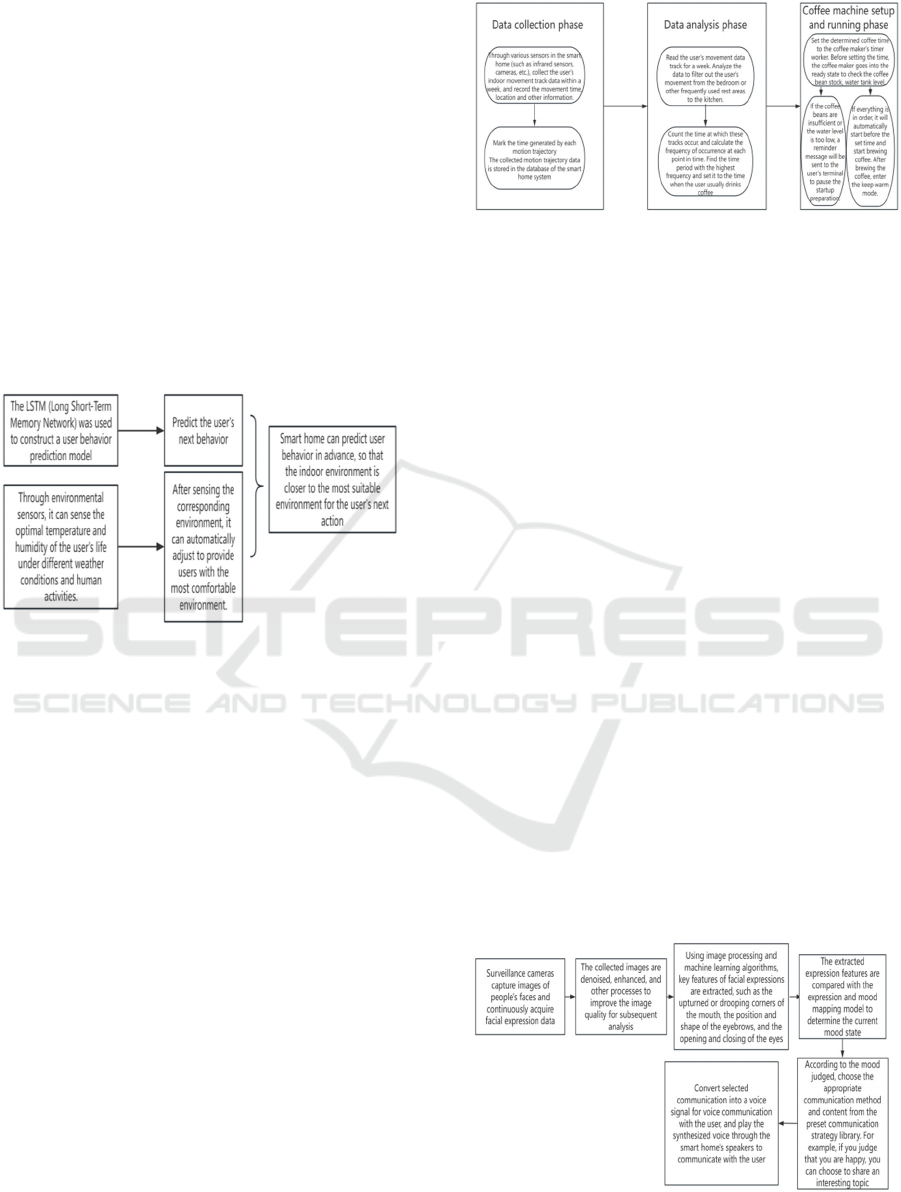
human behavior under varying weather conditions
and identify users' preferred temperature, humidity,
and other parameters in different settings. Once
environmental changes are detected, the system
automatically adjusts to provide the most comfortable
conditions. By employing LSTM (Long Short-Term
Memory Networks) to build a user behavior
prediction model, smart homes collect data on users'
daily activities over the past week, analyze unique
patterns and variations, and generate predictions for
the next day's behavior through big data analytics.
This enables smart homes to proactively adapt indoor
environments to users' optimal preferences during
different activities, thereby better safeguarding their
quality of life. Figure 2 illustrates the structural
framework of this process.
Figure 2: The system structure of intelligent control of the
indoor environment (Picture credit: Original).
Smart home systems enable devices to operate
proactively, reducing user waiting time and
enhancing daily efficiency. Taking coffee machines
as an example—an essential part of daily life—87%
of users believe that the automatic coffee preparation
feature significantly enhances daily convenience. By
integrating smart home technology with the Internet
of Things (IoT), devices are connected via Wi-Fi,
Bluetooth, and other protocols to enable data sharing.
A smart hub (e.g., Amazon Echo, HomePod)
consolidates data from multiple devices, and
computational analysis of this data identifies precise
usage patterns and frequencies in user behavior. This
allows the system to preemptively activate devices
like coffee machines, saving time. The diagram below
illustrates the automated process of a coffee machine
preparing beverages for users. First, IoT technology
is employed to collect data on the coffee machine's
operating hours and users' activity patterns. By
analyzing the peak frequency of coffee consumption
times, the system can prepare coffee in advance, as
shown in Fig. 3.
Figure 3: Coffee machine automatic operation flow chart
(Picture credit: Original).
Over half a century ago, Weizenbaum developed
a simple yet powerful chatbot called ELIZA
(Chkroun & Azaria, 2021). It delivers substantial
emotional resonance to users. Therefore, our smart
home optimization incorporates voice-controlled
interactive communication capabilities between
smart home systems and occupants. Voice control is
one of the most popular control methods for smart
homes, accounting for 56.55% of usage. Consumers
expect voice assistants to recognize the voices of
different family members and provide customized
services based on personal preferences. Through
voice recognition and sentiment analysis algorithms,
the system can capture users' tone, intonation, and
emotion-specific keywords to identify their
emotional state and adapt its responses accordingly.
Additionally, by monitoring users' body language via
cameras, it can achieve multimodal interaction, such
as integrating speech, facial expressions, and physical
movements—to more accurately assess whether the
current environment aligns with user comfort and
make real-time adjustments. For users living alone,
elderly individuals, and children, smart home systems
can infer their emotional states from their facial
expressions and provide emotional value through
conversational interactions, thereby reducing feelings
of loneliness. Figure 4 illustrates the communication
flow between smart home devices and users.
Figure 4: Smart home and user communication flow chart
(Picture credit: Original).
EMITI 2025 - International Conference on Engineering Management, Information Technology and Intelligence
40

4 DISCUSSION
4.1 Advantage
Smart homes, through voice control and remote
operation capabilities, liberate human labor and
optimize the efficiency of daily life management.
Moreover, smart home systems that regulate
temperature and humidity enable people to live in
their most comfortable environment, significantly
enhancing daily comfort and quality of life. Smart
home systems provide personalized services that
bring people a more convenient lifestyle. For example,
smart coffee machines can automatically prepare
beverages for users without requiring manual
operation, significantly enhancing daily convenience.
Furthermore, smart homes can provide emotional
value to people, enabling individuals of all ages to
feel a sense of companionship and enhancing their
overall happiness in daily life.
4.2 Limitation
Smart home devices offer many advantages, but they
also have significant limitations. These limitations
manifest at multiple levels. Firstly, smart homes are
heavily reliant on technology, with these systems
widely employing cloud-based services such as those
provided by Google and Amazon—a dependency that
exposes them to cyber attacks. Internet outages or
system failures can result in complete device
malfunctions. To ensure proper operation, these
systems require both stable internet connectivity and
a secure environment free from cyber threats
(Irugalbandara et al., 2023, Huang, 2023).
Additionally, as smart homes require the collection of
users' daily life data and even facial expressions,
privacy and data security emerge as critical concerns,
with potential leaks posing severe consequences for
users. Furthermore, incompatibility between different
brands of smart home products often forces users to
remain within a single ecosystem, highlighting the
urgent need to reduce technical barriers between
manufacturers and improve cross-brand
interoperability.
5 CONCLUSION
The paper proposes personalized layout design for
smart homes while optimizing their emotional
resonance and personalized features. Through
optimization, smart homes can better enhance
personalized services tailored to individual user needs.
Personalization is a critical pathway toward
optimizing user experience. By integrating voice
emotion recognition and facial expression analysis,
smart systems achieve affective computing
capabilities, supporting emotional well-being and
adaptive environmental adjustments. The evolving
computational capabilities of artificial intelligence,
coupled with progressive developments in Internet of
Things (IoT) architectures, empower smart home
systems to process user behavioral data through
sophisticated algorithms, thereby delivering context-
aware services tailored to individual preferences.
Optimizing smart homes from a human-computer
interaction perspective can not only enhance the
convenience of people's lives but also unlock broader
market opportunities for smart home technologies. In
the future, it will be essential to continuously break
down barriers between different smart home brands,
enabling seamless data sharing across platforms to
avoid redundant data collection.
REFERENCES
Chimamiwa, G., Alirezaie, M., Pecora, F., et al.: 'Multi-
sensor dataset of human activities in a smart home
environment', Data Brief. 2020 Dec 9; 34:106632
Chkroun, M., Azaria, A.: 'A Safe Collaborative Chatbot for
Smart Home Assistants', Sensors (Basel). 2021 Oct
6;21(19):6641.
Costa, N., Domingues, P., Fdez-Riverola, F., Pereira, A.: 'A
mobile Virtual Butler to bridge the gap between users
and ambient assisted living: a Smart Home case study',
Sensors (Basel). 2014 Aug 6;14(8):14302-29.
Du, H., Han, Q., Yang, D., et al.: 'Data privacy and smart
home energy appliances: A stated choice experiment',
Heliyon. 2023 Oct 29;9(11): e21448
Huang, X.: 'Research on the Development of Intelligent
Home InteractionDesign from the Perspective of
Human-Computer Interaction', Footwear craftsmanship
and design, 2023, 3 (06): 171-173
Irugalbandara, C., Naseem, A. S., Perera, S., et al.: 'A
Secure and Smart Home Automation System with
Speech Recognition and Power Measurement
Capabilities', Sensors (Basel). 2023 Jun 21;23(13):5784
Irugalbandara, C., Naseem, A. S., Perera, S., et al.: 'A
Secure and Smart Home Automation System with
Speech Recognition and Power Measurement
Capabilities', Sensors (Basel). 2023 Jun 21;23(13):5784
Liu, S. L., Liang, X. Y.: 'Research on the Intelligent Design
of Elderly-friendly Kitchen Space Based on Multi-
modal Human-computer Interaction', Furniture, 2024,
45 (02):20-25
Xu, H.: 'Design of human-computer interaction system for
aging smart home based on intelligent algorithm',
Automation and Instrumentation, 2022, (12): 16-19
Optimization of Smart Home Based on Human Computer Interaction Perspective
41

Xu, J. Huang, J.: 'Smart Home Security Product Design
Based on the Emotional Experience of Women Living
Alone', Industrial design, 2024, (08): 100-103
Zhao, H. J.: 'Research on the Emotional Design of App
Interface of Smart Home Products under the
Background of Smart Elderly Care', Industrial design,
2024, (09): 97-100.
Zhou, C., Qian, Y., Huang, T., et al.: 'The impact of
different age-friendly smart home interface styles on
the interaction behavior of elderly users', Front Psychol.
2022 Sep 28;13:935202
EMITI 2025 - International Conference on Engineering Management, Information Technology and Intelligence
42
