
Short-Term Wind Energy Production Forecasting and Target Plant
Selection Based on Meteorological Data Using Empirical Mode
Decomposition
İsrafil Karadöl
Department of Electrical-Electronics Engineering, Faculty of Engineering-Architecture,
Kilis 7 Aralık University, Kilis, Turkey
Keywords: Wind Energy, XGBoost, EMD, İzmir.
Abstract: This study aims to identify the most suitable target wind power plant (WPP) for short-term wind energy
production forecasting. Hourly meteorological data for 2022 from İzmir Province were processed using the
Empirical Mode Decomposition (EMD) method to generate 56 Intrinsic Mode Function (IMF) signals, which
were used as input variables for the XGBoost model. As output, production data from 52 different WPPs
located within the same provincial boundaries were individually used as target variables. The model’s
performance was evaluated using R², MAE, and MSE metrics. The results indicated that while high prediction
accuracy was achieved for some plants, the model's performance was limited for others. The best forecast
accuracy was obtained using data from WPP35, whereas the poorest performance was observed with WPP7.
These findings suggest that, despite being within the same province, differences in the geographical locations
of meteorological stations and WPPs, as well as region-specific meteorological characteristics, can
significantly affect prediction accuracy.
1 INTRODUCTION
Globally, energy demand is increasing day by
day(Renewable Energy Agency, 2025). Meeting the
increasing energy demand from traditional energy sources
causes many environmental consequences. The depletion of
traditional energy sources is also recognized as a major
problem by energy producers(Karadöl & Şekkeli, 2022).
For these reasons, states have turned to renewable energy
sources as an alternative to traditional energy sources(Irena,
2025). The fact that renewable energy sources are
environmentally friendly and sustainable is seen as a great
advantage for governments. However, the fact that these
sources have random generation characteristics is
recognized as an economic and technical problem by
electricity grid operators(Karadöl et al., 2021). To
overcome this problem, forecasting energy production is of
great importance.
When we examine the research in the field of short-term
forecasting of wind energy, it is seen that many studies have
been carried out with various machine learning based
methods(Joseph et al., 2023; Liu et al., 2019; Mustaqeem et
al., 2022; Shukla & Pasari, 2025).In addition to these
studies, Li et al. proposed the XGBoost regression model
optimized by Genetic Algorithm (GA) to solve the accuracy
and speed problems in wind power forecasting(X. Li et al.,
2023). Ma et al. proposed the XGBoost algorithm for very
short-term wind power forecasting due to the variability of
wind power(Ma et al., 2020).
There is no research in the literature on wind
power generation forecasting for different targets at
1-hour horizon. To fill this gap in the literature, this
study examines the forecasting performance of the
XGBoost model for different target allocations at 1-
hour horizon. The meteorological data and WPP
generation data of Izmir province for the year 2022
are used to perform this investigation. All data sets
used are hourly resolution and real-time data. All
meteorological data obtained were decomposed into
signals by EMD method. As a result of this process,
56 signals were generated. The generated signals
were defined as input to the XGBoost model. With
this model, 52 WPP productions were defined as
targets in order to perform forecasts for a 1-hour
period. For each target, the forecasting performance
of the XGBoost model was analyzed. As a result of
these examinations, the best facilities for 1-hour
forecasts were determined.
164
Karadöl,
˙
I.
Short-Term Wind Energy Production Forecasting and Target Plant Selection Based on Meteorological Data Using Empirical Mode Decomposition.
DOI: 10.5220/0014299300004848
Paper published under CC license (CC BY-NC-ND 4.0)
In Proceedings of the 2nd International Conference on Advances in Electrical, Electronics, Energy, and Computer Sciences (ICEEECS 2025), pages 164-168
ISBN: 978-989-758-783-2
Proceedings Copyright © 2026 by SCITEPRESS – Science and Technology Publications, Lda.
2 MATERIAL METHOD
In this study, it is aimed to determine the most
suitable target facility to realize wind power
generation forecasting with the XGBoost model at 1-
hour time horizon. For this purpose, firstly,
meteorological measurement data and WPP
generation data of Izmir province were obtained. The
obtained meteorological data were preprocessed by
EMD method and decomposed into IMF signals. As
a result of this decomposition, 56×8760 signals were
generated. These signals were used as input data for
the XGBoost model. With the XGBoost model, 52
WPP productions were selected as separate targets in
order to make WPP production forecasts with a time
horizon of 1 hour. R
2
, MAE, and MSE metrics were
used to evaluate the WPP production forecasting
performance according to the selected target plants.
According to these metrics, the best target WPPs in
Izmir province were determined for the 1-hour
horizon.
2.1 Meteorological Data
For the 1-hour time horizon, empirical mode-
disaggregated meteorological data sets are used to
determine the best target facility for wind power
generation forecasting. The meteorological data used
in the study are hourly resolution and have a 1-year
period (01.01.2022-31.12.2022). These data sets
consist of solar radiation, humidity, cloudiness, air
temperature, soil temperature, rainfall, wind direction,
and wind speed. Some statistical properties of these
meteorological parameters are given in Table 1.
Table 1: Statistical properties of meteorological parameters
Meteorological
parameters
Mean
Standard
Deviation
Maks. value Min value
Number
of data
Period
Cloudiness 2.34 2.56 8 0
8760
01.01.2022-
31.12.2022
Humidity 58.59 17.08 99 13
Radiation 211.19 300.86 1036.4 0
Wind rota 192.1 100.55 360 1
Wind speed 2.86 1.47 11.5 0
Air temperature 18.9 8.31 38.6 -0.1
Soil temperature 20.64 9.8 42.9 0.7
Rainfall 0.053 0.57 24 0
2.2 WPP Generation Data
In the research, 52 WPP production data located
within the borders of Izmir province were used. These
data are real-time and hourly resolution for the year
2022. The total installed capacity of the facilities from
which the data were obtained is 1742 MW. Within
this installed capacity, there are facilities with
different installed capacities, with a minimum
capacity of 3 MW and a maximum capacity of 226
MW. Co.
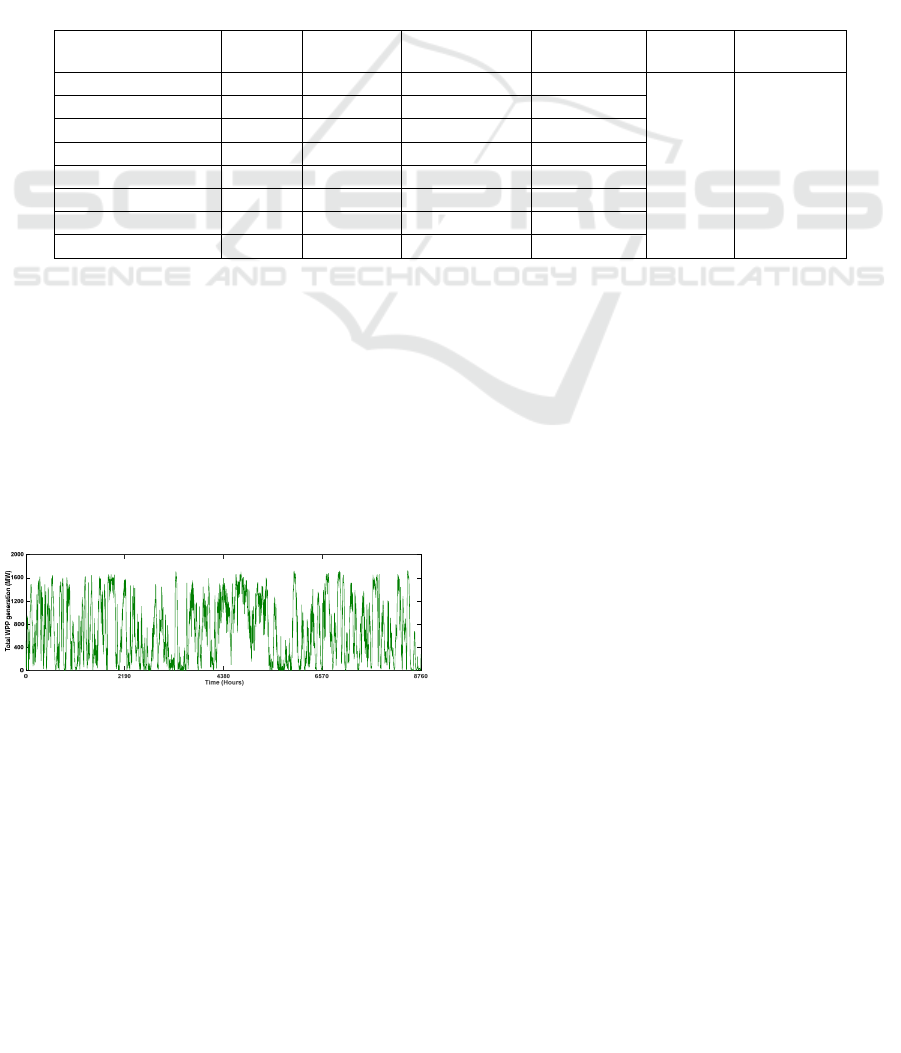
Figure 1: Total WPP production at 1 hour resolution
The total generation graph of these plants at hourly
resolution is given in Figure 1. WPP generation data used
in the study were obtained from Turkish Electricity
Transmission and Distribution
2.3 Empirical Mode Decomposition
(EMD)
The EMD method is based on the principle that
nonlinear and non-stationary complex signals can be
decomposed into sub-components with different
oscillation characteristics
(Jiang & Liu, 2023).
Based on this approach, Huang et al. proposed that a
complex signal can be decomposed into a residual
signal with a finite number of intrinsic mode
functions (IMFs)
(Huang et al., 1998). This method
has found wide application in many fields from
engineering to climate science, from biomedical
signal processing to energy systems, thanks to its
structure suitable for time-frequency analysis.
The EMD method is based on the assumption that
complex signals are composed of components that
oscillate at various frequencies and
amplitudes
(Shukla & Pasari, 2025). According to
this approach, the EMD decomposes a signal
sequentially into subcomponents called Intrinsic
Mode Functions (IMF) and a residual signal
(Shang
et al., 2022)
. IMF components reflect the short-term
Short-Term Wind Energy Production Forecasting and Target Plant Selection Based on Meteorological Data Using Empirical Mode
Decomposition
165
and high-frequency fluctuations of the signal, while
the residual signal refers to the lower frequency and
overall trend of the signal
(Aladağ, 2023; Yuzgec et
al., 2024). The mathematical expression of the
EMD method is given in Equation
1(RajasundrapandiyanLeebanon et al., 2025).In
this equation, Y
t
is the input signal, N is the
number of IMF signals, and R is the residual
signal.
Y
= I𝑀𝐹
+𝑅(𝑡)
(1)
2.4 The Extreme Gradient Boosting
(XGBoost) Model
XGBoost is a supervised machine learning algorithm
based on decision trees, providing high accuracy and
high computational efficiency(Kanji & Das, 2025). It
is widely used in the literature due to its superior
performance, especially in classification and
regression problems (Hakkal & Lahcen, 2024; Joshi
et al., 2024; M. Li et al., 2020; Rathore et al., 2023;
Shi et al., 2021; Yelgeç & Bingöl, 2022; Zhang et al.,
2024). While models in traditional boosting
algorithms try to directly reduce the error values, in
the extreme gradient boosting approach, the model
focuses on the pseudo-residuals that are derivatives of
these errors(Demirer et al., 2024).In other words,
XGBoost is defined as an algorithm based on gradient
boosting, which is faster, more accurate, and more
robust to overlearning.
The gradient boosting method is based on
incrementally training successive decision trees in a
way that reduces the error rates in their previous
models(Demirer et al., 2024; X. Li et al., 2022). Each
new model focuses on the prediction errors of the
previous model and tries to correct them(Yan et al.,
2022). In this way, the generalization capability of the
model is increased, and more accurate predictions are
obtained.
In the literature analysis, it was found that the
XGBoost model is a highly effective approach for
modelling complex and dynamic systems such as
wind power generation forecasting due to its high
accuracy, flexibility, and computational
efficiency(Guan et al., 2023; W. Li et al., 2020; Phan
et al., 2021; Zheng & Wu, 2019).In this study,
XGBoost is used as the main modelling tool for short-
term power generation forecasts. The parameters of
the model used are given in Table 2.
Table 2: XGBoost model parameters
Parameters Value
n
_
estimators 400
Learnin
g_
rate 0.1
Max_depth 6
Subsample 0.8
Colsample_bytree 0.8
Random
_
state 42
Ob
j
ective re
g
:s
q
uarederro
r
3 RESULTS
3.1 Meteorological IMF Signals
The first stage of the research is the conversion of
meteorological data into IMF signals by the EMD
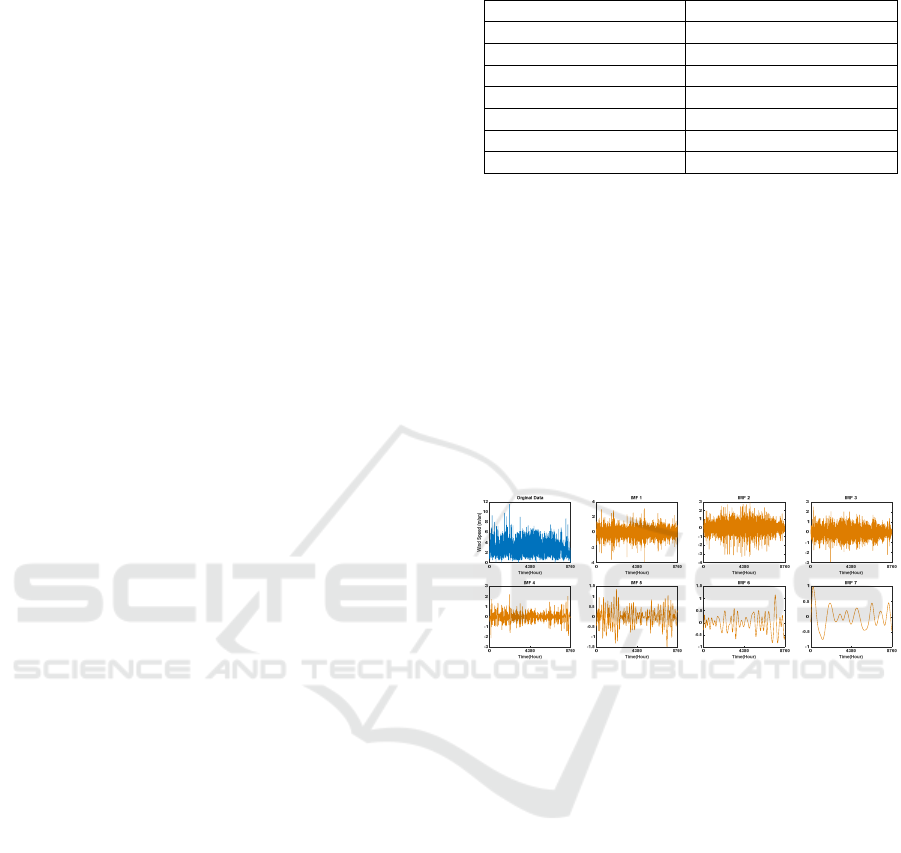
method. At this stage, each meteorological parameter
was converted into 7 IMF signals. A total of 56 IMF
signals were obtained from all meteorological
parameters. IMF signals of wind speed data are given
in Figure 2 as an example.
Figure 2: IMF signals of the wind speed data.
3.2 XGBoost Model WPP Forecasting
Results
In this study, the XGBoost model is used to predict
wind power plant (WPP) generation at 1-hour
forecast horizon and to determine the most suitable
target facility within the same province by using
meteorological measurement data. In this context,
meteorological data of Izmir province were
transformed into Internal Mode Functions (IMF)
using the Empirical Mode Decomposition (EMD)
method, and these signals were used as input data to
the XGBoost model.
To evaluate the performance of the model, 52
different WPP production data sets, each of which is
treated as a different target variable, are used
individually as the output of the model. For these
targets, the forecast performance metrics obtained
with the XGBoost model are presented in Table 3.
When the table is analyzed, it is seen that for some
power plants, forecasts with very high accuracy are
obtained, while for some power plants, the
ICEEECS 2025 - International Conference on Advances in Electrical, Electronics, Energy, and Computer Sciences
166

performance of the model is poor. Forecast results
with R² values of 0.90 and above are shown in bold
in the table.
Table 3: WPP production forecast performance metrics
over a 1-hour horizon.
Plant Number MAE MSE R
2
Plant Number MAE MSE R
2
WPP1 0.075 0.012 0.892 WPP27 0.062 0.008 0.931
WPP2 0.078 0.013 0.907 WPP28 0.064 0.008 0.913
WPP3 0.073 0.010 0.897 WPP29 0.074 0.011 0.904
WPP4 0.065 0.009 0.934 WPP30 0.060 0.007 0.924
WPP5 0.091 0.016 0.856 WPP31 0.064 0.008 0.911
WPP6 0.089 0.016 0.860 WPP32 0.057 0.006 0.937
WPP7 0.048 0.005 0.555 WPP33 0.065 0.009 0.936
WPP8 0.070 0.010 0.916 WPP34 0.058 0.007 0.920
WPP9 0.063 0.007 0.933 WPP35 0.059 0.007 0.938
WPP10 0.079 0.013 0.858 WPP36 0.067 0.009 0.892
WPP11 0.069 0.010 0.924 WPP37 0.100 0.020 0.867
WPP12 0.070 0.009 0.878 WPP38 0.081 0.013 0.889
WPP13 0.068 0.009 0.922 WPP39 0.065 0.009 0.928
WPP14 0.079 0.011 0.888 WPP40 0.059 0.007 0.897
WPP15 0.062 0.008 0.906 WPP41 0.068 0.009 0.912
WPP16 0.061 0.007 0.936 WPP42 0.064 0.008 0.901
WPP17 0.063 0.008 0.880 WPP43 0.067 0.010 0.915
WPP18 0.076 0.011 0.887 WPP44 0.062 0.008 0.929
WPP19 0.063 0.014 0.885 WPP45 0.067 0.009 0.904
WPP20 0.069 0.009 0.875 WPP46 0.061 0.007 0.930
WPP21 0.082 0.013 0.898 WPP47 0.071 0.009 0.918
WPP22 0.060 0.007 0.934 WPP48 0.065 0.008 0.928
WPP23 0.067 0.009 0.920 WPP49 0.058 0.007 0.926
WPP24 0.072 0.010 0.917 WPP50 0.079 0.012 0.894
WPP25 0.071 0.011 0.889 WPP51 0.068 0.009 0.917
WPP26 0.067 0.009 0.923 WPP52 0.079 0.013 0.902
According to the findings, the most accurate
generation forecasts for the 1-hour forecast horizon
were realized with the data from WPP35. On the other
hand, the lowest forecast performance was obtained
with the production data of plant WPP7.
4 CONCLUSIONS
As a result of the research, it was concluded that it is
not always possible to use meteorological
measurement data and all power plant production data
within the same provincial borders together in
forecasting studies. One of the main reasons for this
situation is that meteorological measurement stations
and wind power plants are located in different
locations. Moreover, even if the measurement station
and the power plant are located in the same province,
the fact that some power plants have endemic
meteorological conditions specific to their region is
another reason for the differences in forecasting
performance.
REFERENCES
Aladağ, E. (2023). Ampirik Mod Ayrıştırmasına Dayalı
ARIMA Modeli Kullanılarak Van İli Hava Kirliliğinin
Tahmini. Yüzüncü Yıl Üniversitesi Fen Bilimleri
Enstitüsü Dergisi, 28(2), 495–509.
https://doi.org/10.53433/yyufbed.1220578
Demirer, H., Ayci, D., Ozturk, S. A., Karabal, C., & Valles,
J. A. (2024). A Machine Learning-Based Reference
Baseline Consumption Model for Energy Efficiency
Measurement and Verification. Electrical-Electronics
and Biomedical Engineering Conference, ELECO 2024
- Proceedings, 1–5.
https://doi.org/10.1109/ELECO64362.2024.10847193
Guan, S., Wang, Y., Liu, L., Gao, J., Xu, Z., & Kan, S.
(2023). Ultra-short-term wind power prediction method
combining financial technology feature engineering
and XGBoost algorithm. Heliyon, 9(6), e16938.
https://doi.org/10.1016/j.heliyon.2023.e16938
Hakkal, S., & Lahcen, A. A. (2024). XGBoost To Enhance
Learner Performance Prediction. Computers and
Education: Artificial Intelligence, 7(January), 100254.
https://doi.org/10.1016/j.caeai.2024.100254
Huang, N. E., Shen, Z., Long, S. R., Wu, M. C., Snin, H.
H., Zheng, Q., Yen, N. C., Tung, C. C., & Liu, H. H.
(1998). The empirical mode decomposition and the
Hubert spectrum for nonlinear and non-stationary time
series analysis. Proceedings of the Royal Society A:
Mathematical, Physical and Engineering Sciences,
454(1971), 903–995.
https://doi.org/10.1098/rspa.1998.0193
Irena. (2025). Renewable capacity statistics 2025
International Renewable Energy Agency. In Irena.
https://irena.org/-
/media/Files/IRENA/Agency/Publication/2020/Mar/IR
ENA_RE_Capacity_Statistics_2020.pdf
Jiang, T., & Liu, Y. (2023). A short-term wind power
prediction approach based on ensemble empirical mode
decomposition and improved long short-term memory.
Computers and Electrical Engineering, 110(March),
108830.
https://doi.org/10.1016/j.compeleceng.2023.108830
Joseph, L. P., Deo, R. C., Prasad, R., Salcedo-Sanz, S., Raj,
N., & Soar, J. (2023). Near real-time wind speed
forecast model with bidirectional LSTM networks.
Renewable Energy, 204(May 2022), 39–58.
https://doi.org/10.1016/j.renene.2022.12.123
Joshi, A., Vishnu, C., Mohan, C. K., & Raman, B. (2024).
Application of XGBoost model for early prediction of
earthquake magnitude from waveform data. Journal of
Earth System Science, 133(1).
https://doi.org/10.1007/s12040-023-02210-1
Kanji, S., & Das, S. (2025). Assessing groundwater
potentialities and replenishment feasibility using
machine learning and MCDM models considering
hydro-geological aspects and water quality
constituents. Environmental Earth Sciences, 84(1), 1–
18. https://doi.org/10.1007/s12665-024-11996-2
Karadöl, İ., & Şekkeli, M. (2022). Ramp Events in River
Type Hydroelectric Power Plants: The Case of Turkey.
Fırat Üniversitesi Mühendislik Bilimleri Dergisi, 34(1),
361–375. https://doi.org/10.35234/fumbd.1029081
Karadöl, İ., Yıldız, C., & Şekkeli, M. (2021). Determining
optimal spatial and temporal complementarity between
wind and hydropower. Energy, 230.
https://doi.org/10.1016/j.energy.2021.120790
Short-Term Wind Energy Production Forecasting and Target Plant Selection Based on Meteorological Data Using Empirical Mode
Decomposition
167

Li, M., Fu, X., & Li, D. (2020). Diabetes Prediction Based
on XGBoost Algorithm. IOP Conference Series:
Materials Science and Engineering, 768(7).
https://doi.org/10.1088/1757-899X/768/7/072093
Li, W., Peng, X., Cheng, K., Wang, H., Xu, Q., Wang, B.,
& Che, J. (2020). A Short-Term Regional Wind Power
Prediction Method Based on XGBoost and Multi-stage
Features Selection. 2020 IEEE Student Conference on
Electric Machines and Systems, SCEMS 2020, 614–
618.
https://doi.org/10.1109/SCEMS48876.2020.9352249
Li, X., Leung, F. H. F., Su, S., & Ling, S. H. (2022). Sleep
Apnea Detection Using Multi-Error-Reduction
Classification System with Multiple Bio-Signals.
Sensors, 22(15), 1–17.
https://doi.org/10.3390/s22155560
Li, X., Wang, J., Geng, Z., Jin, Y., & Xu, J. (2023). Short-
term Wind Power Prediction Method Based on Genetic
Algorithm Optimized XGBoost Regression Model.
Journal of Physics: Conference Series, 2527(1).
https://doi.org/10.1088/1742-6596/2527/1/012061
Liu, G., Zhou, J., Jia, B., He, F., Yang, Y., & Sun, N.
(2019). Advance short-term wind energy quality
assessment based on instantaneous standard deviation
and variogram of wind speed by a hybrid method.
Applied Energy, 238(January), 643–667.
https://doi.org/10.1016/j.apenergy.2019.01.105
Ma, Z., Chang, H., Sun, Z., Liu, F., Li, W., Zhao, D., &
Chen, C. (2020). Very Short-Term Renewable Energy
Power Prediction Using XGBoost Optimized by TPE
Algorithm. 2020 4th International Conference on
HVDC, HVDC 2020, 1236–1241.
https://doi.org/10.1109/HVDC50696.2020.9292870
Mustaqeem, Ishaq, M., & Kwon, S. (2022). A CNN-
Assisted deep echo state network using multiple Time-
Scale dynamic learning reservoirs for generating Short-
Term solar energy forecasting. Sustainable Energy
Technologies and Assessments, 52(PC), 102275.
https://doi.org/10.1016/j.seta.2022.102275
Phan, Q. T., Wu, Y. K., & Phan, Q. D. (2021). A hybrid
wind power forecasting model with xgboost, data
preprocessing considering different nwps. Applied
Sciences (Switzerland), 11(3), 1–19.
https://doi.org/10.3390/app11031100
RajasundrapandiyanLeebanon, T., Murugan, N. S. S.,
Kumaresan, K., & Jeyabose, A. (2025). Long-term
solar radiation forecasting in India using EMD, EEMD,
and advanced machine learning algorithms. In
Environmental Monitoring and Assessment (Vol. 197,
Issue 3). https://doi.org/10.1007/s10661-025-13738-8
Rathore, H., Meena, H. K., & Jain, P. (2023). Prediction of
EV Energy consumption Using Random Forest And
XGBoost. Proceedings - 2nd International Conference
on Power Electronics and Energy, ICPEE 2023, 1–6.
https://doi.org/10.1109/ICPEE54198.2023.10060798
Renewable Energy Agency, I. (2025). Renewable Capacity
Statistics 2025. In Irena. www.irena.org
Shang, Y., Miao, L., Shan, Y., Gnyawali, K. R., Zhang, J.,
& Kattel, G. (2022). A Hybrid Ultra-Short-Term and
Short-Term Wind Speed Forecasting Method Based on
CEEMDAN and GA-BPNN. Weather and Forecasting,
37(4), 415–428. https://doi.org/10.1175/WAF-D-21-
0047.1
Shi, R., Xu, X., Li, J., & Li, Y. (2021). Prediction and
analysis of train arrival delay based on XGBoost and
Bayesian optimization. Applied Soft Computing, 109,
107538. https://doi.org/10.1016/j.asoc.2021.107538
Shukla, S., & Pasari, S. (2025). Short-term wind speed
prediction with adaptive signal processing based hybrid
statistical models. In Energy Systems (Issue
0123456789). Springer Berlin Heidelberg.
https://doi.org/10.1007/s12667-025-00727-6
Yan, X., Wang, L., Zhu, J., Wang, S., Zhang, Q., & Xin, Y.
(2022). Automatic Obstructive Sleep Apnea Detection
Based on Respiratory Parameters in Physiological
Signals. 2022 IEEE International Conference on
Mechatronics and Automation, ICMA 2022, 461–466.
https://doi.org/10.1109/ICMA54519.2022.9856347
Yelgeç, M. A., & Bingöl, O. (2022). Ayrık dalgacık
dönüşümü ve Xgboost ile rüzgâr gücü tahmini.
Uluslararası Teknolojik Bilimler Dergisi, 14(2), 58–65.
https://doi.org/10.55974/utbd.1132336
Yuzgec, U., Dokur, E., & Balci, M. (2024). A novel hybrid
model based on Empirical Mode Decomposition and
Echo State Network for wind power forecasting.
Energy, 300(April), 131546.
https://doi.org/10.1016/j.energy.2024.131546
Zhang, T., Zhang, X., Rubasinghe, O., Liu, Y., Chow, Y.
H., Iu, H. H. C., & Fernando, T. (2024). Long-Term
Energy and Peak Power Demand Forecasting Based on
Sequential-XGBoost. IEEE Transactions on Power
Systems, 39(2), 3088–3104.
https://doi.org/10.1109/TPWRS.2023.3289400
Zheng, H., & Wu, Y. (2019). A XGBoost Model with
Weather Similarity Analysis and Feature Engineering
for Short-Term Wind Power Forecasting. Applied
Sciences (Switzerland).
ICEEECS 2025 - International Conference on Advances in Electrical, Electronics, Energy, and Computer Sciences
168
