
Emotion Recognition Using Machine Learning Models
on EEG Signals
Gizem Yildiz
a
and Önder Yakut
b
Department of Information Systems Engineering, Kocaeli University, Kocaeli, Turkey
Keywords: Electroencephalogram (EEG) Signal, Emotion Recognition, Machine Learning, Muse Headset, Principal
Component Analysis (PCA).
Abstract: This study proposes an emotion recognition model based on EEG signals. The performance of the proposed
model was compared with that of various machine learning models. After preprocessing the raw EEG data,
Principal Component Analysis (PCA) was applied for dimension reduction. Emotion classification was
performed using various classifiers such as LSTM, SVM, DNN, GRU, RNN, XGBoost, Logistic Regression,
and Random Forest using the obtained features. As a result of the studies, GRU achieved the most successful
result with an accuracy rate of 97.89%. LSTM achieved 96.25%, DNN 97.81%, Random Forest 95.78%,
Logistic Regression 94.61%, SVM 95.55%, XGBoost 96.72%, and RNN 95.55% accuracy rates. These results
show that emotional states can be classified with high accuracy by effectively processing EEG signals using
PCA.
1 INTRODUCTION
Emotion is a complex physiological behaviour in all
human beings, representing a physiological and
behavioural response to both internal and external
stimuli. The purpose of recognizing human emotions
is to identify them through various methods,
including body language, physiological indicators,
and audio-visual indicators. Emotion is crucial in
human-to-human communication and interaction.
Emotion is the outcome of the mental processes that
people undergo and can be described as a response of
their psychophysiological state (Chatterje and Byun,
2022).
Over the past few years, there has been a great
deal of research on engineering methods for
automatic emotion recognition. These can be grouped
into three broad categories. The first category
analyzes speech, body language, and facial
expressions. These audiovisual methods allow
emotion recognation without physical contact. The
second group mainly focuses on peripheral
physiological signals. Studies have demonstrated that
different emotional states modulates peripheral
physiological signals. In the third group, the focus is
a
https://orcid.org/0000-0001-9389-9366
b
https://orcid.org/0000-0003-0265-7252
on brain signals originating from the central nervous
system, captured using devices that measure brain
wave activity, including electroencephalography
(EEG) and electrocorticography (ECoG). Among
these brain signals, EEG signals have been shown to
possess informative properties in response to
emotional states. Davidson et al. suggest that the
experience of two emotions is associated with
electrical activity in the frontal lobe; which are
positive and negative emotions (Davidson and Fox,
1982). According to these studies, there has been
much debate about the connection between EEG
asymmetry and the emotions.
The electrocardiogram (ECG) signals provide
information that is useful for recognizing emotional
distress in people. Over the years, numerous studies
have been conducted on emotional distress,
particularly in the field of psychology. Mental health
conditions such as depression, anxiety, and bipolar
disorder are strongly influenced by emotional
distress. In the field of affective research, emotions
are commonly classified into two primary categories:
positive (happiness and surprise) and negative
(sadness, anger, fear, and disgust). EEG offers high
temporal resolution in capturing the brain’s electrical
48
Yildiz, G. and Yakut, Ö.
Emotion Recognition Using Machine Learning Models on EEG Signals.
DOI: 10.5220/0014295700004848
Paper published under CC license (CC BY-NC-ND 4.0)
In Proceedings of the 2nd International Conference on Advances in Electrical, Electronics, Energy, and Computer Sciences (ICEEECS 2025), pages 48-53
ISBN: 978-989-758-783-2
Proceedings Copyright © 2026 by SCITEPRESS – Science and Technology Publications, Lda.

activity. In this work, three emotional states (positive,
negative, and neutral) are classified. Acknowledging
that brain activity is individual-specific and that
emotional responses vary across different brain
regions among individuals is crucial for
understanding how emotions can be identified
through neural signal. This study examines the
effectiveness of machine learning (ML) models in the
classification of human emotional states using EEG
data (Chatterje and Byun, 2022).
Determining what specific brain activity patterns
correspond to momentary mental experiences is a
significant challenge in applications involving brain-
machine interfaces. The sheer amount of information
necessary to represent the complex, nonlinear, and
unpredictable nature of EEG signals accurately is one
of the most critical challenges in EEG signal
classification. In this study, a variety of machine
learning (ML) models have been employed to
categorize different emotional states, including GRU
(Gated Recurrent Unit), LSTM (Long Short-Term
Memory), XGBoost (Extreme Gradient Boosting),
RF (Random Forest), DNN (Deep Neural Network),
SVM (Support Vector Machine), and RNN
(Recurrent Neural Network).
2 LITERATURE REVIEW
This literature review extensively examines the field
of EEG-based emotion recognition. This review
examines various aspects of the subject, including
signal processing, feature extraction, classification
techniques and areas of application. Our review
highlights the progress made in EEG based emotion
recognition while also emphasizing the emerging
challenges and potential directions within this
interdisciplinary area. New techniques have been
developed by researchers to make EEG-based
emotion recognition systems more sensitive,
applicable and usable.
In recent years, research on detecting emotions
using EEG signals has gained significant momentum.
In particular, the availability of low-cost EEG devices
and the sharing of open data sets among researchers
have accelerated work on this subject. In this context,
the “EEG Brainwave Dataset: Feeling Emotions”
published on Kaggle, which we also used in this
study, has been one of the sources frequently referred
to in research. The relevant dataset consists of four-
channel (TP9, AF7, AF8, TP10) EEG signals
obtained with the Muse EEG device in positive,
neutral, and negative emotional states.
Earlier studies on EEG-based emotion detection
focused on determining if emotional data could be
obtained from brain waves. Numerous studies have
examined the link between emotional experiences
and brain activity, with a particular focus on the
frontal regions. Within this context, frontal alpha
asymmetry has been explored as it reflects variations
in alpha brainwave activity of the frontal cortex,
which are connected to different emotional states. In
their work, Allen and Reznik identified frontal EEG
asymmetry as a potential marker for vulnerability to
depression. Although frontal asymmetry may help
detect individuals at greater risk for depression, large
scale longitudinal studies are still required to confirm
this finding (Allen and Reznik, 2015).
Frontal alpha asymmetry neurofeedback was
investigated by Mennella et al. as a strategy for
mitigating symptoms of anxiety and negative affect.
In their study, neurofeedback training was employed
to examine discrete changes in positive and negative
affect, anxiety, and depression, as well as variations
in alpha power across the left and right hemispheres.
These pioneering studies established a scientific
foundation for subsequent research into the neural
correlates of emotions using EEG (Mennella, Patron
and Palomba, 2017).
From the acquired EEG signals, J. J. Bird et al.
extracted statistical features across the alpha, beta,
theta, delta, and gamma bands, followed by feature
selection using techniques including OneR,
Information Gain, Bayesian Network, and
Symmetrical Uncertainty. The dataset, consisting of
2,548 features, was reduced using 63 features selected
by Information Gain, and ensemble classifiers such as
Random Forest trained on these features achieved
approximately 97.89% accuracy. The Deep Neural
Network (DNN) achieved 94.89% accuracy (Bird,
Faria, Manso, Ekárt and Buckingham, 2019).
Joshi and Joshi evaluated the performance of
RNN and KNN (K-Nearest Neighbour) algorithms in
classifying human emotions using EEG signals. In the
study, EEG signals corresponding to positive, neutral,
and negative emotions were analyzed. During the
preprocessing stage, channel selection was
performed, and discrete wavelet transform (DWT)
was used for feature extraction. The obtained features
were fed as input to the RNN and KNN algorithms.
The experiments showed that the RNN algorithm
achieved 94.84% accuracy, while the KNN algorithm
achieved 93.43% accuracy. These results
demonstrate that both algorithms performed well in
the EEG-based emotion recognition task. In
particular, the RNN's ability to model dependencies
Emotion Recognition Using Machine Learning Models on EEG Signals
49
in time series data provided an advantage in the
emotion recognition task (Joshi and Joshi, 2022).
Mridha et al. aimed to recognize emotions from
EEG signals using deep learning algorithms and
compared DNN, LSTM, and GRU models. The first
model was a DNN with 98.44% accuracy, the second
was an LSTM with 97.5% accuracy, and the third was
a GRU with 97.18% accuracy. The GRU model has
achieved up to 96% accuracy in identifying negative
emotions. This result shows that different model
configurations can exhibit varying levels of success
depending on the type of emotion (Mridha, Sarker,
Zaman, Shukla, Ghosh and Shaw, 2023).
Dhara et al. developed hybrid structure that
combines machine learning and deep learning
techniques for recognizing emotions using EEG
signals. In the study, various classifiers were tested
after feature extraction from raw EEG signals, and it
was noted that models with early-stage filtering
performed better. Specifically, using the hybrid
CNN-LSTM model, accuracy rates of 96.87% and
97.31% were achieved for valence and arousal
dimensions, respectively. These results demonstrate
that hybrid deep learning models can perform well in
EEG-based emotion recognition tasks (Dhara and
Singh, 2023).
In their study using various machine learning
models, Rachini et al. achieved high success rates
with accuracy rates of 99% for Random Forest, 98%
for SVM, and 94% for KNN (Rachini, Hassn, El
Ahmar and Attar, 2024).
Another study in this field was published by
Prakash and Poulose. In this study, the performance
of eight different supervised machine learning
algorithms was evaluated using the “EEG Brainwave
Dataset: Feeling Emotions” dataset. The models used
included Logistic Regression, Decision Trees,
Random Forest, Gaussian Naive Bayes (GNB),
AdaBoost, SVM, LightGBM, XGBoost, and
CatBoost algorithms. Additionally, PCA, t-SNE, and
LDA techniques were applied for dimension
reduction. Experiments conducted with five-fold
cross-validation revealed that the XGBoost algorithm
achieved the highest performance with an accuracy
rate of 92.79%. This was followed by CatBoost
(92.05%) and LightGBM (91.79%). On the other
hand, the Gaussian Naive Bayes algorithm had the
lowest accuracy rate at 72.83%. However, it has been
observed that the GNB model shows an
approximately 10% increase in accuracy after PCA is
applied. These results demonstrate that data
preprocessing and dimension reduction significantly
impact success, particularly for low performance
algorithms (Prakash and Poulose, 2025).
3 MATERIALS AND METHODS
3.1 Dataset
EEG Brain Wave Data Set: The Feeling Emotions
dataset was employed in this study to classify distinct
emotions. As presented in Table 1, participants in this
dataset were exposed to a series of video clips
designed to elicit three distinct emotional states:
positive, negative and neutral. For each condition, 6
minutes of brain wave activity data were recorded
from two adult subjects, one male and one female,
aged 20 and 22, to produce 36 minutes of brain wave
activity data (Bird, Faria, Manso, Ekárt and
Buckingham, 2019).
Table 1: The movies and scenes watched by the
participants.
Movie Scene Emotion
Marley and Me Death Scene Negative
Up Death Scene Negative
My Girl Funeral Scene Negative
La La Lan
d
Musical Scene Positive
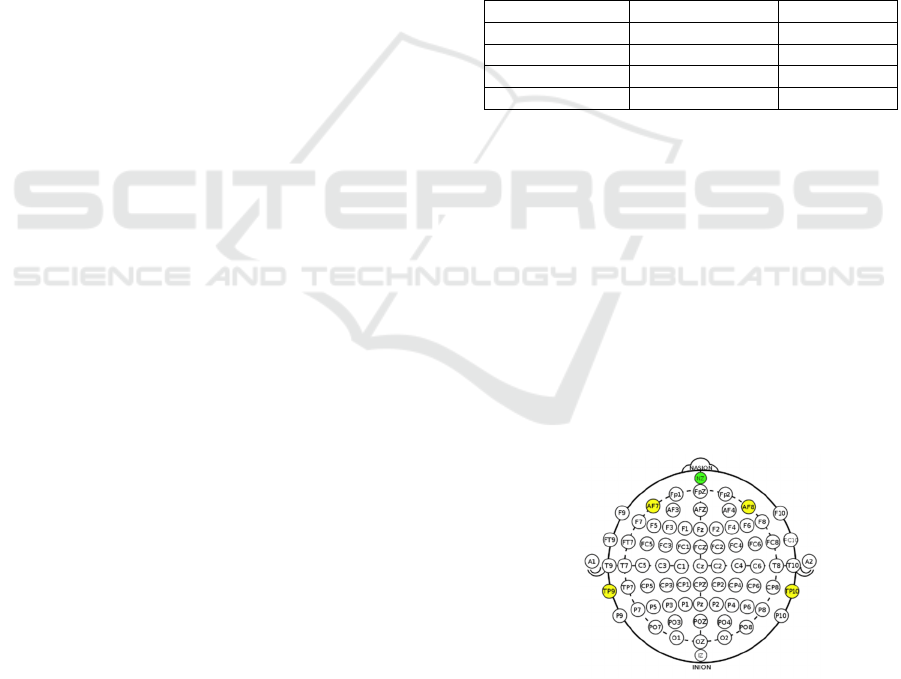
Data were collected using the Muse headset from
extracranial electrodes positioned at TP9, AF7, AF8,
and TP10. Human emotions were elicited through
visual stimuli, and EEG recordings were obtained
according to the 10-20 electrode placement system.
The electrode configuration of the EEG setup is
illustrated in Figure 1. This study focused on
classifying three emotional states: positive, negative,
and neutral. The corresponding emotion graph
indicates that the signal patterns differ across these
emotional states, suggesting that variations in EEG
signal characteristics can serve as a fundamental basis
for emotion classification. (Bird, Ekart, Buckingham
and Faria, 2019).
Figure 1: EEG sensors on the Muse headband in the
international standard EEG placement system: TP9, AF7,
AF8, and TP10 (Bird, Ekart, Buckingham and Faria, 2019).
When the EEG data samples in the dataset were
arranged equally, no problem related to class
ICEEECS 2025 - International Conference on Advances in Electrical, Electronics, Energy, and Computer Sciences
50
imbalance was encountered during the model training
and testing processes of the proposed system. Given
that the dataset contained 2558 features, we
performed feature dimension reduction in our study.
For this purpose, we used the Principal Component
Analysis (PCA) model. Principal Component
Analysis (PCA) is a technique that projects high
dimensional data onto a lower dimensional space
while maximizing the captured variance. For a given
set of points, PCA identifies the ‘best fit line’ that
minimizes the average distance to all points in the
dataset (Prakash and Poulose, 2025).
The use of this public dataset highlights the
unique qualities relevant to the objectives of our
study. Despite its frequent application, this dataset
provides distinctive opportunities to analyze EEG
derived emotional responses within a controlled
experimental framework. Data collected from multi-
electrode regions with the Muse headset yield a
comprehensive set of temporal statistical features,
including mean and variance, alongside frequency
domain characteristics derived via FFT (Fast Fourier
Transform). Such features offer a detailed
representation of brain wave activity, supporting an
in-depth evaluation of ML approaches for emotion
classification. The structure of the dataset is well
suited to our research focus, facilitating a thorough
assessment and generalization of ML methods in
EEG based emotion classification.
3.2 Models Used
In this study, various machine learning algorithms
were used to recognize the emotional states of
individuals based on EEG signals. The dataset used is
the “EEG Brain Wave Dataset: Feeling Emotions,” a
dataset publicly available on the Kaggle platform that
contains EEG recordings corresponding to different
emotional states.
In the “EEG Brain Wave Dataset: Feeling
Emotions” dataset, several preprocessing steps were
applied to prepare the data for machine learning
models. First, categorical labels corresponding to
emotional states were converted into numerical
values using a Label Encoder to ensure compatibility
with the algorithms. Next, normalization was
performed to scale the features to a uniform range,
thereby reducing bias caused by varying magnitudes
and improving model convergence. Finally, Principal
Component Analysis (PCA) was applied for
dimension reduction. This helped minimize
redundancies, highlight the most informative
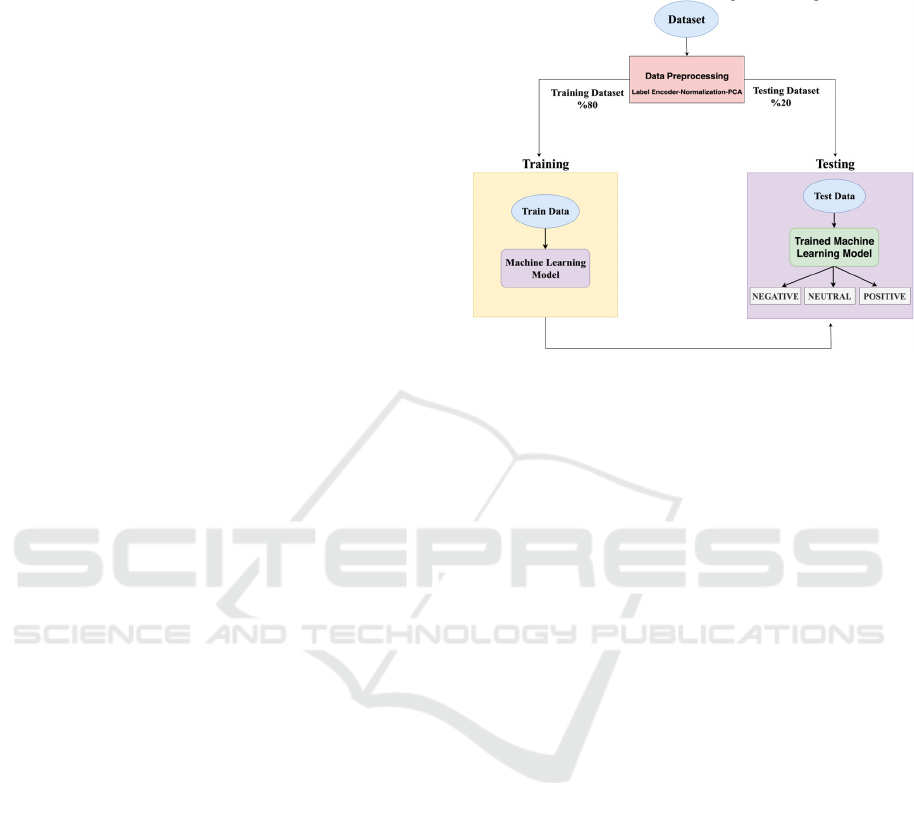
features, and improve computational efficiency. After
undergoing preprocessing phase, the dataset was
employed for training with various machine learning
algorithms. The general architecture of the proposed
model is shown in the block diagram in Figure 2.
Figure 2: Block diagram of the model presented in this
study.
LSTM is a type of RNN known for its ability to
learn long term dependencies in time series data.
Through the integration of memory cells and gating
mechanisms, LSTMs effectively overcome the
vanishing gradient problem, rendering them
particularly well suited for tasks involving sequential
data, such as speech recognition, natural language
processing, and EEG signal analysis. In this study, the
GRU network was applied alongside LSTM in order
to assess its sensitivity to the temporal patterns of
emotional states. DNN, composed of multiple layers
of artificial neurons, is capable of learning high-
dimensional and abstract representations from
complex data. After normalization, EEG features
were provided as input to the DNN, and multilayer
architectures employing Rectified Linear Unit
(ReLU) activation functions were systematically
evaluated. The learning capacity of the DNN shows
strong performance, particularly when combined with
carefully selected features, highlighting its potential
in capturing nonlinear relationships within EEG
signals
(Mridha, Sarker, Zaman, Shukla, Ghosh and Shaw,
2023)
. SVM, a traditional yet robust machine learning
algorithm, has proven effective in scenarios with
limited sample sizes and high dimensional data,
owing to its ability to maximize the decision margin
and generalize well in such contexts (
Rachini, Hassn,
El Ahmar and Attar, 2024
).
XGBoost is a powerful ensemble learning
technique based on gradient boosted decision trees
and it typically achieves high accuracy values by
balancing both model complexity and learning time.
In this study, the XGBoost model trained with
Emotion Recognition Using Machine Learning Models on EEG Signals
51

features extracted from EEG data has drawn
attention, particularly for its robustness against
overfitting. Logistic Regression, despite being a
simple and interpretable algorithm known for
producing linear decision boundaries, has achieved
satisfactory results on well preprocessed EEG data.
Random Forest, on the other hand, is an ensemble
learning technique that classifies by combining the
outputs of multiple decision trees; it has shown
successful performance on EEG data due to its
resilience to noise in the data and its lack of tendency
toward overfitting (Prakash and Poulose, 2025).
Various experiments were conducted on the
dataset using the mentioned models. The results
obtained from these experiments are explained under
the section titled Experimental Results.
4 EXPERIMENTAL RESULTS
In this study, the performance of various machine
learning algorithms (Logistic Regression, Random
Forest, SVM, XGBoost, RNN, GRU, and LSTM) was
compared for emotion classification using FFT based
features that were reduced in dimensionality through
PCA. Table 2 shows the applied machine learning
models and their respective performance metrics.
Table 2: Machine learning models used and their
performance metrics.
Model Accuracy Precision Recall
F1-
Score
LSTM
0,9625 0,9626 0,9625 0,9626
GRU
0,9789 0,9794 0,9789 0,9789
DNN
0,9781 0,9781 0,9781 0,9781
Random
Forest
0,9578 0,9589 0,9578 0,9579
Logistic
Re
g
ression
0,9461 0,9492 0,9461 0,9458
SVM
0,9555 0,9560 0,9555 0,9554
XGBoost
0,9672 0,9676 0,9672 0,9671
RNN
0,9555 0,9569 0,9555 0,9552
Among the models examined in this study, GRU
demonstrated the highest classification accuracy.
This result indicates that GRU exhibits an outstanding
performance with signal-based data due to its ability
to effectively learn time dependent patterns.
Specifically, the GRU's ability to learn similarly to
deep structures such as LSTM with fewer parameters
optimizes training time while also improving
classification performance. In this context, we
conclude that the GRU offers an effective and
efficient alternative model for applications such as
sentiment analysis working with high dimensional
data containing time series features.
Looking at Table 3, we can observe that the GRU,
XGBoost, and RNN models achieve better results
than the studies in the literature, while the other
models achieve similar results to the studies in the
literature.
Table 3: Comparison of literature results and proposed
model performance.
Model Accuracy Authors
LSTM
0,9750
0,9625
Mridha et al. (2023)
Pro
p
osed Model
GRU
0,9789
0,9718
Proposed Model
Mridha et al.
(
2023
)
DNN
0,9489
0,9781
0,9844
J.J. Bird et al. (2019)
Proposed Model
Mridha et al.
(
2023
)
Random
Forest
0,9789
0,9900
0,9578
J.J. Bird et al. (2019)
Rachini et al. (2024)
Pro
p
osed Model
SVM
0,9800
0,9555
Rachini et al. (2024)
Pro
p
osed Model
XGBoost
0,9672
0,9279
Proposed Model
Prakash et al. (2025)
RNN
0,9484
0,9555
Joshi et al. (2022)
Proposed Model
5 CONCLUSIONS
In this study, experimental research was conducted to
perform emotion recognition based on EEG signals
using machine learning models. Current studies in the
literature were reviewed and compared with the
results obtained from the experimental research.
Thus, machine learning models show promising
results in classifying emotional states with high
accuracy rates, even with low-cost EEG devices.
However, the nature of signals being prone to noise,
individual differences, and the challenges
encountered in real time applications are among the
significant problems awaiting further research in this
field.
In our future work, the focus will be on
developing more flexible and reliable systems
through multi-modal approaches, more advanced and
personalized models, and the integration of
explainable artificial intelligence (XAI).
ICEEECS 2025 - International Conference on Advances in Electrical, Electronics, Energy, and Computer Sciences
52

ACKNOWLEDGEMENTS
This work was supported by Research Fund of the
Kocaeli University. Project Number: 4703.
REFERENCES
Allen, J. J., & Reznik, S. J. (2015). Frontal EEG asymmetry
as a promising marker of depression vulnerability:
Summary and methodological considerations. Current
opinion in psychology, 4, 93-97.
Bird, J. J., Ekart, A., Buckingham, C. D., & Faria, D. R.
(2019, April). Mental emotional sentiment
classification with an eeg-based brain-machine
interface. In Proceedings of theInternational
Conference on Digital Image and Signal Processing
(DISP’19).
Bird, J. J., Faria, D. R., Manso, L. J., Ekárt, A., &
Buckingham, C. D. (2019). A Deep Evolutionary
Approach to Bioinspired Classifier Optimisation for
Brain ‐ Machine Interaction. Complexity, 2019(1),
4316548.
Chatterjee, S., & Byun, Y. C. (2022). EEG-based emotion
classification using stacking ensemble approach.
Sensors, 22(21), 8550.
Davidson, R. J., & Fox, N. A. (1982). Asymmetrical brain
activity discriminates between positive and negative
affective stimuli in human infants. Science, 218(4578),
1235-1237.
Dhara, T., & Singh, P. K. (2023). Emotion recognition from
EEG data using hybrid deep learning approach. In
Frontiers of ICT in Healthcare: Proceedings of EAIT
2022 (pp. 179-189). Singapore: Springer Nature
Singapore.
Mennella, R., Patron, E., & Palomba, D. (2017). Frontal
alpha asymmetry neurofeedback for the reduction of
negative affect and anxiety. Behaviour research and
therapy, 92, 32-40.
Mridha, K., Sarker, T., Zaman, R., Shukla, M., Ghosh, A.,
& Shaw, R. N. (2023, August). Emotion Recognition:
A New Tool for Healthcare Using Deep Learning
Algorithms. In International Conference on Electrical
and Electronics Engineering (pp. 613-631). Singapore:
Springer Nature Singapore.
Rachini, A., Hassn, L. A., El Ahmar, E., & Attar, H. (2024).
Machine learning techniques towards accurate emotion
classification from eeg signals. WSEAS Transactions
on Computer Research, 12, 455-462.
Prakash, A., & Poulose, A. (2025). Electroencephalogram-
based emotion recognition: a comparative analysis of
supervised machine learning algorithms. Data Science
and Management.
Joshi, S., & Joshi, F. (2022). Human Emotion Classification
based on EEG Signals Using Recurrent Neural Network
And KNN. arXiv preprint arXiv:2205.08419.
Emotion Recognition Using Machine Learning Models on EEG Signals
53
