
Industrial Symbiosis Improvement with Digital Twins
Aleksandar Anastasovski
a
Faculty of Engineering, International Balkan University, Makedonsko-kosovska Brigada BB, Skopje, Macedonia
Keywords: Digital Twin, Industrial Symbiosis, System Efficiency, Energy and Mass Exchange, System Control.
Abstract: Digital twins (DTs) are dynamic digital representations of physical systems that accurately depict their
behaviour and states through virtual space over their lifetime. They are built on models and computer
programs that use real-time data from sensors or IoT devices. DTs serve as a bridge between the physical and
virtual worlds, enabling real-time tracking, data analysis, and simulation of various scenarios. They facilitate
remote management, immediate intervention, and data-driven decision-making across industries. The
implementation of DT principles in industrial symbiosis can optimize resource usage, improve collaboration,
and create more sustainable production systems. However, the lack of system integration with information
and communication technology tools and the complexity of knowledge sharing within symbiosis networks
delay its effective implementation. To establish DTs in IS, a systematic approach is required, involving the
specification of exchange processes, determination of bottlenecks, prioritization of integrated parts, and the
creation of mathematical models and simulations. The benefits of DTs in IS include reduced time to market,
reduced waste and energy consumption, improved performance monitoring, and enhanced collaboration
between teams. Future developments needed for IS include addressing the lack of big data for training ML
models, ensuring data security, establishing standards and regulations, and overcoming observability and
controllability issues.
1 INTRODUCTION
Industrial symbiosis (IS) is a mutually beneficial
interaction between different industries/companies
for the exchange of waste materials or energy to be
used as a source for other companies. That results in
the design of a production system that is more
resource-efficient and has a reduced environmental
impact (Seager et al.,2010). It is an effective strategy
for the optimization of resource usage and
collaboration improvement in the context of Industry
4.0 (Scafà et al., 2020).
Is also strengthens synergies between humans and
machines (Scafà et al., 2020). It encompasses the
exchange of waste materials and waste energy
between industrial units. Its design could be
facilitated by tools based on information and
communication technology (ICT) (Grant et al., 2010;
Kosmol, 2019) . The implementation of IS can lead
to the development of eco-industrial parks (EIPs),
where more industries collaborate to create a more
sustainable and circular production system (Al-
a
https://orcid.org/0000-0002-6159-5920
Quradaghi et al., 2020). Therefore, IS is a key
component of the circular economy. It promotes the
increasing resource efficiency, waste reduction, and
environmental sustainability. IS is a shift from the
traditional linear economic model to a more circular
approach (Feiferytė-Skirienė & Stasiškienė, 2021).
One of the main challenges in the development of
IS networks is the lack of system integration by the
use of ICT tools. Although the trend of using
semantic web technologies to share information and
knowledge is constantly increasing. These tools are
often not fully incorporated into broader IP activities
(Kosmol, 2019). This gap hinders the effective
implementation and sustainability of IP business
models.
Another major gap lies in the complexity of
knowledge sharing within IS networks. Despite being
considered as crucial in the implementation and
maintenance of IP business models. Knowledge
sharing is rarely explored or implemented in depth
(Kosmol, 2019). This lack of understanding can delay
the development of robust IS networks and limit their
potential benefits.
38
Anastasovski, A.
Industrial Symbiosis Improvement with Digital Twins.
DOI: 10.5220/0014292100004848
Paper published under CC license (CC BY-NC-ND 4.0)
In Proceedings of the 2nd International Conference on Advances in Electrical, Electronics, Energy, and Computer Sciences (ICEEECS 2025), pages 38-47
ISBN: 978-989-758-783-2
Proceedings Copyright © 2026 by SCITEPRESS – Science and Technology Publications, Lda.
The design of EIPs for specific industries reveals
gaps in the early stages of development. While there
are frameworks to guide decision-makers, there is a
need for better integration with design software to
predict product recycling and its production
optimization (Al-Quradaghi et al., 2020). Addressing
these gaps could significantly improve the efficiency
and sustainability of IS initiatives.
Digital twins (DT) are dynamic digital
representations of physical systems. That means a
digital representation of devices or processes that
accurately represent their current and predicted future
states (Gómez-Berbís & Amescua-Seco, 2019). They
depict the behaviour and states of real-life objects
through virtual space over their lifetime (Verdouw et
al., 2021). These virtual replicas are built on a series
of models and computer programs that use real-time
data from sensors or Internet of Things (IoT) devices
(Kaur et al., 2019; X. Zhang et al., 2023) . Moreover,
it can be taken that DT is a digital shadow, digital
replica or digital mirror of physical systems (Lyu,
2024).
DTs are not just conventional data models or
simulations. They make forecasting and optimization
by simulating digital models of systems. DTs do this
by constantly updating and evolving in response to
changes in properties of physical factors (Kang et al.,
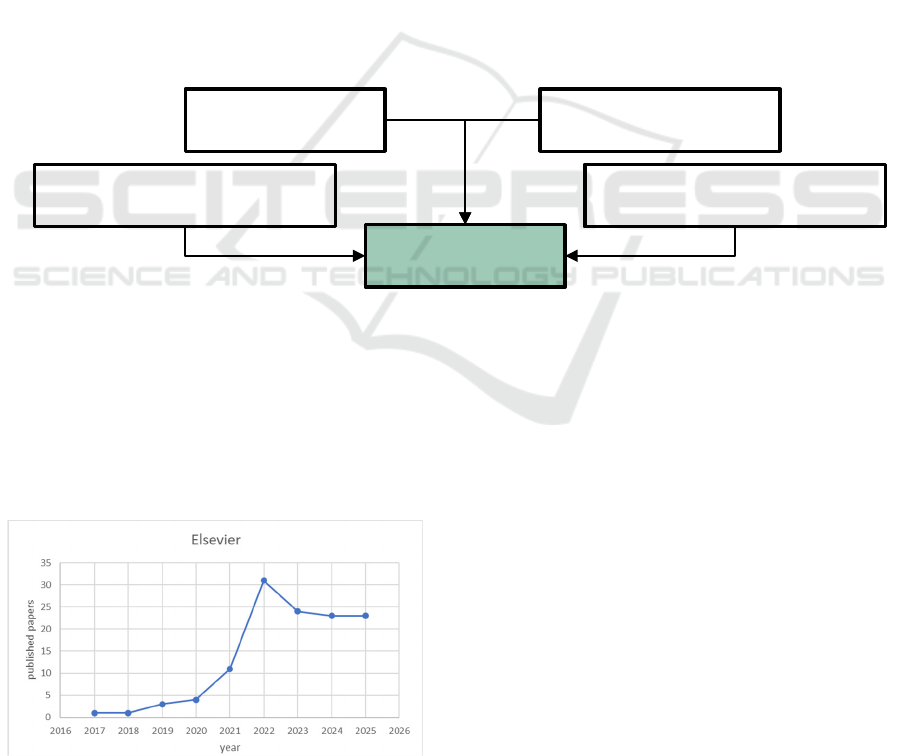
2021). All parts that are integrated into DT can be
visually seen in Figure 1. This dynamic nature
differentiates them from static digital models. DTs
serve as a bridge between the physical and virtual
worlds, allowing for real-time tracking, data analysis,
and simulation of various scenarios (Ferrigno &
Barsola, 2023). They facilitate remote management,
immediate intervention, and data-driven decision-
making across industries. These include
manufacturing, health care, transportation, and smart
agriculture (Kaur et al., 2019; Verdouw et al., 2021).
By integrating technologies such as IoT, artificial
intelligence, and machine learning, DTs can offer a
comprehensive understanding of system behavior,
and can foster improved efficiency, optimization, and
information selection in cyber-physical systems
(Awouda et al., 2024; Fuller et al., 2019).
Figure 1: The four forces that make DT.
Sources for analysis of literature were Elsevier
data basis. For the searching term “Digital twins for
design of industrial symbiosis” appeared 540 raw
articles. Related to energy (used filter) are 81. Other
searching results for (“Digital twins” AND
“industrial symbiosis”) can be found 121 articles
(Fig.2).
Figure 2: Results shown by searching the Elsevier database
for expression — “Digital twins” for design of “industrial
symbiosis”
But, anyway, all those articles are not directly
connected to the use of digital twins (DTs) in IS or
EIP.
2 DIGITAL TWINS
DTs are available in several types. Asset
Administration Shell (AAS) DTs are becoming more
popular in Industry 4.0, within three different types
(J. Zhang et al., 2025). These types of AAS contribute
to the systematic engineering of specific components
in DTs. Moreover, in manufacturing, DTs can be
identified based on the relationship and data flow
between the physical object and its digital equivalent.
These types are evolving with corporate digital
transformation processes, including external data
sources such as social media and artificial intelligence
solutions. The agricultural sector emerging DTs with
levels of complexity. Type classification is based on
DIGITAL TWIN
Type of digitalization
(what functions should be digitalized)
System boundary
(what is needed to be twinned)
Types of entities twinned
(what entities)
Excellence of digitalization
(the level of digitalization)
Industrial Symbiosis Improvement with Digital Twins
39

the sophistication of the twin’s capabilities
(Pylianidis et al., 2021; Verdouw et al., 2021).
Verdóuw et al. (2021) classified different types of
DTs with the proposed conceptual framework for
their design and implementation in smart agriculture.
This framework consists of a control model based on
a general system approach and an implementation
model based on the Internet of Things Architecture
(IoT-A).
DTs can be ranged between simple data-driven
models and designed complex simulations enhanced
by artificial intelligence. The classification of DTs
often depends on their level of sophistication, the
degree of their integration with physical systems, and
the specific industry where they are used.
DTs are emerged as a key technology in Industry
4.0 and 5.0. They are widely used in equipment and
assets in creating virtual representations of physical
machines and devices in smart factories. DTs enable
real-time monitoring, predictive maintenance, and
process optimization (Lampropoulos & Siakas,
2023). IoT devices in smart factories can be
connected to DTs for dynamic representation of a
physical system through its lifecycle (sensor) data
(Catarci et al., 2019). The DTs of systems is modelled
the overall production or overall complex systems.
They provide real-time automated analysis of data
from connected machines, accelerate error detection
and make correction. This type of DTs improves
overall efficiency and reducing costs in industrial
production.
Some research finds the potential of human DTs
in the context of human-robot collaboration and
augmented reality interfaces in Industry 5.0 ((Zafar et
al., 2023)). As Industry 5.0 continues to evolve, DTs
would play an increasingly important role in
achieving smart, sustainable, and human-cantered
manufacturing (Zafar et al., 2023) .
DTs enable real-time visualization, monitoring,
and control of workflows. They simulate process
parameters (Wang et al., 2024). DTs are integrated
with local systems in real-time. This allows the
prediction of the status of production and to perform
effectiveness analysis of human resources (Ruppert &
Abonyi, 2020). They can also be used for predictive
maintenance. Integration of artificial intelligence
enables them to monitor, diagnose, and optimize
different systems (Kerkeni et al., 2025).
DTs are one of the key players in the
transformation of manufacturing towards Industry 4.0
and 5.0. They are used for product design, production
planning, ergonomics, maintenance, and the entire
product lifecycle (Cinar et al., 2020). The integration
of advanced technologies like Vision Transformers
and DTs can make manufacturing sustainable,
stronger, and more personalized (Industry 5.0 goals)
(Fantozzi et al., 2025).
DTs can be integrated within real-time
localization systems (RTLS). That can predict
production status and monitor performances, as well
as analyse the effectiveness of human resources
(Ruppert & Abonyi, 2020). DTs can serve as
independent cloud computing services. That enables
scalability and will control simulations through a
model DT-as-a-Service (DTaaS) (Borodulin et al.,
2017). This showed the importance of cloud
platforms for the concept of DTs in smart factories.
Moreover, the integration can be done with the
IoT and artificial intelligence. That creates precise
digital replicas of production systems. It enables
process optimization, the reduction of downtime, and
the improvement of maintenance strategies (Fantozzi
et al., 2025). The integration of DTs into the industry
requires a combination of hardware and software
components with high performances. That
combination makes a comprehensive virtual
presentation of physical objects and processes.
Many authors gave the basic content of DT in
different ways. Alam and Sadik (2017) reported that
DTs are based on two modules. Those are physical
modules (process and communication systems) and
digital modules (virtual system—computer models
and decision-making). Rodič et al. (2017) divided
systems into digital shadows (physical systems) and
digital masters (computer models that capture the
shadow). Moreover, Lyu (2024) explained
differences between expressions digital model, digital
shadow and DT. Based on him, the digital model is
the presentation of the physical systems without the
automatic exchange of data (system simulation).
Digital shadow has a single connection with the
physical system. It only receives the change of the
state of the physical system. Contrary, DT has
bidirectional communication between digital and
physical systems with changes in both in real-time.
DT can represent part of the physical system
(reactor, separation system, or product), or it can
represent the whole system.
The main hardware for DTs are sensors, IoT
devices, and communication systems to collect real-
time data from physical parts (Costantini et al., 2022;
Khalyasmaa et al., 2023). Sensors collect information
for parameter values like temperature, vibration, and
performance metrics (Okpala Charles Chikwendu et
al., 2025).
The software, which is used creates advanced
computational models. It can contain different
simulation tools and artificial intelligence algorithms
ICEEECS 2025 - International Conference on Advances in Electrical, Electronics, Energy, and Computer Sciences
40
to process and analyse the collected data (Okpala
Charles Chikwendu et al., 2025).
There are several types of software tools for
establishing DTs in the manufacturing industry. Each
of those types of software has a different purpose or
different role in the creation of DTs.
1. Unity3D—This is a tool for real-time 3D
system development. It can be chosen because its
cross-platform capability and simplified modelling of
industrial systems (González-Herbón et al., 2024;
Rassolkin et al., 2020). It is used for physical
simulations and visualization of DTs (Rassolkin et al.,
2020). Similar commercial software are: AspenONE,
CATIA®, SolidWorks®, and AutoCAD® for visual
representation and FlexSim®, Tecnomatrix®,
AnyLogic®, Simio®, Arena®, 3DVIA Composer®,
Matlab, ANSYS, Thermoflow, COMSOL, Modelica,
etc.
2. The Vuforia SDK as a software development
kit is used to simplify augmented reality integration
in DTs (González-Herbón et al., 2024).
3. Node-RED is a system integration option for
DTs (González-Herbón et al., 2024).
4. The MQTT protocol is used for communication
in DT systems (González-Herbón et al., 2024).
5. Object-Z notation is a formal language for
realizing the concept of DTs (Barbie & Hasselbring,
2024).
6. A Unified Modelling Language (UML) is used
to visualize relationships between DT concepts such
as class diagrams (Barbie & Hasselbring, 2024).
Generally speaking, there is no standardized set of
software for implementing DTs. Which software will
be used depends on the specific requirements of the
DT implementation project and the industry in which
it is applied.
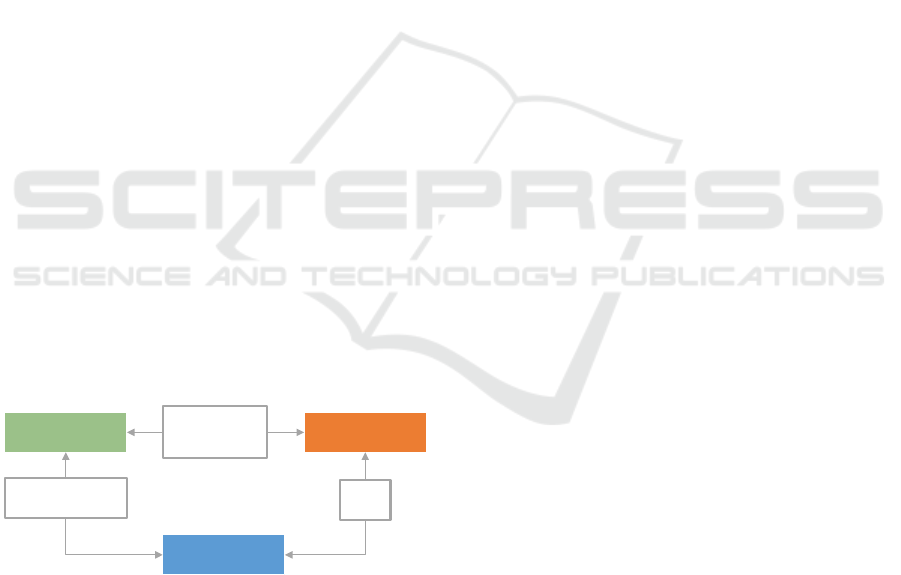
Figure 3: Architecture of DTs.
The connection between physical and virtual
systems is done with a communication interface. Its
role is connection and conversion of data through
sensors, switches, routers, firewalls, hosts, links,
databases, intelligent devices and management
systems (Fig. 3). That is a two-way street.
Communication solutions are IoT, big data, and cloud
technologies (Shin et al., 2018).
DTs can have different levels of autonomy in
response to physical systems, and they can have
different levels of integration of physical systems.
Autonomy is directly connected to responses in real-
time.
3 DIGITAL TWINS AS AN
IMPORTANT TOOL FOR
INDUSTRIAL SYMBIOSIS
The implementation of DT principles in industry or
systems created by IS can be done only on previously
designed models. Lyu (2024) gave differentiation
between models created with various methodologies
as first principle models (models based on numerical
solutions and optimization), statistical models
(machine learning based on historical state and
behaviour data, neural networks), rule-based and
multiagent system based decision-making models,
computer-aided engineering (CAE), deep learning
models, industrial DT applications (for PALM), IoT,
AI-based operational energy-DT (EDT), Data-driven
EDT, power industry EDT, generic EDT, etc.
Software that will be used in any of these types of
models should provide the following: synchronization
rules and template implementation for temporal data,
their synchronization, their aggregation, obtain data
from sensors and other sources in the physical
systems,
data conversion, use of behavioural models
of DT, implementing visual models, creating multi-
images of physical systems (PS), DT data processing
and analysis, results visualization, ensure data
confidentiality, and DT data storage. All these digital
processes with their relations are presented in Fig. 4.
Digital platforms for the implementation of DTs
are IoT, Business process Management platforms,
analytics & data platforms, and application platforms
(Nath, 2021). Moreover, there can be used public
clouds like Microsoft Azure, Amazon Web Services
(AWS), Google Cloud Platform (GCP), Alibaba
Cloud, Oracle Cloud Infrastructure (OCI), IBM
Cloud, and Tencent Cloud.
In manufacturing, the collaboration DT is divided
into the physical world (shop floor and management
floor participants) and the cyber world (DT layers,
industrial technology layers and application layers).
The shop floor participants are factories machines,
workers, monitoring devices, sensors, robotic devices,
etc. The management floor participants are people
who use operational data such
as decision-makers,
management department employees, HR, security,
and all other human supported departments in
administration).
Production process
Sensors,
smart devices,
Databases,
Management system
Physical system data
update
Physical system feedback
Virtual copies
(simulation, other
alg orithms)
Industrial Symbiosis Improvement with Digital Twins
41
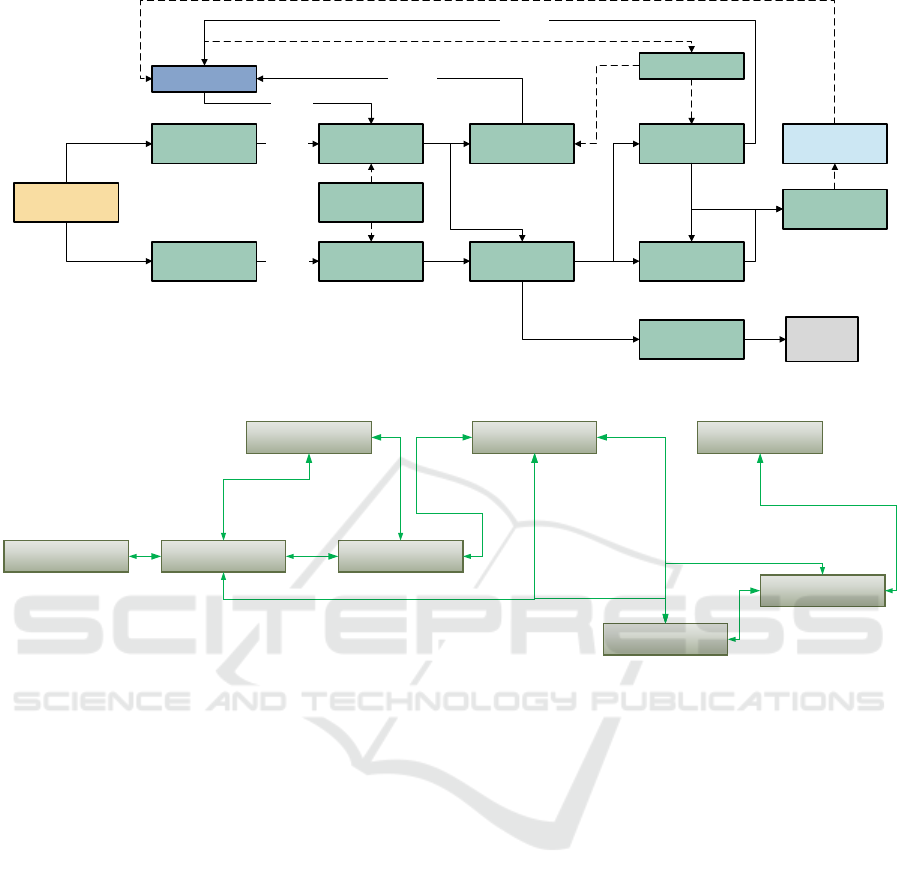
Figure 4: Software system architecture for DTs.
Figure 5. Interaction between different information technologies for creating of DT in industrial symbiosis.
On the other side, in the cyber world, DT layer has
models and solutions for autonomous collaborative
industrial manufacturing. Here could be found real-
time data and predictions of potential risks that are
used by decision-makers and sent to the physical
system. The industrial technologies layer is included
in solutions for collaboration, like blockchain
networks (secure exchange of data), AI-based DT
technologies (predictive data analytics, predict
potential risks, predictive maintenance, etc.), cloud
and edge computing technologies for real-time data
analysis, and visualization tools for clear and quick
understanding of physical systems (Fig. 5). The
application layer is the usage of DT for different
systems, like the energy industry, rail industry,
logistic industry, health care industry, etc.
DTs in manufacturing creates systems at different
levels, like unit level (smallest participant/unit),
system level (system of a few participants or units
connected into a process) and system of systems
(SoS) level (connected to several systems or DT
levels).
The implementation of DT in the industry is in a
low stage. Applications of DT in industry are in
general for optimization and predictions for discrete
manufacturing; manage, predict, optimize, safety and
scheduling of batch processes; predict energy demand
and improve energy distribution; improvement and
prediction of renewable energy generation; conduct
real-time FEM analytics for assessing offshore oil
platforms’ structural integrity using weather and
ocean data; enhance recovery yields in mineral
processing and monitor mine tailings and
environmental waste in real-time and offer expert
recommendations; vehicles supply manufacturers
with usage data for design enhancements. Current
information about implemented projects of DT in the
industry showed partial implementation of specific
processes. DT is implemented in water processing for
future state of the system prediction, an air separation
process for selecting the fastest start up and shut
down, beverage processes for rescheduling based on
various disturbances, steam turbine subsystems for
online performance monitoring, and phosphorus
production for minimal energy consumption. Ma et
Physical object
Behavior data
(sensor 1, 2, 3, …. n)
Muls emedia data
(devices 1, 2, 3, …. m)
Behavior data
synchronization and
aggregation
Mulsemedia data
synchronization and
aggregation
Mathematical mode l
DT data synchronization
and a ggre gation
Behavior dat a analyzi s DT data processing
DT reproduction
Data protection
Actuators
(1, 2, 3, …. n)
VIRTUAL MODEL
- Data
- Ti me st amps
- Data
- Ti me st amps
RESEARCH
- Data
- Ti me st amps
Research results
RESEARCH OBJECTIVES
Research results
- Cloud storage
- Local storage
- Remote users
DATA
(weather, economics, market)
SUPPLY CHAIN
ERP, manufacture, customer,
human capital, management
system
Energy trading system
IoT/intelligent apps
Business apps
CLOUD
(DT apps, IoT platform)
Service managemnet
ENERGY GENERATION
(wind, solar, hydro, other)
ELECTRICITY GRID
ICEEECS 2025 - International Conference on Advances in Electrical, Electronics, Energy, and Computer Sciences
42

al. (2022) reported about DT implementation in the
ceramic industry in China. Implementation in Pharma
can lead by DT connections with cognitive sensors
and simulations. Based on that, DT is directed to
visualization. Visualization is done with smart data
management and integration. It uses data
visualization, data persistence and processing, and
data integration. Integrated data are shown in MES,
SCADA, PLC and IBA (Salis et al., 2023).
Logistics is very important in supply chains for
industrial processes or in systems like IS. DT can be
used in “Logistics 4.0” as part of Industry 4.0. This
helps in tracking the movement of goods.
Moreover, control, energy generation and fault
diagnostics of wind turbines can be supported by DT.
Iyer et al. (Iyer et al., 2024) showed the system of
IS based on the framework of digitalization within
Industry 4.0. They connect existing “industrial
technologies” based on products and information that
are supplied by industry in symbiotic systems. All
these information must be sent to the work centre of
DT (Park et al., 2020). On the other side, the
sustainable smart manufacturing framework suggests
using intelligent design, intelligent production,
intelligent maintenance and service, and intelligent
recovery (Ren et al., 2019).
Determination and creation of DT are done by two
teams: business & operations team, and the IT &
development team (Nath, 2021). The implementation
steps for DT in IS are following:
1. There must have already established IS or
EIP.
2. Specification of all processes that connect
units in IS or EIP. Determination exchange
processes for energy, materials, goods, and
services. The whole system is divided into
subsystems based on the business model that
will be used. (separate system for electricity
generation and distribution, separate heat
generation and distribution, separate
systems for sharing materials, etc.).
3. Determination of bottlenecks and negative
factors. Preparing of high-digital DT
references.
4. Prioritization of integrated parts and data
validation.
5. Creating mathematical models and
simulation.
6. Selecting the best model with simulation
validation.
7. Determination of the connection points for
sensors and all other equipment that is
required. Making a list of equipment for
further projects.
8. Determination of benefits (added value,
economic and quality benefits).
9. The project proposal is analysed for
economic, environmental, production and
social benefits. If there are benefits (higher
incomes), comes the next step. Based on the
type of connection, selection of
communication technology must be done. If
there are no calculated benefits, the whole
process returns back to the basics modelling
and simulation.
10. Determination of complete business process
and operation plan. Decision-making for
investment for the DT project.
11. When all processes and connections are
determined, the digital (virtual) system is
designed.
12. Installation of required equipment (sensors,
flowmeters, ethernet, etc.) and establishing
two-way connection between physical and
digital systems.
13. The first results for the function of created
DT. Testing and improvement.
14. Used Business model will lead to creating
sub-control centres. Those sub-control
centres are control systems of separate
companies that are in charge of the supply or
distribution of utilities, materials or services.
15. All sub-control centres are connected to the
main control centre of IS where the
management of IS can be controlled,
monitored and take action with decision-
making for all units that consist of the IS or
EIP.
In case when IS management is responsible for all
exchange processes in IS, and no other companies are
in charge of specific types of distribution or services,
there is only one control centre.
Establishing DTs in the industry, but also in IS
must be based on key factors for approving that kind
of project. Objective criteria must be set based on the
DT’s target to ensure it adds business value. Business
values and outcomes broadly include improved life of
the asset, process efficiency gains, operational
optimization or lower operating costs, new digital
revenues, competitive advantages, improvement and
customer satisfaction (production units in IS),
improved safety, and social goodness, like the
reduction of the carbon footprint (Nath, 2021).
Moreover, the part of business processes is sending
alerts. Yellow (lower importance) and red (high
importance) alert for the probability of existing
problems in the system. Many monitored parameters
Industrial Symbiosis Improvement with Digital Twins
43

are related to the key performance indicators
determined for the system.
Senna et al. (2020) determined pillars of energy-
DT. The four pillars are factory driver IO, human-
machine interaction, energy data modelling &
standardization, and data-driven services. As
supporting IOT technologies are selected factory
driver IO, big data & cloud computing, industrial
internet of things (IIoT), AI, DT modelling and
simulation, and augmented reality. Major objectives
for establishing are energy savings, environmental
footprint reduction, and life cycle cost reduction.
IS contain production processes as all processes
of exchange and transformation of materials and
energy quality; there are storage, recyclability,
services, etc. Integration of all these additional
segments in DT could be made with specified DTs of
storage/warehouses, DT of shipping, DT of recycle
system, and DT of specific services based on KPIs
related to those services.
4 HOW DT CAN IMPROVE IS
The benefits for the industry gotten by usage of DT
are many. Reduced time to design and to market (DT
utilize digital models to simulate product
performance, potentially reducing or eliminating the
need for field trials. This is because simulations can
identify likely failure scenarios, enabling designers to
make necessary product adjustments before
production.), Reduced waste during manufacturing
(determining optimal manufacturing parameters can
reduce waste and rejects, leading to a greener and
more advanced production process.), Reduced energy
consumption (DT enables first-time right production,
reducing energy consumption per part. It can also
identify products with suboptimal energy
performance for replacement.), Reduced raw
material consumption (operating optimally with
minimal defects reduces raw material consumption,
promoting greener operation.), and Improved
performance monitoring (High-fidelity 3D models
enhance augmented reality, improving product
tracking and problem-solving. IoT technologies also
offer the advantage of remote monitoring.),
Introduction of numerous virtual sensors (digital
models in DTs allow engineers to measure physical
quantities, like temperature and pressure, at locations
unsuitable for physical sensors.), Maintaining
optimal operation (two-way communication between
a DT and its physical twin, like a production machine,
allows for parameter adjustments in the DT to be
applied to the physical counterpart, ensuring optimal
operation.), Reduced cost of maintenance of
machinery and elimination of downtime (By
predicting future states using predictive analytics, a
DT can anticipate maintenance issues, allowing for
preventive maintenance and avoiding costly
shutdowns. Optimizing asset operations also reduces
maintenance costs.), Improved warehousing/shipping
of finished products (A DT mirroring warehousing
and shipping optimizes operations, further reducing
the facility’s carbon footprint.), Improved
collaboration between teams (Digital models linked
by a common digital thread improve factory team
collaboration by providing a “single source of truth”.
This minimizes errors and enhances synergies in
manufacturing optimization.), Improved safety (DT-
controlled augmented reality can train staff in
hazardous trades safely).
5 FUTURE DEVELOPMENTS
NEEDED FOR IS
DTs are not so well presented to the industrial
symbiotic systems. There is not enough knowledge in
management or engineers that are employed in
production plants.
There is a lack of big data for training ML models
in DTs of manufacturing processes. ML models are
crucial in DTs for autonomous decision-making.
They need large, representative data sets, which are
scarce in manufacturing due to its heterogeneous
nature, unlike uniform consumer industries. Each
manufacturing method requires unique data, making
it time-consuming and resource-intensive to build
large data sets. Challenges include finding, accessing,
and transforming data from various sources, along
with issues of poor data quality and translation loss.
Data security in DTs is crucial in a connected IIoT
environment to protect intellectual property,
requiring a focus on privacy, confidentiality,
transparency, and data ownership, particularly in
business collaborations.
The lack of standards, regulations, and
governance in data handling hinders data-centric
technologies like DTs. For effective data sharing,
interoperability standards are vital, especially
between DTs from different organizations. Issues
may also occur when DTs at various levels produce
different data types without correct conversion.
Reluctance to share strategic knowledge: data is
now a key asset, not just a business by-product.
Therefore, companies may keep data confidential to
ICEEECS 2025 - International Conference on Advances in Electrical, Electronics, Energy, and Computer Sciences
44

maintain their competitive edge, hindering
collaboration between organizations’ DTs.
Observability and controllability issues: a DT’s
control system requires processes to be observable
and controllable. Sensors need to capture critical
quantities effectively, while actuators must execute
the DT’s commands. Suitable hardware is essential
for DT success.
Creating physics-informed ML models enhances
accuracy by identifying and removing data outliers,
but their complex multi-physics and multiscale nature
complicate high-fidelity model development.
Lifecycle mismatch: products like aircraft and
cars often last longer than the software used to design,
simulate, or analyze them. Unsupported software can
render the virtual twin obsolete before its physical
version.
Upfront capital outlay: creating reliable DTs
requires significant resources affordable only by large
corporations. Without resource pooling by industry
bodies, DTs may remain inaccessible to smaller
businesses for years.
Conventional engineers must learn new ML and
AI methods and be assured of their effectiveness to
adopt DTs in the factory.
6 CONCLUSIONS
DTs are built on mathematical models and simulation
software that use real-time data from sensors or IoT
devices. The implementation of DT principles in IS
can optimize resource usage, improve collaboration,
and create more sustainable production systems.
However, the lack of system integration with ICT
tools and the complexity of knowledge sharing within
symbiosis networks delay its effective
implementation. To establish DTs in IS, a systematic
approach is required, involving the specification of
exchange processes, determination of bottlenecks,
prioritization of integrated parts, and the creation of
mathematical models and simulations. The benefits of
DTs in IS include reduced time to market, reduced
waste and energy consumption, improved
performance monitoring, and enhanced collaboration
between teams. Future developments needed for IS
include addressing the lack of big data for training
ML models, ensuring data security, establishing
standards and regulations, and overcoming
observability and controllability issues.
REFERENCES
Alam, K. M., & El Saddik, A. (2017). C2PS: A digital twin
architecture reference model for the cloud-based cyber-
physical systems. IEEE Access, 5, 2050–2062.
https://doi.org/10.1109/ACCESS.2017.2657006
Al-Quradaghi, S., Zheng, Q. P., & Elkamel, A. (2020).
Generalized Framework for the Design of Eco-
Industrial Parks: Case Study of End-of-Life Vehicles.
Sustainability, 12(16).
https://doi.org/10.3390/SU12166612
Awouda, A., Traini, E., Bruno, G., & Chiabert, P. (2024).
IoT-Based Framework for Digital Twins in the Industry
5.0 Era. Sensors, 24(2).
https://doi.org/10.3390/S24020594
Barbie, A., & Hasselbring, W. (2024). From Digital Twins
to Digital Twin Prototypes: Concepts, Formalization,
and Applications. IEEE Access, 12, 75337–75365.
https://doi.org/10.1109/ACCESS.2024.3406510
Borodulin, K., Sokolinsky, L., Radchenko, G., Tchernykh,
A., Shestakov, A., & Prodan, R. (2017). Towards digital
twins cloud platform: Microservices and computational
workflows to rule a smart factory. UCC 2017 -
Proceedings of The10th International Conference on
Utility and Cloud Computing, 205–206.
https://doi.org/10.1145/3147213.3149234
Catarci, T., Sapio, F., Firmani, D., Mandreoli, F., Leotta, F.,
& Mecella, M. (2019). A Conceptual Architecture and
Model for Smart Manufacturing Relying on Service-
Based Digital Twins.
https://doi.org/10.1109/icws.2019.00047
Cinar, Z. M., Korhan, O., Nuhu, A. A., & Zeeshan, Q.
(2020). Digital Twins for Industry 4.0: A Review.
https://doi.org/10.1007/978-3-030-42416-9_18
Costantini, A., Antonacci, M., Nehls, D., Bellavista, P.,
Delamarre, C., Galletti, M., Martelli, B., Ahouangonou,
J. C., Di Modica, G., Cesini, D., & Duma, D. C. (2022).
IoTwins: Toward Implementation of Distributed
Digital Twins in Industry 4.0 Settings. Computers, 11.
https://doi.org/10.3390/computers11050067
Fantozzi, I. C., Loy, G., Santolamazza, A., & Schiraldi, M.
M. (2025). Digital Twins: Strategic Guide to Utilize
Digital Twins to Improve Operational Efficiency in
Industry 4.0. Future Internet, 17.
https://doi.org/10.3390/fi17010041
Feiferytė-Skirienė, A., & Stasiškienė, Ž. (2021). Seeking
Circularity: Circular Urban Metabolism in the Context
of Industrial Symbiosis. Sustainability, 13(16).
https://doi.org/10.3390/SU13169094
Ferrigno, E., & Barsola, G. A. (2023). 3D Real Time Digital
Twin. SPE Latin American and Caribbean Petroleum
Engineering Conference Proceedings, 2023-June.
https://doi.org/10.2118/213115-MS
Fuller, A., Fan, Z., Day, C., & Barlow, C. (2019). Digital
Twin: Enabling Technologies, Challenges and Open
Research. IEEE Access
, 8, 108952–108971.
https://doi.org/10.1109/ACCESS.2020.2998358
Gómez-Berbís, J. M., & Amescua-Seco, A. de. (2019).
SEDIT: Semantic Digital Twin Based on Industrial IoT
Data Management and Knowledge Graphs.
Industrial Symbiosis Improvement with Digital Twins
45

Communications in Computer and Information
Science, 1124 CCIS, 178–188.
https://doi.org/10.1007/978-3-030-34989-9_14
González-Herbón, R., González-Mateos, G., Rodríguez-
Ossorio, J. R., Domínguez, M., Alonso, S., & Fuertes,
J. J. (2024). An Approach to Develop Digital Twins in
Industry. Sensors 2024, Vol. 24, Page 998, 24(3), 998.
https://doi.org/10.3390/S24030998
Grant, G. B., Seager, T. P., Massard, G., & Nies, L. (2010).
Information and Communication Technology for
Industrial Symbiosis. Journal of Industrial Ecology,
14(5), 740–753. https://doi.org/10.1111/J.1530-
9290.2010.00273.X
Grant, Seager et al 2010 - Information and Communication
Technology. (n.d.).
Iyer, S. V, Sangwan, K. S., & Dhiraj. (2024). Development
of an Industrial Symbiosis Framework through
Digitalization in the Context of Industry 4.0. Procedia
CIRP, 122, 515–520.
https://doi.org/https://doi.org/10.1016/j.procir.2024.01.
075
Kang, J. S., Chung, K., & Hong, E. J. (2021). Multimedia
knowledge‐based bridge health monitoring using
digital twin. Multimedia Tools and Applications,
80(26–27), 34609–34624.
https://doi.org/10.1007/S11042-021-10649-X
Kaur, M. J., Mishra, V. P., & Maheshwari, P. (2019). The
Convergence of Digital Twin, IoT, and Machine
Learning: Transforming Data into Action. Internet of
Things, 3–17. https://doi.org/10.1007/978-3-030-
18732-3_1
Kerkeni, R., Mhalla, A., & Bouzrara, K. (2025).
Unsupervised Learning and Digital Twin Applied to
Predictive Maintenance for Industry 4.0. Journal of
Electrical and Computer Engineering, 2025(1),
3295799. https://doi.org/10.1155/JECE/3295799
Khalyasmaa, A. I., Eroshenko, S. A., Stepanova, A. I., &
Matrenin, P. V. (2023). Review of the Digital Twin
Technology Applications for Electrical Equipment
Lifecycle Management. Mathematics, 11.
https://doi.org/10.3390/math11061315
Kosmol, L. (2019). Sharing is Caring - Information and
Knowledge in Industrial Symbiosis: A Systematic
Review. Proceedings - 21st IEEE Conference on
Business Informatics, CBI 2019, 01, 21–30.
https://doi.org/10.1109/CBI.2019.00010
Lampropoulos, G., & Siakas, K. (2023). Enhancing and
securing cyber-physical systems and Industry 4.0
through digital twins: A critical review. Journal of
Software: Evolution and Process, 35(7), e2494.
https://doi.org/10.1002/SMR.2494
Lyu, Z. (2024). Handbook of Digital Twins. Handbook of
Digital Twins, 1–902.
https://doi.org/10.1201/9781003425724/HANDBOOK
-DIGITAL-TWINS-ZHIHAN-LYU/RIGHTS-AND-
PERMISSIONS
Ma, S., Ding, W., Liu, Y., Ren, S., & Yang, H. (2022).
Digital twin and big data-driven sustainable smart
manufacturing based on information management
systems for energy-intensive industries. Applied
Energy, 326, 119986.
https://doi.org/10.1016/J.APENERGY.2022.119986
Nath, S. van S. P. I. D. (2021). Building Industrial Digital
Twins. Packt Publishing; Safari.
Okpala Charles Chikwendu, -, Nwankwo Constance
Obiuto, -, & Udu Chukwudi Emeka, -. (2025). Digital
twin applications for predicting and controlling
vibrations in manufacturing systems. World Journal of
Advanced Research and Reviews, 25.
https://doi.org/10.30574/wjarr.2025.25.1.3821
Park, K. T., Lee, D., & Noh, S. Do. (2020). Operation
Procedures of a Work-Center-Level Digital Twin for
Sustainable and Smart Manufacturing. International
Journal of Precision Engineering and Manufacturing -
Green Technology, 7(3), 791–814.
https://doi.org/10.1007/S40684-020-00227-
1/METRICS
Pylianidis, C., Osinga, S., & Athanasiadis, I. N. (2021).
Introducing digital twins to agriculture. Computers and
Electronics in Agriculture, 184.
https://doi.org/10.1016/j.compag.2020.105942
Rassolkin, A., Rjabtsikov, V., Vaimann, T., Kallaste, A.,
Kuts, V., & Partyshev, A. (2020). Digital Twin of an
Electrical Motor Based on Empirical Performance
Model. 2020 11th International Conference on
Electrical Power Drive Systems, ICEPDS 2020 -
Proceedings.
https://doi.org/10.1109/ICEPDS47235.2020.9249366
Ren, S., Zhang, Y., Liu, Y., Sakao, T., Huisingh, D., &
Almeida, C. M. V. B. (2019). A comprehensive review
of big data analytics throughout product lifecycle to
support sustainable smart manufacturing: A
framework, challenges and future research directions.
Journal of Cleaner Production, 210, 1343–1365.
https://doi.org/10.1016/J.JCLEPRO.2018.11.025
Rodič, B. (2017). Industry 4.0 and the New Simulation
Modelling Paradigm. Organizacija, 50(3), 193–207.
https://doi.org/10.1515/ORGA-2017-0017
Ruppert, T., & Abonyi, J. (2020). Integration of real-time
locating systems into digital twins. Journal of
Industrial Information Integration, 20.
https://doi.org/10.1016/j.jii.2020.100174
Salis, A., Marguglio, A., De Luca, G., Razzetti, S.,
Quadrini, W., & Gusmeroli, S. (2023). An Edge-Cloud
based Reference Architecture to support cognitive
solutions in Process Industry. Procedia Computer
Science, 217, 20–30.
https://doi.org/10.1016/J.PROCS.2022.12.198
Scafà, M., Marconi, M., & Germani, M. (2020). A critical
review of symbiosis approaches in the context of
Industry 4.0☆. Journal of Computational Design and
Engineering, 7(3), 269–278.
https://doi.org/10.1093/JCDE/QWAA022
Senna, P. P., Almeida, A. H., Barros, A. C., Bessa, R. J., &
Azevedo, A. L. (2020). Architecture Model for a
Holistic and Interoperable Digital Energy Management
Platform. Procedia Manufacturing, 51, 1117–1124.
https://doi.org/https://doi.org/10.1016/j.promfg.2020.1
0.157
ICEEECS 2025 - International Conference on Advances in Electrical, Electronics, Energy, and Computer Sciences
46

Shin, H. J., Cho, K. W., & Oh, C. H. (2018). SVM-Based
Dynamic Reconfiguration CPS for Manufacturing
System in Industry 4.0. Wireless Communications and
Mobile Computing, 2018(1), 5795037.
https://doi.org/10.1155/2018/5795037
Verdouw, C., Tekinerdogan, B., Beulens, A., & Wolfert, S.
(2021). Digital twins in smart farming. Agricultural
Systems, 189.
https://doi.org/10.1016/J.AGSY.2020.103046
Wang, B., Zhou, H., Li, X., Yang, G., Zheng, P., Song, C.,
Yuan, Y., Wuest, T., Yang, H., & Wang, L. (2024).
Human Digital Twin in the context of Industry 5.0.
Robotics and Computer-Integrated Manufacturing, 85,
102626. https://doi.org/10.1016/J.RCIM.2023.102626
Zafar, M. H., Sanfilippo, F., & Blazauskas, T. (2023).
Harmony Unleashed: Exploring the Ethical and
Philosophical Aspects of Machine Learning in Human-
Robot Collaboration for Industry 5.0. 2023 IEEE
Symposium Series on Computational Intelligence, SSCI
2023, 1775–1780.
https://doi.org/10.1109/SSCI52147.2023.10371798
Zhang, J., Ellwein, C., Wortmann, A., Michael, J., &
Heithoff, M. (2025). Digital twin and the asset
administration shell. Software and Systems Modeling.
https://doi.org/10.1007/s10270-024-01255-0
Zhang, X., Lin, D. K. J., & Wang, L. (2023). Digital Triplet:
A Sequential Methodology for Digital Twin Learning.
Mathematics, 11(12).
https://doi.org/10.3390/MATH11122661
Industrial Symbiosis Improvement with Digital Twins
47
