Solar Energy Advancements and Deployment Strategies in Kwara
State, Nigeria: A Comprehensive Review
Adeleye Adeolu Otepola
1
, Samuel Nii Tackie
1,2
, William Olurotimi Falana
2
and Kamil Dimililer
1,2
1
Department of Electrical and Electronic Engineering, Near East University, Nicosia, Northern Cyprus, Cyprus
2
Centre for Science, Technology and Engineering (BILTEM) Researchers, Near East University,
Nicosia, Northern Cyprus, Cyprus
Keywords: Solar Energy, Kwara State, Nigeria, Solar Home Systems, Renewable Energy, Energy Policy, Off-Grid
Electrification.
Abstract: Solar energy has emerged as a pivotal solution to Nigeria’s chronic electricity supply challenges, particularly
in underserved regions like Kwara State. This review examines the current state, technological advancements,
policy frameworks, and socio-economic factors influencing solar energy deployment in Kwara State. Drawing
on recent empirical and review-based literature, the paper highlights adoption barriers, including limited
financing, regulatory gaps, and socio-cultural factors. Findings indicate an increasing interest in Solar Home
Systems (SHS), particularly in off-grid communities, but underscore the need for policy alignment, technical
capacity, and community engagement to scale up deployment. The paper concludes with actionable
recommendations aimed at researchers, investors, and policymakers.
1 INTRODUCTION
Energy is the backbone of economic development,
industrial growth, and social welfare in any nation. In
developing countries like Nigeria, the scarcity and
unreliability of electricity hinder progress in health,
education, agriculture, and manufacturing sectors.
Despite being endowed with vast renewable
resources, including solar, wind, biomass, and
hydropower, Nigeria continues to experience chronic
energy deficits. Approximately 45–50% of Nigerians
still lack access to reliable electricity, with rural areas
being disproportionately affected (Bamisile et al,
2017).
Solar energy, a clean, sustainable, and
increasingly cost-effective source of power, presents
a promising opportunity to bridge Nigeria's energy
access gap. The country receives annual solar
radiation ranging from 3.5 to 7.0 kWh/m²/day, with
an average of about 6 hours of sunlight daily across
most regions (
Agbo
et al, 2021). This positions
Nigeria—and by extension, Kwara State—as a
potential hub for solar energy deployment.
Kwara State, situated in the North Central
geopolitical zone of Nigeria, is a semi-urban region
characterized by substantial agricultural activity and
moderate industrialization. While the state benefits
from moderate solar irradiance and a relatively stable
geographical landscape, many of its communities
remain off-grid. Electrification rates vary widely
between Ilorin (urban capital) and remote LGAs such
as Baruten or Kaiama (Kehinde et al, 2022).
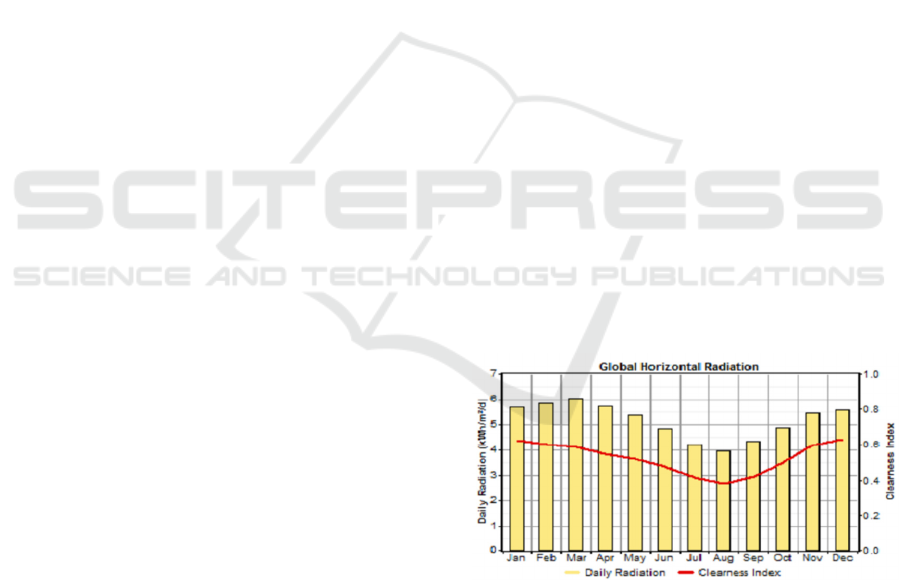
Figure 1. Solar radiation profile for Ilorin (Ajao et al, 2011).
Kwara has attracted interest from development
partners and NGOs for solar-based rural
electrification programs, but large-scale,
government-driven solar initiatives remain limited.
As such, Kwara represents both a microcosm of
Nigeria’s energy dilemma and a promising pilot
region for scalable solar energy solutions.
Otepola, A. A., Tackie, S. N., Falana, W. O. and Dimililer, K.
Solar Energy Advancements and Deployment Strategies in Kwara State, Nigeria: A Comprehensive Review.
DOI: 10.5220/0014288700004848
Paper published under CC license (CC BY-NC-ND 4.0)
In Proceedings of the 2nd International Conference on Advances in Electrical, Electronics, Energy, and Computer Sciences (ICEEECS 2025), pages 211-218
ISBN: 978-989-758-783-2
Proceedings Copyright © 2026 by SCITEPRESS – Science and Technology Publications, Lda.
211
1.1 National and Global Renewable
Energy Context
Globally, there has been a seismic shift toward
renewables. The 2015 Paris Agreement and United
Nations Sustainable Development Goals (SDG 7)
have pushed countries to commit to universal access
to affordable, reliable, sustainable, and modern
energy by 2030. Solar photovoltaics (PV), with
rapidly declining installation costs, have emerged as
a leading technology in this transition.
Nigeria’s energy policy, as outlined in the Renewable
Energy Master Plan (REMP) and Electricity Vision
30:30:30, sets a goal to produce 30% of electricity
from renewable sources by 2030. Solar is expected to
contribute at least 15.27% of this target (Bamisile et
al, 2017). Despite policy intentions, implementation
challenges have hindered meaningful progress,
especially at the state level.
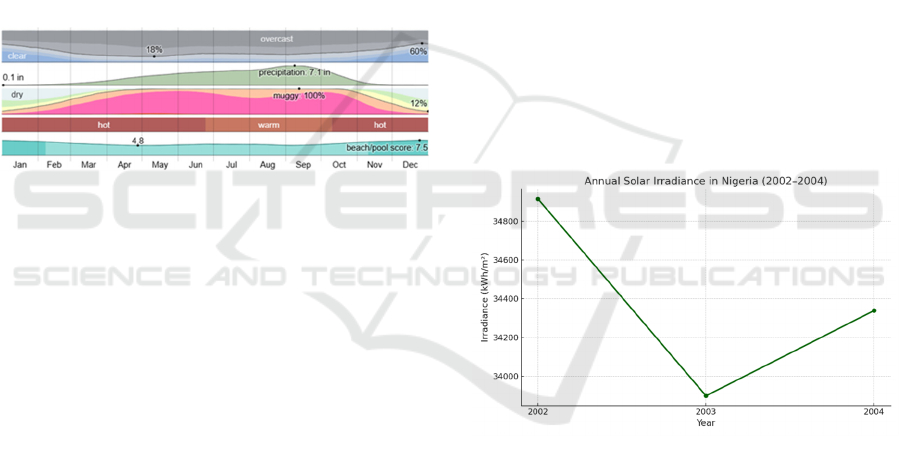
Figure 2. Monthly Solar Radiation in Ilorin, Kwara State
(weatherspark.com).
1.2 Problem Statement
While Nigeria’s solar potential is high, adoption
remains limited due to a combination of technical,
financial, socio-cultural, and regulatory barriers. In
Kwara State, these issues manifest through high costs
of solar systems, inadequate awareness among
residents, and insufficient government-led initiatives.
There is also limited data on how local
socioeconomic factors such as education, income,
and proximity to the national grid influence solar
energy adoption (Ibrahim & Usman, 2019).
1.3 Research Aim and Objectives
The aim of this review is to analyse the current status,
opportunities, and barriers to solar energy adoption in
Kwara State. The paper seeks to:
• Examine the solar potential and
technological advancements relevant to
Kwara.
• Review the policy and institutional
frameworks governing solar deployment.
• Analyse the socioeconomic determinants of
Solar Home Systems (SHS) adoption.
• Identify barriers and enablers to sustainable
solar energy scale-up.
• Offer evidence-based recommendations for
policymakers, researchers, and investors.
1.4 Significance of the Study
This review contributes to both academic literature
and policy discourse on decentralized renewable
energy in Nigeria. By focusing on Kwara State—a
region often underrepresented in energy studies—it
provides localized insights with broader national
implications. The findings could support:
• Targeted policy formulation and state-level
energy planning.
• Informed investment in solar microgrids or
SHS programs.
• Development of educational and technical
capacity-building initiatives.
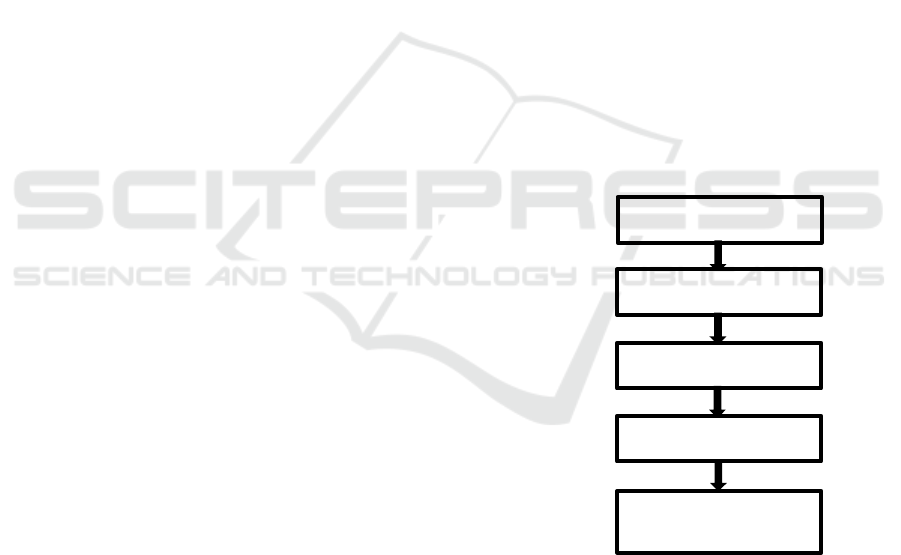
In Figure 3, a line plot shows relatively stable and
high irradiance levels over three years, indicating
consistent solar availability for PV systems. This
confirms that Nigeria, including Kwara State,
receives sufficient solar energy to support robust
deployment of solar technologies.
Figure 3. Annual Solar Irradiance in Nigeria (2002–2004)
(Adapted from ERA5-Land Base Dataset (Idris et al, 2023).
1.5 Renewable Energy Goals and Solar
Potential in Nigeria
Nigeria has one of the highest solar energy potentials
in Sub-Saharan Africa due to its geographic location
and climate. According to (Bamisile et al, 2017), the
nation planned to generate 15.27% of its electricity
from solar sources by 2030, a dramatic increase from
just 1.26% in 2015 (Bamisile et al, 2017). Despite the
robust availability of solar radiation (3.5–7.0
kWh/m²/day), the actual contribution of solar energy
to Nigeria's energy mix remains limited due to
infrastructural, policy, and financial barriers.
ICEEECS 2025 - International Conference on Advances in Electrical, Electronics, Energy, and Computer Sciences
212
1.6 Status and Efficiency of Solar
Energy Technologies
Technological advances in photovoltaic (PV)
systems, including improved efficiency and
durability, have made solar energy more accessible
(
Ojo et al, 2023). Note that innovations tailored to local
climates, including off-grid and hybrid systems, are
especially vital in Nigeria. The study stresses how
crucial it is to develop solar solutions that suit each
region’s unique needs, with real-world examples
taken from both Nigerian villages and colder regions
like Canada (
Ojo et al, 2023). Also, (Idris et al, 2023)
looked at solar radiation data from 2002 to 2004,
finding consistent readings above 33,000kWh/ m² per
year across various areas. Their exploration of
offshore solar power presents a novel opportunity for
Nigeria’s energy sector
(Idris et al, 2023).
1.7 Socio-Economic Drivers and
Constraints
In Nigeria, the uptake of solar technology is heavily
influenced by socioeconomic conditions. A study
involving 400 households in Kwara State used Tobit
and Interval regression models to uncover key trends
(
Adamu & Oladipo, 2023).
It revealed that people with higher incomes and
education levels were more likely to adopt Solar
Home Systems (SHS). At the same time, those who
were satisfied with their current energy supply were
less motivated to switch (Adamu & Oladipo,
2023).
Interestingly, rural communities far from the national
grid were more drawn to SHS, valuing its dependable
and self-sufficient nature over reliable grid power.
1.8 Policy and Regulatory Landscape
National initiatives, such as Nigeria’s Renewable
Energy Master Plan, provide a policy foundation;
however, inconsistent regulations at the state level
present significant barriers to the effective rollout of
solar energy. As
Agbo et al. (2021) highlight, despite
growing recognition of solar energy as a practical
option, progress is stalled by reliance on fossil fuels,
a shortage of government incentives, and inadequate
technical systems to support large-scale adoption
(Agbo et al., 2021).
Moreover, the absence of cohesive monitoring
systems and unclear licensing protocols discourages
private investments in the solar sector, particularly in
less urbanized states like Kwara.
1.9 Environmental and Economic
Implications
All reviewed studies underscore the dual role of solar
energy in environmental protection and economic
empowerment. By reducing carbon emissions, solar
energy addresses climate challenges. Economically,
the promotion of solar technologies fosters job
creation in installation, maintenance, and
manufacturing sectors. Long-term cost savings from
solar use also benefit both households and
enterprises.
2 METHODOLOGY
This review adopted a narrative synthesis
methodology, integrating both qualitative and
quantitative data to assess the state of solar energy
adoption in Kwara State, Nigeria. The study
methodology is divided into five interrelated phases:
defining research objectives, executing a systematic
literature search, screening and selecting relevant
studies, extracting key data, and synthesizing findings
for analysis. A block diagram below is designed to
illustrate the phases.
Figure 4. Block Diagram of Methodology Phases
Figure 5 offers a clear visual breakdown of the
components (panel, controller, battery, inverter,
load), enhancing the reader's understanding of the
SHS architecture in the methodology and results
discussion
Define Objectives
Literature Search
Screen and Select Studies
Collect and Extract Data
Analyze and synthesize findings
Solar Energy Advancements and Deployment Strategies in Kwara State, Nigeria: A Comprehensive Review
213
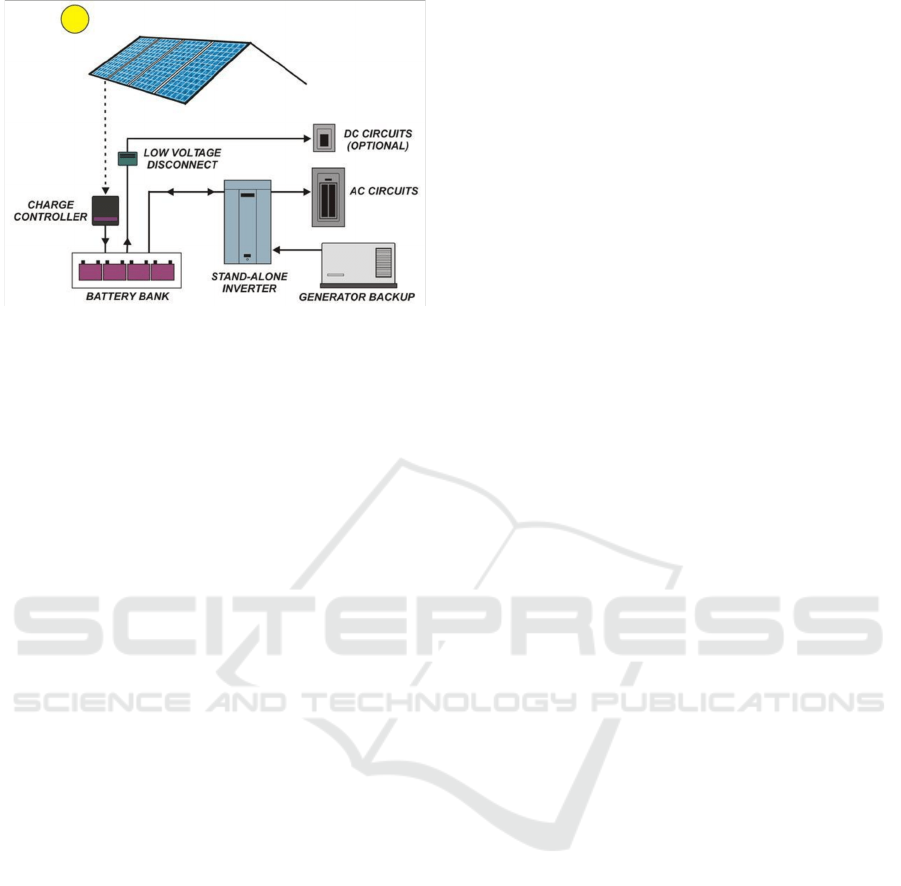
Figure 5: Off-Grid PV System Schematic
2.1 Defining Objectives
The first step in this review is to clearly establish the
research objectives. The central aim of the study is to
explore the status, advancements, and challenges of
solar energy adoption in Kwara State. Specifically,
the review investigates the region’s solar potential,
the technological and socioeconomic factors
influencing adoption, existing policy frameworks,
and the practical barriers to solar energy deployment.
The objectives also encompass a review of
interventions that can potentially scale up renewable
energy penetration in rural and urban Kwara, making
the study both academically relevant and policy
informative.
2.2 Literature Search Strategy
A structured literature search was conducted to
identify relevant peer-reviewed studies, reports, and
datasets. Key databases, including Scopus,
ScienceDirect, IEEE Xplore, and Google Scholar,
were used, as well as the SciSpace AI database for
enhanced coverage. Boolean logic and keyword
combinations such as “solar energy AND Kwara
State”, “photovoltaic AND Nigeria”, “solar barriers
AND adoption”, and “renewable energy AND policy
Nigeria” were employed to filter search results.
The time frame for inclusion spanned from 2015 to
2024, ensuring the inclusion of the most recent and
contextually relevant studies. Only English-language
publications were considered. Emphasis was placed
on empirical studies and review articles that analyzed
solar technology deployment, policy frameworks, or
behavioral adoption factors within Nigeria, with
particular interest in regional contexts applicable to
Kwara State.
2.3 Screening and Selection of Studies
An initial pool of 42 sources was identified. These
were screened based on relevance to solar energy in
Nigeria, especially at the state or community level.
Inclusion criteria required that studies provide either
data on solar irradiance, Solar Home System (SHS)
adoption, or an assessment of policy and
socioeconomic factors influencing solar uptake.
Studies focusing purely on other renewable energy
types (e.g., wind or hydro) or those lacking
methodological transparency were excluded.
Following this process, five peer-reviewed articles
were selected for detailed analysis, each offering a
unique insight into the technical, behavioral, or
institutional dimensions of solar energy adoption in
Nigeria, and in some cases, specifically in Kwara.
2.4 Data Collection and Extraction
The selected studies were examined for both
quantitative and qualitative data. Quantitative data
included metrics such as solar irradiance levels (in
kWh/m²), SHS adoption rates among households, and
demographic predictors of energy behavior (e.g.,
income or education). One of the key parameters
extracted was the annual average solar irradiance for
Kwara State, which consistently exceeds 33,000
kWh/m², reinforcing the state’s viability for solar PV
installations. To understand energy output from a
typical solar panel, the following formula was
employed:
R
EArHP=∗∗ ∗
(1)
Where:
E is the energy output (kWh/day)
A is the area of the solar panel (m²)
r is the panel efficiency (e.g., 0.18 for 18%)
H is the average solar radiation (kWh/m²/day)
P
R
is the performance ratio, accounting for losses
(~0.75)
For example, a 10 m² panel with 18% efficiency in
Kwara, which receives 5.5 kWh/m²/day of sunlight,
would generate:
10*0.18*5.5*0.75 7.425 /EkWhday==
(2)
This calculation demonstrates that small-scale
solar panels are capable of meeting basic household
electricity needs in the region.
Qualitative data focused on institutional barriers,
local perceptions, and the impact of education and
policy initiatives on solar adoption. This dual-
ICEEECS 2025 - International Conference on Advances in Electrical, Electronics, Energy, and Computer Sciences
214
pronged data collection ensured a holistic
understanding of the landscape.
2.5 Data Synthesis and Analysis
The final step involved synthesizing the data to
identify patterns, contradictions, and evidence-
backed insights. The findings were grouped into three
primary dimensions: technical feasibility (solar
potential, PV calculations), socioeconomic influences
(education, income, grid distance), and policy or
institutional barriers (regulations, subsidies,
governance). Cross-study comparisons enabled the
extraction of recurring themes, such as the role of
donor programs in SHS diffusion and the persistent
gap in public awareness. This systematic approach
enabled the generation of evidence-based
recommendations and contextual insights into how
solar energy can be more effectively deployed in
Kwara State.
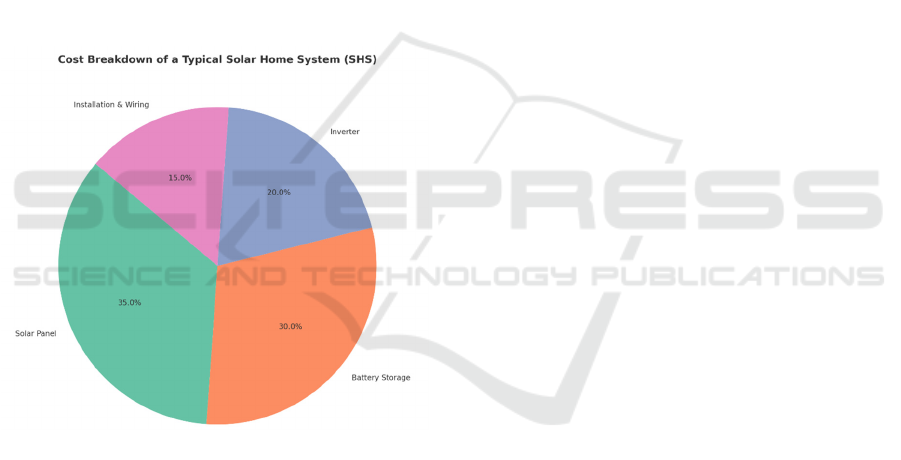
Figure 6. Cost Breakdown of a Typical Solar Home System
(SHS).
This pie chart of Figure 6 illustrates the distribution
of costs in a standard Solar Home System (SHS),
highlighting that solar panels and battery storage
account for the majority of expenses, contributing
significantly to high upfront costs—one of the
primary adoption barriers in rural Nigeria (
Adamu &
Oladipo, 2023)
.
3 RESULTS AND DISCUSSION
The findings highlight three major themes: the current
adoption status of solar technologies, the
determinants of adoption behavior, and the prevailing
challenges inhibiting scale-up.
3.1 Adoption Trends of Solar
Technologies in Kwara State
Solar Home Systems (SHS) remain the most common
form of solar technology adopted in Kwara,
especially in rural and peri-urban communities. The
uptake is largely driven by necessity, particularly in
off-grid regions where the national electricity grid is
absent or unreliable. According to Adamu and
Oladipo (2023), approximately 72% of off-grid
households surveyed expressed willingness to adopt
SHS, citing reliability and independence from the
grid as key motivators (
Ojo et al, 2023)
.
While donor-funded and NGO-supported projects
(e.g., solar micro-grids) have had some success, they
often lack sustainability mechanisms. Maintenance
lapses and inadequate technical support frequently
lead to project failures once donor funding ceases.
3.2 Socioeconomic Determinants of
SHS Adoption
Data from a study of 400 households in Kwara State
provides insight into the key adoption drivers:
• Income Level: Households with higher
disposable income are significantly more
likely to adopt SHS. The cost of full-system
installation is a major barrier for low-income
earners (
Ojo et al, 2023)
.
• Educational Attainment: Literacy and
awareness about energy options are strongly
correlated with adoption. Educated
households understand the long-term cost-
benefit advantage of solar over diesel
generators (
Ojo et al, 2023)
.
• Proximity to Grid: Households located
farther from the grid exhibit greater interest
and willingness to pay for solar technologies
due to a lack of alternatives.
• Satisfaction with Existing Supply:
Interestingly, those who reported being
"satisfied" with their current energy sources
(e.g., fuel generators or partial grid access)
were less likely to consider solar transitions
(
Ojo et al, 2023)
.
These findings suggest the need for targeted
incentive programs, particularly those designed for
rural and lower-income groups. Figure 7, shown
below, describes a bar chart comparing the influence
scores of factors such as income, education, and grid
distance. It emphasizes that socio-economic
Solar Energy Advancements and Deployment Strategies in Kwara State, Nigeria: A Comprehensive Review
215
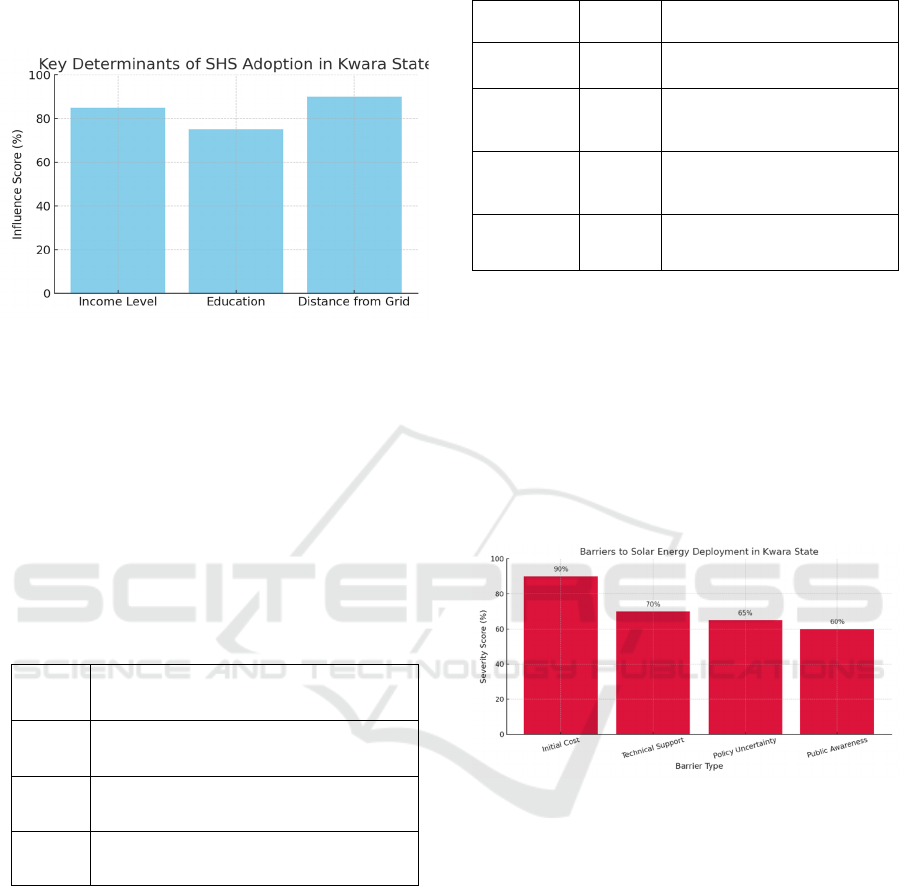
characteristics significantly shape willingness to
invest in SHS. Tailored interventions are needed for
different community profiles.
Figure 7: Key Determinants of SHS Adoption in Kwara
State.
3.3 Evaluation of Solar Resource
Availability
As seen in Table 1, solar irradiance in Nigeria has
remained consistently high, with annual averages
exceeding 33,000 kWh/m². Kwara, situated in the
central belt, receives reliable sunlight year-round,
positioning it as a strategic location for PV
deployment (
Adamu & Oladipo 2023)
.
Table 1. Annual solar irradiance in Nigeria (2002–2004).
Year Irradiance (kWh/m²)
2002 34,914.73
2003 33,898.32
2004 34,338.32
Source: Adapted from Idris et al., 2023 (Adamu & Oladipo, 2023).
3.4 Barriers to Solar Energy
Deployment
Despite the promising solar profile and growing
interest, several obstacles persist. The top barriers
identified from literature and local field studies are
summarized in Table 2.
Table 2: Key barriers to solar energy in Kwara State.
Barrier
Severity
(%)
Description
High Initial
Cost
90%
Upfront cost deters low-
income households
Technical
Expertise
70%
Shortage of trained
technicians for installation &
repai
r
Policy
Uncertainty
65%
Regulatory ambiguity
discourages private
investment
Low
Awareness
60%
Misconceptions and a lack of
information limit adoption
Source: Synthesized from (Agbo et al, 2021), (Ojo et al 2023)., and (Idris et
al, 2023).
These findings emphasize the importance of financial
subsidies, capacity-building programs, and clear
policy frameworks to foster solar market expansion.
Figure 8 describes a severity ranking chart that
shows high installation cost and technical limitations
are the most pressing challenges. It suggests a clear
roadmap for intervention—subsidies, local technician
training, and awareness campaigns can directly
reduce these high-impact barriers.
Figure 8. Barriers to Solar Energy Deployment in Kwara
State.
3.5 Comparative Insight: Kwara vs.
Other Nigerian States
Compared to states in Northern Nigeria (e.g., Kano or
Katsina), Kwara has slightly lower irradiance but
shows higher behavioral receptiveness to SHS due to
stronger education indicators and NGO presence.
However, states like Lagos benefit from more
supportive policies and infrastructure, highlighting
the impact of regional governance and institutional
support. The chart below (Figure 9) compares the
perceived severity of key barriers to solar energy
adoption in Kwara, Lagos, and Kano States. Kwara
shows consistently high ratings across all factors,
especially in cost and technical support, emphasizing
ICEEECS 2025 - International Conference on Advances in Electrical, Electronics, Energy, and Computer Sciences
216
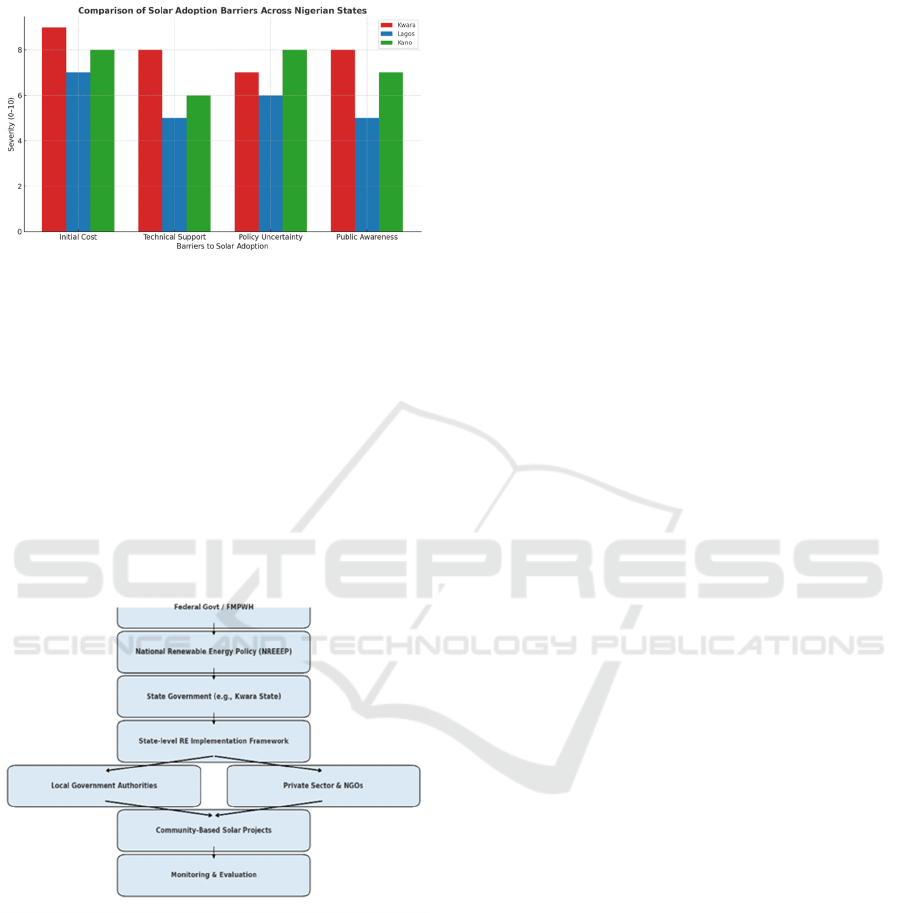
the need for localized interventions (ECN & REEEP
2022), (
REEEP
and
NESP
2022).
Figure 9: Comparison of Solar Adoption Barriers Across
Nigerian States.
3.6 Interpretation and Implications
The interplay between technical feasibility,
socioeconomic realities, and policy infrastructure
defines the success of solar energy programs. In
Kwara State, the latent potential remains high, but
systematic issues must be addressed. The state can
emerge as a model for decentralized solar adoption if
localized strategies are aligned with national goals,
especially in rural electrification, job creation, and
climate action.
Figure 10. Flowchart of Solar Energy Policy and
Implementation Framework in Nigeria.
4 CONCLUSIONS
This review demonstrates that solar energy holds
immense potential for addressing Kwara State’s
persistent electricity access gaps, particularly in rural
and peri-urban communities. The steady availability
of over 33,000 kWh/m² of solar energy each year,
combined with falling prices of solar panels, confirms
that solar power is technically ready for large-scale
use.
Even with solar energy’s potential, its rollout in
Nigeria faces several roadblocks, including steep
initial costs, scarce technical know-how, poor policy
enforcement, and low public engagement. Household
data from Kwara reveal that factors such as income,
education, and how far people live from the grid
significantly affect whether they adopt SHS. These
findings point to the need for policies that address
specific social and economic realities. Additionally,
inconsistent regulations and the lack of unified state-
level renewable strategies only make matters worse.
Kwara holds significant promise as a model for
decentralized solar energy solutions in Nigeria-
provided that key challenges are effectively
addressed – in line with both domestic priorities and
global climate commitments.
To scale up solar adoption in Kwara, a thoughtful
and locally informed strategy is essential. This begins
with drafting a detailed state-specific renewable
energy policy that aligns with national plans but
reflects Kwara’s unique context. The policy should
specify clear steps for implementation, offer financial
incentives, and set realistic, trackable goals to
encourage private investment and infrastructure
expansion.
Breaking down financial barriers is just as
important, especially for households with limited
income. This could involve government-supported
subsidies, grants from donor agencies, and flexible
microfinance options that spread out the cost of Solar
Home Systems. It is vital that these financial solutions
are accessible and aligned with the everyday
economic realities of rural communities.
At the same time, building local capacity through
technical training is vital for the long-term success of
solar energy deployment. Investments should focus
on equipping residents with hands-on skills in
installation and maintenance, using platforms like
vocational centers, technical schools, and
community-led initiatives to train a competent solar
workforce.
Boosting public understanding and energy
knowledge is also a key step towards wider solar
adoption. Education campaigns, hands-on
demonstration projects within communities, and
including renewable energy in school lessons can
play a major role in making solar technology familiar
and trusted- particularly in regions where uptake
remains low.
Public-private collaboration should be actively
pursued as a strategic approach to unite funding and
Solar Energy Advancements and Deployment Strategies in Kwara State, Nigeria: A Comprehensive Review
217

technical know-how. When governments, NGOs, and
private firms work together, they can introduce
creative solutions, reach more communities, and keep
solar energy efforts going strong for the long term.
In the end, successful implementation depends on
having clear systems to monitor progress, evaluate
results, and listen to community voices. Relying on
real-time data and feedback will improve solar
programs over time and make policies more
responsive and effective.
REFERENCES
Olusola Bamisile, Mustafa Dagbasi, Babatunde, A., &
Ayodele, O. (2017). A review of renewable energy
potential in Nigeria; solar power development over the
years. Engineering and Applied Science Research,
44(4), 242–248.
Agbo, Emmanuel. P., Edet, Collins. O., Magu, Thomas. O.,
Njok, Armstrong. O., Ekpo, Chris. M., & Louis, H.
(2021). Solar energy: A panacea for the electricity
generation crisis in Nigeria. Heliyon, 7(5), e07016.
https://doi.org/10.1016/j.heliyon.2021.e07016
Kehinde,O.O, Ehiagwina. F.O., Bamidele, G.K.,
Adekanye, M.J. (2022). An Evaluation of the Global
Solar Energy Resource for
Offa, Kwara State, Nigeria. International Journal of
Research in Engineering and Science (IJRES), 10(7).
Ajao, K., Oladosu, O., & Popoola, O. (2011). Cost-benefit
analysis of hybrid wind-solar power generation by
homer power optimization software. Journal of Applied
Science and Technology, 16(1-2).
https://doi.org/10.4314/jast.v16i1-2.64779.
Ibrahim, B.B. & Usman, A. (2019.). Retscreen Analysis of
Solar Energy Project in Lafiagi, Kwara State, Nigeria.
Global Journal of Science Frontier Research: A
Physics and Space Science, 19(4).
Idris, W. O., Ibrahim, M. Z., & Alibani, A. (2023). The
Trend of Solar Energy Utilization and Its Offshore
Assessment in Nigeria. Preprints.
https://doi.org/10.20944/preprints202307.0803.v1
Ojo, G. G., Lottu, O. A., Ndiwe, T. C., Izuka, U., & Ehiobu,
N. N. (2023). Solar energy adaptation and efficiency
across diverse Nigerian and global climates: A review
of technological advancement. Engineering Heritage
Journal, 5(1), 99-107.
https://doi.org/10.26480/gwk.01.2023.99.107
Adamu, A., & Oladipo, O. S. (2023). A mixed-methods
study on the determinants of solar home systems
utilization in rural, off-grid Nigeria. Journal of Global
Economics and Business, 4(14).
https://doi.org/10.58934/jgeb.v4i14.171.
Energy Commission of Nigeria (ECN), & Renewable
Energy and Energy Efficiency Partnership (REEEP).
(2022). Barriers to renewable energy adoption in
Nigeria: A comparative regional analysis. Abuja,
Nigeria: ECN Publications.
Renewable Energy and Energy Efficiency Partnership
(REEEP) & Nigerian Energy Support Programme
(NESP). (2022). Framework for renewable energy
policy implementation in Nigeria: A multilevel
governance review. Abuja, Nigeria: GIZ/REEEP
Publications.
ICEEECS 2025 - International Conference on Advances in Electrical, Electronics, Energy, and Computer Sciences
218
