Customer Review Summarization in Production with Large Language
Models for e-Commerce Platforms
H. Bahadir Sahin, M. Furkan Eseoglu, Berk Taskin, Aysenur Kulunk and
¨
Omer Faruk Bal
Data Analytics Department, Hepsiburada, Istanbul, Turkey
Keywords:
Large Language Models, Customer Review Summarization, Opinion Summarization, e-Commerce,
LLM-as-a-Judge.
Abstract:
The increasing volume of customer-generated content on large-scale e-commerce platforms creates significant
information overload, complicating consumer decision-making processes. This study presents a case study
of the ”Customer Review Summarization” system, deployed in production at Hepsiburada, one of Turkey’s
leading e-commerce platforms, as a solution to this problem. The system leverages Large Language Models
(LLMs) to generate meaningful and concise summaries from customer feedback. The primary contribution of
this paper is the detailed description of an innovative, staged system architecture that optimizes the trade-off
between operational cost and output quality. This architecture utilizes any LLM model for large-scale and
cost-effective summary generation, while strategically leverages the more powerful GPT-4.1 model for quality
assurance. Furthermore, practical challenges encountered in a production environment, such as inconsistent
summary quality and managing noisy input data, and the iterative solutions developed to address them, are
transparently discussed. Finally, a comprehensive empirical evaluation framework is proposed to compare the
performance of various state-of-the-art LLMs.
1 INTRODUCTION
The modern e-commerce ecosystem is defined by a
massive amount of user-generated content. While
customer reviews serve as a valuable resource by pro-
viding social proof for potential buyers, the presence
of hundreds or even thousands of reviews creates a
dilemma, imposing a significant cognitive load on
consumers. Users are forced to read numerous re-
views to gain a comprehensive understanding of a
product, which prolongs the shopping experience and
complicates the decision-making process. This issue
becomes more pronounced on smaller screens, such
as mobile devices. In this context, the main business
objective is to increase conversion rates by shortening
the time from a customer viewing a product to placing
an order.
In response to this challenge, Hepsiburada has de-
veloped the ”Review Summary” feature, which lever-
ages advanced Large Language Models (LLMs), and
presents these summaries for hundreds of thousands
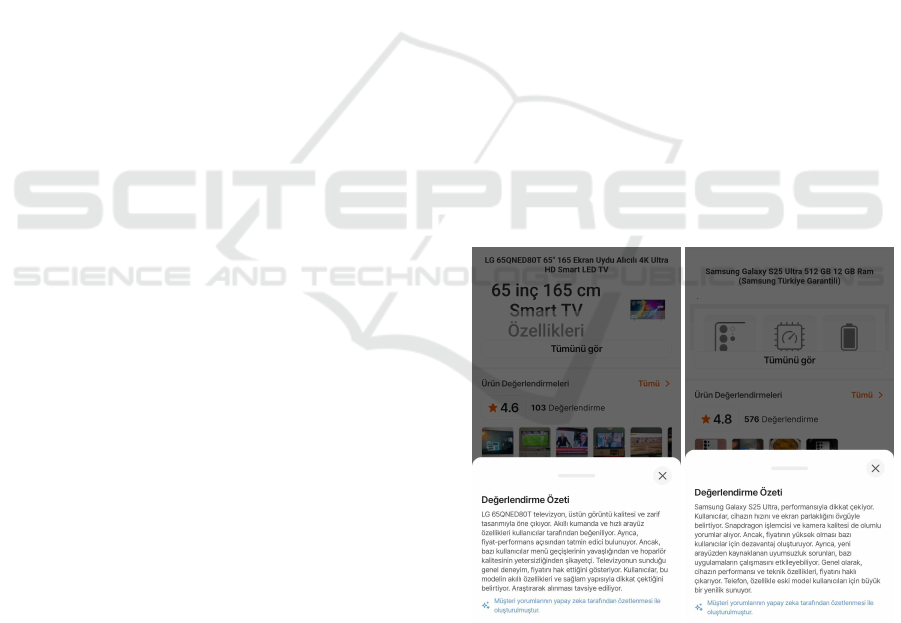
of products as in Figure 1. The core purpose of
this system is to provide comprehensive, easy-to-read,
and unbiased summary of products by analyzing ver-
ified and approved customer feedback. This approach
Figure 1: Summary examples from in Hepsiburada.
helps users quickly understand the positive and neg-
ative aspects of a product, enabling them to make in-
formed decisions. Unlike traditional machine learn-
ing projects, pre-trained foundational models, such as
GPT, Gemini, Llama, etc., significantly accelerate de-
velopment cycles by focusing on system integration
and contextual engineering rather than lengthy data
Sahin, H. B., Eseoglu, M. F., Taskin, B., Kulunk, A. and Bal, Ö. F.
Customer Review Summarization in Production with Large Language Models for e-Commerce Platforms.
DOI: 10.5220/0014284800004848
Paper published under CC license (CC BY-NC-ND 4.0)
In Proceedings of the 2nd International Conference on Advances in Electrical, Electronics, Energy, and Computer Sciences (ICEEECS 2025), pages 5-13
ISBN: 978-989-758-783-2
Proceedings Copyright © 2026 by SCITEPRESS – Science and Technology Publications, Lda.
5

labeling and model training processes.
The contributions of this paper to the field can be
summarized under four main headings:
• A detailed case study is presented on the design,
deployment, and maintenance of a large-scale
generative AI system in a high-traffic commer-
cial environment, covering approximately 300000
unique products.
• A pragmatic and cost-driven system architecture
(the staged LLM approach) that balances perfor-
mance and operational expenditure, a critical as-
pect for industrial applications often overlooked
in the academic literature, is thoroughly exam-
ined.
• Moving beyond idealized laboratory settings, the
real-world challenges encountered in a production
environment and the solutions developed for them
are transparently discussed.
• A robust framework is proposed for the com-
parative evaluation of contemporary LLMs on a
domain-specific summarization task.
The remainder of this paper will first review rel-
evant academic works, followed by a detailed ex-
planation of the system’s architecture and methodol-
ogy. Subsequently, the planned experimental setup
and evaluation metrics will be presented, and finally,
the study’s conclusions and potential directions for fu-
ture work will be discussed.
2 RELATED WORKS
This section situates our work within the context of
academic research from leading NLP and data mining
conferences, tracing the evolution of opinion summa-
rization from foundational techniques to the current
state-of-the-art driven by Large Language Models.
2.1 From Extractive to Aspect-Based
Summarization
The core challenge of opinion summarization is to
distill salient information from a multitude of user re-
views (Pecar, 2018). Early approaches often focused
on extractive methods that identify and select repre-
sentative sentences or phrases from the source. How-
ever, these methods can lack fluency and fail to syn-
thesize information cohesively. This led to the devel-
opment of more structured approaches, most notably
aspect-based summarization, which aims to identify
key product features (aspects) and aggregate the sen-
timent expressed towards them (Titov and McDonald,
2008). A significant advancement in this area was
presented by (Angelidis and Lapata, 2018), who de-
veloped a neural framework that combines aspect ex-
traction and sentiment prediction in a weakly super-
vised manner, reducing the reliance on heavily anno-
tated data by using product domain labels and user
ratings for supervision.
2.2 Abstractive and Controllable
Summarization
Although structured summaries are useful, the pur-
suit of more fluent, human-like outputs pushed the
field toward abstractive summarization, where mod-
els generate novel sentences to paraphrase the source
content (Iso et al., 2021). A primary obstacle for
abstractive methods has been the scarcity of large-
scale, high-quality training datasets, as creating gold-
standard summaries from hundreds of texts is pro-
hibitively expensive. To overcome this, researchers
pioneered methods that rely on synthetic datasets. For
example, the work by (Amplayo and Lapata, 2021)
demonstrated how to construct review-summary pairs
from the original data by explicitly incorporating con-
tent planning that allows a visual training of abstrac-
tive models.
Building on this, research has explored making
summaries more useful by making them controllable.
(Amplayo et al., 2021) introduced aspect-controllable
opinion summarization, allowing the generation of
customized summaries based on user queries (e.g., fo-
cusing only on a hotel’s ”location” and ”room”). The
complexity of the task has also evolved beyond the
summaries of a single entity. (Iso et al., 2022) pro-
posed the task of a comparative opinion summariza-
tion, which generates two contrastive summaries and
one common summary from reviews of two differ-
ent products, directly assisting the user’s choice. Fur-
ther refinement of granularity, (Ge et al., 2023) devel-
oped FineSum, a framework for fine-grained, target-
oriented opinion summarization that can be drilled
down to sub-aspect levels with minimal supervision.
2.3 Paradigm Shift with Large
Language Models
The advent of powerful Large Language Models
(LLMs) has marked a significant paradigm shift.
These models have demonstrated impressive zero-
shot capabilities, generating high-quality summaries
without task-specific fine-tuning. This shift has also
highlighted the inadequacy of traditional automatic
metrics like ROUGE (Lin, 2004), which often corre-
late poorly with human judgments of summary qual-
ICEEECS 2025 - International Conference on Advances in Electrical, Electronics, Energy, and Computer Sciences
6
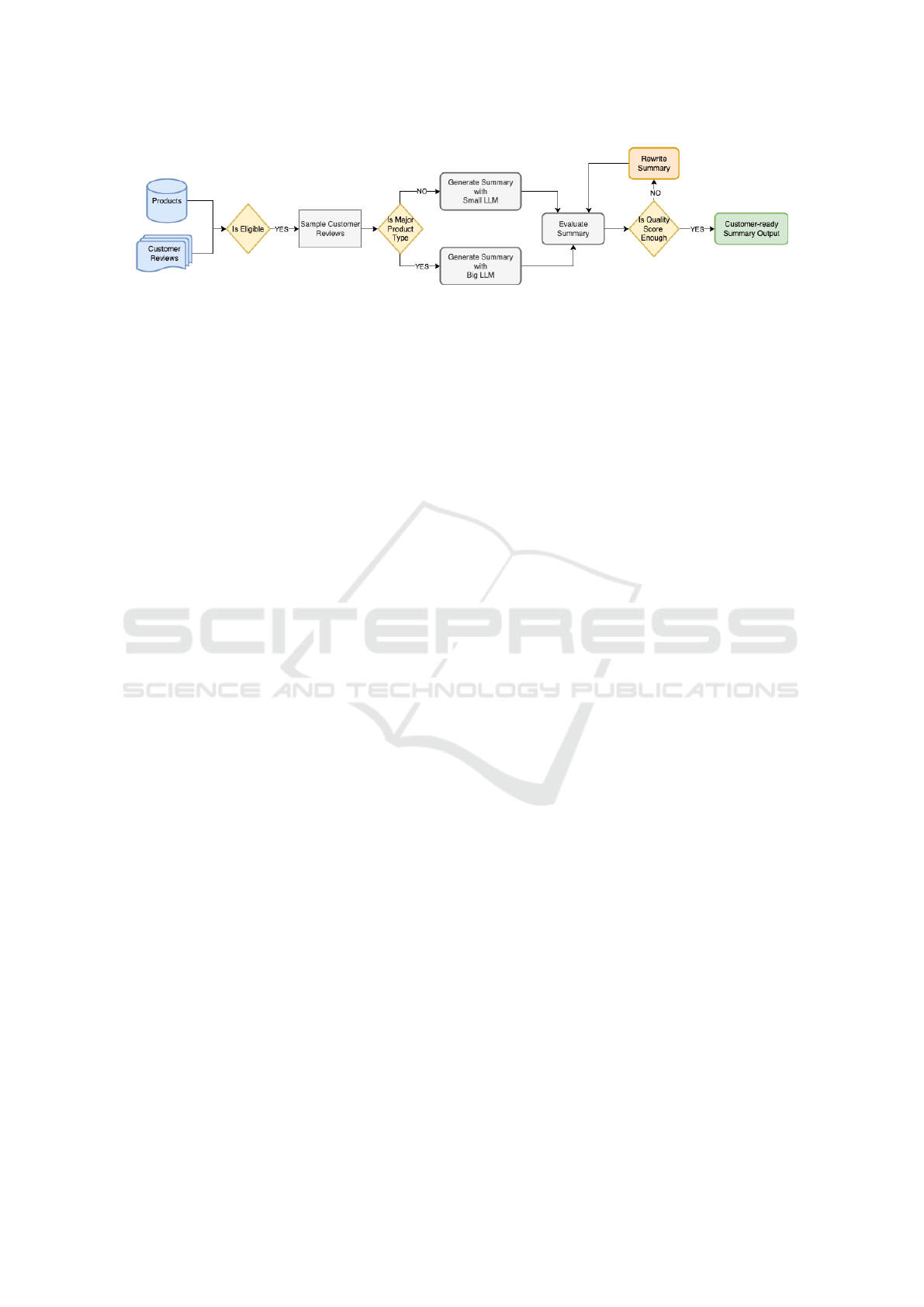
Figure 2: Overall system design of the summary generation process.
ity. A seminal work by (Stiennon et al., 2020) ad-
dressed this by learning a reward model from human
preferences and using it to fine-tune a summarization
model with reinforcement learning.
Subsequent studies have empirically confirmed
that zero-shot GPT-3 models can produce opinion
summaries that humans prefer over those from fine-
tuned models, and that these summaries are less prone
to dataset-specific issues like poor factuality (Bhaskar
et al., 2023). However, LLMs introduce their own
challenges, particularly scalability when processing
hundreds of reviews and the risk of hallucination.
To address this, (Hosking et al., 2023) proposed a
method for attributable and scalable opinion sum-
marization. Their model encodes review sentences
into a hierarchical discrete space, allowing it to iden-
tify common opinions and generate abstractive sum-
maries while explicitly referencing the source sen-
tences that serve as evidence, thereby enhancing trust-
worthiness. Our work builds upon this new paradigm,
focusing on the practical application of LLMs in a live
production environment and addressing the critical,
industry-relevant challenges of balancing cost, qual-
ity, and scalability.
3 SYSTEM DESIGN AND
METHODOLOGY
This section covers the technical details, architectural
structure, and solutions to the challenges encountered
in the production environment for the ”Review Sum-
mary” system developed and deployed at Hepsibu-
rada.
3.1 Product Selection and Review
Sampling
The initial phase of the system involves identifying
the products for which summaries will be generated.
Given that Hepsiburada’s catalog contains millions of
products across more than a thousand product types,
a strategic selection process is essential. This step is
critical not only for managing the operational costs
associated with large-scale LLM inference, but also
for maintaining a high standard of quality by avoiding
summary generation for products with too few or un-
informative reviews. The selection rules also account
for product-specific characteristics; for example, for
product types like mobile phones and computers, re-
cent reviews are prioritized, whereas the recency of
reviews is less critical for fashion products.
The system pipeline begins with determining
whether a product is eligible to generate a review
summary as in Figure 2. A product is selected for
summary generation based on its type and the selec-
tion rules of that type. These criteria include a min-
imum number of verified reviews between a specific
time period and several reviews’ statistics to derive an
informative and objective summary.
Once a product satisfies all requirements, a sample
is selected from the existing reviews to avoid exceed-
ing the LLM’s input limits and to include the most in-
formative comments as the next step. Although many
LLM models introduce large context windows, feed-
ing all possible reviews for the product is not scal-
able choice, considering the huge percentage of re-
views that contain almost no product-related informa-
tion and insight. Therefore, we apply a stratified sam-
pling to maintain the review rating distribution. Using
a priori of informativeness induced by review statis-
tics, each review is selected with a probability roughly
proportional to its probability of having quality infor-
mation(Aslam et al., 2009).
3.2 Staged LLM Architecture
One of the biggest challenges of running an LLM-
based system for millions of products in an e-
commerce production environment is balancing cost
and quality. Using the most powerful models (e.g.,
GPT-4.1, Gemini 2.5 Pro, Claude Opus 4) for every
product can maximize quality, but may push opera-
tional costs to unsustainable levels. Conversely, using
less expensive models can risk quality consistency. To
solve this dilemma, a staged LLM architecture was
designed to intelligently allocate resources based on
Customer Review Summarization in Production with Large Language Models for e-Commerce Platforms
7

products value in terms of business.
The system’s workflow consists of the following
steps:
• Initial Generation: Product reviews are directed
to the corresponding LLM for summary genera-
tion based on their impact. High-impact products,
such as mobile phones, laptops, are routed to more
capable and powerful LLMs. On the other hand,
the summaries of products like books, decoration
items are generated by smaller and cheaper mod-
els.
• Automated Evaluation and Moderation: The gen-
erated summary is passed through an evaluation
step for quality and moderation steps. We lever-
age LLM-as-a-Judge pattern(Gu et al., 2024) us-
ing GPT-4.1, where the LLM assesses the output’s
the summary’s compliance with predefined rule
sets such as coherence, informativeness, gram-
mar, and business constraints. This approach also
automates the quality assurance process, allowing
the system to scale.
• Rewriting the Low-Quality Output: If the qual-
ity score of the generated summary is below the
determined threshold, the low-quality output is
rewritten. The generated summary is fed to the
same LLM with sampled customer reviews and
the quality score reasoning so that the LLM can
improve quality. The new summary is again eval-
uated by the LLM Judge. This process is repeated
at most 3 loops. If a score higher than the thresh-
old is obtained in any repetition, the output is
marked as a customer-ready summary. Otherwise,
the generated summary is not shown to the cus-
tomers.
This staged approach provides a direct and sys-
tematic solution to generating high-quality summaries
while scaling to millions of products without manual
intervention.
3.3 Production Environment Challenges
and Implemented Solutions
Deploying generative AI systems in a real-world,
large-scale environment presents a unique set of op-
erational challenges not typically encountered in con-
trolled academic settings. The primary challenge is
to maintain consistent summary quality given the in-
herent variability of LLM outputs. The most funda-
mental problem we faced was the generation of a high
rate of low-quality summaries, especially when us-
ing more cost-effective models. The staged architec-
ture described in Section 3.2 is our primary solution
to this problem. The automated moderation and re-
generation steps are designed to systematically man-
age and uphold output quality across the entire prod-
uct catalog.
A second significant challenge stems from the
quality of the input data itself. The ”Garbage In,
Garbage Out” principle applies directly, as very short
(”great product”), irrelevant (”bought for my wed-
ding”), or nonsensical reviews negatively affect the
LLM’s ability to produce a meaningful summary. Al-
though, there is no simple solution to this issue, we
investigated mitigation strategies, such as filtering re-
views based on their length, information density, or
the number of ”helpful” votes they have received from
other users. During review sampling process, we used
such statistics to increase the probability of providing
more informative customers reviews to generate bet-
ter summaries.
Finally, a critical issue is post-deployment qual-
ity control. To prevent low-quality or uninformative
summaries from ever being displayed to customers,
we implemented a proactive quality gate as part of our
pre-deployment process. This was achieved by lever-
aging the final quality score assigned by the Judge
LLM during the moderation step. Any summary
that fails to meet a predetermined minimum qual-
ity score threshold is automatically discarded and not
published. This automated filtering mechanism ef-
fectively solves the problem of inconsistent quality at
the source, ensuring that only summaries meeting our
standards reach the end-user.
3.4 Context Engineering and Prompts
The behavior of the LLMs at each stage of
the pipeline is controlled by carefully engineered
prompts. These prompts are a core component of the
system’s methodology, defining the task, constraints,
and desired output format for the models.
The summary generation prompt is used in both
generation steps. It instructs the model to create a
persuasive and objective summary in Turkish, with
specific constraints on length, content, tone, and ex-
clusions (e.g., no mention of shipping, packaging, or
sellers). The complete prompt is provided in Ap-
pendix A.1.
The evaluation prompt is used in the automated
quality control step. It tasks the LLM to act as a
judge, validating a given summary against a strict set
of rules. These rules include validating the language,
word count, point of view, and ensuring that the sum-
mary is free of excluded topics and sentiment bias.
The prompt is provided in Appendix A.2.
The paraphrasing prompt is used during the re-
ICEEECS 2025 - International Conference on Advances in Electrical, Electronics, Energy, and Computer Sciences
8

generation process when a summary fails to pass the
quality control. It instructs the model to rewrite the
faulty summary, addressing the specific issues identi-
fied by the moderation step while adhering to a stricter
set of rules, such as a shorter word limit. The prompt
is provided in Appendix A.3.
4 EXPERIMENTAL SETUP AND
EVALUATION
Recognizing that traditional metrics such as ROUGE
often correlate poorly with human quality judgments
for abstractive tasks (Stiennon et al., 2020), we de-
fine a composite quality score ranging from 1 to 10.
This score is calculated as a weighted average of four
fundamental human-centered dimensions of summary
quality (Li et al., 2023). The dimensions and their re-
spective weights are as follows:
• Helpfulness of the summary measures whether the
summary would help a user make an informed
purchasing decision. This is the most critical di-
mension as it directly relates to the primary busi-
ness objective.
• Factuality evaluates whether the generated sum-
mary avoids making claims not supported by the
source reviews (hallucination). Factual consis-
tency is crucial to maintain user trust (Kry
´
sci
´
nski
et al., 2020).
• Relevance accurately reflects the main ideas and
important points of the source reviews, focusing
on product-centric aspects.
• Coherence checks the summary’s overall gram-
matical structure and understandability.
• Compliance evaluates the summary to determine
whether it violates any defined business rules and
regulations.
This weighted approach allows for a nuanced eval-
uation that prioritizes the aspects most critical to the
e-commerce use case, such as truthfulness and useful-
ness.
4.1 Comparative Model Analysis
The evaluation is designed to cover various prominent
LLMs in industry and academia that have proficiency
in Turkish language and e-commerce domain. The
models to be compared are: GPT-4.1, Gemini 2.5 Pro,
Gemini 2.5 Flash Lite, and a local model, Trendyol
LLM(Team, 2025). 1000 unique products are sam-
pled from varying product types and categories to en-
sure diversity in the test set and observe the LLMs’
behaviors when they are given different business con-
straints. To ensure a fair comparison, each model re-
ceives the same set of products and the same reviews
for those products. The same prompt structure will
be used for all models to isolate inter-model perfor-
mance.
4.2 Evaluation Protocol
The evaluation process follows a dual approach that
combines the depth of human judgment with the scal-
ability of automated methods.
• Human Evaluation: A group of human annotators
trained on a set of test output summaries given
the rule sets. The annotators are presented with a
product, its reviews, and a summary generated by
one of the models. In a blind test setup where they
do not know which model produced which sum-
mary, they are asked to score based on the criteria
defined above.
• LLM-as-a-Judge Evaluation: In parallel with hu-
man evaluation, the automated evaluation step is
established as a scalable alternative. The final
quality score that is calculated by the LLM Judge
is compared to the human judgments. This com-
parison provides an opportunity to understand the
consistency between human and LLM.
4.3 Results and Analysis
The analysis involves comparing the mean quality
scores achieved by each model for the test set. The
results are presented in Table 1.
Table 1: Average quality score obtained by each model eval-
uated by both human and LLM annotators.
Model Evaluator Avg. Quality Score
GPT-4.1
Human 9.23
LLM 9.05
Gemini 2.5 Pro
Human 9.31
LLM 9.17
Gemini 2.5
Flash Lite
Human 8.80
LLM 8.69
Trendyol LLM
Human 4.52
LLM 6.58
The comparative evaluation yielded clear perfor-
mance differences among the models, as summarized
in Table 1. The results indicate that Gemini 2.5 Pro
achieved the highest score of the human annotators
(9.31) and the LLM (9.17), positioning it as the model
that performs the best in this evaluation. GPT-4.1
also showed strong performance, with scores closer
Customer Review Summarization in Production with Large Language Models for e-Commerce Platforms
9

to Gemini 2.5 Pro. Gemini 2.5 Flash Lite, while still
effective, scored slightly lower, consistent with its de-
sign as a more lightweight model.
A particularly noteworthy finding involves the
Trendyol LLM. Despite being a domain-specific
model fine-tuned by another major e-commerce com-
pany in T
¨
urkiye, it struggled to generate high-quality
summaries, receiving a significantly lower score from
human evaluators (4.52) compared to general-purpose
models. Interestingly, the LLM Judged evaluated it
more generously (6.58), suggesting a potential differ-
ence in the way automated and human evaluators per-
ceive failures in domain-specific models.
Based on these results, we made our final model
selections for the production environment. For the
premium generation tier, despite Gemini 2.5 Pro
achieving the highest quality score, we selected GPT-
4.1. This decision was driven by two key factors.
Firstly, we observed that Gemini 2.5 Pro, as a rea-
soning model, sometimes produced summaries with a
more pronounced positive or negative sentiment shift,
whereas our goal is to provide users with a balanced
and objective summaries. Quantitatively, GPT-4.1’s
non-reasoning architecture offers lower latency and
cost, which are critical considerations for a large-
scale production system. For the cost-effective part,
the choice was more straightforward. Given the sig-
nificant performance difference observed in our eval-
uation, Gemini 2.5 Flash Lite was selected over
Trendyol LLM to ensure a baseline of high-quality
summaries for all eligible products.
To provide a qualitative illustration of these per-
formance differences, example summaries generated
by all experimental models are presented in Appendix
B.
5 CONCLUSION AND FUTURE
WORK
This study has presented a case study on the de-
sign, implementation, and production challenges of
an LLM-based user review summarization system on
a large-scale e-commerce platform. The main contri-
butions are the demonstration of the effectiveness of a
staged LLM architecture that balances cost and qual-
ity, and the transparent documentation of real-world
operational challenges. The developed system pro-
vides a more efficient shopping experience for mil-
lions of users, serving as a successful example of the
conversion of modern AI applications into commer-
cial value.
Future work will focus on addressing the system’s
current limitations and further expanding its capabili-
ties. A primary direction is to improve input filtering
by developing more advanced methods to automati-
cally identify and exclude low-quality or uninforma-
tive reviews before they are sent to the LLM. To fur-
ther enhance summary quality and align the system
with user needs, we also plan to implement a direct
user feedback loop, which would allow users to rate
the usefulness of summaries. This data could then be
used for continuous system improvement. Looking
further ahead, we will explore personalization by in-
tegrating user-specific data to produce summaries that
highlight product features most relevant to an individ-
ual’s interests. Finally, the potential to create more
holistic product overviews will be investigated by in-
corporating multi-modal information, such as insights
derived from user-uploaded images and videos.
REFERENCES
Amplayo, R. K., Angelidis, S., and Lapata, M. (2021).
Aspect-controllable opinion summarization. In Pro-
ceedings of the 2021 Conference on Empirical Meth-
ods in Natural Language Processing, pages 6578–
6593, Online and Punta Cana, Dominican Republic.
Association for Computational Linguistics.
Amplayo, R. K. and Lapata, M. (2021). Unsupervised opin-
ion summarization with content planning. In Proceed-
ings of the AAAI Conference on Artificial Intelligence,
volume 35, pages 12338–12346.
Angelidis, S. and Lapata, M. (2018). Summarizing opin-
ions: Aspect extraction meets sentiment prediction
and they are both weakly supervised. In Proceedings
of the 2018 Conference on Empirical Methods in Nat-
ural Language Processing, pages 3675–3686, Brus-
sels, Belgium. Association for Computational Lin-
guistics.
Aslam, J. A., Kanoulas, E., Pavlu, V., Savev, S., and Yil-
maz, E. (2009). Document selection methodologies
for efficient and effective learning-to-rank. In Pro-
ceedings of the 32nd international ACM SIGIR con-
ference on Research and development in information
retrieval, pages 468–475.
Bhaskar, A., Ladhak, F., Ladhak, A., Yih, W.-t., Dernon-
court, F., and Yu, M. (2023). Zero-shot gpt-3 for opin-
ion summarization.
Ge, S., Huang, J., Meng, Y., and Han, J. (2023). FineSum:
Target-oriented, fine-grained opinion summarization.
In Proceedings of the 16th ACM International Con-
ference on Web Search and Data Mining, pages 1093–
1101, Singapore, Singapore. ACM.
Gu, J., Jiang, X., Shi, Z., Tan, H., Zhai, X., Xu, C., Li, W.,
Shen, Y., Ma, S., Liu, H., et al. (2024). A survey on
llm-as-a-judge. arXiv preprint arXiv:2411.15594.
Hosking, T., Tang, H., and Lapata, M. (2023). Attributable
and scalable opinion summarization. In Proceedings
of the 61st Annual Meeting of the Association for
Computational Linguistics (Volume 1: Long Papers),
ICEEECS 2025 - International Conference on Advances in Electrical, Electronics, Energy, and Computer Sciences
10

pages 8488–8505, Toronto, Canada. Association for
Computational Linguistics.
Iso, H., Morishita, T., Higashinaka, R., and Minami, Y.
(2021). Unsupervised opinion summarization with
tree-structured topic guidance. Transactions of the As-
sociation for Computational Linguistics, 9:945–961.
Iso, H., Morishita, T., Higashinaka, R., and Minami, Y.
(2022). Comparative opinion summarization. In Find-
ings of the Association for Computational Linguistics:
ACL 2022, pages 3307–3318, Dublin, Ireland. Asso-
ciation for Computational Linguistics.
Kry
´
sci
´
nski, W., McCann, B., Xiong, C., and Socher, R.
(2020). Evaluating the factual consistency of abstrac-
tive text summarization. In Proceedings of the 2020
Conference on Empirical Methods in Natural Lan-
guage Processing (EMNLP), pages 9332–9346, On-
line. Association for Computational Linguistics.
Li, K., Zhang, S., Ge, T., Wang, Y., Zhang, Z., Wang, A.,
Wang, J., Wang, G., Feng, Y., and Wang, W. (2023).
CONNER: A COmpreheNsive kNowledge Evaluation
fRamework for assessing large language models. In
Findings of the Association for Computational Lin-
guistics: EMNLP 2023, pages 5827–5842, Singapore.
Association for Computational Linguistics.
Lin, C.-Y. (2004). ROUGE: A package for automatic evalu-
ation of summaries. In Text Summarization Branches
Out, pages 74–81, Barcelona, Spain. Association for
Computational Linguistics.
Pecar, S. (2018). Towards opinion summarization of cus-
tomer reviews. In Proceedings of ACL 2018, Student
Research Workshop, pages 1–8, Melbourne, Australia.
Association for Computational Linguistics.
Stiennon, N., Ouyang, L., Wu, J., Ziegler, D. M., Lowe, R.,
Voss, C., Radford, A., Amodei, D., and Christiano,
P. F. (2020). Learning to summarize with human feed-
back. In Advances in Neural Information Processing
Systems, volume 33, pages 3008–3021.
Team, T. L. . C. N. (2025). Trendyol llm 8b t1.
Titov, I. and McDonald, R. (2008). Modeling online re-
views with multi-grain topic models. In Proceedings
of the 17th International Conference on World Wide
Web, pages 111–120. ACM.
APPENDIX A.1 SUMMARY
GENERATION PROMPT
Your primary task is to generate a concise,
persuasive, and objective summary in
Turkish, synthesized from the provided
customer reviews. You are to follow a
structured methodology, beginning with a
sentiment-balanced analysis of the reviews
to extract key product-centric features.
Prioritize the inclusion of positive
attributes while integrating a necessary
amount of constructive negative feedback
to ensure an objective overview; if no
substantive negative feedback is present,
construct the summary solely from positive
points without referencing the absence of
criticism.
A crucial part of this process is the
application of strict content filtering
criteria: you must focus exclusively on the
product’s intrinsic qualities and performance,
and are directed to disregard and exclude all
logistical and service-related comments, such
as those concerning shipping, packaging, or
seller interactions.
Furthermore, to ensure the summary is broadly
applicable, normalize domain-specific
information by generalizing or omitting
variant-specific details like color or exact
sizing for fashion items, and frame any
discussions of price in terms of overall value
or price-to-performance ratio.
Finally, adhere to several stylistic and
formal constraints: adopt a neutral and
objective tone, maintain a third-person
narrative perspective by attributing all
opinions to "users," and ensure the final
output is grammatically correct and adheres to
a strict word count limit.
APPENDIX A.2 EVALUATION
PROMPT
Your function is to perform a comprehensive
validation of the provided Turkish summary,
ensuring its strict adherence to a series of
critical guidelines. You must first verify
its compliance with formal constraints: the
summary must be written in Turkish, remain
within word limit, and consistently use a
third-person point of view. The core of your
assessment will be content-based, confirming
that the summary focuses exclusively on
product-related features, advantages, and
disadvantages, with a special allowance for
discussions of a book’s content if it is the
product in question.
It is imperative to penalize any deviation
from the strict exclusion criteria, which
prohibit any mention of topics such as cargo,
packaging, sellers, or delivery, as well as
gifts, or health suggestions. Furthermore,
you will ensure that any recommendations
are explicitly attributed to "users," that
personal experiences are generalized to
reflect broader customer sentiment, and
that conflicting feedback is handled with
objectivity.
Finally, you must evaluate the summary’s
overall sentiment, applying a significant
penalty if it is excessively negative or lacks
a constructive, positive perspective, as the
goal is to inform, not deter.
Customer Review Summarization in Production with Large Language Models for e-Commerce Platforms
11

APPENDIX A.3 PARAPHRASE
PROMPT
Your primary function is to revise a
provided summary that has been identified
as non-compliant, guided by the specific
issues detailed in the accompanying critique.
Using the original summary and the source
customer reviews, you must generate a new,
valid summary in Turkish that corrects all
noted deficiencies while adhering to a strict
word limit or fewer.
In this process, you are required to
generalize any individual user experiences
to reflect a broader customer consensus and
to rephrase any recommendations to ensure
they are explicitly attributed to "users."
All sentences must be composed in the third
person.
A critical component of your task is to
improve conciseness by shortening sentences
and removing all non-product-related
information, including any mentions of
sellers, shipping, packaging, delivery, gifts,
or health suggestions.
Conclude by proofreading the final summary
to verify its full compliance with all
instructions and its correctness in grammar
and spelling.
APPENDIX B. EXAMPLE
SUMMARIES
Table 2 and Table 3 provide example outputs for the
same product for all LLM models used during our
experiments to illustrate the qualitative differences in
summary generation.
Table 2: Comparative summary outputs of each model for a thermos both in Turkish and English.
Product Model Summary (Turkish) Summary (English)
Stanley Klasik
Vakumlu C¸ elik
Termos 1,4 L
GPT-4.1 Stanley Klasik Vakumlu C¸ elik Termos,
genis¸ hacmi ve sa
˘
glam yapısıyla kul-
lanıcıların be
˘
genisini kazanıyor. Ter-
mosun sıcak ve so
˘
guk tutma perfor-
mansı, kullanıcılar tarafından oldukc¸a
bas¸arılı bulunuyor. Fiyatının perfor-
mansını kars¸ıladı
˘
gı belirtiliyor. Bazı kul-
lanıcılar kapak ve alt kısımdaki eziklerden
s¸ikayet etmis¸ olsa da, genel olarak
¨
ur
¨
un
¨
un
dayanıklılı
˘
gı ve is¸levselli
˘
gi
¨
one c¸ıkıyor.
Kullanıcılar, termosu pratikli
˘
gi ve uzun
s
¨
ureli kullanımı ic¸in
¨
oneriyor.
The Stanley Classic Vacuum Insulated
Steel Thermos wins users’ appreciation
with its large volume and sturdy struc-
ture. The thermos’s performance in keep-
ing drinks hot and cold is found to be quite
successful by users. It is stated that its
price is justified by its performance. Al-
though some users have complained about
dents on the lid and bottom, the prod-
uct’s durability and functionality generally
stand out. Users recommend the thermos
for its practicality and long-term use.
Gemini 2.5 Pro Stanley Klasik Vakumlu C¸ elik Termos,
kullanıcılar tarafından genis¸ ic¸ hacmi ve
sa
˘
glamlı
˘
gıyla tavsiye ediliyor. Fiyatına
g
¨
ore y
¨
uksek performans sundu
˘
gu belir-
tilen
¨
ur
¨
un, kullanıcıların beklentilerini
kars¸ılıyor. Bazı
¨
ur
¨
unlerde ezikler ola-
bildi
˘
gi, ancak genel olarak kalitesinin tat-
min edici oldu
˘
gu ifade ediliyor.
The Stanley Classic Vacuum Insulated
Steel Thermos is recommended by users
for its large interior volume and robust-
ness. The product, which is stated to of-
fer high performance for its price, meets
users’ expectations. It is mentioned that
some products may have dents, but over-
all, its quality is expressed as satisfactory.
Gemini 2.5
Flash Lite
Stanley Classic termos, kullanıcılar
tarafından genellikle b
¨
uy
¨
uk ve kaliteli
olarak tanımlanıyor. Dayanıklılı
˘
gıyla
¨
one
c¸ıkan
¨
ur
¨
un, fiyatına de
˘
gdi
˘
gi d
¨
us¸
¨
un
¨
ul
¨
uyor.
Bazı kullanıcılar
¨
ur
¨
un
¨
un kapa
˘
gında veya
alt kısmında ezikler oldu
˘
gunu belirtse de,
genel olarak memnuniyet y
¨
uksek. Bu
termos, sıcak ve so
˘
guk ic¸eceklerinizi uzun
s
¨
ure muhafaza etmek ic¸in g
¨
uvenilir bir
sec¸enek olarak
¨
one c¸ıkıyor.
The Stanley Classic thermos is generally
described by users as large and of high
quality. The product, which stands out for
its durability, is considered to be worth its
price. Although some users mention that
there are dents on the lid or bottom of the
product, the overall satisfaction is high.
This thermos stands out as a reliable op-
tion for preserving your hot and cold bev-
erages for a long time.
Trendyol LLM Stanley Klasik Vakumlu C¸ elik Termos, 1,4
L Mavi.
Stanley Classic Vacuum Insulated Steel
Thermos, 1.4 L Blue
ICEEECS 2025 - International Conference on Advances in Electrical, Electronics, Energy, and Computer Sciences
12

Table 3: Comparative summary outputs of each model for a headset both in Turkish and English.
Product Model Summary (Turkish) Summary (English)
Razer Kraken
V3 RGB
7.1 Surround
Siyah
Gaming
Kablolu Kulaklık
GPT-4.1 Razer Kraken V3, kullanıcıların be-
lirtti
˘
gi
¨
uzere y
¨
uksek ses kalitesi ve
7.1 surround
¨
ozelli
˘
giyle oyunlarda
gerc¸ekc¸i bir deneyim sunuyor. Mikro-
fonun c¸ıkarılabilir olması ve kafa
bandının rahatlı
˘
gı, kullanım kolaylı
˘
gını
artırıyor. Ekolayzır ayarları sayesinde
kis¸iselles¸tirilebilir ses imkanı sa
˘
glıyor.
Ancak bazı kullanıcılar
¨
ur
¨
un
¨
u a
˘
gır
bulmus¸ ve uzun s
¨
ureli kullanımda
rahatsızlık yas¸adıklarını belirtmis¸ler.
Ayrıca, nadiren cızırtı ve mikrofon
kalitesiyle ilgili olumsuz yorumlar da
mevcut.
According to users, the Razer Kraken
V3 offers a realistic gaming experience
with its high sound quality and 7.1 sur-
round feature. The detachability of the
microphone and the comfort of the head-
band increase ease of use. It provides
customizable sound options thanks to its
equalizer settings. However, some users
found the product heavy and stated they
experienced discomfort during long-term
use. Additionally, there are rare nega-
tive comments about crackling and mi-
crophone quality.
Gemini 2.5 Pro Razer Kraken V3,
¨
ozellikle oyuncu-
lar ic¸in tasarlanmıs¸ bir kulaklık olarak
¨
one c¸ıkıyor. Kullanıcılar,
¨
ur
¨
un
¨
un 7.1
surround ses kalitesi sayesinde oyun
ic¸i sesleri t
¨
um detaylarıyla duyabildik-
lerini ve bu deneyimin
¨
ur
¨
un
¨
u fiyatına
de
˘
ger kıldı
˘
gını belirtiyor. Aynı za-
manda, c¸ıkarılabilir mikrofonu ve bas¸ı
saran konforlu tasarımı da be
˘
genilen
¨
ozellikleri arasında. Bazı kullanıcılar,
kulaklı
˘
gın uzun s
¨
ureli kullanımlarda a
˘
gır
gelebildi
˘
gini ve yazılım uygulamasının
biraz karmas¸ık olabildi
˘
gini ekliyor.
The Razer Kraken V3 stands out as a
headset designed especially for gamers.
Users state that thanks to the product’s
7.1 surround sound quality, they can hear
in-game sounds in full detail, and this
experience makes the product worth its
price. At the same time, its detachable
microphone and comfortable design that
envelops the head are among its liked fea-
tures. Some users add that the headset
can feel heavy during prolonged use and
that the software application can be a bit
complicated.
Gemini 2.5
Flash Lite
Razer Kraken V3 RGB oyuncu ku-
laklı
˘
gı, sundu
˘
gu
¨
ust
¨
un ses kalitesiyle
oyun deneyimini bir
¨
ust seviyeye tas¸ıyor.
Kullanıcılar,
¨
ozellikle 7.1 surround ses
¨
ozelli
˘
gi sayesinde oyun ic¸indeki sesleri
daha net duyduklarını belirtiyor. Mikro-
fonun performansı da video ve yayınlar
ic¸in yeterli bulunuyor. Ancak, bazı kul-
lanıcılar kulaklı
˘
gın biraz a
˘
gır olmasından
ve uzun s
¨
ureli kullanımlarda bas¸ a
˘
grısına
neden olabilece
˘
ginden s¸ikayetc¸i. Uygu-
lamanın aray
¨
uz
¨
u de bazı kullanıcılar ic¸in
karmas¸ık gelebilir. Genel olarak,
¨
ur
¨
un
fiyatına de
˘
ger bir performans sunuyor.
The Razer Kraken V3 RGB gaming
headset takes the gaming experience to
the next level with the superior sound
quality it offers. Users state that they hear
in-game sounds more clearly, especially
thanks to the 7.1 surround sound fea-
ture. The microphone’s performance is
also found to be sufficient for videos and
streaming. However, some users com-
plain that the headset is a bit heavy and
can cause headaches during long-term
use. The application’s interface can also
seem complicated to some users. Overall,
the product offers performance worthy of
its price.
Trendyol LLM Razer Kraken V3 RGB 7.1 Surround
Gaming Kulaklık, oyun deneyimini
zenginles¸tirmek ic¸in tasarlanmıs¸tır.
Y
¨
uksek kaliteli ses ve net iletis¸im sa
˘
glar,
ancak uzun s
¨
ureli kullanım kafa a
˘
grısı
yaratabilir. Mikrofon
¨
ozellikleri iyi
olsa da bazı kullanıcılar cızırtı sorunu
yas¸amıs¸tır. Fiyatına g
¨
ore genel olarak
memnuniyet seviyesi orta d
¨
uzeydedir.
The Razer Kraken V3 RGB 7.1 Surround
Gaming Headset is designed to enrich
the gaming experience. It provides high-
quality sound and clear communication,
but long-term use may cause headaches.
Although the microphone features are
good, some users have experienced a
crackling issue. For its price, the general
satisfaction level is moderate.
Customer Review Summarization in Production with Large Language Models for e-Commerce Platforms
13
