
Optimizing the Classification of SNBP Student Candidate Files Using
the K-Nearest Neighbor (KNN) Algorithm
Diah Ayu Larasati, Amil Ahmad Ilham and Ady Wahyudi Paundu
Department of Informatics, Hasanuddin University, Gowa, Indonesia
Keywords: SNBP, K-Nearest Neighbor (KNN), Certificate Classification, International
Abstract: In addition to academic achievement, non-academic achievement is one of the critical factors that can increase
the chances of being accepted into the SNBP (Seleksi Nasional Berdasarkan Prestasi) pathway. There are
several criteria for non-academic achievement certificates that are used as assessment criteria according to the
portfolio from the Ministry of Education and Culture. This research aims to optimize the classification of each
certificate according to its grouping in the portfolio to make it easier for reviewers to check files. The KNN
algorithm's evaluation using the cross-validation method and evaluation metrics such as precision, recall, and
F1-score shows that text preprocessing has a significant influence on model performance. The best experiment,
experiment 3, which uses complete preprocessing including stopword removal, gives the highest accuracy of
0.722. The lowest performance was consistently found in the “Undefined” class, with an F1-score of only
0.39 in the 3rd experiment. These results show that the KNN method with TF-IDF vectorization and cosine
similarity can classify proof of achievement well.
1 INTRODUCTION
SNPMB (Seleksi Nasional Penerimaan Mahasiswa
Baru) is a selection system organized by the
Indonesian government to attract outstanding
students to continue their education at higher levels,
such as State Universities and State Polytechnics.
One of the selection channels in SNPMB is SNBP
(Seleksi Nasional Berdasarkan Prestasi), which
considers report cards and evidence of academic and
non-academic achievements uploaded by students on
the official SNPMB website.
So far, the selection committee has classified
thousands of proofs of achievement manually, which
takes a lot of time and effort. Therefore, an automated
classification system is needed to help the selection
process. Classification in the context of information
systems is a technique of mapping data into certain
predetermined classes. One of the most popular
classification algorithms is K-Nearest Neighbor
(KNN). This algorithm works by classifying new data
based on its proximity to data that already has a
known class, based on distance calculations.
The KNN algorithm has advantages due to its
simplicity and effectiveness in handling small to
medium datasets. However, the accuracy of KNN is
greatly influenced by the selection of the K value and
the quality of the data used. In this research, a text
mining and OCR (Optical Character Recognition)
approach is used to process raw data in the form of
certificate files into text form. This research explicitly
compares the KNN algorithm's accuracy against three
different text preprocessing scenarios.
The main contribution of this research is a
comprehensive analysis of the effect of text
preprocessing on classification accuracy. In addition,
this research provides practical benefits by offering a
system that can accelerate and streamline the
selection process, while also serving as a basis for the
development of future achievement document
classification methods.
2 METHODOLOGY
2.1 Optical Character Recognition
(OCR)
Optical Character Recognition, or OCR, is a
technology that converts text in image or picture file
format into text that can be read and edited by
Larasati, D. A., Ilham, A. A. and Paundu, A. W.
Optimizing the Classification of SNBP Student Candidate Files Using the K-Nearest Neighbor (KNN) Algorithm.
DOI: 10.5220/0014276800004928
Paper published under CC license (CC BY-NC-ND 4.0)
In Proceedings of the 1st International Conference on Research and Innovations in Information and Engineering Technology (RITECH 2025), pages 231-237
ISBN: 978-989-758-784-9
Proceedings Copyright © 2025 by SCITEPRESS – Science and Technology Publications, Lda.
231
computer applications (e.g., Notepad, and Microsoft
Word) (Firdaus et al., 2021).
In image-type media, text content cannot be
extracted directly because it is considered part of the
visual image, so a special method is needed to extract
text from an image, namely Optical Character
Recognition or OCR (Nugraha, 2024). In the context
of this research, OCR is a fundamental stage because
the proof of achievement data uploaded by students is
in the form of digital files that need to have their text
information extracted. The OCR process involves
several stages of image preprocessing, such as
rotating to correct the document's orientation,
cropping to focus on the area containing the text, and
excluding non-certificate files to ensure the quality of
the data to be processed.
OCR is frequently included as part of systems for
handling documents, efforts to make things digital,
and programs for entering data digitally. OCR can
also be used to understand writing done by hand, but
this use is not as common because handwriting can be
very different from person to person. Older OCR
setups relied on rules created by people, which meant
people had to do a lot of work and the results were not
very exact. Older types of machine learning models
include Support Vector Machines (SVM), Naive
Bayes, and K-Nearest Neighbors (KNN) (Francis &
Sangeetha, 2025).
Modern OCR technology uses deep learning
approaches to improve character recognition
accuracy, especially on documents with varying
image quality. In this research, the EasyOCR library
was chosen for its ability to handle various fonts and
layouts of certificate documents accurately. The PDF
to image conversion process is performed using the
PyMuPDF library, which maintains the visual quality
of the original document.
2.2 Text Mining
Text mining is extracting useful information and
knowledge from extensive, unstructured textual data
(Pertiwi, 2022). Text mining is a well-known method
used in areas like computer science, information
science, mathematics, and management to find useful
information from large amounts of data (Kumar et al.,
2021). In the context of document classification, text
mining consists of three main stages: preprocessing,
data mining, and postprocessing. The preprocessing
stage includes data selection, text cleaning, and
feature extraction, to transform documents into
representations that machine learning algorithms can
process. Text mining can use standard dictionary
ways, ways that let computers learn, and advanced
computer learning ways. The goal of text mining is to
figure out what the text is trying to say (Lai & Chen,
2023).
In this research, text mining is vital in converting
OCR-generated text into numerical features that the
KNN algorithm can process. This process involves
various preprocessing techniques such as case
folding, punctuation removal, space normalization,
and stop words removal. Each preprocessing
technique has a different impact on the quality of the
resulting features and ultimately affects the
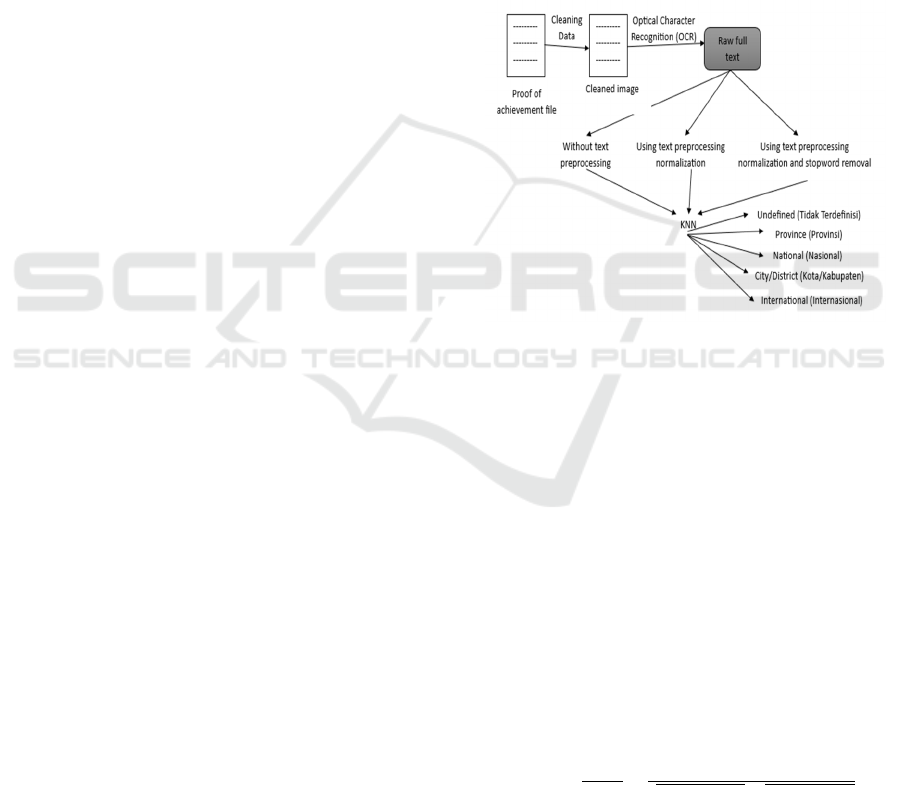
classification accuracy. Figure 1 presents the design
of the system workflow that outlines the main
processes involved in this research.
Figure 1: The design of the system workflow developed.
2.3 K-Nearest Neighbor
The K-NN method works by sorting items into groups
by looking at the training information that is most like
the item being checked (Danny et al., 2024). The K-
Nearest Neighbor algorithm is a supervised learning
method that performs classification based on
closeness or similarity (Cholil et al., 2021). This
algorithm works by finding the K nearest neighbors
of the test data to the training data and determining
the class based on the majority of the neighboring
classes. KNN has lazy learning characteristics
because it does not build an explicit model during the
training phase but instead stores all the training data
and performs computations during the prediction
process.
𝑐𝑜𝑠 (𝑃,𝑄)
|| ||
∑
(
|) (
|)
∑
(
|)
∑
(
|)
(1)
This research uses a similarity measurement
method using cosine similarity (1), which is suitable
for text vector data resulting from TF-IDF. The most
RITECH 2025 - The International Conference on Research and Innovations in Information and Engineering Technology
232

commonly used distance measurement is Euclidean
distance. In this research, similarity measurement
uses cosine similarity, which is calculated by the
following equation 1.
P and Q are different document vectors, and the
components of the two vectors are the frequencies of
certain words in the document. Cosine similarity was
chosen because of its effectiveness in measuring the
similarity of text documents represented in the form
of TF-IDF vectors.
2.4 Term Weighting
Term weighting is a method of weighting words in
documents used to convert text into numerical
representations in text mining algorithms. This
weighting aims to provide a value that reflects the
importance or relevance of a word in the document
and the document collection as a whole.
Long text can generally be weighted using the
usual term weighting method such as TF-IDF
(Ni’mah & Syuhada, 2022). The term weighting
process consists of several main components. First,
Term Frequency (TF) calculates the frequency of
occurrence of a word in a particular document, where
the more often the word appears, the greater its
weight. Second, Inverse Document Frequency (IDF)
measures the uniqueness of the word in the entire
document collection by calculating the logarithm of
the ratio of total documents to the number of
documents containing the word and combining these
two components results in TF-IDF weight, which
gives high weight to words that appear frequently in
a particular document but rarely appear in the overall
document collection (Sholehhudin et al., 2018).
In this research, the term weighting
implementation uses the TF-IDF scheme with
ngram_range parameters of 1-2 to capture the context
of unigrams and bigrams, and max_features of 1000
to limit the feature dimension and avoid overfitting.
Bigrams are essential to capture meaningful phrases
in the context of certificates of achievement, such as
“first place” or “national level”, which have different
meanings when separated into individual words. TF-
IDF performs effectively when the same words are
used again (Gani et al., 2022)
2.5 Text Classification
Text classification is a supervised learning process
that aims to find a model to distinguish data classes
or concepts and predict the class of unidentified
objects. Unlike unsupervised clustering, text
classification requires training data that has been
labeled to build a prediction model (Iqbal Mubarok et
al., 2024).
Text classification specifically focuses on
categorizing and organizing text data to facilitate
easier management and analysis. These techniques
leverage natural language processing, machine
learning, and data mining to extract meaningful
patterns and categorize text data (Taha et al., 2024).
In the context of this research, text classification is
used to categorize proof of achievement based on its
level of achievement: International, National,
Provincial, Regency / City, and Undefined.
The success of text classification depends on the
quality of preprocessing and feature representation
used. Improper preprocessing can produce noise that
interferes with the learning process, while a good
feature representation can improve the algorithm's
ability to distinguish between classes.
3 RESULTS
3.1 Initial Data Collection and
Preparation
The data processing begins by collecting proof of
achievement in PDF/PNG/JPG format from 2022,
2023, and 2024 with 4,338, 6,578, and 11,472 files,
respectively. This research focuses on the PDF format
to homogenize the data processing process. Each PDF
file page is converted into an image in JPG/PNG
format using the PyMuPDF library with sufficient
resolution to maintain the quality of the text to be
extracted.
The image preprocessing stage is done manually
to ensure data quality. Rotating was done to correct
the orientation of tilted or upside-down documents,
while cropping focused on areas that contained
important information. After data cleaning, 3,335
files for 2022, 2,846 for 2023, and 4,571 for 2024
were obtained.
Each image file is then named according to the
convention of SNBP registration year—ID—page
number of the original PDF. This systematic naming
facilitates tracking and debugging during system
development. As illustrated in Figure 2, examples of
the cleaned certificate images are presented.
Optimizing the Classification of SNBP Student Candidate Files Using the K-Nearest Neighbor (KNN) Algorithm
233
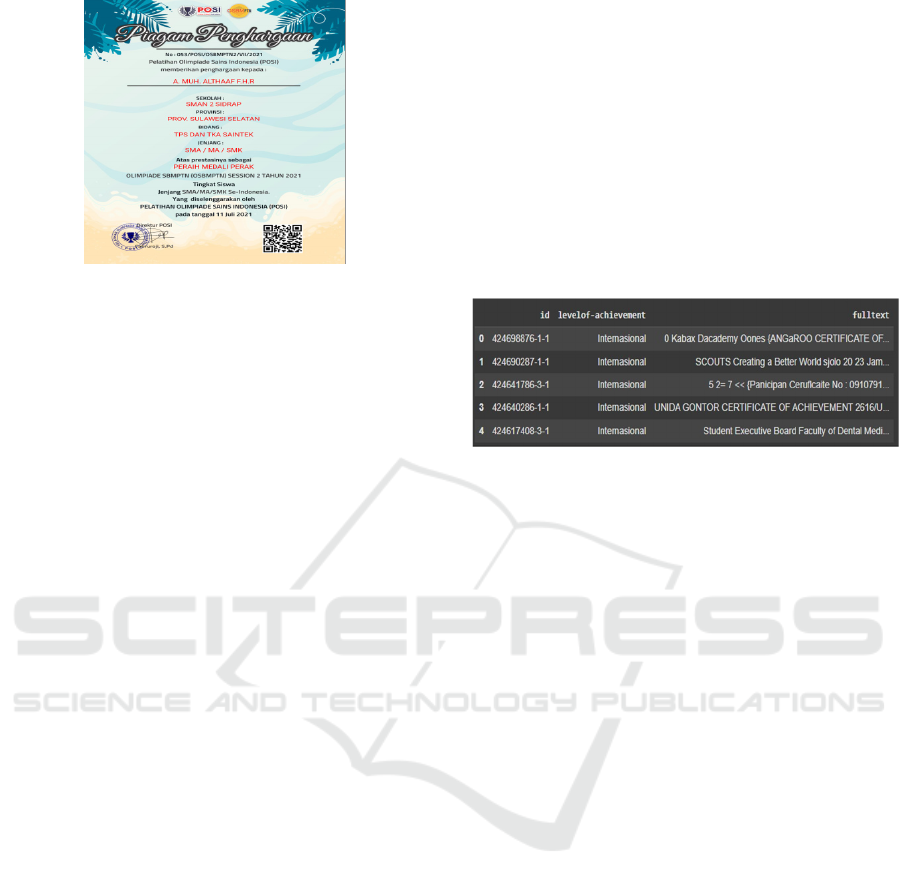
Figure 2: Examples of cleaned certificate images.
Extracting text from images is done using the
EasyOCR library configured for Indonesian and
English, considering that many certificates of
achievement use both languages. The OCR results in
the form of text are then stored as full text for each
year of registration.
3.2 Text Preprocessing
Pre-processing includes case folding, data cleaning,
tokenization, and stopword removal to prepare raw
data in a format suitable for analysis, modeling, and
machine learning tasks (Lewu et al., 2024).
Data Pre-processing is the first step in machine
learning in which the data gets transformed/encoded
so that it can be brought in such a state that now the
machine can quickly go through or parse that data
(Maharana et al., 2022).
The achievement level labeling process is carried
out based on SNBP guidelines that categorize
achievements into five classes, namely International,
National, Provincial, Regency/City, and Undefined.
Labeling is done manually by involving domain
experts to ensure the accuracy of categorization. Data
distribution shows the dominance of national
achievement levels, while international achievement
levels are in the minority. To address the imbalance
in the data, stratified sampling was conducted using
the amount of international data as a reference,
resulting in a balanced dataset with 205 national data
points, 109 district/city data points, 108 provincial
data points, 102 international data points, and 102
undefined data points.
The implementation of three preprocessing
scenarios was carried out in stages to analyze the
impact of each technique on classification accuracy.
The first scenario without preprocessing directly uses
raw text from OCR, which is then vectorized using
TF-IDF. Figure 3 provides an example of the OCR-
generated full text, where each recognized segment is
annotated with the corresponding achievement level
label. The second scenario applies text cleaning,
which includes case folding to convert all characters
into lowercase letters, punctuation removal to remove
irrelevant punctuation marks, number removal to
remove numbers that do not provide essential
information, and whitespace normalization to
normalize excess spaces. The third scenario adds
stopword removal to the text cleaning process. The
removed stopwords come from a combination of the
Sastrawi and NLTK libraries.
Figure 3: Example of OCR Output (fulltext) with labeled
achievement levels.
3.3 Model Evaluation
Model evaluation is performed using a stratified train-
test split with a ratio of 80:20 to ensure a balanced
class distribution in the training and testing data. The
K=3 value in the KNN algorithm was selected based
on the results of preliminary experiments that showed
optimal performance at this value. A small K value
was chosen to avoid bias towards the majority class
in the dataset.
The KNN model is built using the cosine distance
metric, which is more suitable for text-based data or
sparse vectors such as the results of the TF-IDF
process. After the model is trained, the test data will
be predicted to calculate the evaluation metric. A 3-
fold cross-validation process is performed using the
cross_val_score function to obtain more robust
performance estimates. Each fold maintains a
stratified class distribution to ensure the validity of
the evaluation. The evaluation metrics calculated
include accuracy and a classification report that
includes precision, recall, and F1-score for each class
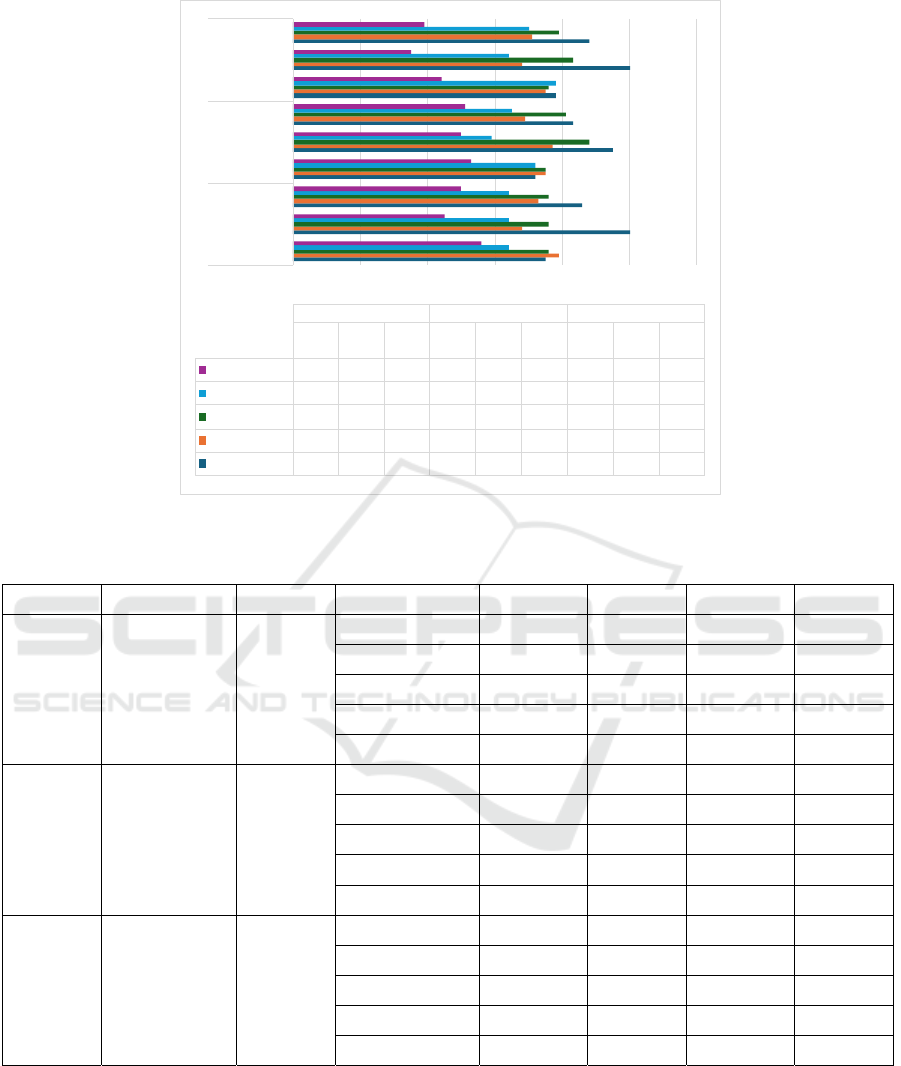
as shown in Figure 4. These evaluation results
provide a comprehensive overview of the model's
performance in general and for each class. To provide
a clearer performance overview, Table 1 presents a
detailed comparison of the evaluation metrics derived
from the three experiments.
RITECH 2025 - The International Conference on Research and Innovations in Information and Engineering Technology
234
0 0,2 0,4 0,6 0,8 1 1,2
Precision
Recall
F1-score
Precision
Recall
F1-score
Precision
Recall
F1-score
Exp 1 Exp 2 Exp 3
Exp 1 Exp 2 Exp 3
Precisio
n
Recall F1-score
Precisio
n
Recall F1-score
Precisio
n
Recall F1-score
4 - Undefined
0,56 0,45 0,5 0,53 0,5 0,51 0,44 0,35 0,39
3 - Province
0,64 0,64 0,64 0,72 0,59 0,65 0,78 0,64 0,7
2 - National
0,76 0,76 0,76 0,75 0,88 0,81 0,76 0,83 0,79
1 - City/District
0,79 0,68 0,73 0,75 0,77 0,69 0,75 0,68 0,71
0 - International
0,75 1 0,860,720,950,830,78 1 0,88
Figure 4: Comparison chart of precision, recall, and accuracy of the three experiments.
Table 1: Detailed comparison of evaluation metrics from the three experiments.
Experiment Preprocessing Accuracy Class Precision Recall F1-score Support
Exp 1
Without
Cleaning
0.714
0 (International) 0.75 1 0.86 21
1 (City/District) 0.79 0.68 0.73 22
2 (National) 0.76 0.76 0.76 41
3 (Proviice) 0.64 0.64 0.64 22
4 (Undefined) 0.56 0.45 0.5 20
Exp 2
OCR Cleaning
+ Casefolding
+ Punct
0.706
0 (International) 0.72 0.95 0.83 21
1 (City/District) 0.75 0.77 0.69 22
2 (National) 0.75 0.88 0.81 41
3 (Province) 0.72 0.59 0.65 22
4 (Undefined) 0.53 0.5 0.51 20
Exp 3
OCR Cleaning
+ Casefolding
+ Punct +
Stopword
0.722
0 (International) 0.78 1 0.88 21
1 (City/District) 0.75 0.68 0.71 22
2 (National) 0.76 0.83 0.79 41
3 (Province) 0.78 0.64 0.7 22
4 (Undefined) 0.44 0.35 0.39 20
4 CONCLUSIONS
This research concludes by creating an automatic
classification system for SNBP proof of achievement
selection using the K-Nearest Neighbor (KNN)
algorithm. The KNN algorithm's evaluation using the
cross-validation method and evaluation metrics such
as precision, recall, and F1-score shows that text
preprocessing has a significant influence on model
performance.
Optimizing the Classification of SNBP Student Candidate Files Using the K-Nearest Neighbor (KNN) Algorithm
235

The best experiment, experiment 3, which uses
complete preprocessing including stopword removal,
gives the highest accuracy of 0.722. The model in this
experiment also performed best on the international
class, with an F1-score of 0.88 and recall of 1.00,
meaning that all International data in the test set was
correctly classified. The National class performed
consistently high in all experiments, with F1-score
between 0.76 and 0.81, indicating that documents in
this category have features easily recognized by the
model. The lowest performance was consistently
found in the “Undefined” class, with an F1-score of
only 0.39 in the 3rd experiment. This indicates that
documents in this category have text structures that
are inconsistent or similar to other classes, making it
challenging to distinguish automatically. In general,
adding preprocessing stages such as stopword
removal improves the quality of feature
representation. It positively impacts classification
results, both overall (accuracy) and per class, except
for the undefined class.
These results show that the KNN method with TF-
IDF vectorization and cosine similarity can classify
proof of achievement well. This approach can speed
up the SNBP selection process automatically and
efficiently and reduce the burden of manual
classification by the committee. For future research,
further preprocessing steps such as stemming or
lemmatization should be added to make the text
feature representation cleaner and more informative.
It is also recommended to explore other classification
algorithms such as Support Vector Machine (SVM),
Naive Bayes, or Random Forest, which have different
approaches in handling text data, especially on OCR
extracted data that tends to be inconsistent.
Image preprocessing in this study was performed
manually (e.g., rotation and cropping) due to
efficiency considerations and time constraints. This
approach was chosen so that the research could focus
on testing the performance of the classification
algorithm, while automation of preprocessing could
be pursued in future studies.
DISCLAMER
AI tools were used to help with this writing so that the
grammar would be improved.
REFERENCES
Cholil, S. R., Handayani, T., Prathivi, R., & Ardianita, T.
(2021). Implementasi Algoritma Klasifikasi K-Nearest
Neighbor (KNN) Untuk Klasifikasi Seleksi Penerima
Beasiswa. IJCIT (Indonesian Journal on Computer and
Information Technology), 6(2), 118–127.
https://doi.org/10.31294/ijcit.v6i2.10438
Danny, M., Muhidin, A., & Jamal, A. (2024). Application
of the K-Nearest Neighbor Machine Learning
Algorithm to Preduct Sales of Best-Selling Products.
Brilliance: Research of Artificial Intelligence, 4(1),
255–264. https://doi.org/10.47709/brilliance.v4i1.4063
Firdaus, A., Syamsu Kurnia, M., Shafera, T., Firdaus, W. I.,
Teknik, J., Politeknik, K., & Sriwijaya -Palembang, N.
(2021). Implementasi Optical Character Recognition
(OCR) Pada Masa Pandemi Covid-19 *1. Jurnal
JUPITER, 13(2), 188–194.
Francis, S. A., & Sangeetha, M. (2025). A comparison
study on optical character recognition models in
mathematical equations and in any language. Results in
Control and Optimization, 18, 100532.
https://doi.org/10.1016/j.rico.2025.100532
Gani, M. O., Ayyasamy, R. K., Alhashmi, S. M.,
Sangodiah, A., & Fui, Y. T. (2022). ETFPOS-IDF: A
Novel Term Weighting Scheme for Examination
Question Classification Based on Bloom’s Taxonomy.
IEEE Access, 10(December), 132777–132785.
https://doi.org/10.1109/ACCESS.2022.3230592
Iqbal Mubarok, M., Purwantoro, P., & Carudin, C. (2024).
Penerapan Algoritma K-Nearest Neighbor (Knn)
Dalam Klasifikasi Penilaian Jawaban Ujisan Esai. JATI
(Jurnal Mahasiswa Teknik Informatika), 7(5), 3446–
3452. https://doi.org/10.36040/jati.v7i5.7676
Kumar, S., Kar, A. K., & Ilavarasan, P. V. (2021).
Applications of text mining in services management: A
systematic literature review. International Journal of
Information Management Data Insights, 1(1), 100008.
https://doi.org/10.1016/j.jjimei.2021.100008
Lai, Y. W., & Chen, M. Y. (2023). Review of Survey
Research in Fuzzy Approach for Text Mining. IEEE
Access, 11(February), 39635–39649.
https://doi.org/10.1109/ACCESS.2023.3268165
Lewu, R. Y., Kusrini, K., & Yaqin, A. (2024). Comparing
text classification algorithms with n-grams for
mediation prediction. IJCCS (Indonesian Journal of
Computing and Cybernetics Systems), 18(2).
https://doi.org/10.22146/ijccs.93929
Maharana, K., Mondal, S., & Nemade, B. (2022). A review:
Data pre-processing and data augmentation techniques.
Global Transitions Proceedings, 3(1), 91–99.
https://doi.org/10.1016/j.gltp.2022.04.020
Ni’mah, A. T., & Syuhada, F. (2022). Term Weighting
Based Indexing Class and Indexing Short Document for
Indonesian Thesis Title Classification. Journal of
Computer Science and Informatics Engineering (J-
Cosine), 6
(2), 167–175.
https://doi.org/10.29303/jcosine.v6i2.471
Nugraha, K. A. (2024). Penerapan Optical Character
Recognition untuk Pengenalan Variasi Teks pada
Media Presentasi Pembelajaran 69. Jurnal Buana
Informatika, 69–78.
Pertiwi, L. (2022). Penerapan Algoritma Text Mining,
Steaming Dan Texrank Dalam Peringkasan Bahasa
RITECH 2025 - The International Conference on Research and Innovations in Information and Engineering Technology
236

Inggris. BIMASATI(Bulletin of Multi-Disciplinary
Science and Applied Technology), 1(3), 100–104.
Sholehhudin, M., Fauzi Ali, M., & Adinugroho, S. (2018).
Implementasi Metode Text Mining dan K-Means
Clustering untuk Pengelompokan Dokumen Skripsi (
Studi Kasus : Universitas Brawijaya ). 2(11), 5518–
5524.
Taha, K., Yoo, P. D., Yeun, C., Homouz, D., & Taha, A.
(2024). A comprehensive survey of text classification
techniques and their research applications:
Observational and experimental insights. Computer
Science Review,
Optimizing the Classification of SNBP Student Candidate Files Using the K-Nearest Neighbor (KNN) Algorithm
237
