
Improving Tsunami Prediction Accuracy Through Stacking
Ensemble and Machine Learning Data Optimization
Hendi Firmansyah
1,3 a
, Ingrid Nurtanio
1b
, Intan Sari Areni
2c
, Joshua Purba
3d
1
Department of Informatics, Hasanuddin University, Borongloe, Bontomarannu, Gowa Regency, South Sulawesi, Indonesia
2
Department of Electrical Engineering, Hasanuddin University, Borongloe, Bontomarannu,
Gowa Regency, South Sulawesi, Indonesia
3
Gowa Geophysical Station, Agency for Meteorology, Climatology and Geophysics (BMKG), Gowa, Tamarunang,
Somba Opu, Gowa Regency, South Sulawesi, Indonesia
Keywords: Tsunami, Stacking Ensemble, Machine Learning, Logistic Regression, Early Warning System.
Abstract: Accurate tsunami prediction is critical for disaster risk reduction. We propose a stacking ensemble that
combines Decision Tree (DT), Random Forest (RF), Support Vector Machine (SVM), K‑Nearest Neighbors
(KNN), Artificial Neural Network (ANN), Naïve Bayes (NB), and Gradient Boosting (GB) with a Logistic
Regression meta‑learner. Global tectonic and volcanic datasets from BMKG, NOAA, and USGS are unified
under a domain‑aware pipeline (imputation, normalization, outlier mitigation, and imbalance handling). The
model outperforms single classifiers, achieving ROC‑AUC 90.1% (tectonic) with accuracy 84.2%, and
ROC‑AUC 87.6% (volcanic) with accuracy 85.8%. Feature‑level signals align with geophysical intuition:
magnitude, depth, and subduction status dominate tectonic cases, while VEI and volcano elevation are most
informative for volcanic events. The limitation is a modest volcanic recall of 59.3%. Ablation indicates
SMOTE improves volcanic recall but not tectonic, highlighting domain‑specific effects of oversampling. The
contribution lies in a unified, deployable pipeline spanning tectonic–volcanic sources that generalizes across
heterogeneous data and supports near‑real‑time operation on commodity hardware. Future work includes
external validation, threshold calibration, and explainability integration.
1 INTRODUCTION
Tsunamis are among the most catastrophic natural
hazards, posing severe threats to coastal communities
worldwide (BMKG, 2024; Horspool et al., 2014).
Indonesia, located at the convergence of the Eurasian,
Indo-Australian, and Pacific plates within the Pacific
Ring of Fire, is highly vulnerable to such events
(Purba et al., 2024, 2025). This tectonic configuration
drives frequent seismic and volcanic activity,
elevating tsunami risk (Hall, 2002; Hutchings &
Mooney, 2021; Irawan Saputra & Hakim, 2022;
Purba et al., 2024; PuSGeN, 2024). Historical
tsunamis, including the 2004 Aceh event (Tursina &
Syamsidik, 2019), the 2018 Palu event (Fang et al.,
2019), and the 2018 Sunda Strait volcanic tsunami
a
https://orcid.org/0009-0007-5382-9313
b
https://orcid.org/0000-0002-3053-4201
c
https://orcid.org/0000-0002-6248-3656
d
https://orcid.org/0009-0006-7959-8288
(Zamroni et al., 2021), underscore the urgency of
accurate, real‑time early warning systems (Wang et
al., 2023; Wang & Satake, 2021).
Traditional forecasting relies on physics‑based
numerical simulations (Yang et al., 2019). While
robust, such models can be computationally intensive
and less suited to strict real‑time constraints. The
growing availability of global seismic and volcanic
datasets enriched with magnitude, depth, eruption
indices, and spatiotemporal attributes opens
opportunities for machine learning (ML) (Mulia et al.,
2022; Satish et al., 2025; Siswanto et al., 2022;
Wibowo et al., 2023). Nevertheless, prediction
remains challenging due to the non‑linear,
imbalanced, and heterogeneous nature of geophysical
data (Juanara & Lam, 2025; Wibowo et al., 2023).
224
Firmansyah, H., Nurtanio, I., Areni, I. S. and Purba, J.
Improving Tsunami Prediction Accuracy Through Stacking Ensemble and Machine Learning Data Optimization.
DOI: 10.5220/0014276300004928
Paper published under CC license (CC BY-NC-ND 4.0)
In Proceedings of the 1st International Conference on Research and Innovations in Information and Engineering Technology (RITECH 2025), pages 224-230
ISBN: 978-989-758-784-9
Proceedings Copyright © 2025 by SCITEPRESS – Science and Technology Publications, Lda.
Ensemble learning, particularly stacking, can
integrate diverse base learners through a meta‑learner
to improve generalization (Fauzi & Mizutani, 2020;
Irawan Saputra & Hakim, 2022; M & Mohamed,
2024) and has been applied in disaster mapping and
risk assessment (Adriano et al., 2019; Takahashi et
al., 2017). However, few studies jointly integrate
tectonic and volcanic tsunami events within a unified,
imbalance‑aware, and deployment‑oriented pipeline.
This study develops a binary tsunami classifier
using unified global tectonic and volcanic datasets
(BMKG, NOAA, USGS). We employ a stacking
ensemble comprising Decision Tree, Random Forest,
Support Vector Machine, K-Nearest Neighbors,
Artificial Neural Network, Naïve Bayes, and
Gradient Boosting as base learners, with Logistic
Regression as the meta-learner. A domain-aware
preprocessing pipeline addresses missing data,
scaling, outliers, and class imbalance. Our
contributions are: (i) a single predictive pipeline
spanning tectonic and volcanic sources, (ii) a
systematic comparison against single classifiers and
boosting methods, and (iii) an emphasis on
operational readiness and interpretability.
2 METHODOLOGY
2.1 Methodology Structure
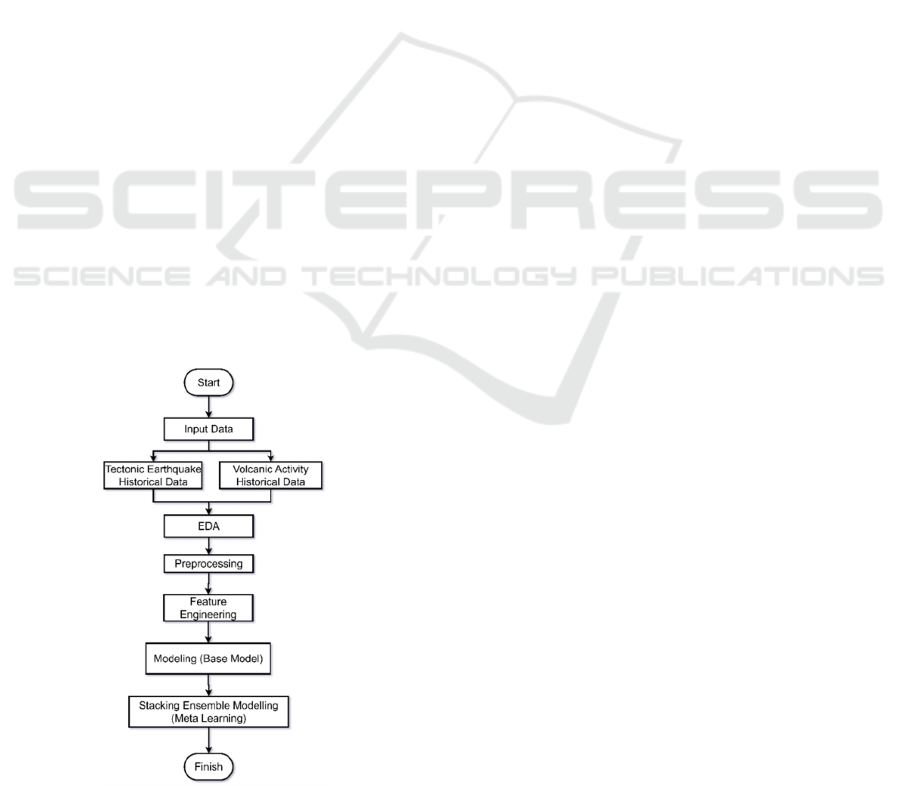
As summarized in Figure 1, the methodology handles
multivariate, heterogeneous, and imbalanced
geophysical datasets.
Figure 1: The workflow of the end-to-end pipeline.
The workflow ingests structured historical event data
(tectonic earthquakes and volcanic activity), proceeds
with Exploratory Data Analysis (EDA), and continues
with preprocessing, feature engineering/selection,
model construction, and meta-learning via stacking.
(Mulia et al., 2022; Siswanto et al., 2022).
Datasets were partitioned into 80% training and
20% testing using stratified sampling to preserve class
distributions (tectonic: 2,748 train; 687 test; volcanic:
451 train; 113 test). Baseline models used 10-fold
stratified CV; the stacking ensemble was tuned with
5-fold GridSearchCV. To prevent leakage, all
transformers (imputation, scaling, encoding, outlier
mitigation, and imbalance handling) were fit only on
training folds and then applied to validation/test data.
Metrics: Accuracy, Precision, Recall, F1, ROC-AUC.
2.2 Data Sources and Features
The study integrates records from BMKG, NOAA,
and USGS (4360 BC–2024) covering tectonic-
earthquake and volcanic-activity events. Raw data
were filtered for consistency, merged by
spatiotemporal proximity, and manually cleaned.
Final core feature set before encoding (≈12 core
variables), later expanded by one-hot encoding and
engineered attributes:
Seismic/Tectonic (2); (1) Magnitude (Mw):
moment magnitude of mainshock (Mw). Source:
USGS/BMKG. (2) Depth: hypocenter depth (km).
Source: USGS/BMKG.
Volcanic (3); (3) Eq: local seismic magnitude
associated with volcanic activity (Mw). Source:
BMKG/USGS. (4) Elevation: volcano summit
elevation (m). Source: GVP/NOAA. (5) VEI:
Volcanic Explosivity Index (ordinal). Source:
NOAA/NCEI.
Spatial (4); (6–7) Latitude, Longitude (deg).
Source: USGS/BMKG. (8) Distance_to_coast_km:
shortest geodesic distance to coastline (km). Source:
Natural Earth/NOAA GSHHS; computed via
Haversine to shoreline geometry. (9)
is_subduction_zone: 1 if within mapped subduction
belt, else 0 (unitless). Source: BMKG/USGS slab
references or RoF polygon.
Temporal (1); (10) days_since_prev: time gap to
previous nearby event (days). Source: derived from
event ordering. Calendar (auxiliary): Year (YYYY),
Month (1–12), Day (1–31) derived from event
timestamps (unitless). Used primarily in the volcanic
analysis and encoded as categorical (one-hot).
Categorical/Context (2); (11) Country (one-hot).
Source: catalogs. (12) Volcano Type (one-hot;
volcanic branch only). Source: GVP/NOAA.
Improving Tsunami Prediction Accuracy Through Stacking Ensemble and Machine Learning Data Optimization
225
Engineering & selection. Continuous features
were Min–Max scaled (0–1); missing values handled
by median (numerical)/mode (categorical); outliers
mitigated by Z-score capping (|z|>3). Categorical
variables were one-hot encoded (drop-first). Pearson
correlation removed redundancies and Recursive
Feature Elimination (RFE) (RF/LR estimators)
retained the most predictive subset per domain.
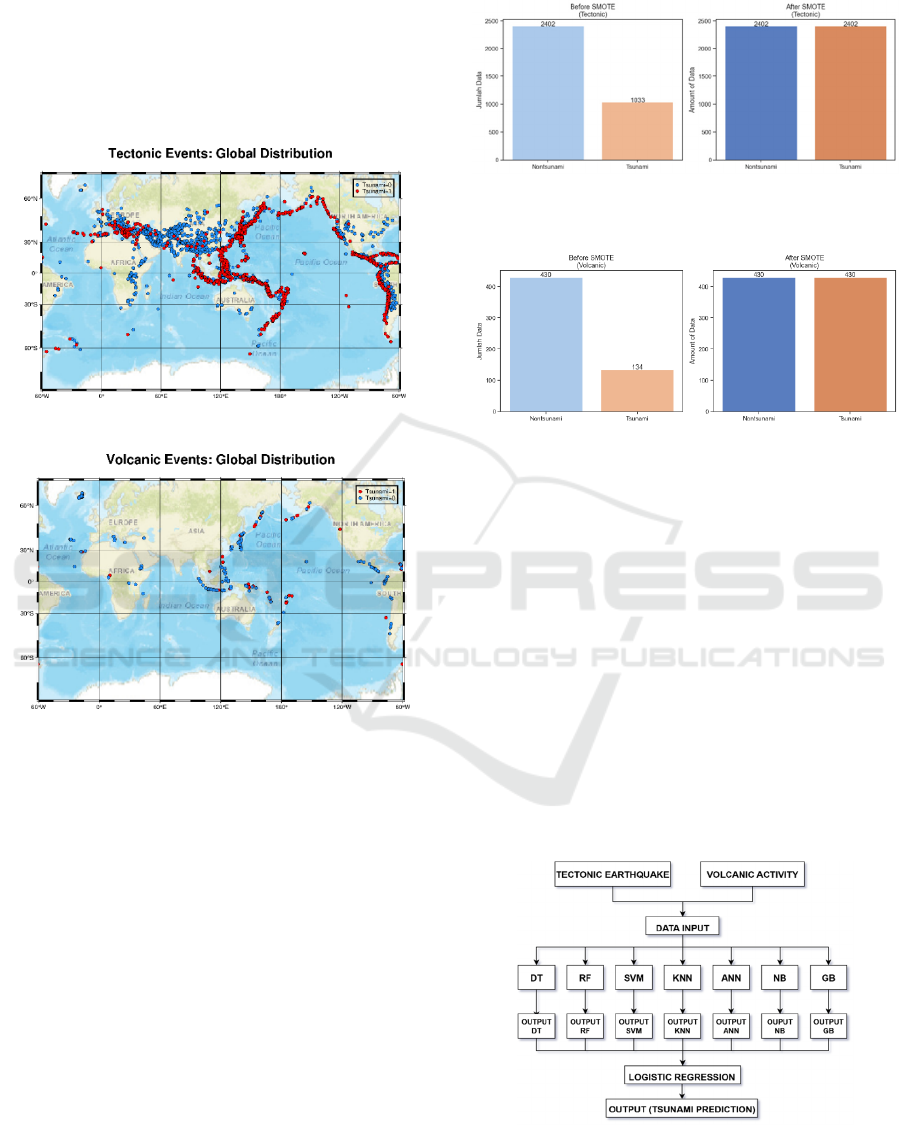
Figure 2: Tectonic events: global distribution.
Figure 3: Volcanic activity: global distribution.
2.3 Exploratory Data Analysis and
Preprocessing
EDA (statistical summaries, heatmaps, histograms,
boxplots) revealed class imbalance (tectonic ≈ 31%,
volcanic ≈ 21%), skewness (depth, VEI), and
multicollinearity among geophysical indicators. The
preprocessing pipeline comprised: (i) removal of
duplicates and irrelevant features, (ii) median or
mode imputation for missingness variables, (iii)
outlier mitigation via Z‑score, (iv) Min–Max scaling,
and (v) SMOTE applied experimentally to test recall
improvements for rare tsunami events.
Figure 4 visualizes the class distribution for
tectonic events before and after SMOTE, while
Figure 5 presents the corresponding distribution for
volcanic events. For tectonic events, tsunami cases
increased from 1,033 to 2,402, reaching parity with
non‑tsunami samples. For volcanic events, tsunami
records increased from 134 to 430, balancing the
minority class.
Figure 4: Class distribution before and after SMOTE
(tectonic).
Figure 5: Class distribution before and after SMOTE
(volcanic).
2.4 Stacking Ensemble Architecture
This study adopts a two‑layer stacking framework.
Layer‑1 base learners (Decision Tree (DT), Random
Forest (RF), Support Vector Machine (SVM),
K‑Nearest Neighbors (KNN), Artificial Neural
Network (ANN), Naïve Bayes (NB), and Gradient
Boosting (GB)) were trained per domain and
produced tsunami-class probabilities. These out-of-
fold probabilities formed meta-features for Layer‑2
Logistic Regression (LR) meta‑learner.
Hyperparameters were tuned with GridSearchCV
(5‑fold) for comparability across models, solver
choices for LR solvers liblinear (tectonic) and lbfgs
(volcanic) were selected based on tuning outcomes.
Figure 6: Stacking ensemble architecture (base‑learner
probabilities fused by Logistic Regression).
RITECH 2025 - The International Conference on Research and Innovations in Information and Engineering Technology
226

3 RESULTS AND DISCUSSION
3.1 Main Findings
The stacking ensemble was evaluated against all base
learners. On the tectonic dataset, it achieved accuracy
84.2%, precision 78.3%, recall 66.2%, F1-score
71.7%, and ROC-AUC 90.1%. On the volcanic
dataset, it reached accuracy 85.8%, precision 76.2%,
recall 59.3%, F1-score 66.7%, and ROC-AUC
87.6%.
SMOTE ablation. For tectonic data, recall
decreased from 70.0% (without SMOTE) to 66.2%
(with SMOTE), while macro-averaged F1-score
increased from 34.0% to 71.7%. For volcanic data,
recall improved from 55.5% to 59.3% and F1-score
from 61.2% to 66.7%.
Comparison to baselines. Stacking achieved the
best trade-off across metrics and surpassed DT, RF,
SVM, KNN, ANN, NB, and GB.
Table 1: Ablation of SMOTE for the stacking ensemble.
Domain Stacking Accurac
y
Precision Recall F1-score ROC-AUC
Tectonic
Without SMOTE 0.847 0.771 0.700 0.340 0.903
With SMOTE 0.843 0.783 0.662 0.717 0.901
Volcanic
Without SMOTE 0.831 0.681 0.555 0.612 0.867
With SMOTE 0.858 0.762 0.593 0.667 0.876
Table 2: Performance of base learners vs. stacking ensemble.
Model Domain Accuracy Precision Recall F1-score ROC-AUC
DT Tectonic 0.785 0.648 0.634 0.640 0.742
RF Tectonic 0.830 0.751 0.653 0.698 0.904
SVM Tectonic 0.699 0.000 0.000 0.000 0.655
KNN Tectonic 0.726 0.561 0.427 0.484 0.722
ANN Tectonic 0.723 0.717 0.209 0.258 0.808
NB Tectonic 0.503 0.372 0.943 0.533 0.689
GB Tectonic 0.839 0.748 0.708 0.727 0.902
Stacking Tectonic 0.842 0.783 0.662 0.717 0.901
DT Volcanic 0.789 0.559 0.502 0.518 0.690
RF Volcanic 0.855 0.766 0.553 0.639 0.890
SVM Volcanic 0.762 0.000 0.000 0.000 0.459
KNN Volcanic 0.711 0.267 0.120 0.162 0.540
ANN Volcanic 0.623 0.307 0.429 0.311 0.587
NB Volcanic 0.439 0.288 0.927 0.439 0.821
GB Volcanic 0.835 0.714 0.523 0.599 0.865
Stacking Volcanic 0.858 0.762 0.593 0.667 0.876
3.2 Feature Importance Analysis
This study reports model-specific importances for
tree-based learners (RF/GB using mean decrease in
impurity/gain) and model-agnostic permutation
importance computed on stratified 5-fold out-of-fold
predictions, so results are comparable across SVM,
KNN, and the stacking meta-learner.
Volcanic dataset (Figure 7). The RF ranks
Elevation as the most influential feature, followed by
Year, Longitude, Days_since_prev, Latitude, and
Distance_to_coast_km; calendar fields (Month/Day)
and VEI still contribute, while the indicator
type_Submarine volcano appears in the tail. The
permutation points broadly corroborate the RF
ordering, indicating that the signal is not an artifact of
tree splits.
Interpretation for EWS: higher Elevation and
larger VEI are consistent with eruption energy and
source geometry controlling initial wave generation;
Improving Tsunami Prediction Accuracy Through Stacking Ensemble and Machine Learning Data Optimization
227
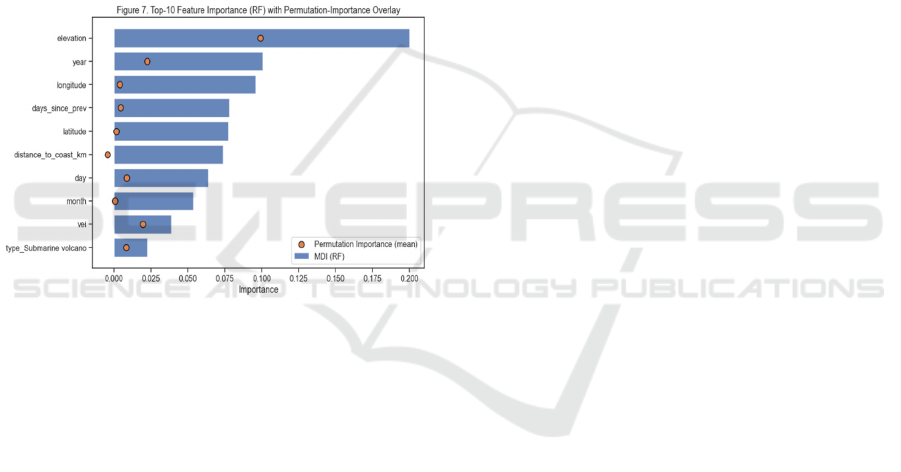
Distance_to_coast_km and the coordinate terms
capture coastal coupling and regionalization;
Days_since_prev suggests temporal clustering;
Month/Day/Year likely proxy regional/seasonal
reporting and should be interpreted cautiously (useful
for prediction, not causation).
Tectonic dataset (textual summary). Importance
concentrates on Magnitude (Mw) and Depth, with
is_subduction_zone and Distance_to_coast_km next,
and Latitude/Longitude adding spatial context—
aligning with shallow large events in subduction
settings being more tsunamigenic.
Stacking meta-weights. In the meta-learner,
Logistic Regression assigns larger coefficients to
RF/GB probabilities on the tectonic set and to
RF/ANN on the volcanic set, indicating
complementary decision boundaries across learners.
Figure 7: Top-10 feature importance (RF) with
permutation-importance overlay (volcanic dataset).
3.3 Discussion
Sensitivity vs. specificity. The tectonic model is
more sensitive to true tsunami events it shows by
Recall 66.2% and F1-score 71.7%, while the volcanic
model attains slightly higher overall accuracy 85.8%
and lower false alarms. Both domains achieve strong
ROC‑AUC 90.1% and 87.6%, indicating robust
discrimination across thresholds (Fawcett, 2006).
Effect of class balancing. The SMOTE ablation
reveals domain‑specific behavior, it improves
volcanic recall from 55.5% to 59.3% but does not
improve tectonic recall 70.0% to 66.2%. This
suggests different class‑overlap and rarity
characteristics between domains; oversampling helps
the rarer volcanic positives but may introduce
borderline noise in tectonic settings. Remedies
include class weighting, threshold tuning, and
probability calibration; more targeted rebalancing
(e.g., borderline) can be explored in future work.
Baseline comparison and significance. As
reported in Results, the stacking ensemble
outperforms strong baselines across metrics and
achieves significant ROC‑AUC gains, supporting the
effectiveness and robustness of stacked
generalization (Bergstra & Bengio, 2012; Sadaka &
Dutykh, 2020; Wolpert, 1992).
SVM behavior under imbalance. The SVM
produced zero precision, recall, and F1-score in some
folds because no positive predictions were made
(decision scores below the default threshold for the
positive class). Under imbalance, an RBF‑kernel
SVM can bias toward the majority class, class
weighting, threshold optimization, calibration, or
post‑encoding SMOTE can mitigate this tendency.
Operational feasibility. On commodity CPUs,
average inference latency is <0.1 s per event
(cold‑start <1 s; throughput 8–12 events/s), indicating
near‑real‑time feasibility. For integration with
operational warning systems (e.g., InaTEWS,
DONET, S‑Net), scaling will require model pruning,
quantization, and/or GPU acceleration alongside
interoperability checks (Gusman et al., 2014;
Takahashi et al., 2017).
Real-case verification. We injected parameters
from Aceh 2004, Palu 2018, Sunda Strait 2018,
Tonga 2022 into the deployment-synchronized
pipeline; all yielded tsunamigenic predictions with
varying margins, supporting external face validity
while motivating region-specific calibration.
Positioning in the literature. Ensemble ML has
been increasingly applied in hazard prediction and
complements physics‑based approaches; our results
(strong ROC‑AUC with balanced recall‑precision
trade‑offs) are consistent with prior findings on
heterogeneous, imbalanced geophysical data (Liu et
al., 2021; Mulia et al., 2022; Sukmana et al., 2024;
Trogrlić et al., 2022; Zhonghan, 2024).
Limitations and next steps. Lower volcanic
recall 59.3 reflects the scarcity and complexity of
volcanic‑triggered tsunamis (Iwabuchi et al., 2025).
We will pursue external validation (e.g., Japan,
Chile), real‑time testing, and explainability (e.g.,
SHAP) to align feature importance with geophysical
insight, while expanding robustness checks and
exploring synthetic data from numerical tsunami
models.
4 CONCLUSIONS
This study introduced a unified, deployable pipeline
for tsunami prediction that integrates global tectonic-
earthquake and volcanic-activity data and addresses
RITECH 2025 - The International Conference on Research and Innovations in Information and Engineering Technology
228

practical issues such as missing values, outliers,
feature scaling, and class imbalance. A two-layer
stacking ensemble with seven complementary base
learners fused by a Logistic Regression meta-learner
consistently outperformed individual classifiers and
conventional voting ensembles across domains.
On tectonic events, the model achieved an
accuracy 84.2% and ROC-AUC 90.1% with a recall
66.2% for the tsunami class. On volcanic events, it
reached accuracy 85.8% and ROC-AUC 87.6% with
a Recall 59.3%. Ablation experiments showed that
oversampling benefits the volcanic domain but not
the tectonic domain under our settings, highlighting
the need for domain-specific balancing strategies
rather than a one-size-fits-all approach.
The end-to-end system runs in near real time on
commodity CPUs (sub-second cold start and <0.1-
second per-event inference), indicating practical
feasibility for integration with operational early-
warning workflows. Remaining challenges include
improving sensitivity to rare volcanic tsunamis and
validating the pipeline across additional regions.
Overall, these results position stacking-based
learning as a strong and pragmatic choice for tsunami
early-warning decision support.
Future work will focus on external and real-time
validation in other tsunami-prone regions, threshold
tuning and probability calibration to improve
sensitivity, and explainability (e.g., SHAP) to link
feature importance with geophysical insight for more
trustworthy decision support.
ACKNOWLEDGEMENTS
The authors thank Hasanuddin University for
institutional support, BMKG for data access, and
NOAA/USGS for global datasets, as well as the
constructive feedback from RITECH 2025.
Declaration of Generative AI and AI-Assisted
Technologies. During the preparation of this work,
the authors used Grammarly to improve grammar and
readability with human oversight. All analyses,
results, and conclusions were designed, implemented,
and verified by the authors, who take full
responsibility for the integrity and accuracy of the
work.
REFERENCES
Adriano, B., Xia, J., Baier, G., Yokoya, N., & Koshimura,
S. (2019). Multi-source data fusion based on ensemble
learning for rapid building damage mapping during the
2018 Sulawesi earthquake and Tsunami in Palu,
Indonesia. Remote Sensing, 11(7).
https://doi.org/10.3390/RS11070886
Bergstra, J., & Bengio, Y. (2012). Random search for
hyper-parameter optimization. Journal of Machine
Learning Research, 13, 281–305.
BMKG. (2024). Katalog Tsunami Indonesia Tahun 416-
2024.
Fang, J., Xu, C., Wen, Y., Wang, S., Xu, G., Zhao, Y., &
Yi, L. (2019). The 2018 Mw 7.5 Palu earthquake: A
supershear rupture event constrained by InSAR and
broadband regional seismograms. Remote Sensing,
11(11), 1–15. https://doi.org/10.3390/rs11111330
Fauzi, A., & Mizutani, N. (2020). Potential of deep
predictive coding networks for spatiotemporal tsunami
wavefield prediction. Geoscience Letters, 7.
https://doi.org/10.1186/s40562-020-00169-1
Fawcett, T. (2006). An introduction to ROC analysis.
Pattern Recognition Letters, 27(8), 861–874.
https://doi.org/https://doi.org/10.1016/j.patrec.2005.10
.010
Gusman, A. R., Tanioka, Y., MacInnes, B. T., & Tsushima,
H. (2014). A methodology for near-field tsunami
inundation forecasting: Application to the 2011 Tohoku
tsunami. Journal of Geophysical Research: Solid
Earth, 119(11), 8186–8206.
https://doi.org/https://doi.org/10.1002/2014JB010958
Hall, R. (2002). Cenozoic geological and plate tectonic
evolution of SE Asia and the SW Pacific: computer-
based reconstructions, model and animations. Journal
of Asian Earth Sciences, 20(4), 353–431.
https://doi.org/https://doi.org/10.1016/S1367-
9120(01)00069-4
Horspool, N., Pranantyo, I., Griffin, J., Latief, H.,
Natawidjaja, D. H., Kongko, W., Cipta, A., Bustaman,
B., Anugrah, S. D., & Thio, H. K. (2014). A
probabilistic tsunami hazard assessment for Indonesia.
Natural Hazards and Earth System Sciences, 14(11),
3105–3122. https://doi.org/10.5194/nhess-14-3105-
2014
Hutchings, S. J., & Mooney, W. D. (2021). The Seismicity
of Indonesia and Tectonic Implications. Geochemistry,
Geophysics, Geosystems, 22(9), e2021GC009812.
https://doi.org/https://doi.org/10.1029/2021GC009812
Irawan Saputra, D., & Hakim, D. L. (2022). Implementasi
Algoritma Gaussian Naive Bayes Classifier Untuk
Prediksi Potensi Tsunami Berbasis Mikrokontroler.
EPSILON: Journal of Electrical Engineering and
Information Technology, 20(2), 122–138.
https://doi.org/10.55893/epsilon.v20i2.94
Iwabuchi, Y., Baba, T., Hori, T., Okada, M., & Igarashi, Y.
(2025). Tsunami height estimation via Gaussian
process regression using the maximum absolute
pressure change and time from seafloor sensors off the
Kii Peninsula, Japan. Marine Geophysical Research,
46(3), 22. https://doi.org/10.1007/s11001-025-09583-6
Juanara, E., & Lam, C. Y. (2025). Machine Learning
Approaches for Early Warning of Tsunami Induced by
Volcano Flank Collapse and Implication for Future
Risk Management: Case of Anak Krakatau. Ocean
Improving Tsunami Prediction Accuracy Through Stacking Ensemble and Machine Learning Data Optimization
229

Modelling, 194, 102497.
https://doi.org/https://doi.org/10.1016/j.ocemod.2025.
102497
Liu, C. M., Rim, D., Baraldi, R., & LeVeque, R. J. (2021).
Comparison of Machine Learning Approaches for
Tsunami Forecasting from Sparse Observations. Pure
and Applied Geophysics, 178(12), 5129–5153.
https://doi.org/10.1007/s00024-021-02841-9
M, Y., & Mohamed, S. (2024). Computational Analysis of
Tsunami Wave Run-Up by Implementation of
TIMPULSE-SIM Model with Japan and Indonesian
Seismic Tsunami. WSEAS TRANSACTIONS ON
ENVIRONMENT AND DEVELOPMENT, 20, 701–720.
https://doi.org/10.37394/232015.2024.20.67
Mulia, I. E., Ueda, N., Miyoshi, T., Gusman, A. R., &
Satake, K. (2022). Machine learning-based tsunami
inundation prediction derived from offshore
observations. Nature Communications, 13(1).
https://doi.org/10.1038/s41467-022-33253-5
NOAA. (n.d.-a). NCEI/WDS Global Historical Tsunami
Database, 2100 BC to Present.
https://doi.org/10.7289/V5PN93H7
NOAA. (n.d.-b). NCEI/WDS Global Significant Volcanic
Eruptions Database, 4360 BC to Present.
https://doi.org/10.7289/V5JW8BSH
Purba, J., Priadi, R., Frando, M., & Pertiwi, I. (2025). The
Purpri Fault: A Newly Identified Active Fault in East
Kolaka, Indonesia, Based on HypoDD and DInSAR.
Geološki anali Balkanskoga poluostrva, 86(1), 121–
143. https://doi.org/10.2298/GABP250417005P
Purba, J., Restele, L. O., Hadini, L. O., Usman, I., Hasria,
H., & Harisma, H. (2024). SPATIAL STUDY OF
SEISMIC HAZARD USING CLASSICAL
PROBABILISTIC SEISMIC HAZARD ANALYSIS
(PSHA) METHOD IN THE KENDARI CITY AREA.
Indonesian Physical Review, 7(3), 300–318.
https://doi.org/10.29303/ipr.v7i3.325
PuSGeN. (2024). Peta Sumber Dan Bahaya Gempa
Indonesia Tahun 2024.
Sadaka, G., & Dutykh, D. (2020). Adaptive Numerical
Modelling of Tsunami Wave Generation and
Propagation with FreeFem++.
https://doi.org/10.20944/preprints202008.0616.v1
Satish, S., Gonaygunta, H., Yadulla, A. R., Kumar, D.,
Maturi, M. H., Meduri, K., De La Cruz, E., Nadella, G.
S., & Sajja, G. S. (2025). Forecasting the Unseen:
Enhancing Tsunami Occurrence Predictions with
Machine-Learning-Driven Analytics. Computers,
14(5). https://doi.org/10.3390/computers14050175
Siswanto, S., Ngatono, & Febri Saputra, S. (2022).
Prototype Sistem Peringatan Dini Bencana Gempa
Bumi Dan Tsunami Berbasis Internet of Things.
PROSISKO: Jurnal Pengembangan Riset dan
Observasi Sistem Komputer, 9(1), 60–66.
https://doi.org/10.30656/prosisko.v9i1.4743
Sukmana, H. T., Durachman, Y., Amri, & Supardi. (2024).
Comparative Analysis of SVM and RF Algorithms for
Tsunami Prediction: A Performance Evaluation Study.
Journal of Applied Data Sciences, 5
(1), 84–99.
https://doi.org/10.47738/jads.v5i1.159
Takahashi, N., Imai, K., Ishibashi, M., Sueki, K., Obayashi,
R., Tanabe, T., Tamazawa, F., Baba, T., & Kaneda, Y.
(2017). Real-time tsunami prediction system using
DONET. Journal of Disaster Research, 12, 766–774.
https://doi.org/10.20965/jdr.2017.p0766
Trogrlić, R., van den Homberg, M., Budimir, M.,
McQuistan, C., Sneddon, A., & Golding, B. (2022).
Early Warning Systems and Their Role in Disaster Risk
Reduction (hal. 11–46). https://doi.org/10.1007/978-3-
030-98989-7
Tursina, & Syamsidik. (2019). Reconstruction of the 2004
Tsunami Inundation Map in Banda Aceh Through
Numerical Model and Its Validation with Post-Tsunami
Survey Data. IOP Conference Series: Earth and
Environmental Science, 273(1).
https://doi.org/10.1088/1755-1315/273/1/012008
Wang, Y., Imai, K., Miyashita, T., Ariyoshi, K., Takahashi,
N., & Satake, K. (2023). Coastal tsunami prediction in
Tohoku region, Japan, based on S-net observations
using artificial neural network. Earth, Planets and
Space, 75(1). https://doi.org/10.1186/s40623-023-
01912-6
Wang, Y., & Satake, K. (2021). Real-time tsunami data
assimilation of S-Net pressure gauge records during the
2016 fukushima earthquake. Seismological Research
Letters, 92(4), 2145–2155.
https://doi.org/10.1785/0220200447
Wibowo, G. C. adhi, Prasetyo, S. Y. J., & Sembiring, I.
(2023). Tsunami Vulnerability and Risk Assessment in
Banyuwangi District using machine learning and
Landsat 8 image data. MATRIK : Jurnal Manajemen,
Teknik Informatika dan Rekayasa Komputer, 22(2),
365–380. https://doi.org/10.30812/matrik.v22i2.2677
Wolpert, D. (1992). Stacked Generalization. Neural
Networks, 5, 241–259. https://doi.org/10.1016/S0893-
6080(05)80023-1
Yang, Y., Dunham, E. M., Barnier, G., & Almquist, M.
(2019). Tsunami Wavefield Reconstruction and
Forecasting Using the Ensemble Kalman Filter.
Geophysical Research Letters, 46(2), 853–860.
https://doi.org/https://doi.org/10.1029/2018GL080644
Zamroni, A., Rizki Widiatmoko, F., & Siamasahari, M.
(2021). The Sunda Strait tsunami, Indonesia: learning
from the similar events in the past.
https://doi.org/10.4108/eai.30-8-2021.2311510
Zhonghan, C. (2024). Application of UAV remote sensing
in natural disaster monitoring and early warning: an
example of flood and mudslide and earthquake
disasters. Highlights in Science, Engineering and
Technology, 85, 924–933.
https://doi.org/10.54097/zak5hp77
RITECH 2025 - The International Conference on Research and Innovations in Information and Engineering Technology
230
