
Parallel Micro-Batching and Scalable Inferencing for ML-Based
Malicious Traffic Detection
Achmad Basuki
1
, Widhi Yahya
1
, Dzaki R. Malik
1
, Rizal Setya Perdana
1
, Kasyful Amron
1
,
Achmad Husni Thamrin
2
, Andrey Ferriyan
2
and Muhammad Niswar
3
1
Universitas Brawijaya, Indonesia
2
Keio University, Japan
3
Universitas Hasanuddin, Indonesia
fi
Keywords:
NIDS, Machine Learning, High-speed Network, Passive Optical Tapping, Scalability.
Abstract:
Network intrusion detection systems based on machine learning (ML-IDS) face significant challenges in high-
speed network environments, such as gigabit-scale packet capture and real-time inference under dynamic
traffic conditions. Efficiently handling these challenges is critical to maintaining accurate and timely detection
without overwhelming the system resources. This paper presents a scalable ML-IDS architecture featuring a
novel parallel micro-batching inference framework integrated with passive optical tapping for non-intrusive
traffic monitoring. The proposed inference architecture is critical to achieving a balance between high classifi-
cation accuracy and computational efficiency. Experimental results demonstrate a 2.65× throughput improve-
ment over traditional sequential processing while maintaining sub-5ms decision times, even under variable
traffic loads. Furthermore, the architecture supports horizontal scaling to accommodate growing network
demands, ensuring sustained low-latency detection performance. These contributions establish a robust foun-
dation for deploying ML-IDS in high-speed network environments.
1 INTRODUCTION
The rapid advancement of computer networking tech-
nologies, including digital twins, has enabled the sim-
ulation and optimization of complex systems across
industrial, residential, banking, and educational sec-
tors—leading to a surge in network users and grow-
ing attack surfaces. As a result, cyber threats have be-
come increasingly sophisticated, posing serious risks
to individuals, organizations, and society by compro-
mising the core tenets of information security: Con-
fidentiality, Integrity, and Availability (CIA), with
consequences ranging from financial and reputational
damage to threats to critical infrastructure and human
safety (Thakkar and Lohiya, 2023). In response, insti-
tutions such as universities and industries are enhanc-
ing their network security to provide safer Internet
access by managing both controlled factors (e.g., hu-
man behavior, access regulation through formal pro-
cedures, and policy enforcement) and uncontrolled
ones, such as anomalous traffic and malware propa-
gation. To address these challenges, organizations in-
creasingly rely on security technologies like firewalls,
Intrusion Detection Systems (IDS), and Intrusion Pre-
vention Systems (IPS), which play a critical role in
identifying and mitigating threats to strengthen over-
all network resilience (Admass et al., 2024).
Network Intrusion Detection Systems (NIDS) are
essential for detecting and responding to anomalous
traffic using two primary approaches: signature-based
and behavioral (anomaly-based) detection. While
signature-based methods rely on predefined rules to
identify known threats, they fail to detect novel at-
tacks until updates are applied, creating security
gaps. In contrast, behavioral detection leverages ar-
tificial intelligence (AI) and machine learning (ML)
to model normal network behavior and identify de-
viations, enabling real-time detection of previously
unseen threats. This adaptability makes ML-based
NIDS critical in combating evolving cyber threats.
Recent studies show that integrating advanced ML
techniques significantly improves detection accuracy
and reduces false positives, reinforcing their role in
modern cybersecurity (Abdulganiyu et al., 2023).
ML-based anomaly detection has emerged as a
promising approach for enhancing network security,
Basuki, A., Yahya, W., Malik, D. R., Perdana, R. S., Amron, K., Thamrin, A. H., Ferriyan, A. and Niswar, M.
Parallel Micro-Batching and Scalable Inferencing for ML-Based Malicious Traffic Detection.
DOI: 10.5220/0014275200004928
Paper published under CC license (CC BY-NC-ND 4.0)
In Proceedings of the 1st International Conference on Research and Innovations in Information and Engineering Technology (RITECH 2025), pages 157-163
ISBN: 978-989-758-784-9
Proceedings Copyright © 2025 by SCITEPRESS – Science and Technology Publications, Lda.
157

offering the ability to learn complex patterns, adapt
to evolving threats, and outperform traditional rule-
based systems that rely on static signatures. While
numerous studies (Dina and Manivannan, 2021; Ab-
delmoumin et al., 2022; Sahani et al., 2023; Yang
and Shami, 2022; Gite et al., 2023; Yu et al., 2024;
Gomez et al., 2023; Zeng et al., 2024; Theofanous
et al., 2024; Kondaiah et al., 2024; Siyyal et al., 2022;
Zang et al., 2024; Ucci et al., 2021; Berbecaru and
Petraglia, 2023) have explored ML-based Intrusion
Detection Systems (IDS), most evaluate performance
in simulation environments, limiting real-world ap-
plicability. Even those that use real testbeds (Siyyal
et al., 2022; Zang et al., 2024; Ucci et al., 2021;
Berbecaru and Petraglia, 2023) often overlook critical
challenges in high-throughput networks—particularly
computational overload and excessive inference la-
tency—leading to delayed detection and reduced ef-
fectiveness under realistic traffic loads.
To address these limitations, we propose a novel
ML-based NIDS architecture designed for low-
latency, high-throughput operation. The system is
divided into two optimized components: (1) traf-
fic capture and preprocessing, and (2) model infer-
ence. For the first, we employ passive optical tap-
ping to capture traffic without disrupting production
networks, combined with the Argus tool for real-time
feature extraction. This ensures timely, lightweight
data preparation with minimal overhead. For infer-
ence, we introduce a parallel micro-batching archi-
tecture that improves detection throughput and scal-
ability, enabling rapid, accurate threat identification
in high-speed environments. By co-optimizing both
stages for minimal decision time, our design enhances
system responsiveness and practical deployability in
operational networks.
This paper proposes a high-throughput ML-based
NIDS architecture designed for real-time operation
in high-speed networks without disrupting production
traffic. The system integrates passive optical tapping
with Argus for efficient, real-time feature extraction,
ensuring timely and relevant input to the detection
model. To maximize scalability and detection per-
formance, we introduce a parallel micro-batching ar-
chitecture for inference, enabling rapid processing of
streaming traffic under demanding conditions. To-
gether, these contributions enhance the practicality,
responsiveness, and accuracy of intrusion detection in
operational network environments.
2 RELATED WORK
In the realm of simulated environments for Ma-
chine Learning-based Intrusion Detection Systems
(IDS), several studies have provided valuable
insights.Traditional approaches employ hybrid
signature-anomaly detection (Dina and Manivannan,
2021), ensemble methods combining PCA with
deep learning (Abdelmoumin et al., 2022), and
diverse ML techniques including SVMs, decision
trees, and neural networks (Sahani et al., 2023;
Yang and Shami, 2022). Recent advances explore
specialized architectures such as graph-based sys-
tems (Yu et al., 2024), unsupervised clustering with
HDBSCAN (Gomez et al., 2023), and ensemble
models integrating deep learning with self-attention
mechanisms (Kondaiah et al., 2024). However,
these simulation-based studies focus primarily on
maximizing detection accuracy while neglecting
critical real-world constraints: inference latency,
traffic capture efficiency, and end-to-end detection
time optimization.
Real testbed implementations reveal additional
limitations. Studies using traditional packet capture
methods (Wireshark, tcpdump) (Siyyal et al., 2022;
Kondaiah et al., 2024) face scalability challenges at
high network speeds, while computationally intensive
approaches like NLP-inspired deep learning (Zang
et al., 2024) introduce prohibitive processing delays.
Existing monitoring solutions integrate multiple tools
(Suricata, Zeek) (Berbecaru and Petraglia, 2023) but
suffer from deployment complexity and lack opti-
mization for high-throughput scenarios. Notably, no
prior work addresses the joint optimization of passive
traffic capture, ML inference efficiency, and detection
time minimization specifically for 10Gbps networks.
Our approach uniquely combines passive optical tap-
ping for zero-latency capture with a two-tier architec-
ture optimizing both network-level filtering and ML-
based detection, explicitly targeting sub-second re-
sponse times in high-speed operational environments.
3 SCALABLE ML-BASED IDS
FOR HIGHT-SPEED
NETWORKS
In this section, we explain the overall design of our
proposed solution and describe it in detail with a pri-
mary goal to achieve real-time detection with high
throughput.
RITECH 2025 - The International Conference on Research and Innovations in Information and Engineering Technology
158
3.1 Design Issues
3.1.1 Gigabit Scale Capturing System
In high-speed network environments, such as enter-
prise or campus network backbones, the sheer volume
of traffic necessitates a robust capturing system. The
system must collect all traffic with zero packet loss to
ensure comprehensive monitoring. Subsequently, live
preprocessing of this high-bandwidth data stream is
required to reduce its size and complexity. Finally,
the preprocessing must efficiently extract only the
features relevant to the subsequent inference model,
presenting a significant challenge given the real-time
constraints. Meeting these requirements simultane-
ously is crucial for effective intrusion detection.
3.1.2 Near-Real Time Inferencing System
In high-speed networks, the data stream captured is
typically processed through sequential inferencing,
where each network flow is analyzed in isolation.
While this serial processing approach is conceptually
straightforward, it introduces substantial delays. The
cumulative effect of processing each flow individu-
ally results in significantly increased response times,
which hinders the timely detection and mitigation of
security threats. Such delays can have severe conse-
quences, as they provide attackers with the opportu-
nity to exploit vulnerabilities and inflict considerable
damage before the intrusion detection system can re-
spond effectively.
3.2 Proposed IDS System
3.2.1 Passive Capture Techniques with Live
Preprocessing for High-Speed Networks
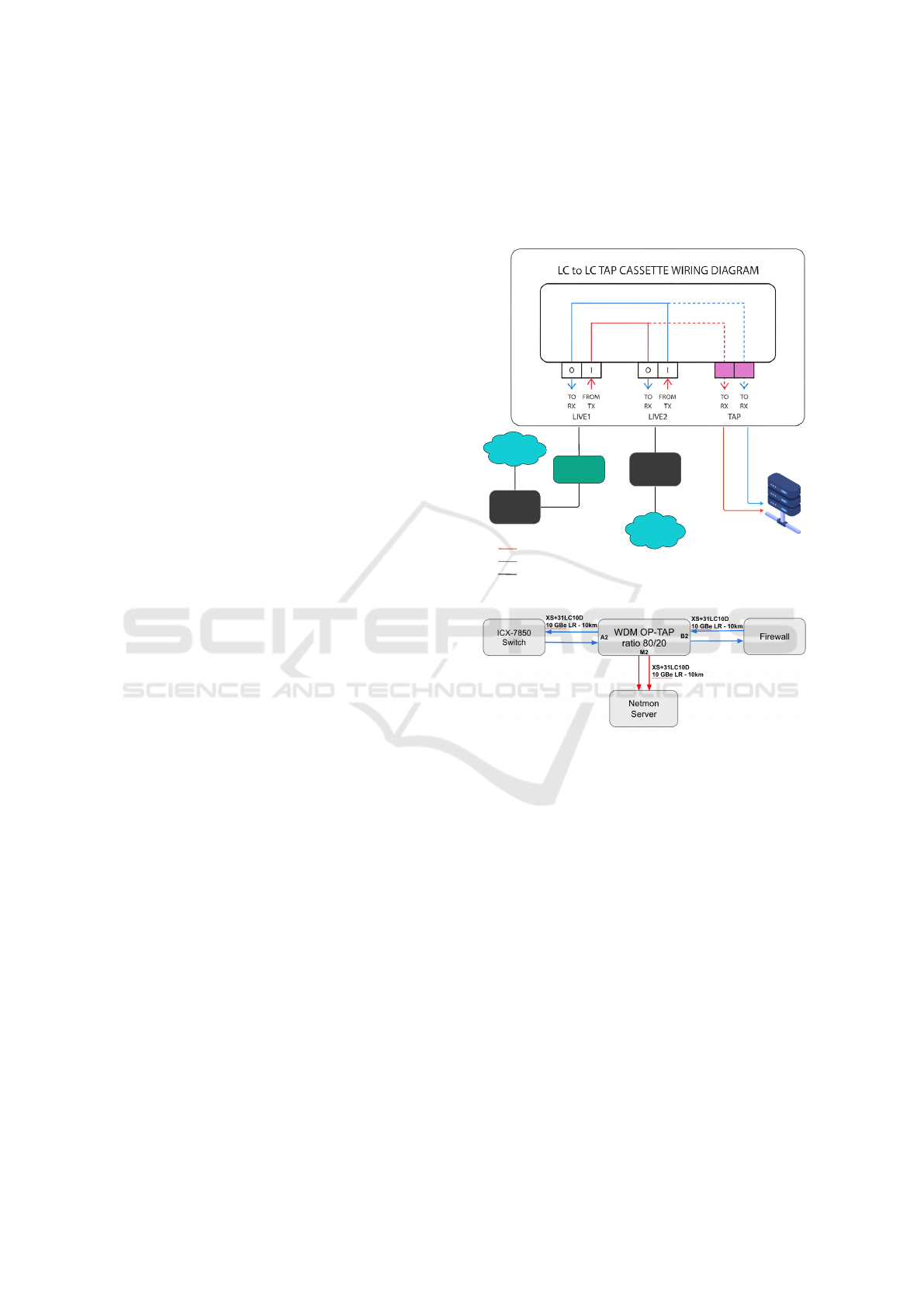
To address gigabit-scale data capture, we employ an
LC-to-LC optical tap (OP-TAP) as shown in Fig. 1a,
enabling seamless integration into high-speed enter-
prise or campus networks. The device uses dual live
connections (LIVE1 and LIVE2) to passively cap-
ture both transmitted (TX) and received (RX) traffic
without introducing computational overhead or dis-
rupting production networks—ensuring lossless, real-
time monitoring. Captured traffic is forwarded to a
dedicated server (Server Netmon) for live preprocess-
ing, enhancing the efficiency of downstream analy-
sis and intrusion detection as shown in Fig. 1b. This
setup forms the second tier of our two-tier architec-
ture, where the first tier (firewall) performs initial
threat filtering, reducing load on the detection system.
The second tier—comprising the OP-TAP and Server
Netmon—handles traffic capture, preprocessing, and
real-time analysis as a unified, low-latency pipeline.
This separation of concerns ensures scalability and re-
sponsiveness in high-throughput environments, meet-
ing the demanding requirements of modern network
security.
Netmon Server
LAN
ROUTER
Firewall
Production Network Link
Internet
NAT
ROUTER
LAN
Captured TX Network Traffic
Captured RX Network Traffic
(a) Two-Tier Intrusion Detection System Architecture
Leveraging Firewall and OP-TAP.
(b) Capturing with passive OP-TAP.
Figure 1: Network capture system implementation.
3.2.2 Parallel Micro-Batching and Scalable
Inferencing Architecture
Fig. 2 illustrates the system architecture, which is or-
ganized into three key modules to enhance through-
put by processing data in micro-batches rather than
streams, thereby reducing latency. The workflow
comprises two main components: a micro-batching
module and an inferencing module, with each in-
ferencing instance connected to a machine learn-
ing model for classifying traffic as benign or mali-
cious. The micro-batching module receives incoming
data via multiple threads, aggregates it into fixed-size
batches, and publishes them to a message queue under
a specific topic. The inferencing module subscribes to
this topic, polls the queue, and forwards each batch to
the ML model for prediction. This decoupled, parallel
design enables efficient load balancing, low-latency
processing, and scalable real-time inference.
Parallel Micro-Batching and Scalable Inferencing for ML-Based Malicious Traffic Detection
159

Figure 2: Architecture of the proposed method.
4 IMPLEMENTATION
4.1 Implementation of Gigabit Scale
Capturing System
To implement the gigabit-scale capture system, we
deployed the setup shown in Fig. 1b. An ICX-
7850 switch connects via fiber to a WDM Opti-
cal Tap 80/20, which passively splits traffic—80%
directed to the firewall, 20% to the traffic capture
server—enabling non-intrusive monitoring with zero
impact on production performance. The capture
server (Netmon) is an HP ProLiant DL380 Gen10
equipped with an Intel Xeon Silver 4214R (12-core),
32 GB RAM, NVIDIA RTX A2000 12 GB GPU, and
an Intel Ethernet Converged Network Adapter X710-
DA4 (quad-port 10GbE SFP+). Two ports are used
to capture TX and RX streams from the tap, while
the system runs Ubuntu 22.04 and leverages Argus
(https://openargus.org/) for flow merging and prepro-
cessing. Using the -i dup:interface-name flag,
Argus aggregates bidirectional traffic into a unified
flow and extracts features in real time. This config-
uration ensures lossless capture, high throughput, and
minimal overhead—aligning with our design goals of
passive, scalable, and low-latency preprocessing in
10 Gbps environments.
4.2 Implementation of Near-Real-Time
Inferencing System
The near-real-time inferencing system leverages
open-source technologies to achieve high through-
put and low latency. ZeroMQ (https://zeromq.org/)
enables asynchronous, non-blocking communication
between stream ingestion workers and the micro-
batching module, supporting scalable data transfer
in high-speed networks. Redis (https://redis.io/) acts
as an in-memory FIFO queue, temporarily storing
micro-batched data with minimal delay, thereby pre-
venting processing bottlenecks. Inference results are
persisted in DuckDB (https://duckdb.org/), an embed-
ded analytical database that supports efficient query-
ing and lightweight data management for downstream
analysis. Together, these components form a stream-
lined, scalable pipeline that implements the parallel
micro-batching architecture Fig. 3, significantly re-
ducing response times and enhancing the system’s de-
tection capabilities.
5 RESULTS AND DISCUSSION
This section evaluates the effectiveness of our scal-
able ML-based IDS with a focus on optimizing infer-
encing time without compromising detection perfor-
mance.
5.1 Survey of Machine Learning
Models and Feature Selection for
Optimized Inferencing
The evaluation leverages multiple network traf-
fic datasets—NF-CSE-CIC-IDS2018-v2, NF-ToN-
IoT-v2, CIC-IDS2017, NF-UNSW-NB15-v2, and
HIKARI 2021—to enhance model generalization
across diverse traffic and attack patterns. The com-
bined dataset is split 80%/20% for training and test-
ing, ensuring robust performance assessment.
Table 1 summarizes the performance of various
ML models across key metrics. Gradient boosting
methods—XGBoost (XGB), LightGBM (LGBM),
RITECH 2025 - The International Conference on Research and Innovations in Information and Engineering Technology
160
and CatBoost (CatB)—achieve near-perfect or per-
fect scores, with XGB attaining 1.00 across all met-
rics, attributed to its ability to model complex feature
interactions via sequential tree learning. In contrast,
simpler models such as Naive Bayes (NVB) and Lin-
ear Discriminant Analysis (LDA) underperform, with
NVB reaching only 78% accuracy.
Given these results, XGBoost (XGB) is selected
for deployment due to its perfect accuracy and favor-
able inference characteristics: (1) native handling of
categorical features, (2) effective tree pruning that re-
duces model size, and (3) strong parallelization sup-
port—well aligned with our micro-batching architec-
ture. These attributes enable high accuracy with min-
imal inference latency in high-speed networks. For
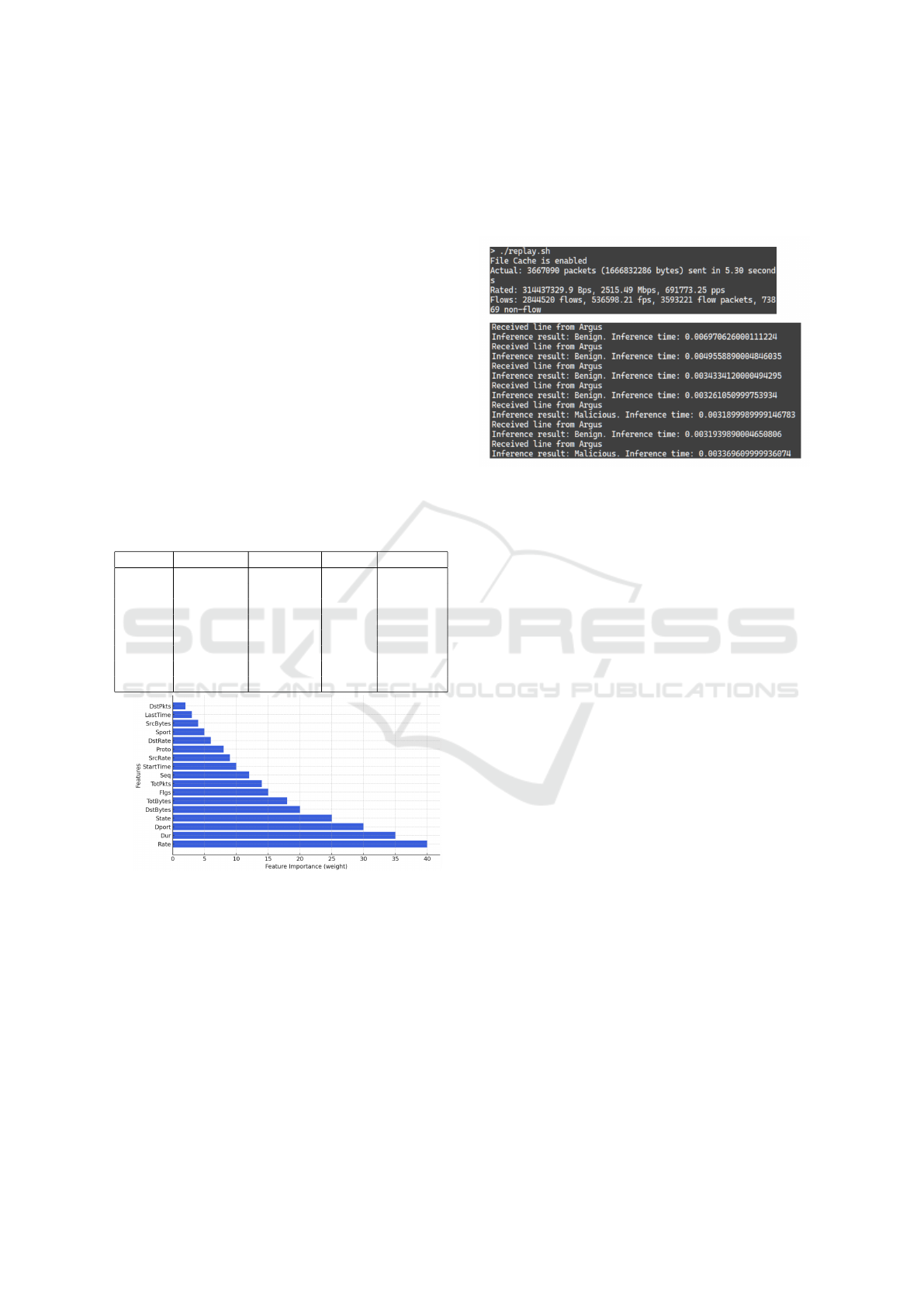
feature selection, we leverage importance weights
from training, as shown in Fig. 3, retaining only
the most impactful features (e.g., Rate, Dur, Dport,
State). This approach reduces dimensionality, stream-
lines preprocessing, and enhances model efficiency
for near-real-time detection.
Table 1: Model Survey Results.
Model Accuracy Precision Recall F1 Score
NVB 0.78 0.76 0.82 0.79
LR 0.92 0.91 0.93 0.92
LDA 0.88 0.87 0.89 0.88
SVM 0.93 0.92 0.94 0.93
XGB 1.00 1.00 1.00 1.00
LGBM 0.99 0.99 0.99 0.99
CatB 0.99 0.99 0.99 0.99
AdaB 0.98 0.97 0.98 0.97
Figure 3: Feature Importance (Weight).
5.2 Performance Evaluation of
Inferencing and Capturing System
This subsection presents experimental results on in-
ferencing latency and capturing time. It compares the
performance of the proposed parallel micro-batching
inferencing system against traditional sequential in-
ferencing, showcasing the improvements in process-
ing speed and system responsiveness enabled by our
architecture. As illustrated in Figure 4, the live in-
ferencing process provides real-time network perfor-
mance metrics alongside AI-based classification re-
sults, demonstrating the system’s capability to ana-
lyze traffic flows and detect anomalies efficiently.
Figure 4: Live inferencing process and performance sum-
mary.
Figs. 5a and 5b analyze the trade-off between
throughput (flow/s) and decision time (ms) across
batch size and worker count configurations. The
10b4w setup achieves an optimal balance, delivering
730 flows/s at just 5 ms decision time—representing
a 265% throughput gain over the baseline 1b1w (200
flows/s). Larger configurations (e.g., 20b3w, 50b3w)
further increase throughput (up to 1300 flows/s,
+450%), but at the cost of elevated decision times
(tens of ms), indicating diminishing returns due to
Netmon server limitations.
This highlights a key design insight: while single-
server performance is strong, scalability is bounded
by resource saturation. To address this, our archi-
tecture supports distributed deployment with multi-
ple inferencing servers—a path for maintaining low
latency under growing workloads. This forward-
looking scalability is a core strength, enabling adap-
tation to larger, more complex networks. Future work
will explore multi-server configurations to optimize
the throughput-latency trade-off and fully realize the
system’s scalable potential.
6 CONCLUSIONS
The proposed architecture advances high-speed net-
work intrusion detection through three key contri-
butions. First, the parallel micro-batching inferenc-
ing system achieves up to 730 flows/s—a 265% im-
provement over sequential processing—while main-
taining a low decision time of 5 ms, effectively bal-
ancing throughput and latency. Second, XGBoost
Parallel Micro-Batching and Scalable Inferencing for ML-Based Malicious Traffic Detection
161

(a) Average detecting time per configuration. (b) Average throughput per configuration.
Figure 5: Performance comparison of detecting time and throughput.
delivers perfect accuracy, precision, recall, and F1-
score, enabling high-confidence detection without
compromising inference speed. Third, the architec-
ture is inherently scalable, supporting distributed de-
ployment across multiple inferencing servers to sus-
tain performance under growing network loads. To-
gether, these results demonstrate a practical, high-
performance NIDS solution for real-time, large-scale
environments.
Future work will explore multi-server scaling
and distributed processing frameworks to further en-
hance throughput. We will also integrate MLOps
practices for automated model monitoring, retrain-
ing, and deployment, ensuring long-term reliabil-
ity. Additionally, federated learning will be inves-
tigated to enable privacy-preserving, collaborative
model training across distributed network nodes, im-
proving adaptability and robustness in heterogeneous
environments.
ACKNOWLEDGEMENTS
This work is part of the project “Real-time Mali-
cious TLS Traffic Detection using a Machine Learn-
ing Classifier,” supported by Keio University and the
APNIC Foundation under the Community Based Re-
search (CBR) scheme (2023–2025). The authors used
AI tools solely for language editing, including proof-
reading for grammar, syntax, and clarity. All research
design, methods, implementation, and results were in-
dependently developed by the authors.
REFERENCES
Abdelmoumin, G., Rawat, D. B., and Rahman, A. (2022).
On the Performance of Machine Learning Models for
Anomaly-Based Intelligent Intrusion Detection Sys-
tems for the Internet of Things. IEEE Internet of
Things Journal, 9(6):4280–4290.
Abdulganiyu, O. H., Ait Tchakoucht, T., and Saheed, Y. K.
(2023). A Systematic Literature Review for Network
Intrusion Detection System (IDS). International jour-
nal of information security, 22(5):1125–1162.
Admass, W. S., Munaye, Y. Y., and Diro, A. A. (2024). Cy-
ber security: State of the art, challenges and future di-
rections. Cyber Security and Applications, 2:100031.
Berbecaru, D. G. and Petraglia, G. (2023). TLS-Monitor:
A Monitor for TLS Attacks. In 2023 IEEE 20th
Consumer Communications & Networking Confer-
ence (CCNC), pages 1–6.
Dina, A. S. and Manivannan, D. (2021). Intrusion detection
based on Machine Learning techniques in computer
networks. Internet of Things, 16:100462.
Gite, P., Chouhan, K., Murali Krishna, K., Kumar Nayak,
C., Soni, M., and Shrivastava, A. (2023). ML Based
Intrusion Detection Scheme for various types of at-
tacks in a WSN using C4.5 and CART classifiers. Ma-
terials Today: Proceedings, 80:3769–3776.
Gomez, G., Kotzias, P., Dell’Amico, M., Bilge, L., and Ca-
ballero, J. (2023). Unsupervised Detection and Clus-
tering of Malicious TLS Flows. Security and Commu-
nication Networks, 2023(1):3676692.
Kondaiah, C., Pais, A. R., and Rao, R. S. (2024). Enhanced
Malicious Traffic Detection in Encrypted Communi-
cation Using TLS Features and A Multi-Class Classi-
fier Ensemble. Journal of Network and Systems Man-
agement, 32(4):76.
Sahani, N., Zhu, R., Cho, J.-H., and Liu, C.-C. (2023). Ma-
chine Learning-based Intrusion Detection for Smart
Grid Computing: A Survey. ACM Trans. Cyber-Phys.
Syst., 7(2).
Siyyal, S. A., Khuawar, F. Y., Saba, E., Memon, A. L., and
Shaikh, M. R. (2022). Analyzing ML-Based IDS Over
Real-Traffic. International Journal of Innovations in
Science & Technology, 4(3):621–640.
Thakkar, A. and Lohiya, R. (2023). A Review on
Challenges and Future Research Directions for Ma-
chine Learning-Based Intrusion Detection System.
Archives of Computational Methods in Engineering,
30(7):4245–4269.
Theofanous, A., Papadogiannaki, E., Shevtsov, A., and
Ioannidis, S. (2024). Fingerprinting the Shadows: Un-
RITECH 2025 - The International Conference on Research and Innovations in Information and Engineering Technology
162

masking Malicious Servers with Machine Learning-
Powered TLS Analysis. In Proceedings of the ACM
Web Conference 2024, WWW ’24, page 1933–1944,
New York, NY, USA. Association for Computing Ma-
chinery.
Ucci, D., Sobrero, F., Bisio, F., and Zorzino, M. (2021).
Near-Real-Time Anomaly Detection in Encrypted
Traffic using Machine Learning Techniques. In 2021
IEEE Symposium Series on Computational Intelli-
gence (SSCI), pages 01–08.
Yang, L. and Shami, A. (2022). IDS-ML: An open source
code for Intrusion Detection System development us-
ing Machine Learning. Software Impacts, 14:100446.
Yu, L., Tao, J., Xu, Y., Sun, W., and Wang, Z. (2024).
Tls fingerprint for encrypted malicious traffic detec-
tion with attributed graph kernel. Computer Networks,
247:110475.
Zang, X., Wang, T., Zhang, X., Gong, J., Gao, P., and
Zhang, G. (2024). Encrypted Malicious Traffic Detec-
tion Based on Natural Language Processing and Deep
Learning. Computer Networks, 250:110598.
Zeng, Z., Xun, P., Peng, W., and Zhao, B. (2024). Toward
identifying malicious encrypted traffic with a causal-
ity detection system. Journal of Information Security
and Applications, 80:103644.
Parallel Micro-Batching and Scalable Inferencing for ML-Based Malicious Traffic Detection
163
