
Evaluating Next-Generation Firewalls Using Machine
Learning-Based Hybrid Feature Selection for Threat Detection and
Risk Mitigation
Trishna Panse
a
and Kailash Chandra Bandhu
b
Department of CSE, Medicaps University, Indore, India
Keywords: Next-Generation Firewalls (NGFWs), Machine Learning for Cybersecurity, Hybrid Feature Selection,
Intrusion Detection System (IDS), Threat Detection and Risk Mitigation.
Abstract: Securing modern networks against evolving cyber threats requires robust and intelligent systems. This
research introduces a novel machine learning-based framework designed to enhance Next-Generation
Firewalls (NGFWs) by improving their ability to manage traffic, detect intrusions, and mitigate risks. We
propose a Random Forest (RF)-based classification approach, leveraging a hybrid feature selection strategy
that combines filter-based ranking (using Information Gain Ratio) with wrapper-based validation (k-means
clustering). In our proposed research we use CSE-CIC-IDS2018 dataset (Canadian Institute for Cybersecurity
- Intrusion Detection System 2018) — is one of the most widely used benchmark datasets for network
intrusion detection system (NIDS) research., KDD'99 dataset and assess the effectiveness of a Next-
Generation Firewall (NGFW) in replicating and improving advanced threat-handling mechanisms. Our
findings suggest that integration of intelligent machine learning models to detect the threats in NGFWs and
achieve more than 98% of the accuracy in threat detection. It recognizes the powerful combined effect of the
machine learning based Intrusion Detection System (IDS) functionalities in NGFWs, which provides a
scalable and very effective solution for dynamic network security.
1 INTRODUCTION
Cyber threats are constantly changing to the digital
scope, promoting the boundaries of traditional
security solutions. Attacks have become more
sophisticated and frequent than traditional firewalls
and infiltration detection systems (IDs). The next
generation firewall (NGFWS) has become all security
power houses in response to this growing threat,
behavioural analysis, real -time threats and
combination of intensive traffic inspection to offer
more flexible defenses. It is still difficult to assess the
performance of these sophisticated NGFWs under the
dynamic, real -world conditions(Hamilton et al. 2020)
. This article deals with the problem by presenting a
whole new penetration module run by machine
learning, especially designed to collaborate with
NGFW frameworks(Zeineddine and El-Hajj
2018).Our research focuses on active improvement of
NGFW skills, with a main purpose that they
a
https://orcid.org/0000-0001-5639-0632
b
https://orcid.org/0000-0002-4337-4198
significantly improve network traffic, identify new
dangers and significantly reduce the incidence of false
positivity that often plagues traditional systems
(Soewito and Andhika 2019). We finish it with an
advanced hybrid function choice technique (Praise,
Raj, and Benifa 2020) using flexible and scalable
machine learning model. We can model properly and
fully evaluate NGFW performance due to danger
detection and risk reduction in this systematic
approach (Nabi, Ahmed, and Abro 2022). Our goal is
to show how this smart integration can make NGFW
even more competent and flexible defenders in today's
difficult network environment.
2 RELATED WORK
With machine learning models such as Support Vector
Machines (SVMs), KNN and decision trees are fully
Panse, T. and Bandhu, K. C.
Evaluating Next-Generation Firewalls Using Machine Learning-Based Hybrid Feature Selection for Threat Detection and Risk Mitigation.
DOI: 10.5220/0014275000004928
Paper published under CC license (CC BY-NC-ND 4.0)
In Proceedings of the 1st International Conference on Research and Innovations in Information and Engineering Technology (RITECH 2025), pages 149-156
ISBN: 978-989-758-784-9
Proceedings Copyright © 2025 by SCITEPRESS – Science and Technology Publications, Lda.
149

investigated for their ability to identify unusual
patterns in network data, there has been an important
focus area in cyber security research for a long time in
infiltration. Despite the effect of these models, inspires
questions with scalability, convenience relevance and
truth flexibility continued research for strong, hybrid
strategies (Mhawi, Aldallal, and Hassan 2022).
Despite their excellent classification accuracy, SVMs
often have a scalability problem due to their high
calculation complexity and sensitivity to
hyperparameter setting, especially when used on mass
or high-dimensional network traffic data (Sebakor
2023). The proposed model attempts to address issues
that enterprise networks face, such as strong
authentication, high data security, multilevel
protection, network traffic encryption, no insider
intrusion, strong masquerades, IPsec, port forwarding,
internet traffic filtering, and various web access
policies for users. A threat prevention policy is
required to ensure security protection (Arefin et al.
2021)(Nife and Kotulski 2020). By utilising ensemble
learning, which blends several decision trees to
increase overall prediction stability, Random Forests
(RFs) provide a strong substitute to overcome these
drawbacks. Compared to single classifiers, RFs are
less likely to overfit and naturally minimise variance.
They are ideal for intrusion detection because of their
capacity to handle high-dimensional data and evaluate
the significance of features. Additionally, RFs work
well on unbalanced datasets, preserving good recall
for minority classes, which is crucial for security
applications such as NGFWs (Jaw and Wang 2021).
Because RFs have built-in procedures for evaluating
feature importance—a critical component of
interpretability and model optimization—they are
especially well-suited for multiclass classification
problems. Convolutional and recurrent neural
networks are used in deep learning techniques that
have been suggested more recently for intrusion
detection systems (IDS) in order to identify temporal
and spatial patterns in network traffic. Although
strong, these models frequently need a lot of
resources, making them unsuitable for use in real-time
security systems such as Next-Generation Firewalls
(NGFWs)(Neupane, Haddad, and Chen 2018) (Gold
2011).Simultaneously, NGFWs have advanced
beyond conventional packet inspection to use machine
learning (ML) for behavioural analysis and intelligent
traffic profiling(Wang et al. 2023). Nevertheless, a lot
of these integrations fail to take optimised feature
selection into sufficient account, which might raise
processing overhead and reduce detection accuracy.
While specifically focussing on their integration
within the operational context of NGFWs, this
research expands upon the advantages of current ML-
based IDS models. By combining hybrid feature
selection (filter + wrapper methods) with an efficient
RF classifier, the proposed framework enhances real-
time detection performance and threat mitigation
capabilities (Wang et al. 2023)(Yin et al. 2023). It
directly addresses the challenge of balancing detection
accuracy and computational efficiency—a critical
factor in the deployment of ML-enhanced security
solutions in dynamic and large-scale networks
(Golrang et al. 2020).
3 METHODOLOGY
3.1 Dataset and NGFW Context
We use CIC-IDS2018 and KDD Cup 1999 datasets to
replicate diverse traffic patterns encountered in
NGFW environments, including both benign and
malicious traffic. The dataset contains 41 features
representing connection-level attributes and labels for
five categories: Normal, DoS, Probe, R2L, and U2R.
TCP/IP attributes (e.g., duration, protocol type,
src_bytes), content-specific indicators (e.g.,
num_failed_logins, hot), and traffic behaviour-based
statistics (e.g., count, srv_diff_host_rate).
3.2 NGFW Emulation Environment
To simulate a Next-Generation Firewall (NGFW)
using a three-stage detection pipeline, each stage plays
a crucial role in identifying, classifying, and acting on
potentially malicious network traffic. Here's a detailed
breakdown of each stage:
3.2.1 Traffic Classification
Accurately identify the type of network traffic (e.g.,
benign, suspicious, malicious) using machine learning
models trained on engineered features.
A. Data Collection
Collect real-time or batch network traffic data,
such as:
• Packet metadata (IP addresses, port numbers,
protocol types)
• Flow features (duration, byte count, packet
count)
• Application-layer metadata (HTTP headers,
TLS handshake info)
• Payload content (if available and privacy-
compliant)
RITECH 2025 - The International Conference on Research and Innovations in Information and Engineering Technology
150

B. Feature Engineering
Derive meaningful features from raw traffic data:
• Statistical features: avg. packet size, standard
deviation, etc.
• Temporal features: burstiness, inter-arrival
time
• Behavioral features: unusual port usage,
connection patterns
• Protocol-specific features: DNS request types,
HTTP methods, etc.
C. ML-Based Classification
Use a trained machine learning model to classify
traffic:
• Models: Random Forests, XGBoost, Neural
Networks (e.g., CNN for payloads), or LSTM
(for sequential flows)
• Output: Traffic is classified into labels such as
benign, malware, botnet, DDoS, anomaly, etc.
• Confidence Score: Along with label, output a
probability/confidence score for further
decision-making.
3.2.2 Policy Enforcement
Use classification results to enforce security policies:
allow, block, or quarantine traffic in real-time.
A. Decision Engine:
Based on classification label and confidence score,
apply action:
• Allow: For trusted or benign traffic.
• Block: For clearly malicious traffic (e.g.,
malware with high confidence).
• Quarantine: For suspicious traffic where
confidence is below a certain threshold.
B. Contextual Rules
Incorporate additional context for smarter
decisions:
• User/device identity (Zero Trust principles)
• Time-based policies (e.g., remote access
outside office hours)
• Reputation scores (e.g., known malicious IPs
or domains)
• Geo-fencing (deny access from risky
regions)
C. Logging & Alerting
Log enforcement decisions with metadata
(timestamp, user, flow ID).
• Send alerts for high-risk activities (e.g.,
command-and-control traffic).
• Use classification results to enforce security
policies: allow, block, or quarantine traffic
in real-time.
3.2.3 Threat Intelligence Feedback
Continuously improve detection by incorporating
feedback from misclassifications and newly observed
threats.
A. Feedback Loop
• When misclassifications are detected (e.g.,
user or analyst flags a false positive or false
negative), they are logged for review.
• Traffic that was initially "quarantined" may be
manually analysed and relabelled.
B. Adaptive Learning
• Update model training dataset with corrected
labels.
• Use techniques like:
• Incremental learning: Update models
without full retraining.
• Online learning: Continuously adapt
using streaming data.
• Active learning: Prioritize uncertain
samples for manual review.
C. Threat Intel Integration
Integrate external threat intelligence feeds:
• Known bad IPs/domains, malware hashes,
behavioural indicators.
Use threat intel to:
• Adjust rules and ML thresholds
• Enrich traffic classification with real-world
threat context
D. Continuous Model Evaluation
• Regularly evaluate model performance
(precision, recall, F1-score).
• Trigger retraining when performance
degrades or new threat types emerge.
E. Benefits of this Architecture
• High Accuracy: ML can detect subtle
patterns missed by traditional rule-based
firewalls.
• Real-Time Decisioning: Immediate
enforcement of policies based on current
threat context.
• Adaptability: Constant learning ensures
evolving threat coverage.
• Scalability: Cloud-native implementation
allows scaling across large networks.
Evaluating Next-Generation Firewalls Using Machine Learning-Based Hybrid Feature Selection for Threat Detection and Risk Mitigation
151

3.2.4 Hybrid Feature Selection
To reduce latency in NGFW deployment while
preserving accuracy:
Filter Stage: Information Gain Ratio ranks features
based on relevance to the class labels.
Wrapper Stage: k-means clustering validates subsets
for class separability with the RF classifier.
This results in an optimized 18-feature subset for real-
time analysis
A. Classification Model: Random Forest
The Random Forest ensemble is configured as
follows:
Trees (T): 100
Max depth: Unlimited (auto)
Split criterion: Gini impurity
Feature sampling: √n features per node
Each decision tree operates on a bootstrapped
sample and a subset of the selected 18 features.
B. Mathematical Model:
Given a label D=
𝑥𝑖,𝑦𝑖
𝑖=1𝑁,𝑤ℎ𝑒𝑟𝑒:
xi∈𝑅
is a feature vector with d=41 features
yi∈Y={Normal,DoS,Probe,R2L,U2R} is the
class label
1. Feature Selection
Mutual Information (MI)
For each feature 𝑥
, compute its mutual information
with the target Y:
𝑀𝐼𝑥
;𝑌=
∑
𝑃𝑥
,𝑦
,
log
,
(1)
This captures the dependency between the feature and
the label.
We select top d
=18 features:
𝑆={𝑥
∣𝑀𝐼𝑥
;𝑌 is in top 18} (2)
2. Model Training
Random Forest Classifier:
Let H=h1,h2,…,hT be an ensemble of 𝑇 =100
decision trees. Each tree h
is trained on a bootstrap
sample D
⊂D and uses a random subset of features
F
⊂S.
Each tree ℎ𝑡 outputs a predicted class ℎ
𝑥
.
The final prediction is made by majority voting:
𝑓
𝑥
=argmax
∈
∑
𝐼
ℎ
𝑥
=𝑦
(3)
where 𝐼
⋅
is the indicator function.
Evaluation Metrics:
Let: TP,𝐹𝑃,𝑇𝑁,𝐹𝑁 denotes true positives, false
positives, true negatives, and false negatives
respectively. Then, for each class importance features
are:
Precision: 𝑃=
(4)
Recall: 𝑅=
(5)
F1-Score 𝐹
=
⋅PR
PR
(6)
Accuracy =
(7)
For each feature 𝑥
∈𝑆, the importance score is:
Imp𝑥
=
∑∑
Δ𝑖
𝑛
∈nodes where
used
(8)
Where Δ𝑖
𝑛
is the reduction in impurity (Gini) at
node 𝑛:
Δ𝑖
𝑛
=𝑖
𝑛
−
left
𝑖
𝑛
left
+
right
𝑖𝑛
right
(9)
4 EXPERIMENTAL RESULTS
The proposed ML-enhanced NGFW model
demonstrates strong performance, achieving 98.21%
accuracy, 97.88% precision, 97.94% recall, and a
97.91% F1-score. These metrics indicate a balanced
and reliable threat detection system with minimal
false positives and high true positive rates, which are
crucial for real-time network protection. The low
training time of 3.1 seconds highlights the model's
computational efficiency, supporting rapid updates
and scalability. The integration of hybrid feature
selection further improves detection accuracy while
reducing processing overhead. Overall, the results
confirm the model’s effectiveness in enhancing
NGFWs for intelligent, adaptive threat detection and
risk mitigation in high throughput, evolving network
environments.
RITECH 2025 - The International Conference on Research and Innovations in Information and Engineering Technology
152
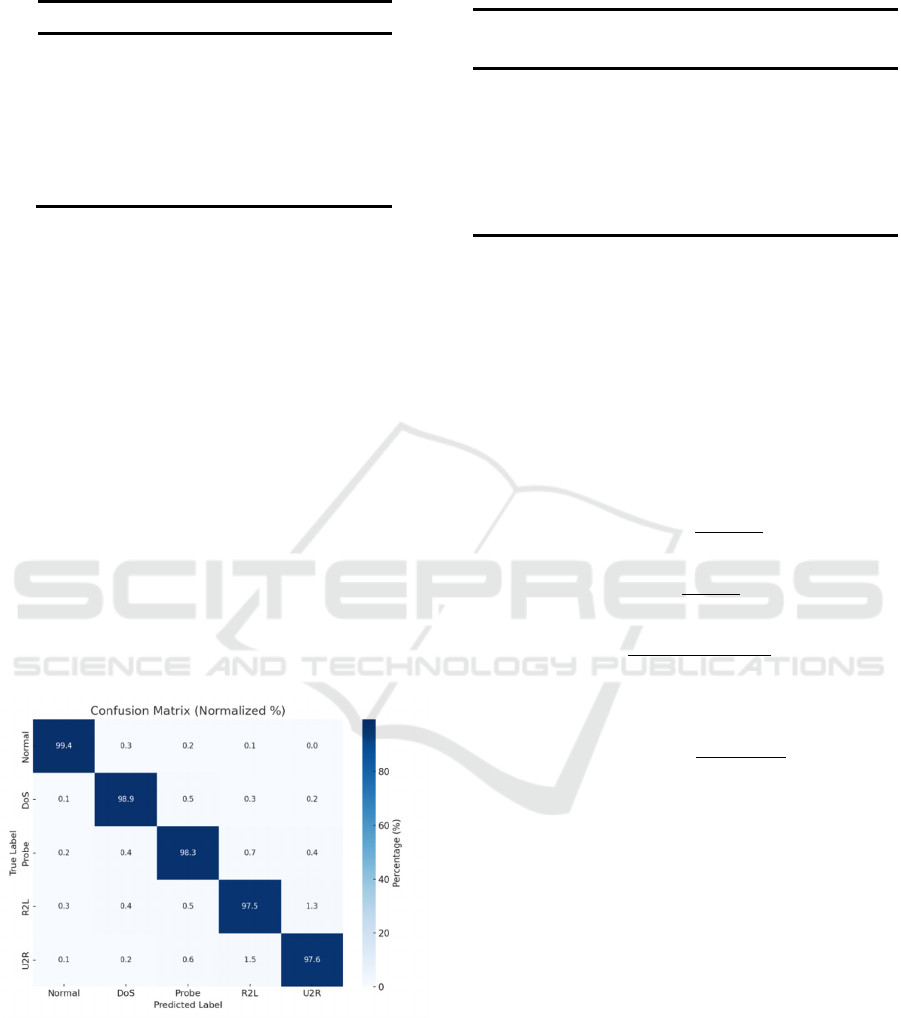
Table 1: Performance Parameters.
Metric Value
Accuracy 98.21%
Precision 97.88%
Recall 97.94%
F1-Score 97.91%
Training Time 3.1 sec
Model Representation
The trained model is:
𝑓
𝑥
=argmax
∈
∑
𝐼
ℎ
𝑥
=𝑦
(10)
where each ℎ
is a decision tree trained on selected
features 𝑆⊂𝑅
𝟙𝟠
Confusion Matrix Representation:
Let the classifier 𝑓 predict class labels 𝑦 for true
labels 𝑦 , where classes are from set 𝑌=
{𝐶
,𝐶
,…,𝐶
} with 𝑘=5 (e.g. Normal, DoS, Probe,
R2L, U2R).
The confusion matrix 𝑀∈𝑁
is defined as:
𝑀
=
𝑥
,𝑦
∈𝐷:𝑦
=𝐶
and 𝑓
𝑥
=𝐶
(11)
𝑀
: counts the number of samples truly belonging to
class 𝐶
but predicted as class 𝐶
.The diagonal entries
M
ii
represent correct predictions for class C
i
Figure 1:Confusion Matrix Sample (Normalized%).
Table 2: Confusion Matrix Table.
Actual \
Pred
Normal DoS Probe R2L U2R
Normal 99.4% 0.3% 0.2% 0.1% 0.0%
DoS 0.1% 98.9% 0.5% 0.3% 0.2%
Probe 0.2% 0.4% 98.3% 0.7% 0.4%
R2L 0.3% 0.4% 0.5% 97.5% 1.3%
U2R 0.1% 0.2% 0.6% 1.5% 97.6%
From the above Table 2, we observe that high
detection rates for Normal and DoS traffic, validating
effective NGFW baseline filtering.
Robust handling of minority classes (R2L and U2R),
often missed by traditional systems.
Low misclassification rates show suitability for real-
time deployment with minimal false positives.
Class-wise metrics like precision, recall, and F1-score
were also derived from the matrix.
Precision
=
∑
(12)
Recall
=
∑
(13)
F1
=
Precision
Recall
Precision
Recall
(14)
The overall accuracy is:
Accuracy =
∑
∑∑
(15)
The model outperformed traditional SVM
implementations on the same dataset both in terms of
execution time and classification robustness,
especially across minority classes such as R2L and
U2R.
The proposed ML-based NGFW system
demonstrates high classification accuracy across all
traffic categories, validating its effectiveness for real-
time threat detection. Normal traffic is accurately
identified in 99.4% of cases, ensuring minimal false
positives, while DoS and Probe attacks are detected
with 98.9% and 98.3% accuracy, respectively. More
impressively, the model achieves 97.5% and 97.6%
accuracy for R2L and U2R attacks—traditionally
difficult to detect due to their low frequency and subtle
behaviour. The success in handling class imbalance is
attributed to the hybrid feature selection approach,
which ensures that only the most relevant and
Evaluating Next-Generation Firewalls Using Machine Learning-Based Hybrid Feature Selection for Threat Detection and Risk Mitigation
153
discriminative features are used. Minimal
misclassifications occur, mainly between semantically
similar attack types, without significantly affecting
overall system performance. These results confirm the
model's robustness, adaptability, and suitability for
deployment in NGFWs, enabling intelligent, multi-
class, and proactive network security.
For experimentation, the CIC-IDS 2018 dataset
was also employed as it provides realistic and labelled
network traffic for both benign and diverse attack
scenarios. The classification models were evaluated
using the confusion matrix along with precision,
recall, and F1-score per class, ensuring a robust
performance analysis as shown in figure 2. Feature
importance evaluation revealed that attributes such as
Flow Duration, Total Forward Packets, Destination
Port, Total Forward Bytes, Flow Bytes per Second,
Packet Length Stored, Flow IAT Minimum, Forward
Packets per Second, and Initial Forward Window
Bytes were among the most influential in attack
detection. These results highlight the relevance of
flow-based features in identifying malicious traffic
and confirm the suitability of CIC-IDS 2018 as a
benchmark dataset for intrusion detection research.
Figure 2: Precision , Recall, F1-Score per Class.
Below figure 3 shows the top 10 features which
contribute to decision making by the proposed model.
Out of these features flow duration, total forwarded
packets and destination port are significant indicators
for suggesting the temporal and traffic-based
characteristics that strongly influence detection
performance in the research.
Figure 3:Import Features from dataset.
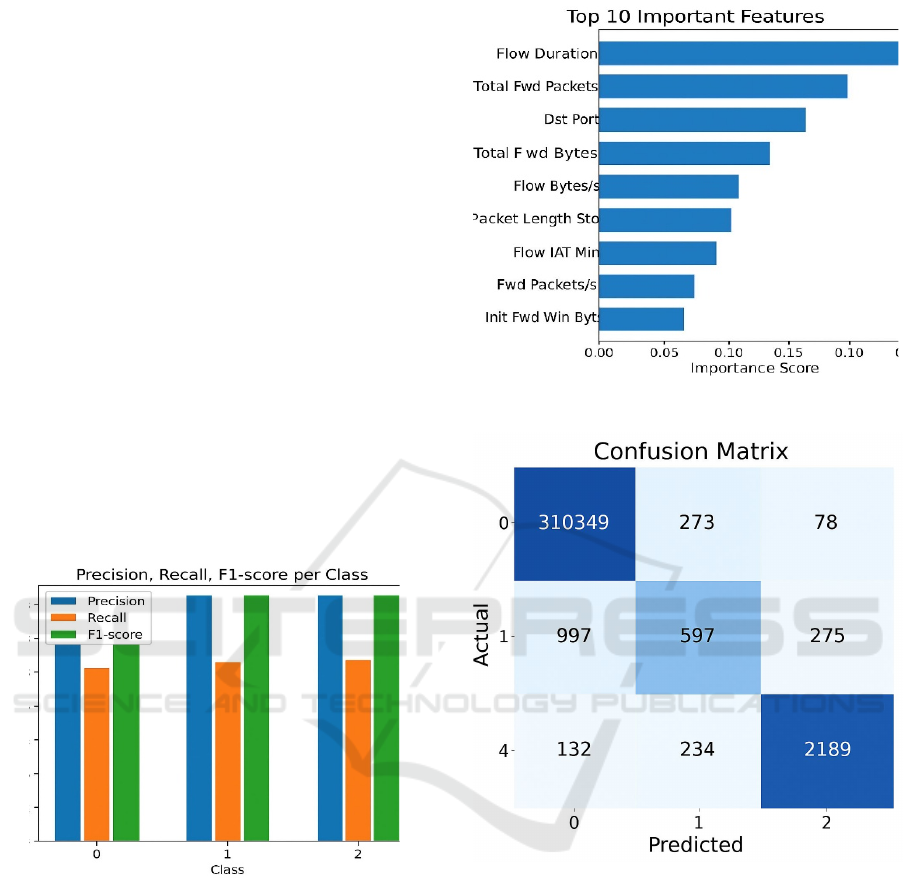
Figure 4:Confusion Matrix.
The above figure 4 of confusion matrix shows
classification performance across three classes of
model. The high values along the diagonal indicate
strong accuracy, while the off-diagonal values reveal
limited misclassifications, which suggest reliable
prediction capability with minor overlap between
classes.
5 DISCUSSION
The integration of machine learning within NGFWs
significantly elevates their operational intelligence,
enabling more granular traffic classification, the
RITECH 2025 - The International Conference on Research and Innovations in Information and Engineering Technology
154

identification of previously unknown threats, and
sustained high performance even under substantial
network loads. The proposed model, based on the
Random Forest algorithm and enhanced through a
hybrid feature selection strategy, not only boosts
detection accuracy but also optimizes computational
efficiency, addressing one of the critical bottlenecks in
real-time threat analysis. Utilising Random Forests'
ensemble learning capabilities, the system becomes
more resilient to noisy and unbalanced data—both of
which are prevalent in actual network settings.
Additionally, because of the model's proactive nature,
NGFWs may identify and react to dangerous
behavioural patterns early in network activity,
frequently before the payload is actually executed,
which lowers the attack surface and limits possible
harm.
The model's interpretability is an equally
significant benefit. Actionable insights into which
characteristics are most suggestive of malevolent
behaviour are provided by the feature importance
scores produced by Random Forests. Security
managers can adapt firewall setups to new threats by
using this interpretability to provide dynamic rule
creation and policy adjustment. In contemporary
cybersecurity ecosystems, where static rule-based
systems frequently fall short in reacting to zero-day
assaults or complex evasion strategies, this flexibility
is essential. All things considered, our ML-enhanced
NGFW architecture represents a paradigm change
from reactive to anticipatory network protection by
strengthening security posture and promoting a more
independent, self-optimizing defence mechanism.
dynamically.
6 CONCLUSION AND FUTURE
WORK
This task indicates unevenly that the next generation
firewall (NGFWS) networks can improve traffic
control and danger restriction when improved by
using machine learning -based infiltration
identification techniques and processed through
customized facilities. The proposed model confirms
the viability of implementing intelligent, adaptive
NGFW in dynamic and heterogeneous network
settings by achieving high identity accuracy of 98.2%
and showing frequent performance in danger types.
These findings with success explore traditional
threats and highlight the ability of a system of faster
complex cyber-attacks.
The limit for this study gives the routes
encouraging to investigate the future. Using
streaming data tube lines and live package catches for
real -time delaying can help stop the difference
between offline detection and early action. The model
will be able to update itself continuously with a new
threat signature and behavior pattern by incorporating
online teaching techniques and guarantee its
projection in the danger environment that develops
rapidly. In addition, checking the federated learning
framework can make it easier to safely and privately
and privately train the model under Trygg and
Private, multi -friendly cloud infrastructure, which is
an important condition for using a comprehensive
industry.
In addition, by mixing deep learning architecture
such as autoencoders or recurrent nerve networks
with existing random forest -based systems, the
functions of detecting scared abnormalities and
attacks on zero day can be improved. These hybrid
models can use deep learning skills to capture the
hybrid model complex and at the same time maintain
the interpretation of the approach to traditional artists
and low data costs.
ACKNOWLEDGMENT
I would like to thank my supervisor, Dr. Kailash C.
Bandhu, for their guidance and support throughout
this research. I also appreciate the assistance provided
by Medicaps University and the encouragement from
my peers. Finally, I’m grateful to my family members
for their constant support and motivation. I
acknowledge the use of generative AI tools in the
creation of this work. Specifically, ChatGPT Go was
utilized to briefly describe purpose, e.g., drafting
content, or refining language. All final decisions,
edits, and interpretations are my own, ensuring the
originality and integrity of the work.
REFERENCES
Arefin, Md. Taslim, Md. Raihan Uddin, Nawshad Ahmad
Evan, and Md Raiyan Alam. 2021. “Enterprise
Network: Security Enhancement and Policy
Management Using Next-Generation Firewall (NGFW)
BT - Computer Networks, Big Data and IoT.” In eds.
A.Pasumpon Pandian, Xavier Fernando, and Syed
Mohammed Shamsul Islam. Singapore: Springer
Singapore, 753–69.
Gold, Steve. 2011. “The Future of the Firewall.” Network
Security 2011(2): 13–15.
Evaluating Next-Generation Firewalls Using Machine Learning-Based Hybrid Feature Selection for Threat Detection and Risk Mitigation
155

https://www.sciencedirect.com/science/article/pii/S135
3485811700150.
Golrang, Anahita, Alale M Golrang, Sule Yildirim
Yayilgan, and Ogerta Elezaj. 2020. “A Novel Hybrid
IDS Based on Modified NSGAII-ANN and Random
Forest.” Electronics 9(4).
Hamilton, R et al. 2020. “Deep Packet Inspection in
Firewall Clusters.” In 2020 28th Telecommunications
Forum (TELFOR), , 1–4.
Jaw, Ebrima, and Xueming Wang. 2021. “Feature Selection
and Ensemble-Based Intrusion Detection System: An
Efficient and Comprehensive Approach.” Symmetry
13(10).
Mhawi, Doaa N, Ammar Aldallal, and Soukeana Hassan.
2022. “Advanced Feature-Selection-Based Hybrid
Ensemble Learning Algorithms for Network Intrusion
Detection Systems.” Symmetry 14(7).
Nabi, Aftab Ul, Mushtaque Ahmed, and Ahad Abro. 2022.
“An Overview of Firewall Types, Technologies, and
Functionalities.” International Journal of Computing
and Related Technologies 3(No 1 SE-Articles).
http://ijcrt.smiu.edu.pk/ijcrt/index.php/smiu/article/vie
w/126.
Neupane, K, R Haddad, and L Chen. 2018. “Next
Generation Firewall for Network Security: A Survey.”
In SoutheastCon 2018, , 1–6.
Nife, Fahad N, and Zbigniew Kotulski. 2020. “Application-
Aware Firewall Mechanism for Software Defined
Networks.” Journal of Network and Systems
Management 28(3): 605–26.
https://doi.org/10.1007/s10922-020-09518-z.
Praise, J Jeya, R Joshua Samuel Raj, and J V Bibal Benifa.
2020. “Development of Reinforcement Learning and
Pattern Matching (RLPM) Based Firewall for Secured
Cloud Infrastructure.” Wireless Personal
Communications 115(2): 993–1018.
https://doi.org/10.1007/s11277-020-07608-4.
Sebakor, M. 2023. “A Design and Implementation of Multi-
Routers and Firewall in a Multi-Homed Environment.”
In 2023 20th International Conference on Electrical
Engineering /Electronics, Computer,
Telecommunications and Information Technology
(ECTI-CON), , 1–4.
Soewito, B, and C E Andhika. 2019. “Next Generation
Firewall for Improving Security in Company and IoT
Network.” In 2019 International Seminar on Intelligent
Technology and Its Applications (ISITIA), , 205–9.
Wang, Chao et al. 2023. “Hybrid Intrusion Detection
System Based on Combination of Random Forest and
Autoencoder.” Symmetry 15(3).
Yin, Yuhua et al. 2023. “IGRF-RFE: A Hybrid Feature
Selection Method for MLP-Based Network Intrusion
Detection on UNSW-NB15 Dataset.” Journal of Big
Data 10(1): 15. https://doi.org/10.1186/s40537-023-
00694-8.
Zeineddine, Ali, and Wassim El-Hajj. 2018. Stateful
Distributed Firewall as a Service in SDN.
RITECH 2025 - The International Conference on Research and Innovations in Information and Engineering Technology
156
