
Comparative Analysis of eBPF-Based Runtime Security Monitoring
Tools in Monitoring and Threat Detection on Kubernetes
Aldien Asy Syairozi and Arizal
Department of Cyber Security Engineering, National Cyber and Crypto Polytechnic, Bogor, West Java, Indonesia
Keywords: eBPF, Runtime Security, Falco, Tetragon, Tracee.
Abstract: The rapid adoption of Kubernetes for managing cloud-native applications has increased the importance of
runtime security. Extended Berkeley Packet Filter (eBPF)-based monitoring tools, such as Falco, Tetragon,
and Tracee, offer real-time visibility and effective threat detection. This study evaluates and compares the
Key Performance Indicator (KPI) and efficiency of these tools in addressing Container Escape, Denial of
Service (DoS), and Cloud Cryptomining attacks based on the OWASP Kubernetes Top 10. Evaluation metrics
include Mean Time to Detect (MTTD), Detection Rate (DR), False Positive Rate (FPR), as well as CPU and
memory usage. The results show that Tetragon excels in detection time for Container Escape and
Cryptomining threats, Falco excels in detecting DoS attacks, while Tracee has relatively lower detection speed.
All tools can detect attacks with full accuracy without false positives. Resource usage analysis revealed
minimal differences between baseline and attack conditions, indicating that detection activities did not
significantly increase system load. Among the tools, Tetragon was the most efficient in CPU usage, Falco in
memory consumption, while Tracee offered balanced resource utilization.
1 INTRODUCTION
The development of cloud native technology makes it
easier to manage distributed applications and
improves system flexibility and scalability
(Bharadwaj & Premananda, 2022; Kosinska et al.,
2023).The Kubernetes platform, as one of the most
popular container orchestration technologies (Cloud
Native Computing Foundation, 2024), faces various
security challenges, especially in the runtime phase.
The runtime phase in Kubernetes is the stage when
applications packaged in containers are actively
running. During this phase, Kubernetes is responsible
for scheduling, scaling, and monitoring applications
(Bhattacharya & Mittal, 2023). Security during this
phase is critical because applications and services are
actively running, increasing the potential for
exploitation (Red Hat, 2024) To mitigate these
security challenges, runtime security solutions based
on extended Berkeley Packet Filter (eBPF)
technology have emerged as effective tools, as they
provide deep visibility into system activities and
detect threats in real-time (Magnani et al., 2022).
Several recent studies have explored the use of eBPF
technology to strengthen runtime security in
containerized environments. The study conducted a
comparative analysis of existing eBPF-based
container monitoring systems, including Falco,
Tetragon, and Tracee. It focused on analyzing event
detection mechanisms, basic policy implementation,
event type identification, and system call blocking
capabilities of each tool (Kim & Nam, 2024).
Building upon these prior studies, the present
research specifically aims to compare the Key
Performance Indicators (KPI) and efficiency of these
three tools in detecting threats included in the
OWASP Kubernetes Top 10, such as Container
Escape, Denial of Service (DoS), and Cloud
Cryptomining (OWASP, 2022). The evaluation is
based on the metrics Mean Time to Detect (MTTD),
Detection Rate (DR), False Positive Rate (FPR), and
resource utilization in terms of CPU and memory
consumption.
2 METHODOLOGY
This study focuses on evaluating three eBPF-based
runtime security tools, Falco, Tetragon, and Tracee,
implemented in Kubernetes clusters. The research is
conducted using a quantitative comparative approach
136
Syairozi, A. A. and Arizal,
Comparative Analysis of eBPF-Based Runtime Security Monitoring Tools in Monitoring and Threat Detection on Kubernetes.
DOI: 10.5220/0014272700004928
Paper published under CC license (CC BY-NC-ND 4.0)
In Proceedings of the 1st International Conference on Research and Innovations in Information and Engineering Technology (RITECH 2025), pages 136-141
ISBN: 978-989-758-784-9
Proceedings Copyright © 2025 by SCITEPRESS – Science and Technology Publications, Lda.

to measure Key Performance Indicator (MTTD,
Detection Rate, False Positive Rate) and efficiency
(CPU and Memory Usage) in addressing attacks such
as Container Escape, Denial of Service, and Cloud
Cryptomining, categorized based on the OWASP
Kubernetes Top 10. The research design uses a
Design Science Research (DSR) approach that
includes the stages of problem identification, solution
objective formulation, design and development of test
environment artifacts, demonstration through attack
simulations, evaluation of results, and
communication of results in the form of scientific
publications (Dresch et al., 2015). Figure 1 illustrates
the design science research methodology used in this
study.
Figure 1: Design Science Research Methodology.
2.1 Problem Identification and
Motivation
This stage focuses on identifying problems and
defining research motivations by justifying the
urgency of the research. The results of the literature
analysis show that there is a research gap in the form
of a lack of comprehensive studies comparing KPI
and the efficiency of runtime security monitoring
tools, namely Falco, Tetragon, and Tracee.
2.2 Objectives of a Solution
Adopting the Design Science Research (DSR)
approach, this study addresses the identified gap by
comparing three eBPF-based runtime security
monitoring tools. To achieve this objective,
structured testing scenarios were designed to evaluate
the KPI and efficiency of these tools in detecting
security threats.
Table 1: Research Scenarios.
Scenario Description
1. Attack Scenario
S11 : Container
Escape
Performing container escape
techniques using nsenter
S12 : Denial of
Service
Running a DoS attack against
pods using stress-ng
Scenario Description
S13 : Cloud
Cryptomining
Simulating cryptomining
attacks using xmrig
2. Resource Usage Scenarios
S21: Baseline
(without attacks)
Run runtime security
monitoring tools (Falco,
Tetragon, Tracee) without
any attacks to obtain a
baseline for resource usage.
S22: Overhead (When
Detecting Attacks)
Run runtime security
monitoring tools (Falco,
Tetragon, Tracee) under
active attack conditions to
measure the additional
resource load during the
detection process.
From this scenario (Table 1), this study measures KPI
and tool efficiency using several metrics that have
been adjusted based on previous research (Villegas-
Ch et al., 2024) as summarized in Table 2 below.
Table 2: Metrics Evaluation.
Metrics Description
1. Key Performance Indicator (KPI)
Mean Time to Detect
(MTTD)
The average time it takes
for security tools to detect
an attack after it has
started.
Detection Rate Percentage of attacks
successfully detected by
the tool.
False Positive Rate Percentage of normal
activity identified as an
attack.
2. Efficiency
CPU Usage Measurement of the
amount of CPU resources
consumed based on the
namespace of each tool.
Memory Usage Measurement of the
amount of memory
allocation used based on
each tool's namespace.
2.3 Design and Development
At this stage, solutions are developed through a
design and implementation process that includes
defining functions, designing architecture, and
developing based on relevant theoretical frameworks
and research methodologies. The testing environment
is designed by setting up three Kubernetes clusters
with identical specifications, supported by Ubuntu
Virtual Private Machines (VPS)
as access machines
Comparative Analysis of eBPF-Based Runtime Security Monitoring Tools in Monitoring and Threat Detection on Kubernetes
137
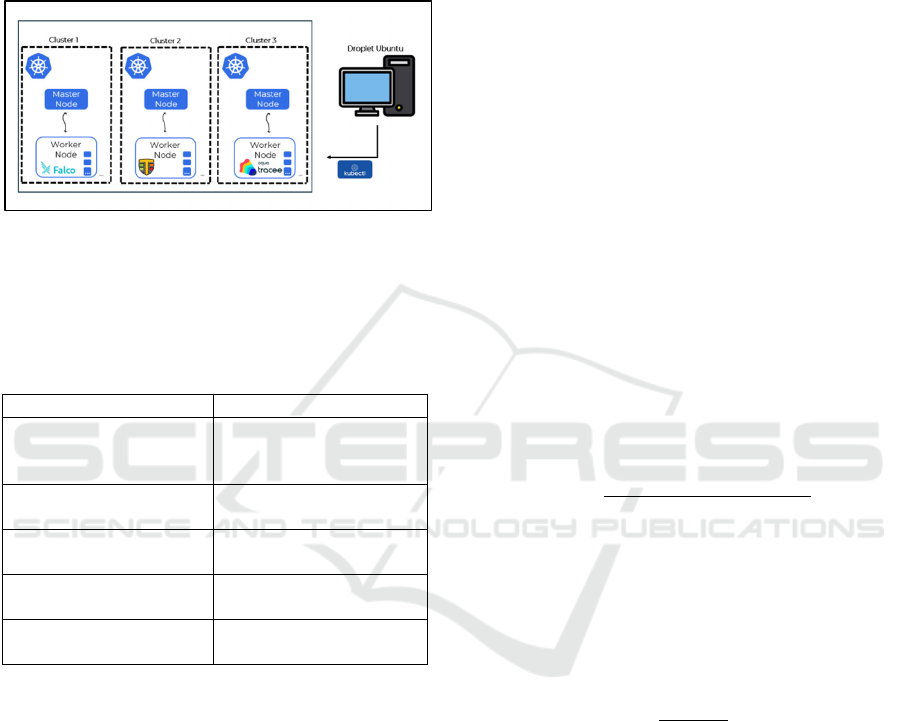
and attack scenario executors (Container Escape,
Denial of Service, and Cloud Cryptomining). Each
cluster is equipped with one of three eBPF-based
runtime security tools (Falco, Tetragon, Tracee), as
well as Dynatrace as an efficiency monitoring and
logging tool. This series of components and design
processes is illustrated in Figure 2.
Figure 2: Test environment design.
To provide a clearer context of the experimental
environment, Table 3 presents the specifications of
the Kubernetes clusters used in this study.
Table 3: Kubernetes cluster specifications.
Specifications Description
Control Plane Node Not exposed (Part of
Digital Ocean's managed
Kubernetes service)
Nodes 2vCPU, 4 GB Ram, 80
GB Disk (x3 node)
Operating System Debian GNU/Linux 12
(bookworm)
Services DOKS (DigitalOcean
Kubernetes)
Server Singapore Datacenter 1
(SGP1)
2.4 Demonstration
The demonstration phase was conducted by
simulating three main attack scenarios on the
Kubernetes cluster, namely container escape, denial
of service (DoS), and cloud cryptomining. Each
cluster was configured with one runtime security
monitoring tool, namely Falco, Tetragon, or Tracee,
which was installed through the official Helm Chart
repository in a separate namespace. The container
escape attack was executed using the nsenter utility,
the DoS attack was run with stress-ng, while
cryptomining was simulated through the execution of
xmrig on compromised containers. All attacks were
launched from a Virtual Private Server (VPS) via
kubectl. Detection data was obtained from each tool's
built-in logging pipeline, while resource usage was
monitored in real-time using Dynatrace and
Kubernetes Metrics Server. To ensure consistency
and reliability of results, each test scenario was
repeated 20 times.
2.5 Evaluation
In the evaluation stage, the researcher verifies
whether the simulation results meet the predefined
research requirements. In this study, the evaluation
was conducted through a comparative analysis of
runtime security monitoring tools by examining their
Key Performance Indicators (KPI) and efficiency,
measured using the established metrics.
2.5.1 Mean Time to Detect
Mean time to detect (MTTD) is an important metric
in cybersecurity and traffic incident detection. MTTD
represents the average duration required by the
system to identify a security incident from the
moment it occurs (Goswami, 2024). In the context of
network traffic incidents, this metric also reflects the
latency between the occurrence of an incident and its
detection (ElSahly & Abdelfatah, 2022). MTTD can
be measured by dividing the total detection time for
each incident by the number of incidents using the
following formula (Fadhillah, 2024).
MTTD =
Total detection time
T
o
tal n
u
m
be
r
o
f in
c
i
de
nt
s
(1
)
2.5.2 Detection Rate
This is the level at which correct attacks are correctly
identified. It is also known as True Positive Rate
(TPR) of this method. It is determined according to
the following expression (Villegas-Ch et al., 2024).
DR =
TP
TP + FN
(2
)
In this context, the terms are defined as follows:
a. True Positive (TP) : The number of attacks that
actually occurred and were successfully detected by
the system.
b. False Negative (FN): The number of attacks that
occurred but were not successfully detected by the
system.
2.5.3 False Positive Rate (FPR)
The rate at which normal activity is incorrectly
identified as an attack. This metric is also known as
fall-out or false alarm rate. FPR is determined
RITECH 2025 - The International Conference on Research and Innovations in Information and Engineering Technology
138
according to the following expression (Villegas-Ch et
al., 2024).
FPR =
FP
FP + T
N
(3)
In this context, the terms are defined as follows:
a. False Positive (FP): The number of incidents where
the system detects an attack when in fact there is no
attack (false alarm).
b. True Negative (TN): The number of incidents
where the system does not detect an attack because
there is no attack
2.5.4 CPU Usage
CPU Usage is an indicator of how much of the
processor's capacity is being used by the server at a
given time. CPU Usage is expressed as a percentage,
where a high value indicates that the CPU is working
hard at high intensity and processing a large number
of tasks (Purwoko et al., 2024).
2.5.5 Memory Usage
Memory usage is an indicator that represents the
amount of memory used relative to the total available
memory (Abdillah et al., 2023).
2.6 Communication
The Communication stage delivers the research
findings to academic and industrial stakeholders
through scientific publications, seminars, or
conferences, ensuring that the results are accessible
and applicable.
3 RESULT
Based on the results of tests conducted on three eBPF-
based runtime security monitoring tools, namely
Falco, Tetragon, and Tracee, a comprehensive picture
of the detection effectiveness and performance
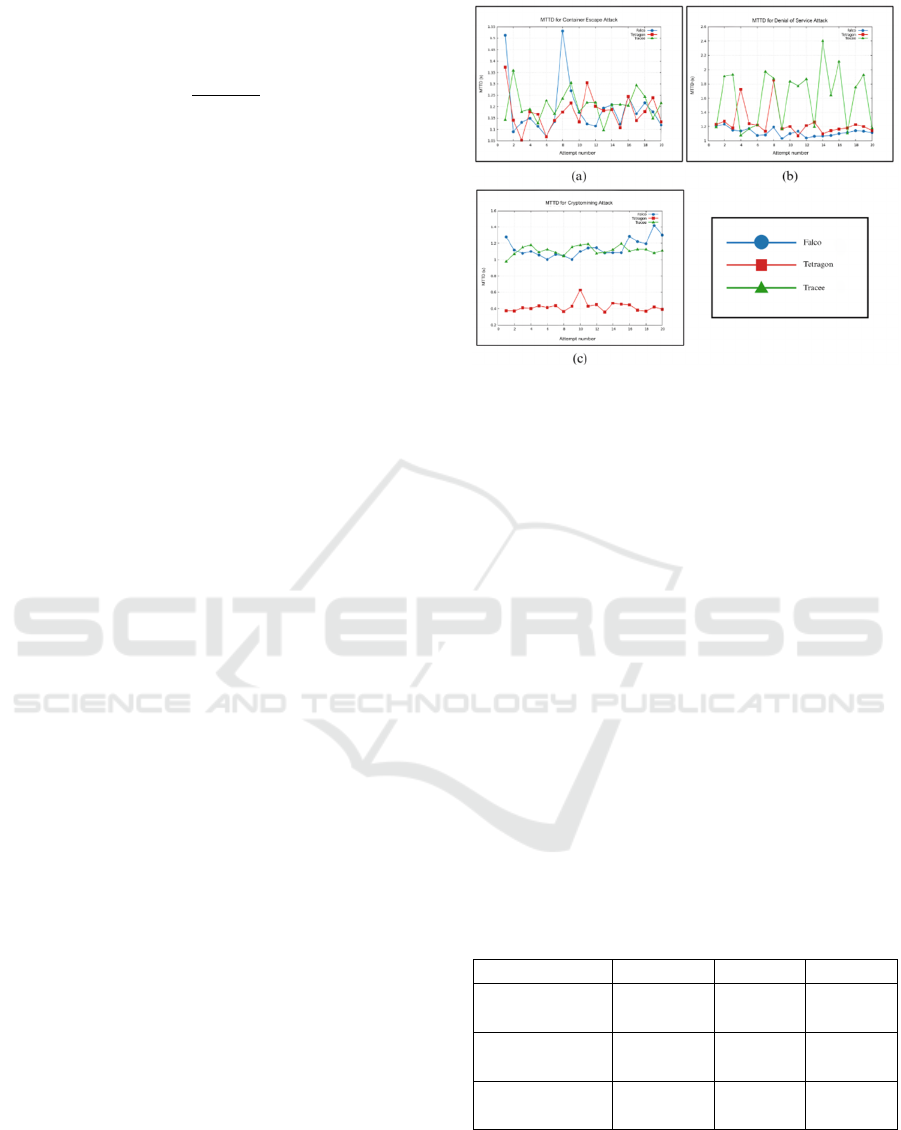
impact of each tool was obtained, as shown in Figure
3.
Figure 3: MTTD Result of (a) Container Escape (b) Denial
of Service (c) Cryptomining.
In the Container Escape attack, all three tools
demonstrated relatively competitive detection
performance, with Tetragon recording the fastest
MTTD of 1.17822 seconds, followed by Falco and
Tracee with only slightly different times (Table 4). In
the Denial-of-Service attack, Falco excelled with the
lowest MTTD of 1.11985 seconds, while also
demonstrating good detection time stability.
Meanwhile, Tracee recorded the slowest detection
time in this scenario, with fairly high variability.
Tetragon demonstrated a significant advantage in the
Cloud Cryptomining scenario, with the fastest MTTD
of 0.420968 seconds, far below Falco and Tracee,
which each recorded MTTDs of over one second.
Although Tracee did not perform best in terms of
detection speed, it was still able to detect all attacks
with 100% TPR and without generating false
positives (FPR 0%), similar to Falco and Tetragon.
The data can be found in the following Table
4.
Table 4: Value of MTTD.
Attack Scenario Falco Tetragon Tracee
Container
Escape
1,19337 s 1,17822 s 1,20866 s
Denial of
Service
1,11985 s 1,24703 s 1,61572 s
Cloud
Cryptomining
1,14044 s 0,42097 s 1,11561 s
For the next test results, all three tools successfully
detected every attack scenario with 100% accuracy.
In addition, none of the tools produced false positives,
Comparative Analysis of eBPF-Based Runtime Security Monitoring Tools in Monitoring and Threat Detection on Kubernetes
139

as reflected in the false positive rate (FPR) of 0% as
shown in Table 5.
Table 5: DR and FPR Results.
Metric Falco Tetragon Tracee
DR 100 % 100 % 100 %
FPR 0 % 0 % 0 %
To establish a performance baseline, resource usage
was first measured under normal operating conditions
without any attack scenarios. Table 6 presents the
CPU and memory consumption of each tool (Falco,
Tetragon, and Tracee) when deployed in an idle state.
These baseline measurements provide insights into
the inherent efficiency of each tool and serve as a
reference point for comparison with resource
utilization during attack detection.
Table 6: Resource Usage without Attacks (Baseline).
Metric Falco Tetragon Tracee
CPU 431,5
mcore
6,5 mcore 91,6
mcore
Memori 397,33
MB
634,59 MB 573,11
MB
Subsequently, resource usage was measured while the
tools were actively detecting threats. Table 7
summarizes the CPU and memory consumption of
Falco, Tetragon, and Tracee under attack conditions.
Comparison with the baseline values highlights the
performance overhead introduced by detection
activities and reveals differences in resource
management strategies among the tools.
Table 7: Resource Usage with Attacks.
Metric Falco Tetragon Tracee
CPU
(mcore)
433,5
mcore
6,9 mcore 93,7 mcore
Memori
(MB)
392,08
MB
641,50 MB 570,47
MB
4 DISCUSSION
Experimental results show that each eBPF-based
runtime security monitoring tool has different
advantages, which are closely related to its
architectural design and detection mechanisms. In
terms of Mean Time to Detect (MTTD) metrics,
Tetragon demonstrated the best performance in
container escape and cryptomining scenarios. This
advantage can be attributed to the implementation of
kernel-level policy enforcement that utilizes eBPF to
perform granular system inspection with minimal
latency. In contrast, Falco achieved the lowest MTTD
value in the Denial of Service (DoS) scenario,
reflecting the effectiveness of its rule-based anomaly
detection approach optimized for resource load
patterns. Tracee displayed stable performance and
competitive results in the container escape and
cryptomining scenarios, but was relatively less
effective in the DoS scenario. This limitation is
related to Tracee's forensic logging architecture,
which must process large volumes of kernel events,
thereby increasing detection latency under high load
conditions. Nevertheless, all three tools consistently
achieved a Detection Rate (DR) of 100% and a False
Positive Rate (FPR) of 0% across all scenarios,
confirming their reliability in identifying malicious
activity without generating false alarms.
Resource usage analysis reveals a trade-off
between computational load and detection
performance. Tetragon is the most CPU-efficient
tool, with an average consumption of 6.5 millicores
under baseline conditions and 6.9 millicores under
attack conditions, making it well-suited for resource-
constrained environments. However, Tetragon also
recorded the highest memory usage, at 634.59 MB
under baseline conditions and increasing to 641.50
MB under attack conditions. In contrast, Falco has the
lowest memory usage (397.33 MB under baseline
conditions and 392.08 MB during attacks), but
requires significantly more CPU resources, namely
431.5 millicores under baseline conditions and 433.5
millicores during attacks. Tracee is in the middle,
with moderate CPU consumption (91.6 millicores
under base conditions and 93.7 millicores during an
attack) and relatively stable memory usage (573.11
MB under base conditions and 570.47 MB during an
attack).
A comparison between baseline and attack
conditions shows that attacks do not significantly
increase resource consumption, indicating that the
detection process runs efficiently without causing any
significant additional load. The results indicate that
resource consumption under attack conditions
remains close to the baseline. This efficiency is
largely due to the use of eBPF for kernel-level event
processing, optimized filtering of relevant events, and
lightweight evaluation of attack patterns. In addition,
adaptive logging strategies prevent excessive CPU
and memory overhead, ensuring stable system
performance during threat detection. These
differences reflect the design strategies of each tool
with Falco prioritizes memory efficiency, Tetragon
emphasizes CPU efficiency, and Tracee strives to
balance both. Thus, the main differences between the
three tools lie in detection speed and resource usage
efficiency.
RITECH 2025 - The International Conference on Research and Innovations in Information and Engineering Technology
140

From a practical perspective, these results
confirm that the selection of runtime security tools
should be tailored to the priorities of the organization
and the available infrastructure capacity. In
environments with highly sensitive workloads,
Tetragon's detection speed may be prioritized despite
its higher memory requirements. Conversely, in
resource-constrained infrastructures, Falco's memory
efficiency makes it a more suitable choice. Tracee can
be positioned as an alternative offering a balance,
with a combination of detection capabilities,
observability, and adequate forensic support.
5 CONCLUSION
The comparison results show that Tetragon excels in
detection speed for container escapes and crypto
mining, while Falco is more effective in DoS
detection. All three tools achieved 100% detection
accuracy without false positives, confirming their
reliability. In terms of performance, Tetragon
recorded the lowest CPU usage, Falco showed the
lowest memory usage, and Tracee balanced both with
moderate CPU and memory usage. Importantly, a
comparison between baseline conditions and attacks
shows that active attacks do not significantly increase
resource usage, reflecting the efficiency of the
detection process. These findings suggest that tool
selection should be based on organizational priorities.
Tetragon is suitable for sensitive workloads that
require fast detection, Falco is recommended for
environments with memory constraints, and Tracee
represents a balanced alternative that offers additional
forensic insights.
REFERENCES
Abdillah, Mgs. M. F., Sardi, I. L., & Hadikusuma, A.
(2023). Analisis Performa GetX dan BLoC State
Management Library Pada Flutter untuk Perangkat
Lunak Berbasis Android. LOGIC: Jurnal Penelitian
Informatika, 1(1), 73.
https://doi.org/10.25124/logic.v1i1.6479
Bharadwaj, D., & Premananda, B. S. (2022). Transition of
Cloud Computing from Traditional Applications to the
Cloud Native Approach. 2022 IEEE North Karnataka
Subsection Flagship International Conference.
https://doi.org/10.1109/NKCon56289.2022.10126871
Bhattacharya, M. H., & Mittal, H. K. (2023). Exploring the
Performance of Container Runtimes within Kubernetes
Clusters. International Journal of Computing, 22(4),
509–514. https://doi.org/10.47839/ijc.22.4.3359
Cloud Native Computing Foundation. (2024). CNCF 2023
Annual Survey. https://www.cncf.io/reports/cncf-
annual-survey-2023/
Dresch, A., Daniel, ·, Lacerda, P., Antônio, J., & Antunes,
V. (2015). Design Science Research A Method for
Science and Technology Advancement. Springer
Cham. https://doi.org/https://doi.org/10.1007/978-3-
319-07374-3
ElSahly, O., & Abdelfatah, A. (2022). A Systematic
Review of Traffic Incident Detection Algorithms.
Sustainability, 14(22), 14859.
https://doi.org/10.3390/su142214859
Fadhillah, R. (2024). MONITORING KEAMANAN
RUNTIME PADA KUBERNETES
MENGGUNAKAN.
Goswami, S. S. (2024). Exploring the Impact of Artificial
Intelligence Integration on Cybersecurity: A
Comprehensive Analysis. Journal of Industrial
Intelligence, 2(2), 73–93.
https://doi.org/10.56578/jii020202
Kim, J., & Nam, J. (2024). eBPF-based Container Activity
Analysis System eBPF. The Transactions of the Korea
Information Processing Society, 13(9), 404–412.
https://doi.org/10.3745/TKIPS.2024.13.9.404
Kosinska, J., Balis, B., Konieczny, M., Malawski, M., &
Zielinski, S. (2023). Toward the Observability of
Cloud-Native Applications: The Overview of the State-
of-the-Art. IEEE Access, 11, 73036–73052.
https://doi.org/10.1109/ACCESS.2023.3281860
Magnani, S., Risso, F., & Siracusa, D. (2022). A Control
Plane Enabling Automated and Fully Adaptive
Network Traffic Monitoring With eBPF. IEEE Access,
10, 90778–90791.
https://doi.org/10.1109/ACCESS.2022.3202644
OWASP. (2022). OWASP Kubernetes Top 10.
https://owasp.org/www-project-kubernetes-top-ten/
Purwoko, R., Priambodo, D. F., & Prasetyo, A. N. (2024).
Quantifying of runC, Kata and gVisor in Kubernates.
ILKOM Jurnal Ilmiah, 16(1), 12–26.
https://doi.org/10.33096/ilkom.v16i1.1679.12-26
Red Hat. (2024). The state of Kubernetes security report.
Villegas-Ch, W., Govea, J., Gutierrez, R., Maldonado
Navarro, A., & Mera-Navarrete, A. (2024).
Effectiveness of an Adaptive Deep Learning-Based
Intrusion Detection System. IEEE Access, 12, 184010–
184027.
https://doi.org/10.1109/ACCESS.2024.3512363
Comparative Analysis of eBPF-Based Runtime Security Monitoring Tools in Monitoring and Threat Detection on Kubernetes
141
