
Implementation of Machine Learning in the Classification of Text
Created by Humans or Artificial Intelligence
Alexander Gosal
1
and Riska Septifani
2
1
Hasanuddin University, Indonesia
2
University of Birmingham, U.K.
Keywords: Classification, GPT 3.5, SVM, XLNet, XAI, SHAP, LIME.
Abstract: Rapid developments in the field of artificial intelligence have triggered significant advances in generative
artificial intelligence technology, particularly large language models. These models, especially conversational
artificial intelligence such as ChatGPT, have the potential to revolutionize various aspects of life. However,
behind this potential lie dangers and concerns that need to be addressed. The model's ability to generate text
that is highly similar to human written text raises concerns about the spread of fake news and misinformation.
This research aims to implement a machine learning model to classify text generated by humans or AI. The
research collected 6650 data points from the Philosophy Exchange website and the GPT-3.5 model, analyzing
responses from 4109 user answers and 2541 GPT model responses. Philosophy Exchange is an online
discussion platform where individuals engage in debates and knowledge-sharing on philosophical concepts,
ethical dilemmas, and critical thinking questions. The XLNet model outperformed the SVM model by 0.03,
achieving precision, recall, and F1 scores of 0.98. The XAI analysis showed that GPT-3.5 tends to use certain
words more frequently, indicating a limited vocabulary and repetitive word usage patterns.
1 INTRODUCTION
Artificial Intelligence (AI), particularly Artificial
Neural Networks (ANNs) and Deep Learning, has
transformed multiple industries through its ability to
solve complex problems and make accurate
predictions. The advent of Large Language Models
(LLMs), built on transformer architectures, has
further revolutionized natural language processing,
enabling models such as GPT to generate human-like
text, translate languages, and serve as virtual
assistants. These generative AI systems are now
applied in diverse fields including content creation,
healthcare, and design. However, their increasing
capabilities also introduce risks. Conversational AI
models like ChatGPT may perpetuate biases
embedded in training data, leading to discriminatory
outcomes, and their ability to produce highly realistic
text makes them vulnerable to misuse in spreading
misinformation or fake news. These challenges
underscore the importance of developing systems to
reliably distinguish between human and AI-generated
text. (Mindner et al., 2023; Yenduri et al., 2023)
A preliminary analysis, using TF-IDF for text
representation and cosine similarity for comparison,
showed that ChatGPT-3.5 outputs exhibit
repetitiveness, with similarity scores reaching 0.61.
(Mitrović et al., 2023) showed that distinguishing
between human and ChatGPT-generated text can be
particularly difficult when human text is paraphrased.
Their research, which employed a DistilBERT model
with SHAP explanations, achieved approximately
79% accuracy and further highlighted distinctive
characteristics of ChatGPT’s writing such as
excessive politeness, lack of specific details,
sophisticated but sometimes unusual vocabulary,
impersonal tone, and limited emotional expression.
Several other studies have investigated the
classification of human versus AI-generated text.
(Maktab Dar Oghaz et al., 2023) demonstrated that
RoBERTa-based deep learning models outperformed
alternative approaches, while SVM with TF-IDF
features ranked highest among traditional algorithms.
Similarly, (Hayawi et al., 2024) performed a
multiclass classification of human, GPT, and Bard
texts, where TF-IDF-based SVM performed strongly.
In another research, (Arabadzhieva - Kalcheva and
Kovachev, 2022) reported that XLNet achieved the
highest accuracy (96%) in classifying English
reviews, outperforming TF-IDF + SVM by 8.5%,
Gosal, A. and Septifani, R.
Implementation of Machine Learning in the Classification of Text Created by Humans or Artificial Intelligence.
DOI: 10.5220/0014269100004928
Paper published under CC license (CC BY-NC-ND 4.0)
In Proceedings of the 1st International Conference on Research and Innovations in Information and Engineering Technology (RITECH 2025), pages 45-52
ISBN: 978-989-758-784-9
Proceedings Copyright © 2025 by SCITEPRESS – Science and Technology Publications, Lda.
45
although TF-IDF combined with SVM remained the
most effective method among traditional machine
learning models.
2 METHODS
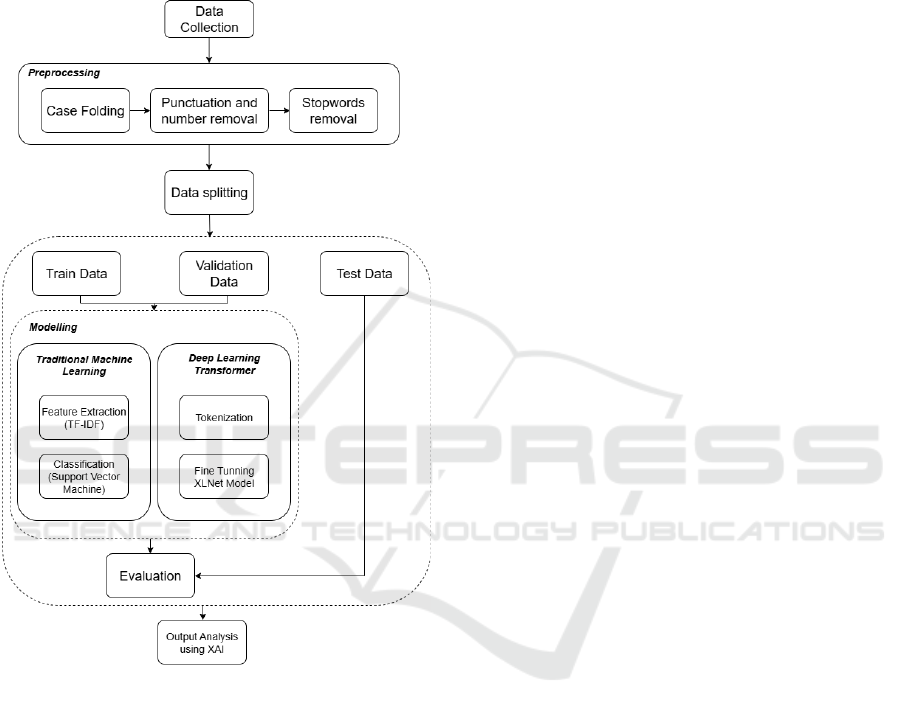
Figure 1: Proposed method.
This research proposes to implement SVM and
XLNet models for classifying human and AI-
generated text. XLNet is selected as it represents a
state-of-the-art deep learning model, achieving
superior accuracy over BERT-based models in text
classification, as demonstrated by (Arabadzhieva-
Kalcheva and Kovachev, 2022). In contrast, SVM is
included as a representative of traditional machine
learning approaches, where TF-IDF will be used to
weight words. A TF-IDF-based SVM serves as a
relatively lightweight yet effective baseline,
consistently proving its value in prior studies on text
classification tasks and offering strong
interpretability compared to more complex neural
models. The classification results will be analyzed
using eXplainable AI (XAI) methods, specifically
Local Interpretable Model-agnostic Explanations
(LIME) and SHapley Additive exPlanations (SHAP).
These post-hoc and model-agnostic techniques,
identified as the most frequently used by (Salih et al.,
2024), will provide insights into how both the
traditional and deep learning models make their
decisions.
The proposed method (Figure 1) begins with data
collection and preprocessing, including case folding,
punctuation/number removal, and stopword
elimination. The preprocessed data is split into
training, validation, and test sets. For modeling, two
methods are employed: (i) a traditional machine
learning pipeline using TF-IDF for feature extraction
and SVM for classification, and (ii) a deep learning
approach using XLNet, where tokenized text is fine-
tuned for the task. Model performance is evaluated on
test data using accuracy, precision, recall, and F1-
score. Finally, output analysis is conducted using XAI
methods (LIME and SHAP) to interpret feature
importance and provide insights into model decision-
making.
2.1 Data Collection
This research utilizes data from the Philosophy
Exchange website, a part of the Stack Exchange
network. This platform was chosen because its
content, primarily user responses, is predominantly
text-based, unlike other Stack Exchange sites that
might heavily feature arithmetic symbols or technical
notations. A key reason for selecting Philosophy
Exchange is its strict policy against generative AI-
produced content, ensuring that all posted content
reflects human thought. The dataset consists of user-
generated answers to a wide range of philosophical
topics, debates, and ethical discussions, making it
suitable for analyzing patterns of human reasoning
and argumentation. Data collection was performed
using the Stack Exchange API, allowing for
structured and efficient download of questions and
answers. Data was retrieved in ascending order by
timestamp, covering the period from 2011 to 2016.
This focus on text-based content enables easier
analysis and comparison of AI-generated answers
with original human contributions. After collecting
questions from the Philosophy Stack Exchange, the
next step involved generating corresponding answers
using the latest GPT-3.5 Turbo model (version 0125)
via its API. To ensure the model's behavior mimicked
that of the ChatGPT website, each query included the
system message: "Assistant is a large language model
RITECH 2025 - The International Conference on Research and Innovations in Information and Engineering Technology
46

trained by OpenAI." (López Espejel et al., 2023;
Ouyang et al., 2022)
From 2541 unique questions, a total of 6650
answer data points were gathered for this research.
This dataset comprises 4109 original human
responses from the Philosophy Stack Exchange and
2541 AI-generated responses from the GPT-3.5
model.
2.2 Preprocessing
This step ensures the data is clean, organized, and
transformed into a format suitable for model
processing. It begins with case folding, where all text
is converted to lowercase to standardize word forms
and enhance consistency. Following this, punctuation
and numbers are removed as they typically don't
contribute significantly to the text's meaning and can
interfere with subsequent analysis. Finally, stopwords
removal is performed to eliminate common, high-
frequency words (such as prepositions and
conjunctions) that have minimal informational value,
further streamlining the data for effective analysis.
After exploring the data regarding the number of
words in each response, it was found that user
responses or answers have an average of 232 words,
with the smallest number of words being 5 and the
largest being 2,773. The responses from the GPT-3.5
Turbo model have an average of 244 words, with the
smallest number of words being 14 and the largest
being 529.
2.3 Data Splitting
Before any model training commences, the text labels
are meticulously encoded numerically. "gpt-
generated" labels are converted to 0, and "human-
generated" labels to 1, making them processable by
machine learning algorithms. The dataset is then
carefully divided into three distinct sets: 70% for
training, 15% for validation, and 15% for testing. To
ensure a balanced representation of each class across
these subsets and prevent any potential bias, stratified
shuffle split is employed. Furthermore, a consistent
random seed of 42 is utilized throughout this process,
guaranteeing the reproducibility of the data splitting
results for every experiment.
2.4 Modelling
The core of this research involves training two
distinct models: Support Vector Machines (SVM)
and XLNet. Both models are designed to classify text
as either human-generated or gpt-generated.
2.4.1 Term Frequency-Inverse Document
Frequency (TF-IDF) and Support
Vector Machines (SVM)
For the SVM model, the text data is first transformed
using the Term Frequency-Inverse Document
Frequency (TF-IDF) method. TF-IDF converts text
into numerical vectors by assigning weights to words
based on their importance within a specific document
relative to the entire collection of documents. This
method incorporates Term Frequency (TF), which
measures how often a word appears in a document as
shown in (1),
TF
=
(
t,d
)
(
1
)
Inverse Document Frequency (IDF), which quantifies
how rare a word is across all documents.
IDF
=log
n
df
(
t
)
(
2
)
The Term Frequency - Inverse Document Frequency
(W
) value is obtained by multiplying the TF value by
the IDF.
W
=TF
×IDF
(
3
)
By adopting a bag-of-words approach, TF-IDF
focuses on word frequency to capture crucial textual
meaning, effectively filtering out less informative
common words.
Once the text is vectorized using TF-IDF, a
Support Vector Machines (SVM) is applied as the
classification algorithm. Given a training set of
instance-label pairs (𝑥
,𝑦
),𝑖 = 1,...,𝑙 where 𝑥
∈
𝑅
and 𝑦 ∈ {1,−1}
, the SVM require the solution
of the following optimization problem:
min
,,
1
2
𝑤
𝑤+𝐶 𝜉
(
4
)
subject to 𝑦
(
𝑤
𝜙
(
𝑥
)
+𝑏
)
≥1− 𝜉
𝜉
≥ 0.
Here training vectors 𝑥
are mapped into a higher
(maybe infinite) dimensional space by the function 𝜙.
SVM finds a linear separating hyperplane with the
maximal margin in this higher dimensional space.
𝐶 > 0 is the penalty parameter of the error term. The
Radial Basis Function (RBF) serves as the main
kernel in this research.
To fine-tune the SVM model performance, Grid
Search combined with Cross-Validation (CV) is
employed. This method systematically searches for
the optimal cost (𝐶) and gamma (ɣ) hyperparameters,
following an exponential growth sequence
(2 𝑥 10
to 2 𝑥 10
), which enables comprehensive
parameter tuning while mitigating overfitting by
validating the model across various data folds. (Guido
et al., 2023)
Implementation of Machine Learning in the Classification of Text Created by Humans or Artificial Intelligence
47

2.4.2 XLNet
The XLNet model combines the strengths of
autoregressive language modeling and autoencoding
approaches to improve text understanding. It does this
by maximizing the expected log-likelihood of a
sequence over all possible permutations of
factorization orders, which enables it to capture
bidirectional context while maintaining the
advantages of autoregressive training. Built upon
Transformer-XL, XLNet incorporates segment
recurrence and relative positional encoding,
enhancing its ability to model longer text sequences
effectively. Its Permutation Language Modeling
(PLM) objective permutes the prediction order of
tokens during training rather than shuffling the actual
text allowing the model to learn complex word
dependencies and deepen contextual comprehension.
To formalize the idea, in equation (5), let ᵶ
be the set
of all possible permutations of the length-T index
sequence [1, 2, . . . , T ]. 𝑧
and 𝑧
denote the t-th
element and the first t−1 elements of a permutation
𝑧 ∈ ᵶ
. Then, the permutation language modeling
objective can be expressed as follows:
max
𝔼
~ᵶ
log𝑝
(
𝑥
| 𝑥
) (5)
The XLNet modeling process begins with
tokenization, where raw text is segmented into
subword tokens and mapped to numerical IDs. A
token length of 512 is used, with longer texts
truncated and shorter ones padded to match this
dimension. After tokenization, data loaders are
created for the training, validation, and test datasets,
each with a batch size of 8. This specific batch size
was chosen to optimize computational resource usage
and prevent memory errors during training. The
AdamW optimizer, which includes weight decay to
combat overfitting, is used to train the XLNet model.
During training, validation is performed at each
epoch, and an early stopping mechanism is
implemented to halt training if no improvement in
validation loss is observed after a certain number of
epochs, thereby preventing overfitting. Upon
completion of training, the best-performing model is
saved and subsequently evaluated using the dedicated
test dataset to assess its final performance. (Gautam
et al., 2021)
2.5 Evaluation
The performance of the SVM and XLNet models is
evaluated on test data using key metrics accuracy,
precision, recall, and F1-score derived from the
confusion matrix. The confusion matrix itself
provides a detailed breakdown of correct and
incorrect predictions, featuring True Positives (TP)
(correctly identified positives), True Negatives (TN)
(correctly identified negatives), False Positives (FP)
(incorrectly identified positives), and False Negatives
(FN) (incorrectly identified negatives). Accuracy (6)
is the proportion of correct predictions out of all
predictions made by the model. (Vickers et al., 2024)
Accuracy=
𝑇𝑃+ 𝑇𝑁
𝑇𝑃+ 𝑇𝑁 + 𝐹𝑃+ 𝐹𝑁
(
6
)
Precision (7) is the proportion of all positive
classifications that are actually positive.
Precision =
𝑇𝑃
𝑇𝑃+ 𝐹𝑃
(
7
)
Recall (8) is the proportion of all actual positive
results that are correctly classified as positive.
Recall =
𝑇𝑃
𝑇𝑃+ 𝐹𝑁
(
8
)
F1-score (9) is the harmonic mean of precision and
recall.
F1-score =
2 × 𝑃𝑟𝑒𝑐𝑖𝑠𝑖𝑜𝑛 × 𝑅𝑒𝑐𝑎𝑙𝑙
𝑃𝑟𝑒𝑐𝑖𝑠𝑖𝑜𝑛 + 𝑅𝑒𝑐𝑎𝑙𝑙
(
9
)
2.6 eXplainable AI (XAI)
After evaluating the models, their predictions are
analyzed using XAI methods to interpret the decision-
making process. XAI enhances trust and
understanding by identifying factors that influence
model outputs, particularly in complex neural
networks. In this research, Local Interpretable Model-
agnostic Explanations (LIME) and SHapley Additive
exPlanations (SHAP) are employed due to their
model-agnostic and post-hoc nature, allowing
practical interpretation of the trained models without
retraining. (Ali et al., 2023; Cesarini et al., 2024)
2.6.1 Local Interpretable Model-Agnostic
Explanations (LIME)
LIME is an algorithm designed to explain individual
predictions of any classifier or regressor by locally
approximating the model's behavior with a more
interpretable one. This process begins by selecting a
specific data point whose prediction needs
explanation. LIME then generates new data points by
perturbing the original data's features, observing how
these changes impact the model's predictions. These
new data points, along with their predictions, are then
used to train a simple, interpretable model (typically
a linear model) that approximates the complex
model's behavior in the immediate vicinity of the
selected data point. LIME analyzes the feature
RITECH 2025 - The International Conference on Research and Innovations in Information and Engineering Technology
48

weights within this simple model to determine which
features are most influential in affecting the
prediction for that specific data point. Features with
the highest weights are considered the most
impactful. The results are visualized, clearly showing
which features contribute positively or negatively to
the prediction. Mathematically, local surrogate
models with interpretability constraint can be
expressed as follows:
𝑒𝑥𝑝𝑙𝑎𝑛𝑎𝑡𝑖𝑜𝑛
(
𝑥
)
=argmin
∈
𝐿
(
𝑓,𝑔,𝜋
)
+Ω
(
𝑔
)(
10
)
The explanation model for instance 𝑥 is the model 𝑔
that minimizes loss 𝐿, which measures how close the
explanation is to the prediction of the original model
𝑓, while the model complexity Ω(𝑔) is kept low. 𝐺 is
the family of possible explanations. The proximity
measure 𝜋
defines how large the neighborhood
around instance 𝑥 that is considered for the
explanation. In practice, LIME only optimizes the
loss part. The user has to determine the complexity by
selecting the maximum number of features that the
model may use.
2.6.2 SHapley Additive exPlanations
(SHAP)
SHAP is a game theory-based approach that explains
the outputs of machine learning models. Rooted in the
concept of Shapley values, SHAP fairly attributes the
contribution of each feature to the final prediction. It
quantifies the marginal contribution of each feature
by systematically manipulating input features and
observing the corresponding changes in the model's
prediction. (Molnar, 2024)
The Shapley value for a given feature is
calculated as the average marginal contribution of
that feature across all possible combinations of other
features. This process considers all possible
permutations of features, measuring how the model's
output changes when a feature is included versus
when it's excluded, taking into account all other
feature combinations. These computed SHAP values
then serve to explain how each individual feature
influences the model's output. SHAP assigns an
importance value to each feature that represents the
effect on the model prediction of including that
feature. To compute this effect, a model 𝑓
∪{}
is
trained with that feature present, and another model
𝑓
is trained with the feature withheld. Then,
predictions from the two models are compared on the
current input 𝑓
∪{}
(𝑥
∪{}
) − 𝑓
(𝑥
) , where 𝑥
represents the values of the input features in the set 𝑆.
Since the effect of withholding a feature depends on
other features in the model, the preceding differences
are computed for all possible subsets 𝑆 ⊆ 𝐹 \ {𝑖}.
The Shapley values are then computed and used as
feature attributions. They are a weighted average of
all possible differences:
𝜙
=
|
𝑆
|
!
(|
𝐹
|
−
|
𝑆
|
−1
)
|
𝐹
|
!
⊆
{
}
𝑓
∪
{
}
𝑥
∪
{
}
− 𝑓
(
𝑥
)
(
11
)
3 RESULTS
Using the SVM model with hyperparameters
obtained from the training process, the model was
tested on the test dataset. During the training process,
the model achieved an accuracy of 1.0 as we can see
in Table 1, indicating that the model was able to
classify the training data perfectly. However, the
model evaluation results on the test dataset (Table 2)
showed an accuracy of 0.95, indicating a slight
decline in performance when the model was tested on
data it had never seen before.
Table 1: SVM model training results.
Model Best Parameter Accuracy
SVM
C = 20
1.0
γ = 0.2
Table 2: Results of SVM model evaluation on test data.
Class Precision Recall F1-Score
“gp
t
-generated” 0.94 0.95 0.94
“human-generated”
0.97 0.96 0.96
Table 3: XLNet model training results.
Epoch
Training
Accuracy
Training
Loss
Validation
Accuracy
Validation
Loss
1 0.933 0.166 0.969 0.072
2 0.991 0.024 0.962 0.139
3 0.987 0.041 0.982 0.046
4 0.996 0.009 0.956 0.145
5 0.996 0.012 0.975 0.115
6 0.995 0.017 0.936 0.31
In Table 3, the XLNet model achieved the lowest
validation loss value of 0.046 in the third epoch. In
this epoch, the accuracy on the validation data was
0.982 and the accuracy on the training data was 0.987.
These results show good and consistent performance
between the training and validation data. From the
fourth to the sixth epoch, although the model's
accuracy on the training data continued to improve,
the model's accuracy on the validation data decreased.
This condition indicates that the model may be
Implementation of Machine Learning in the Classification of Text Created by Humans or Artificial Intelligence
49
overfitting on the training data, so the model to be
used for the evaluation process is the model from the
third epoch.
Table 4 Results of XLNet model evaluation on test data.
Class Precision Recall F1-Score
“gpt-generated” 0.96 0.99 0.97
“human-generated” 0.99 0.98 0.98
The XLNet model performed well with an
accuracy of 0.98 on the test data (see Table 4). These
results indicate that the model performs consistently
with the training and validation data, which achieved
accuracy of 0.987 and 0.982, respectively. The small
difference in accuracy indicates that the model did not
overfit, enabling it to generalize well to previously
unseen data.
Both SVM and XLNet showed lower precision in
the gpt-generated class, and in one instance, both
models failed to classify correctly. SHAP analysis
revealed that the word “wikipedia” received high
importance in both models, contributing to the
misclassification. Further corpus analysis showed
that “wikipedia” appears predominantly in human-
generated texts, which likely biased the models
toward the human class.
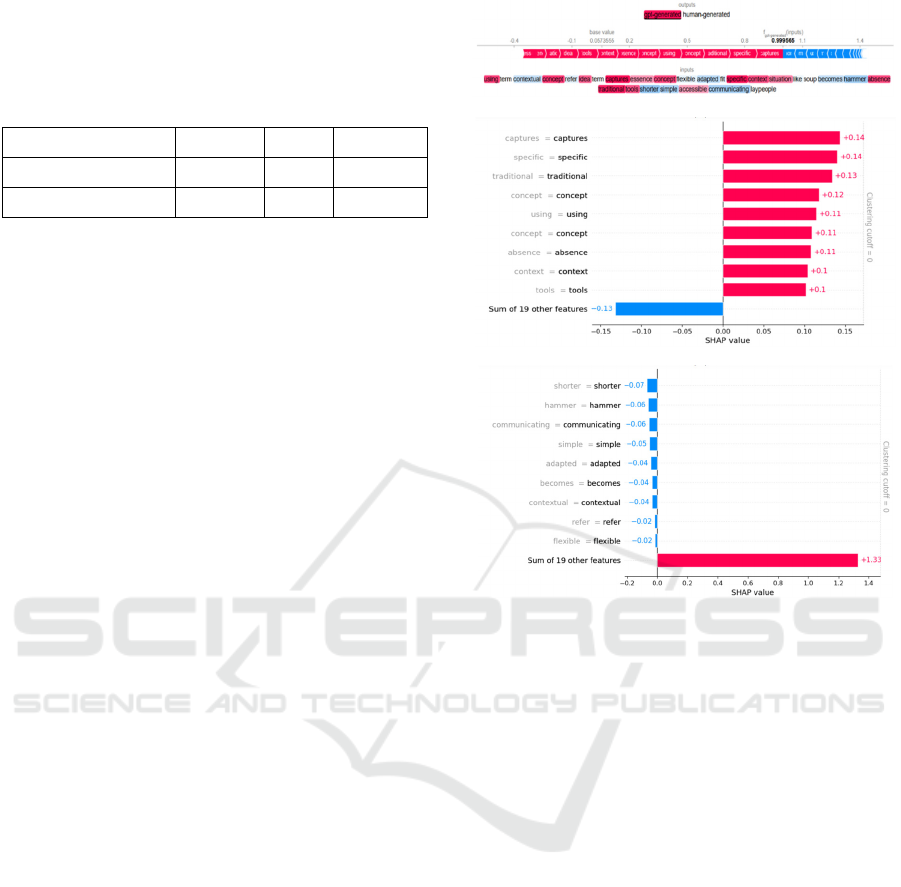
In Figure 2 (a) shows the contribution of each
word to the model prediction using a color scheme to
facilitate interpretation. Words that have a positive
contribution to the model's prediction are marked in
red, where bright red indicates a higher SHAP value.
Meanwhile, words that have a negative contribution
are displayed in blue. Words that do not contribute or
do not influence the model's decision or have a SHAP
value of zero are not colored. Also, Figure 2 (b) shows
these words sorted by SHAP value in descending
order. Figure 2 (b) shows some words or features that
contribute positively to the model's prediction. In the
tested text, the SVM model successfully classified the
text as gpt generated text. In Figure 2 (b), words such
as “captures,” “specific,” and “traditional” have
SHAP values of 0.14, 0.14, and 0.13, respectively.
These words have the greatest influence on the
model's decision to classify the text as gpt generated
text. Meanwhile, in Figure 2 (c), words such as
“shorter,” “hammer,” and ‘communicating’ have
SHAP values of -0.07, -0.06, and -0.06, respectively,
indicating that these words reduce the model's
confidence in the “gpt-generated” class, causing the
model to be more likely to predict the text into the
“human-generated” class.
(a)
(b)
(c)
Figure 2: The results of the SHAP method for the text
“using term contextual concept refer idea term captures
essence concept flexible adapted fit specific context
situation like soup becomes hammer absence traditional
tools shorter simple accessible communicating laypeople”
using the SVM model: (a) words that contribute to the
model prediction; (b) SHAP value graph for ten features
sorted in descending order; (c) SHAP value graph for ten
features sorted in ascending order.
Figure 3 shows several words or features that
contribute positively to the model's prediction, both
as text created by humans and text created by the GPT
model. In the tested text, the SVM model successfully
classified the text as gpt generated text.
Figure 4 (SHAP) and Figure 5 (LIME) shows
several words or features that contribute positively or
negatively to the model's predictions. In the tested
text, the XLNet model also successfully classified the
text as text generated by artificial intelligence.
RITECH 2025 - The International Conference on Research and Innovations in Information and Engineering Technology
50
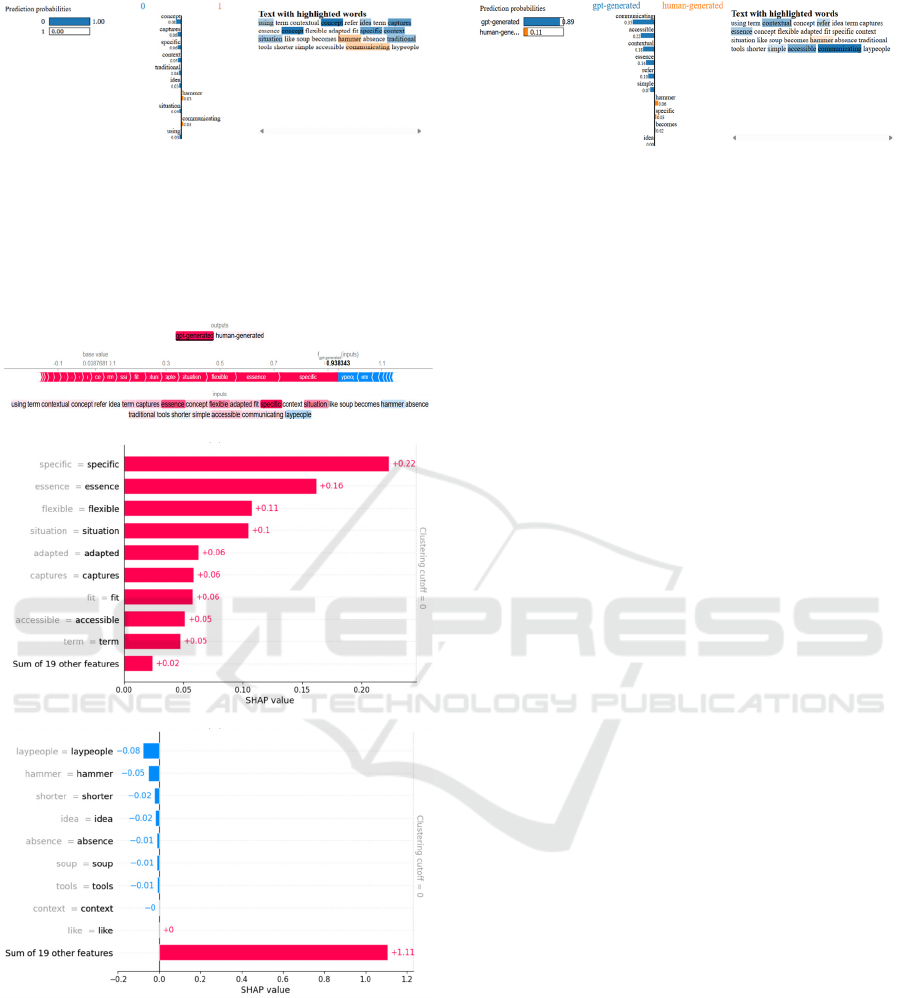
Figure 3: The results of the LIME method for the text “using
the term contextual concept refers to the idea of a term that
captures the essence of a concept that is flexible and
adaptable to specific contextual situations, such as soup
becoming a hammer in the absence of traditional tools, is
shorter, simpler, and more accessible for communicating
with the general public” using the SVM model.
(a)
(b)
(c)
Figure 4: The results of the SHAP method for the text
“using term contextual concept refer idea term captures
essence concept flexible adapted fit specific context
situation like soup becomes hammer absence traditional
tools shorter simple accessible communicating laypeople”
using the XLNet model: (a) words that contribute to the
model prediction; (b) SHAP value graph for ten features
sorted in descending order; (c) SHAP value graph for ten
features sorted in ascending order.
Figure 5: The results of the LIME method for the text “using
the term contextual concept refers to the idea of a term that
captures the essence of a concept that is flexible and
adaptable to specific contextual situations, such as soup
becoming a hammer in the absence of traditional tools, is
shorter, simpler, and more accessible for communicating
with the general public” using the XLNet model.
The results of the data analysis show that words
with high attribution values in the analysis using the
SVM model tend to appear more frequently in the
responses from the GPT model than in the answers
from the user philosophy exchange. These results
explain how the SVM model can achieve relatively
high accuracy in classifying text, as the GPT model
tends to generate text with a more limited vocabulary
and repetitive word usage patterns, or repeatedly uses
the same words when answering multiple questions
using the predefined system message in the model.
Explaining results from text classification using
SHAP and LIME can be challenging due to the
inherently detailed and often redundant nature of their
outputs. In this research, SHAP and LIME is applied
only for local explanations, highlighting the
contribution of individual features within specific
predictions. However, one limitation is that both
methods treats features (tokens) independently,
focusing on their importance values while
overlooking the semantic relationships between
words.
4 CONCLUSIONS
This research implemented and compared SVM and
XLNet models for classifying human- versus AI-
generated text. Both models achieved strong results,
with XLNet slightly outperforming SVM (F1-score
of 0.98 vs. 0.95), reflecting its superior ability to
capture contextual dependencies in text. While the
TF-IDF-based SVM offered a lightweight and
effective baseline, the transformer-based XLNet
proved better suited for handling the complexity and
variability of outputs from GPT-3.5. Explainable AI
(XAI) analysis further revealed linguistic differences:
GPT-3.5 responses showed limited and repetitive
vocabulary, whereas human responses demonstrated
broader and more adaptive language use. These
Implementation of Machine Learning in the Classification of Text Created by Humans or Artificial Intelligence
51

findings underscore the effectiveness of transformer
models in this classification task and the value of XAI
tools in uncovering patterns that distinguish human
from AI-generated text.
Future research could expand the dataset by
including more diverse text types (e.g., programming
code, mathematical equations, and domain-specific
content) to improve generalizability. Exploring the
direct use of Large Language Models (LLMs)
through fine-tuning or prompt engineering may also
enhance classification performance given their strong
contextual understanding. Employing the latest GPT
versions or other state-of-the-art models would
ensure up-to-date results, while programs such as
Azure for Students could be leveraged to reduce
research costs when accessing GenAI model APIs.
ACKNOWLEDGEMENTS
The authors acknowledge the use of OpenAI’s GPT-
5 language model for assistance in idea generation,
drafting, and language refinement during the
preparation of this manuscript. All content produced
with AI assistance was carefully reviewed and
verified by the authors, who take full responsibility
for the final version of the paper.
REFERENCES
Ali, S., Abuhmed, T., El-Sappagh, S., Muhammad, K.,
Alonso-Moral, J.M., Confalonieri, R., Guidotti, R., Del
Ser, J., Díaz-Rodríguez, N., Herrera, F., 2023.
Explainable Artificial Intelligence (XAI): What we
know and what is left to attain Trustworthy Artificial
Intelligence. Information Fusion 99, 101805.
Arabadzhieva - Kalcheva, N., Kovachev, I., 2022.
Comparison of BERT and XLNet accuracy with
classical methods and algorithms in text classification,
in: 2021 International Conference on Biomedical
Innovations and Applications (BIA). Presented at the
2021 International Conference on Biomedical
Innovations and Applications (BIA), IEEE, Varna,
Bulgaria, pp. 74–76.
Cesarini, M., Malandri, L., Pallucchini, F., Seveso, A.,
Xing, F., 2024. Explainable AI for Text Classification:
Lessons from a Comprehensive Evaluation of Post Hoc
Methods. Cogn Comput 16, 3077–3095.
Gautam, A., V, V., Masud, S., 2021. Fake News Detection
System using XLNet model with Topic
Distributions:CONSTRAINT@AAAI2021 Shared
Task.
Guido, R., Groccia, M.C., Conforti, D., 2023. A hyper-
parameter tuning approach for cost-sensitive support
vector machine classifiers. Soft Comput 27, 12863–
12881.
Hayawi, K., Shahriar, S., Mathew, S.S., 2024. The imitation
game: Detecting human and AI-generated texts in the
era of ChatGPT and BARD. Journal of Information
Science 01655515241227531.
López Espejel, J., Ettifouri, E.H., Yahaya Alassan, M.S.,
Chouham, E.M., Dahhane, W., 2023. GPT-3.5, GPT-4,
or BARD? Evaluating LLMs reasoning ability in zero-
shot setting and performance boosting through prompts.
Natural Language Processing Journal 5, 100032.
Maktab Dar Oghaz, M., Dhame, K., Singaram, G., Babu
Saheer, L., 2023. Detection and Classification of
ChatGPT Generated Contents Using Deep Transformer
Models (preprint).
Mindner, L., Schlippe, T., Schaaff, K., 2023. Classification
of Human- and AI-Generated Texts: Investigating
Features for ChatGPT. pp. 152–170.
Mitrović, S., Andreoletti, D., Ayoub, O., 2023. ChatGPT or
Human? Detect and Explain. Explaining Decisions of
Machine Learning Model for Detecting Short
ChatGPT-generated Text.
Molnar, C., 2024. Interpretable Machine Learning.
Ouyang, L., Wu, J., Jiang, X., Almeida, D., Wainwright,
C.L., Mishkin, P., Zhang, C., Agarwal, S., Slama, K.,
Ray, A., Schulman, J., Hilton, J., Kelton, F., Miller, L.,
Simens, M., Askell, A., Welinder, P., Christiano, P.,
Leike, J., Lowe, R., 2022. Training language models to
follow instructions with human feedback.
Salih, A., Raisi-Estabragh, Z., Galazzo, I.B., Radeva, P.,
Petersen, S.E., Menegaz, G., Lekadir, K., 2024. A
Perspective on Explainable Artificial Intelligence
Methods: SHAP and LIME.
Vickers, P., Barrault, L., Monti, E., Aletras, N., 2024. We
Need to Talk About Classification Evaluation Metrics
in NLP.
Yenduri, G., M, R., G, C.S., Y, S., Srivastava, G.,
Maddikunta, P.K.R., G, D.R., Jhaveri, R.H., B, P.,
Wang, W., Vasilakos, A.V., Gadekallu, T.R., 2023.
Generative Pre-trained Transformer: A Comprehensive
Review on Enabling Technologies, Potential
Applications, Emerging Challenges, and Future
Directions.
RITECH 2025 - The International Conference on Research and Innovations in Information and Engineering Technology
52
