
Deep Learning-Based Facial Expression Recognition for Analyzing
Visitor Engagement
Grace Setiaputri, Jason Chrisbellno Mackenzie, Ivan Sebastian Edbert and Derwin Suhartono
Computer Science, School of Computer Science, Bina Nusantara University, Jakarta, 11480, Indonesia
Keywords: Face Expression, ResNet50, VGG, EfficientNetB3.
Abstract: Interpersonal communication relates to facial expression because it's a natural source. In the real world, people
use their facial expressions, particularly when conducting customer satisfaction surveys for business purposes.
Due to the increasing number of fake reviews, evaluating customer satisfaction based on online reviews is
sometimes inaccurate. This study uses three machine learning models, ResNet50, VGG16, and
EfficientNetB3, to classify human facial expressions. The FER-2013 dataset is used, then oversampled and
augmented, the performance of three models was compared using accuracy and F1-Score as comparison
values. EfficientNetB3 gets the highest accuracy of 85.41% and F1-score of 85.34%. Future research should
apply more sophisticated data balancing techniques, such as the Synthetic Minority Over-sampling Technique
(SMOTE), to address data imbalances without adding processing time. Furthermore, extending the number
of epochs and refraining from early stopping strategies may help in determining the model's maximal accuracy
potential.
1 INTRODUCTION
Interpersonal communication depends heavily on
facial expressions, which are a way of visualizing the
emotions that people experience (Xiong et al., 2024).
People can communicate their feelings honestly and
directly through facial expressions. For instance, a
grin can convey joy, but a scowl might convey
anxiety or discontent.
Business owners typically gauge client
satisfaction by reading online reviews. However, this
method usually require to provide precise and reliable
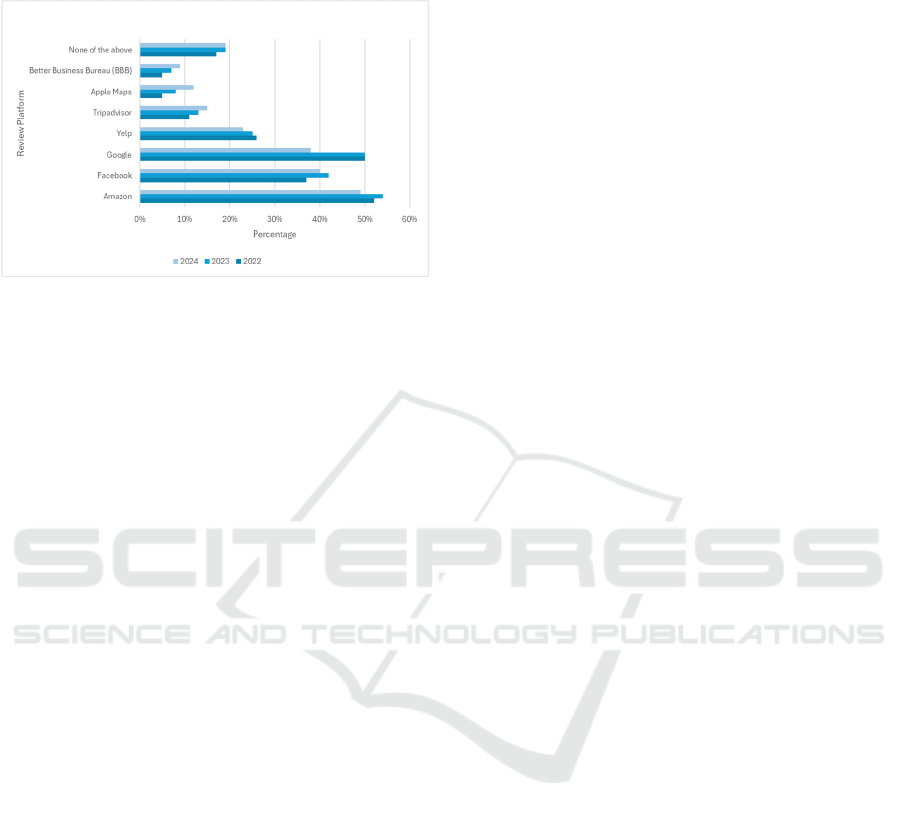
insights. The percentage of phony reviews that
consumers will come across in 2022, 2023, and 2024
across various media is displayed in Figure 1.
According to the 2024 Local Consumer Review
Survey by Bright Research, 82% of false reviews are
spread across multiple platforms, which could lead to
bias evaluating consumer satisfaction (Why Are Fake
Online Reviews a Problem? - BrightLocal, n.d.-a). A
business's ability to evaluate customer happiness is
significantly impacted. For instance, a 5-9% boost in
sales can be achieved by improving a restaurant's
Yelp rating (Customer Reviews: Stats That
Demonstrate the Impact of Reviews -
ReviewTrackers, n.d.). Consequently, business
owners need to utilize face expression analysis.
AI and machine learning (ML) have driven
numerous studies in facial expression estimation.
Approaches from 2021-2024 include CNN with
ResMaskingNet and bResNet-18 (L. Pham et al.,
2021a), (Chaudhari et al., 2022a) . Other 2024
research utilized CNN ensemble models (Xception,
DCNN, VGG16 (Melinte & Vladareanu, 2020a),
EfficientNetB2, DenseNet (Dong et al., 2023a),
RestNet50, and InceptionRestnetv2) and additional
ensemble models (AlexNet, Inception V3, ResNet50)
(Lawpanom et al., 2024a), (Reghunathan et al.,
2024a). Despite using datasets like FER-2013, these
models often struggle to fully capture facial
expressions due to insufficient depth for complex
features, poor generalization, and vanishing gradient
issues.
In its application later when using deep learning,
data in the form of images of expressions obtained
when visitors visit the place will be used as a
reference for assessing visitor satisfaction as well as
being used as material for business evaluation.
This research aims to identify the most effective
facial expression recognition model among
ResNet50, EfficientNetB3, and VGG16, using the
FER-2013 dataset. The goal is to help business
32
Setiaputri, G., Chrisbellno Mackenzie, J., Sebastian Edbert, I. and Suhartono, D.
Deep Learning-Based Facial Expression Recognition for Analyzing Visitor Engagement.
DOI: 10.5220/0014268200004928
Paper published under CC license (CC BY-NC-ND 4.0)
In Proceedings of the 1st International Conference on Research and Innovations in Information and Engineering Technology (RITECH 2025), pages 32-36
ISBN: 978-989-758-784-9
Proceedings Copyright © 2025 by SCITEPRESS – Science and Technology Publications, Lda.
owners improve service quality through better
understanding of customer expressions.
Figure 1: Percentage of fake reviews on each review
platform (Why Are Fake Online Reviews a Problem? -
BrightLocal, n.d.-b).
2 LITERATURE REVIEW
Facial expressions are crucial for conveying human
emotions (Xiong et al., 2024), making their accurate
interpretation valuable for businesses. While various
models like Random Forest, CNN, Residual Masking
Network (L. Pham et al., 2021b; Yeh et al., 2023),
CNN with C4.5, Vision Transformers (ViT)
(Dosovitskiy et al., 2020), and ensemble models have
been explored (Chaudhari et al., 2022b; Lawpanom et
al., 2024b; Wang et al., 2019a). Their accuracy in
facial expression recognition has been less than
satisfactory. This research aims to identify the most
effective method for this task.
Several studies use the FER-2013 dataset
provided by Kaggle (Lawpanom et al., 2024b; Yeh et
al., 2023). Other studies provide additional datasets,
such as JAFFE, CK+, and RAF-DB, to test the
effectiveness of various algorithms and techniques
(Wang et al., 2019b). The VEMO, AffectNet, and
CK+48 datasets are also leveraged to improve model
robustness and generalize performance over a wide
range of facial expressions (Chaudhari et al., 2022b;
L. Pham et al., 2021b).
In 2019, researchers used the Random Forest
Algorithm to detect facial expressions. The study uses
the C4.5 classifier, widely applied in image
recognition due to its vast data handling capacity,
ideal computing efficiency, and intuitive features
(Wang et al., 2019a). This study uses FER-2013
datasets and produces 84.3% accuracy with a running
time of 15,860.5(s).
A 2021 study introduced a Residual Masking
Network that uses a Unet-based localization network
for masking. This approach allows the model to
concentrate on crucial spatial information by
employing a segmentation network to refine feature
maps. Even with imbalanced data, the model
achieved strong performance on the FER-2013
dataset (L. Pham et al., 2021b).
In 2024, a study highlights that ensemble deep
learning models surpass individual ones. This
research utilizes the HoE-7 ensemble, comprising
Xception, DCNN, VGG16 (Melinte & Vladareanu,
2020b), EffcientNetB2, DenseNet (Dong et al.,
2023b), RestNet50, and InceptionResNetV2,
achieving 75.15% accuracy. The HoE-6 ensemble
obtained a slightly lower 73.73% accuracy
(Lawpanom et al., 2024b). This superior performance
is attributed to ensembles' ability to mitigate
overfitting, reduce prediction variance and bias, and
compensate for individual model errors.
3 METHODOLOGY
This study will recognize face expressions using deep
learning model, namely CNN with Resnet50 and
EfficientNetB3 architectures (Zhu et al., 2022), as
well as VGG (Cheng & Kong, 2024). The
methodology starts with data collection,
preprocessing, and splitting so that it is ready for each
model. It is followed by model building and
hyperparametric tuning. The results will be tested and
compared to obtain the best-performing model for
classifying facial expression recognition.
3.1 Data Collection
This research uses a publicly available dataset from
the Kaggle platform. Kaggle created this dataset for
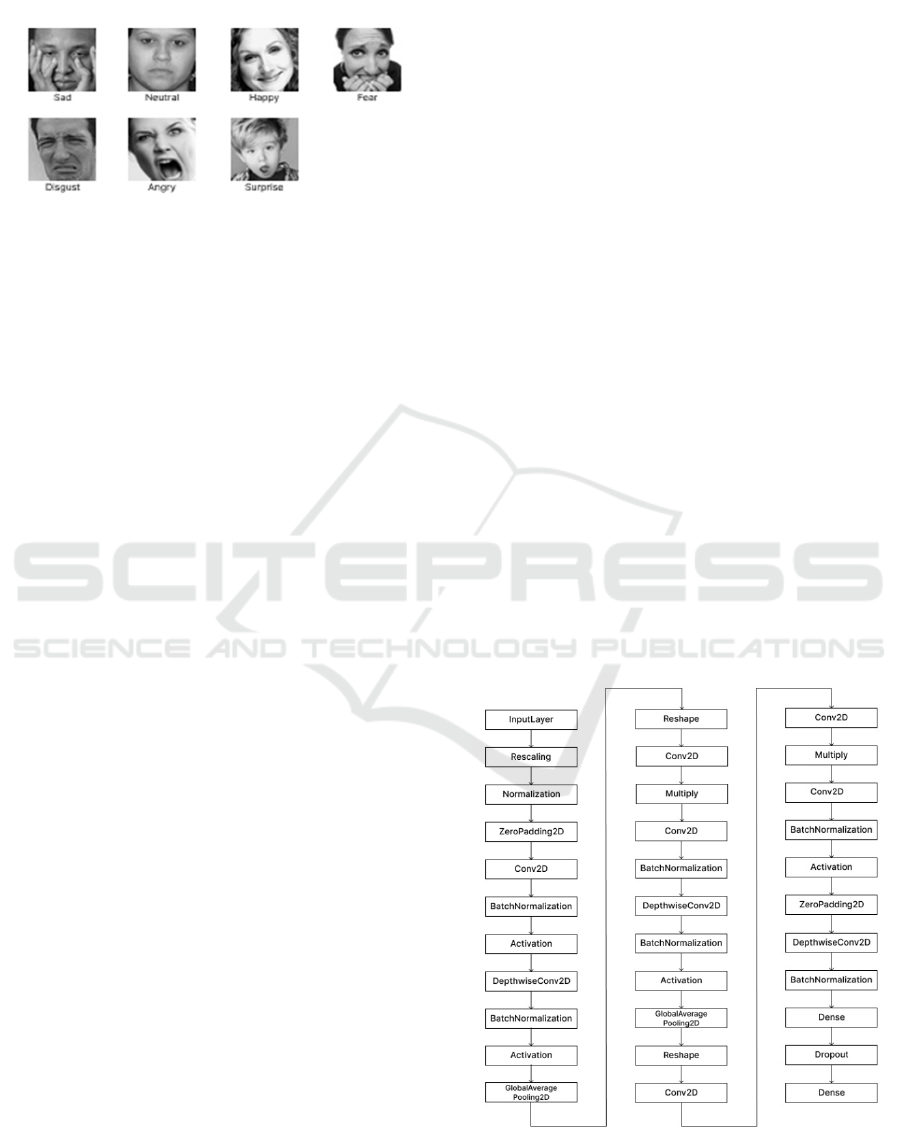
facial expression recognition research (FER-2013,
n.d.) as shown in Figure 2. There are 32,298 photos
grayscale images depicting seven facial expressions:
happy, anger, fear, surprise, sad, disgust, and neutral.
Based on this dataset, this research will classify facial
expression using various models.
3.2 Data Preprocessing
Preprocessing data is a essential process, aimed at
converting unprocessed data into a structured format
optimized for machine learning applications (Zhao et
al., 2021). Data preprocessing techniques will be
Deep Learning-Based Facial Expression Recognition for Analyzing Visitor Engagement
33
carried out in this stage: rescaling, resizing, and label
encoding.
Figure 2: Example Expression from FER-2013 Dataset.
3.2.1 Rescaling
Before processing, each loaded image will be
rescaled based on its pixel value by dividing by 255
so that the data can be in the range 0 to 1 (Zhao et al.,
2021).
3.2.2 Resizing
Each processed image is resized to 48x48 pixels
(FER-2013, n.d.). This uniformity ensures that the
model can efficiently learn from the images without
being affected by varying image sizes.
3.2.3 Label Encoding
One-hot encoding converts categorical features into
numerical ones by creating a new binary feature for
each category, indicating its presence (1) or absence
(0).
3.3 Data Splitting
Splitting the dataset into training and testing sets is
crucial to enhance the generalizability and robustness
of the facial expression recognition model (Dong et
al., 2023b). This research used in facial expression
recognition includes 80% for training and 20% for
testing.
3.4 Model Training
Three deep learning models have been compared to
classify human facial expressions to determine
visitors' interest in a place. Those three models are
described below.
3.4.1 Resnet50
A deep residual learning architecture is well known
for facial expression recognition tasks due to its
effectiveness in learning image features (Tsalera et
al., 2022). This model comprises 50 layers, featuring
16 residual blocks with three layers each and input
and output layers (Reghunathan et al., 2024b). The
structure combines deep learning with residual
learning, which can create connections so that
information flows from one layer to another
(Chouhayebi et al., 2024).
3.4.2 EfficientNetB3
This architecture is widely applied to facial
expression detection, improving overall recognition
performance by identifying and extracting attributes
from facial images. EfficientNet has seven
multidimensional models—which use scaling and
AutoML—the model performs better than the
majority of convolutional neural networks (Zhu et al.,
2022).
3.4.3 VGG16
A popular deep convolutional neural network design
for image classification applications, such as face
expression detection, is VGG16 (Chouhayebi et al.,
2024). VGG16 contains 138,355,752 parameters,
three deep layers, and five convolution blocks. Figure
3 shows the architecture of VGG used. Block output
size and noise are decreased via convolutional layers
in conjunction with a max pooling layer (Zhu et al.,
2022).
Figure 3: Architectures of VGG16 (Melinte & Vladareanu,
2020b).
RITECH 2025 - The International Conference on Research and Innovations in Information and Engineering Technology
34

3.5 Hyperparametric Tuning
To optimize facial expression interpretation, model
parameters will be tuned using the Hyperband method
from Keras Tuner. This study will focus on refining
the learning rate, batch size, dense unit, optimizer,
and regularization for each model.
3.6 Evaluation
Recall, accuracy (Melinte & Vladareanu, 2020b),
precision, and F1 score are key evaluation criteria
(Yeh et al., 2023), each offering insights into a
model's performance by highlighting its strengths and
weaknesses.
4 RESULT AND DISCUSSION
This study evaluated the classification performance
of ResNet50, EfficientNetB3, and VGG16 models on
the FER-2013 dataset. Model accuracy was assessed
using confusion matrices and classification reports,
which included F1 score, recall, and precision. As
shown in Table 1, the EfficientNetB3 model achieved
the highest accuracy score of 0.84467, outperforming
the other models. Its consistent precision, recall, and
F1-score values further indicate that EfficientNetB3
provides more reliable predictions compared to
ResNet50 and VGG16.
Table 1: Model Comparison.
Model Accurac
y
Precision Recall F1
Efficient
NetB3
0.85417 0.85421 0.85417 0.85347
ResNet50 0.76794 0.7673 0.76794 0.76731
VGG16 0.76626 0.76546 0.76626 0.76545
The EfficientNetB3 model demonstrates strong
performance in classifying facial expressions, as
detailed in its confusion matrix (Figure 4). This is
because EfficientNetB3 uses compound scaling,
which increases the model's capacity not only from
depth, width, or input resolution alone, but by
increasing all of them in a balanced way. It achieved
exceptional accuracy for "Disgust" and "Surprise,"
with 1443 and 1395 correct predictions respectively,
and minimal misclassifications across other
categories. The "Angry" expression also showed
good accuracy with 1261 true positives. "Fear" and
"Neutral" expressions were classified accurately 1220
and 1099 times, respectively. While "Happy" and
"Sad" emotions proved more challenging to
differentiate, the model still yielded 1171 and 1039
true positives for these classes. Overall, the consistent
results across all classes indicate that the
EfficientNetB3 model effectively captures and
recognizes crucial features of each facial expression
with stable accuracy.
EfficientNetB3 demonstrates superior facial
expression classification compared to ResNet50 and
VGG16. This conclusion is drawn from the
classification report and confusion matrix, which
further indicate a balanced distribution of true
positives across all classes, signifying no significant
data imbalance.
Figure 4: Confusion Matrix for EfficientNetB3.
5 CONCLUSIONS
Deep learning facial recognition uses human facial
characteristics to help businesses manage and
improve services.
A study compared ResNet50,
EfficientNetB3, and VGG16 models for facial
expression recognition using the FER-2013 dataset.
2
After data preprocessing, EfficientNetB3 achieved
the highest accuracy at 0.84467, outperforming
ResNet50 and VGG16. All models provide reliable
predictions, with this method showing particular
strength in classifying "Disgust" and "Surprise"
expressions.
This study's limitations stem from its extensive
and irregular data, particularly imbalances between
expression classes. While oversampling addressed
this, it increased preprocessing complexity and total
processing time. Consequently, model performance
remained slightly suboptimal in classes with sparser
data. In addition, the use of a single dataset such as
FER-2013 poses a challenge for the model in the
generalization process.
Deep Learning-Based Facial Expression Recognition for Analyzing Visitor Engagement
35

For future research, it's recommended to employ
more sophisticated balancing techniques, such as
Synthetic Minority Oversampling Technique
(SMOTE), the use of SMOTE has a very positive
impact on balancing classes by creating new synthetic
data for minority classes. Additionally, to maximize
the level of accuracy, adding epochs and loss function
(T.-D. Pham et al., 2023) is the right step so that the
model can capture the complexity of the data and low
validation loss. Furthermore, using other datasets
such as RAF-DB, FERPlus (Yao et al., 2023),
AffectNet, or CK+ is highly recommended for cross-
validation and proving that the model is robust or
generalizable.
REFERENCES
Chaudhari, A., Bhatt, C., Krishna, A., & Mazzeo, P. L.
(2022a). ViTFER: Facial Emotion Recognition with
Vision Transformers. Applied System Innovation, 5(4),
80. https://doi.org/10.3390/asi5040080
Cheng, Y., & Kong, D. (2024). CSINet: Channel–Spatial
Fusion Networks for Asymmetric Facial Expression
Recognition. Symmetry, 16(4), 471.
https://doi.org/10.3390/sym16040471
Chouhayebi, H., Mahraz, M. A., Riffi, J., Tairi, H., &
Alioua, N. (2024). Human Emotion Recognition Based
on Spatio-Temporal Facial Features Using HOG-HOF
and VGG-LSTM. Computers, 13(4), 101.
https://doi.org/10.3390/computers13040101
Customer Reviews: Stats that Demonstrate the Impact of
Reviews - ReviewTrackers. (n.d.). Retrieved May 29,
2024, from
https://www.reviewtrackers.com/reports/customer-
reviews-stats/
Dong, J., Zhang, Y., & Fan, L. (2023a). A Multi-View Face
Expression Recognition Method Based on DenseNet
and GAN. Electronics, 12(11), 2527.
https://doi.org/10.3390/electronics12112527
Dosovitskiy, A., Beyer, L., Kolesnikov, A., Weissenborn,
D., Zhai, X., Unterthiner, T., Dehghani, M., Minderer,
M., Heigold, G., Gelly, S., Uszkoreit, J., & Houlsby, N.
(2020). An Image is Worth 16x16 Words: Transformers
for Image Recognition at Scale. ICLR 2021 - 9th
International Conference on Learning Representations.
https://arxiv.org/abs/2010.11929v2
FER-2013. (n.d.). Retrieved June 10, 2024, from
https://www.kaggle.com/datasets/msambare/fer2013/d
ata
Lawpanom, R., Songpan, W., & Kaewyotha, J. (2024a).
Advancing Facial Expression Recognition in Online
Learning Education Using a Homogeneous Ensemble
Convolutional Neural Network Approach. Applied
Sciences, 14(3), 1156.
https://doi.org/10.3390/app14031156
Melinte, D. O., & Vladareanu, L. (2020a). Facial
Expressions Recognition for Human–Robot Interaction
Using Deep Convolutional Neural Networks with
Rectified Adam Optimizer. Sensors, 20(8), 2393.
https://doi.org/10.3390/s20082393
Pham, L., Vu, T. H., & Tran, T. A. (2021b). Facial
Expression Recognition Using Residual Masking
Network. 2020 25th International Conference on
Pattern Recognition (ICPR), 4513–4519.
https://doi.org/10.1109/ICPR48806.2021.9411919
Pham, T.-D., Duong, M.-T., Ho, Q.-T., Lee, S., & Hong,
M.-C. (2023). CNN-Based Facial Expression
Recognition with Simultaneous Consideration of Inter-
Class and Intra-Class Variations. Sensors, 23(24),
9658. https://doi.org/10.3390/s23249658
Reghunathan, R. K., Ramankutty, V. K., Kallingal, A., &
Vinod, V. (2024b). Facial Expression Recognition
Using Pre-trained Architectures. The 2nd Computing
Congress 2023, 22.
https://doi.org/10.3390/engproc2024062022
Tsalera, E., Papadakis, A., Samarakou, M., & Voyiatzis, I.
(2022). Feature Extraction with Handcrafted Methods
and Convolutional Neural Networks for Facial Emotion
Recognition. Applied Sciences, 12(17), 8455.
https://doi.org/10.3390/app12178455
Wang, Y., Li, Y., Song, Y., & Rong, X. (2019b). Facial
Expression Recognition Based on Random Forest and
Convolutional Neural Network. Information, 10(12),
375. https://doi.org/10.3390/info10120375
Why Are Fake Online Reviews a Problem? - BrightLocal.
(n.d.-a). Retrieved May 29, 2024, from
https://www.brightlocal.com/learn/review-
management/fake-reviews/why-are-fake-reviews-a-
problem/
Transformer and Adaptive Method with Visual
Transformer for Robust Facial Expression Recognition.
Applied Sciences, 14(4), 1535.
https://doi.org/10.3390/app14041535
Yao, H., Yang, X., Chen, D., Wang, Z., & Tian, Y. (2023).
Facial Expression Recognition Based on Fine-Tuned
Channel–Spatial Attention Transformer. Sensors,
23(15), 6799. https://doi.org/10.3390/s23156799
Yeh, J.-F., Lin, K.-M., Chang, C.-C., & Wang, T.-H.
(2023). Expression Recognition of Multiple Faces
Using a Convolution Neural Network Combining the
Haar Cascade Classifier. Applied Sciences, 13(23),
12737. https://doi.org/10.3390/app132312737
Zhao, Z., Liu, Q., & Zhou, F. (2021). Robust Lightweight
Facial Expression Recognition Network with Label
Distribution Training. Proceedings of the AAAI
Conference on Artificial Intelligence, 35(4), 3510–
3519. https://doi.org/10.1609/aaai.v35i4.16465
Zhu, H., Xu, H., Ma, X., & Bian, M. (2022). Facial
Expression Recognition Using Dual Path Feature
Fusion and Stacked Attention. Future Internet, 14(9),
258. https://doi.org/10.3390/fi14090258
RITECH 2025 - The International Conference on Research and Innovations in Information and Engineering Technology
36
