
Embedded Metallic Structures as Passive Antennas for Sub-GHz IoT
Communication in Smart City
Nurmayanti Zain
a
, Farhan Rezki Arifin
b
and Lompo Ramos Emakarim
c
Department of Electrical Engineering, University of Cokroaminoto Makassar, Tamalanrea-Makassar, Indonesia
Keywords: Embedded Antenna, Smart City, Sub-GHz Wireless, Metallic Structures, Internet of Things (IoT).
Abstract: The increasing demand for robust and scalable wireless infrastructure in smart city has highlighted the
potential of utilizing existing building materials as functional components in communication systems. This
study investigates the feasibility of embedded metallic structures, specifically steel elements such as
galvanized hollow steel and rebars as passive monopole antennas for sub-GHz Internet of Things (IoT)
applications. Focusing on the 700 MHz frequency range, analytical modeling was conducted to examine the
electromagnetic behavior of monopole configurations formed by structural elements in a concrete medium.
Key parameters such as resonance length, impedance matching, and radiation characteristics were derived
based on standard antenna theory. The simulation results confirm that selected metallic structures can support
monopole resonance with acceptable return loss and bandwidth performance for IoT communication. The
integration of antenna functionality into structural elements opens new possibilities for cost-efficient and
unobtrusive wireless systems in smart city environments.
1 INTRODUCTION
The rapid growth of smart city has increased the
demand for pervasive, energy efficient, and reliable
communication infrastructures, particularly for IoT
applications. Wireless communication at Sub-GHz
frequency is a key enabler due to its long-range and
low-power characteristics, making it suitable for large
scale urban deployments. However, deploying
conventional antennas in dense urban areas remains
challenging due to structural integration and aesthetic
constraints (Hussain et al., 2022; Jusoh et al., 2023).
Recent studies have explored embedding antennas
into metallic infrastructure elements, such as steel
beams, hollow sections, and construction frames, to
reduce installation complexity and transform passive
components into active communication elements,
supporting the vision of ambient intelligence (Vähä-
Savo et al., 2022; Kumar et al., 2024). Passive Sub-
GHz designs (700–900 MHz) embedded in metallic
building elements have shown potential for scalable
and covert IoT deployment in smart structures, smart
a
https://orcid.org/0009-0003-2075-6446
b
https://orcid.org/0009-0001-3526-6883
c
https://orcid.org/0000-0002-8005-592X
buildings, and smart composite structures (Albzaie,
2024; Inclán-Sánchez, 2023; Hassan et al., 2024).
While prior works have used load bearing wall
(Vähä-Savo et al., 2022; Vähä-Savo et al., 2024),
SEVA (Structurally Embedded Vascular Antenna)
(Bal et al., 2021) or concrete embedded antenna (Tan
et al., 2022), this study differs by: (1) Employing
galvanized hollow steel tubes as both load-bearing
and radiating elements, (2) Implementing a quarter-
wavelength monopole precisely tuned for 700 MHz
LPWAN (Low Power Wide Area Network) and
optimized via Ansys HFSS (High Frequency
Structure Simulator), and (3) Achieving full structural
integration by embedding the antenna into the main
structural element. These address limitations of
earlier designs reliant on solid conductors, external
mounting, or higher frequency bands.
Research gaps remain, including limited study on
the electromagnetic and mechanical performance of
hollow galvanized steel tubes, minimal focus on
quarter-wavelength resonance at 700 MHz for dense
urban LPWAN, lack of designs where antennas are
embedded within the main structural elements, and
122
Zain, N., Rezki Arifin, F. and Ramos Emakarim, L.
Embedded Metallic Structures as Passive Antennas for Sub-GHz IoT Communication in Smart City.
DOI: 10.5220/0014266500004928
Paper published under CC license (CC BY-NC-ND 4.0)
In Proceedings of the 1st International Conference on Research and Innovations in Information and Engineering Technology (RITECH 2025), pages 122-128
ISBN: 978-989-758-784-9
Proceedings Copyright © 2025 by SCITEPRESS – Science and Technology Publications, Lda.
the scarcity of comprehensive simulations with
realistic geometries and full specifications. To
address these gaps, this study employs Ansys HFSS,
a 3D (three-dimensional) electromagnetic solver
based on the Finite Element Method (FEM) that
provides rigorous solutions of Maxwell’s equations
for high-frequency structures. This paper presents a
conceptual and analytical investigation of embedded
galvanized hollow steel monopoles in a concrete
medium for Sub-GHz smart city IoT, focusing on key
design parameters, resonance behavior, and
integration scenarios in typical urban infrastructure.
2 METHODOLOGY
This study adopts a simulation-based methodology
that integrates theoretical modeling, dimensional
resonance analysis, and electromagnetic full-wave
simulation to investigate the feasibility of using
galvanized hollow steel structures embedded in
buildings as passive monopole antennas for sub-GHz
communication in smart city environments. The
analysis targets the 700 MHz frequency band, which
is widely adopted for long-range, low-power Internet
of Things (IoT) applications (Albzaie, 2024; Inclán-
Sánchez, 2023).
2.1 Structural and Electromagnetic
Design
The resonant length of the monopole antenna as a
quarter-wavelength radiator is analytically
determined based on:
L
λ
(1)
where:
𝑐 is the speed of light (3×10
8
m/s),
𝑓 is the target frequency (700 MHz).
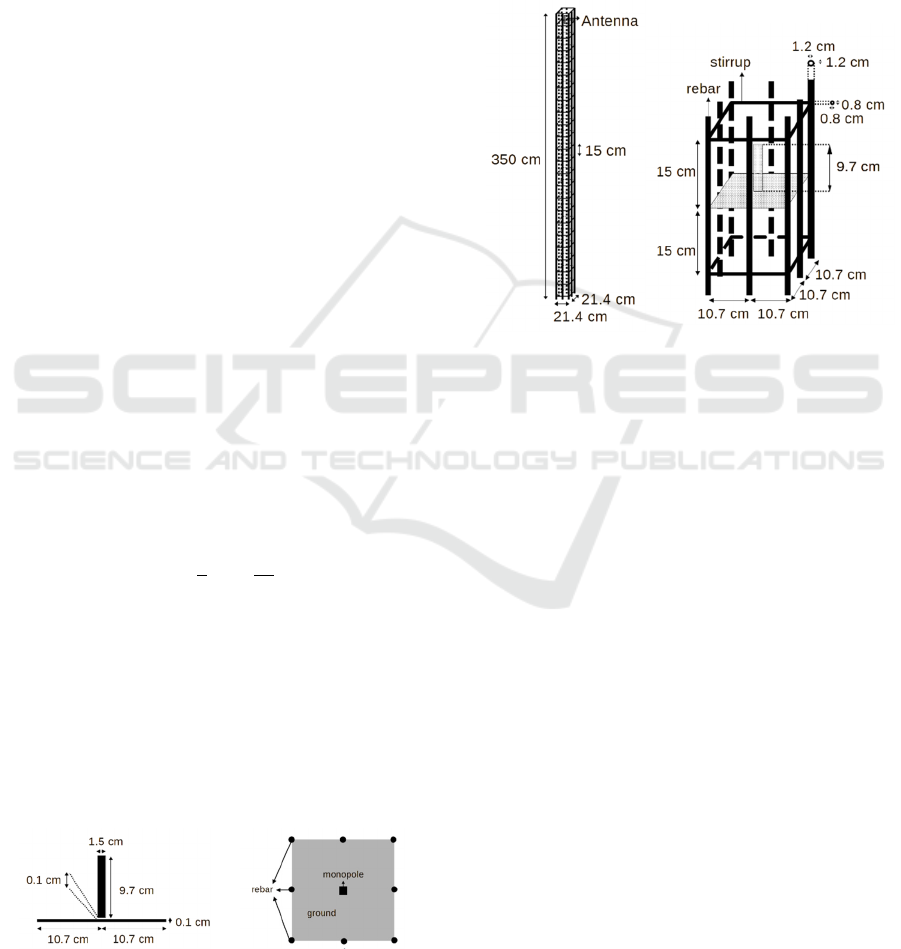
The nominal resonant length of the hollow steel
monopole is calculated to be approximately 10.7 cm.
Considering the finite conductor diameter, the
effective length is slightly reduced to around 9.7 cm,
in accordance with standard diameter correction
factors, as illustrated in Figure 1.
(a) (b)
Figure 1: Antenna Design: (a) Monopole with Ground
Plane, (b) Top View Antenna Configuration.
The metallic material chosen is galvanized
hollow steel, modeled as the antenna and embedded
within a reinforced concrete structure to represent
realistic construction components and evaluate the
fundamental electromagnetic behavior of the
monopole antenna. Galvanized hollow steel is
selected for its mechanical strength, durability, and
common use in building construction, while its
hollow form enables efficient integration with
structural elements, as illustrated in Figure 2.
(a) (b)
Figure 2: Structural Design: (a) Concrete Column Structure,
(b) Embedded Antenna within Rebar Structure.
The quarter-wavelength monopole antenna is
integrated into a reinforced structural column,
replacing one of the stirrups in an arrangement of
eight stainless steel rebars. Appropriate dielectric
properties are assigned to the surrounding materials
to evaluate their effects on the antenna’s resonant
frequency, impedance matching, and radiation
characteristics.
2.2 Simulation Setup
Electromagnetic simulations are performed using
Ansys HFSS, a full-wave 3D FEM solver widely
employed in antenna design. HFSS is selected due to
its capability to accurately model complex
geometries, account for material properties, and
predict the electromagnetic behavior of antennas
under realistic structural and environmental
conditions.
Figure 3 illustrates the simulation model. The
model consists of an air box with radiation boundary
conditions, a concrete column structure, a ground
plane, and a lumped port located at the monopole base
to emulate excitation from an IoT radio. Adaptive
meshing and a frequency sweep from 100 MHz to
Embedded Metallic Structures as Passive Antennas for Sub-GHz IoT Communication in Smart City
123
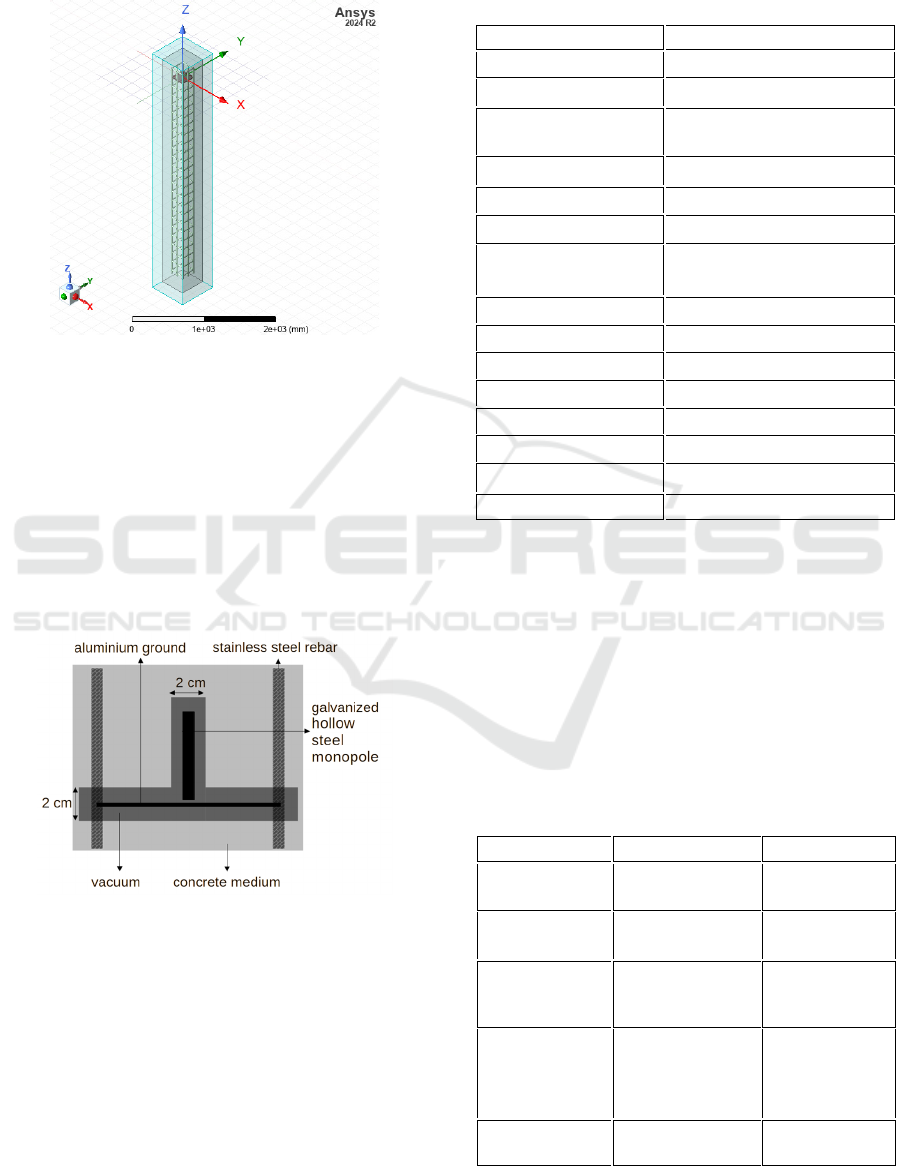
1.400 MHz are applied to ensure accurate evaluation
of reflection coefficients and electromagnetic field
distributions.
Figure 3: Simulation Model.
The quarter-wavelength monopole antenna is
positioned above an aluminum ground plane, with a
surrounding vacuum region of approximately 2 cm,
as shown in Figure 4. The vacuum layer is introduced
to prevent direct contact with the concrete, ensuring
that the antenna is not immediately influenced by the
surrounding cement. This configuration allows
precise evaluation of the antenna characteristics,
considering its integration within structural elements
to preserve performance.
Figure 4: Monopole Antenna in Concrete Medium.
The simulation parameters for the embedded
metallic structures are summarized in Table 1. This
setup enables assessment of the antenna’s
performance under realistic structural conditions,
accounting for material properties, geometric
dimensions, and spatial arrangement of the metallic
components. By replicating practical construction
scenarios, the simulation provides insight into the
antenna’s resonant frequency, input impedance, and
radiation characteristics, ensuring the results are
relevant for real-world structural integration.
Table 1: Simulation Parameters.
Paramete
r
Value
Tar
g
et Fre
q
uenc
y
700 MHz
Frequency Range 100
–
1.400 MHz
Antenna Type
Quarter-Wavelength
Mono
p
ole
Antenna Material
Galvanized Hollow Steel
Physical Length 10.7 cm
Optimized Length
9.7 cm
Hollow Dimensions
1.5 × 1.5 cm (outer)
1.28 × 1.28 cm (inner)
Wall Thickness 0.11 cm
Ground Plane 21.4 × 21.4 cm Aluminium
Reinforcin
g
Bar 8 Stainless Steel
Reinforcing Ba
r
Height 350 cm
Stirrup Spacing 15 cm
Embedding Medium Concrete
Boundary Condition
Radiation (Open)
Excitation Lum
p
ed Port 50 Ω
(
Base
)
2.3 Performance Metrics
The antenna performance is evaluated based on the
following key electromagnetic parameters: (1) Return
loss (S
11
) to determine the resonance frequency and
impedance matching, (2) Radiation pattern to assess
the omnidirectional coverage typical of monopole
antennas, (3) Gain to evaluate power conversion
effectiveness and suitability for low-power IoT
devices.
Table 2: Material Properties Used in Simulation.
Paramete
r
Galvanized Steel Concrete
Relative
Permittivity (εᵣ)
1.0 6.5
Relative
Permeability (μᵣ)
100 1.0
Bulk
Conductivity
(S/m)
1.6 × 10⁶ 0.01
Conductivity
Zinc layer: 1.1×10⁶
Steel core:
6.99×10⁶
Low
Conductivity
Cementitious
Material
Loss Tangent
(
tan δ
)
0 0.02
RITECH 2025 - The International Conference on Research and Innovations in Information and Engineering Technology
124
Paramete
r
Galvanized Steel Concrete
Densit
y
(
k
g
/m³
)
7850 2400
Metallic and dielectric materials are modelled
with physical parameters closely representing actual
construction materials, including relative
permittivity, permeability, bulk conductivity, and
density, as summarized in Table 2. These parameters
provide a practical reference for future experimental
validation and potential large-scale deployment in
real-world smart city environments. This
methodology enables assessment of the embedded
monopole antenna’s performance using standard
structural geometries and Sub-GHz communication
requirements.
3 RESULTS AND DISCUSSION
The electromagnetic performance of an embedded
metallic monopole antenna, designed using a
galvanized hollow steel in a concrete column
structure, was evaluated through full-wave simulation
in Ansys HFSS. The monopole antenna was modeled
with an optimized height of 9.7 cm, corresponding
quarter-wavelength at the target frequency of 700
MHz, to ensure more efficient performance. This
section presents the return loss characteristics,
radiation behavior, and implications for smart city
communication infrastructure.
3.1 Return Loss and Resonant
Frequency
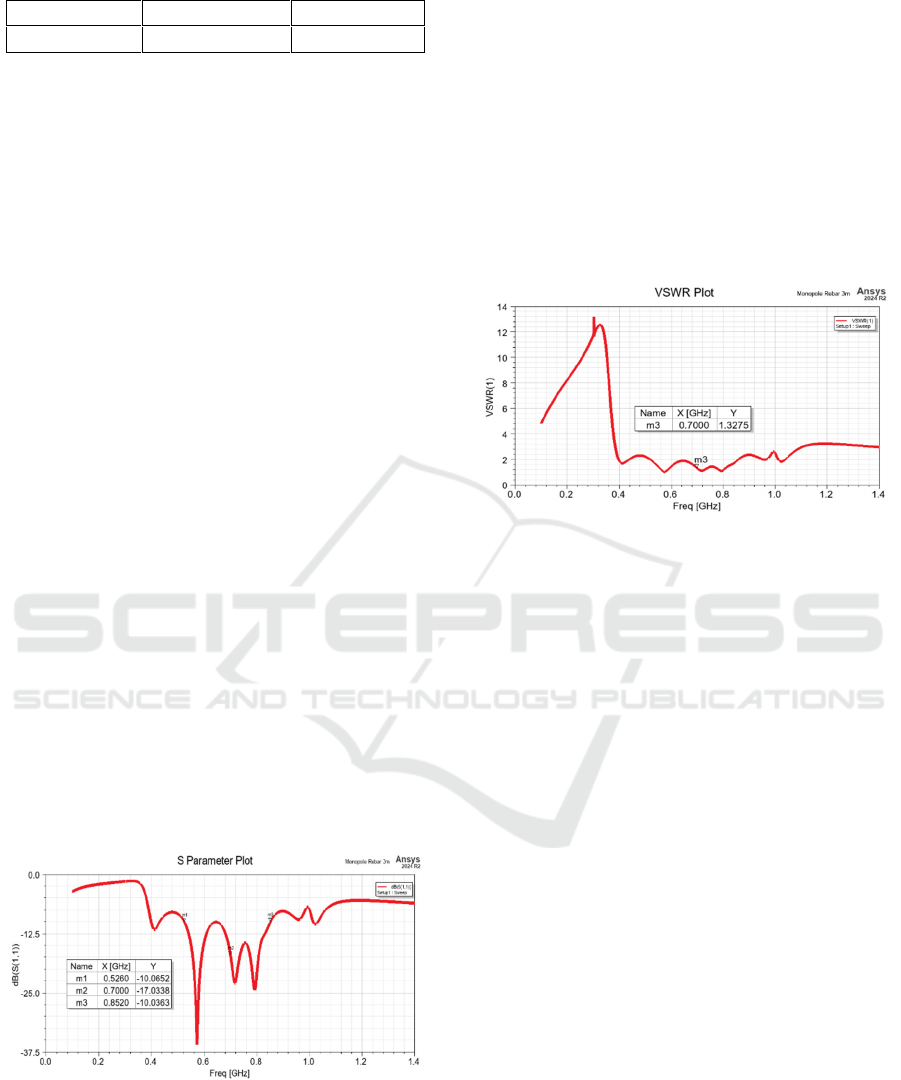
The simulated return loss of the embedded monopole
antenna is presented in Figure 5.
Figure 5. Simulated Return Loss.
A distinct resonance is observed at 700 MHz with
a return loss of −17.03 dB, indicating efficient
impedance matching and minimal reflection at the
feed point. The −10 dB bandwidth spans
approximately 326 MHz, covering the frequency
range from 526 MHz to 852 MHz, which is
remarkably wide and sufficient to accommodate
multiple LPWAN technologies such as NB-IoT
(Narrowband IoT) and LoRaWAN (Long Range
Wide Area Network). The exceptionally broad
bandwidth ensures robust performance over a wide
range of operating frequencies, enhancing the
antenna’s versatility for sub-GHz applications. The
pronounced return loss together with the accurate
resonant frequency validates the effectiveness of the
antenna’s structural dimensioning and integration
within the concrete medium.
Figure 6: Simulated VSWR.
To further validate antenna matching quality,
simulated VSWR (Voltage Standing Wave Ratio)
values were evaluated as shown in Figure 6. The
antenna achieves a VSWR of less than 1.33 at the
resonant frequency (700 MHz) and maintains VSWR
values well below 2 throughout the operating
bandwidth (526–852 MHz). These results clearly
demonstrate excellent impedance matching and
efficient power transmission, making the antenna
highly suitable for low-power IoT communication in
smart city deployments.
These results confirm the theoretical prediction
based on monopole resonance, validating that the
physical dimension of the structure supports quarter-
wavelength operation. The sharpness of the resonance
peak and low return loss indicate that the structure
behaves as a high quality passive radiator suitable for
sub-GHz IoT applications (Rita et al., 2022).
3.2 Radiation Characteristics
The radiation characteristics were evaluated to assess
the antenna’s directionality and gain performance.
The 2D (two-dimensional) patterns provide angular
cuts in the principal planes (E-plane and H-plane) to
analyze radiation symmetry and beamwidth, whereas
the 3D patterns offer a complete spatial visualization
of power distribution. Together, these evaluations
deliver critical insights into the antenna’s coverage
Embedded Metallic Structures as Passive Antennas for Sub-GHz IoT Communication in Smart City
125
efficiency and its capability to radiate power
effectively toward the intended direction.
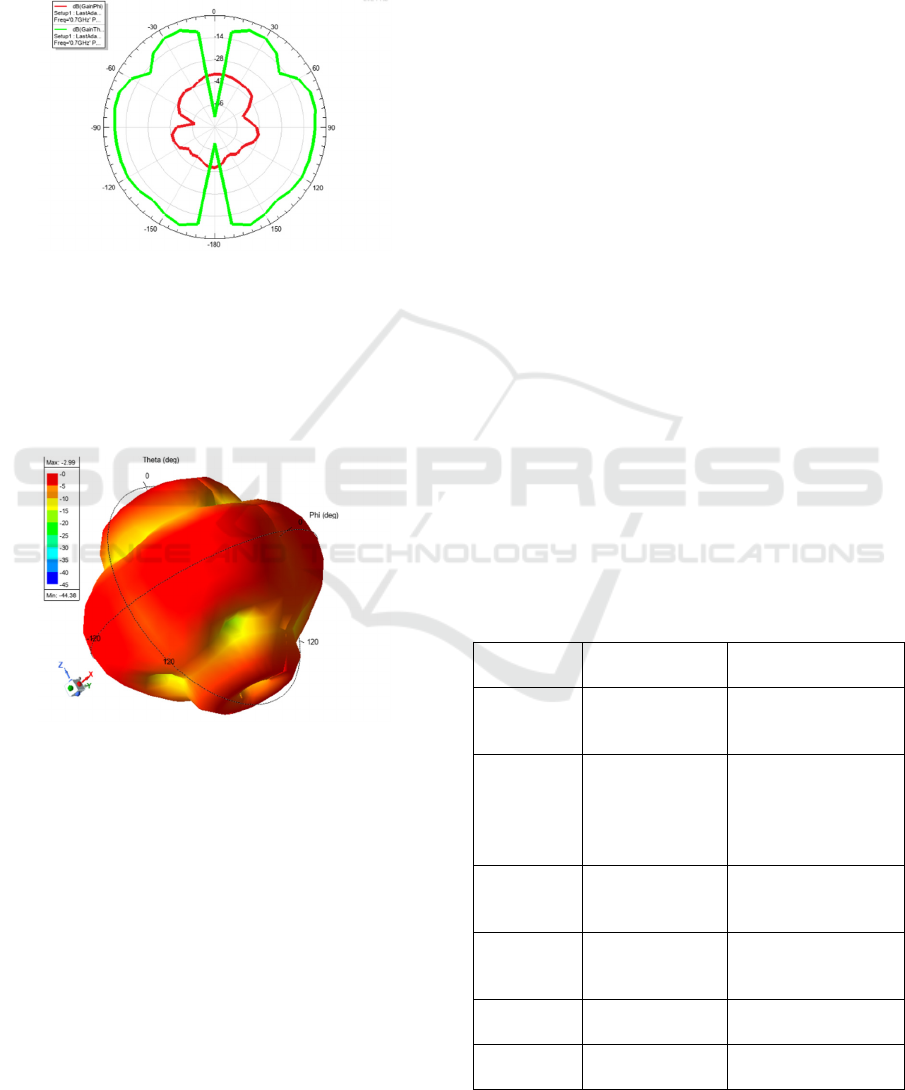
The radiation characteristics, specifically the 2D
radiation pattern, were evaluated to assess the
antenna’s directionality and gain performance, as
illustrated in Figure 7.
Figure 7: Radiation Pattern.
The 2D polar plots indicate that the H-plane
(Phi=0°–360°) radiation pattern is nearly
omnidirectional, providing predominantly uniform
horizontal coverage around the monopole, which is
advantageous for consistent signal reception in all
azimuthal directions.
Figure 8: Gain 3D Polar Plot.
As shown in Figure 8, the E-plane (Theta) exhibits
a doughnut-shaped pattern with nulls at 0° and 180°,
characteristic of monopole antennas. The 3D
radiation pattern further confirms uniform power
distribution in the horizontal plane, with radiation
concentrated around (θ=90°), while maintaining
symmetry and minimal backlobes.
The peak realized gain of 2.99 dBi, though
moderate, is sufficient for embedded antenna in dense
smart city environments where uniform short-range
coverage is prioritized (Chen & Zheng, 2023). The
combination of nearly omnidirectional H-plane
coverage and typical E-plane behavior ensures
reliable performance for sub-GHz LPWAN
applications, such as NB-IoT and LoRaWAN, within
built environments.
To achieve the radiation performance described
above, the monopole antenna is embedded within a
reinforced concrete column by replacing one of the
stirrups in an eight rebars configuration. Compared to
traditional monopoles fabricated on substrates
(Hussain et al., 2022), this structural integration not
only preserves the desired radiation characteristics
but also provides a mechanically robust solution,
allowing the metallic element to function
simultaneously as reinforcement and as a radiating
antenna. Such an approach aligns with previous
investigations on building and wall integrated
antenna systems (Vähä-Savo et al., 2022; Vähä-Savo
et al., 2024), confirming that embedded antennas can
meet the performance requirements for LPWAN
deployment in smart city environments (Khan et al.,
2024).
3.3 Application Potential in Smart City
The use of galvanized hollow steel as a functional
antenna element enables seamless integration into
urban structures while reducing costs, minimizing
visual clutter, and maintaining both durability and
aesthetics. The specifications summarized in Table 3
demonstrate that the proposed embedded quarter-
wavelength monopole antenna satisfies the required
electromagnetic performance targets as well as the
practical considerations for smart city deployment.
Table 3: Specification and Requirements for Antennas in
Sub-GHz IoT Smart City Applications.
Category Specification /
Requirement
Justification
Operating
Frequency
700–960 MHz
(target 700 MHz
in this study)
Provides long-range
coverage for
LPWAN
Antenna
Type
A quarter-
wavelength
monopole
(embedded in
structure)
Omnidirectional in
H-plane; nulls on
vertical axis E-plane;
uniform street-level
coverage
Impedance 50 Ω nominal;
lumped port or
coaxial feed
Matches standard
IoT radio ports
Return
Loss
S
11
≤ −10 dB
across operating
band
Efficient power
transfer and low
reflection losses
VSWR ≤ 2.0 across
operating band
Acceptable
performance
Bandwidth ≥ 100 MHz Complies with
regulations
RITECH 2025 - The International Conference on Research and Innovations in Information and Engineering Technology
126

Peak Gain 0–3 dBi (≥ 1 dBi
desirable)
Adequate link
budget
3.4 Practical Considerations and
Limitations
Passive embedded antennas present notable
advantages such as resilience to weather conditions,
resistance to vandalism, and minimal maintenance
requirements, making them promise for long-term
deployment in smart city infrastructures (Shailesh et
al., 2024).
Nevertheless, several practical considerations and
limitations must be carefully addressed. From a
material perspective, galvanized hollow steel,
although highly conductive, is still vulnerable to
corrosion over time, particularly in humid or coastal
environments where gradual deterioration of the zinc
layer may contribute to increased RF losses. When
antennas are embedded in concrete, the relatively
high dielectric constant (εᵣ = 6.5) and loss tangent (tan
δ = 0.02) introduce dielectric loading that shifts the
resonance frequency and decreases radiation
efficiency.
Moreover, variability in concrete composition,
moisture content, and curing conditions leads to
inconsistent dielectric properties, thereby
complicating accurate antenna tuning. Consequently,
antenna dimensions require careful optimization to
preserve resonance at the desired frequency despite
the dielectric loading effect.
Beyond electromagnetic aspects, structural and
mechanical factors also pose challenges. Embedded
antennas must withstand long-term mechanical
loading, thermal expansion, and vibrations within the
building structure, while any misalignment during
installation can permanently alter the radiation
pattern or coverage area since repositioning is not
possible once integrated. Environmental influences,
such as seasonal humidity variations, temperature
cycling, and pollution, further exacerbate these
challenges by modifying both the conductivity of
metals and the dielectric characteristics of concrete.
In addition, proximity to reinforcement bars,
electrical wiring, or other metallic components may
introduce parasitic coupling and electromagnetic
interference that detune the antenna and degrade
system performance.
To mitigate these limitations, several strategies
have been proposed, including the adoption of
reconfigurable antenna designs, adaptive impedance
matching, and AI-based optimization techniques to
dynamically maintain resonance under varying
environmental conditions (Spachos et al., 2021;
Mishra et al., 2022).
However, such approaches require further
validation through long-term experimental studies,
especially under real-world loading and
environmental stresses. Therefore, while passive
embedded antennas hold significant promise for
smart city communication systems, their practical
deployment demands careful material selection,
robust design methodologies, and rigorous durability
testing. Comprehensive experimental investigations
will be addressed in future studies as a critical part of
the research roadmap to ensure reliable performance
over extended operational lifetimes (Majumder et al.,
2025).
4 CONCLUSIONS
This study has demonstrated, through rigorous full-
wave electromagnetic simulations, the novel
contribution of employing galvanized hollow steel as
an embedded passive monopole antenna within
reinforced concrete columns for sub-GHz IoT
communication in smart city infrastructure.
By utilizing the inherent conductivity of
galvanized hollow steel within structural elements, a
9.7 cm monopole designed for operation at 700 MHz
achieved efficient impedance matching (−17.03 dB
return loss), a wide operational bandwidth (526–852
MHz), and an nearly omnidirectional radiation
pattern with a peak gain of 2.99 dBi.
These findings confirm the feasibility of
integrating communication functionality directly into
construction materials, thereby supporting the
development of smart urban infrastructure with
minimal additional cost and adaptive structural
modification.
This research demonstrates the embedding of
passive antennas within concrete column structures,
preserving their structural function while enabling
sub-GHz IoT communication. The approach
addresses practical urban challenges such as limited
space, aesthetic integration, and efficient deployment,
thereby supporting the development of scalable,
resilient, and low-profile IoT networks for smarter
and more sustainable urban environments.
Future research will focus on experimental
validation of the embedded antenna and the
evaluation of their performance under realistic
environmental conditions. These studies aim to
bridge the gap between theoretical design and
practical implementation in complex urban scenarios,
Embedded Metallic Structures as Passive Antennas for Sub-GHz IoT Communication in Smart City
127

ensuring the embedded antenna operates reliably and
maintains long-term durability.
ACKNOWLEDGEMENTS
The authors gratefully acknowledge the availability
of Ansys HFSS under an academic research license
provided by Department of Electrical Engineering
University of Cokroaminoto Makassar, which was
instrumental in conducting the electromagnetic
simulations presented in this study.
This research was funded by the Ministry of
Higher Education, Science, and Technology of the
Republic of Indonesia, through the Directorate
General of Research and Development, under the
Basic Research Scheme for the 2025 Fiscal Year.
REFERENCES
Albzaie, M. (2024). Smart materials and smart structures:
Transforming engineering and infrastructure.
International Journal of Civil and Structural
Engineering Research, 12(2), 42–47.
Bal, A., Baur, J. W., Hartl, D. J., Frank, G. J., Gibson, T.,
Pan, H., & Huff, G. H. (2021). Multi-layer and
conformally integrated structurally embedded vascular
antenna (SEVA) arrays. Sensors, 21(5), 1764.
Chen, X., & Zheng, Z. (2023). A wideband bow-tie slot
antenna embedded in dielectric for 5G communication.
IEEE International Conference on Microwave and
Millimeter Wave Technology (ICMMT), 1–3.
Hassan, O. S., Saif ur Rahman, M., Mustapha, A. A., Gaya,
S., Abou-Khousa, M. A., & Cantwell, W. J. (2024).
Inspection of antennas embedded in smart composite
structures using microwave NDT methods and X-ray
computed tomography. Measurement: Journal of the
International Measurement Confederation, 226, Article
114086.
Hussain, R., Alhuwaimel, S. I., Algarni, A. M., Aljaloud,
K., & Hussain, N. (2022). A compact Sub-GHz wide
tunable antenna design for IoT applications.
Electronics, 11(7), 1074.
Inclán-Sánchez, L. (2023). 3D-printed transparent mesh
antenna for smart buildings. In Antenna designs for
5G/IoT and space applications (pp. 1308–1320). MDPI.
Jusoh, A. Z., Husain, N. F., Abdul Malek, N. F., Mohd Isa,
F. N., & Mohamad, S. Y. (2023). Design of
miniaturized antenna for IoT applications using
metamaterial. IIUM Engineering Journal, 24(1), 122–
137.
Khan, S., Mazhar, T., Shahzad, T., Bibi, A., Ahmad, W.,
Khan, M. A., Saeed, M. M., & Hamam, H. (2024).
Antenna systems for IoT applications: A review.
Discover Sustainability, 5, 412.
Kumar, N., Kumar, P., & Sharma, M. (2024).
Reconfigurable MIMO antenna for IoT wireless
applications controlled by embedded system. Journal of
Telecommunications and Information Technology,
96(2), 32–40.
Majumder, K., Pramanik, S., Goswami, J. (2025).
Implementation of Smart Building Using Internet of
Things (IoT). In: Acharyya, A., Dey, P., Biswas, S.
(eds) Real-World Applications and Implementations of
IoT. Studies in Smart Technologies. Springer,
Singapore.
Mishra, M., Lourenço, P. B., & Ramana, G. V. (2022).
Structural health monitoring of civil engineering
structures by using the internet of things: A review.
Automation in Construction, 132, 103936.
Rita, J., Salvado, J., Rocha, H. d., & Espírito-Santo, A.
(2025). A comprehensive review of IoT standards: The
role of IEEE 1451 in smart cities and smart buildings.
Smart Cities, 8(4), 108.
Shailesh, Srivastava, G., & Kumar, S. (2024). A flexible
reconfigurable MIMO antenna for IoT-enabled smart
systems. International Journal of Antennas and
Propagation, 2024, Article 7557178.
Spachos, P., Papapanagiotou, I., & Plataniotis, K. (2021).
Microlocation for smart buildings in the era of the
Internet of Things: A survey. arXiv preprint.
Tan, J., Shao, Y., Zhang, J., & Zhang, J. (2022). Empirical
formulas for performance prediction of concrete
embedded antenna. The University of Sheffield.
Vähä-Savo, L., Haneda, K., Icheln, C., & Lü, X. (2022).
Electromagnetic-thermal analyses of distributed
antennas embedded into a load bearing wall. arXiv
preprint.
Vähä-Savo, L., Veggi, L., Vitucci, E. M., Icheln, C., Degli-
Esposti, V., & Haneda, K. (2024). Analytical
characterization of a transmission loss of an antenna-
embedded wall. IEEE Open Journal of Antennas and
Propagation, 5(6), 1765–1772.
RITECH 2025 - The International Conference on Research and Innovations in Information and Engineering Technology
128
