
Development of Penetration Testing Learning Module Based on the
ADDIE Model
Ahmad Anwary Adzirudin, Nanang Trianto, Dimas Febriyan Priambodo
and Septia Ulfa Sunaringtyas
Department of Cyber Security Engineering, National Cyber and Crypto Polytechnic, Bogor, West Java, Indonesia
Keywords: Penetration Testing, Learning Module, ADDIE Model, Learning Management System, Virtual Laboratory.
Abstract: This study outlines the development of a penetration testing learning module based on the ADDIE
instructional design model. The module combines a Learning Management System (LMS) and a virtual
laboratory environment (OVA) to support both theoretical and practical cybersecurity education. Driven by
the rising number of cyberattacks and the shortage of skilled professionals, the module aligns with Indonesia’s
Cybersecurity Testing Competency Standards (SKKNI) and includes seven modules covering key stages of
penetration testing. A mixed-method approach was used: qualitative methods for needs analysis and
instructional design, along with quantitative assessments through the Content Validity Index (CVI) and User
Acceptance Testing (UAT). Expert validation yielded a perfect S-CVI score of 1.00, indicating high content
relevance. The implementation was evaluated via UAT to gather user feedback on perceived usefulness and
ease of use. The acceptance score was 92.17%, classified as highly accepted by participants. This
demonstrates that the developed module effectively enhances technical skills in system penetration testing
and can serve as a structured reference for penetration testing education.
1 INTRODUCTION
Technological developments bring benefits to various
sectors, but they also bring security risks in the form
of cyber attacks. Cyber attacks have increased
significantly in organizations every week, with an
average of 1,876 attacks in the third quarter of 2024
(Fa’izi, 2024). Cyber attacks can be triggered by
internal factors such as weak security systems, lack of
system updates, careless user behavior, and limited
human resource (HR) competence (Azizah et al.,
2024). Weak security systems can be strengthened by
mitigating system vulnerabilities from the outset
through system penetration testing. System
penetration testing is a technique for finding
weaknesses in a system using the same methods as
attackers. Systems are tested by ethical hackers to
help companies understand their security needs
(Kozel & Drozdova, 2024). In the 2024 ID SIRTII
Report, the BSSN Cyber Security Operations
Directorate conducted system penetration testing on
131 agencies. A total of 1,931 security vulnerabilities
were found in 462 applications through system
penetration testing activities (Id-SIRTII /CC, 2024).
In conducting system penetration testing, the
Indonesian National Work Competency Standards
(SKKNI) for Cyber Security Testing serve as a guide
for organizations in both the government and private
sectors. The SKNNI Cyber Security Testing
Standards have the primary objective of providing
information on the results of cyber security testing for
organizational security improvements (Ida Fauziyah,
2022). Although competency standards are available,
cybersecurity human resource capacity in Indonesia
is still very limited. The Chair of the Indonesia Cyber
Security Forum (ICSF) stated that Indonesia requires
10,000 cybersecurity experts annually (KKIP, 2023).
While system penetration testing plays a role in
enhancing cybersecurity, not all organizations
recognize the importance of developing cybersecurity
human resources. The demand for cybersecurity
human resources is increasing, while the number of
cybersecurity experts remains limited. Therefore,
there is a need to enhance human resources through
cybersecurity training with relevant curricula (Kunci,
2025).
108
Anwary Adzirudin, A., Trianto, N., Febriyan Priambodo, D. and Ulfa Sunaringtyas, S.
Development of Penetration Testing Learning Module Based on the ADDIE Model.
DOI: 10.5220/0014266100004928
Paper published under CC license (CC BY-NC-ND 4.0)
In Proceedings of the 1st International Conference on Research and Innovations in Information and Engineering Technology (RITECH 2025), pages 108-113
ISBN: 978-989-758-784-9
Proceedings Copyright © 2025 by SCITEPRESS – Science and Technology Publications, Lda.

Previous studies have developed a learning
product. Research (Dalimunthe, Affandi, & Suryanto,
2021) shows that the R&D method with the ADDIE
approach produces modules with an average score
above 89%. The product has met the criteria for
clarity, relevance, and ease of use. Another study
(Zhang & Liu, 2023) discusses the successful design
and implementation of virtual laboratories integrated
into a virtual experiment learning management
platform, which met functional requirements and
positively impacted learning outcomes, as evaluated
by learners over two years. Additionally, study (Li,
2015) demonstrated that developing learning
modules for system penetration testing through
practical exercises can reinforce theoretical concepts
and technical skills. Another study (Teerakanok,
Rassameeroj, Khurat, & Visoottiviseth, 2022) shows
that participants successfully learned system
penetration testing skills in depth through practical
exercises in a virtual laboratory. The research results
provide recommendations for conducting learning
based on system penetration testing practical
exercises.
In this study, a system penetration test learning
module will be created using the ADDIE model. The
ADDIE model consists of five stages are analysis,
design, development, implementation, and evaluation
(Adolph, 2016). The stages in the ADDIE model will
serve as the foundation for creating an LMS-based
learning product. The LMS will be used as a learning
platform that provides learning materials online
(Mustapha et al., 2023). A virtual laboratory will be
used as a simulation tool for conducting system
penetration testing practices. Participants will
identify security vulnerabilities in the provided server
(Mahtuf, Hatta, & Wihidiyat, 2019). The researcher
will also conduct functional testing to assess the
suitability of the developed learning medium with the
Learning Technology Development Unit. In this
study, the SKKNI Cybersecurity Testing Standards
will serve as a reference for developing the system
penetration testing learning module (Ida Fauziyah,
2022).
This study aims to develop a structured system
penetration testing learning module for conducting
system penetration testing. In addition, the developed
product will be evaluated to determine the level of
participant acceptance of the learning module through
User Acceptance Testing (). The results of this study
are expected to contribute to the community's
development of competencies in the field of system
penetration testing.
2 METHODOLOGY
This study uses a Research and Development (R&D)
methodology aimed at producing a prototype learning
module for penetration testing. The R&D process is
structured using the ADDIE model, an instructional
design framework consisting of five sequential
phases: analysis, design, development,
implementation, and evaluation. Each phase provides
a systematic process for identifying learner needs,
designing instructional content, developing media,
testing implementation, and evaluating outcomes.
This study integrates qualitative and quantitative
approaches. The qualitative approach is used to
collect data related to instructional needs and design
requirements for the penetration testing learning
module. The quantitative approach is applied to
evaluate the usability and acceptance of the module
developed by learners. The final product includes a
Learning Management System (LMS) containing
theoretical content and a virtual laboratory
environment based on OVA that facilitates practical
penetration testing exercises.
3 RESULTS
3.1 Analysis
The analysis stage was conducted to identify the
needs and issues that form the basis for the
development of the system penetration testing
learning module. Based on interviews with the
Learning Technology Development Unit, it was
found that the development of web-based learning
facilities is urgently needed to support the
achievement of competencies in the field of
cybersecurity. The interviewees stated that facilities
such as LMS and virtual laboratories can enhance
participants' abilities and skills through an outcome-
based learning approach. The development of
learning media in the field of system penetration
testing is considered important to support effective
learning processes. Several elements must be fulfilled
in the development of learning media, including:
A clear curriculum foundation;
Consideration of participant characteristics to
align with learning objectives;
Establishment of procedures for using learning
materials;
Evaluation aligned with content and learning
objectives.
Development of Penetration Testing Learning Module Based on the ADDIE Model
109
Documentation of all required configurations
and credentials
Utilization of resources according to needs
3.2 Design
The learning media design is intended to facilitate
participants' understanding of concepts and hone their
technical skills through a systematic learning process.
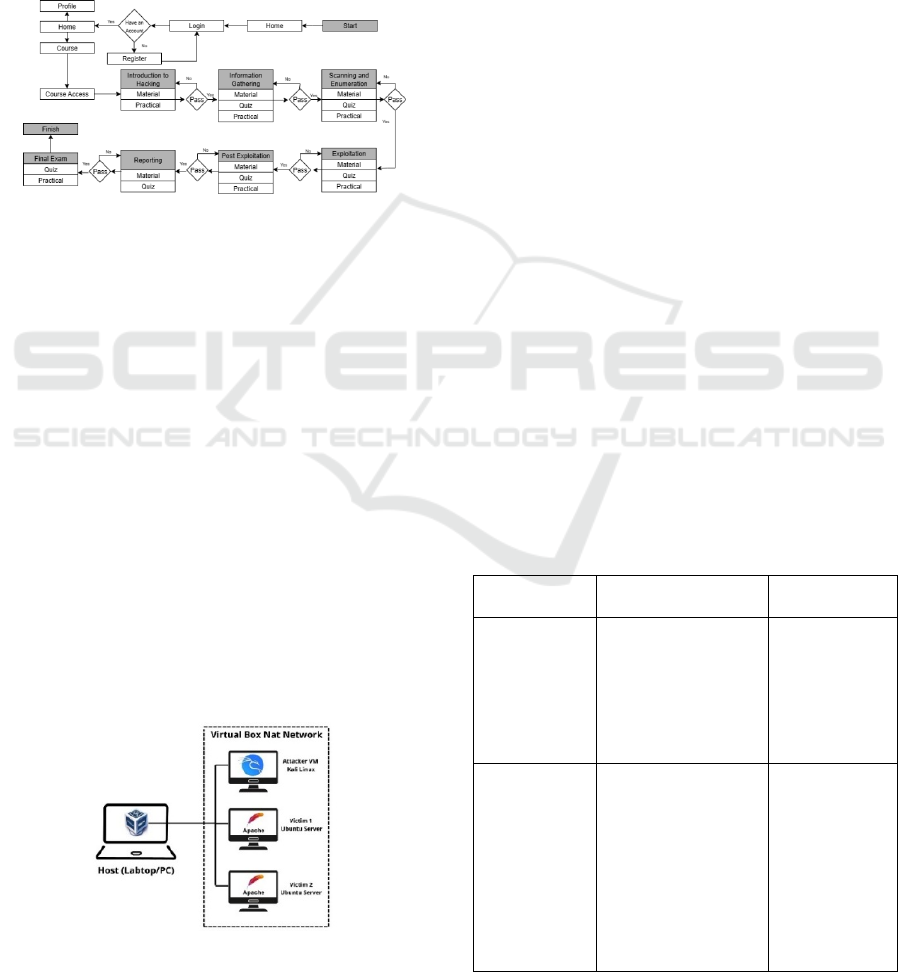
The learning flow in this media is illustrated in Figure
1.
Figure 1: Participant Interaction with Learning Media.
Figure 1 illustrates the flow of participant
interaction with LMS-based learning media and the
OVA laboratory. The process begins on the main
page, where participants can register or log in to the
system. After successfully logging in, participants are
directed to the course page to access the system
penetration testing learning module. The material is
presented in text and image form, while practical
exercises are carried out using the OVA laboratory,
which can be downloaded via the provided link.
Before conducting practical exercises, participants
are given preparatory instructions to set up the virtual
laboratory. Participants can only proceed to the next
module after passing the quiz and completing the
practical exercises in the previous module. A final
exam is conducted to comprehensively assess
participants' understanding of theory and practical
skills. For participants who have not completed the
practical exercises, explanatory videos will be
provided as additional learning materials.
Figure 2: Virtual Laboratory Penetration Testing Topology.
Figure 2 shows the virtual laboratory topology
used in this study. The environment is built on a
VirtualBox NAT network consisting of one attacker
machine (Kali Linux) and two victim machines
(Ubuntu Server). This configuration enables
participants to conduct penetration testing activities,
including information gathering, scanning,
exploitation, and post-exploitation, in a controlled
and isolated environment without affecting external
networks.
3.3 Development
The development stage aims to turn the learning
design into a usable learning product. Learning media
is developed based on the interaction design and
learning flow that have been designed, with the
Learning Management System (LMS) as the main
access point and the OVA laboratory as the practical
facility. The learning module content consists of
seven main sections are introduction to hacking,
information gathering, scanning and enumeration,
exploitation, post-exploitation, reporting, and final
exam. Each module includes theoretical material and
practical scenarios aligned with the competency units
in the SKKNI Cyber Security Testing Standards.
Practical exercises are designed to train participants
in using various tools, such as Nmap, Nikto, Hydra,
and Metasploit, and include activities ranging from
network mapping, access exploitation, to post-
exploitation, such as backdooring and web
defacement. The details of the materials and practical
scenarios for each module are presented in Table 1
below.
Table 1: Practical Materials and Scenarios.
Module
Material
Re
q
uirements
Practical
Scenario
Introduction to
Hacking
Introduction to
Hacking,
Terminology in
Penetration Testing,
Ethics in Penetration
Testing,
Methodolo
g
ies
Kali Linux
installation
Information
Gathering
Concept of
Information
Gathering, Passive
Information
Gathering
Techniques, Active
Information
Gathering
Techniques, Standard
Tar
g
et Identification
Using Nmap for
network and
open port
mapping,
identifying
main service
names,
identifying
versions, and
used
p
orts
RITECH 2025 - The International Conference on Research and Innovations in Information and Engineering Technology
110

Module
Material
Re
q
uirements
Practical
Scenario
Tools, and OS
Fingerprinting
Scanning and
Enumeration
Basics of Metasploit
Framework,
Fundamentals of
Scanning &
Enumeration,
Scanning with
Nessus, OpenVAS,
and Nikto,
Enumeration
Running Nikto
to scan for
vulnerabilities,
FTP
anonymous
enumeration,
and
Enumeration
using
Metasploit
scanne
r
Exploitation
Fundamentals of
Exploitation,
Common
Vulnerabilities and
Exposure (CVE),
Exploits and Attacks
using Metasploit,
Using Hydra
Running Hydra
for brute force,
Exploiting
server access
using SSH
Post
Exploitation
Privilege Escalation,
Backdooring
Techniques,
Persistence
Techniques
Running a
backdoor,
Executing
persistence,
Post-
exploitation
(web
defacement)
Reporting
Writing a Penetration
Testing Report,
Common
Vulnerability Scoring
System (CVSS),
Sample Penetration
Test Report
Writing the
report
document
Final Exam
All materials learned
in previous chapters
System
identification,
Mapping &
scanning,
Directory
enumeration,
Login
exploitation,
Post-
exploitation
with backdoor
and web
defacement
3.4 Implementation
The implementation stage was carried out by
conducting trials of the developed system, penetration
testing learning module with a total of 40 participants.
These participants were selected based on specific
criteria, namely individuals who already possessed
basic knowledge of networking and Linux system
administration, to ensure they were adequately
prepared for the technical content delivered in the
module.
The implementation lasted for one week, during
which participants engaged in structured learning
activities through a Learning Management System
(LMS) and completed hands-on practical exercises
using the provided OVA-based virtual laboratory.
Each day, participants accessed theoretical materials
and carried out penetration testing tasks according to
the learning flow designed in the module.
Throughout the implementation, participants
progressed sequentially through the seven modules,
ranging from introductory concepts to the final exam
by completing quizzes and practical assignments.
Progression to subsequent modules was gated by the
completion of both theory and practice components
from previous modules. The implementation phase
also involved continuous technical support and
monitoring to ensure the module ran as intended and
that learners could complete the practical tasks
without significant obstacles.
3.5 Evaluation
The evaluation of the system penetration testing
learning module was carried out through a User
Acceptance Test (UAT) involving participants who
had completed all modules and practical activities.
The purpose of this evaluation was to assess the level
of user satisfaction and acceptance of the developed
product from the perspective of its usefulness and
ease of use.
The assessment employed two main indicators are
Perceived Usefulness and Perceived Ease of Use,
both measured using a 5-point Likert scale. In this
scale, a score of 1 indicates Strongly Disagree, while
a score of 5 indicates Strongly Agree. The Perceived
Usefulness indicator was intended to evaluate the
extent to which users felt that the learning module
helped facilitate their learning process and improve
their skills in conducting system penetration testing.
Based on the UAT survey results, responses were
overwhelmingly positive. Almost all respondents
gave a score of 5 for the following statements are the
module helped them perform penetration testing more
quickly (97%), improved their overall performance
(93.9%), and made the learning process more
productive (81.8%). Additionally, 87.9% reported
that the module improved their understanding of the
penetration testing stages, while 81.8% agreed that
penetration testing became easier to carry out with the
help of the module. These results suggest that the
Development of Penetration Testing Learning Module Based on the ADDIE Model
111

product provides substantial practical benefits for
developing technical competence.
As for Perceived Ease of Use, the responses were
also highly favorable. A total of 90.9% of participants
stated that the module was easy to operate, 87.9%
rated the interface as user-friendly, and 84.8%
encountered minimal technical issues while using the
system. Furthermore, 81.8% appreciated the
flexibility offered by the module, and 78.8% felt that
it supported the development of their practical skills.
In addition to the UAT survey, quantitative data
was collected from practical exercises. All 40
participants (100%) successfully completed all
learning modules, indicating that the design and
sequence of tasks could be completed within the
given time frame. The average completion time for
each module ranged from 45 to 110 minutes, with the
exploitation and post-exploitation stages taking the
longest. These results indicate that participants were
able to effectively achieve theoretical and practical
learning objectives.
4 DISCUSSION
This study shows that the penetration testing learning
module developed using the ADDIE instructional
design model can effectively improve participants'
theoretical knowledge and practical skills in the field
of cybersecurity. The Content Validity Index (CVI)
achieved a perfect S-CVI score of 1.00, confirming
that all materials and assessments are highly relevant
and aligned with the SKKNI cybersecurity testing
competency standards. The one-week
implementation involving 40 participants further
validated the effectiveness of the module, as the
structured learning flow through seven modules
improved participants' ability to perform complex
penetration testing tasks. UAT results also supported
this effectiveness, showing positive user feedback
and successful completion of the learning process
without major issues.
Compared to the study by (Teerakanok et al.,
2022), which focused on qualitative experiences
using OVA-based laboratories, this study applied a
structured instructional design and incorporated
quantitative metrics, making the modules more
standardized and measurable. Similar international
initiatives, as described by (Li, 2015; Zhang & Liu,
2023), also highlight the effectiveness of integrating
penetration testing training into virtual laboratories
and LMS platforms. However, this study expands on
their findings by aligning the module with Indonesian
SKKNI standards, ensuring national relevance while
maintaining global comparability.
Despite these advantages, several limitations must
be acknowledged. The study was conducted in a
relatively short period and involved participants who
already had prior networking and Linux knowledge,
which may not fully represent a broader target
audience such as beginners or those from non-
technical backgrounds.
Future module development should consider
upgrading the LMS with more interactive features to
increase learner engagement and flexibility.
Examples include gamification elements such as
points, badges, and leaderboards to motivate learners,
adaptive learning paths that adjust to learners' skill
levels, and real-time feedback mechanisms to
reinforce the learning experience. These features will
make the platform more dynamic and sustainable for
diverse learners while remaining aligned with
national standards.
5 CONCLUSIONS
The development of the penetration testing learning
module based on the ADDIE instructional design
model has significantly improved participants’
competencies in system penetration testing. The CVI
results confirmed the strong alignment of the
module’s theoretical content, practical exercises, and
assessments with the SKKNI Cybersecurity Testing
competency standards. The one-week
implementation with 40 participants showed that the
module’s structured approach effectively guided
learners through seven modules, enabling them to
handle complex penetration testing tasks with
improved confidence and technical proficiency. This
outcome was also reflected in the UAT results, where
over 90% of participants acknowledged that the
module enhanced their skills, productivity, and
understanding of penetration testing processes.
Overall, the learning module consistently strengthens
cybersecurity competencies and has the potential to
be adopted as a scalable and standardized training
solution to address the shortage of skilled
cybersecurity professionals in Indonesia.
ACKNOWLEDGEMENT
The authors would like to thank the State Cyber and
Cryptography Polytechnic for their support in
providing facilities and academic guidance during
RITECH 2025 - The International Conference on Research and Innovations in Information and Engineering Technology
112

this research. We would also like to thank the
reviewers for their valuable input, which has
improved the quality of this paper.
REFERENCES
Adolph, R. M. (2009). Instructional design: The ADDIE
approach. Springer. https://doi.org/10.1007/978-0-387-
09506-6
Azizah, S., Ula, Z. N., Mutiara, D., & Prameswari, M. P.
(2024). Keamanan siber sebagai fondasi pengembangan
aplikasi keuangan mobile: Studi literatur mengenai
cybercrime dan mitigasinya. Akuntansi dan Teknologi
Informasi, 17(2), 221–237.
https://doi.org/10.24123/jati.v17i2.6409
Bertagnolli, C. (2011). Perceived usefulness, perceived ease
of use, and user acceptance of information technology.
Delle vicende dell’agricoltura Ital. Studi e note di C.
Bertagnolli, 13(3), 319–340.
Chai, C. S., Hipiny, I., & Ujir, H. (2023). User acceptance
testing (UAT) of self-service checkout kiosks: A case
study in E-Mart Tabuan Jaya, Kuching, Malaysia.
Proceedings of the 2023 IEEE 7th International
Conference on Information Technology, Information
Systems and Electrical Engineering (ICITISEE), 6–11.
Creasey, J. (2017). A guide for running an effective
penetration testing programme. Crest, (April), 1–64.
Dalimunthe, A., Affandi, M., & Suryanto, E. D. (2021).
Pengembangan modul praktikum teknik digital model
ADDIE. Jurnal Teknologi Informasi & Komunikasi
Dalam Pendidikan, 8(1), 17.
https://doi.org/10.24114/jtikp.v8i1.26777
Fa’izi, M. B. N. (2024). Serangan siber global melonjak 75%
di Q3 2024. Cyberhub.
https://cyberhub.id/berita/serangan-siber-global-
melonjak-di-2024
Fauziah, I., Situmorang, R., & Suprayekti. (2022).
Pengembangan modul hypercontent untuk mata diklat
kode etik dan disiplin pegawai BPK RI. Jurnal
Pembelajaran Inovatif, 5(2), 42–49.
Hadi, A. P., Rudjiono, R., & Zainudin, A. (2024). ADDIE
model dalam pengembangan media informasi untuk
menumbuhkan minat peserta. Go Infotech: Jurnal Ilmiah
STMIK AUB, 30(1), 20–27.
Id-SIRTII/CC. (2024). Lanskap keamanan siber Indonesia.
Id-SIRTII/CC BSSN, 1–141.
Kementerian Ketenagakerjaan Republik Indonesia. (2022).
Standar kompetensi kerja nasional Indonesia bidang uji
keamanan siber (Vol. 01, pp. 1–49).
KKIP. (2023). Ulasan ringkas kajian KKIP tahun 2022:
Kajian strategis pembangunan industri pertahanan
bidang siber dan ekosistemnya. Komite Kebijakan
Industri Pertahanan.
https://www.kkip.go.id/2023/03/15/ulasan-ringkas-
kajian-kkip-tahun-2022-kajian-strategis-pembangunan-
industri-pertahanan-bidang-siber-dan-ekosistemnya/
Kozel, V. M., & Drozdova, I. E. A. (2024). Research of
penetration testing methods. Vestnik Kherson National
Technical University, 3(90), 221–227.
https://doi.org/10.35546/kntu2078-4481.2024.3.28
Li, C. (2015). Penetration testing curriculum development in
practice. Journal of Information Technology Education:
Innovations in Practice, 14(1), 85–99.
https://doi.org/10.28945/2189
Machmudi, M. A., Wahyudiono, S., & Susilo, G. (2023).
Analisis dan rancang bangun e-learning dengan metode
ADDIE model. Go Infotech: Jurnal Ilmiah STMIK
AUB, 29(2), 226–232.
Mustapha, A. M., Zakaria, M. A. Z. M., Yahaya, N.,
Abuhassna, H., Mamman, B., Isa, A. M., & Kolo, M. A.
(2023). Students’ motivation and effective use of self-
regulated learning on learning management system
Moodle environment in higher learning institution in
Nigeria. International Journal of Information and
Education Technology, 13(1), 195–202.
https://doi.org/10.18178/ijiet.2023.13.1.1796
NIST. (2021). Technical guide to information security
testing and assessment (SP 800-115). Gaithersburg,
MD: National Institute of Standards and Technology.
OWASP Foundation. (2021). Penetration testing
methodologies. OWASP Web Security Testing Guide.
https://owasp.org/www-project-web-security-testing-
guide/latest/
Pramono, G. J., & Napitulu, T. A. (2022). User acceptance
in non-profit organization applications: The role of
intention to use, perceived usefulness, and community
commitment. ITEJ (Information Technology
Engineering Journals), 7(1), 53–76.
Shahriar, H., et al. (2023). Technology adoption model-
based comparison of clinical trial software. International
Journal of Applied Research in Public Health
Management, 8(1), 1–24.
Shanley, A., & Johnstone, M. N. (2015). Selection of
penetration testing methodologies: A comparison and
evaluation. Australasian Information Security
Management Conference (AISM), 65–72.
Shrestha, N. (2012). Security assessment via penetration
testing: A network and system administrator’s approach
(Master’s thesis). University of Oslo.
Teerakanok, S., Rassameeroj, I., Khurat, A., &
Visoottiviseth, V. (2022). Lessons learned from
penetration testing hands-on training during COVID-19
pandemic. 6th International Conference on Information
Technology, InCIT 2022, 368–373.
https://doi.org/10.1109/InCIT56086.2022.10067755
Wang, F., & Sahid, S. (2024). Content validation and
content validity index calculation for entrepreneurial
behavior instruments among vocational college students
in China. Multidisciplinary Reviews, 7(9).
Yusoff, M. S. B. (2019). ABC of content validation and
content validity index calculation. Education in
Medicine Journal, 11(2), 49–54.
Yusron, M. (2025). Pembinaan peningkatan kapasitas SDM
tim tanggap insiden siber pemerintah daerah Provinsi
Banten. Jurnal Cahaya Nusantara, 1(2), 86–92.
https://jurnal.cahayapublikasi.com/index.php/jcn/article
/view/87
Development of Penetration Testing Learning Module Based on the ADDIE Model
113
