
Design and Implementation of a Hands-on Cyber Drill for Dark Web
Investigation Training
Ummu Khalsum Mustamin, Susila Windarta, Setiyo Cahyono and Rahmat Purwoko
Cyber Security Engineering, National Cyber and Crypto Polytechnic, Ciseeng, Bogor Regency, Indonesia
Keywords: ADDIE, Cyber Drill, Dark Web Investigation, Hands-on Training Lab, TryHackMe.
Abstract: Dark web investigations demand both conceptual knowledge and practical proficiency in navigating
anonymized environments and analyzing illicit activities. Existing training resources, however, are often
limited to theoretical content and lack structured, hands-on learning experiences that reflect real investigative
scenarios. To address these gaps, a cyber drill training module was designed and implemented using the
ADDIE instructional design model and deployed on the TryHackMe platform. The module comprised 21
sequential tasks supported by preconfigured virtual machines and synthetic case files, enabling scenario-based
practice with embedded evaluations. Thirty participants completed the training through guided self-paced
sessions. Evaluation demonstrated strong user acceptance (acceptance index of 86.06%, with 97% positive
responses), significant knowledge improvement (mean scores rising from 66.3 to 85.7; t = -8.69, p < 0.001,
Cohen’s d = 1.59), and satisfactory task-level performance (mean = 74.8%). Content validity was confirmed
by experts using the CVI method (S-CVI = 1.0). These results highlight the feasibility and effectiveness of
the module as a scalable, ethically controlled environment for enhancing investigative competencies in dark
web analysis.
1 INTRODUCTION
Modern threats are no longer confined to the visible
internet in the evolving cybersecurity landscape.
They now propagate within concealed layers such as
the dark web, a non-indexed segment of the internet
that enables anonymity and facilitates a range of illicit
activities, including illegal trade, identity fraud,
digital exploitation, and information warfare (Denic
& Devetak, 2023; Kaushik, 2022; Naufal Bahreisy et
al., 2021). These developments pose significant
challenges to national cyber defence strategies,
particularly in emerging economies with uneven
technical capacity and specialized training.
In 2024, Indonesia recorded over 380 million
cyber anomalies, a sharp indicator of escalating attack
surfaces and adversarial tactics targeting critical
infrastructures (Badan Siber dan Sandi Negara,
2024). Addressing this threat landscape requires
technological hardening and the strategic
development of human capital capable of conducting
dark web monitoring and investigations.
Globally, criminal justice and legal education
programs remain largely theoretical, with minimal
inclusion of dark web investigation practice or digital
simulation platforms. (Belshaw et al., 2019) observed
that few institutions in the U.S. have integrated such
courses, and most rely on lecture-based instruction.
They argue that experiential elements such as labs or
simulations are critical for preparing practitioners for
real-world investigative tasks. Similarly, training
needs identified in national workshops emphasize the
gap in practical readiness among law enforcement
personnel (Goodison et al., 2019).
One of the principal cybersecurity authorities in
Indonesia is tasked with designing and delivering
training programs to strengthen cyber defense
capabilities across governmental and security
institutions. Among its key initiatives is a dark web
investigation training program targeted at personnel
from law enforcement, the military, and other public
agencies involved in cybercrime prevention and
national security. However, the current instructional
model remains largely conventional, dominated by
in-person, instructor-led sessions with limited
interactivity and no dedicated digital platform to
support independent hands-on practice or post-
training reinforcement.
Previous studies highlight the pedagogical value
of cyber ranges and virtual laboratories in enhancing
102
Khalsum Mustamin, U., Windarta, S., Cahyono, S. and Purwoko, R.
Design and Implementation of a Hands-on Cyber Drill for Dark Web Investigation Training.
DOI: 10.5220/0014266000004928
Paper published under CC license (CC BY-NC-ND 4.0)
In Proceedings of the 1st International Conference on Research and Innovations in Information and Engineering Technology (RITECH 2025), pages 102-107
ISBN: 978-989-758-784-9
Proceedings Copyright © 2025 by SCITEPRESS – Science and Technology Publications, Lda.
technical readiness and knowledge retention
(Chouliaras et al., 2021; Glas et al., 2023; Yamin &
Katt, 2022). Gamified instructional models have also
demonstrated potential in fostering learner
motivation and sustained engagement (Papastergiou,
2009). Yet, these advancements have rarely been
systematically applied to dark web investigation
training or integrated into scalable, digitally
facilitated learning platforms.
This paper presents the design and development
of a hands-on cyber drill training lab, implemented on
the TryHackMe platform to deliver structured and
interactive learning experiences for dark web
investigation. The training content is based on a
standardized national cybersecurity curriculum and
emphasizes three core modules: Dark Web
Fundamentals, Hands-On Dark Web Analysis, and
Dark Web Investigation. The development process
follows the ADDIE instructional design model
(Branch, 2010). Effectiveness is evaluated through
User Acceptance Testing (UAT) (Leung & Wong,
1997) and a pretest–posttest design with paired t-test
(Ross & Willson, 2017) analysis to assess cognitive
improvement. The resulting training module aims to
support sustainable capacity building for stakeholders
with investigative mandates in cybercrime and digital
forensics.
2 METHODOLOGY
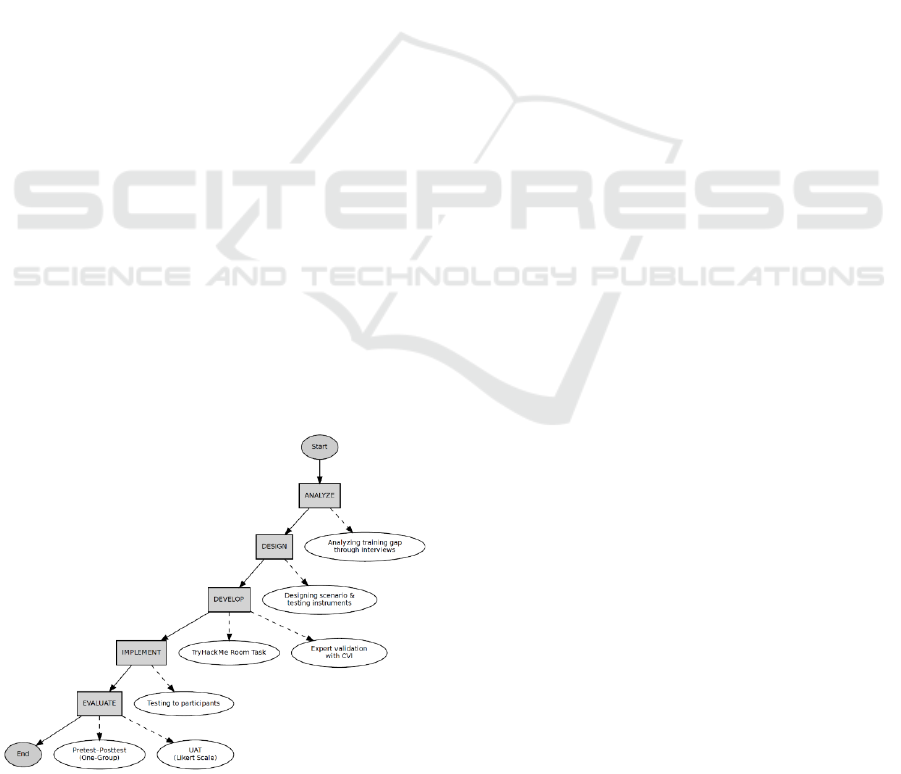
The research applied a Research and Development
(R&D) approach using the ADDIE instructional
design model: Analyze, Design, Develop, Implement,
and Evaluate (Branch, 2010). The design process
followed the five stages of the ADDIE model,
illustrated in Figure 1.
Figure 1: ADDIE Instructional Design Model Applied in
This Study.
2.1 Analyze
This phase began with validating the training
performance gap through interviews with two groups:
training organizers from a national cybersecurity
training institution and former training participants.
Three primary gaps were identified: (1) the absence
of a hands-on, practice-oriented training medium, (2)
the lack of structured guidance during practical
sessions, and (3) the unavailability of reusable
documentation to support independent learning.
These insights informed the instructional goals,
which aimed to deliver an accessible, structured, and
practically oriented training experience through a
digital platform.
Target participants were selected randomly
from a pool of eligible cybersecurity cadets using
Simple Random Sampling (SRS) (Makwana et al.,
2023). Thirty participants (21 male, 9 female, aged
20–25) were included. All were undergraduate cadets
enrolled in the Cyber Security Engineering program.
Baseline surveys revealed that 78% had only basic
cybersecurity exposure, and none had prior dark web
investigation training or direct ties with the authors,
minimizing potential bias. he participant profile was
considered relevant because similar demographic
groups are often the primary target for cybersecurity
training initiatives, as highlighted in recent
simulation-based training studies (Panakkadan et al.,
2025; Salem et al., 2024).
The required resources included participant-
owned computing devices, preconfigured virtual
machines, TryHackMe accounts, internet access, and
supporting case files. All instructional materials were
optimized for independent, cost-effective
deployment, with scalability ensured through GitHub
distribution. The training was delivered
asynchronously in a self-paced format, with optional
instructor support. Project planning was conducted
individually and dynamically adjusted, with
constraints, such as limitations on in-browser VM
deployment, mitigated through downloadable
alternatives.
2.2 Design
Based on the previous analysis, the training was
designed to systematically close the identified
learning gaps. All content was implemented on the
TryHackMe platform and organized into 21 tasks,
including four supporting tasks and 17 core learning
tasks across three modules: Dark Web Fundamentals,
Hands-on Dark Web Analysis, and Dark Web
Investigation. The sequence of tasks ensured a
Design and Implementation of a Hands-on Cyber Drill for Dark Web Investigation Training
103
progression from conceptual understanding to
exploratory exercises and finally scenario-based
investigation, supporting a stepwise learning path
aligned with the curriculum.
Learning objectives were formulated to
remain realistic, measurable, and consistent with both
the curriculum scope and the available technical
resources. Core topics were streamlined to emphasize
essential investigative competencies while reducing
redundancy. Instructional objectives were further
adapted for feasibility; for example, access
demonstrations were provided in commonly used
operating environments to reflect participants’
familiarity. Legal and ethical considerations were
integrated throughout the modules rather than
presented as separate units, reinforcing their
relevance to each investigative step. Each refined
objective was then mapped to measurable indicators
to guide both instruction and evaluation.
valuation strategies included a 14-item
pre/posttest, embedded mini evaluations at the end of
most tasks, and a 12-item UAT questionnaire. The
UAT instrument was developed based on the
Technology Acceptance Model (TAM) and consisted
of items distributed across two dimensions: Perceived
Ease of Use (PEOU) and Perceived Usefulness (PUE)
(Fallatah et al., 2024). The complete items are
presented in Table 1.
Table 1. UAT Items.
No. Aspect Ite
m
1 PEOU The
p
latform was eas
y
to navi
g
ate.
2 PEOU
The instructions were clear and
understandable.
3 PEOU The s
y
stem was flexible to use.
4 PEOU
It was easy to learn how to use the
p
latform.
5 PEOU
Completing tasks required little
effort.
6 PEOU
Overall, the platform was user-
friendl
y
.
7 PUE
The training improved my ability to
p
erform investigative tasks.
8 PUE
The training enhanced my
understanding of dark web
investi
g
ation.
9 PUE
The module increased my efficiency
in completing investigative tasks.
10 PUE
The platform was useful for
p
racticin
g
real-world scenarios.
11 PUE
The training contributed to my
p
rofessional develo
p
ment.
12 PUE
Overall, the module was beneficial
for investigative readiness.
2.3 Develop
The develop phase focused on translating the
designed instructional elements into functional
content on the TryHackMe platform. Each task was
built sequentially with clear objectives, conceptual
guidance, interactive labs, and end-of-task
assessments. The virtual machines, embedded
multimedia, and case-based investigative files were
designed to simulate real-world conditions while
ensuring both security and legality. The training
environment was structured for hybrid deployment,
combining the online platform with locally executed
simulations using preconfigured virtual machines.
Participant orientation was conducted verbally,
and facilitator guidance was delivered in coordination
with content validation. Media validation was
performed by two experts using the Content Validity
Index (CVI) method, yielding S-CVI = 1.0 and
confirming full content validity. One visual
refinement was implemented following expert
feedback to improve text visibility. A pilot test
confirmed that the training operated as expected, with
only minor adjustments required to instructions and
interface text for clarity.
Supporting media included a Kali Linux virtual
machine preconfigured with essential investigative
tools and files. In addition, multimedia assets such as
diagrams, screenshots, and videos were prepared,
along with a collection of static websites simulating
general dark web environments (e.g., marketplaces,
forums, service platforms). These resources were
embedded within the VM to ensure safe offline access
and to provide participants with realistic yet ethically
controlled investigative scenarios.
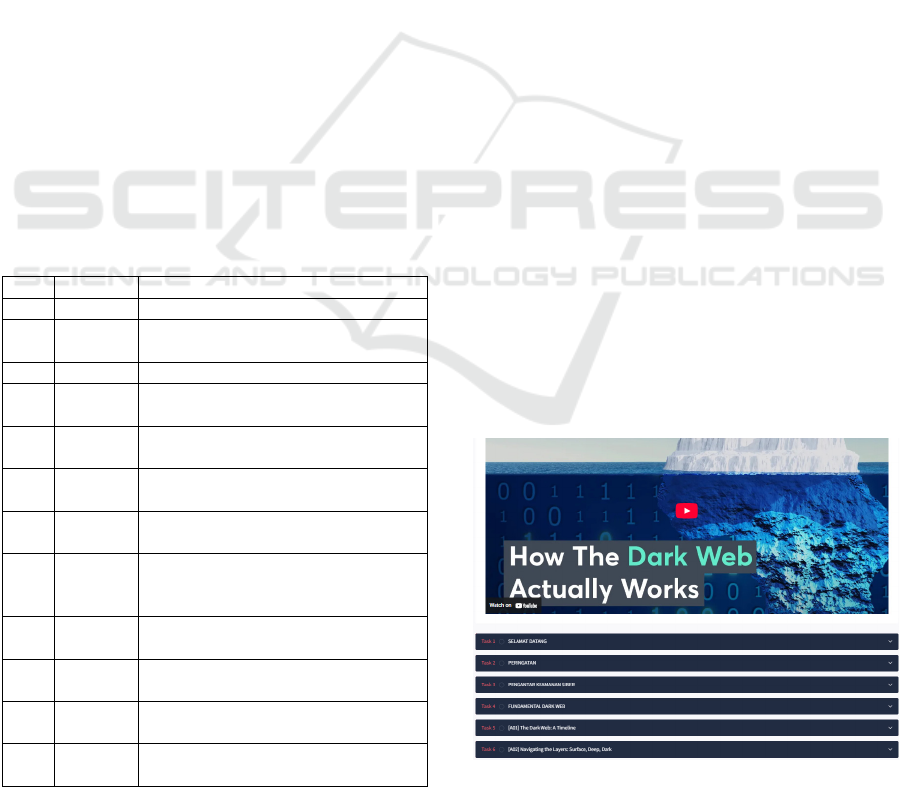
A screenshot of the training room interface is
presented in Figure 2.
Figure 2: Training Room Interface.
RITECH 2025 - The International Conference on Research and Innovations in Information and Engineering Technology
104
2.4 Implement
The implementation phase began with facilitator
preparation, where technical delivery and platform
navigation were introduced during the content
validation session with subject-matter experts.
Participants were then prepared through an
orientation session prior to the training. Thirty cadets
were randomly selected using a spreadsheet-based
randomization method to ensure objectivity. During
orientation, participants were briefed on learning
goals, access procedures, and task instructions.
The training sequence consisted of three stages:
(1) a pretest to assess baseline knowledge, (2)
independent completion of 21 structured tasks with
embedded mini evaluations on the TryHackMe
platform, and (3) a post-test with randomized item
orders to maintain assessment integrity. Throughout
the training, participant progress was monitored using
TryHackMe’s built-in chart and scoreboard features,
which captured task completions and evaluation
scores. These features also provided visual
summaries of both individual progress and overall
group performance.
The overall flow of the implementation, from
pretest to post-test, is illustrated in Figure 3.
Figure 3: Training implementation flow and participant
activity.
2.5 Evaluate
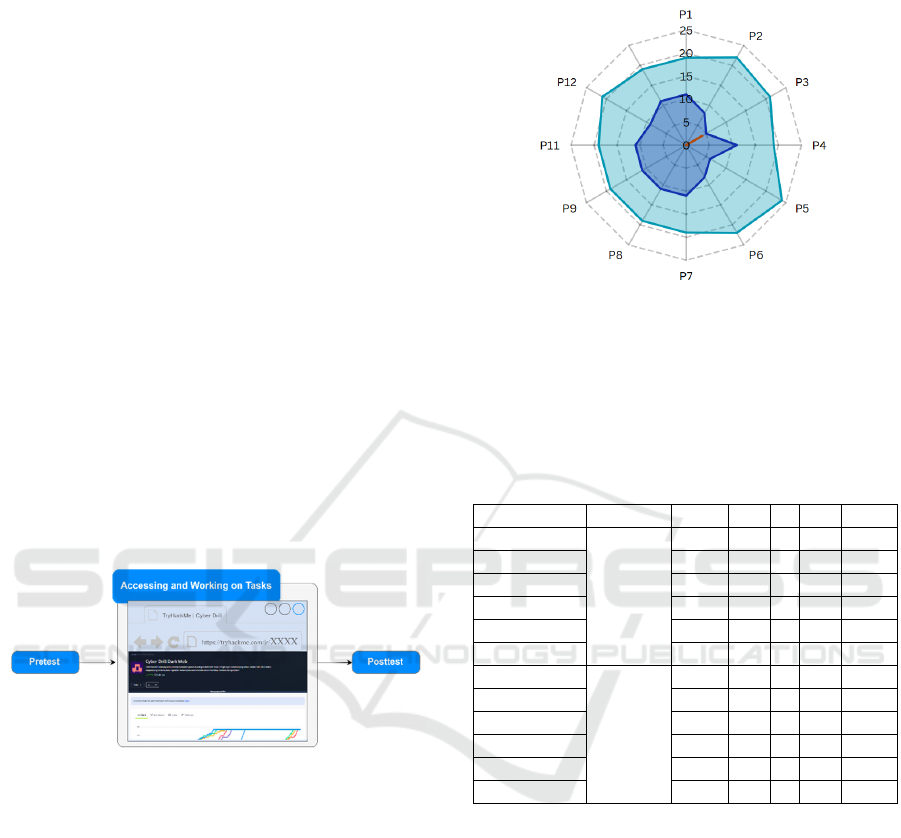
Evaluation was conducted across three levels and
carried out in parallel after the training due to the
compact schedule.
a) Level 1 – Perception (UAT): User acceptance
was measured using a 12-item Likert-scale
questionnaire based on the TAM. The overall
acceptance index reached 86.06%, with 97% of
participants responding positively (Agree or Strongly
Agree). The highest ratings were given to items
concerning content clarity and usefulness, while
slightly lower ratings were observed for ease of
navigation. These results indicate that the training
was well-received and user-friendly. The distribution
of scores across all 12 items is illustrated in Figure 4.
Figure 4: Radar chart of UAT responses across 12 items
(P1–P12).
The summarized results are presented in Table 2,
detailing participant responses for each UAT item
under both PEOU and PUE dimensions.
Table 2. Summary of UAT Responses by TAM Aspect
(PEOU and PUE)
Statement Aspect SA A N D SD
1
P
E
O
U
11 19 0 0 0
2 8 22 0 0 0
3 5 21 4 0 0
4 11 19 0 0 0
5 6 24 0 0 0
6 8 22 0 0 0
7
P
U
E
11 19 0 0 0
8 11 19 0 0 0
9 11 19 0 0 0
10 11 19 0 0 0
11 9 21 0 0 0
12 11 19 0 0 0
b) Level 2 – Learning (Pretest and Posttest): As
shown in Table 3, statistical analysis using paired t-
tests revealed a significant increase in posttest scores
compared to pretest. The mean score rose from 66.3
to 85.7, accompanied by a higher posttest median and
a lower standard deviation, indicating more consistent
performance. The paired t-test yielded t = -8.69, p <
0.001, with a very large effect size (Cohen’s d =
1.59), confirming the substantial impact of the
training. According to Cohen (1988), an effect size
above 0.8 is considered large, indicating substantial
learning improvement. Thus, the observed increase (d
= 1.59) can be classified as a very large effect size,
signifying not only statistical significance but also
strong educational relevance (Glas et al., 2023; Russo
et al., 2023)
Design and Implementation of a Hands-on Cyber Drill for Dark Web Investigation Training
105
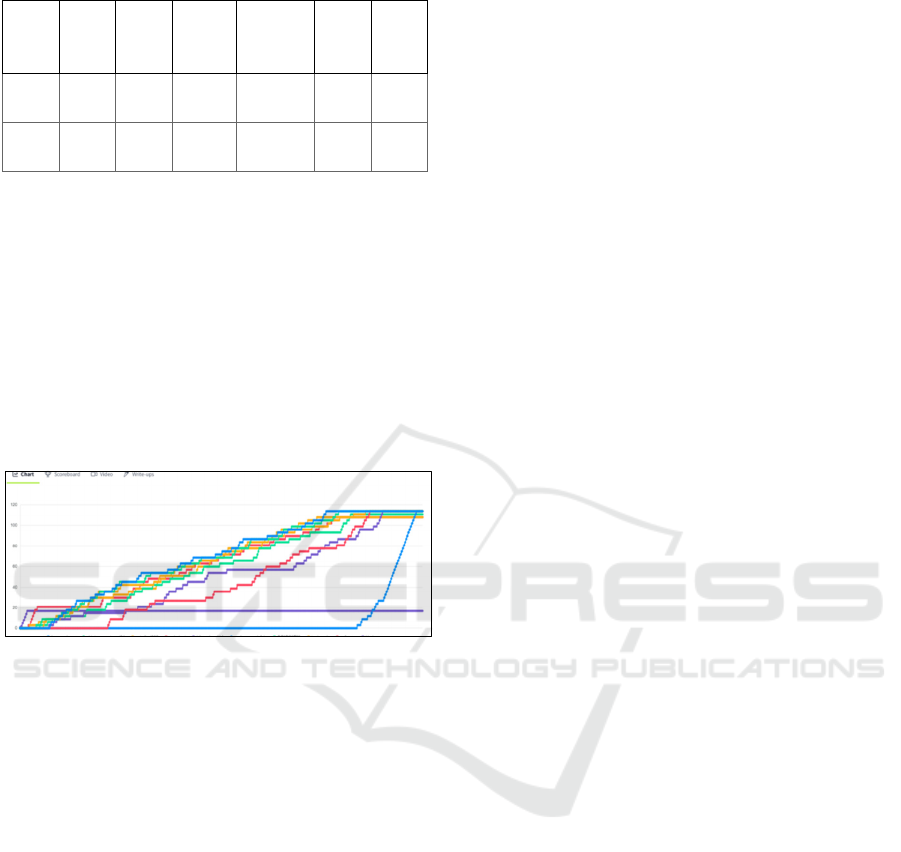
Table 3. Pretest and Posttest Results (n=30).
Me
an
Me
dian
SD t (df=29) p
Coh
en’s
d
Pre
test
66.3 64.0 11.53
Post
test
85.7 86.0 8.69 -8.69 <0.001 1.59
c) Level 3 – Performance (Mini Evaluations): As
illustrated in Figure 4, mini evaluations embedded at
the end of most tasks were used to measure local
understanding and reinforce learning. The average
score was 74.8% (Median = 75.0%, Range = 68.0%–
82.0%). The 70% threshold was applied as a
benchmark of satisfactory performance, consistent
with standard educational practice. Although lower
than the posttest average, this benchmark was
appropriate given the higher complexity and time
constraints of task-level assessments.
Figure 3: Participant progress and task completion chart
from TryHackMe.
3 RESULTS
The training program demonstrated strong outcomes
across all evaluation levels. User acceptance was
high, with an overall index of 86.06% and 97% of
participants responding positively in the UAT,
particularly regarding content clarity and usefulness.
Learning outcomes improved significantly, as shown
by an increase in average scores from 66.3 to 85.7 (p
< 0.001, t = -8.69, Cohen’s d = 1.59), accompanied
by reduced variability in posttest results. Task-level
mini evaluations further confirmed participant
engagement, with an average score of 74.8% (Median
= 75.0%, Range = 68.0%–82.0%), exceeding the
satisfactory threshold of 70%. Collectively, these
findings indicate that the training module was
effective, well-accepted, and capable of improving
both conceptual understanding and applied
investigative skills.
4 CONCLUSIONS
A cyber drill module for dark web investigation was
designed and evaluated using the ADDIE framework
on the TryHackMe platform. The module addressed
critical gaps in conventional training, validated
through expert review (CVI = 1.0) and proven
effective through empirical evaluation: high user
acceptance (86.06%), significant knowledge
improvement (66.3 to 85.7, p < 0.001, Cohen’s d =
1.59), and satisfactory task performance (74.8%). The
results demonstrate that the module is feasible,
scalable, and effective for strengthening investigative
competencies. Future work may extend scenarios,
adopt cloud-based infrastructures, and test broader
participant groups for enhanced generalizability.
ACKNOWLEDGMENT
The authors express their sincere gratitude to the
National Cyber and Crypto Polytechnic for providing
technical and institutional support, and to all
participants who contributed to the implementation of
the training module. The authors also acknowledge
the use of generative AI tools to assist in language
refinement and formatting under strict human
oversight.
REFERENCES
Badan Siber dan Sandi Negara. (2024). Laporan Keamanan
Siber Indonesia (BSSN).
https://www.bssn.go.id/monitoring-keamanan-siber/
Belshaw, S. H., Nodeland, B., Underwood, L., & Colaiuta,
A. (2019). Teaching About the Dark Web in Criminal
Justice or Related Programs at The Community College
and University Levels. In Journal of Cybersecurity
Education, Research and Practice (Vol. 2019, Issue 2).
https://digitalcommons.kennesaw.edu/jcerp
Branch, R. M. (2010). Instructional design: The ADDIE
approach. In Instructional Design: The ADDIE
Approach. Springer US. https://doi.org/10.1007/978-0-
387-09506-6
Chouliaras, N., Kittes, G., Kantzavelou, I., Maglaras, L.,
Pantziou, G., & Ferrag, M. A. (2021). Cyber ranges and
testbeds for education, training, and research. Applied
Sciences (Switzerland), 11(4), 1–23.
https://doi.org/10.3390/app11041809
Denic, N. V., & Devetak, S. (2023). Dark Web − As
Challenge of the Contemporary Information Age.
Trames, 27(2), 115–126.
https://doi.org/10.3176/tr.2023.2.02
RITECH 2025 - The International Conference on Research and Innovations in Information and Engineering Technology
106

Fallatah, W., Kävrestad, J., & Furnell, S. (2024).
Establishing a Model for the User Acceptance of
Cybersecurity Training. Future Internet, 16(8), 294.
https://doi.org/10.3390/fi16080294
Glas, M., Vielberth, M., & Pernul, G. (2023). Train as you
Fight: Evaluating Authentic Cybersecurity Training in
Cyber Ranges. Proceedings of the 2023 CHI
Conference on Human Factors in Computing Systems,
1–19. https://doi.org/10.1145/3544548.3581046
Goodison, S. E., Woods, D., Barnum, J. D., Kemerer, A. R.,
& Jackson, B. A. (2019). Identifying Law Enforcement
Needs for Conducting Criminal Investigations
Involving Evidence on the Dark Web.
https://3g2upl4pq6kufc4m.
Kaushik, K. (2022). Dark Web: A Playground for Cyber
Criminals. Computology: Journal of Applied Computer
Science and Intelligent Technologies, 2(1), 44–52.
https://doi.org/10.17492/computology.v2i1.2206
Leung, H. K. N., & Wong, P. W. L. (1997). A study of user
acceptance tests. Software Quality Journal, 6(2), 137–
149. https://doi.org/10.1023/A:1018503800709
Naufal Bahreisy, M., Rahmadi, R., & Prayudi, Y. (2021).
Analisis Halaman Darkweb Untuk Mendukung
Investigasi Kejahatan. JIKO (Jurnal Informatika Dan
Komputer), 4(1), 1–7.
https://doi.org/10.33387/jiko.v4i1.1817
Panakkadan, R. R., Meher, P., More, S. A., & Sudhakaran,
S. (2025). Enhancing Cybersecurity Education: The
Impact of Simulated Learning and Interactive Tutorials
on Student Performance and Anxiety Reduction. 1775–
1784. https://doi.org/10.21125/inted.2025.0528
Papastergiou, M. (2009). Digital Game-Based Learning in
high school Computer Science education: Impact on
educational effectiveness and student motivation.
Computers and Education, 52(1), 1–12.
https://doi.org/10.1016/j.compedu.2008.06.004
Ross, A., & Willson, V. L. (2017). Paired Samples T-Test.
In Basic and Advanced Statistical Tests (pp. 17–19).
SensePublishers. https://doi.org/10.1007/978-94-6351-
086-8_4
Russo, E., Ribaudo, M., Orlich, A., Longo, G., & Armando,
A. (2023). Cyber Range and Cyber Defense Exercises:
Gamification Meets University Students. Proceedings
of the 2nd International Workshop on Gamification in
Software Development, Verification, and Validation,
29–37. https://doi.org/10.1145/3617553.3617888
Salem, M., Samara, K., Pray, J., & Hussein, M. (2024).
Evaluating the Effectiveness of Online Cybersecurity
Program in Higher Education. 2024 IEEE Global
Engineering Education Conference (EDUCON), 1–9.
https://doi.org/10.1109/EDUCON60312.2024.105788
33
Makwana, D., Engineer, P., Dabhi, A., & Chudasama, H.
(2023). Sampling Methods in Research: A Review.
International Journal of Trend in Scientific Research
and Development (IJTSRD), 7(3).
https://www.researchgate.net/publication/371985656
Yamin, M. M., & Katt, B. (2022). Modeling and executing
cyber security exercise scenarios in cyber ranges.
Computers and Security, 116.
https://doi.org/10.1016/j.cose.2022.102635
Design and Implementation of a Hands-on Cyber Drill for Dark Web Investigation Training
107
