
Analysis of the Polarization of Sentiment in Chinese Film Reviews
and Related Factors
Haoyuan Qin
Faculty of Engineering and Information Technology, The University of Melbourne, Victoria, 3010, Australia
Keywords: Sentiment Polarization, Film Reviews, Natural Language Processing, Box Office Analysis.
Abstract: At a time when film production is increasingly targeting specific audiences, the phenomenon that some
Chinese film reviews have more emotional outputs between different audiences rather than discussions about
the content of the film has attracted widespread attention, but there is still a lack of specific qualitative and
analytical indicators for emotional polarization in reviews. This paper analyzes the public data of Douban
film reviews of 28 film samples, divides the emotional tendencies of their film reviews into three categories
to analyze whether they have emotional polarization, and studies the correlation between polarization and
other factors through quantitative analysis. This paper divides the types of film review polarization into three
categories and analyzes that on the Chinese film review platform, the film actor factor is more likely to cause
emotional polarization in film reviews than other factors and needs to be paid more attention to when taking
advantage of consumers' emotional consumption behavior. Based on this, this paper makes the following
suggestions: In the future, the film review emotional polarization index can be used as a new indicator for
analyzing the controversy and content effectiveness of film content, and more film review data can be
analyzed.
1 INTRODUCTION
In the context of the mature film industry today, the
audience's evaluation of movies has formed a huge
amount of film review data on the Internet. With the
diversification of entertainment forms, the audience's
aesthetic standards for film and television works have
also changed. The audience's evaluation and the
discussion in the comment area have become
important indicators for some users to choose movies.
The light-hearted and funny "popcorn movies" are
still hot-selling, but as an important indicator for
evaluating movies, the movie's comment area
sometimes gives negative opinions. Although some
comedy movies have achieved success at the box
office, there are controversies about cultural criticism
in the film review area, especially whether their jokes
are vulgar or disrespectful, such as "making fun of the
poor". Even in the comment area, some comments are
not directed at the content of the movie but simply
output emotions. On the other hand, although the
quality of movie content varies, many works have
been labeled as "vulgar" because of their overly
deliberate, dramatic, and low-quality movie plots, and
the film review emotions are polarized or one-sidedly
positive/negative comments, but they also have a
strong appeal because of their fast pace and easy to
fascinate people. Therefore, if it can find out the
factors related to the "polarization" and "one-
sidedness" of film reviews, and the factors that make
the reviews as a whole tend to output emotions rather
than content, that is, the emotional polarization of
film reviews, it may have a positive impact on the
review of film production and the early publicity and
promotion. In addition, since the emotional tendency
is generally more extreme when the reviews are
emotional outputs lacking content, studying the
emotional polarization of film reviews may also
provide more quantitative indicators for the analysis
of the controversial degree of film content.
At present, with the rapid development of
machine learning and natural language processing,
many practical models have been put into use. As an
important branch of natural language processing,
sentiment analysis aims to understand and judge the
emotional color contained in the text through
computer algorithms and models, whether it is
positive, negative, or neutral. Nowadays, many
powerful and practical models have emerged, and
some of them have even successfully entered the field
of commercial applications. By using these natural
language models, combined with methods such as the
Qin, H.
Analysis of the Polarization of Sentiment in Chinese Film Reviews and Related Factors.
DOI: 10.5220/0014151400004942
Paper published under CC license (CC BY-NC-ND 4.0)
In Proceedings of the 2nd International Conference on Applied Psychology and Marketing Management (APMM 2025), pages 703-709
ISBN: 978-989-758-791-7
Proceedings Copyright © 2026 by SCITEPRESS – Science and Technology Publications, Lda.
703

sentiment dictionary of the film industry, the
emotional tendency of film reviews can be obtained
more accurately, and some emotional tendency
patterns with statistical validity can be obtained by
analyzing a large number of comments in the film
review area. Specifically, when a film review is input,
the model can quickly analyze the vocabulary,
sentence structure, and context, thereby determining
the emotional attitude expressed by the author when
writing the review, whether it is praise, criticism, or
neutral evaluation of the film (Ullah et al., 2023). In
addition, due to the openness of review data, a large
number of public user reviews can be easily obtained
from domestic film review platforms. The openness
and accessibility of this data provide conditions for an
in-depth understanding of user feedback and
emotional dynamics in the film market and also
provide a strong reference for the development and
optimization of the film industry.
In recent years, with the development of natural
language processing technology, the research on
combining film reviews with sentiment analysis
mainly includes using machine learning methods to
try to extract effective content from the words and
sentences in emotionally extreme film reviews and
improve them. Lee, Sang Hoon, and others use
sentiment dictionaries to assist in analyzing the
sentiment of film reviews and effectively improve the
accuracy of models in the field of film review analysis
(Lee et al., 2016). Because there is a correlation
between the emotionality of film reviews and the
effectiveness of the content, sentiment analysis can be
used to classify film reviews to find more high-
quality film reviews that are worth referring to.
Sudhanshu Kumar and others combine sentiment
analysis with traditional recommendation systems to
filter and classify emotional reviews through
sentiment analysis to recommend reviews and content
that are closer to the user's emotional tendencies
(Kumar et al., 2020; Soubraylu & Rajalakshmi,
2021). In terms of specific analysis methods, they
include using hybrid models, pre-screening and
classification based on text length, and building
extreme word recognition dictionaries to perform
more accurate sentiment analysis, etc., to improve the
accuracy of analysis (Peng & Cheng, 2023). At
present, there is relatively mature analysis software in
the commercial market that can monitor the
generation and decline of hot topics and even judge
social media group polarization, which act as
"accelerators" to jointly promote the generation of
group polarization (Rabiee et al., 2024; Utmhikari,
2017). However, there is still a lack of research from
a specific perspective on the correlation between
audience emotional polarization and film-related
factors.
The core issue of this study is what factors of the
film are mainly related to the emergence of the
emotional polarization phenomenon in the audience's
evaluation in the comment area. Unlike existing film
review sentiment analysis research, this study focuses
on the audience emotional polarization phenomenon
itself. This phenomenon is of great value because if it
can be determined that the type of film or specific
factors are correlated with the audience's emotional
polarization or even causal relationship, it will have a
positive effect on the filmmaker's marketing strategy
formulation, helping them to accurately locate
potential users and improve the success rate of
marketing activities. Specifically, this study aims to
define and classify the emergence of audience
emotional polarization and analyze whether there is a
correlation between the type of film, box office,
ratings, and audience emotional polarization to
provide possible new indicators for the analysis of
film reviews.
2 METHOD
The data for this study comes from the public film
review data uploaded to Kaggle in 2017, which is
sourced from the Douban platform (Yuan et al.,
2020). The data mainly includes the Chinese name,
English name, review content, rating, number of
likes, and other information about the movie. The
earliest movie in the data is Iron Man 1 in 2008, and
the rest of the movies are from 2012 and later. This
data collection method avoids the copyright and
technical difficulties that may be faced by self-
collected data and can quickly obtain a large amount
of real and public film review data.
2.1 Sentiment Tendency Analysis
This study aims to explore whether the type of movie
affects the audience's emotional polarization. The
analysis model selected is the Baidu voice sentiment
tendency analysis model, which has been put into
commercial use and is relatively stable. From the 28
movies in the database, 2000 reviews of each movie
were randomly selected for analysis. Before data
analysis, it first cleaned the comment confidence
(confidence>0.5), then performed sentiment analysis
on each comment, and finally combined statistical
methods to analyze the sentiment distribution and its
possible polarization phenomenon, and obtained the
correlation analysis between the audience's sentiment
APMM 2025 - International Conference on Applied Psychology and Marketing Management
704

polarization phenomenon and the box office, ratings,
and movie types. Specifically, after separating the
extremes, if most of the extreme values are positive,
it is considered to be a positive extreme; otherwise, it
is a negative extreme. However, when the positive
and negative extreme values are relatively balanced,
they need to be discussed in categories. For example,
comments with a positive sentiment bias greater than
0.99 are called positive extreme comments, and vice
versa. After assuming that comments with a positive
sentiment bias greater than 0.99 or less than 0.01 are
extreme values, the number of extreme comments of
each movie is counted and sorted, and it can be
concluded that among the 28 movies, "Nine-story
Demon Tower" and "Why the Flute is Silent"
accounted for more than 66% of negative emotions,
showing a typical negative emotional polarization
phenomenon.
By identifying the opinion keywords and
emotional words in the comments, it is judged
whether there is a conflict of opinion between the
comments. If there are a large number of comments
that refute and argue with each other, and the
sentiment tendencies of these comments are opposite
(one is positive, the other is negative), it means that
there may be emotional polarization in the comment
area. For example, in the comment area about a
certain movie, some users praised the actors for their
excellent performance (positive), while other users
strongly criticized the actors' acting skills (negative),
and the two sides argued fiercely, which may be a
manifestation of emotional polarization. At the same
time, by counting the number and proportion of
controversial comments, the phenomenon of
comment emotional polarization can also be
identified. For example, use Baidu's sentiment
tendency analysis interface to calculate the proportion
of extreme values (prob>0.99/non-middle 50%) and
use distribution statistics indicators to count the
proportion of different sentiment tendencies. If the
proportion of controversial comments gradually
increases, it means that the conflict of opinions in the
comment area is intensifying, which may cause
emotional polarization. Even if the emotional
differences between groups are calculated in real-
time, if the difference in emotional tendencies
between different groups increases, it means that the
emotional differentiation of commentators is
intensifying. Such a possible phenomenon of
emotional polarization can also be predicted in
advance and may have an impact on real-time
marketing strategies (Schwertman et al., 2004).
2.2 Correlation Analysis
Correlation is a statistical indicator used to measure
the strength and direction of the linear relationship
between two or more variables. When analyzing
movie parameters, correlation can help analyze and
understand the degree of correlation between
different parameters (such as movie ratings, box
office, number of moviegoers, etc.). Commonly used
correlation indicators include the Pearson correlation
coefficient, which measures the degree of linear
correlation between two variables, and its value range
is between -1 and 1. A value of 1 indicates a complete
positive correlation, a value of -1 indicates a complete
negative correlation and a value of 0 indicates that
there is no linear correlation. This article uses the
Pearson correlation coefficient to perform correlation
analysis after one-hot encoding nonlinear parameters
such as movie types and actors.
2.3 Word Frequency Analysis of Film
Reviews
In the process of film review sentiment polarization
analysis, the frequency statistics of text data is an
important means to help identify the most
representative keywords in the comments and reveal
the core topics discussed by the audience under
different movie types or emotional tendencies.
To ensure the accuracy of the analysis, this study
first preprocessed the review text, including removing
special characters and punctuation marks and using
the stop word list of Harbin Institute of Technology
to remove stop words from the review text to reduce
the interference of invalid information. After the text
is cleaned, this study uses word frequency statistics,
TF-IDF (word frequency-inverse document
frequency), and other methods to analyze the
distribution of high-frequency words in each movie
review and combines word cloud, table, and other
visualization methods to display the distribution of
keywords, to intuitively present the key content
discussed in the comment area. For example, for
movies with high box office but serious emotional
polarization of film reviews, it is possible to observe
whether high-frequency keywords are concentrated
on specific topics (such as actors, plots, special
effects, etc.) and further analyze whether these
keywords are related to the emotional tendency of
film reviews.
Analysis of the Polarization of Sentiment in Chinese Film Reviews and Related Factors
705
3 RESULT
3.1 Movie Genres and Emotional
Tendencies
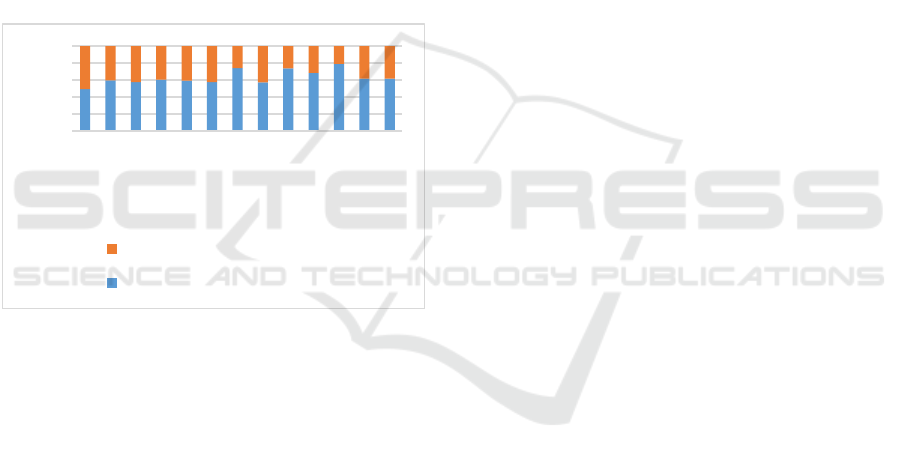
As shown in Fig. 1, in the study of movie genres and
audience emotional tendencies, it was found that the
average emotional tendencies of audiences for
musicals, animations, and science fiction films
showed a significant positive trend. In contrast, youth
and romance films showed a different trend, with
audience emotions tending to be more negative, and
in the evaluation of such films, the phenomenon of
emotional polarization was particularly prominent,
that is, the audience's evaluation was more likely to
be divided into two completely different poles, and
the difference and opposition between positive and
negative evaluations were more significant.
Figure. 1. Average emotional tendency of movies of
different genres.
3.2 Analysis of Three Types of
Sentiment Polarization
Since the quartiles can clearly and directly display the
five important features of the data: the extremes, the
upper and lower hinges (quartiles), and the median
therefore using the quartiles to display the sentiment
tendency score of each movie can directly determine
the proportion of extreme values through the width of
the upper and lower hinges (Guo, 2020). Based on the
in-depth exploration and analysis of the sentiment
analysis quartiles of 28 movies, it can be seen that the
distribution area occupied by some movies in the
quartiles is relatively wide, that is, the box area is
relatively large. This feature means that in the
audience's evaluation system of these movies, the
distribution of positive and negative emotions tends
to be balanced, and its sentiment tendency presents a
diversified pattern, reflecting a large emotional
discreteness. On the contrary, the distribution area of
some other movies in the quartiles is highly
concentrated, and the range is relatively narrow. The
evaluation of these movies focuses more on the
positive emotion dimension, and the proportion of
negative emotions is relatively small. From the
perspective of the theory of emotional polarization,
this phenomenon may imply that such movies are less
likely to cause negative reviews, and the audience
group maintains a relatively consistent positive
emotional attitude towards the movie as a whole,
which in turn causes its distribution in the quadrant to
show a relatively concentrated trend, which is in
sharp contrast to those movies with dispersed
emotional tendencies.
To analyze the three different types of emotional
polarization tendencies more clearly, this study chose
to observe the emotional analysis quadrants of three
specific movies in detail (Fig. 2). It can be seen that
the box of Chronicles of the Ghostly Tribe is
generally lower and the median is almost zero, which
means that the film review sentiment of this movie
tends to be negative, and the most frequent words in
its film reviews are discussions about the original
work, actors, and directors. The box of The Mermaid
is relatively large, and the median is relatively
centered. An in-depth analysis of the main reasons
behind it may be because the film focuses on the
construction and portrayal of the relationship between
actors at the core theme level of narrative and
discussion. The word frequency analysis of the film
reviews shows that the director's name, the leading
actor's name, environmental protection, plot, and
other representative keywords appear. The existence
of these elements may, to a certain extent, reflect the
wide distribution of audience evaluations in the
emotional dimension, which increases the degree of
dispersion of evaluations and makes the emotional
tendency more diversified and decentralized. The box
of Zootopia presents a smaller scale. This
phenomenon intuitively reflects that its evaluation
distribution has a highly concentrated characteristic
and mainly tends to be in the positive evaluation
category. Its degree of emotional polarization is more
concentrated than that of the other two films. The
audience's evaluation of the film is highly consistent,
and the proportion of negative evaluations is
extremely low. The words with a high evaluation rate
in their comments include animals, plots, and stories,
that is, discussions on the content of the movie.
0%
20%
40%
60%
80%
100%
Youth
Drama
Romance
Adventure
Action
Fantasy
Animation
Comedy
Science…
Crime
Musical
Horror
Disaster
Number of negative reviews
Number of positive reviews
APMM 2025 - International Conference on Applied Psychology and Marketing Management
706
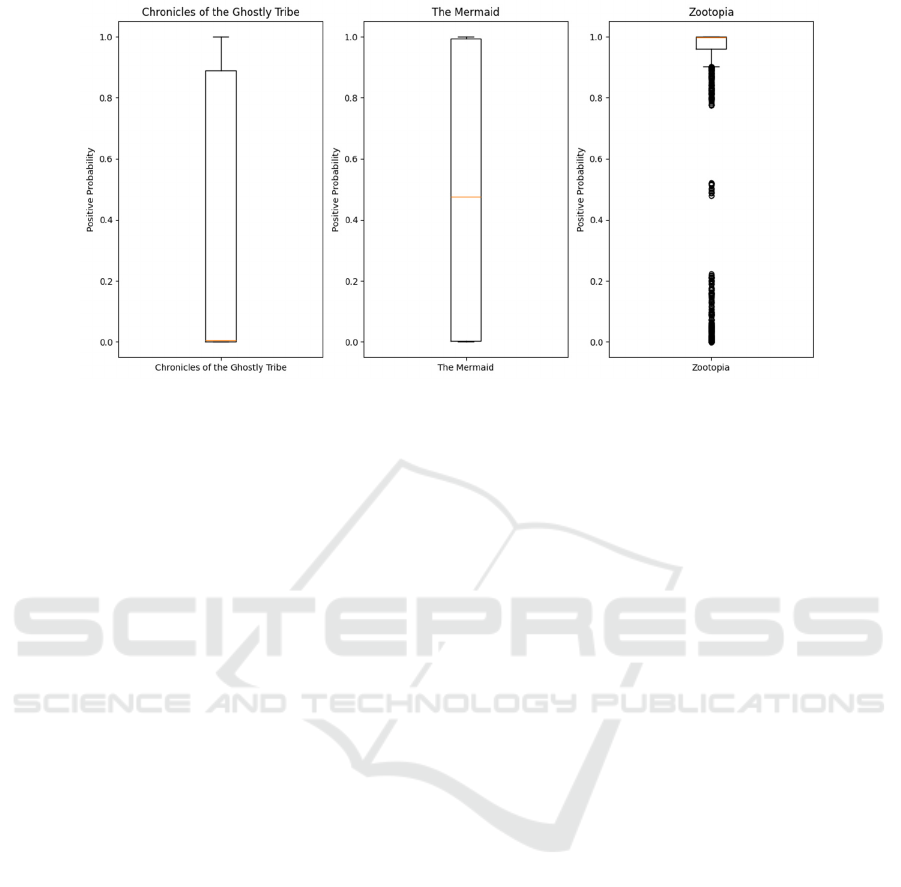
Figure. 2. Quartile chart of sentiment analysis of film reviews for the three films "Chronicles of the Ghostly Tribe", "The
Mermaid", and "Zootopia".
This study uses the proportion of positive
emotions in extreme emotional reviews greater than
66% and less than 33% as the classification of
whether positive polarization and negative
polarization occur. When the proportion of positive
and negative extreme emotional reviews is similar, it
is necessary to analyze specific movies. Generally,
the proportion of noun entities in film reviews of
films with emotional polarization will show obvious
repetition and reduction. Among the 28 movies
analyzed in this study, 9 movies have positive
emotional polarization, 2 movies have negative
emotional polarization, and the remaining 17 movies
have similar proportions of positive and negative
extreme emotional tendency reviews.
At the same time, combined with the movie
ratings, 29.09, 49.65, and 85.98 correspond to the
positive emotional tendency ratios of 28.9, 49.6, and
86.4 for the three movies "Nine-story Demon Tower",
"The Mermaid", and "Zootopia", respectively. It can
also be judged that the emotional tendency of film
reviews and movie ratings have a high correlation.
3.3 Correlation Between Audience
Needs and Emotional Polarity
The data analysis shows that the emotional
polarization of the audience is weakly positively
correlated with the box office. The viewing needs of
Chinese audiences are mainly divided into seven
categories: story, role, director/team, special effects,
art, actor, and action (Li et al., 2022). Among all the
movie data, the two movies with the most obvious
positive and negative polarization are Zootopia and
My Sunshine. After removing stop words using the
stop word list of Harbin Institute of Technology, the
word cloud diagram is generated using WorldCloud.
In My Sunshine, which has the most extreme negative
emotions, the most frequent categories are actor and
story, including discussions about the actor's acting
skills and comparisons with the plots of the TV series
of the same name. In Zootopia, which has the most
extreme positive emotions, the most frequent
categories are character and story. Through a simple
comparison of the two, the story of the movie is a
more important factor affecting the audience's
emotional tendency than other factors.
Whether it is a movie with positive or negative
emotional polarization, the story factor has a large
proportion in the discussion. Therefore, it can be
considered that there is a strong correlation between
the plot of a movie and the polarization of film
reviews. When promoting a movie, special attention
should be paid to avoid any points that make the
audience feel abrupt or even disgusted. At the same
time, the keyword review rate in negatively polarized
film reviews is more concentrated than that in
positively polarized film reviews, which may mean
that the outbreak of negative emotional tendencies is
also highly uncertain. Once there is an opinion leader
at the core of the topic, negative emotions are likely
to become polarized (Rabiee et al., 2024). In addition,
compared with positively polarized film reviews,
negatively polarized film reviews have more
discussions about non-film content, such as actors
and directors.
Analysis of the Polarization of Sentiment in Chinese Film Reviews and Related Factors
707

4 DISCUSSION
4.1 Movie Types and Emotional
Tendencies
When comparing different types of movies, this study
found that love and youth movies are more likely to
have audience emotional polarization than other types
of movies and tend to be negative, and negative
comments are more focused on actors rather than
roles than positive comments; the average emotion of
the audience of musical movies tends to be positive.
Combined with the results of word frequency analysis
of film review data, the difference between positive
and negative comments in the comments of love and
youth movies with strong storylines is more
significant, and the audience generally likes elements
such as music and dance.
In terms of the content of the discussion, strong
story movies are more likely to touch the audience's
emotions and memories and are more likely to lead to
polarization of audience evaluations. Therefore,
when targeting such strong story movies, both in the
early marketing and publicity, it is necessary to pay
attention to the emotional discussions that such
movies may bring and carry out targeted publicity,
especially the publicity of actors. Appropriate
publicity may bring higher attention to such movies
more easily, but inappropriate publicity may also
make such movies more likely to receive low ratings.
For musicals and dances, the data of this study
shows that the average emotion of the audience of
musicals and dances tends to be positive, but there are
also obvious problems, such as a single discussion
structure and a small number of comments. It may be
necessary to pay more attention to other aspects
during promotion, especially factors such as plot and
actors that are more relevant to the audience's
emotions, to attract the audience's attention.
4.2 Correlation Between Emotional
Polarization and Film Indicators
The box office of movies with obvious audience
emotional differentiation in the comment area is often
relatively high, which may be because emotional
polarization will cause more discussion and attention
and then drive the box office to a certain extent. From
the word frequency analysis, it can be seen that
negative polarization is generally more targeted at
specific topics than positive polarization. Therefore,
the promotion of movies may be more targeted at
some specific topics that are more likely to cause
discussion, such as actor selection. Although it may
be more likely to cause emotional polarization in the
evaluation, the discussion will also increase
accordingly and may further improve the box office
performance of the movie.
5 CONCLUSION
This study explored the characteristics of audience
emotional polarization and its related influencing
factors by analyzing Chinese film reviews of 28
different types of films. The study showed that there
was a certain correlation between the phenomenon of
emotional polarization in film reviews and indicators
such as the type, box office, and ratings of the film.
Specifically, youth and romance films are more likely
to cause emotional polarization, while science fiction
and musical films tend to have positive emotional
evaluations. This finding suggests that the type of
film plays an important role in the phenomenon of
emotional polarization.
In addition, the study also found that the
phenomenon of emotional polarization in film
reviews is closely related to the performance of film
actors. Negatively emotionally polarized film reviews
often focus on discussions about the actors' acting
skills or their past reputations, while positive
emotional polarization tends to focus on the
characters or core plots of the film. Therefore, film
production and publicity teams should focus on actor
selection and plot design during the planning stage to
reduce the risk of negative evaluations and enhance
the audience's overall viewing experience.
Although this study conducted a detailed analysis
of the phenomenon of emotional polarization in film
reviews through natural language processing and
statistical methods, the universality of the research
conclusions still needs further study due to the
limitations of sample size and film types. Future
research can further explore the causes and potential
impacts of the phenomenon of emotional polarization
in film reviews by expanding the sample range,
combining more types of film data, and introducing
more accurate sentiment analysis models.
In short, the study of the phenomenon of
emotional polarization in film reviews not only
provides a new perspective on the emotional response
of the audience for the film industry, but also provides
a useful reference for research in related fields. In the
future, with the continuous development of sentiment
analysis technology, this research direction will have
a wider application value.
APMM 2025 - International Conference on Applied Psychology and Marketing Management
708

REFERENCES
A. Ullah, S. N. Khan, N. M. Nawi, Review on sentiment
analysis for text classification techniques from 2010 to
2021. Multimedia Tools Appl. 82(6), 8137-8193 (2023)
G. Peng, X. Cheng, Research on the formation mechanism
of social media group polarization in hot events. J. Inf.
Resour. Manag. 13(2), 42-52 (2023)
H. Rabiee, B. T. Ladani, E. Sahafizadeh, A social network
model for analysis of public opinion formation process.
IEEE Trans. Comput. Soc. Syst. (2024)
J. Yuan, J. Shi, J. Che, C. Xu, J. Wang, Modeling and
simulation analysis of public opinion polarization in a
dynamic network environment. Concurrency Comput.
Pract. Exper. 32(19), e5771 (2020)
L. Guo, Sentiment analysis of domestic film reviews based
on deep learning, Ph.D. thesis, Guangxi Normal
University (2020)
M. Li, Y. Zhang, S. Wang, Comparative study of Chinese
audiences' demand and satisfaction for Chinese and
foreign films based on Word2vec and TF-MONO
algorithm. Intell. Eng. 8(2), 073-086 (2022)
N. C. Schwertman, M. A. Owens, R. Adnan, A simple more
general boxplot method for identifying outliers.
Comput. Stat. Data Anal. 47(1), 165-174 (2004)
S. H. Lee, J. Cui, J. W. Kim, Sentiment analysis on movie
review through building modified sentiment dictionary
by movie genre. J. Intell. Inf. Syst., Korea Intell. Inf.
Syst. Soc. (2016)
S. Kumar, K. De, P. P. Roy, Movie recommendation system
using sentiment analysis from microblogging data.
IEEE Trans. Comput. Soc. Syst. 7(4), 915-923 (2020)
S. Soubraylu, R. Rajalakshmi, Hybrid convolutional
bidirectional recurrent neural network based sentiment
analysis on movie reviews. Comput. Intell. 37(2), 735-
757 (2021)
Utmhikari, Douban movie short comments dataset. Kaggle
(2017). Retrieved from
https://www.kaggle.com/datasets/utmhikari/doubanmo
vieshortcomments/data.
Analysis of the Polarization of Sentiment in Chinese Film Reviews and Related Factors
709
