
Predicting the Popularity of Movies with Social Media
Liangye He
School of Data Science and Engineering, Guangdong Polytechnic Normal University, Heyuan, Guangdong, China
Keywords: Movie Popularity, Correlation Analysis, Descriptive Statistics, Machine Learning.
Abstract: The film industry occupies an important position in the field of culture and entertainment, and the issue of
how to avoid the risk of investing in films has received widespread attention, but the existing prediction
methods still have certain shortcomings in terms of accuracy and practicality. This paper thoroughly analyses
the various dimensions that influence movie popularity, including movie genre, release time, heat, and other
factors, and explores the relationship between these factors and movie popularity. This paper analyses and
concludes that factors such as the combination of actors and directors, the running time of the film, and the
release time have a significant impact on the popularity of the film and thus establish a prediction model for
the popularity of the film. Based on this, this paper makes the following suggestions: if film producers want
to increase the popularity of their films, they should pay attention to the release time of their films and the
combination of directors and actors. At the same time, industry insiders can use the prediction model in this
paper to make decisions about film projects.
1 INTRODUCTION
With the rapid development of information
technology, modern society has fully entered the
information age. Therefore, in the context of this era,
information has become a key element in promoting
social progress and development in various fields,
and the Internet, as the main carrier of information
dissemination, brings together a huge amount of data
resources and provides sufficient information support
for all walks of life. Social media is an important
product of the Internet era and has become the most
widely used tool in people's daily lives, and the
amount of data contained in it is self-evident.
According to Digital 2024, published by We Are
Social and Meltwater, the number of active social
media user identities has surpassed 5 billion,
representing 62.3% of the world's population (Social,
2024). Last year, the global total increased by 266
million, with an annual growth rate of 5.6 percent.
This data not only demonstrates the widespread
popularity of social media but also shows that social
media has great data potential as a major platform for
information dissemination, social interaction, and
cultural exchange.
Film investors want to reduce the risk of
investment, so if they can use scientific methods to
predict the popularity of the film and adopt a
reasonable marketing strategy, film production
companies and distribution companies can avoid the
risk and reduce losses (Li, 2021). For the audience,
what they want more is to be able to watch a good
film, and rating prediction can help them decide
whether to watch the film or not to enhance the
viewing experience. Douban, a famous film website
in China, was mined by scholars for rating prediction
a few years ago (Geng & Guo, 2021; Zou, 2019).
IMDb and TMDB are also popular film websites that
contain a lot of information about the film and
audience comments, and because of their large
number of users, the scores given on the site can be a
good reference option.
There have been many scholarly studies on film
scoring. Among the more recent findings, Liu et al.
were inspired by brain mechanisms to independently
encode static features as control signals and modulate
time-varying contextual features to predict individual
decisions in complex contexts (Liu et al.). Xu et al.
constructed a movie information network from the
relationship between users, movies, and attributes and
used the metapath2vec algorithm to map various
attributes to the corresponding feature space in the
form of network nodes to obtain feature vectors for
rating prediction (Xu et al., 2024). Liu et al. used an
attention network to distinguish the importance of
interactive features and then used DNN to process
higher-order feature combinations to build a
predictive teacher model while using knowledge
662
He, L.
Predicting the Popularity of Movies with Social Media.
DOI: 10.5220/0014150300004942
Paper published under CC license (CC BY-NC-ND 4.0)
In Proceedings of the 2nd International Conference on Applied Psychology and Marketing Management (APMM 2025), pages 662-667
ISBN: 978-989-758-791-7
Proceedings Copyright © 2026 by SCITEPRESS – Science and Technology Publications, Lda.
distillation to build a streamlined model of the student
model to ensure the accuracy of the teacher model
(Liu et al., 2024). Previously, Michael T. Lash and
Kang Zhao used social network analysis and text
mining techniques to delve deeper into the film's cast
and release season, ultimately speculating on the
film's profitability (Lash & Zhao, 2016). N.
Darapaneni et al. chose XGBoost as the final film
success prediction algorithm after working with film
outline plots and testing it with several models
(Darapaneni et al., 2020). Differently, Rijul Dhir and
Anand Raj chose released data from the film as their
data set, rather than listening to what critics and
others had to say about whether the film would be a
success or not, but the final model's predictive
accuracy wasn't very high, and they're also looking
ahead to future work where they want to include
analysis of user comments from social media (Dhir &
Rah, 2018). Rather than simply choosing the optimal
model, Vedika Gupta et al. integrated and compared
different models before using them to predict the
success of the film (Gupta et al., 2023).
At the same time, with the help of social media
analysis, the accuracy of the prediction model will
further improve, as a result of which provides more
scientific decision-making support for film investors.
Social media is an important platform for modern
information dissemination, contains a large amount of
user-generated content, including film reviews, topic
discussions, etc., and this data reflects the audience's
real-time feedback on the film, as well as their
emotional inclination, which is of high research value
(Castillo et al., 2021).
Based on this, this paper will examine the
correlation between various factors that influence a
film's popularity and its rating and will develop a
prediction model.
2 METHOD
2.1 Research Design
The purpose of this paper is to explore the potential
value and laws of film-related data. Through the
comprehensive analysis of multi-dimensional data
such as film release time and audience rating, this
study reveals the internal relationship between film
popularity and these factors and their influence
degree, that is, the weight, to establish a film rating
prediction model. Meanwhile, social media analysis
can be used to capture the expectation value of the
audience, i.e., the social media buzz, at this point
before the film's release, thus predicting the film's
rating and popularity.
Due to the complexity of the factors that influence
a film's popularity, it is difficult for a simple
prediction model to produce accurate results (Geng &
Guo, 2021; He & Yuan, 2021). First of all, this paper
obtains the film data set through Kaggle, the reason
for choosing Kaggle is because it is a more
authoritative and data-rich website, where there is no
lack of scholars in various fields to select the data
inside for academic research, and then remove null
values as well as outliers in the data set. To explore
the factors that affect the popularity of films, this
paper will carry out statistical analysis and correlation
analysis on the popularity of films, which is difficult
to express in numerical terms. Therefore, the
audience rating of films is selected as an indicator to
measure the popularity of films, which is used as a
dependent variable for correlation analysis, and the
influencing factors are obtained by combining
statistical analysis. The first step of this paper is to
conduct a descriptive statistical analysis based on the
data results to explore the correlation between
nonnumerical items, namely, actors, directors, actors,
and directors' specific combinations and film scores.
The second step is to conduct a correlation analysis
between numerical items and film scores and use the
analysis results to establish a prediction model of film
popularity (Abidi et al., 2020). Because the ultimate
goal is to predict the popularity of films, the
popularity of films is defined by five levels, namely
terrible, poor, satisfactory, good, and excellent. The
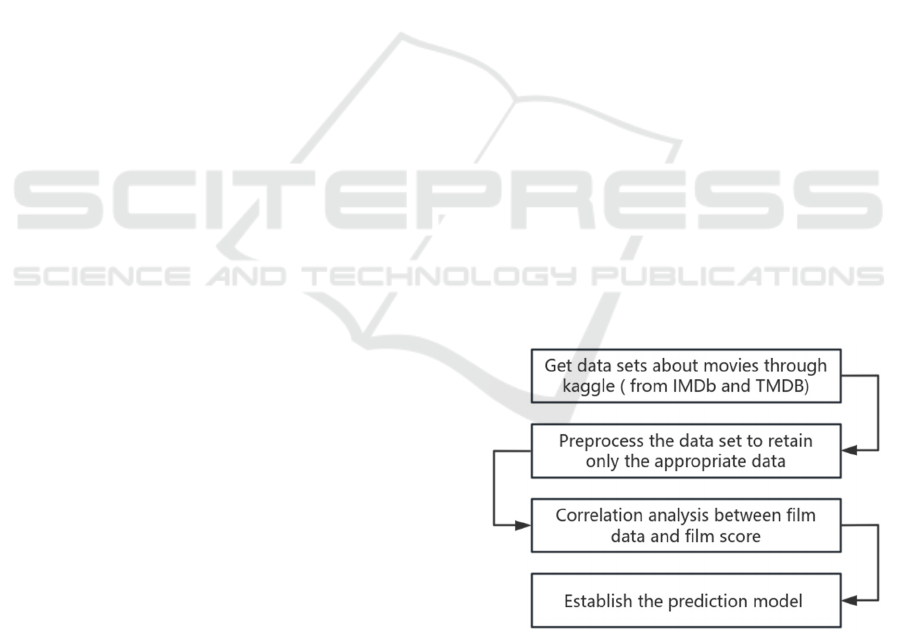
research design is shown in Fig.1.
Figure. 1. Research design.
2.2 Data Collection
To better predict the popularity of movies, a perfect
data set is needed to obtain more accurate results.
There are 880,990 original datasets in the data set
used in this paper, including 27 dimensions, such as
Predicting the Popularity of Movies with Social Media
663

film title, actor, director, film type, score, etc. To
ensure consistency, too short and too long movies are
removed from the data set, and only movies with a
movie duration of 80 to 200 minutes are retained. At
the same time, the reference value of film rating
obtained when there are few rating users is not
significant, so to ensure objectivity, films with rating
users less than 100 should be removed. In addition, to
avoid randomness, factors affecting the fairness of the
research results, such as screenwriters, film travel
companies, original titles, etc., are removed. Because
Python is selected for prediction in this paper, the
prediction of floating-point values may affect the
accuracy, so the score is multiplied by 10 manually.
Moreover, to realize the prediction, the profit should
not appear in the data set because this is the data that
can be obtained only after the film is released.
Through the above steps, the data set with 12,997
pieces of data is finally obtained, and 11 dimensions
are reserved for analysis, including vote_average,
vote_count, release_date, revenue, budget, runtime,
popularity, genres, cast, director, imdb_rating,
imdb_votes。
At the same time, in order to focus on the films
with high and low scores, two different data sets are
used, top_1000 (score greater than 7.5) and
lowest_100 (score less than 4.0), which are mainly
used for the statistical analysis of non numerical
items, so the dimensions only include date, score,
genre, director, crew.
3 RESULT
3.1 Specific Combinations and Film
Score
The combination of specific directors and actors may
form a brand effect, which can attract their loyal fans
to a certain extent, thus affecting the film score. In the
most popular top1000 data set, based on its data
characteristics for statistical analysis, this study will
arrange and combine the directors and leading actors,
and evaluate them by combination and score.
As shown in Table 1, when these directors and
actors cooperate, the average film score is high, so it
can be considered that when the above combination
appears, the film score will be high. At the same time,
the replacement of the combination will also have an
impact on the film score, just like the combination of
Akira Kurosawa, the same director, and cooperating
with different actors, Toshir ô Mifune and Tatsuya
Nakadai. Then, do the same work through the lowest
data set, and the rules are similar. Therefore, if a
director and an actor appear in a film at the same time,
it may cause brand effect and get a higher score. On
the contrary, the "chemical reaction" will lead to a
lower film score. Therefore, it can be considered that
the specific combination of director and actor has an
impact on the film score to a certain extent.
Table 1. The top five director and actor groups and the
average score of their films.
Director Actor
Cooperative
times
Average
film score
Akira
Kurosawa
Toshirô
Mifune
7 8.24
Richard
Linklate
r
Ethan
Hawke
5 7.98
Akira
Kurosawa
Tatsuya
Nakadai
5 8.10
Peter
Jackson
Ian
McKellen
5 7.80
John Ford
John
Wayne
4 7.80
3.2 Main Factors
In the first section of this chapter, actors and directors
are studied. Therefore, in this section, the relevance
between them and film scoring will not be explored,
but other characteristics will be studied. Through the
exploration of correlation, it is found that several
factors are significantly correlated with the film
score, namely the release time and the playing time,
and the corresponding p-value is less than 0.05,
indicating that they have a significant correlation with
the film score. In addition, there is only a weak
correlation between film popularity and film score.
Table 2. Release month and IMDb score.
M
on
th
J
a
n
F
e
b
M
a
r
A
p
r
M
a
y
J
u
n
J
u
l
A
u
g
S
e
p
O
c
t
N
o
v
D
e
c
ra
ti
ng
6
2
.
0
6
3
.
0
6
4
.
0
6
3
.
0
6
5
.
0
6
5
.
0
6
4
.
0
6
3
.
0
6
6
.
0
6
5
.
0
6
6
.
0
6
7
.
0
The first is to explore the correlation between the
release time and the score. To examine the correlation
between the two, their Spearman's Rho and Kendall's
tau were calculated to be 0.091 and 0.064
respectively, so it can be assumed that the release
month has a significant correlation with the film
score. As shown in Table 2, the average film score
showed an upward trend from January to March and
a downward trend from June to August, while the
average film score was higher in September,
November and December.
APMM 2025 - International Conference on Applied Psychology and Marketing Management
664
What's more, the data shows that when the playing
time is too short or too long, the film score will
decline. Therefore, most of the films now control the
film time between 85 and 110 minutes to reduce the
impact of the playing time on the film score. In the
descriptive statistical analysis of the data set, the
average playing time of the film is 107 minutes. This
study chose to use the regression model to find the
correlation between the playback duration and the
film score. At the same time, to avoid the influence of
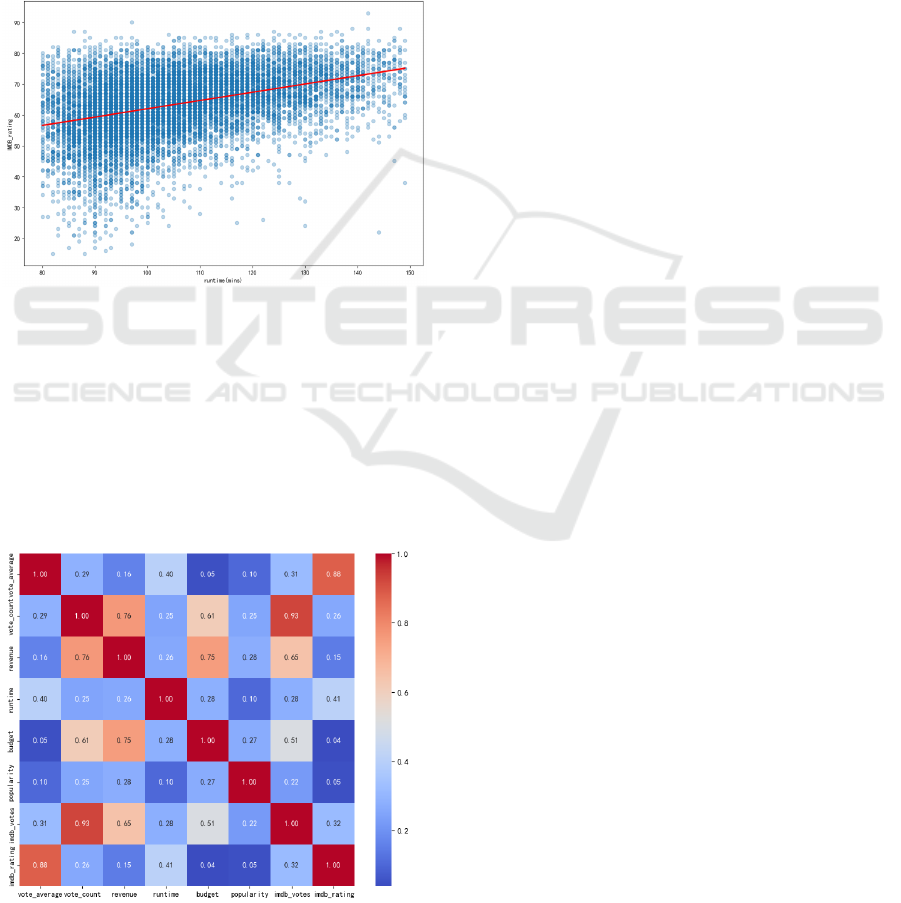
extreme circumstances, the IQR was used to remove
the abnormal value of the playback duration. The
filtered results are shown in Fig. 2.
Figure. 2. IMDb_rating by runtime (filtered).
The filtered results are more intuitive, and the
slope of the regression line of the regression model is
0.268, indicating that there is a positive correlation
between the playing time and the film score.
This paper uses the Pearson correlation formula as
the calculation basis to calculate the correlation
between the numerical column in all movies and the
movie score, and the correlation matrix is shown in
Fig. 3.
Figure. 3. Correlation matrix.
Figure 3 shows that the correlation between
vote_average and imdb_rating and popularity is not
great. Therefore, even if a film is very popular on
social media, it may only indicate that the marketing
strategy before the film's release was relatively
successful, that the film's theme is attractive, or that it
happens to have a popular actor or director.
3.3 Prediction Model
To avoid the influence of film type on the score, this
study will eliminate this influence factor artificially
so the model can focus on predicting the popularity of
the same type of film. Combined with the above
research, the release time, the length of time, and the
popularity of the film were selected to establish the
model. In this section, classifiers, clustering, and
simple linear regression are used. At first, it is divided
into nearly 100 categories, that is, each score is a
category. At this time, a random forest is used for
prediction (Tan, 2021).
To get more accurate prediction results, this study
divides every 2 points into an interval of 0,1,2,3,4,
corresponding to terrible, poor, satisfactory, good,
and excellent. For the most accurate prediction, the
score is manually multiplied by 10. This allows
research to ignore the inaccuracy caused by floating
point values, i.e., every 20 points is taken as an
interval. Converting continuous values to discrete
values helps to fit the most appropriate values. Taking
80% of all movies as the training set and the
remaining 20% as the test set, four models will be
selected for implementation, namely random forest,
gradient boosting, KNN, and multiple linear
regression model. Especially in multiple linear
regression, the regression value will be rounded off
because the predicted value of linear regression is
usually related to the distribution of the target label,
so the rounded result can match the classification
label in most cases. In particular, when the regression
result is 4.6, it will become five according to the rule,
but there is no 5 in the classification, so it is necessary
to force the value greater than 4 to take four and
continue to follow the rounding between 0 and 4. The
obtained performance indicators are shown in Table
3
.
Predicting the Popularity of Movies with Social Media
665
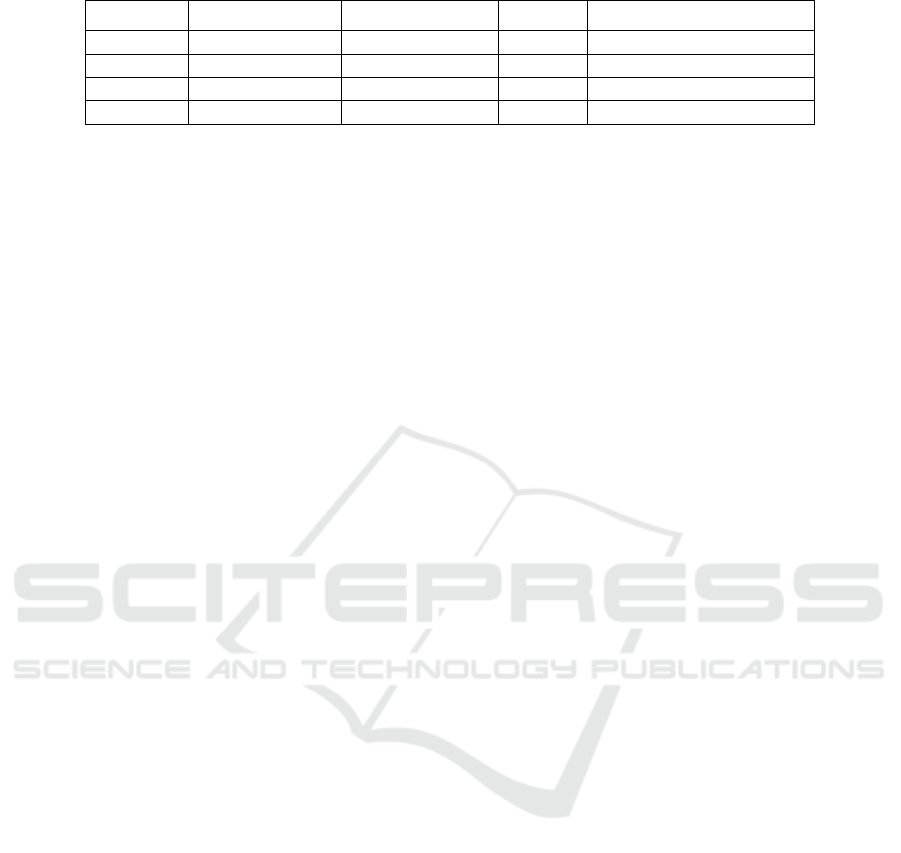
Table 3. Performance index of each machine algorithm.
Random Forest Gradient Boosting KNN Multiple Linear Regression
Accuracy 86.65% 87.00% 60.46% 84.08%
MSE 0.13 0.13 0.45 0.45
MAE 0.13 0.13 0.41 0.41
R
0.59 0.60 -0.39 -0.39
The gradient boosting shows the best prediction
results, which shows that the gradient climb
algorithm has obvious advantages in dealing with the
problem of film popularity prediction. It can
effectively extract key features from a large number
of data and gradually approach the optimal solution
through the iterative learning process to improve the
accuracy of prediction and the generalization ability
of the model. Therefore, this paper establishes a
prediction model by gradient boosting and inputs the
budget, popularity, release month, playing time, and
user expected score on social media to obtain the
corresponding possible popularity level.
4 DISCUSSION
From the above research, it can be concluded that the
combination of specific directors and actors may form
a brand effect or "chemical reaction", thus affecting
the film score. Therefore, when investors choose
these specific combinations of directors and actors as
investment targets, they can ensure the quality and
popularity of the produced films. Similarly, some
combinations will lead to the reduction of film scores.
Investors can also try to choose some newer
portfolios through public feedback so that they can
learn from mature and better-performing portfolios so
that the new portfolio can better realize innovation for
the development of films.
Film duration also has a partial impact on film
ratings, so it should be limited effectively.
Meanwhile, it should not abandon the integrity of the
content in order to control the length of the film. At
that time, the harm to the film is greater than the
advantage, so investors should pay more attention to
the overall balance between the content and the time.
Choosing a more appropriate time for the release
of the film can enhance the popularity of the film.
Different types of films will be released at different
times. For example, comedy can be released during
the Spring Festival in China, and love films can be
released on Valentine's Day, which may make the
film more popular.
In any case, making a good film is the key to
winning the popularity of the public. Good content
plus the above key factors can make the film more
popular (Zou, 2019). Absolutely, early publicity work
is necessary, otherwise no one knows even though the
film is of high quality, which is one of the reasons for
the low popularity.
5 CONCLUSION
This study firstly explores the influence of actors and
directors' combinations on film ratings through
statistical analysis, then uses regression analysis to
select the main influencing factors and establish the
prediction model of film popularity, and finally
selects the gradient climbing algorithm to complete
the modeling. This paper has been conducted on a
sample of films with a duration ranging from 80 to
200 minutes. It is acknowledged that certain film
genres, such as epic films, may extend beyond this
range. Consequently, the data about these films is
incomplete. It is recommended that subsequent
studies extend the scope of research to include these
films.
The release month and rating of films in different
months have been shown to have a certain impact, but
different regions may show different results. For
example, the release of comedies during the Spring
Festival in China is a significant factor in their
popularity, and different regional cultures have been
found to affect films. In the future, the exploration of
this possibility in a specific region or a region with
the same culture will be a valuable avenue for further
research.
REFERENCES
A. Castillo, J. Benitez, J. Llorens, X. (R.) Luo, Social
media-driven customer engagement and movie
performance: Theory and empirical evidence. Decis.
Support Syst. 145, 113516 (2021)
J. Geng, M. Guo, Douban top 250 movie data mining and
score prediction. Hebei Enterp. (02), 11-13 (2021)
J. Tan, Research on IMDB movie score prediction based on
random forest algorithm. Mod. Comput. (30), 24-31
(2021)
APMM 2025 - International Conference on Applied Psychology and Marketing Management
666

M. T. Lash, K. Zhao, Early predictions of movie success:
The who, what, and when of profitability. J. Manag. Inf.
Syst. 33(3), 874-903 (2016)
N. Darapaneni et al., Movie success prediction using ML,
2020 11th IEEE Annual Ubiquitous Computing,
Electronics & Mobile Communication Conference
(UEMCON), New York, NY, USA, 0869-0874 (2020)
N. Li, Research on investment risk and box office revenue
prediction of China's film industry, Ph.D. thesis,
Dongbei University of Finance and Economics (2021)
Q. He, F. Yuan, Research on the influencing factors of film
consumption and box office prediction in the era of
digital economy: Based on the perspective of machine
learning and model fusion. Price Theory Pract. (09),
163-167+204 (2021)
R. Dhir, A. Raj, Movie success prediction using machine
learning algorithms and their comparison, 2018 First
International Conference on Secure Cyber Computing
and Communication (ICSCCC), Jalandhar, India, 385-
390 (2018)
S. M. R. Abidi, Y. Xu, J. Ni, et al., Popularity prediction of
movies: from statistical modeling to machine learning
techniques. Multimed. Tools Appl. 79, 35583-35617
(2020)
Social, Digital 2024 Global Overview Report (2024).
Retrieved from:
https://wearesocial.com/cn/blog/2024/01/digital-2024-
5-billion-social-media-users/
T. Liu, S. He, Y. Peng, Q. Yuan, D. Zeng, Research on
movie score prediction based on strategy coding. Syst.
Eng. 1-10 (no date)
T. Liu, S. Yu, W. Ni, Movie score prediction based on
attention mechanism and knowledge distillation.
Comput. Appl. Softw. (07), 5-60 (2024)
V. Gupta, N. Jain, H. Garg, et al., Predicting attributes
based movie success through ensemble machine
learning. Multimedia. Tools Appl. 82, 9597-9626 (2023)
X. Xu, M. Zhang, R. Zhao, Y. Zhu, Movie score prediction
based on interaction attribute enhancement. Soft. Guide,
(01), 182-189 (2024)
Y. Zou, An empirical study on the influencing factors of
movie word-of-mouth and the relationship between
word-of-mouth and box office: An analysis based on
Douban score data from 2011 to 2017. West. Leather
(06), 106-107 (2019)
Predicting the Popularity of Movies with Social Media
667
