
The Impact of Corporate Social Responsibility Disclosure on Social
Media on Consumer Purchase Intentions
Meixi Liu
Sunwah International Business School, Liaoning University, Shenyang, Liaoning, China
Keywords: Corporate Social Responsibility, Purchase Intention, Social Media.
Abstract: The development of the Internet is rapid. Social media makes dissemination of information fast and wide.
This allows for an increase of the social's attention to corporate social responsibility. Focus on corporate social
responsibility is an important issue for the current society. The present study was designed to determine the
effect of does watching videos on social media about corporate social responsibility has an impact on
consumer purchasing intentions. This study shows that Enterprises have a very strong social responsibility,
which has improved their consumers' purchase intention after being shown on TikTok through video data.
This paper found that reviewers focus on the company's culture and connotation, the positive energy content,
transparency, and integrity of the company to determine whether or not to improve purchases. Based on this,
this paper gives the following recommendations. Businesses should implement CSR in multi-angle and multi-
faceted, balance the relationship between the acquisition of profits and CSR, and ensure CSR Sustainability.
Consumers need to support the companies that have the social responsibility to buy goods and also need to
identify whether the videos of some corporations contain false advertising and over-marketing.
1 INTRODUCTION
The internationally accepted concept of corporate
social responsibility (CSR) is while businesses
generate profits and have legal responsibilities to
shareholders and employees, they also have
responsibilities to consumers, communities, and the
environment (Wang, 2005). Corporate Social
Responsibility is essentially a concept whereby
companies voluntarily decide to contribute to a better
society and a cleaner environment. It is based on the
idea that the overall performance of a company
should be evaluated in terms of its combined
contribution to the economic prosperity,
environmental quality, and social well-being of the
society in which it operates (Rhou & Singal, 2020).
With the rapid growth of society, sustainable
development has become an important topic. The
enterprises are concerned not only about their
interests but also about the impact of their behavior
on society and the environment. The specific
performance is corporate social responsibility (CSR).
Therefore, analyzing this matter is helpful for the
increase of social well-being, and then promoting and
advancing the goal of sustainable development come
true. Nowadays consumers' values are constantly
changing, people don't only care about the quality and
price but also pay attention to whether their behavior
can bring positive effects to society. With the
development of the Internet, and the rise of social
media such as WeChat, TikTok, and Twitter, it seems
all the people are connected as a whole. Social media
is a speedy communication platform, it makes the
behavior of enterprises and individuals more
transparent and helps to spread and carry forward
good behavior.
Carroll proposed that businesses' acceptance of
CSR, recently framed as purpose or sustainability, has
been a major driver in the growth of CSR (Carroll,
2021). Ali and Sohail confirmed the conclusion that
customer-centric, philanthropism, green environment,
public awareness, and creating social value are all
variables that affect purchase intention (Ali & Sohail,
2018). These instructed the current topic between the
importance of CSR and corporate CSR and consumer
purchase intention is what everyone has been
focusing on at the moment. But at present, there are
some research gaps for this topic reflected in social
media. Based on this, this paper discusses the
relationship between CSR and purchase intention on
social media.
Liu, M.
The Impact of Corporate Social Responsibility Disclosure on Social Media on Consumer Purchase Intentions.
DOI: 10.5220/0014147400004942
Paper published under CC license (CC BY-NC-ND 4.0)
In Proceedings of the 2nd International Conference on Applied Psychology and Marketing Management (APMM 2025), pages 605-609
ISBN: 978-989-758-791-7
Proceedings Copyright © 2026 by SCITEPRESS – Science and Technology Publications, Lda.
605

2 METHOD & RESULT
2.1 Research Methods and Design
This paper aimed to study the impact of corporate
social responsibility video disclosure on consumers'
purchase intention in social media. Based on this, this
text uses the method of questionnaire, emotional
polarity analysis, and word cloud diagram to analyse.
2.1.1 Questionnaire
The questionnaire can target a large audience, and
collect diversified feedback information at a fast
speed to get direct feedback. The questionnaire
consists of three parts, including what the public
understands about CSR, can videos that have strong
CSR enhance purchase intention, and in these
corporate social responsibility video reviews, the
reviewers' preference in which aspect to enhance the
purchase intention. In research on designing
questions in logical groupings, most of the answer
options are mutually exclusive to ensure the validity
of the questionnaire. This study adopted the
investigation method of a random sample, randomly
distributing questionnaires through the questionnaire
star. A total of 144 questionnaires were filled out in
this study. After excluding invalid questionnaires
and samples with consistency in the selection of
questionnaire options, the number of valid
questionnaires was 200. The questionnaire response
rate is 97. 5%. It is high enough to use for data
analysis.
2.1.2 Emotional Polarity Analysis
On this basis, this paper selects the emotional polarity
analysis method to extract and analyse the video
comment data and through the specific content of
comments analyse the timely feedback of viewers
after watching. This article selects a video of an
enterprise disclosing its social responsibility on
TikTok and then extracts 895 effective comment data
from it to analyse emotional polarity. To further
verify the conclusion of the relationship between CSR
disclosure and consumer purchase intention obtained
in the questionnaire. After that, A, B, C, and D four
enterprises are chosen to extract 1000 comments each
to analyze the emotional polarity to further
confirmation of the above conclusion. The
commentators' analysis of the emotional attitude
towards the implementation of CSR by the above
enterprises helps to make people understand and
attach importance to the implementation of CSR and
also helps to deeply understand the development
trend of social-emotional trends and consumers'
purchase intention.
2.1.3 Word Cloud Diagram
In addition, this paper analyses the frequency of
vocabulary by way of word cloud. In this study, 1000
comments were extracted from each of the four
videos of A, B, C, and D enterprises to extract high-
frequency nouns, verbs, adjectives, and quantifiers in
the comment data. To analyse which points in the
current CSR video are the key points that motivate the
commentators to further enhance their willingness
and put forward proposals for sustainable
development and share expansion after Enterprises.
2.2 Research Findings
2.2.1 The Positive Effect of the Expression
of Corporate Social Responsibility on
Consumers' Purchase Intention
Consumers will have some concerns about social
responsibility. The results of the questionnaire show
that 89% of the people choose whether to buy a
product based on whether the company has fulfilled
its social responsibility, which indicates the
importance of CSR for corporate performance.
Furthermore, the information that enterprises
show their sense of social responsibility on social
media will also increase consumers' purchase
intention to a certain extent. It can also be seen from
the questionnaire that 87. 29% of people stated that
they wanted to purchase the item before viewing the
video and 12. 71% of people stated that they did not
want to purchase the item before viewing the video.
Those who originally wanted to buy increased their
purchase intention after 78. 48% browsed. For those
who didn't want to buy in the first place, 70. 83% of
them became eager to buy after browsing. Moreover,
in this study, 1136 comments were extracted from the
video of an enterprise disclosing its social
responsibility on the dither and got 895 valid pieces
of data including 824 positive comments, 25 neutral
comments, and 38 negative comments. There were 97
comments (11. 77%) that showed purchase intention.
The two can jointly demonstrate the above conclusion.
Using this as a basis, this paper uses sentiment
polarity analysis to analyze corporate performance in
depth. Comment polarity of 1000 comments extracted
from four videos of four enterprises A, B, C, and D.
Overall comment data presented a Positive State. For
example, in terms of the data of 1000 comments
disclosed by A's corporate social responsibility, 89.
APMM 2025 - International Conference on Applied Psychology and Marketing Management
606
8% were positive comments, 6. 4% were neutral
comments, 3. 8% were negative comments, and there
also have 143 comments clearly expressed
willingness to buy in 898 comments. Analyze the
emotional polarity of 1000 comments disclosed in the
B corporate social responsibility video, of which 86.
8% are positive data, 4. 5% are neutral comments, and
8. 8% are negative comments. The intention to
purchase was clearly expressed in 54 of the positive
data. For the CSR video of Company C, the emotional
polarity of its comments was analyzed, including 97.
5% of comments as positive, 16% as neutral, and 9%
as negative. Among the comments expressed as
positive were 106 comments expressing a desire to
buy. In the video comment on D's corporate social
responsibility on Tiktok, after analyzing the
emotional polarity, the positive comments accounted
for 88. 88%, the neutral comments accounted for 4.
9%, and the negative comments accounted for 6. 3%.
Among them, 138 comments clearly expressed the
reviewer's purchase intention in the positive
comments. This is consistent with Faeq's point of
view that the positive and significant effect of
corporate social responsibility on purchase intentions
(Faeq et al., 2022). The above data further clarifies
the validity of the above conclusion.
2.2.2 Analysis of the Key Points of Social
Responsibility Disclosure
The first one is corporate culture and connotation.
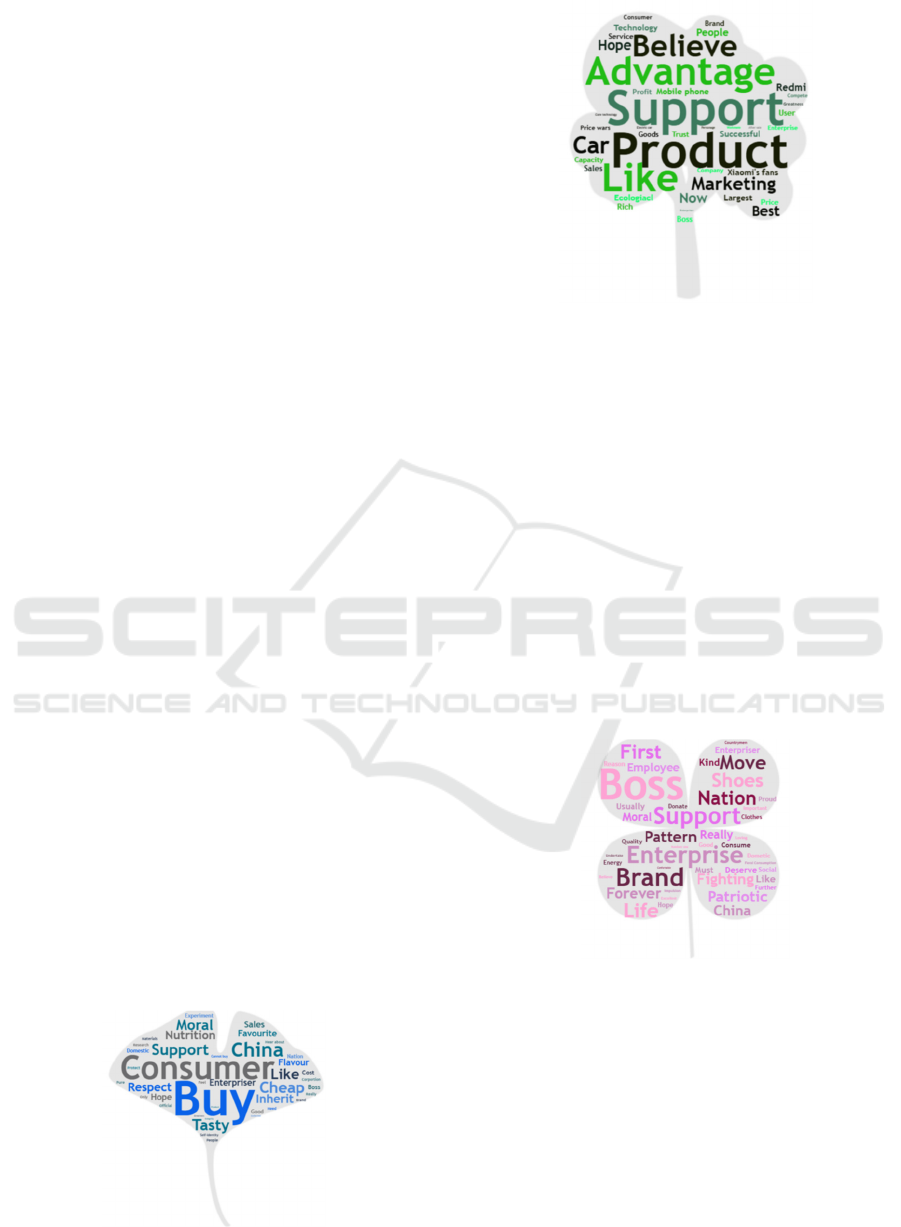
The word cloud diagram shows how well
commentators' corporate culture and connotation fit
with themselves during the comment process. As
shown in Fig. 1 and Fig. 2, the words "Nutrition",
"Moral", "Self-identity", "Ecological", "Best", and
"Xiaomi's fans" in the diagrams represent consumer
values that resonate with the business. These words
verify that when the CSR of enterprises reflects the
values recognized by consumers, consumers are more
likely to resonate with the brand. Whether enterprises
can resonate with consumers when performing CSR
determines the effectiveness of CSR and further
promotes the generation of purchase intention.
Figure. 1. Enterprise A word cloud results.
Figure. 2. Enterprise B word cloud results.
Second, corporate Positive Energy Content. The
results show that the commentators show patriotism
and concern for the social morality of enterprises in
the process of commenting. As shown in Fig. 1 and
Fig. 3, the words countrymen, nation, patriotic, China,
Proud, and Domestic in the diagram illustrate that
patriotic feelings increase the national consciousness
of the commentators. Therefore, expressing
patriotism is the key point to enhance consumers'
purchase intention. Commentators want to support
domestic products and help enterprises develop
through purchase. Like the word "Moral", "Social" in
Fig. 3 also expresses the commentator's concern
about social morality, which can enhance the
consumption amount of enterprises with a higher
sense of social morality.
Figure. 3. Enterprise C word cloud results.
Third, corporate transparency and integrity.
Reviewers pay attention to the transparency and
integrity of enterprises, which is an important
manifestation of whether reviewers have become
consumers. In Fig. 2, "Empressement" demonstrates
the sincerity of the B corporation in its CSR activities.
It reflects that enterprise B is not only making
external commitments for marketing but also taking
actions to consider consumers. This kind of honest
practice helps to enhance the transparency of
The Impact of Corporate Social Responsibility Disclosure on Social Media on Consumer Purchase Intentions
607
enterprises, increase the trust of consumers, and
naturally increase the willingness to buy. As shown
in Fig. 3, Donate, Kind, Enterpriser reflects the
reviewers' recognition of the integrity of Enterprise C,
and shows the true entrepreneurial spirit of Enterprise
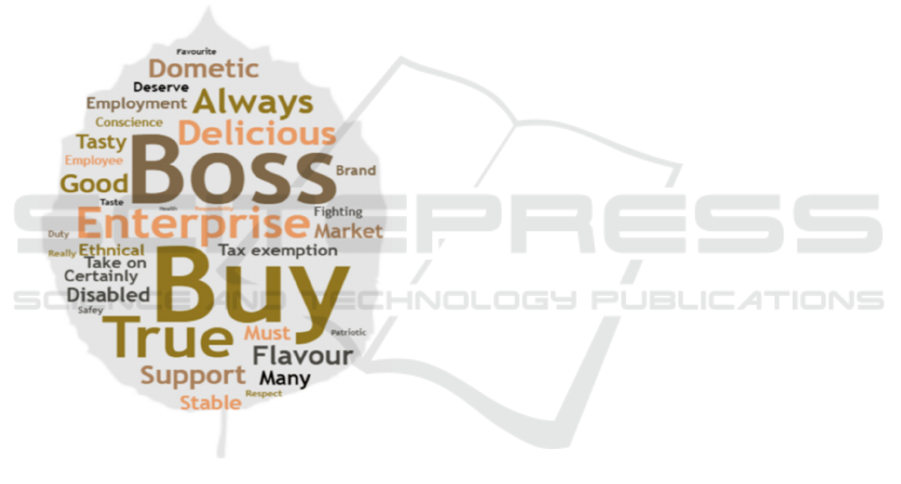
C, with transparent and true behavior. As shown in
Fig. 4, the words "Conscience", "Really", and
"Stable" represent reviewers looking for authenticity
in the products of D Enterprises. Enterprises show
transparent and honest behavior in CSR videos,
which can enhance consumers' trust in the brand and
enhance their purchase intention. 90. 5%, 90% and 82.
5% of the respondents in the questionnaire agreed
with patriotism, respectively, and the resonance of
reviewers with corporate values and the transparency
and integrity of the company were the key points for
reviewers to increase their purchase intentions.
Figure. 4. Enterprise D word cloud results.
3 SUGGESTION
3.1 Suggestions to Enterprises
3.1.1 Implement CSR in Multi-Angle and
Multi-Faceted
Corporations not only need to focus on responsibility
to consumers but are also concerned about
environmental protection and responsibility to
suppliers and employees. The entrepreneur or
manager needs to understand how the firm can make
the customer better off, while at the same time
offering an attractive value proposition to employees,
suppliers, communities, and financiers (Freeman &
Velamuri, 2023). It is important to note that it is not
possible to sustain making customers better off,
without at the same time making the other
stakeholders better off (Freeman & Velamuri, 2023).
Based on the above analysis, strong CSR will enhance
consumers' purchase intention. Therefore, enterprises
should pay attention to disclosing more issues related
to CSR in this aspect. For example, currently, there
will be a greater focus on sustainable development
issues. The Sustainable Development Goals (SDGs)
were launched in 2015 by the United Nations as a
global initiative aimed at eradicating poverty,
safeguarding the environment, and promoting peace
and prosperity for all by 2030, as outlined in the
United Nations 2030 agenda (Ghosh & Chakravarty,
2024). If society wants to achieve sustainable
development, enterprises should recognize that
multiple types and disclosures are necessary. Many
kinds of videos can help consumers learn about these
corporations and enhance purchase intention further.
3.1.2 Balance the Relationship Between the
Acquisition of Profits and CSR
To earn a lot of profits, enterprises may put too many
videos of implementation responsibility, which may
become a problem. CSR spending positively affects a
firm's revenue growth and profitability (Okafor et al.,
2021). Corporations can closely align CSR activities
with their main business objectives, rather than taking
CSR as an additional cost, and design the appropriate
amount of CSR videos according to the current
corporate strategy, rather than taking profit as the
purpose of CSR. CSR will promote market share
gains while gaining profits.
3.1.3 Make Sure CSR Sustainability and
Transparency
Corporations should take the CSR view as a long-
term view to ensure CSR sustainability and
transparency. CSR is a voluntary practice (Macro-
Lajara et al., 2022). Business leaders and
policymakers should promote and incentivize the
adoption of specific corporate governance
mechanisms to help firms better achieve CSR goals
(Derchi et al., 2021). Based on the above analysis,
reviewers focus on the transparency and integrity of
enterprises as the key points to generate purchase
intention for enterprises. Therefore, enterprises
should continue to disclose such behaviors, maintain
continuous interaction with consumers, and make
CSR content more transparent, expressing concrete
APMM 2025 - International Conference on Applied Psychology and Marketing Management
608

and real content that can affect consumers in videos.
The sustainability of CSR will contribute to
enhancing consumers' loyalty.
3.2 Suggestions to Consumers
First, consumers need to follow and support CSR
when they buy goods. Based on the questionnaire
above, buyers pay attention to social responsibility
and take it into the purchase decision as an important
factor to measure when they buy a product after
watching the video. When purchasing products,
consumers can give priority to the enterprises donate
the poor areas and have environmental protection
products. Moreover, these enterprises can be selected
to support CSR for a long time in subsequent
purchases. This will help more companies to
emphasize CSR and improve innovative development.
Second, consumers should be aware of the over-
marketing role of enterprises in terms of corporate
social responsibility. Consumers should particular
attention to the fact that some businesses are
exaggerating the responsibility of their
implementation and launching a large number of
marketing on social media, creating a false
impression of strong CSR and causing customers'
purchase intention. Let the potential crisis in the early
stage get an early warning; let the trend of public
opinion get insight; and make the response of
enterprises more scientific and accurate (Shao et al.,
2022). Consumers should also Do adequate market
research and product understanding before shopping
to avoid impulse buying due to over-marketing by
enterprises.
4 CONCLUSION
In summary, this study found that the expression of
corporate social responsibility has a positive effect on
consumers' purchase intention and corporate culture
and connotation. Corporate positive energy content,
corporate transparency, and integrity are the key
points of social responsibility disclosure. The
findings have advantages to make the companies
better use of social media for publicity and improve
social progress. It also helps enterprises pay more
attention to CSR and lead other enterprises to follow
suit, promoting sustainable development together.
More suggestions are to be given to the corporations
and consumers separately based on the findings of the
research. It makes CSR go deeper into the hearts of
businesses and consumers. Despite the contributions
of this study, several limitations need to be
acknowledged. One limitation is research data is
relatively simple. This paper has selected some
representative companies to analyze, but the current
types of companies are diverse. Future research
should further refine the types of firms. Moreover,
researchers should further explore the impact of the
type of video disclosure CSR on consumers' purchase
intention, and whether the purchase intention is
finally transformed into behavior. In addition,
exploring different social media applications and
different cultures may bring more in-depth insights
into CSR.
REFERENCES
A. B. Carroll, Corporate social responsibility: Perspectives
on the CSR construct's development and future. Bus.
Soc. 60(6), 1258-1278 (2021)
A. Okafor, B. N. Adeleye, & M. Adusei, Corporate social
responsibility and financial performance: Evidence
from US tech firms. J. Clean. Prod. 292, 126078 (2021)
B. Marco-Lajara, P. Zaragoza-Sáez, J. M. Falcó, & L. A.
Millan-Tudela, Corporate social responsibility: A
narrative literature review. In Frameworks for
Sustainable Development Goals to Manage Economic,
Social, and Environmental Shocks and Disasters 16-34
(2022)
D. K. Faeq, P. F. Saleh, H. Hiwa, A. Ismael, & M. Nawzad,
Purchase intention in the scope firm of corporate social
responsibility. Int. J. Res. Bus. Soc. Sci. 11(6), 43-55
(2022)
F. Ali, & M. Sohail, Effects of corporate social
responsibility on consumer purchase intention. Pak. J.
Humanit. Soc. Sci. 6(4), 477-491 (2018)
G. B. Derchi, L. Zoni, & A. Dossi, Corporate social
responsibility performance, incentives, and learning
effects. J. Bus. Ethics 173(3), 617-641 (2021)
J. Shao, T. Zhang, H. Wang, & Y. Tian, Corporate social
responsibility and consumer emotional marketing in the
big data era: A mini literature review. Front. Psychol.
13, 919601 (2022)
M. Wang, To build a harmonious society, corporate social
responsibility must be strengthened. Seeking Truth (23),
17-19 (2005)
P. Ghosh, & T. Chakravarty, Sustainable Development
Goals: Challenges, Opportunities, and the Way
Forward. Sustainability: Science, Policy, and Practice
in India: Challenges and Opportunities, 235-241 (2024)
R. E. Freeman, & S. R. Velamuri, A new approach to CSR:
Company stakeholder responsibility. In R. E. Freeman's
Selected Works on Stakeholder Theory and Business
Ethics. Cham: Springer International Publishing 251-
264 (2023)
Y. Rhou, & M. Singal, A review of the business case for
CSR in the hospitality industry. Int. J. Hosp. Manag. 84,
102330 (2020)
The Impact of Corporate Social Responsibility Disclosure on Social Media on Consumer Purchase Intentions
609
