
A Study of the Impact of Emotional Surrogates Provided by
Companion AI on Real-Life Social Initiative of Active Users
Dingjing Lu
Journalism, Communication University of China, 211172 Jiangsu, China
Keywords: Companion AI, Emotional Surrogates, Social Initiative, Human-Computer Interaction.
Abstract: With the rapid development of artificial intelligence technology, AI technology has gradually penetrated
people's daily lives. Companion AI products, such as Replika and Character AI, offer users emotional support
and companionship by mimicking natural language communication and establishing a simulated emotional
connection with users through dialogues and other forms. User groups that frequently use the product and
have a high level of interaction with it within a certain period usually reflect a higher demand for AI
companion products and may become dependent on AI companion products in terms of emotion, social
interaction, or entertainment, which in turn affects the willingness and behavioral ability of such users to
initiate, participate in, or maintain interpersonal interactions in social interactions. This study uses
questionnaires and data collection methods to analyze the impact of the emotional surrogate provided by
companion AI on the real-world social initiative of active users. It is found that users’ relationships with AI
companion intelligent agents will impact their social initiative, and AI companion products will indirectly
stimulate some users’ social activity on social media platforms.
1 INTRODUCTION
Technological advances in Large Language Models
(LLMs) have facilitated the rise of Role Playing
Language Agents (RPLAs), which have vivid role-
playing properties, thus catalyzing several AI
applications, of which companionable AI products
are one of them (Chen et al., 2024). This study looks
at how the emotional surrogates provided by
companion AI products (e.g., Replika, Character AI,
etc.) affect the real-world social initiative of active
users in the context of rapidly evolving technology in
AI. This research is highly relevant in understanding
the potential impact of AI products on social
behaviors, especially at the intersection of
psychology, sociology, and information science. It
can provide a theoretical basis and practical guidance
for the optimization and design of AI products
(Strohmann et al., 2023). This study explores the role
of companion AI on users’ emotional compensation
and how it affects users’ social interactions in reality
in two specific aspects, focusing on analyzing how
companion AI products satisfy users' emotional needs
and their impact on social initiative. Through the
analysis of related literature, it is concluded that users
turn to AI companion tools to seek emotional
compensation due to the fear that sharing negative
emotions in real life will affect others' moods, the
inability to have 24/7 real-time interactions with real-
life friends and relatives, the difficulty of being
understood by others in real life, and the fear that
sharing secrets with others in real life will be leaked.
In the existing research on human-robot
emotional relationships, some scholars have
constructed a theoretical framework that covers the
types of relationships, formation mechanisms, and
consequences, pointing out that intelligent social
robots have important potential for emotional
companionship and emotional comfort (Liu et al.,
2024). Some scholars' findings indicate that
individuals with higher loneliness are more likely to
recommend AI partners with strong social presence,
supporting the theoretical hypothesis of “emotional
compensation” (Merrill et al., 2022). Some scholars
have explored how virtual characters and intelligent
assistants can help alleviate users' loneliness and
anxiety and enhance their emotional satisfaction
(Dang & Liu, 2023). However, there are relatively
few studies on the impact of companion AI products
on users' social initiative and their social interaction
behaviors. Most of the existing literature on human-
computer interaction in AI is limited to samples from
specific groups, such as designing dialogue
488
Lu, D.
A Study of the Impact of Emotional Surrogates Provided by Companion AI on Real-Life Social Initiative of Active Users.
DOI: 10.5220/0014136900004942
Paper published under CC license (CC BY-NC-ND 4.0)
In Proceedings of the 2nd International Conference on Applied Psychology and Marketing Management (APMM 2025), pages 488-493
ISBN: 978-989-758-791-7
Proceedings Copyright © 2026 by SCITEPRESS – Science and Technology Publications, Lda.

companions for the elderly to reduce their loneliness
and social isolation (Alessa & Al-Khalifa, 2023). This
study attempts to fill the research gap on the impact
of human-computer emotional relationships on real-
world social interaction by exploring the specific
impact of emotional compensatory mechanisms on
users' social initiative behavior.
The companion AI products referenced in this
study are Replika, Character.AI, Talkie, Glow,
Dream Island, after reviewing relevant information
and literature on the functions and features of the
above companion AI products to have a further
understanding of the basis of the use of Python in the
REDnote platform to carry out the keyword crawling,
the keywords captured are AI companion, Replika,
Character.AI, Talkie, Glow, Dream Island, for each
keyword to select the top 50 hot posts to crawl,
according to the results of the captured text to
generate a word cloud map, trying to discover the user
characteristics of these companion AI products. In
addition, the questionnaire survey method is used and
the sample data obtained is analyzed, and the
advantage of this method is that it is highly flexible
and operable, capable of designing structured
questions for the research topic, and facilitating the
systematic collection and analysis of a large amount
of sample data. At the same time, the questionnaire
can be filled out anonymously, reducing the social
expectation effect, ensuring the objectivity and
accuracy of the data, and providing a reliable basis for
the subsequent statistical analysis. The object of the
questionnaire survey is the active users of the
companion AI, and to locate this target group, the
questionnaire is selected to be distributed in the
companion AI product-related topics and online
communities on the REDnote platform; the ultimate
research goal of this study is to explore the impact of
the companion AI The ultimate goal of this study is
to explore the impact of the emotional compensation
provided by companion AI on the real social initiative
of active users and to provide reference for theoretical
research and practical application in related fields.
2 METHOD
2.1 Questionnaire
This study adopts the questionnaire survey method as
the main research method, aiming to explore the
impact of the emotional surrogate provided by
companion AI on the real social initiative of active
users. The questionnaire survey method can reflect
users' behavioral patterns and psychological states
through the collection and analysis of quantitative
data, and it is especially suitable for the collection and
analysis of large-scale samples, to improve the
representativeness and universality of the results. In
this study, the questionnaire can not only effectively
assess the degree of satisfaction of AI companion
products on users' emotional needs, but also explore
in depth the specific impact of these products in terms
of social behavior, emotional surrogacy, and real-life
social initiative.
The research object of this study is users who
actively use companion AI products, and the samples
come from groups of different ages, genders, and
regions to ensure the diversity and representativeness
of the samples. The questionnaire design is based on
the frequency and duration of users' use of AI
companion products, the satisfaction of their
emotional needs, and their impact on social behavior.
The questions are set around the following aspects:
the basic information of the users (gender, age,
occupation, etc.); the frequency and duration of using
AI companion products and the type of products most
often used by the users; the changes in the social
behavior of the users before and after the use of the
AI companion products, especially the changes in the
frequency of offline social interaction and online
social interaction AI companion products ‘support for
the users’ emotional needs and their impact on the
real-life social initiative. The impact of AI companion
products on users' emotional needs and real-life social
initiatives.
In this study, data were collected through an
online questionnaire, about 213 questionnaires were
distributed, and 199 questionnaires were finally
recovered, with a recovery rate of 93.4%. To ensure
the validity of the questionnaire, a logical jump was
set for the first question of the questionnaire, ‘Have
you ever used AI accompaniment products (e.g.
Replika, Character.AI, etc.)’; so that only respondents
who chose the ‘Yes’ option could continue with the
questionnaire. Respondents who chose the ‘Yes’
option could only continue to answer the
questionnaire. The valid questionnaires have been
strictly screened to ensure data quality. The results of
this survey will be used to analyze the impact of
companion AI products on the real-world social
initiatives of active users, especially the role of
emotional compensation.
Among the valid samples, male participants
accounted for 49.75 percent and female participants
accounted for 50.25 percent, with a relatively
balanced overall gender ratio. The 18-25 age group
has the highest proportion, at 65.33 percent, and the
proportion of respondents with bachelor's degrees or
A Study of the Impact of Emotional Surrogates Provided by Companion AI on Real-Life Social Initiative of Active Users
489
above is higher, at 41.71 percent. This shows that the
respondents are mainly young and have a higher
overall education level. The proportion of
interviewees who use AI companion products every
day is 16.08%, and the proportion of those who use
them more than three times a week is 29.65%. The
proportion of users who use AI companion products
for a single time is concentrated in the range of 10-90
minutes, and the proportion of those who use AI
companion products for a single time for less than 10
minutes and more than 90 minutes is relatively low,
which is 10.05% and 7.54% respectively. This
indicates that respondents use AI companion products
more frequently and for a longer single time, proving
that the sample is consistent with the characteristics
of active users of companion AI products.
The results of the questionnaire survey show that
the emotional vicarious effects of the AI companion
tool have different degrees of influence on users'
social interactions, emotional regulation, and social
initiative, and this study will further expand and
deepen on this basis to explore the specific effects on
real social behaviors.
2.2 Data Collection
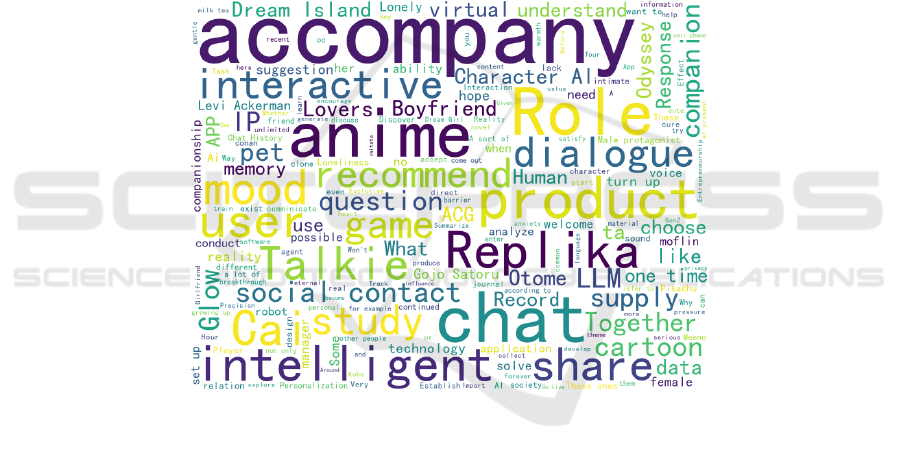
Use Python to grab the data of the top 50 hot posts
under the keywords AI companionship, Talkie,
Dream Island, and Glow on the REDnote platform,
and perform word frequency statistics on them
respectively. After the word frequency statistics of 50
hot posts under the keyword AI companionship, the
word cloud map in Figure 1 is generated, in which the
words with higher frequency are companionship,
emotion, chat, and so on.
Alt Text:A word cloud generated from the top 50 posts on REDnote platform related to the keyword "AI companionship."
The cloud highlights the most frequent terms such as "accompany," "intelligent," and "chat," illustrating key topics in the
discussions surrounding AI companionship and user experiences.
Figure. 1. Word cloud.
The same steps were used to continue the word
frequency analysis of the hot posts under the
keywords Talkie, Dream Island, and Glow. It is found
that Talkie appears as a high-frequency word in the
word clouds related to Glow and Dream Island. In
addition, in the hot posts related to these four
keywords, ‘recommend cubs’ appears as a high-
frequency word, and after analyzing the details of the
related posts, it is found that users of these four
products call their original characters ‘cubs', and
some of the users choose to call their own original
‘cubs; and some of them choose to call their own
original ‘cubs’. Some users will choose to make their
original ‘cubs’ public on social media platforms,
allowing ‘cubs’ to interpret the plot with other users,
and this behavior is ‘recommend cubs’.
3 RESULTS
In this study, data from 199 valid samples were
analyzed through questionnaires using the statistical
analysis software SPSS 12.0.
Result 1 The relationship between users and AI
companion intelligent agents will impact users' social
initiative.
APMM 2025 - International Conference on Applied Psychology and Marketing Management
490

The questionnaire data shows that 56.78% of the
respondents are satisfied with the emotional support
provided by the AI companion products, of which
69.85% choose to anthropomorphize the AI
companion products, and 30.15% say they will not
anthropomorphize the AI companion products.
56.28% of the users who anthropomorphized AI
companion products said that they had developed a
dependent emotion on AI companion products, and
they tended to regard AI products as existences with
personality traits, and preferred AI companion
intelligent agents to accompany them as
psychological consultants, virtual story characters,
and game companions, and at the same time, they
tended to learn and explore role-playing together with
AI intelligent agents or to discuss daily life and
emotional problems.
Table 1 was produced by importing the pertinent
data into SPSS for correlation analysis to investigate
the connection between the user's social initiative
change and the relationship between the user and the
AI companion intelligent agents.
From Table 1, it can be seen that there is a
significant positive correlation between the
relationship between the user and the AI companion
intelligent agents and the change in the user's social
initiative.
Table 1. Correlation analysis between user-AI companion
relationship and changes in user social initiative.
User-AI
Companion
Relationship
Changes
in User
Social
Initiative
User-AI
Companion
Relationship
Pearson
correlation
coefficient
1 .792**
Changes in User
Social Initiative
Pearson
correlation
coefficient
.792** 1
Note: ** indicates that the correlation is highly
significant at the 0.01 level (two-tailed); * indicates
that the correlation is significant at the 0.05 level
(two-tailed), with positive values representing a
positive correlation and negative values representing
a negative correlation.
Result 2: AI companion products will indirectly
stimulate some users' social activity on social media
platforms.
In the process of using AI companion products,
some users will generate online social behaviors such
as exchanging and sharing experiences with other
players on social media platforms, joining
communities about AI companion products on social
media platforms, and communicating with fellow
players. To explore the connection between the
degree of users’ social activity involving AI
companions in social media platforms and the change
in users’ social initiative, the relevant data were
imported into SPSS for correlation analysis, and
Table 2 was obtained.
Table 2. Correlation analysis between user's AI
companionship activity on social media and changes in user
social initiative.
AI
companionship
activity on
social media
Changes
in User
Social
Initiative
AI companionship
activity on social
media
Pearson
correlation
coefficient
1 .759**
Changes in User
Social Initiative
Pearson
correlation
coefficient
.759** 1
Note: ** indicates that the correlation is highly
significant at the 0.01 level (two-tailed); * indicates
that the correlation is significant at the 0.05 level
(two-tailed), with positive values representing a
positive correlation and negative values representing
a negative correlation.
From Table 2, it can be seen that there is a
significant positive correlation between the degree of
users’ social activeness involving AI companionship
in social media platforms and the change in users’
social initiative.
4 DISCUSSION
The relationship between users and AI companion
intelligence will have an impact on users' social
initiative, users who choose to anthropomorphize AI
companion products want AI intelligence to
accompany them in the form of existence with
personality traits, for example, providing emotional
companionship to users as a psychological counselor,
virtual storytelling character, or game companion.
Users of companion chatbots report that interactions
with chatbots satisfy users' social needs and provide a
safe and secure interaction experience, and that
chatbots may undermine or replace human
interactions (Guingrich & Graziano, 2023). In terms
of psychotherapy, AI accompaniment is particularly
suitable for individuals who are lonely or socially
isolated, and AI products such as psychological
counselors accompany with provide new digital tools
A Study of the Impact of Emotional Surrogates Provided by Companion AI on Real-Life Social Initiative of Active Users
491

for mental health interventions (De Freitas et al.,
2024). According to the data in Conclusion, 1, more
than half of the users who anthropomorphized the AI
companion intelligence became dependent on the AI
companion intelligence, which is likely to lead to a
compression of time and energy to cope with real-life
social activities in the short term for these users, thus
reducing their real-life social initiative.
Emotional surrogates provided by companion AI
to promote real-life social initiatives of active users
may be found in three AI companion products,
namely Talkie, Glow, and Dream Island. In general
video games, the character settings of the game
characters are decided by the game development
team, in which the users have less autonomous
creativity (Pretty et al., 2024). However, in these
three AI companion products users can freely create
virtual characters according to their wishes. After the
user inputs the character's personality characteristics,
appearance features, growth background, and other
key information, the AI companion tool based on the
LLMs model can capture the character's personality
to a certain extent and bring the character to life. One
study compared the personality shown by the chatbot
with the expected personality of the character by
humans and calculated a consistency ratio of 82.8%
(Wang et al., 2023). Such a high degree of
reproduction stimulates users to some extent to create
characters on their own and make these characters
public on social media, allowing other users to
interpret the plot with them, forming a co-creation
mechanism. In addition, in-depth users will share tips
for extending the plot on social media, and even join
communities about AI companion products on social
media platforms to communicate with fellow users,
and these communication behaviors belong to the
manifestation of the increase in users' online social
initiative.
5 CONCLUSION
The findings of this study are that there is a significant
positive correlation between both the users’
relationship with the AI companion intelligence and
the users’ level of social activity involving AI
companions in social media platforms and the
changes in the users' social initiative. From this, two
further research conclusions are drawn, most users
who anthropomorphize AI companion intelligence
become dependent on AI companion intelligent
agents, which in the short term leads to the
compression of these users' time and energy to cope
with real social activities, thus reducing their real
social initiative; the characteristic gameplay of the
companion AI product stimulates the users to actively
communicate with their peers in social media
platforms, thus indirectly promoting the users' social
initiative. This study has the limitation of insufficient
sample diversity; the questionnaire respondents in
this study mainly originated from the REDnote
platform, which differs from the characteristics of
user groups on other social media platforms. This
may limit the applicability of the findings to a wider
population. In addition, with a high proportion of
young people in the sample, the findings may not
adequately reflect the usage and impact of other age
groups. In addition, it is not possible to provide
insight into the long-term impact of companion AI on
users' real-life social initiatives. Short-term
dependence may transform into adaptive adjustment
or further dependence in the long term, which
requires a combination of longitudinal studies for
more comprehensive conclusions.
This study expands the understanding of the social
effects of AI companion products, provides a new
perspective on the theoretical research and practical
application of human-computer interaction, and
points out the direction for future research in related
fields. Future research should focus more on the
following directions for in-depth investigation:
through long-term tracking of user behaviors,
revealing the dynamic changes and potential
mechanisms of the impact of AI accompaniment
products on users' social initiative. In-depth analysis
of the possible negative impacts of AI
accompaniment, such as the risk of social isolation
caused by users’ reliance on emotional surrogates,
and how to design products to enhance users’ social
competence.
REFERENCES
A. Alessa, H. Al-Khalifa, Towards designing a ChatGPT
conversational companion for elderly people. Proc.
16th Int. Conf. Pervasive Technol. Relat. Assist.
Environ. 667-674 (2023)
E. J. Pretty, H. M. Fayek, F. Zambetta, A case for
personalized non-player character companion design.
Int. J. Hum.-Comput. Interact. 40(12), 3051-3070
(2024)
J. Chen, X. Wang, R. Xu, et al., From persona to
personalization: A survey on role-playing language
agents. arXiv preprint arXiv 2404, 18231 (2024)
J. Dang, L. Liu, Do lonely people seek robot
companionship? A comparative examination of the
loneliness–robot anthropomorphism link in the United
APMM 2025 - International Conference on Applied Psychology and Marketing Management
492

States and China. Comput. Hum. Behav. 141, 107637
(2023)
J. De Freitas, A. K. Uğuralp, Z. Oğuz‐Uğuralp, et al.,
Chatbots and mental health: Insights into the safety of
generative AI. J. Consum. Psychol. 34(3), 481-491
(2024)
K. Merrill Jr, J. Kim, C. Collins, AI companions for lonely
individuals and the role of social presence. Commun.
Res. Rep. 39(2), 93-103 (2022)
R. E. Guingrich, M. S. A. Graziano, Chatbots as social
companions: How people perceive consciousness,
human likeness, and social health benefits in machines.
arXiv preprint arXiv 2311, 10599 (2023)
T. Strohmann, D. Siemon, B. Khosrawi-Rad, et al., Toward
a design theory for virtual companionship. Hum.
Comput. Interact. 38(3-4), 194-234 (2023)
W. Liu, Y. Dong, C. Li, Robots are not "cold": A review of
research on consumer emotional relationships with
intelligent social robots. For. Econ. Manag. 46(06), 98-
111 (2024)
X. Wang, Y. Fei, Z. Leng, et al., Does role-playing chatbots
capture the character personalities? Assessing
personality traits for role-playing chatbots. arXiv
preprint arXiv 2310, 17976 (2023)
A Study of the Impact of Emotional Surrogates Provided by Companion AI on Real-Life Social Initiative of Active Users
493
