
A Review of the Current State of Rural Tourism in the Age of Social
Media and Exploration of Optimization Paths: A Case Study of
Jizhou District, Tianjin
Zishan Liu
School of Culture and Communication, Institute of Disaster Prevention, 065201 Hebei, China
Keywords: Smart Farm, Rural Tourism, Rural Revitalization.
Abstract: With the acceleration of urbanization and city rhythm, it makes most people feel stressed and exhausted. More
and more people choose to return to the countryside to experience the natural landscape, traditional farming
culture, local flavor and slow-paced lifestyle, driving the demand for rural tourism The research theme focuses
on the current situation of rural tourism in Jizhou District, Tianjin, using the rural tourism videos in social
media in Jizhou District, Tianjin, as a specific object of investigation. In terms of research methodology,
various research methods such as PEST analysis and Textual Analysis were used to deeply analyze the
development status, basic conditions and social media marketing status of rural tourism in Jizhou District.
The results of the study show that rural tourism in Jizhou District has made certain achievements, but there
are some shortcomings in the promotion of social media and its related areas. To achieve sustainable
development, it is necessary to pay attention to the power of social media and hit its selling points and
characteristics, and this study mainly affects the development strategy and path selection of rural tourism.
1 INTRODUCTION
Jizhou District has responded positively to the call for
the Full text of the report to the 20th National
Congress of the Communist Party of China to
“Comprehensively Promote the Revitalization of the
Countryside” and has made remarkable progress in
the four areas of politics, economy, society, and
technology. Politically, five villages in Jizhou District
were successfully selected to the national list of key
villages for rural tourism, showing the positive results
of rural revitalization. Economically, the projected
GDP growth is solid, and tourism reception and
comprehensive income have risen sharply, showing
the strong pulling effect of rural tourism on the
economy. Socially, the strategy of cultural and
tourism integration has been deepened, with
innovative projects broadening the breadth and depth
of cultural tourism, while a number of sporting events
and cultural festivals have been successfully
organized, greatly enhancing the region's visibility
and attractiveness. Technologically, Jizhou District
has actively embraced digital services and built a
smart tourism public service platform to enhance the
exposure and attractiveness of rural tourism, while
increasing investment in infrastructure to
significantly improve the accessibility and comfort of
rural tourism.
This study focuses on the development status and
challenges of rural tourism in Jizhou District, Tianjin
in the era of social media, which is of great
significance in promoting the transformation and
upgrading of the rural tourism industry in Jizhou
District, Tianjin, enhancing the attractiveness and
competitiveness of rural tourism, and realizing
sustainable development. It also provides favorable
ideas and methods for solving farmers' problems and
promoting rural revitalization strategy. This study
focuses on the current situation of rural tourism in
Jizhou District, Tianjin, specifically in terms of the
current situation, basic conditions, social media
publicity status and user satisfaction. In this process,
the literature analysis method was used to find and
read relevant information and literature, and the
advantage of this method is that it can well analyze
the status quo and effective strategies of rural tourism,
which provides a strong support for the smooth
progress of the research. At the same time, the PEST
analysis method was combined to grasp the external
environment from the four aspects of politics,
economy, society and technology in a macro way, and
to grasp the development prospect as a whole;
Liu, Z.
A Review of the Current State of Rural Tourism in the Age of Social Media and Exploration of Optimization Paths: A Case Study of Jizhou District, Tianjin.
DOI: 10.5220/0014123600004942
Paper published under CC license (CC BY-NC-ND 4.0)
In Proceedings of the 2nd International Conference on Applied Psychology and Marketing Management (APMM 2025), pages 447-453
ISBN: 978-989-758-791-7
Proceedings Copyright © 2026 by SCITEPRESS – Science and Technology Publications, Lda.
447

moreover, the text analysis method was used to
collect video comments on social media platforms
about the rural tourism in Jizhou District of Tianjin
City, so as to dig deeper into the direct feedback of
tourists, which is conducive to the conduct of the
study. The ultimate research goal of this study is to
promote the prosperous development of rural tourism
industry in Jizhou District, Tianjin, and then lead the
economic prosperity of the countryside and its
surrounding areas. In order to reach this goal, an in-
depth investigation and analysis is carried out to put
forward effective solution strategies and suggestions.
2 LITERATURE REVIEW
Through China Knowledge Network database,
Google Scholar and other academic platforms, search
for “rural tourism”, “social media”, “leisure farm”
and other keywords to search, collect and review the
rural tourism and rural lodging related literature and
materials, and analyze the latest theoretical research
at home and abroad to summarize some reference
points and conclusions. Rural lodging related
literature, and the latest theoretical research at home
and abroad to carry out an in-depth understanding of
the analysis, so as to summarize some of the reference
significance of the research point of view and
conclusions.
Cawley and Gillmor, in their article 'Integrated
Rural Tourism: Concepts and Practice', provide an in-
depth study of the concept and practice of integrated
rural tourism. They make important contributions to
the integration of rural tourism resources, stakeholder
roles, and the promotion of the effectiveness of rural
tourism as a rural development strategy. However, the
article does not cover much in terms of the current
situation, challenges and solutions of rural tourism for
specific geographic areas. In addition, although the
article emphasizes the importance of network
cooperation and embedded development to achieve
sustainability of rural tourism. This article will start
from the current situation of rural tourism in Jizhou
District of Tianjin, analyze in-depth the challenges it
faces, and explore how to supplement the existing
research gaps by means of resource integration and
network cooperation, so as to provide practical
guidance for realizing the sustainable development of
rural tourism in this area (Cawley & Gillmor, 2008).
Yeajin Joo, Hwayoon Seok, and Yoonjae Nam in
the article The Moderating Effect of Social Media Use
on Sustainable Rural Tourism: A Theory of Planned
Behavior Model. The article examines the important
factors affecting the potential behavior of rural
tourism tourists and the impact of social media use on
rural tourism, and contributes to the analysis of the
behavioral decision-making process of rural tourism
tourists using Theory of Planned Behavior (TPB)
model. However, the article does not cover much
about the specific strategies for the sustainable
development of rural tourism and the mechanism of
social media's role in rural tourism. This paper will
start from the strategy of sustainable development of
rural tourism and the specific mechanism of social
media in promoting the development of rural tourism
to conduct in-depth research to supplement the
existing research gaps (Joo et al., 2020).
Laxmita et al. in the article Sustainable Rural
Tourism Development in the Era of Social Media:
Shape Identities and Discourse in Digital Settings
examines how sustainable rural tourism development
in the The article 'Sustainable rural tourism
development in the era of social media: shape
identities and discourse in digital settings' examines
how sustainable rural tourism development in the era
of social media shapes identities and discourse in
digital settings, and contributes to this study in terms
of exploring the impact of social media and digital
settings on rural tourism development. However, the
article does not cover much on the impact of social
media use on the specific behavioral decision-making
process of rural tourism tourists. This paper will
explore how sustainable rural tourism can be
promoted in the context of social media and digital
environments, complementing existing research gaps
and providing useful insights for rural tourism
destination marketers and the industry as a whole
(Laxmita et al., 2021).
In Development Paths and Strategies of
Literature and Tourism Integration in the Age of
Social Media to Help Rural Revitalization in
Xinjiang, Hang Jie examines how the integration of
literature and tourism in the age of social media can
promote rural revitalization in Xinjiang. He analyzes
the characteristics and roles of culture and tourism
integration and describes the current development
status. However, the problems in communication
channels, network facilities construction,
professional talents and other aspects are not covered
much, and the content study is not comprehensive
enough. This paper will start from these aspects and
conduct in-depth research to supplement the existing
research gaps (Hang, 2024).
Huang Zhaoye in the Ctrip Jiangxi Holiday Farm
rural tourism marketing strategy optimisation
research in this article studied the differences
between domestic and foreign rural tourism and rural
lodging, for the high-end rural lodging - Ctrip Jiangxi
APMM 2025 - International Conference on Applied Psychology and Marketing Management
448
Holiday Farm marketing the status quo analysis, in
the tourism accommodation market has contributed to
this study, but in the ordinary townships Exploring
the content of the analysis is not much involved, this
paper will start from the ordinary countryside aspect,
the current situation of the farm research, to
supplement the existing research gaps (Huang, 2023).
3 RESEARCH METHODOLOGY
PEST analysis is a method to review the external
macro-environment, which mainly involves the four
aspects of Politics, Economics, Society and
Technology, and is also used as the basis for strategic
decision-making. Its advantage is that PEST can
stand in the macro perspective of a comprehensive
and systematic analysis of the external environment,
in a variety of perspectives, from the change of the
factors on the study of the development potential of
things, the overall grasp of the development
prospects. It is especially suitable for the
development and the field where the research is not
comprehensive and thorough. The disadvantage is
that: the changing factors are large, and there are
many factors to be considered for decision-making.
The method of Textual Analysis is to analyse the
contents of web travelogues and reviews and draw the
corresponding conclusions. Given the openness,
diversity and freedom of the website, tourists are able
to express their own travelling experience and
experience etc. genuinely. In this paper, we collect
videos of rural tourism in Jizhou District of Tianjin
through descent collector, Jisooker, and Dadoduo
Shake data website, and analyse them with the help
of various functions of micro-word cloud software,
which is mainly involved in data pre-processing,
word division data processing, word frequency data
analysis, sentiment analysis, etc., and finally obtain
the image perception of tourists on rural tourism in
Jizhou District.
4 SOCIAL MEDIA MARKETING
FOR RURAL TOURISM IN
JIZHOU DISTRICT
Social media are tools and platforms that people use
to share opinions, insights, experiences and views
with each other, which at this stage mainly include
apps such as Jitterbug, Weibo, WeChat, blogs,
Xiaohongshu, etc. These platforms allow users to
spontaneously create, share and disseminate
information, forming a huge social network. Utilising
the interactive convenience provided by social media,
companies and brands can also receive real-time
feedback and suggestions from consumers and fans
about their attitudes and opinions on specific products
or brands (Zhuang, 2023).
4.1 Textual Analysis
In this study, more than 100 videos related to Tianjin
Jizhou District on popular social media platforms
such as Bilibili, Xiaohongshu, and Tik Tok were
collected, and the comment data underneath these
videos were deeply mined by using crawler
technology, descent collector, set searchers and
manual statistics. After a strict data cleaning process,
we successfully screened out the comment
information with high relevance and validity,
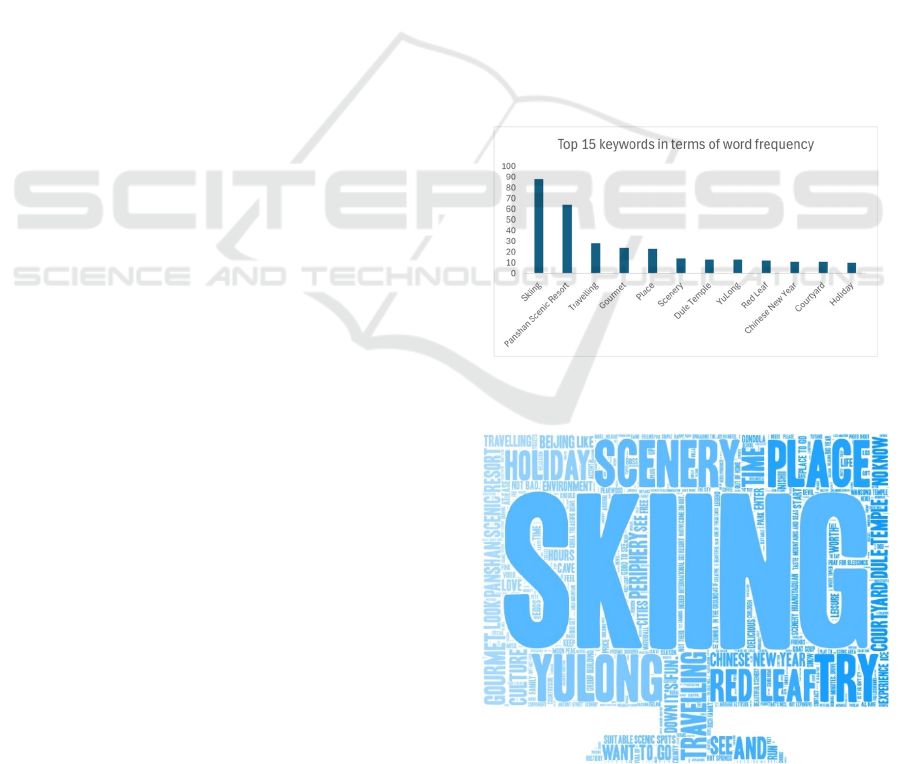
totalling close to more than 300. The comments are
subjected to lexicographic processing, after removing
deactivated words and removing words for word
frequency statistics as in Fig. 1 and making word
cloud map as in Fig. 2.
Figure. 1: Top 15 keywords in terms of word frequency.
(Picture credit: Original)
Figure. 2: Keyword word cloud map. (Picture credit:
Original)
A Review of the Current State of Rural Tourism in the Age of Social Media and Exploration of Optimization Paths: A Case Study of Jizhou
District, Tianjin
449
An in-depth analysis of the top fifteen keywords in
the word frequency of social media video comments
in Jizhou District, Tianjin, clearly shows the
multifaceted interests and concerns of tourists and
social media users in Jizhou District. People attach
great importance to the four aspects of eating, drinking
and playing in rural tourism.
In terms of natural landscapes, visitors showed
great interest in the winter skiing activities in the
Jizhou District, the natural landscape of the Banshan
Scenic Area, the autumn foliage viewing and the
overall natural scenery. In terms of humanistic
landscapes, people were very interested in the cultural
heritage and folklore of the Jizhou District, with the
Dule Temple being very popular. In terms of tourism
activities, tourists were very concerned about the
overall tourism planning, accessibility,
accommodation, as well as recreational facilities and
amusement programmes.
4.2 Sentiment Analysis
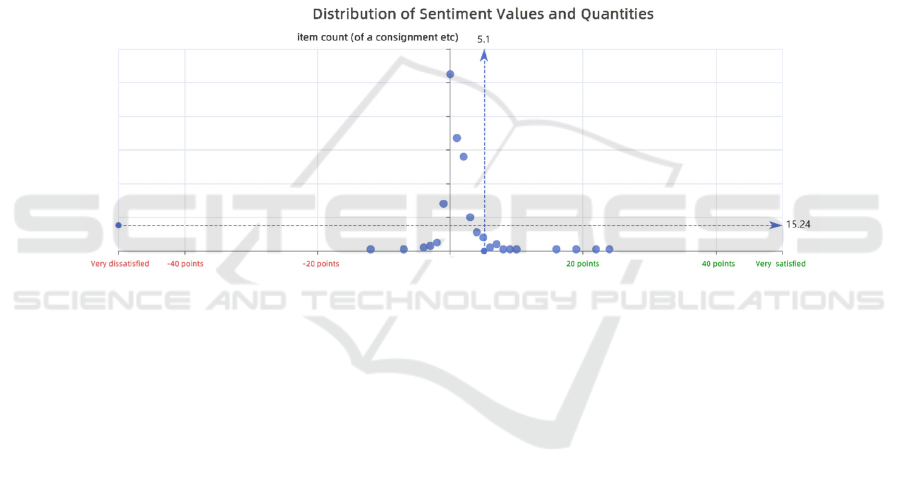
This study covers the comments under social media
videos in Jizhou District, Tianjin, and through the
division of emotional tendencies, we obtained 159
positive emotional comments accounting for 49.69%,
56 negative emotional comments accounting for
17.5%, and 105 neutral comments accounting for
32.81%. This data provides a direct feedback about
the tourist experience in the Jiju district. As shown in
Figure 3 Distribution of Sentiment Values vs.
Number.
Figure 3: Distribution of Sentiment Values and Quantities. (Picture credit: Original)
Positive comments accounted for a larger
proportion of the comments. These comments express
positive sentiments such as appreciation of the beauty
of the Jizhou district, satisfaction with the tourist
experience, and fondness for the local culture.
Negative comments, although relatively few in
number, are equally noteworthy. These comments
relate to complaints about inconvenient transport,
poor service attitudes, and poorly maintained
attractions. There is still room for improvement in the
development of tourism services and facilities in the
Thistle District. This includes both the construction
of transport infrastructure such as roads, bridges, car
parks, etc. used to improve the accessibility of visitors
to the countryside and scenic spots. It also includes
the construction of living infrastructure such as public
toilets and resting pavilions to provide a more
comfortable environment for tourists. Through
investment and planning, the completeness of the
infrastructure is ensured, and the overall
attractiveness of rural tourism is improved (Song,
2025).
5 PROBLEMS OF SOCIAL
MEDIA VIDEOS FOR RURAL
TOURISM IN JIZHOU
DISTRICT
5.1 Serious Homogenisation
The homogenisation of rural tourism marketing
content on new media platforms is becoming
increasingly significant, and has become an important
obstacle to rural development. Agricultural
enterprises at all levels tend to imitate successful
cases, resulting in a large number of promotional
materials with similar styles and serious
homogenisation on online marketing platforms,
which not only diminishes the uniqueness and
freshness of the information, but also makes it
difficult to stimulate the interest and purchase desire
of potential consumers (Ye & Ping, 2024).
APMM 2025 - International Conference on Applied Psychology and Marketing Management
450

Famous sites such as Panshan Scenic Resort and
Dule Temple are often featured as the main content in
videos about Jizhou District, but the angles and ways
of displaying them often lack novelty. For example, a
large number of videos focus on the magnificent
scenery of Banshan, but the shooting angles, camera
use and narration are all similar, making it difficult
for viewers to distinguish the characteristics of
different videos. At the same time, the narrative is
limited by thinking, most of the videos are in
accordance with the ‘introduction + display +
summary’ or ‘background introduction + event
development + results presentation’ fixed mode to
carry out the narrative. This monotonous narrative
structure makes the video lack of ups and downs and
changes in the plot, and it is difficult to attract the
audience's attention.
In the videos popularising the history and culture
of the Jizhou district, only some basic background
information is briefly introduced, without digging
deeper into the stories and connotations behind them.
This shallow presentation makes the historical and
cultural content seem monotonous and boring,
lacking depth and attraction. When introducing the
food specialities of Jizhou, many videos only listed
the names of some common dishes and specialities,
without detailing their production process, taste
characteristics and cultural background. This kind of
general introduction makes the content of the food
specialities seem bland and uninteresting, and it is
difficult to stimulate the audience's appetite and
curiosity.
5.2 Network Information Overload
With the popularity of social media platforms and the
rise of short videos, video information related to
Jizhou District in Tianjin has shown explosive growth
on social media. These videos cover a wide range of
aspects such as natural scenery, history and culture,
food specialities, tourism activities, etc. However, the
lack of an effective information screening and
integration mechanism has led to a large amount of
repetitive and redundant information flooding into
users' view. Browsing a large amount of video
information for a long time, users are prone to fatigue
and boredom. This fatigue not only affects the user's
viewing experience, but may also reduce the user's
sensitivity to information and processing ability.
Thistle's video content lacks a clear target
audience positioning on social media and does not
build a clear user profile. Due to the lack of in-depth
knowledge of the target audience, the video content is
overly generalised and tries to reach all possible
audience groups. This results in content that lacks
relevance and depth, making it difficult to capture the
attention of a specific audience. This results in video
content that is difficult to accurately reach potential
viewers, and a lack of resonance and interest among
viewers, which reduces the content's dissemination
efficiency and impact.
6 RURAL TOURISM STRATEGY
FOR JIZHOU DISTRICT
The biggest highlight of rural tourism lies in its rural
characteristics (Chen & Xu, 2021). If the rural
tourism in Jizhou District does not have its own
positioning and characteristics but just copy the ‘
successful experience ’ of other regions, blindly
imitating all kinds of Netflix attractions. In the long
run, rural tourism will become the same, and the local
characteristics of cultural and tourism resources have
not been developed (Gao, 2024). In order to change
this situation, it is necessary to constantly explore and
develop new tourism projects, and strive to create
new and diversified rural tourism routes.
6.1 Differentiated Rural Tourism
Products
According to Delineation and labelling of natural
selenium-rich land (DD2019-10) and Administrative
Measures for the Identification and Labelling of
Natural Selenium-rich Land (Trial), 37 land parcels,
including the natural selenium-rich parcels in Xiaying
Township of Jizhou District, Tianjin City, are
recognised as natural selenium-rich land. Jizhou
District, Tianjin is blessed with a unique ecological
environment where the soil is rich in selenium, an
element that is beneficial to human health. This
natural advantage provides a unique selling point for
Dongshan Village's agricultural and healthcare
products.
Positioning Jizhou's products as ‘healthy, green
and high-end’. By emphasising the selenium content
of the products and the advantages of the ecological
environment, it creates a unique brand character and
attracts consumers who pursue a healthy lifestyle.
The core concept of ‘Selenium for Health, Green for
the Future’ conveys the health benefits of Jizhou
products and the protection of the ecological
environment. Through this concept, it builds
emotional resonance with consumers and enhances
brand loyalty. Use social media, e-commerce
platforms and other online channels to promote the
A Review of the Current State of Rural Tourism in the Age of Social Media and Exploration of Optimization Paths: A Case Study of Jizhou
District, Tianjin
451

products. Attract consumers' attention by posting
content such as product introduction and health
knowledge.
6.2 Rural Tourism Characterisation
Strategy
Creating special humanistic and flavourful tourism
routes, the opening of Dule Temple, Yuyang Ancient
Village and the surrounding areas shuttle bus routes
cover a wide range of Buddhist culture, ancient
architecture, rural culture, artisan culture, etc., which
provide tourists with a rich and diverse tourism
experience, appreciate the unique flavour of different
cultural backgrounds, and satisfy different tourism
needs. Meanwhile, relevant information about the
featured attractions, such as route introduction,
attraction recommendations, activity highlights, etc.,
is posted on social media platforms to attract tourists'
attention and interest. Encourage tourists to share
their own experiences and feelings on social media,
and set up interactive topics or challenge activities to
stimulate tourists' participation and creativity.
Marketing for specific seasons. In winter, for
example, live broadcasting at the ski resort site to
show the ski slopes, facilities, atmosphere, etc., to
attract potential tourists; releasing the wonderful
moments taken by tourists at the ski resort, such as
skiing skills demonstration, beautiful photos of the
snow scene, etc., to increase user interaction and
participation; launching online activities such as
skiing skills challenge, snow scene photography
contest, etc., and encouraging users to participate in
them and share them on social media to Expand brand
exposure; co-operate with travel agencies and online
travel platforms to launch co-branded ski packages
for joint promotion; co-operate with ski equipment
brands for product implantation and joint marketing.
Virtual reality technology has been actively
introduced to provide tourists with a brand-new
tourism experience. For example, in the ‘Hip Hop
Carnival VR Experience Pavilion’ project at Yuyang
Ancient Street in Jizhou, tourists can experience a
variety of high-tech amusement facilities through VR
equipment, and feel the cyberpunk decoration style
and sci-fi sense of the VR world. In addition, the
opening of VR live broadcasting allows consumers to
experience the natural scenery and unique charm of
Jizhou District. This kind of live broadcast not only
enhances the interactivity and participation of
tourists, but also improves the visibility and
reputation of Jizhou District.
7 CONCLUSION
The findings of this study are a comprehensive review
and analysis of the current situation of rural tourism
in Jizhou District, Tianjin. The situation of rural
tourism in Jizhou District of Tianjin is the specific
object of investigation, and various research methods,
such as PEST analysis and text analysis, are used to
deeply analyse the development status of rural
tourism in Jizhou District, as well as the status of
social media marketing. The study found that rural
tourism in Jizhou District has made certain
achievements, but there are some deficiencies in
social media promotion and its related areas, and a
lack of characteristics and differences, which limit the
further development of rural tourism and affect the
tourists' travel experience and satisfaction. From this,
it further concludes its study that in order to achieve
sustainable development of rural tourism in Jizhou
District, Tianjin, it is necessary to focus on the power
of social media, hit its selling points and
characteristics, and improve the relevance and depth
of content to attract the attention of specific audiences.
This study highlights the importance of content
innovation and differentiated development, providing
new ideas for the transformation and upgrading of
rural tourism. At the same time, this study also reveals
the important role of social media in the promotion of
rural tourism, which provides useful reference for
future marketing strategies. Future research should
focus more on the sustainable development path of
rural tourism for in-depth investigation. The current
situation and problems of rural tourism development
in different regions and cultures can be further
analysed, and more targeted and effective
development strategies can be explored. At the same
time, we can also pay attention to the deep integration
of rural tourism and new media technology, and study
how to use new technology to enhance the popularity
and reputation of rural tourism and promote the
prosperous development of rural tourism industry.
REFERENCES
J. Hang, Path and strategy of cultural and tourism
integration in the social media era to help Xinjiang rural
revitalisation development. Village Dir. (13), 243-245
(2024)
M. Cawley, D. A. Gillmor, Integrated rural tourism:
Concepts and practice. Ann. Tour. Res. 35, 316-337
(2008)
APMM 2025 - International Conference on Applied Psychology and Marketing Management
452

M. Song, Exploration on the strategy of high-quality
development of rural tourism in Suihua City in the new
era. North Econ. Trade (01), 156-160 (2025)
N. A. Laxmita, W. Setyaningsih, O. Purwani, Sustainable
rural tourism development in the era of social media
shape identities and discourse digital settings. IOP Conf.
Ser. Earth Environ. Sci. 778, 012010 (2021)
W. Ye, B. Ping, New media marketing development
strategy for agricultural products in digital village
environment. China Market (35), 93-96 (2024)
W. Zhuang, Research on the mechanism of influence
formation of content creators on social media platforms.
Shanghai Univ. Finance Econ. (2023)
X. Chen, X. Xu, Research on rural tourism development
problems in Henan Province. North Econ. (11), 53-55
(2021)
Y. Gao, An analysis of the path of rural revitalisation
empowered by cultural and tourism integration.
Seeking Sage (12), 42-43 (2024)
Y. Joo, H. Seok, Y. Nam, The moderating effect of social
media use on sustainable rural tourism: A theory of
planned behavior model. Sustainability 12, 4095 (2020)
Z. Huang, Research on the optimisation of rural tourism
marketing strategy of Ctrip Jiangxi holiday farm.
Jiangxi Univ. Finance Econ. (2023)
A Review of the Current State of Rural Tourism in the Age of Social Media and Exploration of Optimization Paths: A Case Study of Jizhou
District, Tianjin
453
