
The Mediating Role of Anxiety: The Relationship Between Anxious
Attachment Style and Willingness to Move out of Multi-Person
Dormitories in Chinese University Students
Shiyao Luo
Department of Behavioral Sciences, Vincennes University, Vincennes, IN 47591, U.S.A.
Keywords: Anxious Attachment Style, State Anxiety, Dormitory Life.
Abstract: Dormitory life has an important impact on university students, especially in China, where the total population
and the number of university students are large. In China, university students usually live in multi-person
dormitories based on social common sense and even social norms. Studies have shown that different
attachment styles are likely to have different preferences for accommodation, but there are still gaps in
research on how the various influence mechanisms work. This study analyzed the direct and indirect effects
of anxious attachment style on the willingness to move out of multi-person dormitories, mediated by anxiety
state. An online questionnaire was distributed to Chinese university students via Chinese social media. The
results show that the anxiety state is the important and significant influence mechanism in achieving the
correlation between anxious attachment style and moving-out willingness and was linked closely to both of
them. For the direct effect, there was a nearly significant positive correlation between the independent and
dependent variables. The results are consistent with the previous research on attachment and housing choices.
On this basis, the conclusion obtained in this study regarding the significant correlation of the anxiety state
with the variables and effect is important for revealing the way attachment styles work.
1 INTRODUCTION
Dormitory life is an important and integral part of
universities, especially in China. If students decide to
live in the multi-person dormitories on campus, i.e.,
not in a private room by themselves, it means that
they have to share their living space with others. In
these spaces, university students inevitably have to
interact with other people. Moreover, the situation
might be more intense in Chinese society. In China, it
is common sense that university students need to,
should, or can live in multi-person dormitories is
social common sense. Meanwhile, under the tight
policies in many universities, most students choose to
live in multi-person dormitories instead of
commuting when they enroll. Moreover, due to the
high population and increasing number of university
students, the multi-person dormitory environment
that students need to face may be even more severe.
According to the statistics from the Ministry of
Education of the People’s Republic of China (MOE)
in 2023, there were a total of 47.6319 million students
enrolled in various forms of higher education, an
increase of 1.0811 million from the previous year
alone, and a gross enrollment rate of 60.2% (Ministry
of Education of the People’s Republic of China,
2024).
Dormitory life can bring more things to handle for
university students. University students who live in
dormitories, no matter male or female, have higher
stress and social dysfunction levels than those who do
not live in dormitories, as the study by Molasaeidi
points out (Molasaeidi, 2014). These differences may
be explained through attachment theory to some
extent. Attachment theory was first proposed by
Bowlby, who noted that this infant attachment
behavior to the mother would bring them rich
emotional responses and teach them social adaptation
skills (Bowlby, 1997). In the study by Ainsworth et
al., this pattern of attachment was further
distinguished into secure, anxious, and avoidant
attachment styles through the Strange Situation,
expressing a pattern of exploration of the
environment influenced by the caregiver’s behavior
(Ainsworth, 2014). Individuals with an anxious
attachment style in adulthood are more likely to have
stronger emotional ups and downs and a desire for
return in romantic relationships, while those with
170
Luo, S.
The Mediating Role of Anxiety: The Relationship Between Anxious Attachment Style and Willingness to Move out of Multi-Person Dormitories in Chinese University Students.
DOI: 10.5220/0014110100004942
Paper published under CC license (CC BY-NC-ND 4.0)
In Proceedings of the 2nd International Conference on Applied Psychology and Marketing Management (APMM 2025), pages 170-176
ISBN: 978-989-758-791-7
Proceedings Copyright © 2026 by SCITEPRESS – Science and Technology Publications, Lda.

avoidant attachment styles are more likely to avoid
intimacy (Hazan, 1987). In the last thirty years, as
more and more studies on adult attachment styles
have been conducted, new research has emerged that
can explain the relationship between attachment
styles and dormitory life. According to Lapsley and
Edgerton, insecurely attached individuals are less
adaptable to college, which may affect their
adjustment to residential life and their ability to
manage interpersonal interactions in multi-person
dormitories (Lapsley, 2002). Attachment styles do
affect the housing choice during university.
Compared to securely attached individuals,
avoidantly and anxiously attached individuals are
more likely to choose to live alone or with their
parents instead of sharing the space with others, as
pointed out in Sasso and Paladini’s study (Sasso and
Paladini, 2021). However, there is still a gap in the
field regarding the specific mechanism through how
insecure attachment styles lead to their choice of not
living with other students, including living in multi-
person dormitories.
This study focused on the relationship between
anxious attachment style and willingness to not live
in multi-person dormitories. It further confirmed the
hypothesis that individuals with higher anxious
attachment styles are more likely to have the
willingness to move out of multi-person dormitories
based on the social culture and atmosphere of the
research subjects, Chinese university students. The
independent variable was set as the score of anxious
attachment styles, while the dependent variable was
the willingness to move out of multi-person
dormitories. To study the influencing mechanism, an
intervening variable, the anxiety state of living in a
multi-person dormitory, was set up to investigate
whether the correlation between anxious attachment
style and the willingness to move out of a multi-
person dormitory is achieved by anxiety state
2 MATERIALS AND TOOLS
2.1 Samples
The questionnaire was imported into a well-known
Chinese platform and distributed through Chinese
social media to find college students currently
enrolled in universities in China. In addition to the
main questions, questions were added to count the
current accommodation situation and the grade of the
sample. The valid rate of the questionnaire was
calculated by excluding responses that were too short,
too random, or too repetitive.
2.2 Experience in Close Relationships
Scale- Chinese Short (ECR-CS)
This study used the Experience in Close
Relationships Scale- Chinese Short (ECR-CS) to
measure the attachment styles of the subjects. The
ECR-CS was first revised into a Chinese version by
Chinese scholars Li et al. in 2016, based on the
original ECR developed by Brennan, Clark, and
Shaver, and then revised again into a Chinese short
version by She et al. in 2014. The ECR-CS revised by
She et al. has good internal consistency (She et al.,
2015). This study indirectly cited the ECR-CS by She
et al. in the appendix of Dong’s article (Dong, 2021).
The advantage of ECR-CS is that it is suitable for the
measurement of adult attachment styles, conforms to
the Chinese context, and is short enough to ensure
more valid data can be collected in a limited time.
Considering that the subjects were Chinese university
students, which was different from the young and
middle-aged people in Dong's research, the author
replaced all the “spouses” with “partners” in the scale.
Also, the main question section indicated that
subjects could imagine future partners or important
others if they did not have romantic relationship
experience since some Chinese university students
might lack it.
2.3 State Anxiety Inventory (SAI)
Concerning the moderate variable, anxiety state, this
study used the State Anxiety Inventory (SAI) part of
the State-Trait Anxiety Inventory, STAI-Form
Y(STAI). The original English version was
developed by Spielberger et al., and the Chinese
version used by this questionnaire was developed by
Wang et al. in 1992 and is included in the Rating
Scale for Mental Health (Wang et al., 1999). The
reason for choosing the SAI instead of the Trait
Anxiety Inventory (TAI) or STAI is that the anxiety
experienced by individuals in the dormitory that
motivates them to want to move out of the dormitory
is more likely to be state anxiety than trait anxiety.
Meanwhile, the SAI is shorter than the STAI,
ensuring that the questionnaire has a high return rate
and is efficient.
2.4 Moving-Out Willingness
Considering the sociocultural context of China,
besides the dependent variable itself, which was the
willingness to move out of a university dormitory, the
subjects also had to answer the difficulty level of
moving out of the dormitories if they had ever had
The Mediating Role of Anxiety: The Relationship Between Anxious Attachment Style and Willingness to Move out of Multi-Person
Dormitories in Chinese University Students
171
thought about moving out (i.e., not choosing “I have
never considered about it, I have never had such
thoughts”). This was to make sure the difficulty of
moving out would not affect the willingness.
3 PROCEDURE
This study developed an online questionnaire that was
distributed online via Chinese social media, and a
total of 343 valid questionnaires were collected. The
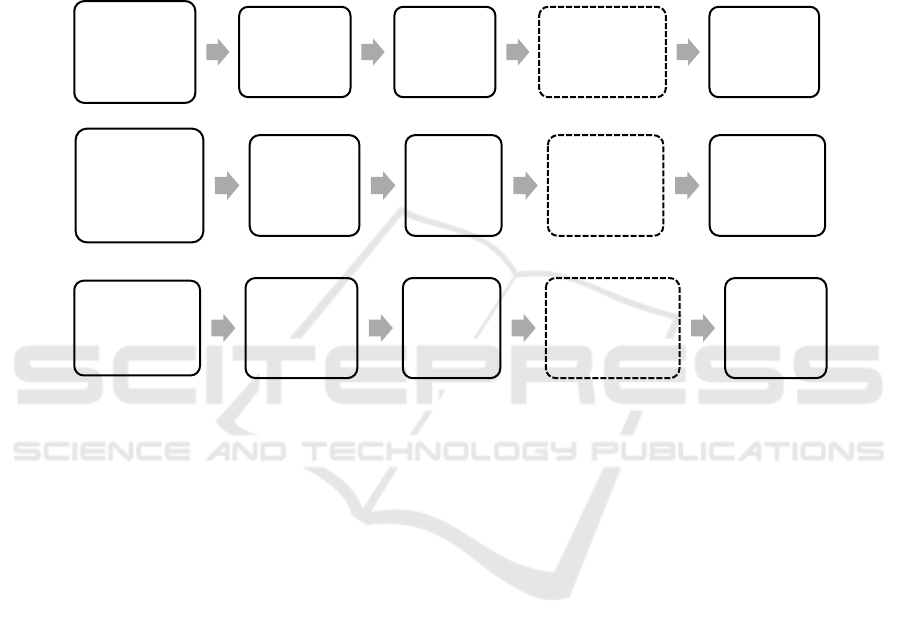
questionnaire divided the subjects into three groups
through their campus housing situation and set
different question-skipping logic. This is intended to
allow subjects in different housing situations to
answer SAI scales with different modifiers, and
subjects who no longer live in university dormitories
do not need to answer the questions about their
willingness to move out.
Figure 1: Different questions that need to be answered by different groups (Photo/Picture credit: Original).
There were three sets of SAI with different
modifiers for three different groups (See Fig. 1.). The
differences were nearly only the modifiers of some
sentences to make the questions more relevant to the
situation of the subjects. For example, the stems for
SAI for Group 1 and Group 2, respectively,
“Considering my feelings about dormitory life and
staying in the dormitory” and “Thinking back to when
I lived in the university dormitory before;” for the
scale questions, one in Group 1 was “I am presently
worrying about living in the dormitory, feeling it may
be over possible misfortunes,” whereas the other was
“I worry about living in the dormitory, feeling it may
be over possible misfortunes.” It is worth noting that
the English version of the questionnaire shown in this
article is translated by the author for only
demonstration purposes. It was not used in formal
experiments and has not been reliability tested.
Because the ECR-CS and the three versions of the
SAI scale for different groups all had different extents
of changes in modifiers and question sentences,
Cronbach’s Alpha was used to measure the reliability
of those for scales. However, the SAI scale for Group
3 was not tested due to insufficient samples (N=1).
After data collection was completed, the
questionnaire data was exported from the online
questionnaire platform to IBM SPSS statistical
software. It was finally found that there was a total of
336 questionnaires in Group 1, while there were 4 and
3 in Group 2 and 3, respectively. Since the sample
sizes of Group 2 and 3 were too small, this study
mainly limited the scope of the data analysis to the
336 Chinese university students in Group 1 who were
still living in the school dormitories.
Before the formal analysis, the correlation and
significance between the willingness to move out and
the difficulty of moving out were first analyzed using
the Spearman correlation coefficient to ensure that the
difficulty of moving out would not affect the
individual's willingness to move out. Because the
original questionnaire included the option “I'm not
sure/I haven't looked into how difficult it is to move
out of the dormitory,” the sample that selected this
option was excluded from the analysis of the
correlation between willingness and difficulty. The
willingness to move out and the difficulty of moving
out were treated as 0-5 and 0-4, respectively. For the
main hypothesis, PROCESS Version 4.2 was used to
Group1:
Living in
university
multi-person
dormitories
SAI (Anxiety
state in
dormitories)
Moving out
willingness
[If ever thought
about moving
out] Moving out
difficulty level
ECR-CS
(Attachment
style)
Group2: Living
in university
multi-person
dormitories
SAI (Anxiety
state in
dormitories)
Moving out
willingness
[If ever
thought about
moving out]
Moving out
difficulty level
ECR-CS
(Attachment
style)
Group3: Living
in university
multi-person
dormitories
SAI (Anxiety
state in
dormitories)
Moving out
willingness
[If ever thought
about moving
out] Moving out
difficulty level
ECR-CS
(Attachment
style)
APMM 2025 - International Conference on Applied Psychology and Marketing Management
172
obtain the results of the mediation analysis on the
independent variable of the mean score of anxious
attachment style, the mediator variable of the mean
score of anxiety state, and the dependent variable of
the willingness to move out.
The main hypothesis was additionally verified from
the dimension of avoidant attachment, that is, X was
replaced by the mean value of the individual avoidant
attachment dimension measured by the ECR-CS, and
an additional multiple regression analysis was
performed. Meanwhile, a cross-tabulation analysis
was also conducted based on demographic questions
to determine differences in propensity to move out
between different grades.
4 RESULTS
After a total of 371 responses to this questionnaire,
questionnaires with obviously unreasonable answers
(those with evidently repeated and regular answers, as
well as those with answers that were too short) were
eliminated. A total of 343 valid questionnaires were
collected, for an effective rate of approximately
92.5%. Of these, 336 were from Group 1 (currently
living in a university multi-person dormitory) and
were used for the main data analysis. The grade
distribution of the 336 subjects ranged from
undergraduate freshmen to third-year graduates.
Among them, there were 135 undergraduate freshmen
(FR), 59 undergraduate sophomores (SO), 62
undergraduate juniors (JR), 49 undergraduate seniors
(SR), 5 first-year graduate students (G1), 15 second-
year graduate students (G2), and 11 third-year
graduate students (G3).
The reliability of the 20-item SAI for Group 1
(336 samples), using Cronbach’s Alpha, turned out to
be alpha=0.956, which is a high internal consistency
and consistent measurement of the topic of anxiety
states. The Group 2 version, which also had 20 items,
only yielded four valid responses, but was still
measured, and turned out with an alpha of 0.958. All
343 valid responses answered the 12-question ECR-
CS, yielding an alpha of 0.856, indicating good
internal consistency.
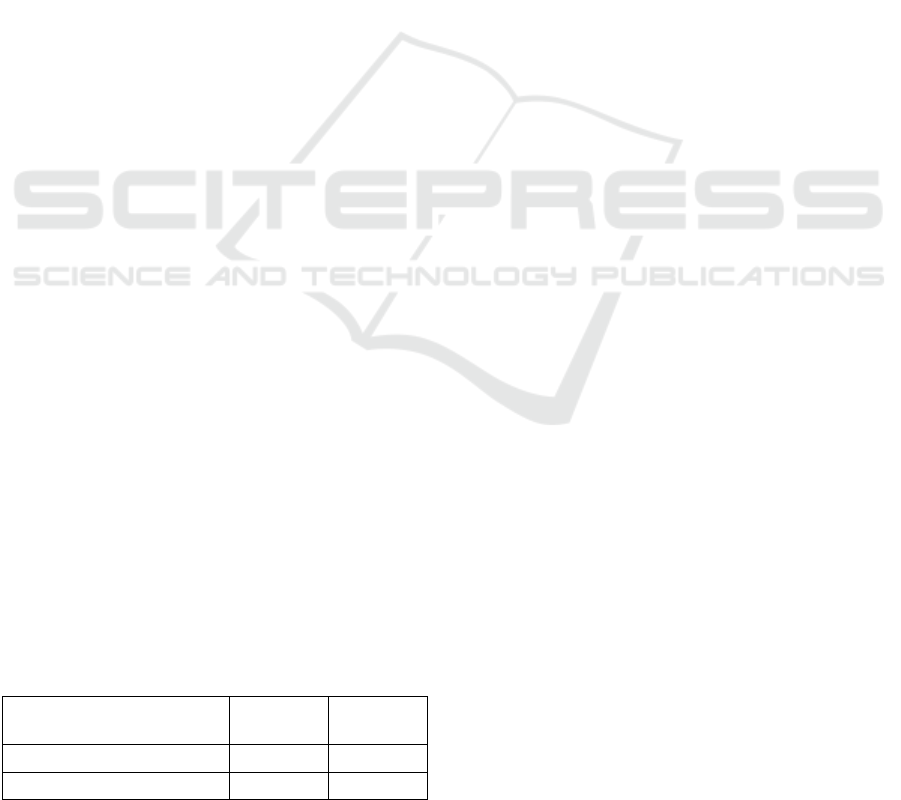
Table 1. Mean value and standard deviation of willingness
to move out and difficulty of moving out.
Mean
value
Standard
Deviation
Willingness to move out 1.32 1.225
Difficult
y
of movin
g
out 2.13 1.103
The willingness to move out and the difficulty of
moving out were treated as 0-5 and 0-4, respectively.
The mean value and standard deviation are shown in
Table 1. In the Spearman correlation and significance
test to examine the willingness to move out and the
difficulty of moving out, r=-0.003 and p=0.968 were
obtained. This shows that there is no significant
correlation between the willingness to move out and
the difficulty of moving out. Therefore, the difficulty
of moving out is not considered as a variable. The
dependent variable only considers the willingness to
move out.
4.1 Mediation Analysis
In a multiple regression analysis using PROCESS
v4.2 with a confidence level of 95%, the R² was
0.0265 in the meditator model part, which means that
the mean value of the individual anxious attachment
style scale (X) explained 2.65% of the meditator
variable, anxiety state (M). It turned out that
p=0.0027, which is less than 0.05, can be considered
statistically significant. The non-normalized
regression coefficient b is 0.0804, which indicates
that for every unit increase in the individual anxious
attachment style score, the anxiety state score
increases by about 0.0804.
With regard to the part of the dependent variable
model, it can be seen from R²=0.4791 that X and M
explained 47.91% of the dependent variable, the
willingness to move out (Y). It is evident that
individuals’ anxious attachment style and anxiety
state in the dormitory had a very strong explanatory
power on the willingness to move out of the
dormitory. Meanwhile, in the indirect effect, the
effect was 0.1045, which means that part of the effect
of X on Y is achieved through the anxiety state; and
the confidence interval is 95% CI [0.0314, 0.1759],
which indicates that it is significant. If the effect of M
on Y is considered alone, b=1.3008, p<0.0001, it can
be seen that the mediator variable, anxiety state, has
an extremely strong and significant effect on
increasing the willingness to move out. However,
when X acts on Y alone, b=0.0697, p=0.0675, is not
statistically significant but close to, and the effect is
not as strong as M on Y. This might mean that the
effect of anxious attachment style on willingness to
move out is mainly achieved by the mediator variable.
That is, it is more the anxious attachment style that
leads to an anxiety state, and the anxiety state leads to
a willingness to move out, rather than the anxiety
state acting as an influencing factor.
When X is replaced with individual avoidant
attachment style scores and analyzed again, the effect
The Mediating Role of Anxiety: The Relationship Between Anxious Attachment Style and Willingness to Move out of Multi-Person
Dormitories in Chinese University Students
173
of X on M, M on Y, and the mediation effect were
basically the same, but for the direct effect, which is,
the effect of X on Y alone, b=-0.0421, p=0.1662. In
other words, for every unit increased in avoidant
attachment style scores, the willingness to move out
decreased by 0.0421, but the result is not significant
(See Table 2).
Table 2. Direct and indirect effects in mediation analysis.
X→M M→Y X→Y indirect effect
X: Anxious attachment b=0.0804 b=1.3008 b=0.0697
p
=0.0675
0.1221
Y: Avoidant attachment b=0.0905 b=1.3493 b=-0.0421
p=0.1662
0.1045
4.2 Cross-Tabulation Analysis
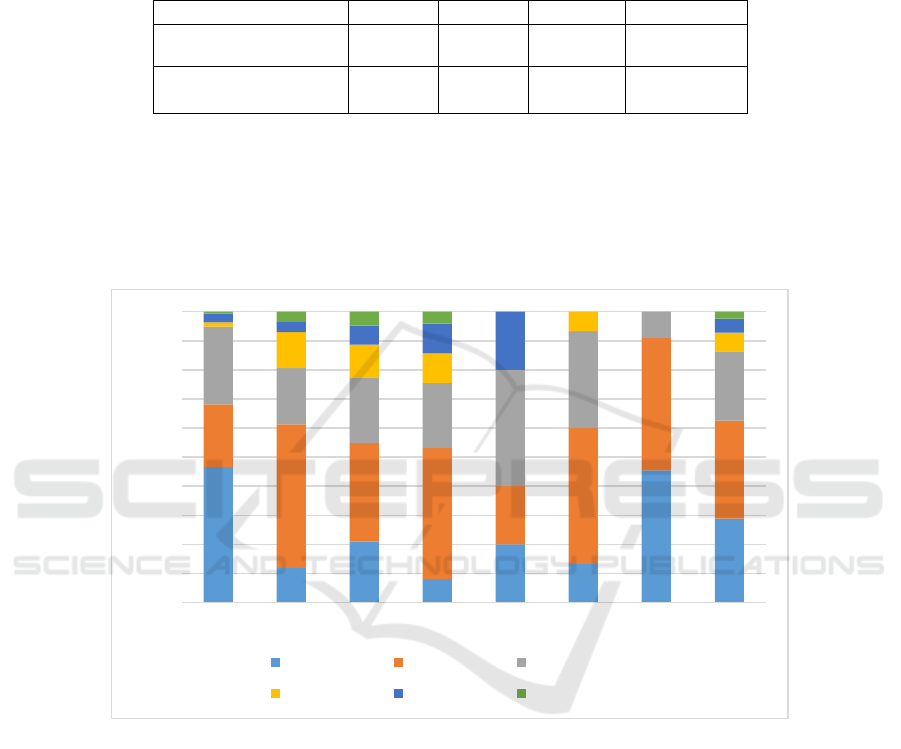
In the cross-tabulation analysis of the differences in
the willingness to move out between different grades
based on the demographic questions, the comparison
of the percentages of options selected in each grade is
shown in the figure below (See Fig. 2.). It can be seen
that the largest number of people in FR and G3 chose
to have not considered moving out of the dormitory
at all, and the smallest number of people in FR
already had a complete plan.
Figure 2: Proportions of dormitory moving out willingness levels among students by grade (Photo/Picture credit: Original).
5 DISCUSSION
5.1 Anxious Attachment Style, Anxiety
State, and Moving-out Willingness
In mediation analysis, it was shown that the direct
effect of anxious attachment style to moving out
willingness was relatively low and close to significant
(b=0.0697, p=0.0675), while the indirect effect when
using anxiety state as mediator variable (the effect
was 0.10450, 95% CI [0.0314, 0.1759]), the effect of
independent variable to mediator variable (b=0.0804,
p=0.027), and the effect of mediator variable to
dependent variable (b=1.3008, p <0.0001) all had
high and significant effectiveness. First, consistent
with the hypotheses of this study, these results can
prove that anxiously attached individuals are more
likely to show anxiety state in multi-person
dormitories, and this kind of state will increase their
willingness to move out of the dormitories.
Meanwhile, the anxiety state was an extremely
important mediation in this indirect effect, and this
result was also statistically significant. However,
although anxious attachment style also had a direct
effect on moving-out willingness, it is not significant
enough.
0%
10%
20%
30%
40%
50%
60%
70%
80%
90%
100%
FR SO JR SR G1 G2 G3 Total
Willingness=0 Willingness=1 Willingness=2
Willingness=3 Willingness=4 Willingness=5
APMM 2025 - International Conference on Applied Psychology and Marketing Management
174

This shows a situation that this mediation effect
was mainly achieved through the mediator variable,
anxiety state, which may reflect a certain
psychological mechanism in Chinese culture and
society: Although an individual is anxiously attached,
if they do not feel a more influential, intuitive, and
“obvious” anxiety state, they may not easily realize
their internal need to move out of the dormitory, nor
will they easily realize that moving out of the
dormitory is more in line with their personal needs. In
the Chinese culture, this may stem from an emphasis
on collectivism; “living in a dormitory” is seen as
something that everyone should do as a matter of
course and is harmless, while “behaving differently
from the group” brings cultural pressure and a sense
of shame to the individual. A prior study by Guess
points out that under collectivist values, individuals
are more cautious and want their decisions to conform
to social expectations (Guess, 2004). When this
culture reflects onto society, the individuals may
discover that the vast majority of people around them
are either viewing tolerating dormitory living as a
matter of course or just continuing tolerating it
reluctantly. At the same time, if individuals seek
feedback from the outside world, they find that
parents and teachers do not have a positive attitude
towards moving out of the dormitory. Especially
anxiously attached individuals might be more likely
to seek feedback from others, for example, Hepper
and Carnelley’s research shows that individuals with
a high-anxious attachment style are more eager for
feedback and more open to negative feedback
(Hepper and Carnelley, 2010). These are all possible
reasons that affect the result that individuals did not
evaluate their decision on dormitory through their
own personality and interpersonal characteristics
until they realized their distress in an anxiety state. In
the design stage of this study, three groups were
designed based on different accommodation
situations, but the final samples that were not
currently living in a dormitory only accounted for
about 2.04%. This data distribution can also prove to
some extent that not living in a shared
accommodation is not mainstream at all.
On the contrary, when using avoidant attachment
style as an independent variable, the result can only
support avoidantly attached individuals are also more
likely to have anxiety state in multi-person
dormitories, and this state can prompt them to
consider moving out. When the avoidant attachment
style directly affects the moving-out willingness, the
direction of this effect is negative, and the result is
very insignificant. This can prove that the effect of an
avoidant attachment style and an anxious one on the
moving-out willingness is different. It is worth noting
that, as shown in Table 1, the greatest effect value in
the two mediating analyses is the part where anxiety
leads to an increase in the willingness to move out.
This shows that regardless of attachment style,
anxiety is a strong factor influencing the willingness
to move out of the dormitory.
The results of the cross-analysis of demographic
questions and willingness to move out show that
undergraduate freshmen (FR) were the least likely to
consider moving out of the dormitories, but this
changed with increasing grade levels. As the grade
level increases, more and more individuals have a
stronger desire to move out of the dormitories, which
might be related to the anxiety state they experienced
in their residential life, or the gradual maturity of their
abilities as growing up. It is worth noting that the
sample size among the graduate student population
was very limited, so the proportions of willingness
levels among the three graduate student grades are of
limited reference value.
5.2 Limitation and Expectation
In terms of sample collection, the sample size of
different grades was not evenly distributed, which
might have a certain impact on the results of the
specific situations in different grades, such as
undergraduate freshmen seemed less likely to think
about moving out. The most significant limitation of
this study was that the cultural and social background
might have a strong impact on the subjects, for
example, there was a very limited size of subjects that
did not live in university multi-person dormitories.
Meanwhile, as mentioned earlier, collectivist values
might have an impact on the study. Subsequent
research should add culture-related questions to the
questionnaire to increase consideration of the impact
of cultural background on individual values and
decision-making patterns. At the same time, the
hypothesis also deserves cross-cultural research and
observation if the direct effect would be stronger.
This hypothesis also needs to be carried out in
societies with more diverse university
accommodation and commuting methods to assess
whether anxious attachment styles and anxious states
have an impact on different commuting methods, that
is, a further subdivision based on moving out of the
dormitory.
The Mediating Role of Anxiety: The Relationship Between Anxious Attachment Style and Willingness to Move out of Multi-Person
Dormitories in Chinese University Students
175

6 CONCLUSION
In this study of the correlation between anxious
attachment style and willingness to move out of
multi-person dormitories, in addition to the near-
significant correlation between the two variables, the
role of anxiety as a mediator variable was
significantly verified. The results show that anxiety
state is a very strong and powerful factor in the
achievement of the relationship between anxious
attachment style and moving-out willingness,
especially the impact of anxiety state on willingness
(b=1.3008, p <0.0001). This means that, if anxiously
attached individuals decide to live in multi-person
dormitories, they need to pay more attention to their
anxiety and find coping strategies to ensure that stress
does not affect their study life. In addition, they also
need to focus more on their own needs in daily life
and when making housing decisions, and consider the
high risk of anxiety state they may encounter. For
those anxiously attached individuals who are in
anxiety in multi-person dormitories, this study will be
a tool that helps them understand their situation and
reminds them to pay attention to their mental state.
For higher education institutions, such as universities,
this will be a reminder to provide more flexible
commuting policies and give more understanding to
diverse students. For the field of attachment theory
research, this can be an introduction to focusing on
the more specific influence pattern of anxious
attachment styles.
REFERENCES
Ministry of Education of the People's Republic of China,
Statistical bulletin on the development of national
education in 2023, Ministry of Education of the
People's Republic of China Official Website (2024)
Molasaeidi, A comparison of mental health in dormitory
and non-dormitory students, Indian J. Fundam. Appl.
Life Sci. 4, 328–334 (2014)
J. Bowlby, Attachment and loss: Vol. 1. Attachment,
Pimlico, London. (1997)
M.D.S. Ainsworth, Patterns of attachment: A psychological
study of the strange situation, Psychology Press, New
York. (2014)
C. Hazan, P. Shaver, Romantic love conceptualized as an
attachment process, J. Pers. Soc. Psychol. 52, 511–524
(1987)
L.K. Lapsley, D.J. Edgerton, Separation-individualization,
adult attachment style, and college adjustment, J.
Couns. Dev. 80, 484–492 (2002).
P.A. Sasso, A. Paladini, Around the house: A descriptive
study of attachment styles, living arrangement, and
involvement in undergraduate commuter students, J.
Campus Act. Pract. Scholar. 3, 16–29 (2021)
Z. She, Q. Sun, G. Jiang, Revision of the Experience in
Close Relationship Scale-Short Version (ECR-CS), in
Proceedings of the 18th National Academic Conf. on
Psychology: Psychology and Social Development,
Chinese Psychological Society Ed., 945–946 (2015)
S.Q. Dong, Intervention research on psychological distress
in middle-aged and young lymphoma patients based on
adult attachment theory, Master’s thesis, Zhengzhou
University (2021)
X.D. Wang, X.L. Wang, H. Ma, Manual of mental health
assessment scales (Revised Edition), Chinese J. Ment.
Health Press, Beijing. (1999)
C.D. Guess, Decision making in individualistic and
collectivistic cultures, Online Read. Psychol. Cult. 4, 1
(2004)
E.G. Hepper, K.B. Carnelley, Adult attachment and
feedback-seeking patterns in relationships and work,
Eur. J. Soc. Psychol. 40, 448–464 (2010)
APMM 2025 - International Conference on Applied Psychology and Marketing Management
176
