
The Relationship Between Sleep Quality, Sleep Duration and
Students' Academic Performance
Hengyu Zhu
Springboard International Bilingual School, Beijing, 100020, China
Keywords: Sleep Quality, Sleep Duration, Students' Academic Performance.
Abstract: With growing concerns about student health and academic achievement, this study explores the critical role
of sleep quality in educational outcomes. The implications lie in the effects of sleep on cognitive function and
emotional regulation necessary for learning. This article objectively measures, through questionnaires and a
huge amount of data, the relationship between sleep patterns and academic indicators. The result of the
research shows that there is a nonlinear relationship between sleep duration and academic achievement, which
is especially prominent among younger primary school students with insufficient sleep. The authors found
that alertness mediated the relationship between children's sleep quality and their academic performance when
they were 10 to 12 years old, hence the need for sleep regularity to ensure academic success. Poor sleep
patterns disrupt the biological clock, which negatively impacts cognitive functions responsible for learning.
The conclusion outlines that good quality sleep, appropriate duration, and regularity are the factors that will
help in achieving academic success. The study insinuates that for students to achieve full academic potential,
sleep is of the essence and hence it should always be considered at an educational policy level. Mediating
factors like stress, motivation, and learning strategies do need further analysis in later studies for the
realization of focused educational interventions. Lastly, what the study insists on, is an overall approach:
students' well-being and performance, taking sleep as the core of it, and invites further research into complex
relationships between sleep and academic outcomes.
1 INTRODUCTION
It is the quality of sleep that has received considerable
attention from scholars in educational research in
regard to academic performance-a key determinant of
students' wellbeing and achievements. Much
literature, including the seminal work of Okano et al.,
supports the fact that sleep quality and duration are
important in academic success because it affects
cognitive functions and emotional regulation
responsible for learning and memory consolidation.
However, while there is consensus on all these
factors, there still remains a poor understanding of
how such sleep factors interact with students'
academic performance across the continuum of age
and stages of education. This lacuna in research is
particularly disturbing because growing academic
pressures lead to sleep deprivation in students, which
apart from the disturbance in learning processes,
might also threaten their health over the long term
(Okano et al., 2019). It is further emphasized by the
work of Itani et al. in their systematic review study in;
this shows the linkage of short sleep duration and
different various it can have. Among them are
mortality, diabetes, cardiovascular diseases, coronary
heart disease, and obesity. These findings reveal the
importance of addressing sleep deprivation with
urgency, both academically and from the standpoint
of the overall health and well-being of students. The
significance of this study lies in its comprehensive
approach to filling these research gaps (Oi and
Miyake, 2016). We will further examine the complex
interplays among sleep quality, duration, and
regularity that affect academic performance to a great
extent and will try to provide a theoretical framework
and some actionable insights for educational
policymakers. This study becomes particularly
relevant in view of the growing attention being given
to the importance of sleep for educational outcomes,
and the need for evidence-based strategies to support
students' health and performance.
Zhu, H.
The Relationship Between Sleep Quality, Sleep Duration and Students’ Academic Performance.
DOI: 10.5220/0014109600004942
Paper published under CC license (CC BY-NC-ND 4.0)
In Proceedings of the 2nd Inter national Conference on Applied Psychology and Marketing Management (APMM 2025), pages 153-158
ISBN: 978-989-758-791-7
Proceedings Copyright © 2026 by SCITEPRESS – Science and Technology Publications, Lda.
153

2 IMPACT OF SLEEP QUALITY
ON ACADEMIC
PERFORMANCE AND
MENTAL HEALTH
According to the data from China Family Panel
Studies in 2018, Liu's study used data from 3993
primary and secondary school students aged 6 to 16
and both of their parents for this research. The results
pointed out that the average hours for sleeping among
primary and secondary school students were around
9. 02±0. 96 while those for studying were at an
average of 2. 78 ± 0. 92 hours. The measure of
academic performance is primarily test scores:
academic achievement is measured by grades or
GPAs). The results of the study showed that increased
sleep duration did improve academic performance,
but mainly for primary school students who did not
meet the sleep duration requirement. For primary and
middle school students who meet the sleep standards,
their academic performance decreases with the
increase of sleep time (Liu, 2024). This finding
suggested that the relationship between sleep and
academic achievement may not be linear, and the
effect of sleep duration on academic achievement
may vary for students under different sleep
conditions. Okano et al found that sleep quality,
duration, and consistency were positively related to
college students' academic performance. This paper
tested the relationship between these measures of
sleep and academic performance with a sleep dataset
collected with wearable Fitbit devices from 100 MIT
students. Devices by Fitbit are worn to track a user's
daily activities: sleep, exercises, and general health.
These results indicated that the combined three sleep
measures accounted for 24. 44% of the variance in
overall achievement, hence a significant association
of sleep and academic achievement. The finding
underpins the use of sleep as a key factor in
educational outcomes (Okano et al., 2019).
Hou et al. investigated the relationship between
sleep quality and classroom attention and academic
performance. In this research, undergraduates from
10 full-time universities in Guangdong Province were
selected as research objects by adopting stratified
random sampling. In the paper, a total of 838 valid
questionnaires were recovered, and the investigation
showed that sleep quality was in significant
correlation with students' attention and academic
performance, which again proved the importance of
good sleep for cognitive function (Hou et al., 2020).
This would therefore suggest that strategies to
improve sleep quality will also enhance classroom
concentration and thereby improve academic
performance.
A systematic review and meta-analysis were
performed by Itani et al., that linked short sleep
duration to aspects of health outcomes, namely
mortality, diabetes, Cardiovascular Disease (CVD),
Coronary Heart Disease (CHD), and obesity. In the
study, insufficient sleep, which was defined here as
less than 6 hours, considerably raised these health
aspects (Oi and Miyake, 2016). Thus, sleep seems to
be not only important regarding academic
performance but also related to health in general.
Cooper et al. briefly reviewed in the relationship
of sleep deprivation to obesity. Based on this study,
sleep deprivation may modulate the increase in body
mass index through increased ghrelin, leptin
inhibition, and hedonic signaling during food intake.
Moreover, sleep reduction promotes increased
fatigue, hence decreasing the capacity to exercise. On
the other hand, obesity can also enhance sleep
disorder vulnerability, which is associated with poor
quality sleep (Cooper et al., 2018). The review
presents a bidirectional relationship between sleep
and health, with an impact on academic performance.
3 EFFECTS OF SLEEP QUALITY
ON ACADEMIC
PERFORMANCE IN
CHILDREN AGED 10-12 YEARS
Fang examined the effect of sleep quality on the
academic performance of children aged 10-12 years
old, considering the mediating role of alertness.
Alertness is the ability of a child to be awake and
focused during the day. It is one of the most important
factors affecting academic performance because it
involves cognitive control and efficiency of
information treatment. The study has shown that
sleep quality may influence academic performance
through alertness, therefore giving a new insight into
the relationship between sleep quality and academic
performance (Fang et al., 2023). This might mean that
improvement in sleep quality could indirectly result
in the improvement of academic performance
because of improved alertness.
Yang et al. conducted a survey of 6401 high
school students from 28 high schools in Shanghai
using a three-stage sampling method. The results
showed that 94. 8% of the students slept less than 8
hours, and of those, 62. 8% had less than 7 hours of
sleep. Using a rank correlation analysis, sleep time
and self-reported academic performance showed that
APMM 2025 - International Conference on Applied Psychology and Marketing Management
154

the spearman rank correlation coefficient is 0. 109;
P<0. 01, which implies an association of both factors.
In particular, students sleeping 7-8 hours and over 8
hours had higher academic achievements with OR
scores of 1. 42 and 2. 04, respectively, compared with
students sleeping less than 7 hours (Yang et al.,
2018).
The study showed that sleep loss or poor sleep
quality can affect the executive function of the
prefrontal cortex of the brain, thereby reducing the
capability for learning and achieving good academic
performance. More critically, sleep loss could
weaken the activity in the brain necessary for
neurocognitive processing during nighttime, further
degrading high-order cognitive capacities, including
abstract thinking and creativity. Thus, with a good
night's rest, changing school start times can help
improve academic performance among high school
students. In addition, an intervention such as
education in sleep health should also be given to the
high schoolers for improvement in their sleeping and
hence academic performance.
According to Qian et al., it was suggested that
sleep deprivation would have a complex, higher-order
impact on various cognitive domains, such as
attention, executive function, and long-term memory.
This study used a cross-sectional survey of 6401 high
school students via a three-stage sampling method
and found that 94. 8% of the students slept less than
8 hours and 62. 8% slept less than 7 hours. Through
the use of statistical analysis, a significant positive
relationship was revealed between sleep duration and
the self-perceived academic performance of students,
suggesting that longer the sleep duration, better is the
self-perceived academic performance by students.
(Qian et al., 2020)
Among the most important research issues in
education is how sleep influences learning and
memory. Sleep deprivation has been shown to have a
negative impact on the process of memory
consolidation, which makes it difficult to retain new
information. This is particularly harmful for academic
performance since it hampers students' ability to learn
and apply new knowledge. Getting enough sleep is
therefore necessary to support effective learning and
memory processes.
Indeed, Long et al. show that sleep quality was
strongly positively related to emotional eating and
expressive suppression but weakly and
nonsignificantly with cognitive reappraisal, which is
indicative of the fact that sleep quality may affect the
use of emotion regulation strategy selection and
frequency, hence emotional eating behavior.
Furthermore, the negative effects of sleep deprivation
on emotion may relate to changes in neural circuit
activity in the brain involved in emotion regulation. It
has been shown that sleep loss can affect the
functioning of the prefrontal cortex and the amygdala,
two brain regions strongly implicated in emotional
processing and regulation (Long et al., 2020).
The interplay between sleep quality, emotion
regulation, and emotional eating is complex.
Improved sleep quality may enhance the ability of
emotion regulation, reduce emotional eating, and then
exert a positive effect on an individual's mental health
and quality of life. Further studies are needed to
establish the interaction between sleep quality and
emotion regulation and then develop effective
interventions to enhance sleep quality and improve
the emotional well-being of the subjects.
Sheng et al. showed that sleep provides a critical
period for memory consolidation. Indeed, research
has confirmed different types of learning related to
the mechanisms of sleep-based memory
consolidation and differential brain effects on various
parts of the brain during nocturnal stages of sleep.
Sleep promotes the development of the process of
long-term enhancement (LTP), the essential
mechanism of memory consolidation. Total sleep
deprivation, REM sleep deprivation and fragmented
sleep may disrupt memory consolidation through
different molecular mechanisms (Sheng and Zhang,
2013).
Okano also noted in the research study the
importance of a holistic perspective in determining
the relationship of sleep to academic performance.
Besides the quality and quantity, consistency of sleep
patterns plays an important role in maintaining sleep.
Irregular sleep patterns have shown to disrupt the
body's internal rhythms, leading to difficulty sleeping
or staying asleep. This disruption can affect the
quality and quantity of sleep and, in effect, poor
academic performance (Okano et al., 2019).
It also underlined the gender differences in sleep
and school performance. Some studies have
demonstrated that female students tend to have better
sleep and more regular sleep patterns compared to
their male peers. Once the sleep patterns were
statistically equal, the female advantage in academic
performance disappeared, suggesting that it may be
particularly important to encourage male students to
develop better sleep habits. However, good sleep
could be habits that are worth adopting by all students
without consideration for gender. The associations of
sleep and school performances are complex and
multi-dimensional depending on the individual's
difference in sleep needs and also varying with
lifestyle and environmental factors. This association
The Relationship Between Sleep Quality, Sleep Duration and Students’ Academic Performance
155
does therefore requires overall consideration along
the different involved factors interaction.
4
METHOD
The purpose of this study was to investigate the
effects of sleep quality, duration, and consistency on
the academic performance of students of different
genders, ages, and education levels. The goal of this
study is to provide a scientific basis for educational
practices to improve sleep quality and thereby
improve academic performance.
4.1 Object of Study
Random sampling method was used to investigate the
results of a random questionnaire in a high school in
Beijing. 156 questionnaires were received. Gender:
There are slightly more women than men, and the
gender distribution is not exactly equal. Typical study
time: Most students study for less than 10 hours.
Sleep time per night: Most students sleep between 6
and 8 hours. Feeling tired or lacking energy in the
morning: Most students rarely or occasionally feel
tired. Sleep quality: Most students consider their
sleep quality to be average. Insomnia experience:
Most students sometimes or rarely experience
insomnia. Academic performance: Most students'
academic performance is between "good" and
"excellent". Inability to concentrate due to lack of
sleep: Most students are rarely or occasionally
distracted by this. Cell phone use before bed: Most
students do not have the habit of using cell phones
before bed. Nap habit: Most students are not used to
nap. Feeling sleep deprived before a test: Most
students don't feel this way. Reduce sleep time before
exams: Most students rarely or occasionally do this.
The impact of sleep on learning efficiency: Most
students believe that enough sleep has a certain effect
on improving learning efficiency.
4.2 Analysis
In order to investigate whether there are significant
differences in academic performance among different
groups of sleep quality, we used analysis of variance
(ANOVA) to study the relationship between sleep
quality (qualitative) and academic performance
quantitative.
4.3 Descriptive Analysis
Among this group of high school students, the
relationship between sleep duration and academic
performance can be summarized as: Among students
who slept less than six hours, a lower proportion of
students received excellent (more than 90 points) and
good (70-90 points) grades, and a higher proportion
received poor (less than 60 points) grades. Among
students who slept six to seven hours, the proportion
of students who got excellent and good grades
increased, while the proportion of students who got
poor grades decreased. The percentage of students
who got excellent and good grades remained higher
among those who slept 7-8 hours. Almost no students
who slept more than eight hours received poor grades,
and the highest percentage of students received
excellent grades. Overall, with the increase of sleep
time, the proportion of students achieving excellent
and good grades increased, while the proportion
achieving poor grades decreased, showing a positive
correlation between sleep time and academic
performance.
5
RESULT
Sleep data and academic performance were assigned
as less than 6 hours = 1, 6-7 hours = 2, 7-8 hours =3,
and more than 8 hours =4. 2 poor (below 60 points)
=1, average (60-70 points) =2, good (70-90 points)
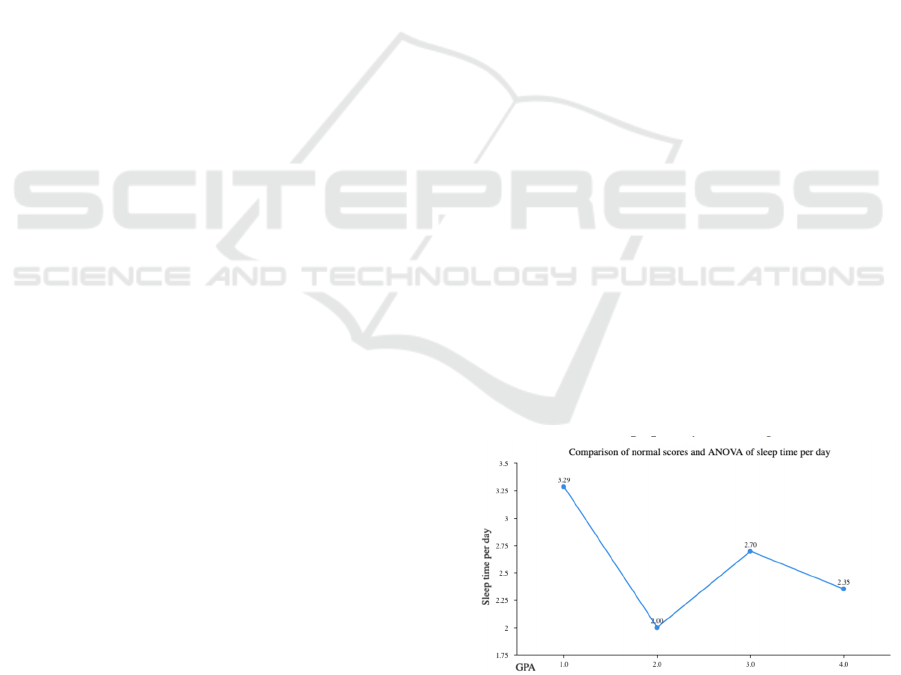
=3, excellent (above 90 points) =4. Table 1 and figure
1 are obtained
The relationship between academic performance
and sleep quality is not linear. Among other things,
when academic achievement scores were low, there
was cross-draft sleep quality (See Figure 1).
Figure 1 : Relation between academic achievement and
students' well-being (Photo/Picture credit: Original).
As can be seen from the table 1, all samples of
different ordinary scores have a significant effect on
the daily sleep time (p<0.05), which means that
APMM 2025 - International Conference on Applied Psychology and Marketing Management
156

different samples of ordinary scores have differences
in the daily sleep time. Specific analysis shows that:
Normal scores showed a 0.05 level significance
for daily sleep time (F=3.559, p=0.017), and the
specific comparison differences showed that the
average scores of the groups with significant
differences were "1.0>2.0; 1.0>4.0 "(it can also be
visually displayed using a line chart).
In summary, it can be seen that different samples
of normal performance have significant differences in
the daily sleep time.
Table 1. ANOVA results of the relation between academic
achievement and students' well-being.
Normal grade
(mean ± standard deviation)
Sleep time per day
1. 0(n=7) 3. 29±0. 95
2. 0(n=7) 2. 00±0. 58
3. 0(n=46) 2. 70±0. 94
4. 0(n=40) 2. 35±0. 86
F 3. 559
p 0. 017*
* p<0. 05 ** p<0. 01
6 CONCLUSION
The papers discuss a study that addresses the complex
relationship between sleep quality and academic
achievement, two very important subjects in the
realm of educational research. The core data for the
research originate from a random sample survey at a
high school in Beijing, with 156 questionnaires,
which have value but allow only limited
generalizability and representativeness. The limited
sample size may not representative of all sleep
patterns and academic performance from different
demographics and geographical and cultural
limitations of the study reduce generalizability of this
study to students in the Beijing area alone, perhaps
neglecting specific differences in educational
systems, ways of life, and cultural influence which
may modify the association of sleep and academic
performance elsewhere.
The research targets students in high school, not
covering a wider age bracket or level of education,
such as elementary school students or college
students. Moreover, the absence of follow-up data
does not allow for the establishment of the long-term
effects and stability of the relationship between sleep
patterns and academic performance. In this regard,
the methodological issue probably prohibits the paper
from acquiring in-depth analyses, since its basis only
lies in questionnaire surveys and literature reviews,
without experimental design or more profound
qualitative studies, such as interviews or case studies.
Although these limitations exist, the study shows
that good academic performance is achieved by
regular sleep, while disrupted sleep patterns impede
cognitive skills required for learning. It points out the
role of sleep in cognitive development and in the
regulation of emotions, important factors for
academic performance. Adequate sleep is not only
essential for physical and mental health, but it also
promotes cognition by enhancing learning and
memory.
It significantly provides a conceptual
underpinning and guiding framework within which
policy planners of educational disciplines place the
meaning of sleep in terms of academic successes to
develop educationally enlightened interventions. It
also underlines the need to understand that initiatives
aimed at boosting pupil welfare and achievement
have to incorporate multi-faceted approaches to this
issue in which sleep does or should stand central. By
catching up on lost sleep and practicing healthy sleep
habits, students will realize their full potential
academically and in general. Such findings might
translate into better educational interventions and
policies that support the cognitive development and
academic performance of students.
REFERENCES
Okano, K., Kaczmarzyk, J. R., Dave, N., Gabrieli, J. D. E.,
& Grossman, J. C. (2019). Sleep quality, duration,
and consistency are associated with better academic
performance in college students. npj Science of
Learning, 4(16).
Oi, M. J., & Miyake, Y. (2016). Short sleep duration and
health outcomes: A systematic review, meta-analysis,
and meta-regression. Sleep Medicine, 26, 56-73.
Liu, L. (2024). The Influence of Sleep Duration on
Academic Performance of Primary and Middle
School Students. Advances in Psychology, 14(3), 68-
73.
Hou, Y., Chen, X., & Zheng, H. (2020). Sleep Quality and
Its Relevant Factors among Undergraduates.
International Journal of Psychiatry and Neurology,
9(3), 60-67.
Cooper, C. B., Neufeld, E. V., Dolezal, B. A., & Martin, J.
L. (2018). Sleep deprivation and obesity in adults: A
The Relationship Between Sleep Quality, Sleep Duration and Students’ Academic Performance
157

brief narrative review. BMJOpen Sport & Exercise
Medicine, 4, 000392.
Fang, H. Y., Zhu, X. L., & Zhao, X. (2023). Sleep
quality’s impact on the academic performance of
children aged 10 to 12: The mediating role of
updating ability. Journal of Psychological Science,
46(5), 1090-1097.
Yang, D. L., Luo, C. Y., Sun, L. J., Zhou, Y. F., Zhang, Z.,
Qu, S. X., & Feng, X. G. (2018). Correlation analysis
of sleep duration and academic performance among
high school students in Shanghai. Shanghai Journal
of Preventive Medicine, 30(3), 194-197.
Qian, L., Ru, T., Luo, X., Niu, J., Ma, Y., & Zhou, G.
(2020). Effect of sleep restriction on cognitive
function and its underlying mechanism. Advances in
Psychological Science, 28(9), 1493–1507.
Long, X., Wu, H., Ma, Y., Zhang, S., & Yu, Z. (2020).
Study on the Relationship among Sleep Quality,
Emotion Regulation and Emotional Eating of College
Students. Advances in Education, 10(2), 200-209.
Sheng, Z. -F., & Zhang, Y. -H. (2013). Effect of Sleep on
Memory Consolidation. Acta Neuropharmacologica,
3(1), 37-47.
APMM 2025 - International Conference on Applied Psychology and Marketing Management
158
