
The Influence of Healthy Consumption Trend on Coca-Cola
Marketing Strategy
Yiying Zhang
Business Management, Singapore Institute of Management, Singapore, 999002, Singapore
Keywords: Innovation, Sustainability, Health.
Abstract: The Coca-Cola Company was established in 1886 and it ranks among the leading companies that deal with
the production of brands of beverages which include more than 200 brands that are sold in more than 200
countries. Through such strategies as product differentiation, sustainability, and innovation, the company has
continued to remain relevant in the market.However, the health effects of its tremendously popular sweetened
products have been an issue, hence it has responded with non-sweet products like Coca-Cola Zero Sugar and
Diet Coke. For environmental concerns, the company has focused on programs such as “World without
Waste”, in recycling, and other efforts that have been made towards sustainability. However, the organisation
has some threats such as competition, changing consumer awareness regarding health and obesity, and
regulations. It should grow its products with health benefits, increase focus on sustainability, embrace e-
commerce, and partner with wellness companies. These aspects and the subsequent strategies of Coca-Cola
to enter the emerging markets reveal the corporate intentions to maintain its dominant market position while
adapting to the new-age consumer and ecological imperatives.
1 INTRODUCTION
Coca Cola was founded in Atlanta Georgia in 1886
and has been in existence for 137 years. This mission
states “refreshing the world because it is different”
and has made the company the largest beverage
company globally (Chabrandmanagement, 2013).
Coca Cola Company has over 200 brands available in
over 200 countries and regions and is comprised of
some famous brands like Sprite, Minute Maid, Fanta
and Dasani (Chung et al., 2021). In response to
changing consumer preferences and an increasing
focus on healthy lifestyles, Coca-Cola has expanded
its offerings to include no-sugar options like Coca-
Cola Zero Sugar and Diet Coke, as well as low-
calorie products, aligning with the broader shift
towards healthier consumption choices.
In response to changing consumer preferences and
the growing focus on healthy lifestyles, Coca-Cola
continues to prioritize sustainable development
alongside product innovation. This commitment
reflects the company’s awareness of shifting market
demands while contributing to broader environmental
goals. The company has undertaken social
responsible programs to address some of the
environmental issues, including the “World without
Waste” program, where it is relentlessly working to
eliminate plastic waste, while its beverage bottles are
100% recyclable and made sustainably
(Hafizah Adnan and Sayadi, 2021). The constant
market presence and unchallenged brand voice of
Coca-Cola has placed the company among the most
valuable and recognizable in the world. The latter can
be attributed to constant striving to meet current
consumer needs, develop relevant products and
remain committed to sustainability.
2 SWOT ANALYSIS OF
COCA-COLA
Coca-Cola market position involves evaluation of
internal and external environments that comprise both
the strengths and weaknesses of the company as well
as opportunities and threats which is discussed below:
2.1 Strengths
Coca-Cola’s greatest advantage is the tremendous
brand power it holds in the market. Coca cola has been
of the largest brands known all over the world and it
has its operations in almost all the countries of the
globe (Jamshidifarsani et al., 2019). They are sold
68
Zhang, Y.
The Influence of Healthy Consumption Trend on Coca-Cola Marketing Strategy.
DOI: 10.5220/0014074100004942
Paper published under CC license (CC BY-NC-ND 4.0)
In Proceedings of the 2nd International Conference on Applied Psychology and Marketing Management (APMM 2025), pages 68-73
ISBN: 978-989-758-791-7
Proceedings Copyright © 2026 by SCITEPRESS – Science and Technology Publications, Lda.

practically in every country, in effect catering to a
diverse group of customers from all around the globe.
Another major strength is the availability of a large
sales network where products are available through
various outlets (Kottacheruvu, 2023). Coca-Cola
products are sold in supermarkets, restaurants and
through vending machines and any consumer can
easily purchase it. In addition, Coca-Cola has well-
established distribution networks, which enable the
company to offer its products to consumers around the
globe.
Coca cola products are almost available worldwide
and have a presence in many outlets such as stores,
restaurants, and vending machines. For instance,
while Coca-Cola is available in over 200 countries,
more than 3.9 million vending machines which are
distributed worldwide indicate expansion (Lovett et
al., 2020). This immense global network of operations
gives Coca Cola a competitive advantage in that it can
easily expand to new markets thus cementing its
position in the beverage market. The company’s
innovative capabilities also support its strengths,
especially in relation to shifts in consumers’ needs and
preferences (McMaster et al., 2020). For example, the
launch of healthier items such as Coca-Cola Zero
Sugar and Diet Coke show that the business can shift
to meet changing consumer requirements.
Besides, innovation is supported by Coca-Cola’s
wide product range, which includes more than 200
brands and appeals to a larger audience. The Coca-
Cola Company has its products as soft drinks, fruit
juices, bottles water, and energy drink among others
to ensure it fulfills the needs of the clients (Meng,
2024). This broad portfolio increases the company’s
market share and establishes Coca-Cola as a key
player in the beverage industry.
2.2 Weaknesses
However, Coca-Cola has some issues that limit its
competitive advantage. One of its major weaknesses
is that it is directly linked to sweetened beverages,
which have been under much scrutiny for being
positively related to obesity and diabetes, among other
ailments (Opait, 2020). This perception has adversely
affected Coca-Cola’s market share in the healthy
beverage segment, where players such as PepsiCo and
Nestlé have seized the opportunity and expanded their
presence. Furthermore, the firm has continued to
heavily focus on traditional products like the cola
beverages, and thus they lack product diversity in new,
health-conscious categories (Rosário et al., 2019).
Although Coca-Cola is trying to diversify its healthy
product offerings, the speed at which it introduces new
products is significantly slower compared to
competitors like PepsiCo, which launched X number
of new health-focused products last year
(Saleem Khasawneh, 2021). This slower pace makes
it difficult for Coca-Cola to capture the growing
market for healthier options. This overreliance on
traditional products may limit the capacity of Coca-
Cola to adapt to new customer needs.
2.3 Opportunities
The change toward increased awareness of healthy
nutrition is a clear positive for Coca-Cola in several
ways. Based on the relevance of the sugar-free and
low-sugar products to the consumers, Coca-Cola
possesses great potential to diversify in this area.
Thus, introducing new products like Diet Coke or
Coca-Cola Zero Sugar, along with successful case
studies from other brands in the low-sugar or sugar-
free segment, shows the prospect of growth in the
health-conscious drink industry (Anukeerthi and
Baranidharan, 2024). Further, governmental policies,
such as those promoting healthier lifestyles, reducing
sugar intake, and encouraging sustainable practices,
along with increasing level of public health
consciousness, provide the right background for
Coca-Cola to develop new products. Strategic
alliances with health organizations and the
introduction of new environmentally and health-
friendly products and services can enhance its
competitive position (Saleem Khasawneh, 2021).
Social media platforms allow Coca-Cola to spread its
influence widely, while the growth of e-commerce
provides new opportunities to engage with consumers
and expand its digital presence.
2.4 Threats
Coca-Cola Industry is one of the most competitive
Industries in the market where it is faced with strong
Competitors like PepsiCo, Dr. Pepper Snapple Group
and Nestle among others. This pressure of
competition has the net effect of prodding Coca-Cola
to look for differentiated products
(Chabrandmanagement, 2013). Other impacts include
increases in operating costs through the effects of
inflation on most important requisites like sugar and
aluminium. For instance, the price of sugar has risen
by 15% over the last five years and the price of
aluminum has risen by 20% for the same period.
These price increases have greatly affected
production and packaging expenses. However, the
social and environmental issue on plastic waste and
recycling still are concern to the sustainability of this
The Influence of Healthy Consumption Trend on Coca-Cola Marketing Strategy
69

company (Kottacheruvu, 2023). This means that if the
environmental issues are not addressed then the
image of Coca Cola brand and its consumers may be
negatively influenced.
3 PESTEL ANALYSIS OF
COCA-COLA
3.1 Political Factors
The political structure reflects a challenging political
environment that reacts to government policies across
the globe and affects Coca-Cola. New taxation
measures such as the Ireland and the UK sugar taxes
affect its traditional product portfolio given that it
directly targets Sugar-Sweetened Beverages (SSBs)
(Meng, 2024). Health advocacy movements also
further complicate Coca-Cola’s line of products.
However, its “World without Waste” sustainability
program helps to improve its image as a conscious
business and a part of global legislation to recycle and
preserve the environment. Despite challenges like
sugar taxes and health advocacy movements, Coca-
Cola's proactive initiatives, such as the 'World
without Waste' program, help mitigate these impacts,
keeping the negative effects of political factors within
a manageable range.
3.2 Economic Factors
Fluctuations in the global economy, which determine
inflation levels and increase in the cost of inputs like
sugar, aluminum and water, have a direct impact on
the Coca-Cola Company. The massive global
network reduces localized pressures but competitive
pricing for premium, health-conscious products is
vital (Rosário et al., 2019). However to appeal to the
masses, the company has to make the product
relatively cheap while at the same time ensuring that
it makes adequate profits. Growth in emerging
markets can be attributed to the increasing middle-
income population that demands differentiated prices
and promotion techniques to address their need.
3.3 Social Factors
Regarding social factors, the growing consumer
preference for healthier lifestyles has prompted Coca-
Cola to diversify its product range, offering healthier
options like Coca-Cola Zero Sugar and Diet Coke.
Customers are now more particular with the choice
they make and they are opting for beverages with less
sugar content, natural ingredients and even healthy
boosts. However, Coke has slightly lagged in this
segment compared to its competitors through the
launch of products such as Coca-Cola Zero Sugar and
Diet Coke (Lovett et al., 2020). Furthermore, the
generations in power want to buy and support the
brands that are environment friendly which is why the
environment responsibility of Coca-Cola is very
important for it.
3.4 Technological Factors
Coca-Cola continued to integrate technological
solutions to improve product innovation and
promotion. Advancements in technologies such as in
alternative sweeteners, enhanced packaging methods,
and increased research and development make it
possible to satisfy the needs of the consumers
(Selvaraj and Aziz, 2019). For instance, Coca-Cola's
investment in enhanced packaging methods, such as
lightweight aluminum cans and eco-friendly bottles,
reduces material costs while increasing profit
margins. Additionally, advancements in alternative
sweeteners allow for healthier product innovation.
The expansion of the e-commerce platform presents
opportunities to increase the company’s online
presence and market to a wider range of customers
since data analytics and artificial intelligence help in
targeting different customers.
3.5 Environmental Factors
Concerning corporate social responsibility, more
specifically environmental management, Coca-Cola
continues to invest in recyclable bottles, as well as
decreasing plastic production. However, issues like
water deficiency in critical production areas cannot be
ignored and proper water management should be
practiced (Suswanti, 2021). Government and
community partnerships, such as local water
conservation initiatives and recycling programs, can
address resource shortages. Moreover, Coca-Cola's
use of renewable energy in production processes,
including solar-powered facilities and energy-
efficient transportation, aligns with international
climate goals, reducing emissions and enhancing
environmental sustainability.
3.6 Legal Factors
Soft drinks manufacturers such as Coca-Cola equally
face strict legal restraints concerning health
information, packaging, promotion, and
environmental disposal. Failure to comply with the
APMM 2025 - International Conference on Applied Psychology and Marketing Management
70
regulation exposes one to penalties or fines and also
harms one’s reputation. To avoid such risks, the
company has to be transparent and adhere to the
changing laws (Anukeerthi and Baranidharan, 2024).
For Coca-Cola, protecting intellectual property is
critical in safeguarding its innovations, trademarks,
and brand assets. This ensures long-term stability and
maintains its competitive edge in a highly dynamic
market.
4 PERCEPTUAL MAP:
COCA-COLA VS.
COMPETITORS
A positioning map or perceptual map is a marketing
tool that can be helpful in an analysis of how
consumers view a certain brand or product compared
to its competitors (Jamshidifarsani et al., 2019). There
are two dimensions for positioning it where it slots
individual attributes such as price, quality, health
orientation, modernity, or taste, in accordance with
the consumers’ preference. Every product or brand is
located on the map based on its performance or
perceived by the consumer on those aspects. From the
map, it is easy to know how the brand is placed in the
market and sees areas where it is well positioned to
offer a point of difference. For instance, firms can
find that some market segments are underserved
while others are oversaturated and adapt their
offerings to fit the new consumer demand.
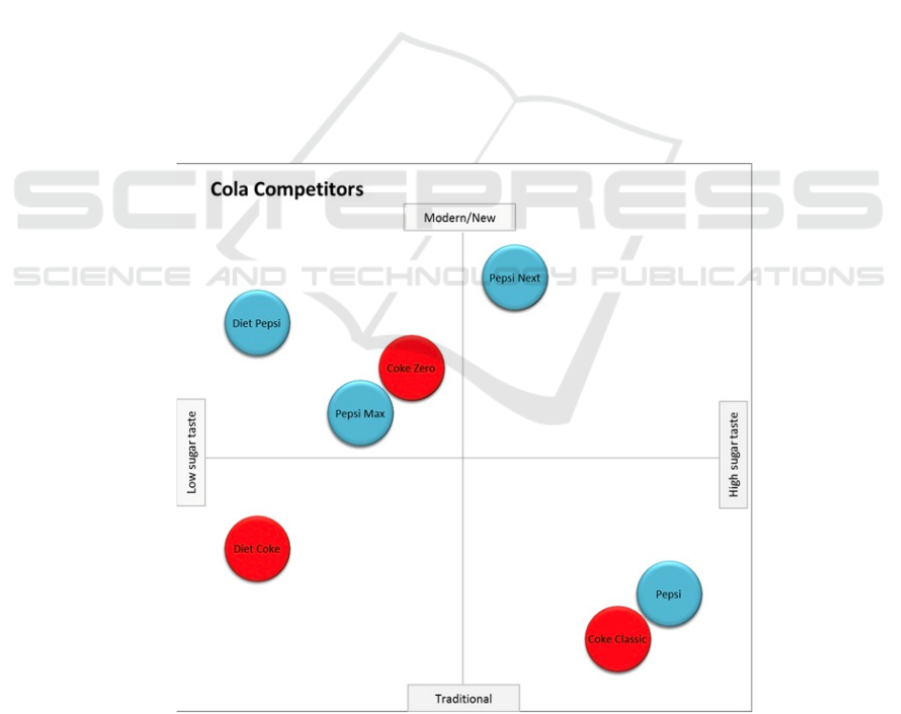
In the case of Coca-Cola and its competitors in the
soft drink industry, as shown in Fig.1, the positioning
map could have axes such as sugar level (low to high)
and formality (traditional to contemporary). It also
assists in visualizing competition where new product
ideas can be positioned against Coca-Cola and
competitors’ products like Pepsi and Diet Pepsi or
Coca-Cola Classic and Coca-Cola Zero Sugar. The
map highlights Coca-Cola's strong position in
traditional beverage segments and its growing
presence in health-conscious categories. However,
competitors like Pepsi are also strengthening their
footprint in these segments, presenting both
challenges and opportunities for Coca-Cola
(Chabrandmanagement, 2013). Through this
branding, it is easier for the Coca-Cola Company to
gauge market trends and modify its operations to
meet these new trends.
Figure 1. Perceptual Map (Photo/Picture credit: Original).
The Influence of Healthy Consumption Trend on Coca-Cola Marketing Strategy
71

5 SUGGESTIONS FOR
COCA-COLA
By aligning its strategies with consumer demands,
adapting to regulatory changes, and innovating its
product portfolio, Coca-Cola can maintain its
leadership in the global beverage industry.
5.1 Expanding Health-Oriented
Product Lines
Coca-Cola has to expand its portfolio of healthy
beverages as consumers increasingly look for
products that support healthy lifestyles. Apart from
Coca-Cola Zero Sugar and Diet Coke, the company
should launch beverages with functional attributes
including vitamins, probiotics, or antioxidants
(Wang, 2019). It can also diversify its offer utilizing
natural sweeteners such as stevia and focusing on
plant based or organic drinks that would attract
consumers interested in healthy diets. These
initiatives will help Coca-Cola to be relevant to the
modern trends and will enhance the company’s status
as an innovative company.
5.2 Strengthening Sustainability
Initiatives
While Coca-Cola has already developed the “World
without Waste” program, more profound initiatives
are needed. Making biodegradable or reusable
materials for packaging and working with
governments to improve the recycling system around
the world can further the environmental mission
(Selvaraj and Aziz, 2019). Strategies like waste
collection partnerships, renewable power utilization,
and consumer sensitization will put Coca-Cola at the
forefront of sustainability besides lowering on carbon
footprint. Such measures not only support
environmental goals but also align with rising
consumer demand for sustainable brands. Initiatives
like waste collection partnerships, renewable energy
adoption, and public awareness campaigns enhance
Coca-Cola's reputation and strengthen consumer
loyalty.
5.3 Enhancing e-Commerce and Digital
Presence
The rise of e-commerce presents opportunities for
Coca-Cola to connect directly with consumers.
Enhancing the organization’s digital presence and
providing subscription services for health beverages
can enhance accessibility for consumers
(Kottacheruvu, 2023). Using data analytic tools for
targeted marketing and product promotions on social
media pages and with the help of celebrities can
create hype among the target consumers and make
them more interested in the new Coca-Cola products
that are rated to be healthier.
5.4 Collaborating with Health and
Wellness Brands
Coca-Cola can seek endorsement from organisations
and companies that may promote health and wellness,
nutritionists, and fitness companies (McMaster et al.,
2020). Organizing events such as marathons and co-
creating products with doctors will show its intent
towards wellness, making Coca-Cola a wellness
company.
5.5 Targeting Emerging Markets with
Tailored Strategies
Emerging markets such as India, Indonesia, and
Nigeria offer significant opportunities due to their
growing middle-class populations and increasing
health consciousness. Coca-Cola can tailor its
strategies by offering affordable healthy options and
fortified beverages to meet nutritional needs in these
regions (Suswanti, 2021). The markets that are
health-conscious and sustainability-oriented will be
targeted through marketing promotional campaigns
that will ensure Coca-Cola captures these markets for
future growth.
6 CONCLUSION
Coca-Cola is a leading beverage company in the
global market, which has faced several issues and
threats and can explore new opportunities that will
help it maintain its dominance in the relevant market.
These factors make Coca Cola stand out in a
competitive and dynamic industry given the
company’s adaptability to customers’ changing needs
and the trend towards sustainability. In the context of
Coca Cola, this research seeks to discover the
strategic management areas that the company can put
its attention on through the application of SWOT
analysis and PESTEL factors. Key findings indicate
that brand power, broad range of products and
corporate social responsibility remain as key factors
that make Coca-Cola Company to stand out.
However, there are some threats like the increased
APMM 2025 - International Conference on Applied Psychology and Marketing Management
72

concern for health by consumers, competition from
health conscious brands, issues with laws that restrict
the sale of fizzy and sweet drinks. The responsiveness
of the company is evident through adaptation efforts
like offering sugar-free products and recyclable
packaging, but it shows that more can be done.
The recommendations provided in this paper
highlight a number of essential strategic directions for
Coca-Cola. Offering more health-oriented products,
including functional beverages and products with
plant-based ingredients, can help attract dietary
consumers. Expansion of the sustainability agenda
and bolstering of biodegradable packaging, recycling,
and affiliates shall ensure Coca-Cola adheres to
international environmental concerns. Furthermore,
future strategies such as the development of its e-
commerce platform and digitization allow for direct
selling of the products and an increase in consumer
interaction. Partnering with wellness organizations
and bringing focused strategies to fresh markets also
solidifies Coca-Cola in an evolving world.
Stakeholder engagement is central for understanding
and shaping systems where businesses like Coca-
Cola operate and achieve strategic relevance while
adhering to societal expectations. Besides, weaving
innovation with sustainability and adapting to new
consumer consumption tendencies, Coca-Cola
enhances its market leadership and promotes well-
being and sustainability worldwide, making the
company’s practices an example for emulation in
today’s historical context of businesses.
REFERENCES
Chabrandmanagement. . How Pepsi and Coke are perceived
by consumers. Coke vs Pepsi. (2013), Available online
at :
https://cokevspepsibm2013.wordpress.com/2013/12/0
7/how-pepsi-and-coke-are-perceived-by-consumers/
H.Q. Chung, V. Chen, & C.B. Olson. The impact of self-
assessment, planning and goal setting, and reflection
before and after revision on student self-efficacy and
writing performance. Read. Writ., 34 (2021)
N. Hafizah Adnan, & S.S. Sayadi. ESL students’ readiness
for self-directed learning in improving English writing
skills. Arab World Engl. J., 12(4), 503–520 (2021)
H. Jamshidifarsani, S. Garbaya, T. Lim, P. Blazevic, & J.M.
Ritchie. Technology-based reading intervention
programs for elementary grades: An analytical review.
Comput. Educ., 128, 427–451 (2019)
N. Kottacheruvu. Developing writing skills through English
short stories: A case study in the classroom. Int. J. Lang.
Lit. Stud., 5(1) (2023)
M.W. Lovett, J.C. Frijters, K.A. Steinbach, R.A. Sevcik, &
R.D. Morris. Effective intervention for adolescents with
reading disabilities: Combining reading and
motivational remediation to improve outcomes. J.
Educ. Psychol., 113(4) (2020)
K.L. McMaster, E.S. Lembke, J. Shin, A.L. Poch, R.A.
Smith, P.-G. Jung, A.A. Allen, & K. Wagner.
Supporting teachers’ use of data-based instruction to
improve students’ early writing skills. J. Educ.
Psychol., 112(1), 1–21 (2020)
S. Meng. Marketing strategy plan of Coca-Cola Company
in the UK. J. Innov. Dev., 6(2), 34–41 (2024)
G. Opait. The Coca-Cola and Pepsi-Cola businesses, „Fizzy
Meeting” in the management of the pole position. Ann.
Dunarea de Jos Univ. Galati Fasc. I Econ. Appl.
Inform., 26(1), 167–176 (2020)
P. Rosário, J. Högemann, J.C. Núñez, G. Vallejo, J. Cunha,
C. Rodríguez, & S. Fuentes. The impact of three types
of writing intervention on students’ writing quality.
PLoS ONE, 14(7), e0218099 (2019)
M.A. Saleem Khasawneh. Language skills and their
relationship to learning difficulties in English language
from the students’ point of view. Shanlax Int. J. Educ.,
9(4), 128–135 (2021)
S. Anukeerthi, & S. Baranidharan. Comparative analysis of
advertisement strategies used by Coca-Cola and Pepsi:
A literature review study. Shanlax Int. J. Arts Sci.
Humanit., 11(S3-Feb), 217–224 (2024)
M. Selvaraj, & A.A. Aziz. Systematic review: Approaches
in teaching writing skill in ESL classrooms. Int. J.
Acad. Res. Prog. Educ. Dev., 8(4) (2019)
H. Suswanti. Improving students’ reading comprehension
of procedure texts by using collaborative strategic
reading. TELL-US J., 7(1), 59–79 (2021)
M. Wang. Brief analysis of sports marketing strategy
adopted by Coca-Cola Company. Asian Soc. Sci.,
11(23) (2019)
The Influence of Healthy Consumption Trend on Coca-Cola Marketing Strategy
73
