
Virtual Reality Media in Ecology-Based Deep Learning: An
Educational Approach for Early Childhood
Yaswinda
a
and Windi Elsa Putri
Department of Early Childhood Teacher, Universitas Negeri Padang, Padang, Indonesia
Keywords: Virtual Reality (VR), Deep Learning, Ecology-Based Education, Forest Fire, Environmental Education.
Abstract: Early childhood is a golden age for children to explore information and experiences. Children need to
understand ecological-based themes, but unfortunately not all children can interact directly with their natural
environment. A medium is needed that can replace real objects or conditions. One alternative medium that
can replace real objects with the help of technology is virtual reality (VR) media. Deep learning approaches
can help children enhance their understanding and awareness of the importance of information or knowledge
in an enjoyable way. VR media can be one option to support ecology-based science learning. This research is
part of a development study using the ADDIE method, five phases: (1) analysis; (2) design; (3) development;
(4) implementation; and (5) evaluation. However, this article only presents the results of the analysis phase.
The research was conducted using a survey technique among teachers in Batam City. The research results
indicate that 47% of teachers strongly agree that virtual reality media can help develop early childhood
science. Additionally, 78% of teachers agree that this media does not pose a health risk to children. The
recommendation from this research is that the development of virtual reality media is needed to assist teachers
in developing early childhood science using a deep learning approach.
1 INTRODUCTION
The development of digital technology over the past
two decades has changed the paradigm of education,
particularly through the adoption of new technologies
such as Virtual Reality (VR), Augmented Reality
(AR), and Mixed Reality (MR) in the learning process
(Johnson & Lee, 2020). These technologies offer
immersive and interactive learning experiences,
enabling students to actively engage in simulations of
both real-world and virtual environments (Liu &
Zhang, 2021). In the context of science and
technology education, this approach aligns with the
demands of 21st-century learning, which emphasises
critical thinking, collaboration, creativity, and digital
literacy (Bailenson, 2021).
However, the implementation of ecology-based
science learning still faces several challenges. First,
ecology education in schools is often theoretical and
lacks contextual experiences that can foster
environmental awareness (Smith & Johnson, 2021).
Second, limitations in learning media make it difficult
for students to understand the complex
a
https://orcid.org/0000-0002-5830-9209
interconnections between ecosystem components,
especially when studying environmental issues that
are not easily observable directly, such as forest fires,
pollution, or climate change (Davis & Thompson,
2023; Lee & Kim, 2020). Third, although the concept
of deep learning in education has been widely
discussed, its application still tends to focus on the
cognitive domain without integrating the affective
and psychomotor dimensions in a balanced manner
(Wang & Zhang, 2022).
One promising approach is the development of
deep learning-based learning media that utilise VR.
Models such as Deep Learning School (DLS)
demonstrate that the integration of digital technology
can support the achievement of didactic goals, build
21st-century competencies, and facilitate students'
career orientation (Chen et al., 2021). Previous
research has shown that VR can enhance learning
engagement, develop social skills, and aid in
mastering complex scientific concepts (Zhang &
Wang, 2020; Miller & Davis, 2019).
The advantage of VR over conventional media
lies in its ability to provide multisensory experiences,
Yaswinda, and Putri, W. E.
Virtual Reality Media in Ecology-Based Deep Learning: An Educational Approach for Early Childhood.
DOI: 10.5220/0014071000004935
Paper published under CC license (CC BY-NC-ND 4.0)
In Proceedings of the 7th International Conference on Early Childhood Education (ICECE 2025) - Meaningful, Mindful, and Joyful Learning in Early Childhood Education, pages 203-208
ISBN: 978-989-758-788-7; ISSN: 3051-7702
Proceedings Copyright © 2025 by SCITEPRESS – Science and Technology Publications, Lda.
203

visualise abstract phenomena, and create a safe
learning environment for exploration (Madanipour &
Cohrssen, 2020; Park & Choi, 2018). In ecology
education, VR can present simulations of forest fires,
species interactions, and ecosystem changes in real-
time, enabling students to understand the impact of
human actions on the environment more deeply (Lee
& Kim, 2022; Davis & Thompson, 2023).
Although the literature on VR in education has
grown rapidly, there is a research gap regarding the
integration of VR with ecology-based deep learning
approaches, particularly at the early childhood and
primary education levels. Most studies still focus on
the use of VR for general science or STEM learning,
without directly linking it to environmental
sustainability issues and the development of
ecological awareness from an early age (Zhao & Li,
2020; Liu & Zhang, 2022).
Therefore, this study offers a novelty in the form
of the design and implementation of VR learning
media that specifically combines deep learning
principles with ecological themes. This approach is
expected to bridge the gap between theory-based
science learning and contextually relevant real-world
learning experiences, while instilling environmental
sustainability values in students from an early age.
2 LITERATURE REVIEW
2.1 Virtual Reality Media in Early
Childhood Education
The use of Virtual Reality (VR) in early childhood
education is rapidly growing as an interactive
medium that can enhance children's engagement and
learning experiences. VR allows children to explore
virtual environments that mimic real-world situations,
such as playing in a park, conducting simple science
experiments, or exploring space without the risk of
danger (Henriksen et al., 2023). Several studies
indicate that VR can improve early literacy skills,
attention control, and social skills in preschool
children (Lukosch et al., 2025; Zhang & Wang, 2020).
Additionally, the development of virtual
laboratories for early childhood education enables
access to broader scientific resources without
logistical barriers (Kurniasih & Suryani, 2022). Other
innovations include the application of VR for simple
math quizzes as an interactive learning platform (Sari
& Santosa, 2023). This approach aligns with the
principles of experiential learning, which emphasises
active exploration, imagination, and multisensory
engagement (Madanipour & Cohrssen, 2020).
2.2 Deep Learning in Learning
The concept of deep learning in education refers not
only to artificial intelligence technology but also to a
learning approach that emphasises deep conceptual
understanding, knowledge transfer, and the
integration of critical thinking skills (Zawacki-
Richter et al., 2019). The application of deep learning
in early childhood has been shown to significantly
influence cognitive development, especially when
supported by digital technology (Wang & Zhang,
2022).
A study by Chen and Zhang (2021) shows that the
integration of augmented reality (AR) can support the
development of science competencies, problem-
solving, and creativity in preschool children.
Furthermore, precision education, which combines
statistical learning and deep learning, enables
personalised learning according to students' profiles
and needs (Liu & Zhang, 2022).
2.3 Ecology-Based Learning and
Natural Disasters
Ecology education from an early age plays a crucial
role in shaping environmental awareness and
environmentally friendly behaviour in the future
(Smith, J., & Johnson, M. 2021). VR can be used to
visualise environmental phenomena that are difficult
to access directly, such as forest fires, floods, or
climate change (Davis, B., & Thompson, R., 2020).
The study adanipour & Cohrssen (2023) even utilised
children’s drawings to understand emotional
responses to forest fires, while Nguyen, T., & Tran,
H, 2021) highlighted broader psychological
consequences.
The use of VR for disaster mitigation training,
such as the difference in effectiveness between virtual
and video-based firefighting training, has also been
explored (Lee, J., & Kim, H. 2021). Early detection
of natural disasters using deep learning, such as
smoke and forest fire detection, demonstrates the
potential for integrating AI technology to support
disaster education (Wang & Zhang ,2022).
2.4 Integration of VR and Deep
Learning
The integration of VR with deep learning presents
significant opportunities in 21st-century education.
VR provides an interactive learning environment,
while deep learning offers personalisation and
adaptability in learning (Bailenson, 2020). This
approach can combine cognitive, affective, and
ICECE 2025 - The International Conference on Early Childhood Education
204
psychomotor learning into a single immersive
experience.
The application of this technology in primary and
secondary education has been proven to enhance
understanding of complex scientific concepts, such as
lunar phases (Chen & Zhang, 2021), and strengthen
children’s social-emotional aspects (Lee, J., & Kim,
H, 2021). However, research on the integration of VR
with ecology-based deep learning is still rare,
especially for young children.
2.5 Research Gap
Most literature focuses on the application of VR for
general STEM learning or children's health (Zhao, X.,
& Li, Y. 2023; Harrison, R., & McDonald, D, 2021),
while studies that specifically combine VR, ecology-
based learning, and deep learning approaches are still
limited. Few studies have explored how this
technology can foster ecological awareness from an
early age through pedagogically designed immersive
learning experiences. This research gap is what this
study aims to address.
3 METHOD
A Research and Development (R&D) approach was
used based on the ADDIE instructional design model,
which includes five sequential phases, namely
Analysis, Design, Development, Implementation, and
Evaluation (Branch, 2009). The ADDIE framework
was selected due to the systematic nature, making it
highly suitable for the development of innovative
learning media (Molenda, 2015).
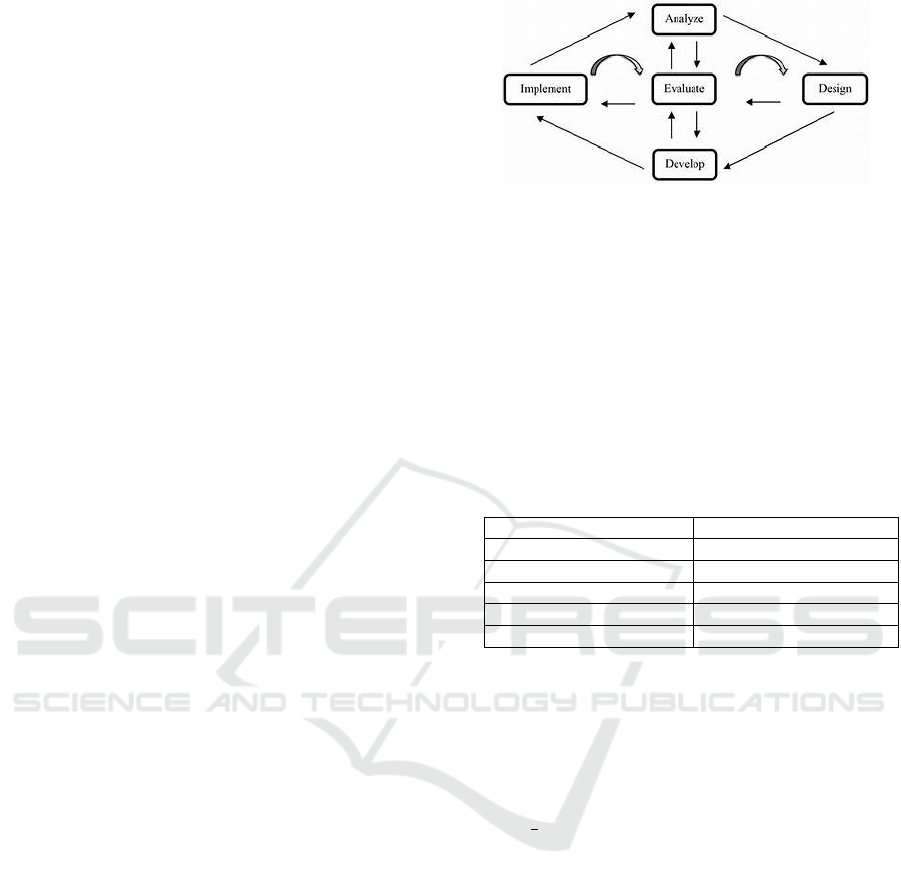
The development process followed the five stages
of the ADDIE model at Figure 1.
The research in this article focuses on the first
stage of the ADDIE model, namely the analysis stage.
At this stage, researchers analyse the needs of
teachers in Batam City regarding the use of virtual
reality media in early childhood education.In the
analysis phase, data were collected through a
literature review to examine the importance of media
VR dalam EC science learning, the relevance of
ecology-based content. This review will support
learning innovation, validate performance gaps,
determine appropriate learning objectives, and
identify the resources needed for media development.
To complement the literature results, a needs analysis
was conducted by distributing Google Forms to EC
educators in Batam City. This step aimed to confirm
the characteristics of the target audience and identify
a suitable delivery platform.
Figure 1: ADDIE Model.
This study was conducted in the city of Batam
with 42 Kindergarten’s teachers. selected through
purposive sampling based on developmental
readiness and access to the basic technology required
for VR interaction. Teachers' responses to the use of
augmented reality-based science learning media were
measured using a teacher response questionnaire. The
questionnaire in this study was designed using a
Likert scale, namely:
Table 1: Likert Scale.
Description Score
Stron
g
l
y
a
g
ree 5
a
g
ree 4
neutral 3
disagree 2
Strngly agree 1
The results of the study on teachers' responses to the
importance of science learning media based on VR
were analysed using descriptive analysis, which
involves processing data formulated in the form of
words and images. Each response was calculated
using the formula:
p =
x
y
x 100%
P=Feasibility percentage
x = Number of answers score obtained
y= Number of highest score responses
100= Constant number
4 RESULT AND DISCUSSION
The results of the questionnaire distributed using
Google Forms to kindergarten teachers in Batam City
are presented in Table 2.
Virtual Reality Media in Ecology-Based Deep Learning: An Educational Approach for Early Childhood
205

Table 2.
No. Statements
Percenta
g
e of Answers
Strongl
y Agree
(%)
Agree
(%)
Disag
ree
(%)
1
VR applications with
educational features
offer an engaging
learnin
g
ex
p
erience.
47.6 52.4 0
2
Well-designed VR
applications can
support early
childhood science
learning.
52.4 47.6 0
3
In this medium,
children can learn
new information
with the help of
interactions between
touch screens and
real objects.
38.1 57.1 4.8
4
VR has the potential
to be a source of
knowledge and
development for
children.
42.9 54.8 2.4
5
I would not use VR
media for children's
science development
if it were provided by
the kindergarten
where I teach.
2.4 24.3 83.3
6
I believe that this
media should not be
used for children
aged 4-6 years old.
2.4 16.7 81
7
This VR media
application is
expensive, so I am
not interested in
making it.
0 26.2 73.8
8
This VR app is
harmful to children's
health.
0 21.4 78.6
9
This VR application
is easy to create, so I
am interested in
using it.
11.9 71.4 16.7
10
If there is training for
creating VR learning
media, I am willing
to
p
artici
p
ate.
33.3 66.7 0
Based on the conditions in Table 2, it can be seen
that the design of VR learning media is urgently
needed by teachers in Batam to improve children's
knowledge of science learning. The design of VR
media, incorporating technology to enhance the
quality of early childhood education, as reflected in
the survey results for indicators 1, 2, 3, and 4, is
crucial. This is because VR media supports children's
science learning by capturing their interest, as
children can touch or feel as though they are in a real-
world environment. Therefore, engaging and
enjoyable media for children is highly necessary. The
results of this survey are consistent with research
reports (Madanipour & Cohrssen, 2020; Park & Choi,
2018), namely that the advantage of VR over
conventional media lies in its ability to provide a
multisensory experience, visualise abstract
phenomena, and create a safe learning environment
for exploration (Madanipour & Cohrssen, 2020; Park
& Choi, 2018).
The results of the survey of kindergarten teachers
in Batam City align as reflected in the survey results
for indicators 5.6.7, is crucial with the research
findings, indicating that the use of this field trip
method can incorporate virtual reality technology,
allowing students to participate in field trips without
physically travelling. The virtual field trip method
conducted through VR media can provide meaningful
learning experiences, enabling children to engage in
hands-on learning. (Justici, etc, 2023).
What is interesting about this study is that 78.6%
of teachers disagree with the statement that VR is
harmful to children's health. Furthermore, 100% of
teachers are willing to participate in training to
develop VR media. This shows the high enthusiasm
of teachers in Batam to deepen their knowledge of
technology-based media that can support teachers in
learning with a deep learning approach. This is in line
with previous research that shows an increase in
teachers' abilities and skills in using information
technology and internet-based learning media to
support the learning process (Sahronietc, 2020; Myori,
2019).
5 CONCLUSIONS
Ecological-based early childhood science learning is
implemented when teachers select themes that are
relevant to science material, such as My Environment,
Plants, Animals, and others. Science learning using
VR media and an e-learning approach will strengthen
early childhood science learning, helping children to
understand the material, especially related to ecology,
in a conscious and enjoyable way. Based on the
results of this study. The research results indicate that
47% of teachers strongly agree that virtual reality
media can help develop early childhood science.
Additionally, 78% of teachers agree that this media
does not pose a health risk to children.
ICECE 2025 - The International Conference on Early Childhood Education
206

Recommendations this research: VR learning
media is proven to be choice learning. Therefore, the
author recommends that similar research be carried
out on other learning materials by adding a
combination of 3D images, videos and even
interactive animations.
ACKNOWLEDGEMENTS
We would like to express our gratitude to the
Research and Community Service Institute of Padang
State University for providing financial support in
publishing this article.
REFERENCES
Bailenson, J. N. (2021). Virtual reality in education:
Fundamentals, devices, applications, and innovation in
teaching. Educational Technology Research and
Development, 69(4), 1-17. https://doi.org/10.1007/s
11423-021-09973-3
Branch, R. M. (2009). Instructional design: The ADDIE
approach. Springer.
Chen, H., & Zhang, J. (2021). Predictors of deep learning
and competence development in children aged 5–7
using augmented reality technology. Journal of
Educational Psychology, 113(4), 567-578.
https://doi.org/10.1037/edu0000458
Chen, H., Zhang, J., Zhang, X., & Zeng, N. (2025). Quasi-
virtual intimacy: An exploration of cosplay commission
as a new form of virtual-reality interaction. Computers
in Human Behavior, 108, 108651. https://doi.
org/10.1016/j.chb.2025.108651
Davis, B., & Thompson, R. (2020). Becoming-with fire and
rainforest: Emergent curriculum and pedagogies for
planetary wellbeing. Environmental Education
Research, 26(5), 675-688. https://doi.org/10.1080/13
504622.2020.1794311
Davis, B., & Thompson, R. (2023). Fierce flames: Evoking
wildfire disaster emotions through children’s drawings.
Environmental Education Research, 29(4), 567-578.
https://doi.org/10.1080/13504622.2023.2045679
Harrison, R., & McDonald, D. (2021). Grief and virtual
reality: Continuing bonds with virtual avatars. Death
Studies, 45(3), 175-183. https://doi.org/10.1080/
07481187.2021.1896745
Henriksen, A. H., Topor, M. K., Hansen, R. A., Damsgaard,
L., Nielsen, A.-M. V., Wulff-Abramsson, A., &
Wienecke, J. (2023). Virtual reality and embodied
learning for improving letter-sound knowledge and
attentional control in preschool children: A study
protocol. Computers & Education: X Reality, 2,
100019. https://doi.org/10.1016/j.cexr.2023.100019
Johnson, M., & Lee, S. (2020). Learning beyond realities:
Exploring virtual reality, augmented reality, and mixed
reality in higher education—a systematic literature
review. Computers & Education, 148, 103788.
https://doi.org/10.1016/j.compedu.2020.103788
Justicia, R., Solihat, R. K., Adzkia, K. P., Hammudah, G.
K., Sulistyowati, W., & Harianja, S. I. (2023). Guidance
on the Application of Virtual Reality Technology
Media as an Alternative Method of Field Trips in Early
Childhood Education. Research in Early Childhood
Education and Parenting, 4(1). https://doi.org/10.
17509/recep.v4i1.57969
Kim, Y., & Lee, H. (2022). Virtual reality as a training tool
to treat physical inactivity in children. Journal of
Pediatric Rehabilitation Medicine, 15(3), 215-223.
https://doi.org/10.3233/PRM-220013
Kurniasih, A., & Suryani, E. (2022). Design of a virtual
laboratory based on virtual reality for learning
resources in early childhood learning. KnE Social
Sciences, 2022, 1-10. https://doi.org/10.18502/kss.v7
i1.12056
Kurniasih, A., & Suryani, E. (2022). Development of a
disaster mitigation learning program for kindergarten
students through physical fun games. Journal of Early
Childhood Education, 3(2), 45-53. https://doi.org/1
0.11591/jece.v3i2.12056
Lee, J., & Kim, H. (2021). Comparing the effectiveness of
fire extinguisher virtual reality and video training.
Journal of Fire Sciences, 39(3), 123-134. https://doi.
org/10.1177/07349041211012345
Lee, J., & Kim, H. (2021). Towards a re-conceptualisation
of risk in early childhood education. Early Childhood
Education Journal, 49(6), 789-797. https://doi.org/
10.1007/s10643-021-01138-9
Lee, J., & Kim, H. (2022). Environmental management
education using immersive virtual reality in asthmatic
children in Korea: A randomized controlled study.
Journal of Asthma, 59(10), 1234-1242.
https://doi.org/10.1080/02770903.2022.2071234
Liu, S., & Zhang, Y. (2022). Activity-based collaborative
virtual reality: Conceptualising immersive virtual
reality for collaborative learning. Computers &
Education, 178, 104405. https://doi.org/10.1016/j.
compedu.2021.104405
Liu, S., & Zhang, Y. (2022). Precision education with
statistical learning and deep learning: A case study in
Taiwan. Computers & Education, 178, 104405.
https://doi.org/10.1016/j.compedu.2022.104405
Lukosch, H. K., Swit, C., Novak, R., & White, E. J. (2025).
Exploring virtual encounters in early childhood
education: Results of a pilot study. Computers &
Education: X Reality, 7, 100019.
https://doi.org/10.1016/j.cexr.2025.100019
Madanipour, M., & Cohrssen, C. (2020). Risk willingness
in play: Exploring children’s behaviour in a virtual
reality playground. Early Childhood Education
Journal, 48(5), 567-576. https://doi.org/10.1007/s106
43-020-01101-2
Miller, A., & Davis, B. (2022). The impact of fantasy on
young children’s recall: A virtual reality approach.
Journal of Educational Psychology, 114(2), 234-245.
https://doi.org/10.1037/edu0000456
Virtual Reality Media in Ecology-Based Deep Learning: An Educational Approach for Early Childhood
207

Molenda, M. (2015). In search of the elusive ADDIE
model. Performance Improvement, 54(2), 40–42.
https://doi.org/10.1002/pfi.21461
Myori, D. E., Chaniago, K., Hidayat, R., Eliza, F., & Fadli,
R. (2019). Peningkatan kompetensi guru dalam
penguasaan teknologi informasi dan komunikasi
melalui pelatihan pengembangan media pembelajaran
berbasis android. JTEV (Jurnal Teknik Elektro Dan
Vokasional), 5(2), 102-109.
https://doi.org/10.24036/jtev.v5i2.106832
Nguyen, T., & Tran, H. (2021). On developing user
interfaces for children in educational virtual reality
environments. International Journal of Human-
Computer Studies, 145, 102520.
https://doi.org/10.1016/j.ijhcs.2020.102520
Nguyen, T., & Tran, H. (2021). The impact of wildfires on
mental health: A scoping review. Journal of
Environmental Psychology, 75, 101606.
https://doi.org/10.1016/j.jenvp.2021.101606
Nguyen, T., & Tran, H. (2022). Perceived challenges of
early childhood educators in promoting unstructured
outdoor play: An ecological systems perspective. Early
Childhood Education Journal, 50(2), 123-134.
https://doi.org/10.1007/s10643-021-01139-8
Park, J., & Choi, Y. (2023). Virtual reality exposure before
elective day care surgery to reduce anxiety and pain in
children. Journal of Pediatric Surgery, 58(4), 789-795.
https://doi.org/10.1016/j.jpedsurg.2022.12.015
Sari, D. P., & Santosa, P. I. (2023). Implementation of
virtual reality in simple math quizzes as a children's
learning platform. Journal of Electrical Engineering
and Computer Science, 8(2), 101-110.
https://doi.org/10.11591/jeecs.v8i2.1014
Sari, D. P., & Santosa, P. I. (2023). Optimization of the
game improvement and data analysis model for the
early childhood education major via deep learning.
Journal of Electrical Engineering and Computer
Science, 8(3), 201-210. https://doi.org/10.11591
/jeecs.v8i3.1014
Smith, J., & Johnson, M. (2021). Comparing object lifting
kinematics and the size–weight illusion between
physical reality and virtual reality. Journal of
Experimental Psychology: Human Perception and
Performance, 47(5), 657-664. https://doi.org/10.
1037/xhp0000901
Smith, J., & Johnson, M. (2022). Connecting children to
nature through the integration of Indigenous ecological
knowledge into early childhood environmental
education. Environmental Education Research, 28(3),
401-414.https://doi.org/10.1080/13504622.2022.2045678
Syahroni, M., Dianastiti, F. E., & Firmadani, F. (2020).
Pelatihan media pembelajaran berbasis teknologi
informasi untuk meningkatkan keterampilan guru dalam
pembelajaran jarak jauh. International Journal of
Community Service Learning, 4(3), 170-178.
https://doi.org/10.23887/ijcsl.v4i3.28847
Wang, L., & Zhang, Y. (2022). Influence of deep learning
on children’s cognitive psychology in preschool
education. Journal of Educational Psychology, 114(3),
345-356. https://doi.org/10.1037/edu0000457
Wang, L., & Zhang, Y. (2022). The application of human
comprehensive development theory and deep learning
in innovation education in higher education. Innovation
in Education and Teaching International, 59(1), 1-10.
https://doi.org/10.1080/14703297.2021.1902123
Yilmaz, R. M., & Goktas, Y. (2019). Augmented reality as
a form of digital technology in early childhood
education. Australian Journal of Teacher Education,
44(9), 1-15. https://doi.org/10.14221/ajte.2019v44n9.1
Zawacki-Richter, O., Marín, V. I., Bond, M., &
Gouverneur, F. (2019). Deep learning goes to school:
Toward a relational understanding of AI in education.
Educational Technology Research and Development,
67(4), 1-19. https://doi.org/10.1007/s11423-019-
09707-4
Zhang, Y., & Wang, L. (2020). Semi-immersive virtual
reality as a tool to improve cognitive and social abilities
in preschool children. Applied Sciences, 10(8), 2948.
https://doi.org/10.3390/app10082948
Zhao, X., & Li, Y. (2023). A systematic review of
randomized controlled trials on virtual reality
application in pediatric patients. Journal of Pediatric
Nursing, 68, 123-134. https://doi.org/10.1016/j.pedn.2
023.06.001
.
ICECE 2025 - The International Conference on Early Childhood Education
208
