
Application of Deep Learning in Meaningful Learning, Through
Fun Learning Practices in Kindergarden
Dadan Suryana
1a
and Ayu Mustika Sari
2b
1
Universitas Negeri Padang, Indonesia
2
STITNU Sakinah Dharmasraya, Indonesia
Keywords: Deep Learning, Meaningful Learning, Through Fun Learning, Kindergarden.
Abstract: This research is conducted to see the effectiveness of deep and enjoyable learning for early childhood, which
can involve all of the child's senses and maximally stimulate the child's growth and development based on the
principles of Mindful, Meaningful, and Joyful learning. Research conducted at TK Islam Terpadu Yadiaksa
Dharmasya, Learning theme of Vegetable Plants. This study uses a quantitative research method with a type
of Quasi Experimental Design and a form of Nonequivalent Control Group Design. The instruments used in
this research employ an observation sheet in the form of a checklist (√). The data collection techniques in this
research use observation techniques and documentation techniques. The data analysis techniques in this
research test validity, descriptive statistics, normality, independent sample t-test, homogeneity, and paired
sample t-test using statistics with the help of SPSS. Based on the calculated t value using the t-test with Sig.
(2-tailed) = 2.563 < 2.048, this means that Ha is accepted and Ho is rejected. Based on the results, it can be
concluded that there is an influence of Deep Learning Implementation on the kognif development of children
in Kindergarten. The statistical test using the t-test with a significance level of 0.05% resulted in a t-value
obtained (2,568) > t-table value (2.048), thus H0 is rejected. Based on the research results, it can be concluded
that deep learning influences children's motor development. Deep learning is more effective in stimulating
children's motor development. This research has found that deep learning has a significant impact on the
motor development of children in kindergarten.
1 INTRODUCTION
Kindergarten as the foundational stage of education
faces challenges in creating interactive, enjoyable
learning methods that are suitable for children's
characteristics. In this context, deep learning can play
a role in enhancing the effectiveness of learning.
Deep learning refers to a learning approach that
encourages deep understanding, active engagement,
and the ability to apply knowledge in various
contexts. Deep learning is a process involving strong
contextual understanding that goes beyond mere
memorization of information (Mehta 2019). Deep
learning includes the acquisition of 6 global
competencies: citizenship character, collaboration,
communication, creativity, and critical thinking
(Fullan, M., Quinn, J., & McEachen, J. 2017). This
approach is taken to produce learning that not only
a
https://orcid.org/0000-0002-0953-3124
b
https://orcid.org/0009-0008-3158-6442
masters the content but is also able to apply
knowledge to solve problems in the real world. In
applying deep learning, there are at least three main
pillars that are used as a foundation in its application
or implications. The three main pillars are mindful
learning, meaningful learning, and joyful learning
(Mehta, J., & Fine, S. 2019). Deep learning as the
acquisition of 6 global competencies: citizenship
character, collaboration, communication, creativity,
and critical thinking (Fullan, M., Quinn, J., &
McEachen, J. 2017). This approach is implemented to
produce learning that not only masters the content but
also applies knowledge to solve real-world problems.
In implementing deep learning, there are at least three
main pillars used as a foundation for its application or
implications. The three main pillars are mindful
learning, meaningful learning, and joyful learning
(Mehta, J., & Fine, S. 2019).
258
Suryana, D. and Sari, A. M.
Application of Deep Learning in Meaningful Learning, Through Fun Learning Practices in Kindergarden.
DOI: 10.5220/0014070400004935
Paper published under CC license (CC BY-NC-ND 4.0)
In Proceedings of the 7th International Conference on Early Childhood Education (ICECE 2025) - Meaningful, Mindful, and Joyful Learning in Early Childhood Education, pages 258-263
ISBN: 978-989-758-788-7; ISSN: 3051-7702
Proceedings Copyright © 2025 by SCITEPRESS – Science and Technology Publications, Lda.

Mindful Learning is an approach that encourages
children to learn with full awareness of what they are
doing, feeling, and learning. It helps children build
focus and emotional regulation (Fullan, M., Quinn, J.,
& McEachen, J 2017). Meaningful Learning means
learning that is connected to the child's experiences
and the real world. It helps children form meaning
and build long-term understanding. Joyful Learning
emphasizes that the learning process should be
enjoyable and involve positive feelings, as good
emotions support engagement and memory (Taguma,
M., & Barrera, M. 2019).
Due to the extensive scope of this research, the
researcher focuses more on how deep learning with
Mindful Learning, Meaningful Learning, and Joyful
Learning can stimulate children's cognitive
development. Cognitive development in early
childhood can be defined as knowing or the process
of knowing, organizing, and using knowledge
(Hasibuan & Suryana, 2021). Cognition is the ability
to learn, think about learning new concepts,
understand what is happening in the surrounding
environment, and the skill of using memory
(Draganoudi et al., 2021). Cognitive can also be
defined as the ability to understand something. The
ability to comprehend something, with a child’s
cognitive ability, they will be able to act and choose
between right and wrong, and solve problems in their
lives. Cognitive development for children aged 4-6
years includes (1) learning through problem-solving
(2) logical thinking, (3) symbolic thinking.
(Ministerial Regulation No. 4 of 2022). A child's
cognitive development is also influenced by their
inner child (Suriana, 2023) therefore the environment
needs to stimulate the child's development. The
importance of implementing learning is to help
children solve problems that exist in their
environment (Junita et al., 2021). facilitating children
to understand the theme (Rofieq et al., 2019),
enhancing problem-solving development, logical
thinking (Ummah et al., 2019). The implementation
of deep learning is effective to apply because it can
enhance children's development in Kindergarten
(Valen & Satria, 2021; Natty et al., 2019), deep
learning is implemented in Kindergarten to improve
children's development (Faridah et al., 2022; Abidin
et al., 2020). In the implementation of deep learning,
we will also need technological media, in this case,
the researcher uses educational game media.
Educational games have been effective in enhancing
child development (Suryana, 2024; Rakimahwati &
Hanifah, 2022), educational games can improve
concentration (Rakimahwati & Hanifah, 2022;
Borman & Erma, 2018), problem-solving skills
(Harris & Isyanti, 2021), stimulate children to
develop, and can generate ideas for determining the
learning to be conducted (Suryana, 2025).
Development can enhance cognitive development in
children (Langer, E. J. 2020, Fullan, M., 2017,
Ramakrishnan, K, 2024).
2 METHOD
This research is a quantitative experimental study,
using two classes, namely a control class and an
experimental class. The implementation of the
research was conducted by comparing the two
classes, where one class was treated using a deep
learning model and the control class was treated using
conventional teaching methods, group learning in the
classroom, or teacher-centered learning. In this study,
the population consists of 30 children in kindergarten,
with two different classes, 15 children in the
experimental class, and 15 children in the control
class. This research was conducted at TK Islam
Terpadu Yadiaksa in West Sumatra.
The instrument used in this study is an
observation sheet in the form of a checklist (√). The
data collection techniques in this study use
observation techniques and documentation
techniques. The data analysis techniques in this study
test validity, descriptive statistics, normality,
independent sample t-test, homogeneity, and paired
sample t-test using statistics with the help of SPSS.
Based on the calculated t value using the t-test with
Sig. (2-tailed) = 0.001 < 0.05, this means that Ha is
accepted and Ho is rejected.
Evaluation Criteria for tools to measure motor
skills in kindergarten children using tools to assess
motor development, with a numerical scale ranging
from 1 to 4, corresponding to different degrees of
development: (1) Not Developed; (2) Starting to
develop; (3) Developing as expected; (4) Developing
Very well. The assessment tool used is a daily
checklist for children's motor development. This
instrument was first tested for validity (authenticity)
and reliability (dependability). Data obtained from
the daily checklist were analyzed using homogeneity
and normality tests. The post-test homogeneity test
aims to determine the follow-up for the difference test
(t-test) that will be used. The normality test of the data
aims to determine whether the final test data is
normally distributed or not.
Application of Deep Learning in Meaningful Learning, Through Fun Learning Practices in Kindergarden
259
3 RESULT AND DISCUSSION
3.1 Result
The result of the implementation of deep learning in
the Integrated Islamic Kindergarten Yadiaksa aimed
at providing experiences and stimulating children's
cognitive development, as preparation for their daily
lives. The effectiveness of the learning was tested
using hypothesis testing with a t-test. Before
conducting the t-test, normality and homogeneity
tests were performed on the research results. After
conducting normality tests on the experimental and
control classes, Ho and Ha were obtained at a
significance level of 0.05, and for N15, it can be seen
in table 1 below.
Table 1: Results of the Liliefors test calculations for the
Experimental Class and Control Class.
No Class N Lo Lt note
1. Ex
p
eriment 15 0.1783 0.22 Normal
2. control 15 0.1641 0.22 Normal
In Table 1. Above, the experimental class has a
calculated L value of 0.1783, which is less (<) than
the table L value of 0.22 for α 0.05. The experimental
class value is derived from normally distributed data.
In the control class, a calculated L value of 0.1641 is
obtained, which is also less (<) than the table L value
of 0.22 for α 0.05. This means that the control class
data also comes from normally distributed data. The
homogeneity test was carried out using the Bartlett
test. This test is conducted to see whether the data
comes from homogeneous classes, between the
experimental class and the control class. If the
calculated chi-square is < the table chi-square, it
means the data comes from a homogeneous class.
Effectiveness Percentage = Ideal Score / Maximum
Score x 100%.
Table 2: Results of Homogeneity Test Calculation.
Class A X2hitung X2tabel Conclusion
Ex
p
eriment 0.05 0.1512 3.841 Homo
g
en
Control 0.05 N
Table 2 above shows the results of the X2
calculation in the experimental class and the control
class, where it is larger than the X2 table (X2
calculated < X2 table), indicating that the
experimental class and the control class have
homogeneous variance. After conducting normality
and homogeneity tests, it was found that both sample
classes are normally distributed and have
homogeneous variance. Therefore, hypothesis testing
can proceed using the t-test technique.
If t calculated > t table, then the null hypothesis is
rejected and the alternative hypothesis is accepted.
If t calculated < t table, then the null hypothesis is
accepted and the alternative hypothesis is rejected.
The following will illustrate the data processing
with the t-test.
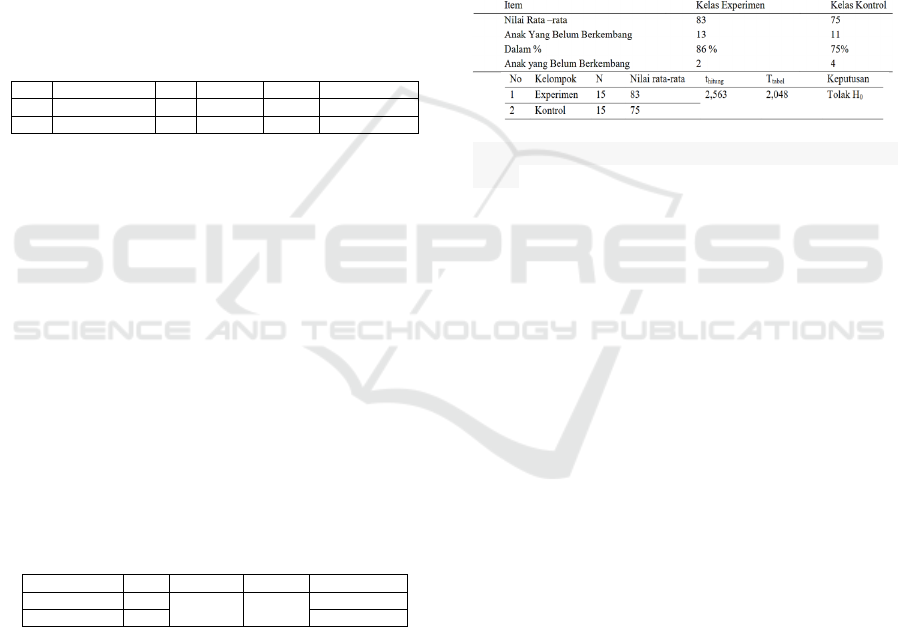
Based on the results of the child development
observation sheet conducted by the teachers, the
average development score of the experimental class
is 83.02, which is greater than the control class score
of 75.07. Thus, the deep learning in the integrated
Islamic kindergarten Yadiasa can be clearly seen in
the table below.
Table 3: Effectiveness of Deep Learning to Improve
Children's Cognitive Development.
The following will describe data processing using the
t-test:
In the table above, the df table for a significance
level of α=0.05 (5%) shows a critical t value of 2.048,
thus the calculated t value is greater than the critical t
value (2.563 < 2.048). Therefore, the hypothesis H a
is accepted and H o is rejected. It is concluded that
there is a significant effectiveness on the stimulation
of children's cognitive development when using deep
learning. The average score obtained by learning
using deep learning is higher than that of the class
using other methods. This research acknowledges that
the use of deep learning is very effective in
kindergarten education. The hypothesis test
conducted to see the difference in scores between the
experimental class and the control class is suspected.
There are two hypotheses in this study, namely the
first hypothesis (H0), which is a preliminary
assumption of the research, and the second hypothesis
(H1), which can be seen from the results of the
research conducted. From the T-test, we can observe
the average in each control group and experimental
group. Thus, the results of the hypothesis testing
show the difference in the effectiveness of deep
learning and conventional learning models. The deep
learning model can enhance children’s development
in kindergarten. The success of the research is proven
by the increase in children's cognitive development.
The data analysis results obtained show that deep
learning has a significantly greater impact on
children's cognitive development than the
conventional learning model.
ICECE 2025 - The International Conference on Early Childhood Education
260
Education in Kindergarten (TK) plays a crucial
role in shaping the foundation of a child's overall
development. During this time, children are in a phase
of exploration, play, and learning through concrete
experiences. In the context of the Independent
Curriculum which emphasizes differentiated learning
and the psychological well-being of children, the
application of deep learning technology can be one of
the important innovations. On the other hand, the
approaches of Mindful Learning, Meaningful
Learning, and Joyful Learning are increasingly
recognized as essential elements in early childhood
education. With deep learning technology, learning
can be adaptively tailored to children's needs in real-
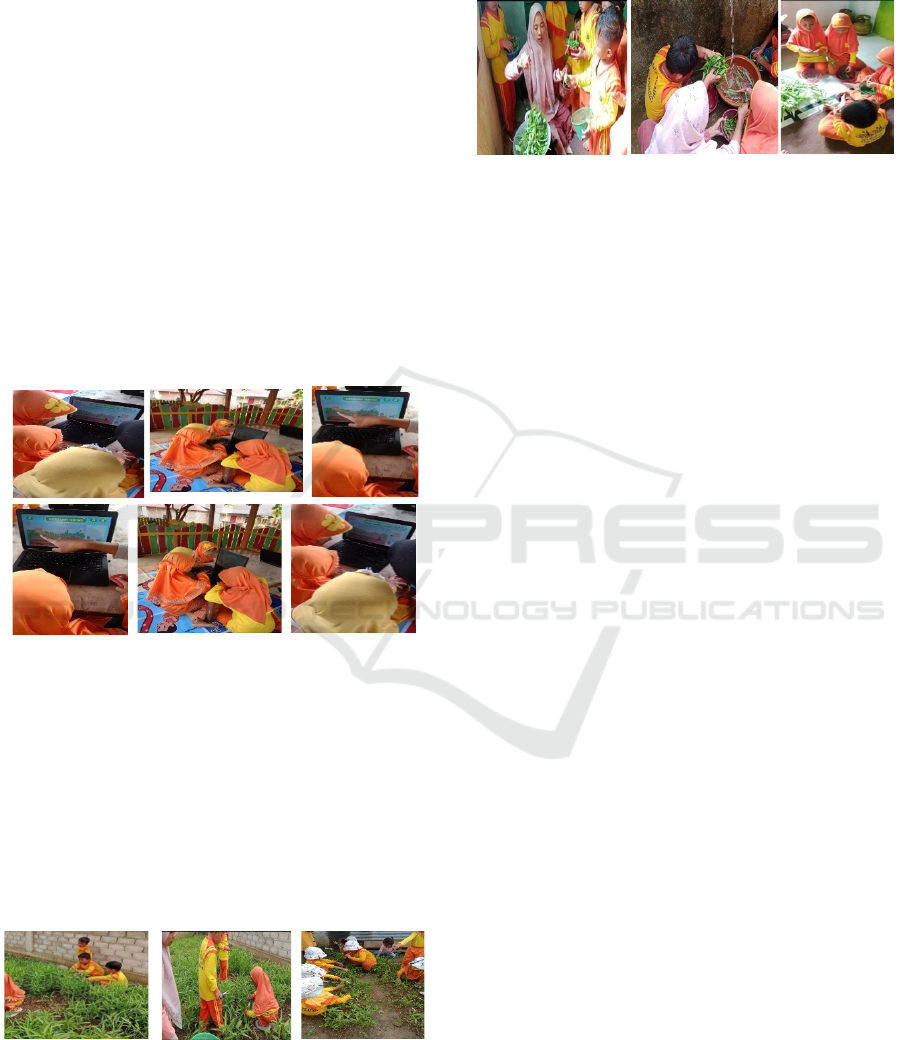
time.An example of how Mindful Learning can be
implemented is by introducing the topic of plants,
which will be learned through educational games and
instructional videos. By using educational videos, the
benefits of vegetables, various types of vegetables,
and how to plant vegetables will be explained.
Figure 1: Mindful Learning activities.
After the child understands the concept, it is
continued with the form of Meaningful Learning.
Meaningful Learning means learning that is
connected with the child's experiences and the real
world. It helps the child to form meanings and build
long-term understanding. In this activity, children
will be taken to a vegetable garden, where they will
be taught how to plant vegetables and pick
vegetables; in this case, the children will be directly
involved.
Figure 2: Meaningful Learning Activities.
The Joyful Learning approach emphasizes that the
learning process should be enjoyable and involve
positive feelings, as good emotions support
engagement and memory retention. In support of this,
educators will harvest vegetables together with the
children and cook the vegetables at school.
Figure 3: The form of Joyful Learning.
Based on the results of implementing deep
learning at the Integrated Islamic Kindergarten
Yadiaksa, focusing on vegetables. It was found that
the implementation of deep learning makes children
enthusiastic during activities, helps them understand
that vegetables are healthy food, fosters a love for
plants, and a liking for vegetables. Most importantly,
it stimulates children's cognitive abilities, enhances
problem-solving skills through games, encourages
critical thinking, symbolic thinking can be stimulated,
and through the practice of planting vegetables,
harvesting them, and cooking vegetables, children
can think logically, solve problems, and become more
independent. Overall, the deep learning model can
enhance six aspects of children's development, in
addition to providing benefits for the children,
Among other things, it can strengthen children's
character in developing active potential, children can
also design their own learning, so that they can be
skilled, have a resilient attitude, and possess
knowledge in carrying out projects, children can
manage the allotted time. (Sulistyani Puteri
Ramadhani, Zulela MS, 2021) Deep learning can also
train the ability to solve problems, be responsible and
care for the surrounding environment, as well as take
pride in the results achieved. Meanwhile, the
weakness of deep learning implementation is that
educators are not yet able to design themes to the
fullest because deep learning has not been commonly
integrated into the teaching and learning process
(PBM) so far. Educators are still struggling and need
habituation to link with theme and sub-theme
materials. In addition, the activities conducted have
the potential to consume a lot of time because
children enthusiastically dig for information, making
them lose focus on the results of their practice.
Moreover, educators are also unable to provide
examples of products that can serve as input sources
because deep learning is relatively new for preschool-
aged children. Teachers do not feel they have
maximized in creating modules and lesson plans
Application of Deep Learning in Meaningful Learning, Through Fun Learning Practices in Kindergarden
261

(RPP) due to the absence of a comprehensive
guidebook for teachers on deep learning, especially in
Kindergarten. It is also challenging for teachers to
observe student progress because there is no clear
assessment guidebook for deep learning. That deep
learning affects children's thinking creativity, because
in deep learning they are stimulated to be able to
generate ideas, work in groups, and produce creative
projects. Abidin et al. (2020) also conducted research
showing that deep learning is effective in enhancing
child development. The deep learning model
influences child development because in both the
experimental and control classes, descriptively, the
development of children using deep learning is higher
compared to the control class.
4 CONCLUSIONS
The effectiveness of deep learning in the Integrated
Islamic Kindergarten Yadiaksa is effective in
stimulating children's cognitive development,
evidenced by the average differences between the
experimental class and the control class. The
assessment was carried out through observational
activities when children were engaged in play,
observational assessments from the results of deep
learning activities, as well as assessments using daily
checklist sheets. The evaluation results show that the
standard level of child development achievement can
develop as expected, with an average of 83% of all
development aspects and indicators being at the
expected developmental stage (BSH) and very good
development stage (BSB) after using deep learning.
The application of deep learning can realize active
group learning, which can enhance children's
development. The activities of deep learning
undertaken by children develop their talents and
creativity, as well as conceptual understanding, which
can be achieved through problem-solving alongside
deep learning activities within a specified timeframe.
Deep learning conducted by children in group
activities can increase children's skills and
responsibility towards assigned tasks, thus allowing
them to develop and be optimally stimulated. Deep
learning in kindergarten has great potential to support
the Mindful, Meaningful, and Joyful Learning
approach, creating adaptive, personalized, and
enjoyable learning experiences. However, the success
of this integration heavily relies on teachers'
readiness, technological infrastructure, and the
selection of child-friendly applications. Therefore,
teacher training and inclusivity need to be a primary
focus.
ACKNOWLEDGEMENTS
This research is supported by Padang State
University through the 2025 Research program. We
are very grateful for the financial support provided.
REFERENCES
Abidin, Z., Utomo, A. C., Pratiwi, V., & Farokhah, L.
(2020). Pembelajaran Project Based Learning –Literasi
Dalam Meningkatkan Kemampuan Penalaran
Matematis Siswa Di Sekolah Dasar. Educational
Journal of Bhayangkara, 1(1), 30–36. https://doi.org
/10.31599/Edukarya.V1i1.106
Aisyah. (2019). Jurnal Basicedu. Jurnal Basicedu, 3(2),
524–532.
Am Mahasneh, A.A. (2018). The Effect of Project-Based
Learning on Student Teacher Self-Efficacy and
Achievement. International Journal Of Instruction.
Ambarwati, D., & Kurniasih, M. D. (2021). Pengaruh
Problem Based Learning Berbantuan Media Youtube
Terhadap Kemampuan Literasi Numerasi Siswa. Jurnal
Cendekia : Jurnal Pendidikan Matematika, 5(3), 2857–
2868. Https://Doi.Org/10.31004/Cendekia.V5i3.829
Ausubel, D. P., Novak, J. D., & Hanesian, H. (1978).
Educational psychology: A cognitive view.
Ayu Mustika Sari & Maldin Ahmad Burhan. (2020).
Pengembangan Perangkat Pembelajaran Berbasis
Model Sentra. Jurnal Pendidikan Teknologi Kejuruan,
5(1), 76–80.
Ayuningsih, F., Malikah, S., Nugroho, M. R., Winarti, W.,
Murtiyasa, B., & Sumardi, S. (2022). Pembelajaran
Matematika Polinomial Berbasis Steam Pjbl
Menumbuhkan Kreativitas Peserta Didik. Jurnal
Basicedu, 6(5), 8175–8187. https://doi.org/10.31004/
Basicedu.V6i5.3660
Bentri, A. (2017). A Model of Local Content Disaster-
Based Curriculum. International Journal of Geomate,
13(40), 140–147.
Crowley, B. M. (2016). The Effects of Problem-Based
Learning on Mathematics Achievement of Elementary
Students Across Time. Masters Theses & specialist
Project, https://digitalcommons.wku.edu/ theses/1446/
Darling-Hammond, L., Herman, J., Pellegrino, J., Abedi, J.,
Aber, J. L., Baker, E., & Steele, C. M. (2013). Criteria for
high-quality assessment. Stanford Center for Opportunity
Policy in Education, 2, 171-192.
Fullan, M., Quinn, J., & McEachen, J. (2017). Deep learning:
Engage the world change the world. Corwin Press.
Hattie, J. (2012). Visible learning for teachers: Maximizing
impact on learning. Routledge. https://doi.org/10.4324
/9781315885025
Langer, E. J. (1997). The Power of Mindful Learning.
Addison-Wesley.
Langer, E. J. (2000). Mindful learning. Current directions in
psychological science, 9(6), 220-223.
ICECE 2025 - The International Conference on Early Childhood Education
262

Mayer, R. E. (2002). The promise of educational
psychology: Teaching for meaningful learning. Merrill.
Mayer, R. E. (2019). Problem solving. In Oxford research
Encyclopedia of education.
Mehta, J., & Fine, S. (2019). In search of deeper learning: The
quest to remake the American high school. Harvard
University Press.
Natty, R. A., Kristin, F., &Anugraheni, I. (2019). Peningkatkan
Kreativitas Dan Hasil Belajar Siswa Melalui Model
Pembelajaran Project Based Learning Di Sekolah Dasar.
Jurnal Basicedu, 3(4), 1082–1092.
Https://Doi.Org/10.31004/Basicedu.V3i4.262
Nurhadiyati, A., Rusdinal, R., & Fitria, Y. (2020). Pengaruh
Model Project Based Learning (Pjbl) Terhadap Hasil
Belajar Siswa Di Sekolah Dasar. Jurnal Basicedu, 5(1),
327–333. Https://Doi.Org/10.31004/Basicedu.V5i1.684
Rahmawati, D. (2022). Teknologi AI dalam Pendidikan
Anak Usia Dini. Jurnal Pendidikan Usia Dini, 10(1),
25–38.
Ramakrishnan, K. (2024). Emotion Analysis using Spiking
Neural Networks. In 31st International Conference on
Neural Information Processing (Vol. 1).
https://doi.org/10.24135/ICONIP12
Rofieq, A., Latifa, R., Susetyarini, E., & Purwatiningsih, P.
(2019). Project-Based Learning: Improving Students’
Activity and Comprehension Through Lesson Study In
Senior High School. JPBI (Jurnal Pendidikan Biologi
Indonesia), 5(1), 41–50. https://doi.org/10.22219/Jpbi.
V5i1.7456
Satria, R., Adiprima, P., Wulan, K. S., & Harjatanaya, T. Y.
(2022). Projek Penguatan Profil Pelajar Pancasila. Panduan
Pengembangan Projek Penguatan Profil Pelajar Pancasila,
137.
Suryana, D., Yulia, R., & Safrizal. (2021). Model of
Questioning Skill Teacher for Developing Critical
Thinking Skill In Early Childhood Education In West
Sumatra, Indonesia. Educational Sciences: Theory And
Practice, 21(2), 101–114. https://doi.org/10.12738/Jestp.20
212.007
Suryana, D., & Hijriani, A. (2022). Pengembangan Media
Video Pembelajaran Tematik Anak Usia Dini 5-6 Tahun
Berbasis Kearifan Lokal. 6(2), 1077–1094.
Https://Doi.Org/10.31004/Obsesi.V6i2.1413
Suryana, Dadan, Lina Lina, and Novi Engla Sari. 2024. "E-
Module to Assist Early Childhood Learning."The
International Journal of Early Childhood Learning 31
(2): 55-76. http://doi.org/10.18848/2327-7939/CGP/v3
1i02/55-76
Suryana, Dadan, and Rita Kurnia. 2025. "Introducing Local
Culture through Local Content Curriculum to Young
Children." The International Journal of Inter-
disciplinary Educational Studies 20 (1): 161-177. http://
doi.org/10.18848/2327-011X/CGP/v20i01/161-177.
Taguma, M., & Barrera, M. (2019). OECD future of education
and skills 2030: Curriculum analysis.
Application of Deep Learning in Meaningful Learning, Through Fun Learning Practices in Kindergarden
263
