
What’s in My House? Development of Meaningful and Joyful Digital
Learning Media for Early Childhood
Qonita Fardlillah
1
a
, Choirunnisa Nurul Latifa
1
and Yuni Eka Lestari
2
1
Department of Early Childhood Education, Muhammadiyah University of Surabaya, Sutorejo 59 Street,
Surabaya, Indonesia
2
Palur Kindergarten, Karanganyar, Indonesia
Keywords: Digital Learning Media, Fun and Immersive Learning, Early Childhood.
Abstract: This study aims to develop digital learning media in the form of an animated video titled "What's in My
House?" and to examine the implementation of digital learning media and integrate a fun and meaningful
approach for early childhood. This study uses Research and Development (R&D) with the ADDIE (Analyze,
Design, Develop, Implement, and Evaluate) model. The subjects were 5-6 year old children at the PKK
Kindergarten in Palur, Karanganyar. The results indicate that the digital learning media developed in the form
of the "What's in My House?" learning video can be used by teachers to support conscious, meaningful, and
fun learning, interactive, and contextual, and has a positive impact on children's development.
1 INTRODUCTION
The era of the Industrial Revolution 4.0 and the
current Society 5.0 era is characterized by rapid and
increasingly sophisticated developments in
information and communication technology. This era
has transformed the way people think, leading to
greater use of technology in their lives. Along with
increasingly sophisticated technological
developments, there is a demand for improved
knowledge quality through the use of technology
across all age groups, including early childhood.
Children are now growing up as a digital generation,
exposed to digital technology from birth. Early
childhood is in a golden age, a period of rapid growth
in various aspects of development, such as cognitive,
motor, social, emotional, and language (Nurhayati,
2020). To optimize this golden age, children need
appropriate stimulation through playful learning from
their surroundings. Good stimulation can be provided
by addressing every aspect of physical, motor,
cognitive, social, emotional, religious and moral
values, and language development appropriate to
their age.
In digital era, efforts to improve the quality of
learning in early childhood education (PAUD)
a
https://orcid.org/0009-0003-8659-9447
require the use of technology throughout the learning
process, including the role of teachers. The role of
teachers is crucial in designing and producing
innovative, relevant and popular digital learning
media that provide appropriate stimulation and
positively impact children. Innovative learning media
aims to increase the effectiveness and appeal of the
learning process for children of preschool age
(Arifudin, 2021). Digital learning media in early
childhood education is all forms of technology used
to support the teaching and learning process of
children (Suryani, 2023). There are various forms of
technology such as laptops, tablets, smartphones and
computers that can be used to create digital learning
media designed by teachers, including software
applications, digital games, animated videos,
interactive videos, interactive quizzes, augmented
reality (AR) and other multimedia content.
Media Several studies have been conducted on
digital learning media for early childhood. ABaCa
game-based learning media can improve early
literacy skills in children aged 5-6 years, particularly
in terms of phonological awareness, reading
comprehension, and letter and word recognition
(Nirwana, 2021). Digital game-based learning has a
positive impact on children's learning (Behnamnia,
2023). Meanwhile, a common phenomenon is the
108
Fardlillah, Q., Latifa, C. N. and Lestari, Y. E.
What’s in My House? Development of Meaningful and Joyful Digital Learning Media for Early Childhood.
DOI: 10.5220/0014070300004935
Paper published under CC license (CC BY-NC-ND 4.0)
In Proceedings of the 7th International Conference on Early Childhood Education (ICECE 2025) - Meaningful, Mindful, and Joyful Learning in Early Childhood Education, pages 108-118
ISBN: 978-989-758-788-7; ISSN: 3051-7702
Proceedings Copyright © 2025 by SCITEPRESS – Science and Technology Publications, Lda.
limited implementation of early childhood learning,
particularly the use of digital learning media in rural
educational institutions. Based on initial
observations, the PKK Kindergarten in Palur,
Karanganyar, lacks the ability of teachers to create
enjoyable and meaningful digital learning media that
are implemented in the learning process. In terms of
learning strategies, learning activities remain
monotonous, with only student worksheets,
magazines, and reading, writing, and counting
activities without media, making children reluctant to
participate.
Learning can take place in a fun and meaningful
way through the role of digitalization of education
through the use of digital technology, making it easier
for children to understand the material presented by
teachers. Digital media technology can encourage
children to be more verbally expressive through
storytelling (Tang, 2024). Furthermore, it has
encouraged the birth of various innovative
approaches in the teaching and learning process that
can increase children's interest during learning
activities. Efforts to integrate the role of technology
in learning in the digital era require innovation in
digital learning media for early childhood through a
fun and meaningful approach that can be applied
specifically in early childhood education institutions
in rural areas to make the learning process more
enjoyable, meaningful, and appropriate to the child's
developmental stage. Therefore, the current research
aims to develop digital learning media in the form of
an interactive learning video "What's inside my
house?" that can be used by early childhood to
stimulate various aspects of child development such
as cognitive, language, motor, and social-emotional.
2 RESEARCH METHODS
This study uses the Research and Development
(R&D) type of development research with the
ADDIE model (Analyze, Design, Develop,
Implement and Evaluate) (Sugiyono, 2016). The
ADDIE model includes (1) Analyze: Analysis of
teacher and child needs, curriculum, and available
technology. (2) Design: learning video content
“What’s in My House?” using visual, audio, and
interactivity elements. (3) Develop: creating a
prototype of an existing learning video with the help
of a laptop and the Canva application but using the
theme “What’s in My House?” in stimulating the
developmental aspects of children aged 5-6 years. (4)
Implement: implementing the learning video “What’s
in My House?” for ages 5-6 years at the Palur PKK
Kindergarten. (5) Evaluate: evaluating the
implementation of the product. The implementation
of the learning video “what’s in my house” was
carried out by integrating a fun and meaningful
approach for early childhood. The research subjects
were 15 students aged 5-6 years at the Palur PKK
Kindergarten. Data was collected using observation,
interviews, checklists, then analyzed quantitatively
and qualitatively based on the results of expert media
material tests.
3 DISCUSSION
Result
Based on the research results, researchers developed
digital learning media in the form of interactive
game-based learning videos with an environmental
theme and a sub-theme of home. This learning video
is specifically for students aged 5-6 years, totaling 15
children at Palur Karanganyar Kindergarten, with the
topic "my home." The video contains educational
materials about the rooms in the house, namely the
family room, bedroom, kitchen, and bathroom, as
well as the objects in those rooms in Indonesian
language. In each game menu there will be a pause
for children to think, and at the end of the game, an
explanation will be given to always keep the house
clean.
Analyze
At this stage, an initial observation analysis is
conducted to assess the learning process, child
development, and media used. The purpose of the
analysis is to determine the digital learning media
needs of children aged 5-6 years
Table 1: Initial needs analysis.
Aspects analyzed Indicator
The need for video-
based digital learning
media has not been met.
Teachers' limitations in
preparing/designing
enjoyable and meaningful
di
g
ital learnin
g
media.
The suitability of the
material to the ongoing
theme.
The material needs to be
adapted to the child's
needs by integrating all
as
p
ects of develo
p
ment.
Lack of interest in
learning among children
Learning methods are still
conventional
Availability of
technological devices in
schools
Laptops are available but
use is limited to school
administ
r
ation needs.
What’s in My House? Development of Meaningful and Joyful Digital Learning Media for Early Childhood
109
Based on this analysis, digital learning media based
on learning videos is needed at the Palur PKK
Kindergarten.
Design
In this video design, Indonesian language is used
because the students at the Palur PKK kindergarten
still do not understand English language. The concept
for developing digital learning media in the form of
an interactive video lesson, "What's Inside My
House?", is a game-based learning video aimed at
introducing the spaces and objects found inside a
house in Indonesian language. The video not only
introduces the spaces and objects, but also explains
the function of each room in the house. The digital
learning media developed includes several elements
such as images, sounds, and words or sentences. The
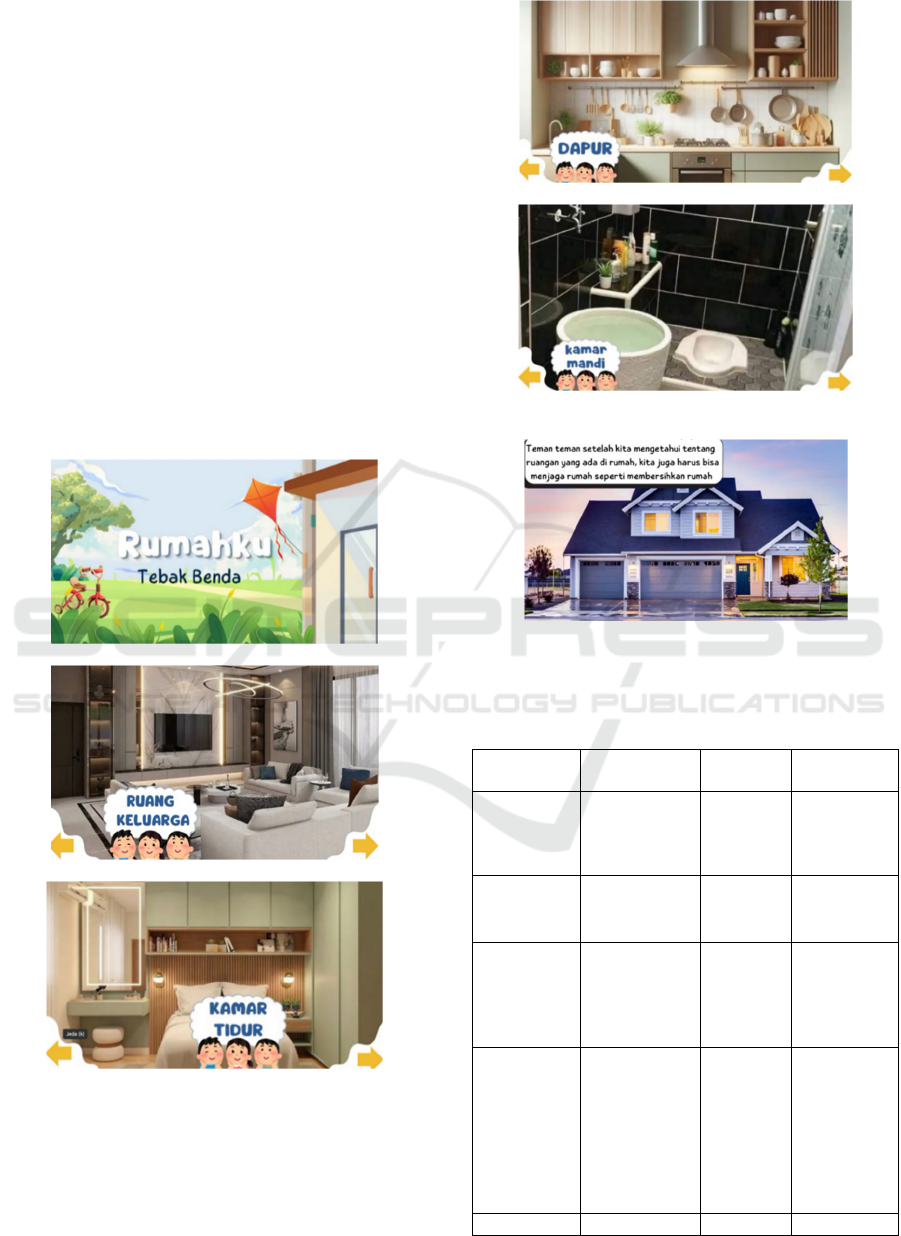
following is a preview of the menu design for the
"What's Inside My House?" learning video:
(a)
(b)
(
c
)
(d)
(e)
(f)
Figure 1: Display of the interactive learning video menu
"what's in my house?" with Indonesian language.
Table 2: Design.
Design
Aspect
Indicator
Average
Score
Percentage
Suitability
of design to
learning
ob
j
ectives
Material
according to
development
indicators
4,87 97,4%
Audio-
visual
appeal
Sound, color,
illustrations,
and layout.
4,80 96%
Clarity of
narrative
Simple
language,
easy for
children to
understan
d
4,73 94,6%
Integrasi
audio-
visual
Videos
contain
sound and
images to
support the
visualization
of the
material.
4,80 96%
Rata-rata 96%
ICECE 2025 - The International Conference on Early Childhood Education
110
Develop
At this stage, digital learning media was developed in
the form of a video lesson titled "What's inside my
house?" assessed by media experts using a
questionnaire. The video was then revised based on
the media experts' suggestions, resulting in its
feasibility. This learning video stimulates multiple
senses, builds emotional engagement, and encourages
active interaction between children, teachers, and the
reading material. Furthermore, the learning video
concept also addresses various developmental
aspects, including:
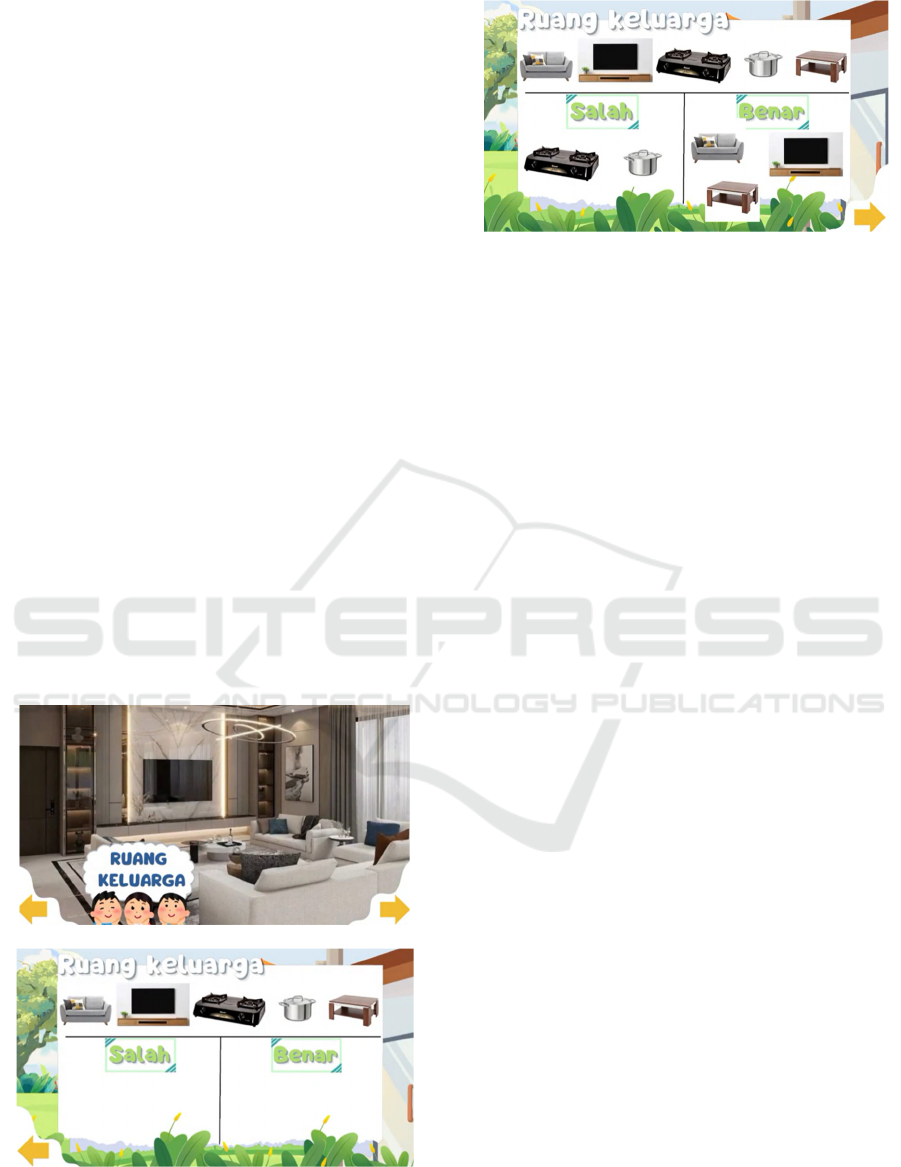
3.1 Family Room
In the family room, there's a game menu for
distinguishing objects. In this menu, students can
operate interactive games such as:
a) If the item is not a living room item, it is
placed in the wrong section. This menu
displays items like pots and stoves.
b) If the item is a living room item, it is placed
in the correct section. This menu displays
items like sofas, TVs, and tables.
The developmental stimulation provided focuses on
cognitive development. In this section, students are
asked to name objects found in the living room. Then,
on the next slide, the types of objects are matched to
the "true" and "false" columns provided.
(a)
(
b
)
(c)
Figure 2: Family room or ruang keluarga (Indonesian
language).
3.2 Bedroom
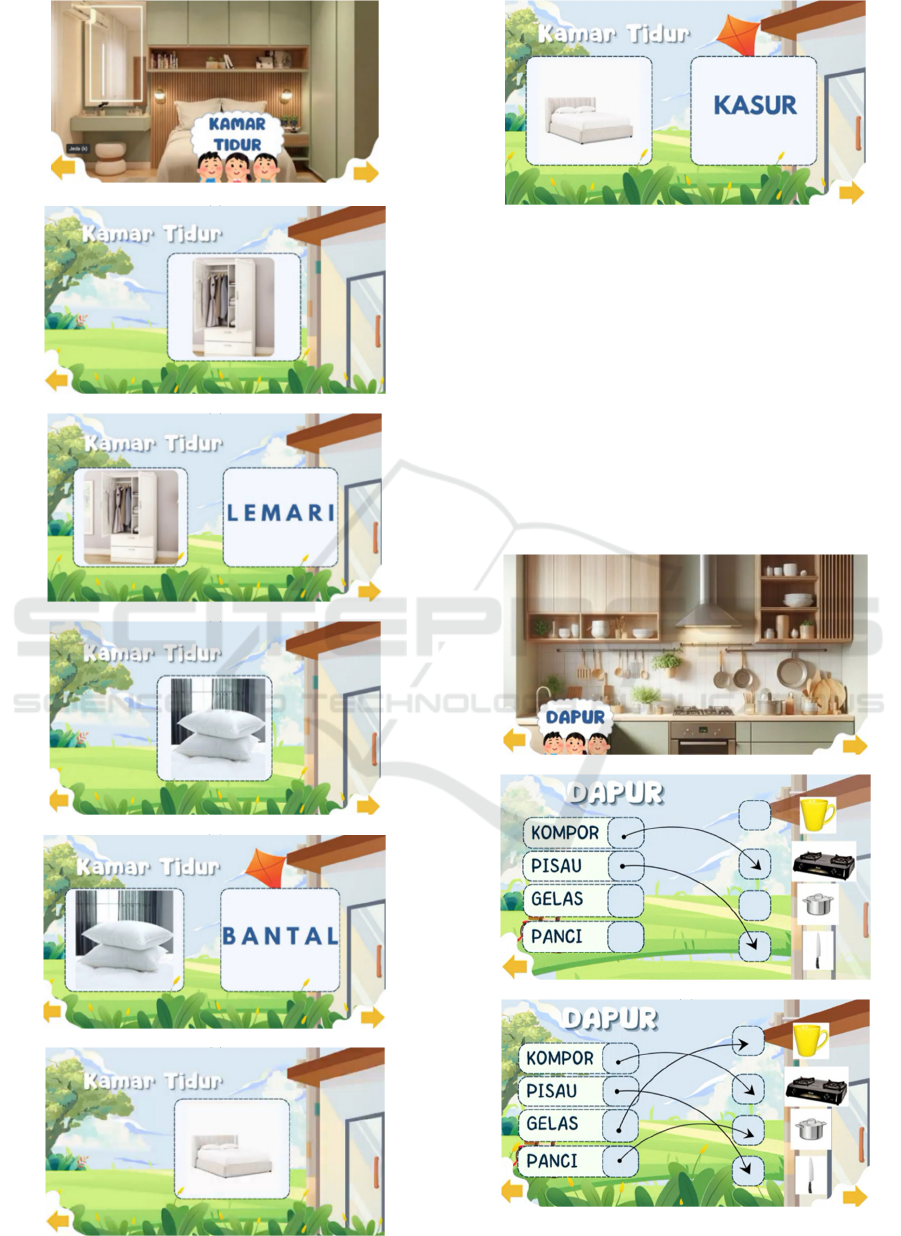
In the bedroom section, a game menu is provided
explaining the function of the bedroom and the
objects found in the bedroom. In addition, there is a
game menu for guessing the names of objects in the
bedroom. In this menu, students can operate
interactive games such as:
a) A picture of a cupboard is displayed, followed
by the word "cupboard." In this menu, students
can spell the letters L-E-M-A-R-I (Indonesian
Languange) in the word "Lemari" (Indonesian
languange) or “Cupboard” (English language)
b) A picture of a pillow is displayed, followed by
the word "pillow." In this menu, students can
spell the letters B-A-N-T-A-L in the word
“BANTAL” (Indonesian language) or "pillow"
(English language)
c) A picture of a mattress is displayed, followed
by the word "kasur." In this menu, students can
spell the letters K-A-S-U-R in the word “kasur”
(Indonesian language) or "bed" (English
language)
The developmental aspect provided is language
development. In this section, students are asked to
guess the name of the object in the picture. Then, on
the next slide, a picture and corresponding word
appear, such as cupboard, pillow, mattress. In the
video there is also a voice inviting you to spell letters
into words, then students can follow along by spelling
the letters into words.
What’s in My House? Development of Meaningful and Joyful Digital Learning Media for Early Childhood
111
(
a
)
(b)
(c)
(
d
)
(
e
)
(
f
)
(g)
Figure 3: Bedroom or kamar tidur (Indonesian language).
3.3 Kitchen
In the kitchen or dapur (Indonesian language) area,
there's a game menu that explains the kitchen's func-
tions and the objects found there. There's also a game
menu for naming the objects in the kitchen. In this
menu, students can operate interactive games such as:
a) The word “Gelas” (Indonesian language) or
"Glass" is displayed, then connected with a line
to the image of the "Glass," and then explained
the function of the glass as a drinking utensil.
(a)
(
b
)
(c)
Figure 4: Kitchen.
ICECE 2025 - The International Conference on Early Childhood Education
112
b) The word “pisau” (Indonesian language) or
"Knife" is displayed, then connected with a line
to the image of the "Knife," and then explained
the function of the knife in cutting food.
c) The word “kompor” (Indonesian language) or
"Stove" is displayed, then connected with a line
to the image of the "Stove," and then explained
the function of the stove in cooking.
d) The word “panci” (Indonesian language) or
"Pan" is displayed, then connected with a line to
the image of the "Pan," and then explained the
function of the stove in cooking soup.
The developmental aspects provided are cognitive
and language development. In this section, students
are asked to name the objects in the picture. Then, on
the next slide, a word and corresponding image
appear, such as stove, knife, glass, and pan. The video
also includes voice prompts to connect the words with
the images of fig.4.
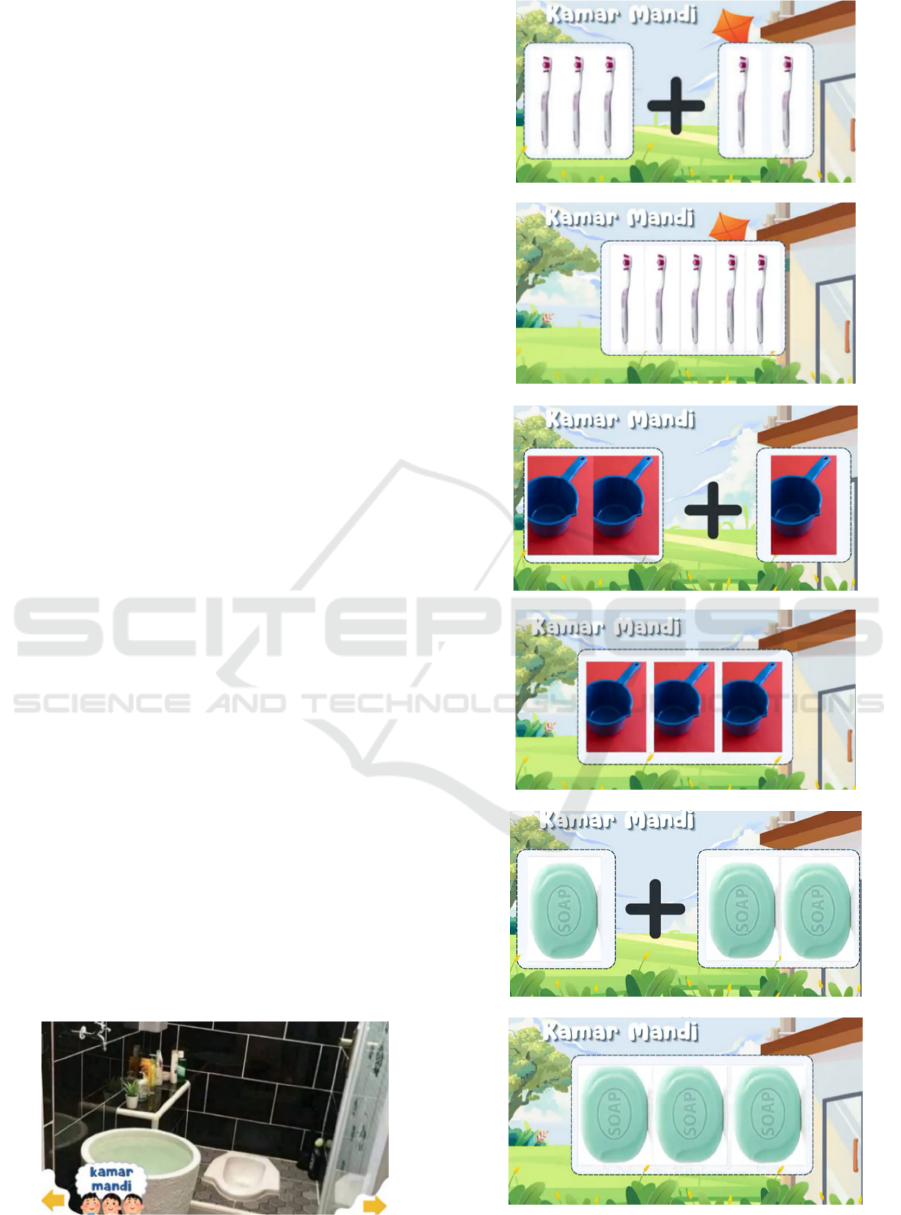
3.4 Bathroom
In the bathroom area or kamar mandi (Indonesian
language), a game menu is provided explaining the
function of the bathroom and the objects found there.
In addition, there is a game menu for guessing and
counting the number of toothbrushes, soap, and
ladles, as objects found in the bathroom. In this menu,
students can understand interactive games such as:
a) A picture of three "Toothbrushes" or “sikat gigi”
(Indonesian language) plus two "Toothbrushes"
is displayed. In this menu, students can count the
total number of "Toothbrushes" displayed,
which is five toothbrushes.
b) A picture of two “ladle” or “gayung”
(Indonesian language) plus one "Ladle" is
displayed. In this menu, students can count the
total number of "Ladles" displayed, which is
three ladles.
c) A picture of one "Soap" or “sabun” (Indonesian
language) plus two "Soap" is displayed. In this
menu, students can count the total number of
"Soaps" displayed, which is three bars of soap.
(
a
)
(b)
(c)
(d)
(
e
)
(f)
(g)
Figure 5: Bathroom.
What’s in My House? Development of Meaningful and Joyful Digital Learning Media for Early Childhood
113
The developmental aspect provided is cognitive
development. In this section, students are asked to
name the number of objects in the picture. Then, on
the next slide, a picture of a toothbrush, ladle, and soap
appears. In the video there is also a voice inviting
students to count the matching pictures, then students
are invited to count the number of matching pictures.
4 IMPLEMENT
At this stage, after product trials were conducted
according to expert advice, the learning video "What's
inside my house?" was implemented for 15 children
aged 5-6 years at the Palur PKK Kindergarten. This
study aims to develop digital learning media in the
form of a learning video "What's inside my house?"
so that it stimulates various aspects of child
development such as cognitive, language, motoric,
and social-emotional. Based on the findings of
observations and teacher interviews, the following
results are presented.
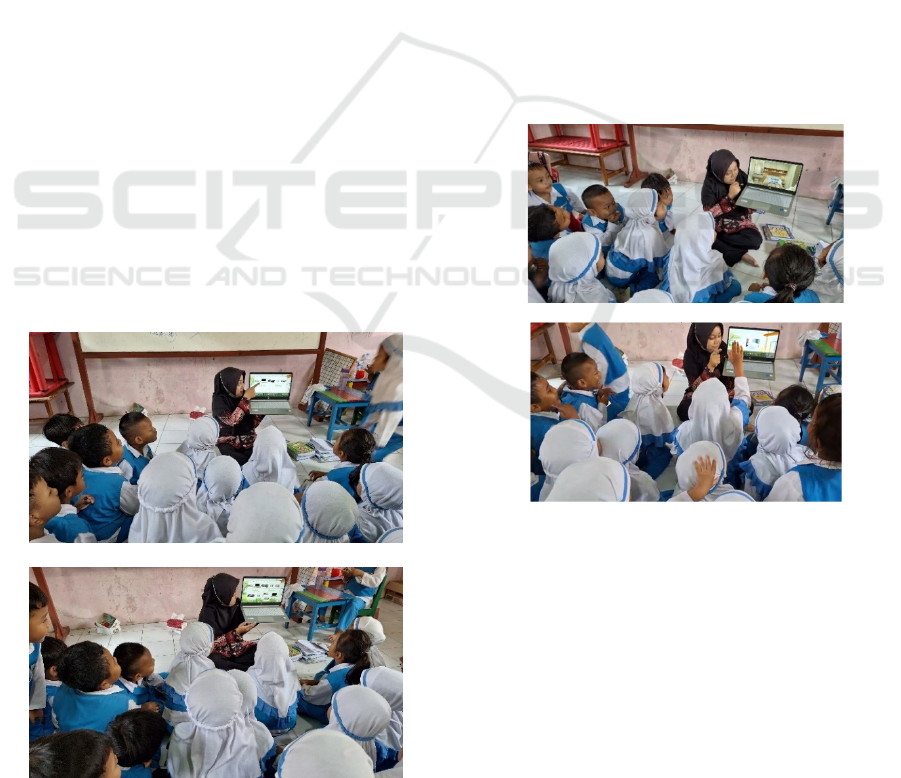
4.1 Family Room
Observations of implementation in the field revealed
that when the teacher showed a learning video on the
family room menu, students were very enthusiastic
about the learning process. They were able to name
and differentiate objects in the family room. They
actively answered the teacher's questions due to the
teacher's engaging teaching methods.
(a)
(b)
Figure 6: Implementation of video viewing.
Meanwhile, interviews with teachers revealed:
"The children enjoyed playing the game.
They didn't think it was learning, even
though the video contained several
questions, which the children could answer
using animated images." (interview with
teacher SR).
"It was very enjoyable and helped the
children understand the parts of the house.
Some of the children were just learning about
the living room because they didn't have one
at home." (interview with teacher NI).
This demonstrates the visualization of the digital
learning media, which makes it easier for students to
understand the objects in the living room.
4.2 Bedroom
Observations of implementation in the field revealed
that when the teacher showed a learning video on the
bedroom menu, students were very enthusiastic about
participating in the learning process. Students were
able to name objects that matched the pictures.
(a)
(b)
Figure 7: Implementation of video viewing.
In addition, students also spelled letters to form words
that corresponded to the images. Teacher interviews
revealed that
"Introducing literacy through animated video
learning media provides a different learning
experience for children. Children are more
enthusiastic and motivated to learn to spell
and read the captions together, following the
audio from the video" (interview with
teacher SR).
ICECE 2025 - The International Conference on Early Childhood Education
114
"Children are more familiar with their
immediate environment, especially their home,
and the various parts of the house, through
animated learning videos than through
worksheets" (interview with teacher NI).
This demonstrates that the visualization of images
and nouns encourages students to look at and read the
captions. In line with the above, it is explained that
digital learning media, especially in reading, has
transformed the conventional reading experience into
an immersive and interactive form through the use of
tools such as 3D videos and audiovisual animations
(Sun, 2025). In addition to introducing objects in the
bedroom, these learning videos can also be used to
introduce the uses of each object.
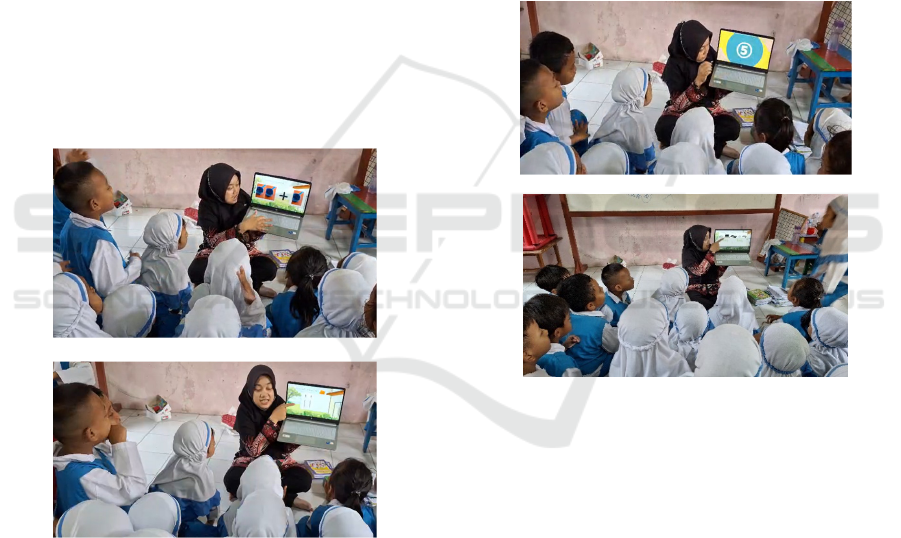
4.3 Bathroom
Observations of implementation in the field revealed
that when the teacher showed a video of the bathroom
menu, students were very enthusiastic about the
learning process. Students were able to name objects
that matched the pictures.
(a)
(
b
)
Figure 8: Implementation of video viewing.
Meanwhile, interviews with teachers revealed that
"After showing the video, when they saw a
picture of a ladle, the children immediately
counted the number of ladles in the picture
and then answered, counting together until
they were competing to answer" (interview
with teacher SR).
"If I gave them a worksheet with a counting
activity, the children quickly gave up and
were reluctant to write down the results"
(interview with teacher NI).
This indicates that students were enthusiastic about
this interactive video-based learning medium.
Students were very enthusiastic in answering the
questions in the video. This learning video made it
easier for children to understand the objects in the
bathroom, making it a real learning experience, even
though it was still in the form of visual images.
4.4 Kitchen
Observations of implementation in the field revealed
that when the teacher showed a video of the kitchen
menu, students were very enthusiastic about the
learning process. Students were able to name objects
that matched the pictures.
(a)
(
b
)
Figure 9: Implementation of video viewing,
Meanwhile, teacher interviews revealed that
"The children seemed enthusiastic in
answering questions in the interactive
learning video" (interview with teacher SR).
"Using laptops as learning media was very
enjoyable and increased the children's
interest in recognizing letters and objects
around the home, especially in the kitchen"
(interview with teacher NI).
This demonstrates that video-based digital learning
media can spark interest in learning and support
children's literacy and object-matching skills.
What’s in My House? Development of Meaningful and Joyful Digital Learning Media for Early Childhood
115
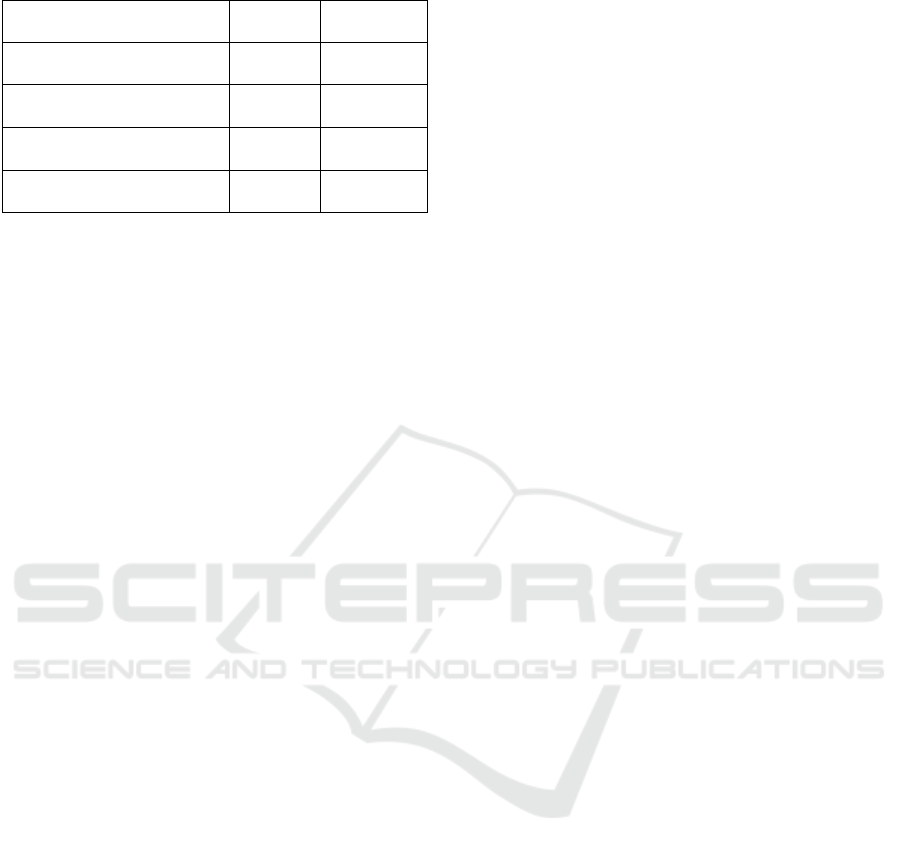
Table 3: Implementation results.
Observation Indicator
Average
Score
Percentage
Children focus on following
the teachin
g
video
3,80 95%
Name the objects according
to the picture
3,60 90%
Active participation during
learning
3,73 93,25%
Counting objects according
to the
p
icture
3,80 95%
Evaluate
The evaluation phase is based on expert advice, which
is then implemented. These results lead to
suggestions such as adding sound or music if the child
has successfully answered the questions in the
learning video.
5 DISCUSSION
Based on the analysis and its relationship to the digital
era, which has opened up opportunities and
challenges in digital life for early childhood, the
digital era requires more complex thinking capacity
and cognitive skills, both in students and educators
(Mhlongo, 2023). One challenge refers to data
showing that 37.02% of children aged 1-4 years and
51.9% of children aged 5-7 years have access to the
internet (https://www.komdigi.go.id/). Given the high
rate of internet usage among children, this also
presents an opportunity to pay attention to the digital
content accessed and digital literacy assistance as part
of character education implemented in schools and at
home.
Starting in late 2024, the Indonesian Ministry of
Primary and Secondary Education has developed a
curriculum with a deep learning approach as a
conscious, meaningful, and enjoyable learning
approach integrated with the use of technology in
learning. The curriculum is more engaging with the
integration of video-based learning media, training
for teachers to optimize the use of video in learning,
and the importance of parents' role in supporting early
childhood learning motivation through a selection of
educational and relevant videos (Hudain, 2023).
Referring to the current government policy, namely
the deep learning approach in early childhood
education, the current research integrates the use of
technology in developing digital learning media
based on interactive video learning "What's inside my
house?" for children aged 5-6 at the Palur PKK
Kindergarten.
The development of digital learning media in the
current research was made using laptops or
smartphones with the help of the Canva application
by considering the content, context, and needs of
students. During its implementation, children
appeared enthusiastic about participating in learning,
especially when shown the learning video "What's
inside my house?". The creation of the learning video
was adjusted to the principles of learning media
design referring to several things, including 1) digital
learning media must be child-friendly, 2) digital
learning media must be of high quality in terms of
content, context, and usability, 3) the digital learning
media developed must be appropriate to students'
needs (Suryani, 2023). This is in line with research
findings showing that educational software and
applications can be developed into digital learning
media to attract children's interest in participating in
learning and understanding the concepts taught
(Susanti, 2019). Visual and audiovisual components
can help improve children's memory and
understanding of thinking concepts (Hudain, 2023).
By providing digital learning media accompanied by
elements of games, visual and audiovisual
animations, as well as parental guidance, children can
be happier and are able to stimulate aspects of child
development.
Forms of digital learning media suitable for early
childhood include interactive learning applications,
learning videos, educational games, simple 2D and
3D media, interactive audio and multimedia (Suryani,
2023). Referring to these forms, one of the learning
media developed in the current research is an
educational game-based learning video, such as
guessing objects found in the rooms of the house. The
development of digital learning media in the form of
an interactive learning video "What's inside my
house?" is a game that aims to introduce the spaces
and objects in the house. Here, not only introduces the
spaces and objects, but this learning video explains
the function of each room in the house, thereby
stimulating cognitive, language, and social-emotional
development. In line with the objectives of the current
research, information technology (ICT)-based
educational applications such as interactive games,
instructional videos, and digital teaching aids can
enhance children's cognitive development (Hilmiah,
2024). By utilizing technology packaged in this
game-based learning video, the learning process can
be more enjoyable and meaningful for children.
Digital technology serves as an effective
pedagogical tool to encourage and develop critical
thinking skills (Jodoi, 2021). The use of digital
learning media based on designed learning videos has
ICECE 2025 - The International Conference on Early Childhood Education
116

had a positive impact on the stimulation of children's
development through the use of technological tools
such as laptops or tablets for students at the Palur
PKK Kindergarten. This aligns with research findings
that children aged 3-5 years have the ability to access
technological devices such as laptops, smartphones,
or iPads, thus requiring attention to the impact and
applications specifically designed for early childhood
groups (Livingstone, 2020). The duration of
children's access to laptops, smartphones, or tablets
can increase with age. Research results show
differences in the influence of digital media use on
children's cognitive development (Pedrotti, 2024). A
28.7% negative impact on children's cognitive
development occurs when media use is unsupervised
by parents, accesses non-educational content, and
accesses for longer durations. Meanwhile, a 5.3%
negative impact occurs when media use is
accompanied by parents, uses educational content,
and uses media simultaneously with parents. This
leads to a negative relationship with attention and
working memory in children's cognitive
development. Likewise, the role of teachers in
teaching new learning materials developed through
the use of technology as a digital learning medium for
children is crucial.
The use of technology on children not only has
negative but also positive impacts. The positive
impact found in the results of the current study is that
researchers found that students at the Palur PKK
Kindergarten have followed the learning material in a
fun and meaningful way. Students more easily
understand the learning material through the display
of the learning video "What's inside my house?" They
better remember the rooms in the house and their
contents. In addition, this learning video becomes
more meaningful and provides new knowledge for
students after viewing this video. For example, during
the display of the learning video, several students said
that there is no living room in their house and they
now know the objects in the living room (interview
with teacher SR). By providing digital learning
media, children are also able to operate digital devices
independently, demonstrate spatial understanding of
object placement in applications, demonstrate
conceptual understanding of the material being taught
(Tang, 2024). Through the display of learning videos,
it has contributed to the involvement of children's
experiences and knowledge, behavior and emotions
related to the focus of knowledge, understanding of
content, increased motivation, and a fun and
innovative learning environment. Innovation in
digital learning media can be achieved through
engaging and meaningful learning, not only engaging
children but also fostering interest in learning,
enhancing conceptual understanding, and developing
cognitive, motor, social, and emotional aspects.
Digital learning media can train children to operate
digital devices independently, demonstrate spatial
understanding of object placement within
applications, and demonstrate conceptual
understanding of the material being taught. However,
when using animated video-based digital learning
media, the role of a mentor is essential, and social
interaction with others remains a crucial aspect to
consider.
6 CONCLUSIONS
Digital learning media designed based on interactive
learning videos "what's inside my house?" provides
material about rooms and their functions (family
room, living room, bedroom and bathroom), objects
in each room, in the video also includes sound and
images so that the learning video is more interesting
and interactive. The interactive learning video "what's
inside my house?" can stimulate various child
developments, namely cognitive, language and social
emotional. Students can better understand and
stimulate aspects of their development through
quizzes given such as distinguishing objects in the
family room, spelling letters to become nouns in the
bedroom, matching words with pictures and counting
the number of objects. Thus, the implications of the
game-based learning video "what's inside my house?"
can be a digital learning media used by teachers to
support conscious, meaningful and fun learning,
interactive, contextual, and have a positive impact on
developmental aspects.
ACKNOWLEDGEMENTS
The author would like to thank the research team, the
PKK Palur Kindergarten teachers who facilitated and
actively participated in the research.
REFERENCES
Arifudin, O. (2021). Media Pembelajaran Pendidikan Anak
Usia Dini. Bandung : Widina Bhakti Persada.
Behnamnia, N. K. (2023). A review of using digital game-
based learning for preschoolers. Journal of Computers
in Education, 10(4), 603-636. doi:10.1007/s40692-022-
00240-0
What’s in My House? Development of Meaningful and Joyful Digital Learning Media for Early Childhood
117

Hilmiah, H. &. (2024). Peran TIK pada Pembelajaran Abad
21 dalam keterampilan Kritis, Kreatif dan Kolaboratif
Anak Usia Dini. Journal of Instructional and
Development Researches, . 4(6), 609-618. Retrieved
from https://doi.org/10.53621/jider.v4i6.449
Hudain, M. A. (2023). Media Pembelajaran Berbasis
Video: Apakah berpengaruh terhadap peningkatan
motivasi belajar pada Anak. Jurnal Obsesi: Jurnal
Pendidikan Anak Usia Dini,, 7(4), 4881-4891.
doi:10.31004/obsesi.v7i4.4924
Jodoi, K. T. (2021). Developing an active-learning app to
improve critical thinking: item selection and
gamification effects. Heliyon, 7(11).
doi:10.1016/j.heliyon.2021.e08256
Livingstone, S. &.-R. (2020). Parenting for a digital future:
How hopes and fears about technology shape children’s
lives. In Oxford Academic. doi:10.1093
Mhlongo, S. M. (2023). Challenges, opportunities, and
prospects of adopting and using smart digital
technologies in learning environments: An iterative
review. Heliyon, 9(6). Retrieved from
https://doi.org/10.1016/j.heliyon.2023.e16348
Nirwana, E. S. (2021). Pengembangan media pembelajaran
berbasis game android untuk anak usia 5-6 tahun.
Jurnal Obsesi: Jurnal Pendidikan Anak Usia Dini, 6(3),
1811-1818. doi:10.31004/obsesi.v6i3.1684
Nurhayati, R. (2020). Pendidikan Anak Usia Dini Menurut
Undang–Undang No, 20 Tahun 2003 Dan Sistem
Pendidikan Islam. Al-Afkar, Journal For Islamic
Studies, 57-87.
Pedrotti, B. G. (2024). Context of digital media use in early
childhood: Factors associated with cognitive
development up to 36 months of age. . Infant Behavior
and Development, 76. doi: 101963
Sugiyono, S. (2016). Metode penelitian kuantitatif,
kualitatif, R&D. Bandung: Alfabeta.
Suryani, L. H. (2023). Media Pembelajaran Digital untuk
Anak Usia Dini. Yogyakarta: Deepublish.
Susanti, B. (2019). Penggunaan Media Pembelajaran Video
Scribe untuk Meningkatkan Motivasi Belajar Siswa
Kelas V Madrasah Ibtidaiyah At-Taqwa Pinang. .
Naturalistic: Jurnal Kajian Penelitian Pendidikan Dan
Pembelajaran, 3(2), 387–396. Retrieved from
https://doi.org/10.35568/naturalistic.v3i2.399
Tang, K. S. (2024). Exploring the multimodal affordances
of digital coding devices in fostering creative thinking
in early childhood education. Thinking Skills and
Creativity, 1-15. doi:10.1016
ICECE 2025 - The International Conference on Early Childhood Education
118
