
Innovation in Designing Interactive Game-Based Tactile Carpets for
Sensory and Motor Stimulation in Early Childhood
Elvira Khori Ulni
1a
, Effran Zudeta
2b
and Amalia Husna
1c
1
Universitas Negeri Padang, Indonesia
2
Universitas Mercubaktijaya, Indonesia
Keywords: Early Childhood Development, Sensorimotor Stage, Tactile Carpet, Multisensory Learning, Sensory
Stimulation, Texture Exploration.
Abstract: Early childhood is at a crucial stage of sensorimotor development, where learning occurs through direct
experiences such as touching, feeling, seeing, and moving. Therefore, learning media that can stimulate
multiple senses simultaneously is necessary to make information easier to understand and enjoy. One
appropriate medium for this need is a tactile carpet, an interactive carpet with a variety of textures and surfaces
specifically designed for children to explore. Tactile carpets not only provide sensory stimulation but can also
be linked to the introduction of various animals. Each area of the carpet has a different texture, and in each
area, relevant animals are introduced. Through this exploration, children not only learn to recognize various
types of textures but also connect sensory information with real-life concepts about animals and their
environment. Tactile carpets are linked to a game of finding animals among the many toys scattered on the
carpet's surface. This activity simultaneously develops motor skills, tactile sensitivity, imagination, and
naturally enriches children's vocabulary. Using the 5W + 1H approach, this tactile carpet was developed as a
fun and educational play-learning medium. The design process involved observations, interviews, and hands-
on testing with children to ensure the rug was safe, engaging, and developmentally appropriate. The tactile,
animal-themed rug is expected to be an effective learning tool for children, helping them understand the world
around them through fun, meaningful, and active exploration.
1 INTRODUCTION
Enjoyable learning creates a comfortable and
harmonious learning atmosphere, especially in early
childhood education. At this stage, learning takes
place through a playful learning approach, in
accordance with the characteristics of a child's world
which is full of exploration and play (Helleman et al.,
2023). Play stimulates various areas of development,
including cognitive, motor, and language skills, as
well as fostering creativity and problem-solving
abilities (da Silva et al., 2024; Fan et al., 2024). Play
encourages social interaction, improves
communication skills and relationships with peers,
which are crucial for academic success and emotional
well-being (Lubis, 2019). In addition, play is also
important for children's physical and mental health
a
https://orcid.org/0009-0002-7359-5634
b
https://orcid.org/0000-0001-8416-6873
c
https://orcid.org/0009-0006-7033-4892
(Dodd et al., 2021). Play is not only a fun activity, but
also the primary means for children to learn about the
world around them and develop various aspects of
development.
Early childhood is at a crucial stage of
sensorimotor development, where learning occurs
through direct experiences such as touching, feeling,
seeing, and moving. Therefore, multisensory
stimulation is essential to make the learning process
more meaningful and enjoyable. Involving multiple
senses in the learning process has been shown to
improve children's memory and concentration. A
study found that preschoolers who received
multisensory learning experiences showed up to a
35% increase in their cognitive abilities, particularly
in memory and attention (Dahua et al., 2024).
Children who learn through a multisensory approach
Ulni, E. K., Zudeta, E. and Husna, A.
Innovation in Designing Interactive Game-Based Tactile Carpets for Sensory and Motor Stimulation in Early Childhood.
DOI: 10.5220/0014069300004935
Paper published under CC license (CC BY-NC-ND 4.0)
In Proceedings of the 7th International Conference on Early Childhood Education (ICECE 2025) - Meaningful, Mindful, and Joyful Learning in Early Childhood Education, pages 169-176
ISBN: 978-989-758-788-7; ISSN: 3051-7702
Proceedings Copyright © 2025 by SCITEPRESS – Science and Technology Publications, Lda.
169

use all their senses, which helps strengthen neural
development. This approach is beneficial for children
with communication and language difficulties, as it
involves various sensory modalities that can
strengthen neural connections and improve learning
outcomes (Tubele, 2023). Providing appropriate
stimulation will support optimal cognitive, motor,
social-emotional, and language development in
children. One way to provide this stimulation is
through learning media designed according to the
child's developmental stage.
Learning media in the context of early childhood
must be able to involve various senses
simultaneously. Concrete and interactive media have
been proven to be more effective in building
children's understanding. Tactile media in early
childhood education includes various activities that
stimulate the sense of touch, such as touch through
massage, exploration of various textures, to
experiences related to body awareness
(proprioception) (Roziah, 2019). These activities
have an important role in supporting children's
psychomotor development and contribute to
improving cognitive abilities and social emotional
aspects and can improve children's neuromotor,
cognitive, and socio-affective development
(Camacaro, 2013). The importance of integrating
tactile experiences into educational activities, as a
means to build warmer communication and emotional
connections between educators and children. This
approach is considered capable of encouraging
comprehensive or holistic development in the early
childhood learning environment.
One innovative learning medium that supports
multisensory stimulation is tactile carpet, an
interactive carpet with a variety of textures and
surfaces specifically designed for children to explore.
Play environments designed with smooth textures,
both soft and hard, better support the duration of early
childhood play activities, and varied play surfaces
create a more engaging play environment and support
children's exploration (Zahra et al., 2019). In reality,
not all children have the opportunity to interact
directly with various natural textures such as grass
and rocks. Many parents in urban areas are very busy
working, so they rarely have time to play with their
children. Furthermore, the limited availability of
green open spaces in urban areas (PUPR, 2020) is a
challenge in itself, so children miss the opportunity to
experience the diversity of environmental textures
directly. In this context, tactile carpet can be a
practical and educational alternative solution. By
presenting textures that resemble real environments,
tactile carpets allow children to explore the sensation
of touching various surfaces without having to go to
a specific location. This approach aligns with the
concept of a simulated natural environment (Chawla,
2015), where natural elements are replicated in the
learning space to provide a multisensory experience
that benefits children's cognitive, motor, and
language development.
Interaction with various textures such as rough,
smooth, or springy on tactile carpets helps enrich
children's sensory experiences (Moreno, 2015). This
type of multisensory stimulation plays an important
role in strengthening sensorimotor nerve connections
in the brain, which support movement coordination,
perception, and responses to environmental stimuli
(Case-Smith & O’Brien, 2015). Tactile carpets not
only stimulate the sense of touch but can also be a
means of introducing real-world concepts, such as
animals. This learning activity can be enriched with a
game of finding animals among the many toys
scattered on the carpet's surface. This game combines
aspects of tactile exploration with visual search, thus
encouraging children to connect sensory information
(texture) with cognitive information (types of
animals). According to Zahra et al (2019), a learning
process that combines direct experience, exploration,
and reflection will strengthen conceptual
understanding as well as fine motor skills. In addition,
the activity of finding animals also trains focus,
concentration, and problem-solving skills, because
children must distinguish relevant toys (animals)
from inappropriate objects. According to Tūbele
(2023), play activities that involve sorting and
classifying objects according to certain categories can
develop logical thinking skills in early childhood.
Through the 5W + 1H approach (What, Who,
When, Where, Why, How), tactile carpets are
developed as educational and fun play-learning
media, which not only meet the needs of early
childhood sensory development but also support
contextual thematic learning. Toys that combine
visual, auditory, and tactile stimuli increase the
interest and engagement of children aged 3–6 years.
Integrated tactile stimulation also helps children build
descriptive vocabulary and understanding of objects
based on tactile sensations (Fan et al., 2024).
However, currently there are still many early
childhood children who do not have access to
learning media that are appropriate to their needs and
developmental stages. Therefore, this research is
important to develop innovative learning media based
on tactile carpets as an alternative solution that can be
integrated into the learning process in early childhood
environments.
ICECE 2025 - The International Conference on Early Childhood Education
170

2 METHOD
This research is a type of research and development
(R&D). R&D is a research method used to produce a
product and test its effectiveness. This development
research refers to the ADDIE (analysis, design,
development, implementation, & evaluation)
development model. The research was conducted in
10 early childhood schools in Padang, West Sumatra.
The subjects tested for the tactile carpet media
product were feasibility test subjects. The product
feasibility was assessed by the experts involved: a)
Media experts who mastered media concepts; b)
Material experts who mastered early childhood
materials; and c) Early childhood teachers, consisting
of 5 teachers in the initial field trial and 18 teachers
in the main field trial.
x
̄
= Σ x / N
Description
x
̄
: Average score
Σ x :Total scores
N : Number of people assessing
The instrument used was a questionnaire. The
questionnaire was used by material experts, media
experts, and early childhood teachers. The
questionnaire functioned to assess product quality
and obtain suggestions for product development. The
study used two analytical techniques: qualitative
descriptive analysis and quantitative descriptive
analysis. Qualitative descriptive analysis presented
data in the form of assessments or reviews provided
by media experts, material experts, and teachers. The
results of the data analysis will serve as a basis for
product improvements. Quantitative descriptive
analysis is used to describe the data resulting from the
percentage analysis that has been made. Data
processing is obtained through a questionnaire in the
form of descriptive percentages from each subject to
determine product feasibility as follows:
Table 1: Product Eligibility Categories.
Score Interval Criteria
x ≥ 4.2 Very Goo
d
3.4 ≤ x < 4.2 Goo
d
2.3 ≤ x < 3.4 Fairly Goo
d
1.8 ≤ x < 2.3
N
ot Goo
d
x < 1.8 Ba
d
3 RESEARCH RESULTS
The listening text material which will be in the form
of 5W + 1H questions (What, Who, When, Where,
Why, How) which will be asked to early childhood
children when playing with tactile carpets is given to
material experts to then be assessed by filling out a
questionnaire on a scale of 4. The results of the
material expert's assessment can be seen in Table 2
below.
Table 2: Summary of Average Scores from Material
Expert Validation Results.
N
o Assessment Aspect
Average
Score
Category
1 Suitability to Child's Ability 3.86 Good
2 Language Skills 3.66 Good
3 Presentation Suitability 4.40 Very Goo
d
Total 11.92
Average 3.97 Good
The assessment shows an average in the good
category. The input from the material expert is: 1)
Question material that is close or familiar to children
2) Question text should not be too long for early
childhood 3) Question cards should be provided
categorized or divided into groups (What, Who,
When, Where, Why, How)
Input from material experts during the validation
phase suggested two key points for improving the
tactile carpet media. First, use places and names in the
text that are close or familiar to children. This
principle is in line with contextual learning theory,
which emphasizes the importance of linking material
to the environment and real-life experiences of
students (Pacini-Ketchabaw et al., 2016). Early
childhood children tend to more easily understand
information that is linked to things they are familiar
with, such as the names of places around their home
or school, so that learning becomes more meaningful
(Chung, 2022). Second, question texts should not be
too long for early childhood. Children in the
preoperational stage have limited working memory
capacity, so instructions or questions that are too long
can reduce focus and understanding. Muthanje
(Muthanje, 2023) also showed that short, clear
sentences and using simple vocabulary are more
effective in increasing children's participation in
learning. By implementing these two inputs, tactile
carpet media can be more child-friendly, facilitate
understanding, and increase student engagement in
learning activities. Adapting content to the child's
cognitive development level and life context also has
Innovation in Designing Interactive Game-Based Tactile Carpets for Sensory and Motor Stimulation in Early Childhood
171

the potential to strengthen learning motivation and
transfer knowledge to real-life situations.
Providing question cards categorized or divided
into What, Who, When, Where, Why, and How
groups can be an effective strategy for developing
critical thinking skills and language skills in early
childhood. This approach refers to the concept of
questioning techniques in learning, where questions
are directed to encourage exploration, understanding,
and reinforcement of concepts (Pant et al., 2024).
What and Who-type questions help children
recognize objects, events, or figures, as well as
expand basic vocabulary. When and Where questions
train children's understanding of the concepts of time
and space, which are important parts of cognitive
development in the preoperational stage (Musnir &
Sumantri, 2019). Meanwhile, Why and How
questions stimulate higher-order thinking skills,
training children to make cause-and-effect
relationships and explain the process of an event
(Moreno, 2015). This grouping of questions also
makes it easier for teachers to design systematic and
gradual tactile carpet-based learning. With a
structured format, teachers can adjust the difficulty
level of questions to suit the child's abilities, while
ensuring that all aspects of language skills, from
literal comprehension to logical reasoning, are trained
in a balanced manner (Servelin et al., 2019).
The tactile carpet media to be used was given to
media experts to then be assessed by filling out a
questionnaire on a scale of 4. The results of the media
expert's assessment can be seen in Table 3 below.
The assessment shows an average in the very good
category. The input from media experts is: 1) For the
texture of the tactile carpet must be made with good
quality, such as grass and stones, must be made as
similar as possible. 2) The carpet must be able to be
disassembled like puzzle pieces to save space 3) in
each texture there is not only one carpet but the
number is increased for example a grass themed
carpet 3 carpets and a stone themed carpet 3 carpets,
The quality of the design of learning media,
especially tactile carpets, is a key factor that
determines its effectiveness in supporting
multisensory stimulation of early childhood. Tactile
carpets designed with textures that resemble real
conditions such as grass and stones can increase the
realism of children's learning experiences. Early
childhood is in the preoperational stage of
development, where learning is more effective
through concrete direct experience (Rahman &
Nuraini, 2023). By presenting textures that are
visually and tactilely accurate, children can more
easily build new cognitive schemes through
exploration of the sense of touch. In addition to the
realism of texture, the functional aspect also plays an
important role. Tactile carpets that can be
disassembled like puzzle pieces provide flexibility of
use in various spaces, save storage space, and make it
easier to arrange according to the learning theme.
This advantage is in line with the view (Rupnidah &
Suryana, 2022) that effective learning media must
consider ease of use, portability, and suitability to
user needs.
Table 3:
Summary of Average Scores from Media Expert
Validation Results.
The addition of units for each texture theme, for
example three grass-themed carpets and three stone-
themed carpets, serves to support group learning
activities. This minimizes queues for use, increases
children's exploration opportunities, and supports
social interaction through cooperative play. Aryanti
(2024) emphasized the importance of social
interaction in learning, where cooperative activities
can expand children's Zone of Proximal Development
(ZPD). The results of the media expert assessment
showed that the tactile carpet design met the "very
good" category in terms of visual, functional, and
suitability for learning objectives. This finding
strengthens the opinion of Rohibni et al (2022) that
effective learning media must meet three main
criteria: aesthetically appealing, relevant to learning
objectives, and easy to use by target users. However,
constructive input from media experts is still needed
to improve product quality, including improving
texture, material durability, and design variations. By
combining visual quality, texture realism, design
flexibility, and support from media expert studies,
tactile carpets can be an innovative learning media
that is not only attractive but also optimally supports
N
o Assessment Aspec
t
Average
Score
Category
1 Content Quality 4.33 Very Goo
d
2 Learning goal
ali
g
nmen
t
4.14 Goo
d
3 Feedback and adaption 5.00 Very Goo
d
4 Affective 4.83 Very Goo
d
5 Presentation design 4.85 Very Goo
d
6 Interaction 4.00 Goo
d
7 Accessibility 5.00 Very Goo
d
8 Usability 4.50 Very Goo
d
9 Standards compliance 4.50 Very Goo
d
Total 41.15
Average 4.57 Very Goo
d
ICECE 2025 - The International Conference on Early Childhood Education
172

the cognitive, sensorimotor, and social-emotional
development of early childhood.
Table 4: Summary of Average Scores from Initial
Field Trial Results.
N
o
Assessment
Aspects
Assessment
Score
Total
score
Ave
r
a
g
e
Catego
r
y
1 2 3 4 5
1 Attractive 10 15 72 10 107 3.56 Goo
d
2 Easy to use 148 15 163 4.07 Goo
d
3 Content
Qualit
y
152 10 162 4.05 Goo
d
Total 437 11.68
Average 3.97 Goo
d
Media assessment during the initial field trial
phase showed overall good product results,
supplemented by suggestions for improvement. The
results of the initial field trial phase are shown in
Table 4 below.
Initial field trials, teachers as respondents
provided comments and suggestions The comments
from teachers were 1) The use of tactile carpet media
is very interesting and makes it easier to convey the
material. 2) The material is explained in a coherent
manner that is easy to understand for early childhood
In addition to positive comments, teachers provided
comments and suggestions for the products
developed as follows: 1) There should be a guidebook
for implementing learning using tactile carpets 2) The
design of the question cards is made with a colorful
design and added with interesting characters.
The results of the initial field trial showed that
teachers responded positively to the use of tactile
carpet media. Teachers considered this media very
interesting and made it easier to convey material to
early childhood. This is in line with the opinion of
Kmurawak & Setyaningsih (2020) that interesting
learning media can increase student attention,
motivate learning, and facilitate understanding of the
concepts being taught.
The teacher also mentioned that the material
presented through the tactile carpet media was
delivered in a coherent manner so that it was easy for
early childhood children to understand. According to
Sumarmi & Afendi (2022), early childhood children
are in the pre-operational stage, where the learning
process will be more effective if the material is
delivered in a structured manner, using concrete
media, and supporting direct experience. Tactile
carpet media designed with a coherent learning flow
helps children understand the material through
multisensory experiences. In addition to positive
comments, the teacher provided several suggestions
for product development. First, the need for a tactile
carpet usage guidebook. This guidebook will serve as
a guide for teachers in implementing the media,
starting from preparation, implementation steps, to
learning evaluation. According to Rosalianisa et al.
(2023), media usage guidelines play an important role
in ensuring consistency of application and
maximizing the benefits of the media in various
learning contexts.
Second, the teacher suggested that the question
card design be made more colorful and equipped with
interesting characters. Visual designs rich in color
and illustrations can increase learning motivation in
early childhood. Sudarsana et al. (2020) showed that
children are more interested in media that displays
bright visual elements and familiar characters,
because it can foster curiosity and trigger interaction.
The addition of characters to the question cards can
also function as a visual stimulus that strengthens the
association of learned concepts (Mardhatillah, 2021).
Overall, input from teachers at this initial stage is an
important foundation for refining the tactile carpet
media before wider scale trials. Improvements in
aspects of the user guide and visual design are
expected to increase the effectiveness of the media in
supporting the learning process in early childhood.
The main field trial received an overall rating of
"very good," with suggestions for improvement. The
results of the main field trial assessment can be seen
in Table 5 below.
Main field trial, teachers as respondents provide
comments and suggestions. The comments from
teachers are: 1) Tactile carpet media is now more
flexible to use 2) the appearance of the carpet is
attractive 3) easy to use. In addition to comments,
teachers provide suggestions for the products being
developed as follows: 1) tactile carpet media should
be produced in larger quantities so that it can be used
in many schools 2) various characters and animals
can be added
The results of the main field trial showed that
teachers as respondents gave positive comments on
the tactile carpet media developed. These comments
covered three aspects: flexibility of use, attractive
appearance, and ease of use. These three aspects
reflect that the developed media has met most of the
criteria for effective learning media (Rahman &
Nuraini, 2023), namely practicality, attractiveness,
and ease of use by both educators and students. The
flexibility of using tactile carpet media is an
important point, because it allows teachers to adjust
its use in various learning contexts, both in the
Innovation in Designing Interactive Game-Based Tactile Carpets for Sensory and Motor Stimulation in Early Childhood
173
classroom and outside the classroom. This is in line
with Mardhatillah's opinion (2021) that flexible
learning media can increase student engagement and
make it easier for teachers to adapt materials
according to needs. In addition, the visually appealing
appearance of the carpet can increase learning
motivation in early childhood. Media with an
attractive design can stimulate interest in learning and
increase children's attention to the material being
presented.
Table 5: Summary of
Average
Scores from the Main
Field Trial Results.
N
o Assessment
Aspects
Assessment
Score
Total
score
Ave
r
a
g
e
Catego
r
y
1 2 3 4 5
1 Attractive 6 316 135 457 4.23 Very
Good
2 Easy to use 3 396
2
20 619 4.29 Very
Good
3 Content
Qualit
y
396
2
25 621 4.31 Very
Goo
d
Total 1697 12.83
Average 4.28 Very
Goo
d
The ease of use of the media is also an advantage,
considering that teachers need tools that do not
require complicated operational procedures. This
ease makes the media more quickly adopted and used
sustainably (Kmurawak & Setyaningsih, 2020). This
is especially important in early childhood education,
where the focus of learning is on exploration,
interaction, and direct experience. In addition to
positive comments, teachers also provided
constructive suggestions for further development.
First, the tactile carpet media should be produced
more widely so that it can be used in various schools.
This suggestion shows the potential for wider product
implementation (scalability), which is in line with the
principle of diffusion of innovation in education
(Rohibni et al., 2022), where the dissemination of
media that has been proven effective needs to be
pursued so that its benefits can be felt by more
students.
Second, adding a variety of characters and
animals to the tactile carpet media is considered to
increase attractiveness and expand learning content.
According to multisensory learning theory (Case-
Smith & O’Brien, 2015), variations in shapes, colors
and objects introduced through tactile media can
enrich children's learning experiences, help develop
vocabulary, and strengthen associations between
visual, tactile and language experiences. Thus, the
findings of this trial not only confirm the success of
the initial design of tactile carpet media, but also
provide useful input for further product development,
both in terms of distribution and content variations.
Strengthening the aesthetic aspects and media content
will further increase the potential of tactile carpet
media to become an adaptive, interesting and
effective learning tool for young children.
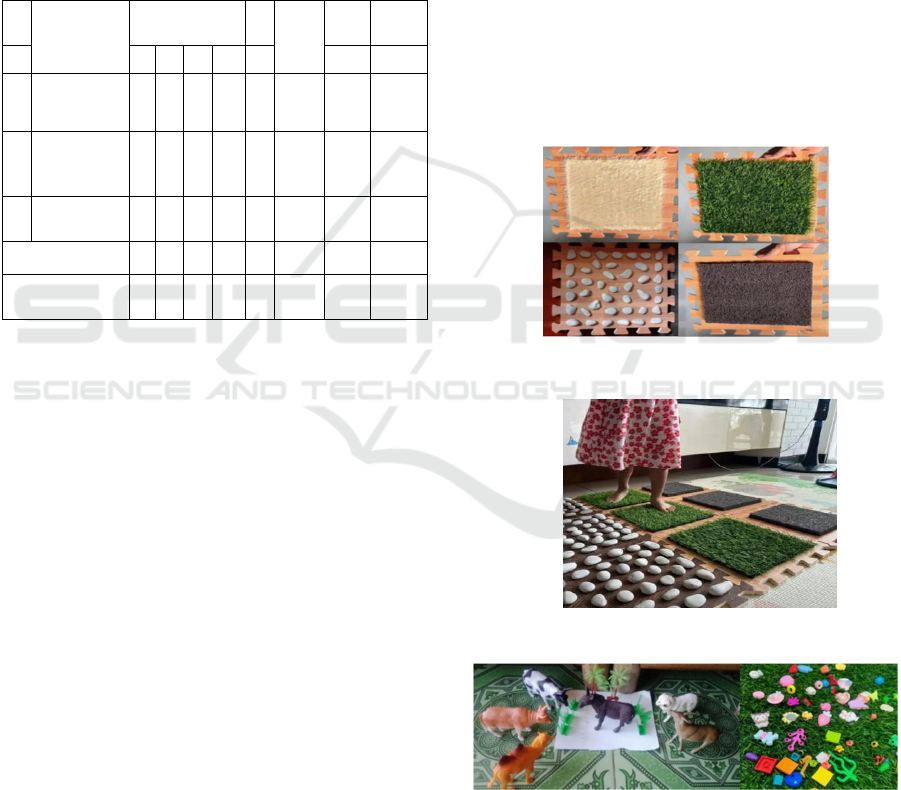
The final form of the product developed is a tactile
carpet for early childhood. The tactile carpet was
developed from 4 main components, namely 1) A
carpet consisting of 4 textures, namely stone, grass,
foam, fur in the form of a puzzle and can be
disassembled 2) Animal miniature toys, 3) a
guidebook for using the tactile carpet 4) 5W + 1H
statement cards (What, Who, When, Where, Why,
How)
Figure 1: The carpet consists of 4 textures, namely fur,
stone, grass and soft foam.
Figure 2: Carpets can be put together like a puzzle.
Figure 3: Miniature Animals and other Toys to use in the
game of finding animals on the carpet.
ICECE 2025 - The International Conference on Early Childhood Education
174
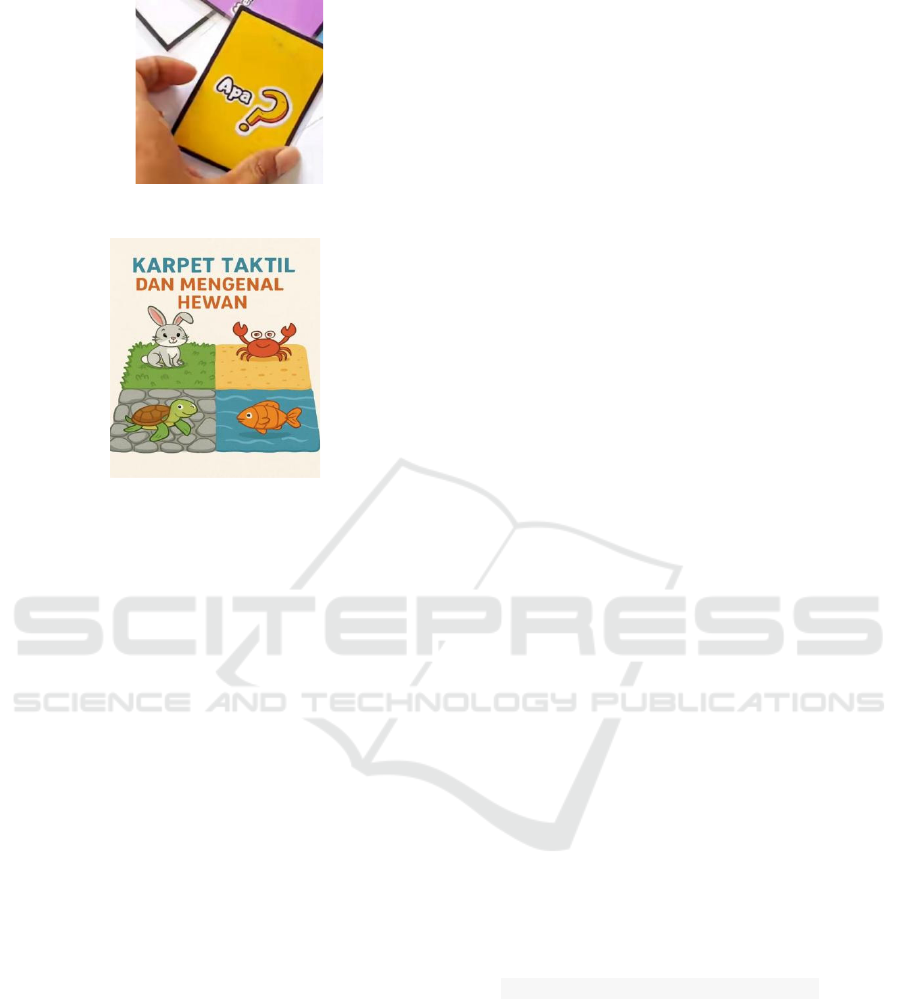
Figure 4: Question Card.
Figure 5: Guide Book.
The general description of the implementation of the
tactile carpet in the guidebook is as follows: (1) Many
toys are spread on the surface of the carpet and
children are asked to look for the animal requested by
the teacher (2) After finding the toy, children are
asked to take a question card and children are asked
to answer the question, the question in question is
according to the animal taken (3) If the child is
successful in answering the child can play with the
toy, if not the child must return the toy to the carpet.
4 CONCLUSION
The use of tactile carpets in early childhood learning
is used to enrich sensory experiences through direct
interaction with various textures, such as smooth,
rough, hard, soft and fluffy. This media not only
stimulates the sense of touch, but also helps children
connect tactile experiences with real concepts while
playing with animals. The design of the tactile carpet
that can be disassembled like puzzle pieces, with
good visual and functional quality, facilitates storage,
maximizes the variety of activities, and extends the
media's lifespan. Support from media experts
indicates that this carpet has met the criteria for
learning eligibility, although constructive feedback is
still needed for quality improvement. The tactile
carpet also uses a guidebook to facilitate use. With
proper application, tactile carpets have the potential
to be an effective, fun, and multifunctional
educational tool to develop fine motor skills, enrich
vocabulary, build imagination, and strengthen
children's sensorimotor nerve connections.
REFERENCES
Aryanti, P. G., Lailany, A. A., Amelia, I., Regita, A. N. H.,
Setiawan, K. M. P., & Yel, M. B. (2024). Media
Interaktif Pembelajaran Berbasis Multimedia
menggunakan Adobe Flash untuk TK dan PAUD.
AJAD Jurnal Pengabdian Kepada Masyarakat, 4(1).
https://doi.org/10.59431/ajad.v4i1.282
Camacaro, M. (2013). Educational Strategies for sense
approach physical education in touch child. 37(78), 96–
108. http://www.scielo.org.ve/pdf/ri/v37n78/art05.pdf
Case-Smith, J., & O’Brien, J. C. (2015). Occupational
Therapy for Children and Adolescents. St. Louis: Mosby.
Chawla, L. (2015). Benefits of nature contact for children.
Journal of Planning Literature, 30(4), 433–452.
https://doi.org/10.1177/0885412215595441
Chung, K. D. (2022). Drawing as an encounter with
materials in early childhood education spaces.
International Journal of Education Through Art, 18(2),
181–189. https://doi.org/10.1386/eta_00093_3
da Silva, E., Amaral Ramos, C., da Silva Mendes, M. A.,
Trevizan Tramontina, F., & da Silva, J. M. (2024).
Playing in early childhood education. Revista Gênero e
Interdisciplinaridade, 5(05), 86–96. https://doi.org/10.
51249/gei.v5i05.2226
Dahua Robelly, J. E., Chocano Mena, M., Hurtado Abad, J.
del R., & Silva, L. J. (2024). Evaluación del impacto de
la integración multisensorial en el desarrollo
neurosensorial de niños preescolares: un estudio en el
Centro de Desarrollo Neurosensorial y Rehabilitación
Integral Úpala Kids. Polo Del Conocimiento, 9(12),
1029–1046. https://doi.org/10.23857/pc.v9i12.8527
Dodd, H. F., Nesbit, R. J., & Maratchi, L. R. (2021).
Development and evaluation of a new measure of
children’s play: the Children’s Play Scale (CPS). BMC
Public Health, 21(1), 878. https://doi.org/10.11
86/S12889-021-10812-X
Fan, Y., Chong, D. K., & Li, Y. (2024, March). Beyond
play: a comparative study of multi-sensory and
traditional toys in child education. In Frontiers in
Education (Vol. 9, p. 1182660). Frontiers Media SA.
https://doi.org/10.3389/feduc.2024.1182660
Helleman, G., Nio, I., & De Vries, S. I. (2023). Playing
outdoors: What do children do, where and with whom?
https://doi.org/10.37291/2717638x.202343285
Kementerian Pekerjaan Umum dan Perumahan Rakyat.
(2020). Pedoman Penyediaan dan Pemanfaatan Ruang
Terbuka Hijau. Jakarta: Direktorat Jenderal Cipta
Karya.
Kmurawak, R., & Setyaningsih, D. (2020). Use Of
Augmented Reality as A Learning Media In Early
Childhood Education Solideo Perumnas I Jayapura.
3(1), 1–5. https://doi.org/10.23917/ECRJ.V3I1.10544
Innovation in Designing Interactive Game-Based Tactile Carpets for Sensory and Motor Stimulation in Early Childhood
175

Lubis, M. Y. (2019). Mengembangkan sosial emosional
anak usia dini melalui bermain.Geotechnique, 2(1), 47–
58. https://doi.org/10.25299/GE.2019.VOL2(1).3301
Mardhatillah, M. (2021). Media learning for early
childhood in early childhood education. Sensei
International Journal of Education and Linguistics.
https://doi.org/10.53768/sijel.v1i4.109
Moreno Lucas, F. M. (2015). Función pedagógica de los
recursos materiales en educación infantil /
Pedagogical function of material resources in early
childhood education. 133, 12–25. https://doi.org/10.
15178/VA.2015.133.12-25
Murillo, E., Rujas, I., Sierra, T., Zamora, E., & Azagra, G.
(2025). Tactile Cues and Object Use in Multimodal
Communicative Behaviors: Parent-Infant Interactions
From 9 to 12 months of Age. Infancy: the official
journal of the International Society on Infant Studies,
30(4), e70038. https://doi.org/10.1111/infa.70038
Musnir, N., & Sumantri, S. (2019). Development of
Material Learning Based Multimedia for Early
Childhood Inclusion Education. https://doi.org/10.2991
/ICPEOPLEUNNES-18.2019.54
Muthanje, A. K. (2023). Mainstreaming Instructional
Materials for Early Childhood Education and its
Influence on Children’s Participation Rates in Public
Primary Schools in Embu County, Kenya. Journal of
Studies in Education, 13(2), 30. https://doi.org/10.
5296/jse.v13i2.20767
Pacini-Ketchabaw, V., Kind, S., & Kocher, L. (2016).
Encounters With Materials in Early Childhood
Education. https://www.taylorfrancis.com/books/mo
no/10.4324/9781315743257/encounters-materials-
early-childhood-education-veronica-pacini-ketchabaw-
sylvia-kind-laurie-kocher
Pant, I., Sharma, L. K., & Sharma, M. K. (2024). Use of
Audio-Visual Teaching Learning Materials in
Facilitating of Health Education in Early Childhood
Development Centers, Pokhara, Nepal. Journal of
Health Promotion, 12(1), 55–66. https://doi.org/10.
3126/jhp.v12i1.72697
Rahman, T., & Nuraini, Y. (2023). Analysis of the Use of
Learning Media in Early Childhood Education. Scientia
(Panamá). https://doi.org/10.51773/sssh.v2i2.244
Rohibni, R., Rokhmawan, T., Sayer, I. M., & Fitriyah, L.
(2022). The Variety of Mathematics Learning Media
for Early Childhood in Improving Basic Mathematics
Ability. Bulletin of Science Education, 2(3), 102.
https://doi.org/10.51278/bse.v2i3.427
Rosalianisa, R., Purwoko, B., & Nurchayati, N. (2023).
Analysis of Early Childhood Fine Motor Skills Through
the Application of Learning Media. IJORER, 4(3), 309–
328. https://doi.org/10.46245/ijorer.v4i3.307
Roziah, R. (2019). Pengembangan media pembelajaran
berbasis sensory carpet untuk pemahaman panca
indera anak usia 1-2 tahun (Doctoral dissertation,
Universitas Islam Negeri Maulana Malik Ibrahim).
Rupnidah, R., & Suryana, D. (2022). Media Pembelajaran
Anak Usia Dini. Jurnal PAUD Agapedia, 6(1), 49–58.
https://doi.org/10.17509/jpa.v6i1.48199
Salna, I., Rahmadanti, L., Sa’adah, N., Fatimah, F.,
Khadijah, K., & Putri, H. A. (2024). Mengembangkan
Sosial Emosional Anak Usia Dini Melalui Bermain.
Ta’rim, 5(3), 63–71. https://doi.org/10.59059/tarim.
v5i3.1340
Servelin, J. M. da S. B., Oliveira, S., & Conceição, A. de N.
(2019). Revisão bibliográfica sobre espaços e materiais
para a Educação Infantil (2019-2023). Revista Do
Instituto de Políticas Públicas de Marília, 10, e024008.
https://doi.org/10.36311/2447-780x.2024.v10.e024008
Sudarsana, I. K., Suhardiana, P., Oktarina, P., & Dantha, N.
K. (2020). Flashcard As A Learning Media For Early
Childhood. https://doi.org/10.4108/EAI.20-6-2020.2
300615
Sumarmi, S., & Afendi, A. R. (2022). Improving Learning
Creativity in Early Childhood Through Learning Media
Loose Part: Energetic, Concentrated and Creative.
Journal of Education and Learning Innovation, 2(3),
392–398. https://doi.org/10.35877/454ri.eduline1262
Tubele, S. (2023). Multisensory Approach in Speech
Therapy for Preschool Children. To Be or Not to Be a
Great Educator, 815-823. https://doi.org/10.22364/
atee.2022.55
Zahra, M. F. A., Wardono, P., & Maharani, Y. (2019). Studi
Preferensi Tekstur Pada Permukaan Lantai Dalam
Menunjang Perilaku Bermain Anak Di Sekolah
Montessori. Idealog: Ide dan Dialog Desain
Indonesia, 4(2), 119-126.
ICECE 2025 - The International Conference on Early Childhood Education
176
