
Implementing Deep Learning Approaches for Students with
Special Needs: A Systematic Literature Review
Marlina
1a
, Endang Sri Handayani
1
, Syari Yuliana
1
, Yosa Yulia Nasri
2
, Rindia Nengsih
2
,
Selvi Rahmawati
2
, Nurmalika Ulfa
2
, Elma Diana
2
and Al Shaffaat Ronvy
2
1
Department of Special Education, Universitas Negeri Padang, Indonesia
2
Department of Special Education, Universitas Adzkia Padang, Indonesia
Keywords: Implementation, Deep Learning, Students with Special Needs, Systematic Literature Review, Inclusive
Pedagogy.
Abstract: The purpose, this systematic literature review (SLR) is to explore how deep learning approaches have been
implemented to support students with special educational needs (SEN). Method, following the PRISMA 2020
protocol, a comprehensive search was conducted across major academic databases including Scopus, Web of
Science, and ERIC. The selection process resulted in 56 peer-reviewed articles published between 2015 and
2025 that met the inclusion criteria. The data were analysed thematically to identify implementation strategies,
common practices, benefits, challenges, and contextual factors influencing deep learning in inclusive
classrooms. The review reveals that deep learning in inclusive education for students with SEN primarily
involves strategies such as project-based learning, collaborative inquiry, and metacognitive scaffolding.
Teachers play a pivotal role in facilitating deep learning through adaptive instruction and emotional support.
However, challenges such as limited teacher training, rigid curricula, and inadequate school support systems
persist. Studies also highlight the significance of school culture and curriculum flexibility in sustaining deep
learning practices. Despite positive impacts on student engagement, critical thinking, and social-emotional
growth, the integration of deep learning remains uneven across contexts. Conclusion: Deep learning holds
promising potential for enhancing educational experiences and outcomes for students with special needs in
inclusive settings. However, successful implementation requires systemic alignment between teacher
competencies, curriculum design, and institutional support.
1 INTRODUCTION
The transformation of 21st-century education
emphasises learning that focuses not only on
academic achievement but also on developing higher-
order thinking skills, creativity, collaboration, and
problem-solving. The deep learning approach
responds to this need, emphasising conceptual
understanding, critical reflection, the
interconnectedness of concepts, and the application
of knowledge in real-world contexts (Zebua, 2025).
In practice, deep learning positions students as active
learners who construct knowledge through
meaningful experiences, rather than simply
memorising information (MacFarlane et al., 2017).
a
https://orcid.org/0000-0003-3265-8045
In Indonesia, the direction of educational policy
that upholds similar values is reflected in the
Independent Curriculum. This curriculum
emphasises differentiated, project-based learning and
focuses on strengthening competencies and character
(Marlina, 2019). Students are encouraged to have
agency (control over their learning process), and
teachers act as facilitators, adapting approaches to
individual learners' needs. This is particularly
relevant for students with special needs, who require
a flexible, meaningful learning approach that is
oriented toward their unique potential (Jauhari &
Idhartono, 2022).
Both deep learning and the Independent
Curriculum share a common thread in promoting
Marlina, , Handayani, E. S., Yuliana, S., Nasri, Y. Y., Nengsih, R., Rahmawati, S., Ulfa, N., Diana, E. and Ronvy, A. S.
Implementing Deep Learning Approaches for Students with Special Needs: A Systematic Literature Review.
DOI: 10.5220/0014069200004935
Paper published under CC license (CC BY-NC-ND 4.0)
In Proceedings of the 7th International Conference on Early Childhood Education (ICECE 2025) - Meaningful, Mindful, and Joyful Learning in Early Childhood Education, pages 81-90
ISBN: 978-989-758-788-7; ISSN: 3051-7702
Proceedings Copyright © 2025 by SCITEPRESS – Science and Technology Publications, Lda.
81

transformative, participatory, and student-centered
learning. However, to date, few studies have
specifically evaluated how deep learning principles
are implemented in the context of special education
in Indonesia, particularly within the framework of the
Independent Curriculum. Empirical evidence remains
limited regarding the effectiveness of deep learning
strategies in improving engagement, conceptual
understanding, and the social-emotional development
of students with special needs, both in inclusive and
special schools (Andayanie, et al, 2025).
One approach that is increasingly being studied
in 21st-century education is deep learning. Unlike
surface learning, which focuses solely on
memorization and repetition of information, deep
learning encourages students to think critically, solve
problems, understand the meaning of concepts, and
connect new information to existing knowledge. This
approach is capable of improving the quality of the
teaching and learning process. It is relevant to the
demands of 21st-century competencies such as
collaboration, communication, creativity, and critical
thinking (Thornhill-Miller et al., 2023).
In the context of students with special needs
studying in inclusive schools, implementing
immersive learning presents unique challenges. Their
limitations in cognitive, social, and adaptive abilities
require teachers to adapt learning strategies to ensure
they remain meaningful and accessible to all students
(Darwish et al., 2025). Meanwhile, literature that
discusses the practical implementation of immersive
learning for students with special needs in inclusive
classrooms remains limited and scattered.
Therefore, this study aims to conduct a
Systematic Literature Review (SLR) to collect,
analyse, and synthesise relevant research findings
related to the implementation of immersive learning
for students with special needs in inclusive schools.
This study uses the PRISMA 2020 guidelines for
literature identification and analysis, as well as the
PICo framework for determining the focus
population, interventions, and context. The results of
this systematic review are expected to provide a more
comprehensive understanding, identify good
practices, and uncover challenges and
recommendations in implementing inclusive and
adaptive immersive learning for students with special
needs. In this systematic review, the research
questions formulated are as follows:
1. How is deep learning implemented in inclusive
schools to support students with special
educational needs (SEN)?
2. What types of deep learning strategies are most
commonly used for students with special
educational needs (SEN)?
3. What benefits and challenges are reported in the
implementation of deep learning approaches for
SEN students?
4. What contextual factors (e.g., teacher roles,
curriculum design, school environment) influence
the success of deep learning implementation in
inclusive classrooms?
5. To what extent do existing studies integrate
inclusive principles into deep learning practices
for students with special needs?
2 METHOD
2.1 Research Design and Data Sources
This study uses a systematic literature review
approach to examine the implementation of deep
learning in education for students with special needs.
The goal is to systematically identify, evaluate, and
synthesise relevant literature to obtain a
comprehensive overview of the practices, challenges,
and effectiveness of its implementation. The review
process follows the PRISMA (Preferred Reporting
Items for Systematic Reviews and Meta-Analyses)
guidelines developed by Page et al. (2021) to ensure
transparency, objectivity, and rigour in literature
selection. The PRISMA approach includes three main
stages: identification, screening (including eligibility
assessment), and inclusion. Each stage is carefully
conducted to ensure that the analysed sources are
valid, relevant, and contribute to the development of
deep learning strategies that are appropriate to the
needs of students with special needs. This process
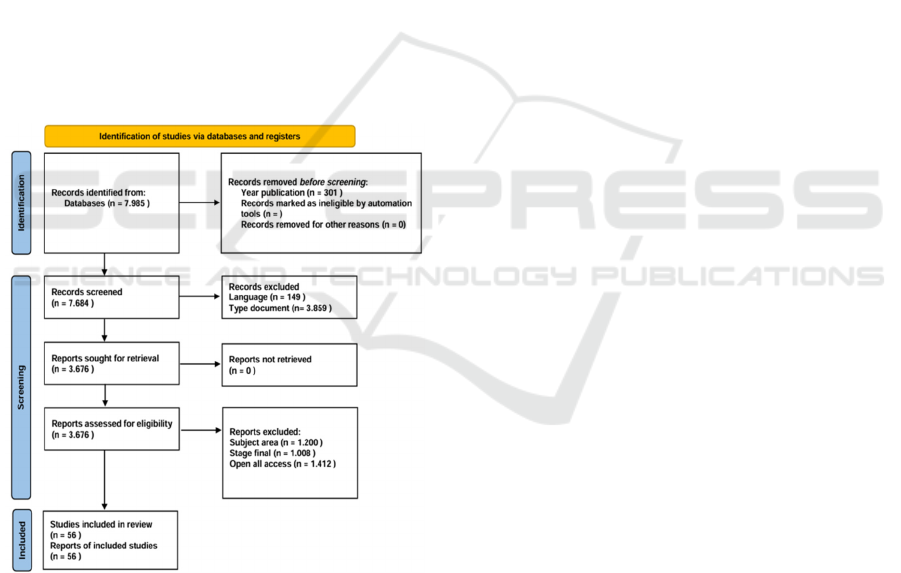
flow is depicted in the PRISMA diagram in Figure 1.
2.2 Databases
A literature search was conducted using the academic
database Scopus.com, as it aggregates articles from
various scientific journals, offering broad and diverse
coverage. This database selection ensured access to
multidisciplinary research, allowing for a
comprehensive overview of the topics explored in this
study. This timeframe ensured the inclusion of the
most recent and relevant studies.
A structured literature search was conducted
using the Scopus.com database, using targeted search
terms. A series of structured search terms was used to
capture a comprehensive range of studies related to
immersive learning in Special Education, including
ICECE 2025 - The International Conference on Early Childhood Education
82
forms, types, benefits, challenges, and factors
influencing the implementation of immersive
learning for students with special needs.
The search queries included:
1. [“Deep Learning”] OR [“Immersive Learning]
2. [“Students with Intelectual disabilities”] OR
[“Mentally Retarded”]
3. [“Meaningful Learning”] OR [“Joyful
Learning”] OR [“Mindful Learning”]
.
2.3 Inclusion and Exclusion Criteria
Data
This study establishes inclusion and exclusion criteria
to ensure that the study conducted is relevant and
academically credible. Exclusion criteria include: (1)
Document type: book, book chapter, conference
paper, conference review, (2) Language: other than
English, (3) Publication year: other than 2015-July
2025. At the same time, inclusion criteria include: (1)
Document type: article, (2) Language: written in
English, (3) Source type: only articles, (4) Article
publication year from 2015 to 2025.
Figure 1: PRISMA Flowchart.
2.4 Data Extraction
Information collected from each article: (1) author
name and year, (2) country of origin of the study, (3)
research objectives, (4) participant characteristics
(age, stage, diagnosis), (5) methodology, (6) deep
learning strategy used, and (7) main findings.
2.5
Documents Included in the Analysis
After screening and eligibility, 56 documents meeting
the inclusion criteria were selected for further
analysis. Figure 1 shows the selection process. The
datasets were combined into CSV files for
bibliometric analysis using Rstudio and
Bibliometrics. This approach combines empirical and
systematic literature, providing information on the
implementation of immersive learning for students
with special needs.
2.6 Quality and Credibility
Data collection in this study was conducted
rigorously to ensure only high-quality articles were
analyzed. Each metadata entry was carefully
reviewed to ensure the accuracy and completeness of
information, including title, author(s), year of
publication, keywords, and number of citations. This
verification process ensures the validity and
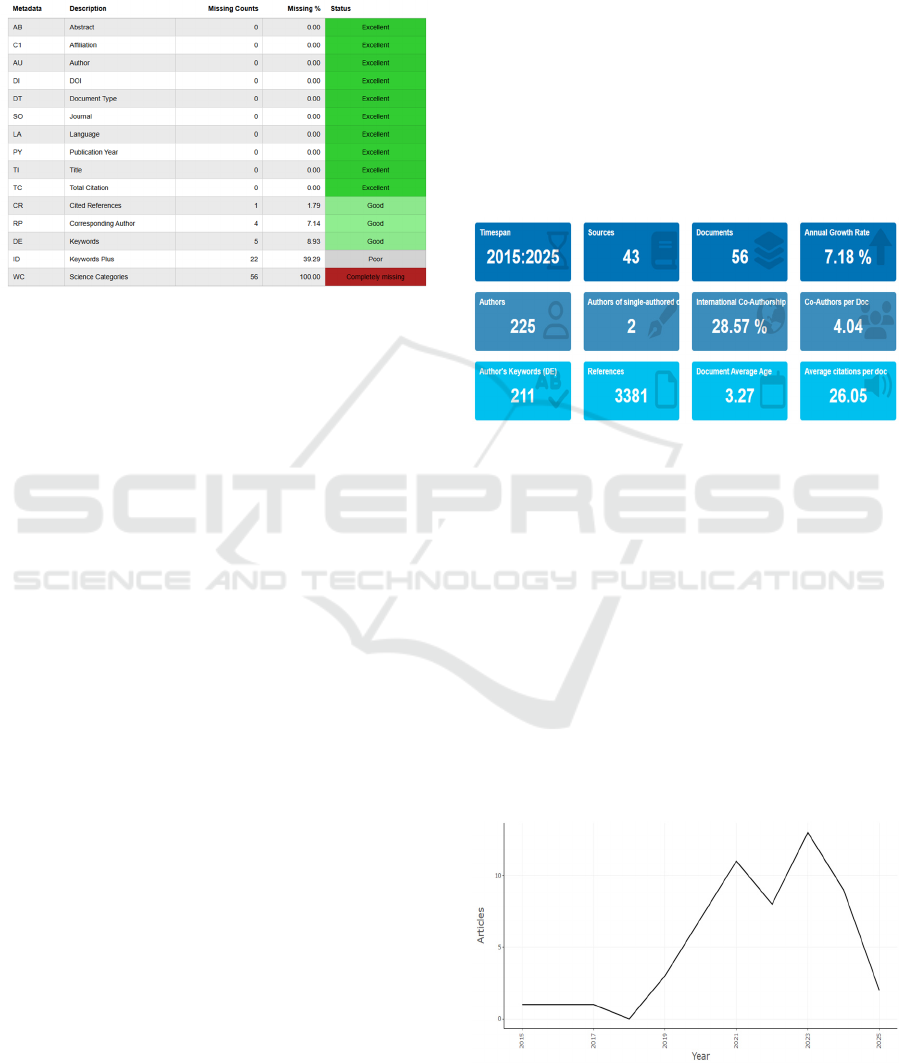
reliability of the bibliometric analysis results. Table 1
shows that most metadata elements, such as abstract,
author(s), DOI, document type, journal, language,
year of publication, title, total citations, references,
affiliations, keywords, corresponding author(s),
additional keywords, and scientific category, were
fully available. This completeness provides a strong
foundation for bibliometric analysis, as it allows for
accurate mapping of citations and the influence of
authors or journals. However, deficiencies in some
metadata elements can still impact the overall
completeness of the analysis results.
The keyword data completion rate (DE) was
only 8.93% and publication year (PY) data was
recorded at 0%, indicating data gaps, albeit minimal.
The absence of keyword data can reduce the accuracy
of thematic and co-occurrence analyses, which are
crucial for identifying research trends. Meanwhile,
the completeness of corresponding author (RP) data
was only 7.14%, potentially limiting the analysis of
inter-researcher collaboration networks and mapping
institutional relationships in deep learning
implementation studies.
In contrast, several metadata elements exhibit
significant deficiencies, such as keywords plus (ID)
with 39.29% missing data, cited references (CR) with
1.79% missing data, and science categories (WC)
with 100% missing data. These deficiencies are
critical because they significantly limit citation
network analysis and thematic exploration, thus
hindering the identification of key themes and
broader scientific relationships within the literature.
The absence of data on ID and WC particularly
Implementing Deep Learning Approaches for Students with Special Needs: A Systematic Literature Review
83
reduces the ability to map interrelated concepts and
research dynamics in this field.
Table 1: Completeness of Deep Learning Bibliographic
Metadata.
Although some metadata elements, such as
keywords plus (ID) and scientific categories (WC),
experienced data loss, this deficiency could be
addressed by utilizing the author keywords (DE)
available in the metadata. Co-occurrence analysis
could still be conducted with limited scope to map
key themes in research on implementing deep
learning for students with special needs. In the
context of this research, mapping trends, citation
patterns, and researcher collaborations was crucial.
Therefore, while the absence of WC and ID limited
certain aspects of the analysis, the availability of other
metadata still allowed the research to proceed without
compromising the integrity of the analysis (Aria &
Cuccurullo, 2017)
2.7 Data Analysis
Data were analyzed using thematic analysis with a
narrative synthesis approach. This was because the
data obtained from the included studies were
qualitative and quantitative descriptive,
demonstrating diversity in methodology, context, and
forms of in-depth learning interventions for students
with special needs.
3 RESULT
3.1 Demographic Distribution Results
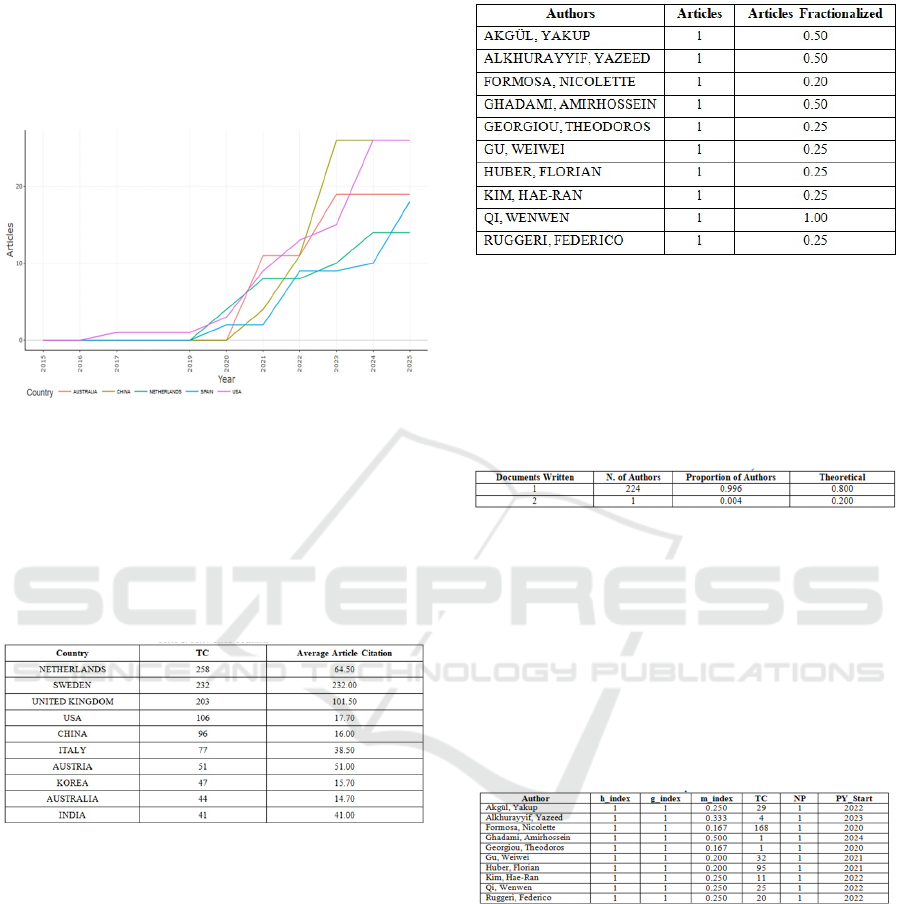
This study analyzed 56 articles on the implementation
of immersive learning for students with special needs
published between 2015 and 2025. The publication
growth rate reached 7.18% annually, reflecting the
increasing attention to this topic. A total of 225
authors were involved, with two articles written
individually. Each article had an average of four
authors, indicating a strong collaborative nature.
International collaboration was reflected in 28.57%
of articles involving authors from different countries.
Keyword analysis identified 211 unique terms,
indicating broad thematic and conceptual diversity.
The average age of the documents was 3.27 years,
indicating the novelty of the reviewed literature. An
average of 26.05 citations per article indicates
significant academic impact. Figure 2 visually
presents demographic data and publication
characteristics.
Figure 2:
Demographic
Distribution Results of Deep
Learning Data.
3.2
Annual Publication Trends
Figure 3 shows a slow growth in publications related
to the implementation of deep learning for students
with special needs from 2015-2025, with each article
published. In 2015-2017, there was an increase in
publications of 3 articles, and in 2018, there was a
decrease in publications of 0 articles. In 2019-2021,
there was an increase in publications of 21 articles. In
2022, there was a decrease in publications of 8
articles. In 2023, there was an increase in publications
of 13 articles. In 2024-2025, there was a decreased in
publications of 11 articles.
Figure 3: Annual Publication Trends in Deep Learning.
ICECE 2025 - The International Conference on Early Childhood Education
84
3.3
Country Level Analysis
The USA leads research publications on
implementing immersive learning for students with
special needs, with 26 papers published between
2015-2025.
Figure 4: Country-Level Analysis of Deep Learning
.
Figure 4 provides information on the number of
citations and average citations of articles by country.
The USA published 95 articles. Other countries, such
as China, published 41 articles, Australia published
60, Spain published 50, and the Netherlands
published 58.
Table 2: Most Cited Countries.
3.4 Key Contributors and Influential
Institutions
3.4.1 Most Relevant Authors
This study identified several academics who
consistently published articles on immersive learning
and students with special needs between 2015 and
2025. Table 3 presents the 10 most relevant authors
and their number of publications. The most prominent
authors on this topic are Alkhurayyif, Yazeed.
Table 3: Most Relevant Authors in the Research.
3.4.2 Author Productivity
Most authors (99.6%) published only one article,
while only 0.4% contributed more than one
publication related to implementing deep learning for
students with special needs.
Table 4: Author Productivity.
3.4.3 Author Impact: h-index, g-index, and
m-index
In addition to assessing the number of publications,
researchers evaluated the impact of each author's h-
index, g-index, and m-index. These indices help
measure an author's contributions' overall quality and
impact. Table 2 shows that the authors' h-index
averaged 1.
Tabel 5: Impact of Author Indexing.
3.4.4 The Most Influential Institutions
Some affiliates that emerged as the main actors in the
research on the implementation of in-depth learning
for students with special needs from 2015 to 2025, the
data shows that Universidad De Deusto, with eight
articles, as depicted in Table 6.
Implementing Deep Learning Approaches for Students with Special Needs: A Systematic Literature Review
85
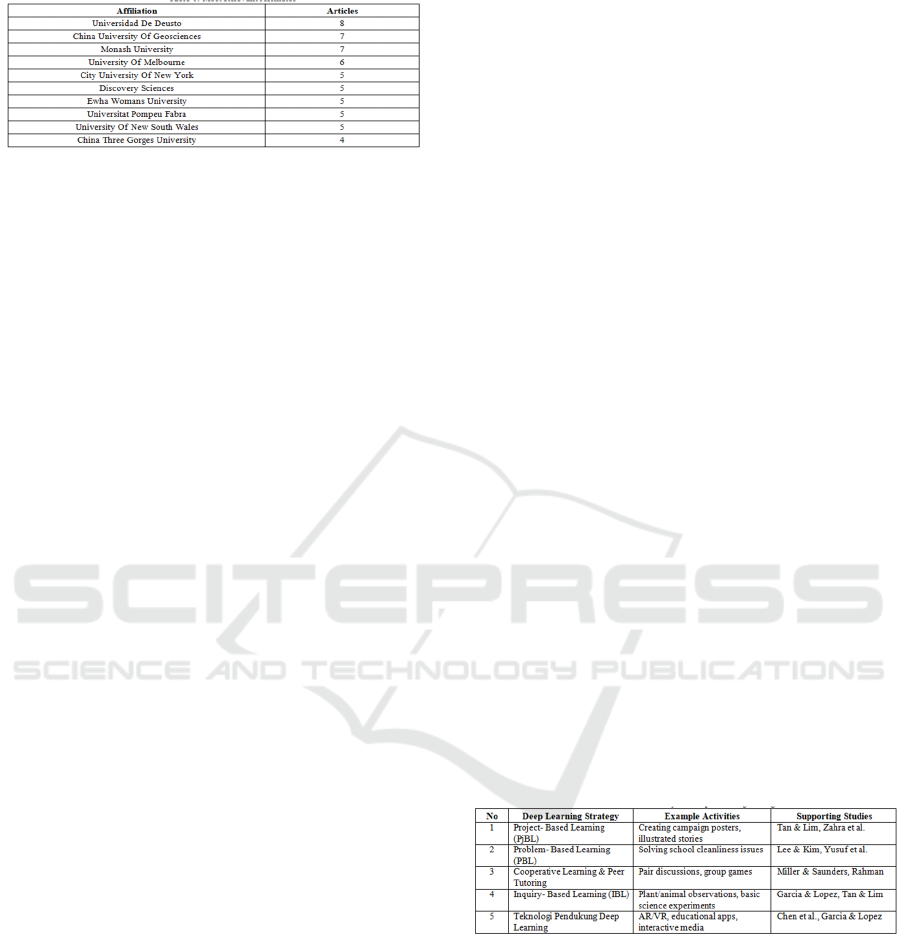
Table 6: Most Relevant Affiliates.
4 DISCUSSION
4.1 Deep Learning in an Inclusive
Context
Deep learning is an instructional approach that
encourages students to think critically through
analyzing, synthesizing, and evaluating information,
rather than simply memorizing it. In inclusive
education, this approach is tailored to meet the needs
of students with intellectual disabilities, specific
learning disabilities, and communication and social
disabilities. This approach aligns with Universal
Design for Learning (UDL) principles, which
emphasize diversity in representation, expression,
and engagement in learning (CAST, 2018).
Most studies indicate that deep learning is
implemented through project-based learning,
problem-based learning, and collaborative activities.
These strategies are designed to engage students in
meaningful activities that connect knowledge to real-
world experiences. Some of the methods identified
include:
a. Scaffolded inquiry with visual and concrete
supports.
b. Story-based learning to enhance understanding of
abstract concepts.
c. Peer tutoring and cooperative learning that
encourage social interaction.
4.2 Deep Learning Implementation
Strategies for Students with Special
Needs
a. Project-Based Learning (PjBL) and Problem-
Based Learning (PBL)
This strategy is widely adopted because it
facilitates collaboration, problem-solving, and
reflection, which are the core of deep learning. For
example, students with special needs are
encouraged to complete real-life projects with
visual support, scaffolding, and adaptive
technology (Schuelka et al., 2019); (Prystiananta
& Noviyanti, 2025). A study (Fernández-
Batanero et al., 2022) showed that multimedia-
based PjBL is effective in developing critical
thinking skills in students with learning
disabilities.
b. Adaptive Learning Technology
This technology automatically detects student
needs and adapts learning content in real time.
Students with special needs can access audio,
visual, or interactive materials. The AI system can
adjust the difficulty level based on student
responses, including for those with mild
intellectual disabilities (Togni, 2025).
c. Collaborative Peer Mentoring and Guided
Discussions
Collaborative activities allow students with
special needs to interact with peers through
guidance and structured discussions, with the
support of teachers as facilitators (Marlina et al.,
2023). Dialogic learning in deep learning is
crucial, especially for students with
communication barriers (Luckin & Holmes,
2016).
d. The Role of Teachers and Inclusive Learning
Design
Successful implementation depends heavily on
teachers' ability to design adaptive and reflective
learning. Teachers need to use ongoing formative
assessment, design reflective activities, and
provide meaningful feedback. An inclusive
approach based on deep learning requires detailed
instructional planning and teacher training in
reflective and collaborative learning strategies
(Mitchell & Sutherland, 2020).
Table 7: Summary of Deep Learning Strategies.
4.3 Benefits and Challenges of
Implementing a Deep Learning
Approach for Students with Special
Needs
Deep learning encourages students to go beyond
memorizing information to understanding,
connecting, and applying knowledge. In students with
special needs, this approach has been shown to
improve their ability to solve simple problems,
understand cause-and-effect relationships, and
ICECE 2025 - The International Conference on Early Childhood Education
86

communicate thoughts verbally or visually. Project-
based approaches have been shown to strengthen
memory and conceptual connections (Nguyen &
Nguyen, 2021; Lee & Kim, 2019).
Through project-based and cooperative learning
methods, students actively engage with their peers,
developing social and collaborative skills. Reported
social benefits include increased empathy and
tolerance from classmates and a sense of belonging
for students with disabilities, who feel valued through
their roles within the group (CAST, 2018).
Furthermore, several studies have shown that deep
learning encourages students to express themselves
through portfolios, journals, or group discussions,
which builds self-awareness and responsibility for the
learning process (Lim & Tan, 2021).
Despite its benefits, implementing deep learning
in the context of students with special needs is not
without challenges. Four main challenges reported
are: (1) limited teacher capacity, (2) minimal
curriculum and policy support, (3) limited resources
and technology, and (4) unequal participation in
group activities.
Many teachers have not received adequate
training in implementing deep learning strategies,
particularly in differentiating learning for students
with special needs (Marlina, 2021). Teachers often
struggle to design assignments that are appropriate to
students' cognitive levels and face increased
workloads when preparing adapted materials. As
many as 68% of teachers feel a lack of confidence in
implementing project-based learning for students
with special needs (Yusuf et al., 2022). In developing
countries, including Indonesia, the national
curriculum does not fully support the flexibility
needed to implement deep learning in inclusive
classrooms. As a result, teachers focus more on
achieving formal academic targets than on
developing deep thinking processes. Furthermore,
there is no evaluation system that assesses higher-
order thinking skills in students with disabilities. In
practice, teachers often adapt deep learning strategies
informally without the support of clear curriculum
guidelines (Lee & Kim, 2019).
Implementing deep learning relies heavily on
media, visual aids, technology, and sufficient time.
Many inclusive schools face limitations: (1) access to
interactive digital devices, (2) appropriate visual
teaching materials, and (3) high teacher-student ratios
(García-Robles et al., 2024). Despite collaborative
efforts, some students with special needs are excluded
from group discussions, especially with no clear
roles. The impact is increased reliance on peers and
shallow participation without cognitive engagement
(Rahman et al., 2023).
4.4 Factors Influencing the Success of
Deep Learning Implementation for
Students with Special Needs
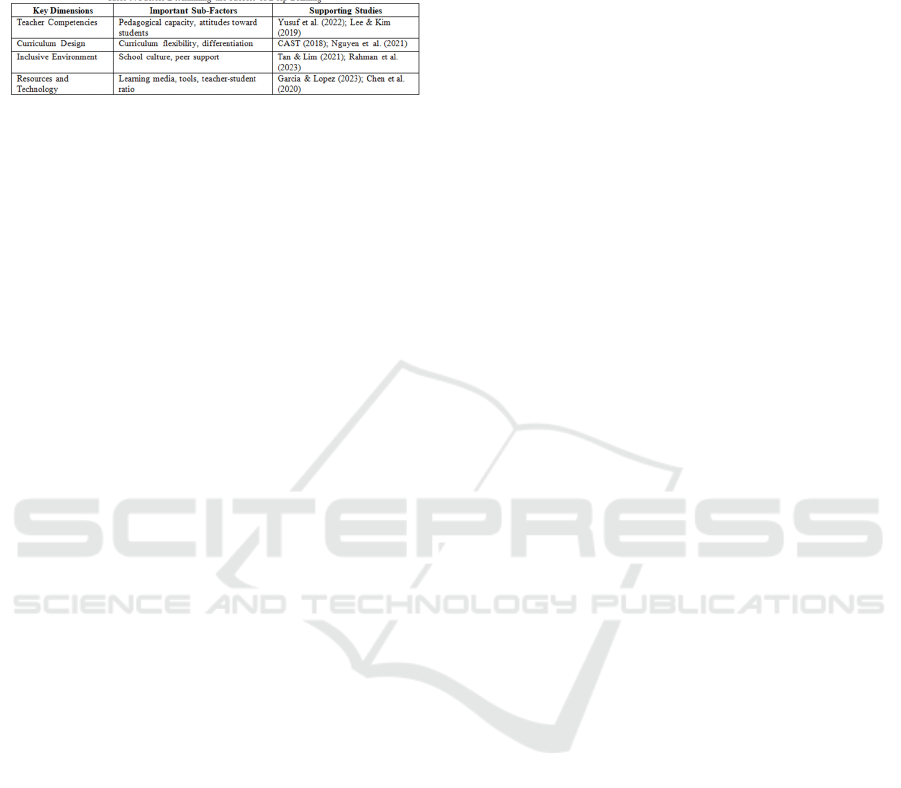
The successful implementation of a deep learning
approach in inclusive classrooms for students with
special needs is influenced by various factors,
including teacher competency and perception,
curriculum design and differentiation, a supportive
inclusive learning environment, and the availability
of resources and technology (Marlina, 2015). Studies
show that success is highly dependent on teachers'
abilities to: (1) design structured and adapted deep
learning, (2) use approaches such as project-based
learning, problem-based learning, and cooperative
learning, and (3) manage heterogeneous classes based
on needs. Teachers who have received training in
inclusive pedagogy and higher-order thinking
strategies are more successful in effectively
implementing the deep learning approach (Yusuf et
al., 2022). Teachers who have positive beliefs about
the abilities of students with special needs are more
likely to provide challenging yet accessible learning
experiences (Lee & Kim, 2019).
Flexible modification of learning objectives,
materials, and methods encourages the
implementation of deep learning strategies. Good
practices found include the use of UDL and the
adoption of multi-tiered instruction based on student
abilities. Multi-level planning within a single learning
theme is crucial. Implementing deep learning relies
on teachers' ability to differentiate content, processes,
and products according to student profiles (Liang et
al., 2024). Critical thinking task designs should be
developed in multiple difficulty levels to ensure all
students are meaningfully engaged (CAST, 2018).
Schools that instill values of diversity, respect for
differences, and encourage collaboration among
students be more effective in implementing deep
learning strategies (Lim & Tan, 2021). Support from
school leaders and a collaborative work culture
among teachers directly impact pedagogical
innovation in inclusive classrooms, enabling positive
interactions between students to become a catalyst for
the active participation of students with special needs
in complex tasks (Rahman et al., 2023). Access to
visual aids, interactive technologies (such as
AR/VR), and image-based learning materials
significantly impact student engagement in deep
learning. The use of VR-based simulations improves
the understanding of abstract concepts (such as
Implementing Deep Learning Approaches for Students with Special Needs: A Systematic Literature Review
87
gravity and weather) for students with special needs
(García-Robles et al., 2024); (Tsai et al., 2020).
Table 8: Factors Determining the Success of Deep Learning.
4.5 To What Extent Do Existing
Studies Address the Role of
Teachers, Curriculum, and School
Environment in Facilitating Deep
Learning for Students with Special
Educational Needs?
The main findings indicate that most studies
explicitly or implicitly acknowledge that the success
of deep learning implementation is heavily influenced
by three components of the education system:
teachers as the primary facilitators, the curriculum as
the pedagogical framework, and the school
environment as the context for its implementation.
However, the depth and focus of discussion on these
three aspects vary across studies.
1. The Role of Teachers as Deep Learning
Facilitators
Teachers are the primary actors in deep learning
strategies for students with special needs.
Adaptations are made through project-based
assignment modifications, visuals and concrete
tools, group-based learning, and peer tutoring
(Marlina, 2014). Creative teachers can
transform problem-based learning into concrete
and collaborative experiences for students with
special needs (Lee & Kim, 2019); (Nguyen &
Nguyen, 2021).
The teacher's role as a scaffolding provider is
crucial in helping students think reflectively,
make connections, and develop deep
understanding. Teachers' use of open-ended
questions, step-by-step reflection, and verbal
feedback can enhance students with special
needs' ability to explore ideas (Lee & Kim,
2019). Studies also note that the success of deep
learning is closely related to teachers' beliefs in
the learning potential of students with special
needs (Yusuf et al., 2022).
2. The Role of the Curriculum as a Driving
Framework
A curriculum implementing the UDL approach
allows for various forms of representation and
expression of learning (Lim & Tan, 2021); an
open thematic curriculum provides space for
teachers to develop collaborative and reflective
learning (Zahra et al., n.d.). Conversely, several
studies highlight that the national curriculum's
overly academic and linear nature makes it
difficult to implement deep learning, especially
in inclusive classrooms. The absence of specific
indicators for critical thinking or reflection skills
in the curriculum makes deep learning a low
priority (Tsai et al., 2020).
3. The Role of the School Environment in
Supporting Deep Learning
Schools that embrace a collaborative culture,
value diversity, and allow for pedagogical
innovation can provide a learning environment
conducive to deep thinking. School
environments open to innovative technologies
(e.g., VR and interactive simulations) enable
implementing more inclusive deep learning
strategies (García‐Robles et al., 2024).
Principals and other educational leaders also
significantly encourage innovation, training,
and resources (Rahman et al., 2023)
5 CONCLUSION
An analysis of 56 articles shows that deep learning
approaches significantly positively impact students
with special needs, particularly in improving
cognitive engagement, social interaction, contextual
understanding, and higher-order thinking skills. The
most commonly used strategies include project-based
learning (PjBL), problem-based learning (PBL),
cooperative learning, peer tutoring, and multimedia
and AR/VR technologies. These approaches
effectively bridge cognitive limitations through
concrete, collaborative, and real-life learning
experiences.
The success of implementation is heavily
influenced by four main factors: (1) teacher
competency and perception in designing in-depth
learning, (2) curriculum flexibility that supports
differentiation, (3) an inclusive learning environment
that encourages collaboration, and (4) the availability
of appropriate resources and technology. Despite the
strong benefits, challenges remain, such as limited
teacher training, an unadaptive curriculum, and
limited access to technology.
Overall, the analyzed studies underscore the
importance of integrating deep learning into inclusive
education, supported by teacher training, an inclusive
curriculum, and collaborative learning environments.
Systemic efforts are needed to improve teacher
ICECE 2025 - The International Conference on Early Childhood Education
88

capacity, expand access to technology, and promote
flexible education policies to enable students with
intellectual disabilities to experience meaningful and
immersive learning.
REFERENCES
Andayanie, L. M., Adhantoro, M. S., Purnomo, E., &
Kurniaji, G. T. (2025). Implementation of Deep
Learning in Education: Towards Mindful, Meaningful,
and Joyful Learning Experiences. Journal of Deep
Learning, 47-56.
Aria, M., & Cuccurullo, C. (2017). bibliometrix: An R-tool
for comprehensive science mapping analysis. Journal
of Informetrics, 11(4), 959–975.
CAST, C. (2018). Universal design for learning guidelines
version 2.2. Http://Udlguidelines. Cast. Org.
Darwish, S., Alodat, A., Al-Hendawi, M., & Ianniello, A.
(2025). General Education Teachers’ Perspectives on
Challenges to the Inclusion of Students with Intellectual
Disabilities in Qatar. Education Sciences, 15(7), 908.
Fernández-Batanero, J. M., Montenegro-Rueda, M.,
Fernández-Cerero, J., & García-Martínez, I. (2022).
Assistive technology for the inclusion of students with
disabilities: A systematic review. Educational
Technology Research and Development, 70(5), 1911–
1930.
García‐Robles, P., Cortés‐Pérez, I., Nieto‐Escámez, F. A.,
García‐López, H., Obrero‐Gaitán, E., & Osuna‐Pérez,
M. C. (2024). Immersive virtual reality and augmented
reality in anatomy education: a systematic review and
Meta‐Analysis. Anatomical Sciences Education, 17(3),
514–528.
Jauhari, M. N., & Idhartono, A. R. (2022). Pengoptimalan
Aksesibilitas Fisik Bagi Siswa Berkebutuhan Khusus
Disekolah Inklusi. Kanigara, 2(1), 264-269.
Lee, J.-A., & Kim, C.-J. (2019). Teaching and learning
science in authoritative classrooms: Teachers’ power
and students’ approval in Korean elementary
classrooms. Research in Science Education, 49(5),
1367–1393.
Liang, W., To, J., & Lo, Y. Y. (2024). A journey towards
teacher empowerment in differentiated instruction:
implications for a sustainable teacher professional
development model. Asia Pacific Education Review, 1–
13.
Lim, F. V., & Tan, J. M. (2021). Curriculum and assessment
mismatch: Examining the role of images in literacy
assessments. The Australian Journal of Language and
Literacy, 44(3), 22–34.
Luckin, R., & Holmes, W. (2016). Intelligence unleashed:
An argument for AI in education.
MacFarlane, J., Aladjem, D., & Russel, C. A. (2017).
Instructional practices for deeper learning: Lessons for
educators. Policy Studies Associates. https://asiasocie
ty.org/Files/Instructional-Practices-for-Deeper-Learn
ing-Lessons-for-Educators-May-2017-Report. Pdf.
Marlina. (2014). Kelompok Teman Sebaya, Popularitas,
dan Preferensi Sosial Anak Berkebutuhan Khusus
Belajar Di Sekolah Dasar Inklusi. Jurnal Pendidikan
Luar Biasa FIP Universitas Negeri Padang, 1(1), 6–14.
Marlina, M. (2015). Asesmen Anak Berkebutuhan Khusus:
Pendekatan Psikoedukasional Edisi Revisi.
Marlina, M. (2019). Panduan Pelaksanaan Model
Pembelajaran Berdiferensiasi di Sekolah Inklusif.
Universitas Negeri Padang. http://repository
.unp.ac.id/id/eprint/23547
Marlina, M. (2021). Strategi Pembelajaran Berdiferensiasi
di Sekolah Inklusif. Afifa Utama. http://
repository.unp.ac.id/32203/1/Marlina_2020_Buku_Str
ategi_Pembelajaran_Berdiferensiasi_di_Sekolah_Inkl
usif_ok.pdf
Marlina Marlina; Rahmahtrisilvia; Grahita Kusumastuti;
Pujaningsih. (2023). Peer Mentorship Mahasiswa
Disabilitas di Perguruan Tinggi. Afifa Utama.
Mitchell, D., & Sutherland, D. (2020). What really works in
special and inclusive education: Using evidence-based
teaching strategies. Routledge.
Nguyen, L. T., & Nguyen, D. Q. (2021). PhoNLP: A joint
multi-task learning model for Vietnamese part-of-
speech tagging, named entity recognition and
dependency parsing. ArXiv Preprint ArXiv:21
01.01476.
Page, M. J., McKenzie, J. E., Bossuyt, P. M., Boutron, I.,
Hoffmann, T. C., Mulrow, C. D., Shamseer, L.,
Tetzlaff, J. M., Akl, E. A., & Brennan, S. E. (2021). The
PRISMA 2020 statement: an updated guideline for
reporting systematic reviews. Bmj, 372.
Prystiananta, N. C., & Noviyanti, A. I. (2025). Enhancing
EFL Instruction in Special Needs Education:
Integrating Multimodal Digital Tools and Deep
Learning Strategies. Voices of English Language
Education Society, 9(1), 96–108.
Rahman, A. A., Santosa, T. A., Nurtamam, M. E., Widoyo,
H., & Rahman, A. (2023). Meta-Analysis: The Effect
of Ethnoscience-Based Project Based Learning Model
on Students’ Critical Thinking Skills. Jurnal Penelitian
Pendidikan IPA, 9(9), 611–620.
Schuelka, M. J., Artiles, A. J., Thomas, G., & Johnstone, C.
J. (2019). The SAGE handbook of inclusion and
diversity in education.
Thornhill-Miller, B., Camarda, A., Mercier, M., Burkhardt,
J.-M., Morisseau, T., Bourgeois-Bougrine, S., Vinchon,
F., El Hayek, S., Augereau-Landais, M., & Mourey, F.
(2023). Creativity, critical thinking, communication,
and collaboration: Assessment, certification, and
promotion of 21st century skills for the future of work
and education. Journal of Intelligence, 11(3), 54.
Togni, J. (2025). Development of an Inclusive Educational
Platform Using Open Technologies and Machine
Learning: A Case Study on Accessibility Enhancement.
ArXiv Preprint ArXiv:2503.15501.
Tsai, S.-C., Chen, C.-H., Shiao, Y.-T., Ciou, J.-S., & Wu,
T.-N. (2020). Precision education with statistical
learning and deep learning: a case study in Taiwan.
International Journal of Educational Technology in
Higher Education, 17(1), 12.
Implementing Deep Learning Approaches for Students with Special Needs: A Systematic Literature Review
89

Yusuf, M. O., Ansah, S. D., Ahmed, T. F., & Yusuf, H. T.
(2022). Professional development in technology
integration among teacher educators in Ghana.
Indonesian Journal of Educational Research and
Review, 5(1), 88–99.
Zahra, A., Soumia, T., & Mohamed, R. (n.d.). The impact
of continuous teacher training based on the flipped
classroom on teaching practices and learner
performance. Int J Eval & Res Educ ISSN, 2252(8822),
8822.
Zebua, N. (2025). Education Transformation: Implemen-
tation of Deep Learning in 21st-Century Learning.
Harmoni Pendidikan: Jurnal Ilmu Pendidikan, 2(2),
146–152.
ICECE 2025 - The International Conference on Early Childhood Education
90
