
Digital Entrepreneurship Education Model for B40 Group
Kindergarten
Abdul Halim Masnan
a
, Azizan Zain and Hafizul Fahri Hanafi
b
Faculty of Human Development, Universiti Pendidikan Sultan Idris, Malaysia
Keywords: Digital Education, Entrepreneurship Education, Model, B40 Group, Kindergarten.
Abstract: The objectives of this study are to (i) Analyze the needs in the construction of the Digital Entrepreneurship
Education Model for B40 Group Kindergarten Children based on teachers' perceptions, (ii) Design the Digital
Entrepreneurship Education Model for B40 Group Kindergarten Children based on expert consensus, (iii)
Validate the usability of the Digital Entrepreneurship Education Model for B40 Group Kindergarten Children
based on teachers' views. This model will be developed based on three phases of Design and Develop
Research (DDR). The first phase, which is the analysis of the content needs of the model to be built, involves
80 kindergarten teachers using a questionnaire. The second phase is to design the model using the Interpretive
Structural Modelling (ISM) method based on the decisions of 10 expert panellists. The third phase is to
validate the usability of the model using the fuzzy Delphi method involving 40 kindergarten teachers. The
results of this study can assist educators and entrepreneurs in delivering entrepreneurship knowledge based
on the development of the Digital Entrepreneurship Education Model for Kindergarten Children in a more
engaging and effective manner. In addition, the implementation of this module can raise awareness among
parents, the community, and stakeholders about the needs of this generation in ensuring balanced economic
well-being based on the National Transformation 2050 concept.
1 INTRODUCTION
Based on the Covid-19 pandemic situation, UNESCO
launched the Sustainable Development Goal 4
program in 2020 through Education 2030, focusing
on educational development starting from early
childhood, especially for the poor, towards the need
for survival. Although Malaysia has the Shared
Prosperity Vision aimed at balancing living standards
and community development, education and the
cultivation of basic entrepreneurship among B40
children have been found to be less emphasized.
Education systems around the world have been shown
to be impacted in a number of ways by the unstable
economic expansion brought on by the Covid-19 pandemic
and the contemporary explosion of digital technology. The
United Nations Educational, Scientific, and Cultural
Organization (UNESCO), in partnership with UNICEF, the
World Bank, and other international organizations,
introduced the Incheon Declaration Education 2030 to
reaffirm their commitment to supporting education
systems, including economic factors, in severely affected
a
https://orcid.org/0000-0003-3288-5248
b
https://orcid.org/0000-0002-3205-0956
countries due to the uncertain state of global educational
development (UNESCO, 2020).
Furthermore, by implementing youth entrepreneurship
programs, the government plays a critical role in supporting
family institutions, according to the United Nations,
through its Sustainable Development Goals (SDGs)
program—more especially, the youth entrepreneurship
initiative known as "Exploring Youth Entrepreneurship"
(UN-DESA). These initiatives serve young people's
educational needs by assisting them in managing their funds
(United Nations, 2020).
2 RESEARCH METHOD
2.1 Cultivating Foundational
Entrepreneurship in Kindergartens
The National Preschool Standard Curriculum (KSPK)
includes Science and Technology as one of its six
core pillars, which incorporates objectives for
financial literacy education (Ministry of Education
164
Masnan, A. H., Zain, A. and Hanafi, H. F.
Digital Entrepreneurship Education Model for B40 Group Kindergarten.
DOI: 10.5220/0014068900004935
Paper published under CC license (CC BY-NC-ND 4.0)
In Proceedings of the 7th International Conference on Early Childhood Education (ICECE 2025) - Meaningful, Mindful, and Joyful Learning in Early Childhood Education, pages 164-168
ISBN: 978-989-758-788-7; ISSN: 3051-7702
Proceedings Copyright © 2025 by SCITEPRESS – Science and Technology Publications, Lda.

Malaysia, 2017). This pillar integrates early
mathematics and emphasizes money-related concepts
in children's learning. One of its key activities
involves introducing basic financial principles to help
children understand money management and daily
expenses.
However, modern education must also focus on
future career readiness. Research indicates that early
entrepreneurship education for children aligns well
with this need, as it fosters social engagement and
skill-specific development (Sarikaya & Coşkun,
2015).
2.2 Digital Education and Accessibility for
the B40 Group
Under Budget 2021, the Malaysian government
allocated RM50 million to upgrade the Malaysian
Research & Education Network (MYREN),
improving internet connectivity for educational
purposes (Ministry of Finance Malaysia, 2020).
While digital education access remains largely
limited to urban areas, there is hope that free internet
access will eventually reach all communities,
particularly the B40 group. Nevertheless, urban
underprivileged children still face gaps in accessing
free WiFi and digital learning resources, highlighting
the need for more inclusive infrastructure.
2.3 Early Entrepreneurial Exposure and
Long-Term Success
Cheng et al. (2020) studied business education from
an early age, focusing on immigrant families from
China in the 1960s. Their findings revealed that
successful entrepreneurs in the study attributed their
achievements to proactive family upbringing, where
children were involved in business activities from a
young age. This highlights the importance of
instilling entrepreneurial fundamentals—such as
money management and age-appropriate business
activities—in B40 children to foster financial
independence and decision-making skills for
adulthood (Inanna et al., 2020).
This multifaceted approach cultivates leadership,
competitiveness, financial acumen, and discipline—
key traits for future success (Mohamad Fazli &
Nurhayatul Nira, 2018). Educators play a critical role
in creating a supportive environment for B40 children
to thrive in entrepreneurial learning.
Abdul Halim & April Ann (2016) advocate for
"young entrepreneur" programs rooted in real-life
experiential learning. Aligning with Malaysia’s
Education Development Plan (Ministry of Education,
2018) and Shared Prosperity Vision 2030 (Ministry
of Economic Affairs, 2019), early entrepreneurship
education prepares children for an increasingly
competitive workforce. Financial literacy is a core
component, ensuring children grow into savvy
financial managers (Inanna et al., 2020; Nurul ‘Alyaa
Adilla, 2015).
3 RESEARCH METHOD
Creating a Digital Entrepreneurship Education Model
for Kindergarten Students from the B40 Group is the
main goal of this study. Ritchey and Klein (2007)
introduced the Design and Development Research
(DDR) Approach, which is the research approach
used in this study. This approach was used in order to
support current ideas and confirm the applicability of
related models (Richey & Klein, 2007).
The study makes use of the Design and
Development Research (DDR) technique, a modern
framework for research that facilitates the
identification and development of models through
three crucial stages: Phase of Needs Analysis; Phase
of Design and Development; Phase of Evaluation
3.1 Phase of Needs Analysis
For this phase, a questionnaire instrument was
developed and distributed to collect pilot study data.
The sample for this pilot study comprised National
Preschool teachers under the Selangor State
Education Department, Federal Territory of
Putrajaya, and Federal Territory of Kuala Lumpur.
The pilot study involved 120 preschool teachers, with
subsequent distribution to 500 kindergarten teachers
(actual sample). The collected data will be analyzed
using SPSS software, categorized into three levels:
low, moderate, and high.
3.2 Phase of Design and Development
Interpretive Structural Modelling (ISM) and the
Nominal Group Technique (NGT) were used to
collect data and reach expert consensus. Using NGT
sampling, particular specialists who could supply the
data needed for this investigation were chosen. Ten
interdisciplinary experts participated in a workshop to
identify the essential components for creating the
Digital Entrepreneurship Education Model for B40
Kindergarten Students.
Digital Entrepreneurship Education Model for B40 Group Kindergarten
165
3.3 Phase 3: Assessment of Usability
A systematic questionnaire was created as the
research tool for this assessment stage. This survey,
which has been approved by experts, evaluates the
Digital Entrepreneurship Education Model for
Kindergarten Students among kindergarteners in B40
construct validity by measuring:
Level of knowledge
Level of comprehension
The ability to use
To assess the model's usability, 40 preschool
instructors were given the questionnaire after it had
been validated by experts.
4 RESULTS AND DISCUSSION
4.1 R
ESULTS
4.1.1 Phase 1 - Needs Analysis
The pilot study involved 120 preschool teachers, with
subsequent distribution to 500 kindergarten teachers
(actual sample). The Phase 1 framework was
developed after analyzing all research data.
Key Findings:
The needs analysis for developing a digital
entrepreneurship education model for B40
kindergarten children revealed:
"Children understand the benefits of saving money"
received the highest agreement:
o Agree: 61.9%
o Strongly agree: 18.8%
o Mean score: 3.93 (indicating high importance)
4.1.2 Phase 2 - Usability Evaluation
Data collection and expert consensus were conducted
using:
1. Nominal Group Technique (NGT) – Structured
expert discussions
2. Interpretive Structural Modelling (ISM) –
Hierarchical element prioritization
Process:
A workshop was held with researchers and Graduate
Research Assistants (GRA) to facilitate element
voting. A preliminary Digital Entrepreneurship
Education Model was formulated.
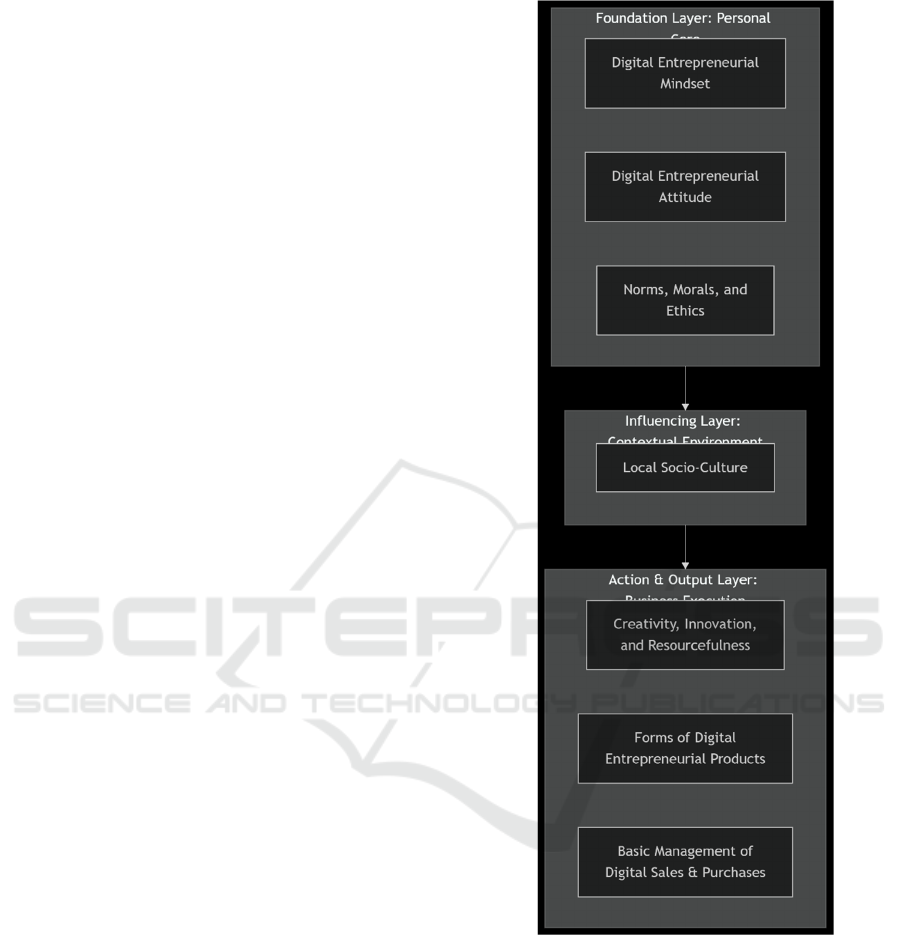
Visual Output:
Figure 1 illustrates the prioritized needs processed
through NGT and ISM:
Figure 1: Digital Entrepreneurship Education Model for
B40 Kindergarten Children.
4.1.3 Phase 3 - Usability Evaluation
In this phase, the Digital Entrepreneurship Education
Model for B40 Kindergarten Children was evaluated
using a structured questionnaire. The results
demonstrate the model's practicality and
effectiveness based on teacher feedback.
ICECE 2025 - The International Conference on Early Childhood Education
166

Key Findings:
Table 1: Presents the mean scores and standard deviations
(SD) for the Overall Usability Perception of the model:
N
o. Questionnaire Statemen
t
MeanSD
1
The model is practical for
teachers to train and implement
digital entrepreneurship elements
in children
4.17 0.98
2
The model clearly guides
teachers in detailing each
element to be applied to children
3.98 0.89
3
The model effectively assists
teachers in planning training and
implementing digital
entrepreneurship elements for
children
3.95 0.93
Overall Usabilit
y
Score 4.57 3.51
5 DISCUSSION
The basic digital entrepreneurship model for
kindergarten children is very important for the
purpose of formulating best practices and
implementing appropriate improvements. The
exposure to basic entrepreneurship for the B40 group
is closely related to financial information and can
have a positive impact on long-term practices
(Syahrin et al. 2020). This national-level strategy also
supports collaboration in the field of research and
guides future policy formulation initiatives to raise
public awareness about the importance of financial
literacy (Financial Education Network, 2019).
In addition, this program can help parents, the
community, and relevant parties by benefiting from
the National Transformation 2050 initiative in
shaping the well-being of children through a balanced
Malaysian economy. Since the target of the National
Financial Literacy Strategy 2019-2023 also includes
preschool children from the B40 group, this study will
add basic entrepreneurship elements to the National
Preschool Standard Curriculum in terms of activities,
strategies, and implementation. The financial literacy
of children through digital entrepreneurship
education from an early age can enhance the country's
economic status based on the National
Transformation 2050 concept.
This study makes a significant contribution to the
elements of entrepreneurship, especially the need to
develop of a Digital Entrepreneurship Education
Model for Kindergarten Children of the B40 group
based on teachers' perceptions. This is because the
study of entrepreneurship in kindergarten is still not
carried out much. This study also provides evidence
and explanation for the need to develop a model of
digital entrepreneurship education for B40 children in
kindergarten. It also helps to increase the importance
of entrepreneurial knowledge for students' readiness
to apply entrepreneurial elements.
6 CONCLUSIONS
A new medium in forming a basic model of
entrepreneurship in digital form for kindergarten
children is very important for the purpose of devising
best practices and implementing appropriate
improvements. Disclosure of the B40 group's
entrepreneurial fundamentals is closely related to
financial information and can have a positive impact
on long-term practices (Syahrin et al. 2020). This
national-level strategy also supports research
collaboration and guides policy-making initiatives in
the future to increase public awareness of the
importance of financial literacy (Financial Education
Network, 2019). In addition, this programme can help
parents, the community, and related parties by
receiving benefits based on the idea of National
Transformation 2050 in shaping the well-being of
children through a balanced Malaysian economy.
ACKNOWLEDGEMENTS
This research under the Fundamental Research Grant
Scheme (FRGS) is supported by the Ministry of
Finance (MOF) through the Malaysian Ministry of
Education (KPM). This study is part of the main study
titled "Development of a Digital Entrepreneurship
Education Module for B40 Group Kindergarten
Children Group" (FRGS/1/2021/SSI0/UPSI/02/18).
We would like to thank all the research members who
contributed to this study with their ideas and
dedication. We also thank the steering committee,
critical informants, teachers, parents, and other
stakeholders who participated in this study.
Digital Entrepreneurship Education Model for B40 Group Kindergarten
167

REFERENCES
Abdul Halim Masnan & April Ann M. Curugan (2016).
Financial Education Program for Early Childhood
Education, International Journal of Academic Research
in Business and Social Sciences, 6(12), 113-120.
Cheng, Z. Guo, W. Hayward, M. Smyth, R. & Wang, H.
(2020). Childhood Adversity and the Propensity for
Entrepreneurship: A Quasi-Experimental Study of the
Great Chinese Famine, Journal of Business Venturing,
35(3), 1-63.
Financial Education Network (2019). Strategi Literasi
Kewangan Kebangsaan 2019-2023. Putrajaya.
Inanna, I., Rahmatullah, R., Haeruddin, M.I.M., &
Marhawati, M. (2020). Silk weaving as a cultural
heritage in the informal entrepreneurship education pers-
pective. Journal of Entrepreneurship Education, 23(1).
Kementerian Hal Ehwal Ekonomi (2019). Wawasan
Kemakmuran Bersama 2030. Percetakan Nasional
Malaysia Berhad: Kuala Lumpur.
Kementerian Kewangan Malaysia. (2020). Ringkasan
Belanjawan 2021. Boleh diperolehi di: http://belanj
awan2021.treasury.gov.my/pdf/touchpoints/budget-
2021-touchpoints-bm.pdf
Kementerian Pendidikan Malaysia (2017). Buku
Penerangan Kurikulum Standard Prasekolah
Kebangsaan (Semakan 2017). Bahagian Pembangunan
Kurikulum: Putrajaya.
Kementerian Pendidikan Malaysia (2018). Laporan
Tahunan 2017 Pelan Pembangunan Pendidikan
Malaysia 2013-2025. Putrajaya: Kementerian
Pendidikan Malaysia.
Mohamad Fazli Sabri. & Nurhayatul Nira Ramli. (2018).
Pendidikan Awal Kewangan Kanak-kanak. Serdang:
Universiti Putra Malaysia
Nurul 'Alyaa Adillah Mokhtar (2015). Pengurusan
Kewangan Dalam Kalangan Kanak-Kanak Sekolah
Rendah Di Malaysia, Tesis Master: UPM.
Richey, R. C., & Klein, J. (2007). Design and Development
Research: Methods, Strategies, and Issues. Mahwah,
NJ: Lawrence Erlbaum Associates, Publishers.
Sarikaya, M. & Coskun, E. (2015). A New Approach in
Preschool Education: Social Entrepreneurship
Education. Procedia - Social and Behavioral Sciences,
195, 888 – 894
Syahrin Suhaimee, Mohd Azlan Shah Zaidi, Mohd Adib
Ismail & Noorasiah Sulaiman (2020). Social innovation
and social entrepreneurshipd as mediators of the
relationship between social capital and income level of
B40 households, International Journal of Business and
Society, 21(2), 837-856.
UNESCO, United Nations, Educational, Scientific and
Cultural Organization (2020) Education 2030: Incheon
Declaration and Framework for Action. Diperolehi
dari:https://unesdoc.unesco.org/ark:/48223/pf0000245
656
United Nation (2020). Exploring Youth Entreprenuership’
(UN-DESA). Diperolehi dari: https://sdgs.un.org/s
ites/default/files/2020-07/Youth_Entrepreneurship.pdf
ICECE 2025 - The International Conference on Early Childhood Education
168
