
Coding-Based Joyful Learning Through ScratchJr in Kindergarten
Widya Dwi Hardiyanti and Prayitno
Early Childhood Education, Universitas Negeri Yogyakarta, Indonesia
Keywords: Coding, Early Childhood, Joyful Learning, Kindergarten, ScratchJr.
Abstract: Coding has received attention from the national education ministry in Indonesia. Most kindergarten teachers
in Indonesia lack the experience to implement coding learning. Focusing on ScratchJr being the most popular
free introductory block-based programming language app designed specifically for children aged five to seven,
this paper explores the application of ScratchJr in kindergarten. This study explores how ScratchJr can be
used as a new learning media tool in kindergarten. This paper presents a case study of a kindergarten teacher's
experience in designing and implementing coding learning through ScratchJr, which is integrated with digital
technology media. This study employs a qualitative case study approach to explore how early childhood
learning experiences and teachers' experiences in implementing coding learning through ScratchJr in
kindergarten are influenced over one week. The study participants were 20 children aged five to six years.
The results of this study provide evidence that children can design, build, and program animation projects
after one week of intensive ScratchJr learning. In addition, the results of the study show that teachers have
successfully integrated coding learning through ScratchJr in kindergarten, which includes basic coding
concepts while also involving children in efforts to develop imagination and creativity. The results of the
study show the importance of applying coding learning through ScratchJr to help develop early childhood
creativity in the early years. Furthermore, this study looks at preliminary evidence that the State of Indonesia
will start implementing the coding curriculum in basic education. This research supports the latest policy rules
of the national education ministry through the application of coding learning through ScratchJr in kindergarten.
1 INTRODUCTION
Early childhood education is education intended for
children aged zero to eight years (NAEYC, 2022).
This period is also called the golden age period
because children experience a process of rapid growth
and development, especially the brain's thinking
ability, which develops by up to 80%. It is hoped that
during this period, positive stimuli will be given that
help children grow according to the progress of the
times. Based on the results of the survey, the use of
technology today is increasing, as evidenced by 92%
of families having internet access at home in 2021,
while this percentage level was initially only 90% in
2020. It has also increased children's access to
technology and the internet (Bunce & Woolley,
2021). Researchers, educators, and practitioners
agree on the importance of developing the 5Cs skills
to prepare children for the challenges of the 21st
century. These abilities can be taught and learned
effectively by integrating digital technology media in
learning that can start from the early childhood
education level.
The 21st century, as it is now, is an era of very
rapid technological development. Technology is
developing and spreading to various sectors of life to
help humans solve various things. Technology is used
from various ages until children unknowingly grow
up to be digital natives. Digital native is a term for
children who are born and raised in the digital era
(Yildiz & Guler Yildiz, 2021). Several studies have
sought that children not only consume digital media,
but also need to engage in positive activities, so that
programs focused on STEM (Science, Technology,
Engineering, Mathematics) and coding or
programming have emerged (Yalçın & Erden, 2021).
Whether children are aware of it or not, children use
digital technology media as a daily consumption
activity. Therefore, it is necessary for digital
education as a provision for children to face the
world. One of the efforts to realize digital education
is to introduce coding learning (Unahalekhaka &
Bers, 2021). Many developed and developing
countries have taken policies to utilize digital
technology media in the school learning curriculum,
Hardiyanti, W. D. and Prayitno,
Coding-Based Joyful Learning Through ScratchJr in Kindergarten.
DOI: 10.5220/0014068400004935
Paper published under CC license (CC BY-NC-ND 4.0)
In Proceedings of the 7th International Conference on Early Childhood Education (ICECE 2025) - Meaningful, Mindful, and Joyful Learning in Early Childhood Education, pages 65-73
ISBN: 978-989-758-788-7; ISSN: 3051-7702
Proceedings Copyright © 2025 by SCITEPRESS – Science and Technology Publications, Lda.
65

one way is by learning coding.
Early childhood coding is a series of cognitive
processes that start from a simple stage to a higher
level to solve problems by finding effective and
efficient solutions or systematic such as how
computer systems work (Bakala et al., 2021).
Children's coding is defined as problem-solving
activities by applying computer science concepts that
are often associated with computational thinking
skills (Terroba et al., 2021). Based on the theory of
cognitive development of the Bloom taxonomy, the
computational thinking ability of the debugging
aspect and the design process is at the highest level,
namely, vacuuming and creating.
The debugging process for children tries to find
the right solution to the problem by conducting
several experiments. Children's design process tries
to work according to their imagination (Critten et al.,
2022). The results of the study stated that children
who were given coding learning were able to solve
problems more creatively and had higher levels of
cognitive skills, such as analysis and evaluation,
which were more developed compared to children
who were not given coding learning (Gerosa et al.,
2022). Learning coding is an important skill today,
because through coding learning children can develop
abilities based on the knowledge and experience
gained to reach the optimal stage of development. The
selection of technology tools and interactive media
must be adjusted to the child's developmental age,
individual readiness and interests, and appropriate in
the context of the family and community culture will
determine how effectively technology can be used as
a coding learning medium (Singhal, 2022). One of the
media that can be used for learning coding in an early
childhood education environment is a computer
programming application called ScratchJr. The main
problem faced in this context is the lack of systematic
and targeted implementation in integrating coding
learning as part of the early childhood education
curriculum in the city of Surakarta. This research has
the urgency to explore more deeply how the coding
process is practiced for children aged 5-6 years. The
purpose of this research was to describe the practice
of the early childhood coding process, which can be
used as an illustration of the implementation of
coding learning in an early childhood education by
utilizing a technology program called ScratchJr.
The results show that children aged 5-6 years have
limited ability to understand coding, so simple
features in the form of images or symbols are needed
that will be easier for children to understand, such as
ScratchJr (Misirli & Komis, 2023). All blocks are
completely graphic-based (with no text other than
numbers) to make it easier for children to use this
programming language before they can read.
Research proves that ScratchJr can develop
computational thinking skills because children learn
exploratively by trying out complex programming
blocks (Çiftçi & Topçu, 2023). Other research shows
that when children code with ScratchJr, children
learn to express themselves and be creative (Zeng et
al., 2023). ScratchJr also supports the joyful learning
approach that is being implemented in Indonesia.
The application of the joyful learning approach is,
in principle, by the recommendations of the
government in Indonesia that professional teachers
are obliged to create a meaningful, fun, creative, and
dynamic learning atmosphere. It is more important
that the learning process in early childhood education
must be carried out in an inspiring, interactive
manner, motivating children to participate actively,
providing enough space to develop creativity and
independence at the stages of child development.
Joyful learning will arouse children's curiosity. If
learning can be conditioned in a fun atmosphere,
children will be active and creative in the learning
process. Children will have the ability to organize and
be themselves in the learning process. Joyful learning
in it has no pressure, both physical and psychological
pressure, so that a fun and non-monotonous
classroom atmosphere is created. Joyful learning
makes the learning process exciting and meaningful.
Exciting means that learning can be enjoyed by
children without any pressure. Meanwhile, meaning
means that the knowledge gained by children in
learning can be useful in their lives.
The fact that problem that always occurs in the
field is that teachers still use boring methods, models,
and strategies for early childhood. The learning
methods, models, and strategies used by teachers in
the implementation of learning still often come from
one direction, namely, learning is only centered on
the teacher without understanding the characteristics
of each child. As a result, children become bored, so
they are not enthusiastic about following the learning
process in the classroom. To overcome these
problems, professional teachers must carry out
various efforts by implementing various learning
strategies so that children have strong motivation in
the learning process. One of the efforts that can be
made by teachers in the learning process is to use
joyful learning strategies. In addition, teachers also
need to introduce the use of digital technology media
from an early age, so coding-based learning through
ScratchJr is very suitable to be applied in early
childhood education. Thus, this article will shed light
on the implementation of coding-based fun learning
ICECE 2025 - The International Conference on Early Childhood Education
66
through ScratchJr in early childhood education.
2 METHOD
This study uses a qualitative method with a case study
approach to understand and explore in depth the
practice of coding through ScratchJr in children aged
5-6 years. This research is a case study because it
addresses the "how" question that allows for an in-
depth examination of a phenomenon. This research
employed a case study method, which allows people
to gain a greater insight into a specific case by
investigating it in depth and within its actual context
(Babbie, 2010). This research is designed as
qualitative research because it focuses on detailed
information and phenomena in the best possible way.
Qualitative research focuses on understanding
how people perceive events, describing them, and
connecting meanings, rather than on the analysis of
statistical data as seen in quantitative research
(Christensen et al., 2014). This study aims to explore
the practice of coding through ScratchJr in children
aged 5-6 years, so that the qualitative research method
is in accordance with this study. The data of this study
were collected from 20 children aged 5-6 years in one
of the early childhood education institutions in the
city of Surakarta, Indonesia. All children have the
same knowledge background, socioeconomic status,
and ability to use technological media devices.
Qualitative research argues that the depth and
originality of knowledge are more important than
generalizations, so it focuses on in-depth and specific
data from smaller groups rather than large samples
(Johnson & Christensen, 2014b). Therefore, 20
samples of children will generate data for this study.
Participants were selected based on the purposive
sampling method. Purposive sampling was used in
this study to select information-rich cases for in-depth
analysis according to the research objectives.
In this study, the coding process through ScratchJr
in children aged 5-6 years was studied in depth
through observation. Observation is a carefully
observed activity that fosters a deep awareness of an
event, situation, or place, as well as the behavior of
the people in it, to obtain data and information (Gall,
2014). Observations can be categorized in various
forms; some reference sources classify them into
direct and indirect observations (Johnson &
Christensen, 2014a), while others differentiate it into
participatory and non-participatory observation
(Mukherji & Albon, 2015). In this study, observation
was carried out directly without intermediaries on the
subject at the place where the event took place, and
the researcher was with the subject being studied. In
addition, observation is also carried out by actively
participating directly to observe the ScratchJr coding
process carried out by children aged 5-6 years, so that
researchers know and get information accurately and
in detail. In addition to the observation method, the
documentation method is also used in this study to
document the results of children's work during the
coding process using ScratchJr. Therefore,
observation and documentation methods are used in
this study to facilitate consistency and accuracy in the
data collection process.
Observation forms are a data collection tool to
discover children's processes as they code in
ScratchJr. Observation can foster a deep awareness of
an event, situation, or place, as well as the behavior
of the people in it (Mukherji and Albon, 2015). The
observation form was created by the researcher and
used during data collection. In addition to the
observation form, the data collection tool used is
documentation of children's work during the coding
process using ScratchJr. Data is collected
individually, and each child has between 45-60
minutes to explore and create a project using
ScratchJr. During the child's exploration of ScratchJr,
the child's progress in the coding process is recorded
on an observation form. In addition, every
documentation of the children's ScratchJr project is
stored for analysis.
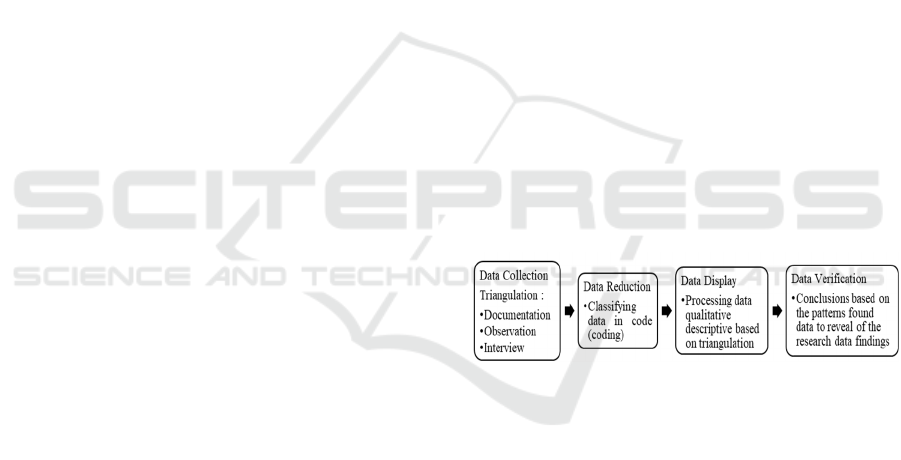
Figure 1: Data Analysis Technique.
Data from observation and documentation results
were analyzed using descriptive analysis techniques.
After completing the data collection process, all
observation results and documentation of children's
ScratchJr work are thoroughly analyzed to reveal the
results of the research. This process involves
encoding the data, identifying themes, and drawing
conclusions based on the patterns found in the data.
Due to the ethical research process, to ensure the
confidentiality of participants' privacy, the analysis of
children's data was abbreviated "Child" (C), followed
by a number, so that it became a form of code.
3 RESULT
Joyful learning for early childhood is learning while
Coding-Based Joyful Learning Through ScratchJr in Kindergarten
67

Table 1: Coding-Based Joyful Learning Through ScratchJr in Early Childhood Education.
N
o Activit
y
Title Warm Up Activit
y
Main Activit
y
Concludin
g
Activit
y
1.
Introducing the
ScratchJ
r
Children observe and listen to the
teacher's ex
p
lanation in ScratchJ
r
Children try to open
ScratchJr on their own
Children and teachers sit
together in a circle (circle
time) to discuss the
activities that have been
carried out, share ideas,
discuss what happened,
what worked, what
didn't, and provide each
other with feedback on
the work project
children's animations to
make them meaningful
and interesting.
2.
Create a new
animation project
The teacher gives an example using
blocks to create animations
Children try to create
animations using different
b
lock
p
ro
g
rammin
g
3.
Add a background
(story theme)
The teacher gives an example of how
to add a background
Children add background
(theme) freely according to
their creativit
y
4.
Add characters and
make the character
move
The teacher guides in adding
characters based on the background
and gives an example of how to
make a character move by dragging
and arranging blocks
Children are free to choose
characters based on the
theme and select blocks that
are arranged to make
characters move
5.
Save animation
project using
children's names
The teacher gave an example of how
to save the finished animation
project work with the child's name
Children save the work of
animation projects by typing
their names
6.
Tell the animation
(display project or
presentation)
The teacher invites children to share
and tell of their animation and to
appreciate the work of a friend's
animation
Children share and tell of
their animation and
appreciate the work of a
friend's animation project
playing, which will invite children to be active. While
playing, children are actively learning, and while
learning, children are actively playing. Joyful
learning for early childhood is learning while playing,
which will invite children to be active. Joyful learning
uses an approach that evokes feelings of fun and
creativity to reduce the boredom and learning tension
experienced by children. The steps of coding-based
joyful learning through ScratchJr in in Table 1.
The ScratchJr used in this study was integrated
with a larger exploration unit on early childhood
learning as part of the kindergarten. This learning
lasts about 10 hours of work over 5 days (about 2
hours per day). The implementation of this research
is an intensive experience where early childhood will
delve into the basic concepts of the coding process
using ScratchJr for one week. During this period,
early childhood in kindergarten spends one week
focusing on designing, creating, and programming
ideas that can help with the child's development. The
researcher adjusts the learning principles that the
teacher has applied in his class. Researchers provide
an opportunity for children to discuss ideas about
daily activities, share new ideas, and give each other
feedback. The implementation used in this study is an
adaptation of the curriculum created by the DevTech
Research Group at Tufts University.
The learning presented in this paper provides a
learning experience where children can use ScratchJr
as a medium to develop a sense of competence and
confidence in the ability to use technology. ScratchJr
also develops creativity to create animation projects,
from coming up with ideas to implementation, and
ending up being able to share them with the
community. The curriculum focuses on learning the
basics of coding to create simple animations using a
variety of programming blocks. The researcher
adapted the curriculum to suit the stages of early
childhood development.
The benefit of implementing the coding
curriculum through ScratchJr is that teachers are able
to adapt the curriculum to meet the talents, needs, and
abilities of early childhood interests. Teachers are
able to create a comprehensive curriculum based on
coding concepts through ScratchJr and adjust the
content of the curriculum according to the stages of
early childhood development as a whole. The teacher
follows the child or follows the direction of the class.
Teachers try to plan as much learning as possible, but
still leave room for flexibility, and it's a bit difficult.
Teachers must be confident that this will succeed and
see the coding curriculum as a learning process that is
in line with the development of the 21st century,
which is all digitalized. Coding through ScratchJr can
provide children with the freedom to use technology
in a new way and follow the mutually agreed class
rules. Overall, the children feel enthusiastic and
happy when doing coding through ScratchJr.
The first lesson of the programming with
ScratchJr, which is divided into two sessions, is
devoted to introducing ScratchJr. Instead of visiting
the playground for warm-up activities, researchers
showed the graphic programming blocks inside
ScratchJr to the children. Then, the children with
ICECE 2025 - The International Conference on Early Childhood Education
68

great enthusiasm and curiosity discuss questions such
as: "What is the name of this game?"; "What is the
function of this block?"How to move the
character?"How do I change the background of the
theme?"Can I add another character?"; "How do I
delete a character?" which the researcher then
answered by showing directly through the ScratchJr
application. This session meeting is very energetic
because the child discovers something new in the
classroom. Researchers introduced various forms of
graphic programming blocks within the ScratchJr
application to create animation projects. The
researchers told the children about the functions of
the various forms of programming blocks and
demonstrated how they were used.
After the teacher demonstrated how to make
animations using programming blocks. The next
activity was that the children were asked to create an
animation project using the programming blocks.
ScratchJr is a storytelling programming language that
allows children aged five to seven to create their own
interactive stories, collages, and games. With
ScratchJr, children combine graphics programming
blocks to make characters move, jump, dance, and
sing. Children can modify characters and add their
sounds. Children display one category of instructions
at a time by clicking the selector on the left. Dragging
the instruction block from the palette to the script area
below it activates it. Putting the blocks together will
create a program that is read and played from left to
right. ScratchJr asks children to create coding from
left to right, just as they are learning to read and write.
After completing the animation, children have the
opportunity to present their animated work to their
friends, explain the animated themes that have been
created, and tell the characters in the animation.
Letting children speak for themselves about their
work and showing what they are proud of brings joy
to researchers and teachers. Children enjoy
interacting with friends, and this gives them the
opportunity to help develop their language and social
skills. The children take turns showing their
animation programs and perfecting them if they
encounter problems. At the end of each activity,
children have a presentation where they can
communicate and share ideas from their animation
projects with teachers and friends in the classroom.
Children can see the work of their friends' animation
projects and can give appreciation or opinions
regarding their friends' animation projects. This
activity provides tangible evidence that coding
activities through ScratchJr can develop children's
language, confidence, and social-emotional skills.
4 DISCUSSION
ScratchJr is a block-based programming language
that supports children to explore great ideas in
computer science, such as algorithms, debugging,
modularization, control structures, and design
processes in a fun and developmentally appropriate
way for children (Relkin et al., 2021; Yang et al.,
2022). ScratchJr introduces computational concepts
such as sequencing, looping, occurrence, and
operators, and engages the child in cognitive
processes related to problem-solving. ScratchJr
invites early childhood to engage in coding as 21st-
century literacy and develop the ability to use
symbols (language) to understand, generate,
communicate, and express ideas or thoughts by
producing products that can be shared with others
(Lin et al., 2020; Tuli & Mantri, 2020). As a literacy,
coding can help develop a new way of thinking,
namely computational thinking, and a new way of
producing animations in the coding process to help
develop problem-solving skills and creativity in early
childhood at work. Implementing ScratchJr in early
childhood, in kindergarten, can expand the scope of
concepts and basic coding. ScratchJr allows children
to drag and drop blocks to create a program for each
character they choose. Children combine motion
blocks, sounds, and displays to program their own
stories and games. Further, children can create their
own stories with a maximum of four pages in each
project that has a beginning, middle, and end.
ScratchJr is described as a tech playground for early
childhood in kindergarten. Like a playground, the
environment is open and allows for child-directed
exploration and the creation of projects that express
the child's unique interests and individuality(Pellas,
2024; Yang et al., 2022).
ScratchJr users are encouraged to learn through
experimentation and fix errors, fix bugs, and
troubleshoot. ScratchJr is a block programming
language that has visual properties that correspond to
syntactic properties (Delacruz, 2020; Govind et al.,
2020). This helps prevent syntax errors and allows
young users to focus their entire attention on the
project their child is working on. ScratchJr, as an
introductory programming language, allows children
to express themselves and develop creativity.
ScratchJr appeals to early childhood learners who
enjoy the process of coding to create animation
projects. Research in early childhood using ScratchJr
found that children showed significant changes in
attitudes and self-efficacy related to social emotional
development after engaging in coding (Fidai et al.,
2020; Unahalekhaka & Bers, 2021). The
Coding-Based Joyful Learning Through ScratchJr in Kindergarten
69

programming block-based language in ScratchJr
offers an open setup to create projects of any choice,
while engaging with great ideas from computer
science. ScratchJr encourages children to explore and
practice certain aspects of programming, such as
cause and effect, logical sequences, and problem-
solving. ScratchJr is like a playground and invites
creativity and conflict resolution, constructed
according to certain cognitive mechanisms structured
in such a way as to allow children to develop certain
great ideas (Kyza et al., 2022; Unahalekhaka & Bers,
2022; Konstantina & Stamatios, 2024). One of the
main differences between the ScratchJr programming
language and other games is that the ScratchJr
programming language provides a tool for children to
come up with their own projects openly, and not just
to play around with games that are already in
development. Process of creating animations,
children become programmers of animation, also
being able to develop problem-solving skills.
The implementation of the coding curriculum
through ScratchJr in kindergarten classrooms aims to
invite early childhood to discover, explore, and
develop great ideas from computer science concepts
that are appropriate to their development. Seymour
Papert uses the term great idea to refer to the concept
of computer science as a meaningful and useful
discipline (del Olmo-Muñoz et al., 2020; Metin,
2020). Bers explained seven great ideas from
computer science that can be learned by every early
childhood according to its development, namely
algorithms, modularity, control structures,
representations, hardware or software, design
processes, and debugging (Saxena et al., 2020;
Bakala et al., 2021). These great ideas can be
connected to many curricular areas of the experience
domain outside of computer science, one of which is
through a coding-based curriculum. The
implementation of this coding curriculum is
consistent with the content proposed by the policies
of the Ministry of Basic Education and national
government regulations in the State of Indonesia.
The implementation of the coding curriculum
through ScratchJr is suitable for children in
kindergarten classrooms because it facilitates the
development of language, cognitive, fine motor,
social-emotional, and art skills. Children become
programmers by creating their animations through the
coding process and becoming storytellers by sharing
stories from meaningful animation projects with their
environment. The use of programming blocks is in
harmony with most early childhood curricula that
invite children to explore depicted characters of
humans and animals (Relkin et al., 2021; Singhal,
2022). ScratchJr programming blocks can develop a
child's potential to be imaginative and creative,
imagining projects that can move into meaningful and
engaging animations. Children can identify mistakes
and complete steps to correct mistakes. Problem-
solving skills are one of the most important skills that
need to be emphasized in early childhood education
(Yang et al., 2023; Zurnacı & Turan, 2024). In
addition, ScratchJr also involves learning how to
manage frustration, develop perseverance, and
teamwork skills. Therefore, when teachers provide
opportunities for children to do coding activities, they
aim to provide support for cognitive and socio-
emotional development.
The implementation of coding through ScratchJr
in kindergarten, in addition to learning problem-
solving strategies, also provides new ways to express
oneself, such as language and art. ScratchJr offers
coding activities using a variety of digital
programming blocks that can develop children's self-
expression through the creation of meaningful and
engaging animation (Dittert et al., 2021; Critten et
al., 2022). ScratchJr is an expressive medium of self-
expression, similar to writing, speaking, and art.
ScratchJr gives children the opportunity to express
their ideas in a meaningful, creative, and expressive
way in a personal way. This is in line with the
understanding of programming as one of the hundred
languages of children described by the popular early
childhood pedagogical approach of Reggio Emilia
(Gerosa et al., 2022; Bers et al., 2023). ScratchJr
offers easy and challenging activities for early
childhood. The implementation of ScratchJr needs to
adjust to the development and cognitive abilities.
Therefore, at the same age level, the study found pre-
reading children and fluent readers (reading symbols)
with different cognitive abilities.
Early childhood basically needs to be given
stimulation and challenges to learn new things. The
selection of ScratchJr for the implementation of the
coding curriculum in this study was due to three
different factors. First, ScratchJr is the most popular
programming language for early childhood.
Secondly, ScratchJr is free (can be downloaded
anywhere, anytime, and by anyone). Third, ScratchJr
includes abilities that expose children to great ideas
in a way that is appropriate for children's
development because it is designed specifically for
children aged five to seven. ScratchJr provides a
means to express themselves because it allows
children to create stories and projects openly (Misirli
& Komis, 2023; Guss et al., 2024). ScratchJr can help
develop problem-solving with complex concepts
such as loops. ScratchJr offers an easy-to-understand
ICECE 2025 - The International Conference on Early Childhood Education
70

look so that children can get started easily by simply
moving one character and then move on to create
complex multi-character and multi-page projects (Na
et al., 2024; Zurnacı & Turan, 2024). This makes
ScratchJr an ideal candidate as a medium for the
implementation of coding in kindergartens.
This research answers specific needs following
the national education policy in Indonesia and
provides a unique learning experience for early
childhood, so that it can be integrated, integrated, and
adjusted according to the needs of the curriculum in
kindergarten and teacher professional development.
However, regardless of the choice of media, the
successful implementation of a children's coding
curriculum in a kindergarten classroom must be
appropriate for early childhood development, provide
a medium for self-expression, develop rapid problem-
solving skills, and be able to provide flexible media
that is easy to use for early childhood (Clarke-Midura
et al., 2023; Quinn et al., 2023; Masarwa et al., 2024).
It's important to note that the benefits of
implementing a coding curriculum aren't limited to
technology literacy. The coding curriculum can
support the development of language, cognitive,
physical, motor, math, socio-emotional, and art.
Teaching coding also trains problem-solving skills.
The problem faced by the field of learning technology
education today is not whether to teach coding in
early childhood, but how best to choose media or
devices and curriculum that are in accordance with
the stages of early childhood development in the
kindergarten classroom.
5 CONCLUSIONS
The results of this case study indicate that an effective
coding curriculum, implemented through ScratchJr in
kindergarten, should include materials that are
tailored to the stages of early childhood development
as a whole, teachers who are comfortable and
confident in teaching coding, and a collaborative
learning environment. Based on the study's results,
integrating ScratchJr into kindergarten coding does
not require teachers to allocate time outside of their
teaching hours. Instead, teachers use ScratchJr as a
learning medium to invite children to explore the
coding process in creating animation. Because early
childhood learning values personal exploration and
achieving goals from any path that makes sense for
each child, ScratchJr offers a unique way for children
to express their creativity and create new ideas.
Traditional early childhood learning is typically
explored through reading books, class discussions,
and working on children's worksheets. Coding
through ScratchJr can be another way to understand
material in a new, more modern way, as it utilizes
digital technology media that gives children the
opportunity to create moving images in the form of
meaningful and interesting animations. As
technology becomes increasingly important in a
global society, ScratchJr could become a new way to
teach coding in kindergarten. Teachers integrate the
principles of early childhood learning with the use of
technology. The teacher pointed out that ScratchJr
can be used as a medium that allows early childhood
to learn basic concepts of simple coding. Although
ScratchJr is relatively new in early childhood
education, this study shows that implementing a
learning curriculum that utilizes technology media
can be applied in other kindergartens, provided that
learning is tailored to the stages of early childhood
development. Overall, the findings of this study
provide early evidence that coding through ScratchJr
has a positive impact on early childhood development
in the cognitive, social-emotional, and creativity
domains.
ACKNOWLEDGEMENTS
The authors would like to extend many thanks to
LPDP. This research was funded by the Indonesia
Endowment Fund for Education (LPDP) and the
Ministry of Finance of the Republic of Indonesia.
REFERENCES
Babbie, E. (2010). The practice of social research
(Twelfth). Wadsworth.
Bakala, E., Gerosa, A., Hourcade, J. P., & Tejera, G. (2021).
Preschool children, robots, and computational thinking:
A systematic review. International Journal of Child-
Computer Interaction, 29, 1–24. https://doi.org/10.
1016/j.ijcci.2021.100337
Bers, M. U., Blake-West, J., Kapoor, M. G., Levinson, T.,
Relkin, E., Unahalekhaka, A., & Yang, Z. (2023).
Coding as another language: research-based curriculum
for early childhood computer science. Early Childhood
Research Quarterly, 64(1), 394–404. https://doi.org/
10.1016/j.ecresq.2023.05.002
Bunce, L., & Woolley, J. D. (2021). Fantasy orientation and
creativity in childhood: A closer look. Cognitive
Development, 57(December 2020), 100979. https://doi.
org/10.1016/j.cogdev.2020.100979
Christensen, L. B., Johnson, R. B., & Turner, L. A. (2014).
Research methods : design, and analysis. Pearson.
Coding-Based Joyful Learning Through ScratchJr in Kindergarten
71

Çiftçi, A., & Topçu, M. S. (2023). Improving early
childhood pre-service teachers’ computational thinking
skills through the unplugged computational thinking
integrated STEM approach. Thinking Skills and
Creativity, 49(1), 1–14. https://doi.org/10.1016/j.tsc.
2023.101337
Clarke-Midura, J., Lee, V. R., Shumway, J. F., Silvis, D.,
Kozlowski, J. S., & Peterson, R. (2023). Designing
formative assessments of early childhood
computational thinking. Early Childhood Research
Quarterly, 65(January 2022), 68–80. https://doi.org/
10.1016/j.ecresq.2023.05.013
Critten, V., Hagon, H., & Messer, D. (2022). Can pre-
school children learn programming and coding through
guided play activities? A case study in computational
thinking. Early Childhood Education Journal, 50(6),
969–981. https://doi.org/10.1007/s10643-021-01236-8
del Olmo-Muñoz, J., Cózar-Gutiérrez, R., & González-
Calero, J. A. (2020). Computational thinking through
unplugged activities in early years of primary
education. Computers and Education, 150(1), 1–19.
https://doi.org/10.1016/j.compedu.2020.103832
Delacruz, S. (2020). Starting from scratchjr: integrating
code literacy in the primary grades. Reading Teacher,
73(6), 805–812. https://doi.org/10.1002/trtr.1909
Dittert, N., Thestrup, K., & Robinson, S. (2021). The
SEEDS pedagogy: Designing a new pedagogy for
preschools using a technology-based toolkit.
International Journal of Child-Computer Interaction,
27(1), 1–12. https://doi.org/10.1016/j.ijcci.2020.100210
Fidai, A., Capraro, M. M., & Capraro, R. M. (2020).
“Scratch”-ing computational thinking with arduino: A
meta-analysis. Thinking Skills and Creativity, 38(July),
100726. https://doi.org/10.1016/j.tsc.2020.100726
Gall, B. (2014). Applying educational research: How to
read, do, and use research to solve problems of practice
(6th ed.). Pearson. www.pearsoned.co.uk
Gerosa, A., Koleszar, V., Tejera, G., Gómez-Sena, L., &
Carboni, A. (2022). Educational robotics intervention
to foster computational thinking in preschoolers:
Effects of children’s task engagement. Frontiers in
Psychology, 13(1), 1–13. https://doi.org/10.3389/
fpsyg.2022.904761
Govind, M., Relkin, E., & Bers, M. U. (2020). Engaging
children and parents to code together using the scratchjr
app. Visitor Studies, 23(1), 46–65. https://doi.org/
10.1080/10645578.2020.1732184
Guss, S. S., Clements, D. H., Sharifnia, E., Sarama, J.,
Holland, A., Lim, C., & Vinh, M. (2024). Designing
inclusive computational thinking learning trajectories
for the youngest learners. Education Sciences,
1(1), 1–
24. https://doi.org/10.3390/educsci14070733
Johnson, B., & Christensen, L. (2014a). Educational
research (5th ed.). Sage.
Johnson, B., & Christensen, L. (2014b). Educational
research quantitative, qualitative, and mixed
approaches (5th ed.). Sage.
Konstantina, L., & Stamatios, P. (2024). Enhancing
computational thinking in early childhood education
through ScratchJr integration. Heliyon, 10(10), e30482.
https://doi.org/10.1016/j.heliyon.2024.e30482
Kyza, E. A., Georgiou, Y., Agesilaou, A., & Souropetsis,
M. (2022). A cross-sectional study investigating
primary school children’s coding practices and
computational thinking using ScratchJr. Journal of
Educational Computing Research, 60(1), 220–257.
https://doi.org/10.1177/07356331211027387
Lin, Chien, S., Hsiao, C., Hsia, C., & Chao, K. (2020).
Enhancing computational thinking capability of
preschool children by game-based smart toys. Electronic
Commerce Research and Applications, 44(1), 1–16.
https://doi.org/10.1016/j.elerap.2020.101011
Masarwa, B., Hel-Or, H., & Levy, S. T. (2024). Kindergarten
children’s learning of computational thinking with the
“sorting like a computer” learning unit. Journal of
Research in Childhood Education, 38(2), 165–188.
https://doi.org/10.1080/02568543.2023.2221319
Metin, S. (2020). Activity based unplugged coding during the
preschool period. Journal of Technology and Design
Education, 32(1), 149–165. https:// doi.org/10.1007/
s10798-020-09616-8
Misirli, A., & Komis, V. (2023). Computational thinking in
early childhood education: The impact of programming
a tangible robot on developing debugging knowledge.
Early Childhood Research Quarterly, 65(January 2022),
139–158. https://doi.org/10.1016/j.ecresq.2023.05.014
Mukherji, P., & Albon, D. (2015). Research methods in
early childhood an introductory guide (2nd ed.). Sage.
Na, C., Clarke-Midura, J., Shumway, J., van Dijk, W., &
Lee, V. R. (2024). Validating a performance assessment
of computational thinking for early childhood using
item response theory. International Journal of Child-
Computer Interaction, 40(1), 1–16. https://doi.org/1
0.1016/j.ijcci.2024.100650
NAEYC. (2022). National Association for the Education of
Young Children. National Association for the
Education of Young Children; National Association for
the Education of Young Children. https://www.naeyc.
org/
Pellas, N. (2024). Enhancing computational thinking,
spatial reasoning, and executive function skills: The
impact of tangible programming tools in early
childhood and across different learner stages. Journal
of Educational Computing Research, 0(0), 1–30.
https://doi.org/10.1177/07356331241292767
Quinn, M. F., Caudle, L. A., & Harper, F. K. (2023).
Embracing culturally relevant computational thinking
in the preschool classroom: Leveraging familiar
contexts for new learning. Early Childhood Education
Journal, 1(1), 1–11. https://doi.org/10.1007/s10643-
023-01581-w
Relkin, E., de Ruiter, L. E., & Bers, M. U. (2021). Learning
to code and the acquisition of computational thinking
by young children. Computers and Education, 169(1),
104222.https://doi.org/10.1016/j.compedu.2021.104222
Saxena, A., Lo, C., Hew, K., & Wong, G. (2020). Designing
unplugged and plugged activities to cultivate
computational thinking: An exploratory study in early
childhood education. Asia-Pacific Education
ICECE 2025 - The International Conference on Early Childhood Education
72

Researcher, 29(1), 55–66. https://doi.org/10.1007/s402
99-019-00478-w
Singhal, V. (2022). Precoding skills-teaching
computational thinking to preschoolers in Singapore
using unplugged activities. Proceedings of
International Conf. on Computational Thinking
Education, 86–87. https://doi.org/10.34641/ctestem.
2022.452
Terroba, M., Ribera, J. M., Lapresa, D., & Anguera, M. T.
(2021). Observational analysis of the development of
computational thinking in Early Childhood Education -
3 years old- through a proposal for solving problems
with a ground robot with programmed directionality.
Revista de Educación a Distancia, 21(68), 1–20.
https://doi.org/10.6018/red.480411
Tuli, N., & Mantri, A. (2020). Usability principles for
augmented reality based kindergarten applications.
Procedia Computer Science, 172(2019), 679–687.
https://doi.org/10.1016/j.procs.2020.05.089
Unahalekhaka, A., & Bers, M. U. (2021). Taking coding
home: analysis of scratchjr usage in home and school
settings. Educational Technology Research and
Development, 1(1), 1–20. https://doi.org/10.1007
/s11423-021-10011-w
Unahalekhaka, A., & Bers, M. U. (2022). Evaluating young
children’s creative coding: rubric development and
testing for ScratchJr projects. Education and
Information Technologies, 27(5), 6577–6597.
https://doi.org/10.1007/s10639-021-10873-w
Yalçın, V., & Erden, Ş. (2021). The effect of STEM
activities prepared according to the design thinking
model on preschool children’s creativity and problem-
solving skills. Thinking Skills and Creativity, 41(1), 1–
14. https://doi.org/10.1016/j.tsc.2021.100864
Yang, W., Ng, D. T. K., & Gao, H. (2022). Robot
programming versus block play in early childhood
education: Effects on computational thinking,
sequencing ability, and self-regulation. British Journal
of Educational Technology, 53(6), 1817–1841.
https://doi.org/10.1111/bjet.13215
Yang, W., Ng, D. T. K., & Su, J. (2023). The impact of
story-inspired programming on preschool children’s
computational thinking: A multi-group experiment.
Thinking Skills and Creativity, 47(1), 1–12.
https://doi.org/10.1016/j.tsc.2022.101218
Yildiz, C., & Guler Yildiz, T. (2021). Exploring the
relationship between creative thinking and scientific
process skills of preschool children. Thinking Skills and
Creativity, 39(1), 1–12. https://doi.org/10.10
16/j.tsc.2021.100795
Zeng, Y., Yang, W., & Bautista, A. (2023). Teaching
programming and computational thinking in early
childhood education: a case study of content knowledge
and pedagogical knowledge. Frontiers in Psychology,
14(1), 1–13. https://doi.org/10.3389/fpsyg.2023.1
252718
Zurnacı, B., & Turan, Z. (2024). Educational robotics or
unplugged coding activities in kindergartens?:
Comparison of the effects on pre-school children’s
computational thinking and executive function skills.
Thinking Skills and Creativity, 53(1), 101576.
https://doi.org/ 10.1016/j.tsc.2024.101576
Coding-Based Joyful Learning Through ScratchJr in Kindergarten
73
